

by Régis Soavi
The spirit of discovery that awakens at birth, and perhaps even before, is a manifestation of our vital instinct and, if it is not mutilated by an environment that I would describe as inappropriate, it will enrich our daily lives until the very end of our days.
What guides us
Our encounters, whether positive or negative, rich or mediocre, are indicators that allow us to navigate our surroundings. It is therefore of utmost importance to discern therein what we should follow and what we should reject. In most cases, our education has not prepared us to react correctly; on the contrary, it has often led us to passive conformity or impulsive rebellion, which is not very constructive.
It is quite rare to meet people who have followed a truly different path, who have led a life being guided not by ease or immediate profit but by something deeper. That is why these encounters are precious and can be useful to us, giving us guidance that we can use in our own way in our own lives. When these people are sincere and “real”, it is important to recognise them without being misled, because the world is out there and falsehood is all too often just around the corner, and if we are deceived, the physical and psychological damage can be immeasurable. Even if we think so, we are never truly or completely lost or alone in these moments of encounter, where the risk of losing ourselves is present.
We must never forget that we have extremely precise and sharp tools at our disposal, provided we have maintained them and protected them from the ambient contamination of the world of ideologies. One of these tools is experience, if it has been managed, understood and used appropriately. The other is, of course, our intimate intuition, if it has not been destroyed in the name of “official, materialistic science”, which finds it difficult to recognise anything that cannot be verified by “double-blind” testing. Both are, at that moment, capable of guiding us from within.
Sometimes, we do not know – or no longer know – how to see perspectives that are opening up for us; we do not know how to seize upon them and we reject them on the basis of theories that have been instilled in us by our environment, when perhaps there was an opportunity within our reach to find the path that suits us. Others present themselves that are often easier and more comfortable, but these are sometimes also the ones that have unfortunately brought us to where we are today, to what – already then – we no longer wanted.
One day, weary, we decide to act, ready to do anything, to follow anyone, as long as it changes. This is where danger can arise. If we act out of despair or depression, everything can “fall apart”, and contrary to what we hoped for, we may find ourselves swept away to where we never wanted to go or towards what we did not desire.

Intuition, a deception?
Intuition is no deception – but can it deceive us? Yes, certainly. In this case, it is clearly not intuition in the true sense of the word; it may simply be a dream, a hope, or a burning desire. It can also mislead us if what manifests itself is not intuition, but rather the result of a misinterpretation of something deep that cannot assert or manifest itself. This something is present in the subconscious and sometimes consumes us, even destroying us little by little.
Can we rely on intuition to make a decision? Certainly more than to make a choice, although we must be cautious in this area. Taking precautions while following intuition will never be negative if that intuition is real and deep. If, however, it is nothing but an illusion, the precautions will then take on their full meaning and may be used for good purposes. By then, we will have learned how to land on our feet and distinguish between intuition and its substitutes, such as ambition, fantasy, unfulfilled desires, etc. This experience will enable us to move forward, clarify what led us astray – provided the consequences are not too disastrous – and thereafter discern the difference between imagination and intuition more clearly.
Intuition, a certainty?
Even when it appears to be so, intuition is rarely a certainty. It asserts itself and is verified when the resulting acts, or the consequences stemming from these acts, come together and complement each other in harmony with what was intuited. However, there may still be false leads and certainty will only be achieved at the end of the process. Doubt is necessary; it is even a good sign, helping us to keep a cool head and not get carried away with wild imaginings – for imagination can replace intuition and become fertile ground where, if we are not careful, it is easy to get bogged down. If we move forward in small steps, we will be able to see if things are working out, organising themselves as we had sensed, and if the existing difficulties are being ironed out.
Intuition is independent of visualisation, but the two often work together and in doing so they support the accomplishment and realisation of a project, of a life lived to the full. Together, they will always help us to choose the best path and the most suitable route because they are “the unity of the body finally realised”. While the realisation of intuition is not an end in itself, it is part of a much larger project that is destined to be accomplished.
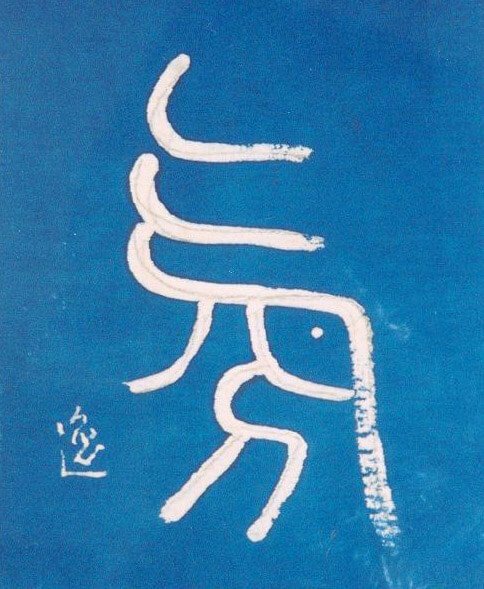
Another dimension, Ki
As soon soon as we begin to perceive Ki, even at the very beginning of practising Aikidō or Katsugen undō, we can feel a kind of relief, a return to something we knew sometimes already in childhood, an unexplained, inexplicable but deeply felt sensation, whether positive or negative.
Ki is often referred to as a “vital” energy, attributed with virtues and power, or denied because it cannot be reproduced at will, as it depends on too many diverse and sometimes even contradictory elements. It is therefore not considered a scientific fact but rather some mystical data. I can only explain it as a dimension that few people are willing to acknowledge, but whose reality is ultimately indisputable. It is a dimension beyond the four we are accustomed to considering, which all living beings – animals, plants, minerals, and others – perceive in their own way.
There are many exercises in Aikidō that help us perceive it, that allow us to give it a form that makes it more tangible, more concrete. Sometimes even usable or visible.
It does not give any power, much to the disappointment of those seeking special effects, but it does provide information which, if misused, can cause disasters and conflicts. However, it will obviously be of great help to those who know how to use it positively. This is why the utmost caution is required when guiding people in this direction.
Tsuda Itsuo said: ‘The best water from the clearest spring, if drunk by a cow, gives milk; if drunk by a snake, it gives venom.’1[see also The Dialogue of Silence, Chap. XII, 2018, Yume Editions (Paris), p. 99: ‘To have been a pupil of the Master does not mean much to me, for teaching is not a sort of varnish applied to an object. It is a matter of knowing how it has been absorbed. The water absorbed by a cow produces milk; that absorbed by a snake makes venom.’]. Ultimately, each human being takes responsibility for the path they choose.
A very ancient path
Before it become conscious, the perception of Ki was simply instinctive, completely unconscious. It was a basic fact of life, enabling people to feed themselves, move around safely, defend themselves against predators, find a place to live and reproduce. It was quite simply part of everyday life, like survival. Human beings had virtually no metaphysical questions to ask themselves, few things were purely mental, the body was unified, the koshi and hara resolved the difficulties or attempted to take care of them.
Thousands of years ago, with their upright posture, there was a slow upward movement of vital energy from the koshi to the brain, which led to a heightened awareness of oneself and one’s “special” nature. Over the centuries, this movement became increasingly important and rapid, and this excessive acceleration became exponential as the reference points that governed the lower body were lost. This new state of consciousness led humans to want to direct and control everything through the power of their minds alone. As a result, as if spellbound by their narrow vision – which had become independent of the rest of their bodies –, they separated themselves from the world around them. Applying this new way of thinking had an immediate effect on their surroundings and on the society in which they lived, profoundly transforming it.
In recent centuries, we can see the evolution and rise of this energy in paintings, sculptures and other works, both religious and secular, from all regions of the world, with a preponderance in the West but excluding neither the Middle East nor the East.
Despite it all, ancient traditions have retained a different relationship, which is often dismissed as magic or fantasy by champions of modernity, even though nuclear physicists and most advanced mathematicians are now reduced to asking profound philosophical and metempirical questions in an attempt to explain phenomena that current knowledge cannot explain, without deviating from the imposed dogma.
Fundamentally, human beings have not changed in essence. There are, therefore, opportunities to rediscover what has never been lost, but has simply become misguided and directed inappropriately because exclusively.
Your work, should you choose to accept it, …
…will be to restore order to the body without damaging or mistreating it. That is to say, allowing the body to take control of operations and giving it the time it needs to do so by trusting it, without being blinded or obsessed by new theories that take little or no account of the state we are in today.
Just as it would be harmful and dangerous to blindly follow something or someone who claims to have all the answers and all the means to remedy every situation, we urgently need to regain common sense. Otherwise, it would be a kind of dictatorship of the voluntary system, secretly directed by mental theorising and accepted “willingly or unwillingly” by the entire body to the detriment of the involuntary system, as a result of the weakening of our ability to think and react – a kind of numbness that leads us to take the easy way out, be irresponsible and consequently rely on powers other than our own.
On the other hand, the involuntary system has many skills that can restore lost or damaged faculties, but above all, it is its ability to enable the whole living environment to achieve balance that makes it an indispensable actor of everyday life. Dependent on nothing and no one but ourselves, it allows us to rediscover the inner freedom we were seeking.
The involuntary
The involuntary acts through “Non-Doing” thanks to and through the manifestations of Ki and its deployment, which is nothing other than one of the expressions of life that may or may not have taken form. The involuntary system’s work is about simplification and purification, filtering out the unnecessary by clearing Ki pathways, unblocking access points and making living tissues more flexible or resistant and putting the organs back in order whenever possible or necessary. The aim is not to exhaustively list all the possibilities in order to sell a new product or an umpteenth method, but rather to restore the body to its former glory and promote once again the independence and autonomy of the individual.
Although the involuntary system exists in all individuals, animals, plants and perhaps even minerals, albeit in very different ways, it is apparently in modern humans that it is most weakened and, as a result, most deficient. It is of paramount importance to reawaken it if dormant and liberate it if imprisoned. The extrapyramidal motor system, or the involuntary system, also plays a complex regulatory role. If its management is impeded or cancelled out entirely, the entire body is affected and considerable, potentially irreparable, damage can result.
A warning to rebuild oneself
If we need to rebuild ourselves, it is not because we are broken, but rather because we have already realised that something is missing, something is not quite as we would like it to be. In reality, it is often because we are in a state of great sensitivity – a sensitivity that is simple from a certain point of view, but in truth it is a state of hypersensitivity. It is as if we sensed that we needed to find ourselves again, but without knowing how. This is a difficult and sometimes even dangerous state because we begin to question many things that are part of our daily lives and our behaviours, be they towards ourselves or others, our surroundings, perhaps too much so, and there is a high risk of “throwing the baby out with the bathwater” and losing ourselves even more.
The philosophy expressed in Tsuda Itsuo’s books enables us to rediscover and rebuild our sensitivity while keeping our feet on the ground. It allows us to be perfectly in touch with reality without being absorbed by the perverse and facile aspects that tend, precisely, to destroy us, to deprive us of our freedom of thought and action. Once the terrain has been normalised, it is healthy, and natural balance will return of its own accord. It is important to let our sensitivity guide us in order to rediscover the intuition of our childhood ‘without being childish’2[see also The Path of Less, Chap. XVIII (end), 2018, Yume Editions, p. 175 (‘It takes art to become a child without being childish.’) or Heart of Pure Sky (same author & publisher), ‘Excerpt from Bushido’ (beginning), 2025, p. 179 (‘[Master Tsuda] often said that through breathing “Aikido is an art of becoming children again… without being childish”.’)], as Tsuda Itsuo told us.
Notes
- 1[see also The Dialogue of Silence, Chap. XII, 2018, Yume Editions (Paris), p. 99: ‘To have been a pupil of the Master does not mean much to me, for teaching is not a sort of varnish applied to an object. It is a matter of knowing how it has been absorbed. The water absorbed by a cow produces milk; that absorbed by a snake makes venom.’]
- 2[see also The Path of Less, Chap. XVIII (end), 2018, Yume Editions, p. 175 (‘It takes art to become a child without being childish.’) or Heart of Pure Sky (same author & publisher), ‘Excerpt from Bushido’ (beginning), 2025, p. 179 (‘[Master Tsuda] often said that through breathing “Aikido is an art of becoming children again… without being childish”.’)]