
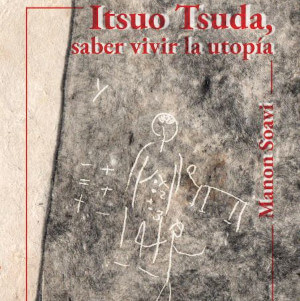
The story begins with the publication of Manon Soavi’s book in 2022. Unless… it actually began on 8 December 1967! On that day, Paris publisher Gallimard released Raoul Vaneigem’s The Revolution of Everyday Life1[The original French title translates more directly as Treatise on The Art of Living for The Younger Generations. All chapters are available online.]. Vaneigem was a writer (now the author of some fifty books), philosopher and historian specialising in heresy. An anarchist and Situationist, he was one of the leaders, alongside Guy Debord, of the Situationist International. His treatise The Revolution of Everyday Life would have a considerable influence on the rebellious youth of 1968 and the decades that followed. For some, it was a detonation that changed their world forever. Among them was Régis Soavi, seventeen at the time, for whom the book would remain a constant companion.
Years later, his daughter Manon also read it as a teenager, and when she wrote Itsuo Tsuda, The Anarchist Master, Raoul Vaneigem’s ideas were not only cited but permeated the book.
When the book was released in 2022, Manon met filmmaker Sandra Blondel at a bookshop event. Blondel was finishing a documentary film chronicling the Zapatistas’ “Journey for Life” – a journey that celebrates, in its own way, the indigenous peoples’ entry into resistance five hundred years ago during the Spanish conquest of Mexico. The Zapatistas are making the reverse journey to rename the Old Continent ‘Unsubmissive Land’ with a message to Europeans: ‘Wake up!’
Sandra is very enthusiastic about the book The Anarchist Master and sends it to Raoul Vaneigem, whom she knows, as he is in close contact with the Zapatistas.
A few months later, a Chilean anarchist, whom we shall call R. B., dropped in on Raoul Vaneigemand came across the book. He did not really speak French, but the title caught his eye and Vaneigem said to him, ‘This book is for you; read it.’ A few months later, R. B. had read the whole book and visited Tenshin dōjō for a meeting with Régis Soavi sensei, Manon Soavi and a few members. Following a discussion lasting several hours, an aikidō session and a great deal of enthusiasm, plans were set in motion to publish part of the book in Spanish for distribution in South America and Spain.
Today we are delighted to announce that the book was published in March 2026. It has the immense privilege of a foreword written by Raoul Vaneigem. What a fascinating loop of time!

As you will see, this text is a “non-foreword” entirely worthy of an anarchist of his calibre, and we are pleased to share it with you.
For an Alchemy of The Self
I have always believed that a book that stands on its own has no need for a preface. In truth, its richness lies precisely in the echoes it awakens and which, in turn, stimulate the reader’s consciousness.
Dissociating the social from the existential is a practice that originated in the first hierarchical collectivities which, succeeding pre-agrarian civilisations, were populated by exploiters and exploited, dominators and dominated, masters and slaves. It continues today through intellectual work, which reigns in the name of the Mind over a body forced into manual servitude. A split has occurred between the body mechanised by work and the body whose sensitive intelligence is attentive to its vital impulses.
While propaganda, dismayed by a Profit rate in dire straits, pushes us to take refuge and confine ourselves in fear, regression, and dehumanisation (assimilated by petty journalists as a form of fascism), no one is immune, consciously or unconsciously, to a kind of alchemy of the Self in which – as health deteriorates – grows the feverishness to restore balance amid the imbalance that plagues the world over.
This struggle is not new. It is none other than the debate and dialogue with oneself that has for thousands of years pitted the desire to live against the necessity to work in order to survive.
What is new, however, is the threat of annihilation that the implosion of capitalism poses to the Earth and to all living things.
Until recently, religions propagated their share of pathetic consolations. Their death throes are no longer enough to resurrect Gods whose remains have been wrung dry by an economy that created them in the image of the first tyrants.
No human being has ever been so alone with themselves. But, paradoxically, it is an extremely populated loneliness. The torch of protest that is being lit everywhere is radically different from the uprisings of the past. This is the first time we have seen insurrectionary movements without chiefs, without leaders, without the intervention of political and trade union apparatus.
This is not the class struggle that the bureaucratic labour movement of the past liquidated. Strictly speaking, there is no longer a class struggle, but the project of a classless society is at the heart of spontaneous revolutions whose often futile pretexts can no longer hide the fact that these are truly insurrections of everyday life.

These are mass movements that do not make a clean break with the past. They will reconnect with the most radical tendencies that brutal repression and official propaganda have broken off. For consciousness always re-emerges from ignorance. Nothing will prevent us from learning from our failures. The Paris Commune, the workers’ and peasants’ councils of 1917, the Spanish libertarian collectivities of 1936 and the timid attempts at self-management in May 1968 are just waiting to be taken further.
The individual aspiration for happiness is about to fuel the desire for a new society as never before. There is a tendency to no longer obey ideologies which, in any case, are mired in total political confusion. As left-wing clientelism sinks into ridicule, existential reflection, reflection on happiness, is growing in importance – a sensitive importance –, its perception both clandestine and public. Within it, the awareness of a reversal of perspective is maturing. By this I mean the shift from a perspective of death to a perspective of life.
Consciousness will have taken a great leap forward in human evolution when our dialogue with the universal life power is conducted from me to me, as in the alchemy that takes place every moment when my choice wavers between a reaction of life and deadly lethargy.
The impulse of love gradually awakens from the weariness caused today by boredom, mediocrity, distress, and hatred of oneself and others. The option arising from an alchemy of the self where the discomfort of survival calls for a transcendence that is nothing other than life itself is a gamble. It is here that human evolution truly resumes its course, in opposition to the option of death, of which the “self-made man” is the perfect representation.
The self-made man, whom the United States has elevated to a model of inhumanity, is a product promoted by the fanaticism of John Calvin. Calvin identifies God with a protective and dynamic economy. The God of the evangelists places a benevolent hand on the shoulder of those who reap profits and withdraws it unceremoniously the moment they lose them. Misfortune condemns the “failed” one, signifying that they have failed in their divine duties. The collapse and disintegration of capitalism now ridicules what passes off for the triumph of a capitalism from which anti-capitalism has yet to learn its lesson.
Individual autonomy is only just beginning to take up arms against individualism. Those addicted to Power want us to cry out our forlornness in a vast desert of incomprehension. In reality, it is their own loneliness that terrifies them. Once the cardboard shell of the roles they have taken on is pierced, they find themselves on the edge of the black hole of their non-existence. Behind the scenes of oblivion, they are confronted with their gasping remains.
We have the advantage over them in knowing that our struggle stems from a life where there is nothing to lose, nothing to gain. The intimate presence of a universal heart fills us with a multitude whose flashes of insurrection hail the rebirth of mutual aid.
There is no supreme being other than the human being in the making.
Would you like to hear about the next article?
Notes
- 1[The original French title translates more directly as Treatise on The Art of Living for The Younger Generations. All chapters are available online.]