Category Archives: Articles_Blog

Without dreams or fear

by Régis Soavi

For the first time in its history, Tenshin, our dojo in Paris, is closed for an indefinite period, as are all the dojos in our school (Milan, Rome, Turin, Ancona, Toulouse, Amsterdam, etc.). This is all the more exceptional given that the dojo has never closed since it opened in 1985. There are sessions every morning, all year round, regardless of vacations or public holidays.

The Itsuo Tsuda School is a special school because we practice Aikido, of course, but also Katsugen Undo (Regenerative Movement), which can be practised alone at home. And for a small number of students interested in the ancient koryū that are at the origin of our art, there are also sessions dedicated to the weapons of the Bushūden Kiraku Ryū school. This school, which includes many kata, has in its teaching curriculum the practice of bare-handed jūjutsu, Naginata, Kusarigama, Bō, Tessen, etc. There is also work on other techniques that come from the two-sword schools, Niten Ichi Ryū.

Despite the closure of dojos, as far as I know, almost no one has stopped practising. Some people practice weapon kata at home, but above all, we are fortunate to have a first part in the Aikido sessions (a kind of Aiki-Taisō) that my master, Tsuda sensei, had practised with O-sensei, and which he already called “solitary practice.” This first part lasts about twenty minutes and can be done in a small space (equivalent to a single tatami mat). What differentiates it from gymnastics is that it focuses on breathing and the circulation of ki in the body. In some ways, it resembles the exercises that some Tai Chi practitioners do, with its own specific characteristics, of course. This solitary practice can therefore be done every day. I know that practitioners also take advantage of this break to read or reread the books of Tsuda Itsuo (nine books published by Le Courrier du Livre – Paris) but also, as I have often recommended, the great authors and philosophers such as Chuang Tzu, Li Tzu, Sun Tzu, or even The Tale of Genji by Murasaki Shikibu.

kakugo
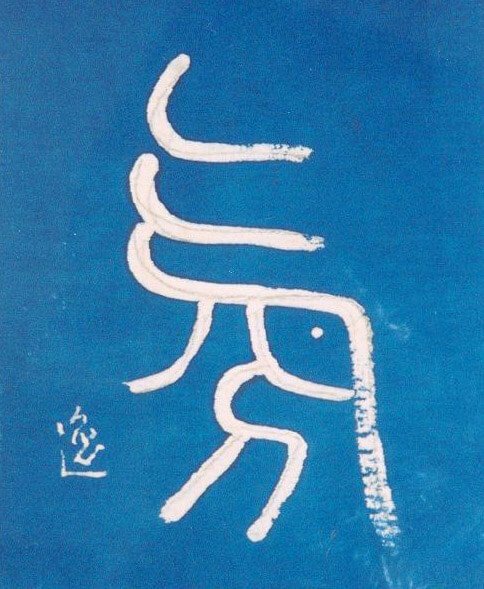
_Even if the stallion is locked in the stable, it is still capable of galloping thousands of miles_. Calligraphy by Tsuda Itsuo

While no practice is obviously a ready-made solution to the situation we are experiencing, it is clear to me that having a daily practice helps us to stay on track internally. Tatsuzawa Kunihiko sensei, 19th master of Bushūden Kiraku Ryū, a school with over four hundred years of history, talks about Kakugo 覚悟, which is usually translated as determination or clarity in the face of a situation. His personal interpretation struck me as relevant in the light of the crisis we are currently experiencing. When asked, ‘Why do people still practice such an ancient art?’ he replied, ‘It is to achieve stability of the heart (Kokoro). This is what Kakugo originally meant. Kakugo is difficult to translate into English. It means conceiving of oneself without dreams or fear. Becoming, having the mentality of Nec spe nec metu in Latin. Without hope of reward and without fear of punishment.’1Tatsuzawa Kunihiko, « Le sens de la beauté » [‘A Sense of Beauty’], interview by Yann Allegret, Karaté Bushido N° 371 (October 2008) Practice, even when solitary, helps us to regain our breath and inner calm.

Similarly, philosopher Hans Jonas – whom I have sometimes quoted in my lectures – seems to me to be particularly relevant in these uncertain times. On the occasion of the Rio de Janeiro environmental summit in 1992, the newspaper Der Spiegel published an interview entitled Closer to a fatal outcome. When asked by the journalist about the plundering of the planet and whether he thought it was possible to change our way of life, he replied, unfortunately already visionary: ‘Paradoxically, in my view, hope lies in education through catastrophes.’2Hans Jonas, Une éthique pour la nature [An Ethics for Nature], pub. Flammarion (Paris), 2017, p. 39 Nevertheless, there remains this imperative that concerns us all, which he expresses as follows:

‘Act in such a way that the effects of your actions are compatible with the permanence of an authentically human life on Earth.’3Hans Jonas, The Imperative of Responsibility, 1979

Afterword, January 2021

Ten months have passed, ten months of restrictions, ten months of a nameless night, with no end in sight. The rise of an insidious form of authoritarianism on health grounds that is currently taking place is leading us all to a form of self-censorship, so as not to hinder the resistance that has been put in place almost everywhere in this “new world” that is far from being a “new world.”

The stability of the “Kokoro” is maintained by our practices; without them, tensions would threaten to overwhelm us and we could succumb to the surrounding atmosphere.

A different atmosphere

All our dojos have been able to stay open and pay their rent despite being closed for months, thanks to the unique association model they have adopted since their creation, some as far back as the 1980s. The dojos belong to all their members, who are like “room-mates,” so it is of their own free will that they come together to keep these places of practice alive. The members pool what is necessary, without depending on any subsidies, municipal facilities, or even customers. Thus, this mode of operation, which usually seems quite fragile, is in fact proving to be quite resilient in the period we are going through.

The first part of our Aikido sessions, “individual breathing practice,” continued everywhere, depending on the weeks when it was legally permitted, sometimes in parks, as in Milan, to recreate the missing connection, or else at home or at the homes of friends who were already practitioners.

Everyone was able to continue practising Katsugen undo (Regenerative Movement) at home, alone or with their family, as they do whenever they are unable, for one reason or another, to come to the dojo. This practice, which allows the body’s innate movement to express itself, contributes to the overall balance of the individual. By keeping the involuntary system active, it promotes early reactions, accelerates and amplifies the regulatory aspect of the body’s functioning.

Contacts and exchanges between members, both nationally and internationally, have enabled the circulation of information and references, texts and books, emphasising and thus activating once again the cultural role of dojos. No one could have predicted what we are currently experiencing, but perhaps this excerpt from a poem by Estelle will calm everyone’s strength and guide them towards Non-doing, Wu-wei:

In a world undergoing destruction,
Building places where another space-time reigns,
Where another relationship with life is created,
Where beings can flourish. […]
The only way not to sink is to keep swimming.

Demori4Demori means “I remain” in Cathar (Occitan). Estelle Soavi, « Bâtir » [‘To Build’], Utomag N°4 (June 2020) [online: http://estellesoavi.fr/utomag/ ]

Régis Soavi

Would you like to hear about the next article?

Subscribe to our newsletter

Article by Régis Soavi (on the topic “Coronavirus, thoughts on the situation”) written in March 2020 for the review Aikido Journal n° 74

Régis Soavi

Notes

  • 1
    Tatsuzawa Kunihiko, « Le sens de la beauté » [‘A Sense of Beauty’], interview by Yann Allegret, Karaté Bushido N° 371 (October 2008)
  • 2
    Hans Jonas, Une éthique pour la nature [An Ethics for Nature], pub. Flammarion (Paris), 2017, p. 39
  • 3
    Hans Jonas, The Imperative of Responsibility, 1979
  • 4
    Demori means “I remain” in Cathar (Occitan). Estelle Soavi, « Bâtir » [‘To Build’], Utomag N°4 (June 2020) [online: http://estellesoavi.fr/utomag/ ]

Testifying

by Régis Soavi

Responsibility

If the teaching we have received and integrated has changed our lives, if it has allowed us to deepen the values we hold dear and discover others that, although previously unknown, have proved essential to our quality of life, it is important to “pass on this treasure” because it is our responsibility not to let a heritage of humanity that is there to serve the living fall into oblivion.

Passing on

Teaching Aikido is not a profession in the usual sense of the word; fortunately for our art, it is something else entirely. It is a task that we are called upon to accomplish, a bit like a freely accepted mission that has been given to us in order to allow others to discover this path, this way, this Tao that we continue to follow. “[W]hen we work in the human professions, we work in de-mastery, that is, in something over whose outcome we have no control, since it is the person themselves who shapes what they are becoming.”1Jacques Marpeau, Un mot, un enjeu : « Profession » et « métier », [One Word, One Issue: ‘profession’ and ‘trade’], 3 March 2023 (pub. online), emphasis by R. Soavi It is the transmission of a legacy that has been passed down to us little by little over many years and continues to resonate in our daily lives. Whatever rigid rules are imposed by the state and implemented by the various federations, there is still a small margin that allows the teaching of our art to remain above all a gift of self, and a way to deepen our own journey. It is mainly about communicating the incommunicable, and despite this, succeeding in conveying the message that was passed on to us by Tsuda sensei. Changing the world, at least locally, “regionally,” was, in my opinion, an important part of Itsuo Tsuda’s philosophical and physical work. He particularly emphasised what he called “solitary practice,” which he conducted every morning.

Within the Aikido session, this is a very ritualised, profound first part, based solely on “Breathing” (the circulation of Ki and its visualisation), and it was his way, besides writing his books, of directly intervening in his surroundings, in the world.

Itsuo Tsuda

In our school, it is specified in the first articles of the statutes that we ‘practice without purpose.’ Tsuda sensei insisted that these few words be prominently featured, because therein lies the essence of our practice. They are rarely understood at the very beginning, and even later, unfortunately, because they are often considered practically inconceivable in the West – except for people who are seriously involved in the practice and who, as a result, deepen their knowledge of Japan or the East in general. A wide variety of opinions are expressed during initial encounters or when discussing it with friends and acquaintances. They range from the mildest, such as ‘that is crazy,’ to ‘that is ridiculous, that is nonsense.’

What is more, and often unsettling and difficult to admit, there are no “classes” as in gyms or yoga clubs, just daily sessions usually led by the most experienced practitioners. There is no progression either, but rather a real deepening, also an opening towards a strengthened sensitivity and a world of sensations which, as soon as one is capable of it, allows anyone who has the courage and desire to discover what it means to lead a session: all that is needed is continuity, respect for others, and, of course, the agreement of the group. Even in the practice of Aikido, it is not a question of teaching sophisticated techniques or correcting at all costs, but rather of creating an atmosphere conducive to the development of each individual. It is about allowing people to reach deep within themselves, at the level of the “Hara,” the “Breath,” to become aware of the circulation of Ki. This is all the more evident in the practice of Katsugen Undo, where, from a technical point of view, all you need to know is how to count to twenty at a given rhythm to enable the coordination of the group of practitioners.

The same applies to Aikido: it is the concrete, physical, non-intellectualized perception of yin and yang and posture that are the determining factors in conveying a message that is both visual and sensory. Conducting sessions has “no value in itself”; it is enough that they are appreciated by everyone. Nevertheless, it sometimes allows us to better understand where we are in our practice, to see if we are able to convey what we have discovered and which may be useful to others. It is important to communicate at different levels; sometimes we understand better when the demonstration is done by a senpai who is closer to what we are capable of doing, seeing, and feeling. On the other hand, if we understand this well, even if it does not flatter our ego, leading sessions allows us to break free from the social castration that limits our abilities and freezes us in whatever role we find ourselves in, to find ourselves without running the risk of a destructive overvaluation of the ego.

A School without grades

Given that our School is a School without grades, without levels, ‘without fixed benchmarks’ as Tsuda sensei told us, every step forward, every deepening of our practice is important, and even the smallest discoveries must be given their due value. Wearing the hakama is significant in more ways than one and has a meaning that must be discovered if we want to understand what it can bring us. There is incidentally an essential text available for those who wish to read it. The black belt is not a rank but an opportunity to be seized (there is a text that lists the words spoken on this occasion). Each practitioner follows a path that is personal and purely individual. No one should be jealous or even envious of another’s journey, at the risk of losing the meaning of what is being taught.

Becoming a Sensei

It is not a matter of “fate” but rather a destiny that has been created independently of desire or will, by someone who, through correct and regular practice over many years, has become capable of giving back what he or she has received. The term Sensei, as everyone knows, is not a rank or even a recognition and has no particular value. It could be interpreted as “walking ahead,” being older (regardless of the number of years) and having real experience and abilities in one’s art, understanding and feeling “the Other” and knowing how to communicate with simplicity. As in everything, there is “chocolate and chocolate,” and so in all arts there is “sensei and sensei.” I think that no one can claim or, above all, impose such a title. It can be attributed to someone for a variety of reasons. In any case, it can only serve those who use it, because considering someone as one’s sensei is the student’s position, and it is this position that allows them to understand other things from their sensei.

A journey

When I was a child in my judo school, as in all martial arts, there were coloured belts. We were children, then teenagers, and this was supposed to motivate us, to “allow healthy competition alongside the school system,” in order to get a bigger piece of the pie, even if it meant crushing others to get it. The world encourages a certain lifestyle and educates us in that direction, there are winners and losers, that is the form of egalitarianism that is offered to us, a far cry from equity, is it not!

At the time, I had no other choice. If I wanted to practice a martial art, I had to play the game, pass the exams, and win fights to earn ranks. First white belt, then yellow, then orange, then green, and finally blue. From there, I had to prepare for brown belt with a view to the ultimate achievement, the black belt.

Another point of view

The 1960s brought about a reversal in perspective. As a result of the post-war period, a social, societal, and cultural upheaval began. Everything was called into question. I was seventeen and took a break from my training to devote myself to other discoveries. The world, or rather “my vision” of the world, had changed. As society disintegrated, something impossible became possible. Nothing would ever be the same again. I WOULD NEVER BE THE SAME AGAIN.

After this break, I took up martial arts again, specifically “judo jujitsu,” but I no longer found the same spirit there. My spirit too was different.

The old world is dead, another world is blossoming within me. I want to use the remains of the old world to turn them against itself in order to create a new situation. Aikido is one of the non-lethal weapons available to me to continue in the direction I have taken. I am twenty years old and I am starting Aikido, a new and revolutionary path for me.

A new journey begins, with a white belt, of course. Very quickly, I serve as Uke during demonstrations (I know how to fall very well and I have good balance). Maroteaux sensei gives me the 1st kyu, which means I can wear the hakama and be sempai.

Next came the black belt, which I obtained in the three streams originating from the Aikikai – first from Nocquet sensei, then from Tamura sensei, and then by Noro sensei – but above all, it was my encounter with the man who would become my master, Itsuo Tsuda, that guided me.

With my master, I continued to wear the white belt every morning and during training sessions, while I wore the black belt and led sessions as an instructor throughout the three “official” schools approved by the federations. Finally, after seven years of inner conflict, I could no longer bear this imbalance, so I let go and decided to only lead sessions as Tsuda sensei had taught us. This decision puts me in a somewhat unusual situation in the various dojos I work with, but it is the price I must pay to regain stability in my practice and further deepen my search for the truth about the circulation of Ki. This is the moment I choose to start wearing the black belt during Master Tsuda’s sessions.

Régis Soavi.

A grey Hakama

A few years later, I am fifty years old and have deepened my practice. I have gained experience that allows me to guide practitioners in our school. I am responsible for seminars in many dojos where I am invited, even in other federations. I seek to demonstrate our way of practising, to convey the flow of Ki, and the general spirit of our school. It is at this point that I decide to wear a grey hakama, which for me is a sign of seniority and a statement of position. My master has been gone for over thirty years, and I feel it is my duty to ensure the continuity of a teaching that must not disappear, as I consider it a path and a hope for humanity. Many elements have matured in my personal practice over the years, from my breathing and concentration to the way I circulate Ki in the simplest of moments. During kokyu-Ho, for example, by simply placing my hand on people’s backs to make them feel the flow of Ki, instead of giving them technical instructions on the position of their body or hands.

One morning during the first part of the session, which Tsuda sensei called solitary practice, my “breathing” suddenly intensified. It is an event that is impossible to describe except in terms that could be described as mystical, when in fact it was much more rudimentary and spontaneous. This is a new breakthrough for me, giving me a feeling of natural freedom, but it is also a new step on a path that is familiar, modest, and difficult, as well as unknown. For several months, I had felt that my practice was deepening, but something was missing, a kind of confirmation that would make it tangible, more physical in some way. Today I am in my seventy-fifth year and, as with other transitions I have experienced, a new opportunity to evolve is presenting itself to me. It seems important to me now to confirm it, to give concrete form to the work I have done over the last fifty years. A simple act must reflect this: since “that morning,” I have simply put on a white belt again.

Visualising

The act of visualising depends essentially on the posture that allows the circulation of Ki, or “vital energy.”

If the body posture directs energy toward the brain, imagination comes into play and takes over. Imagination can be positive or negative, is difficult to control, and can easily run wild, so it is not very useful in immediate action. If the imagination is positive, it can be used in everyday life because it can be creative, for example in writing, drawing, or art in general, but it is a hindrance when it comes to taking action and giving a direct physical response. When it is negative, it very often blocks action and makes it impossible to react unless it is overcome by a rapid and supreme effort of will to avoid being drawn into an unproductive spiral.

When energy is produced and gathered in the lower body, “the hara,” then visualisation becomes possible. You have to start training it with exercises that can be done daily during Aikido. The most important thing is the resonance it must have for each individual. It must correspond to their personality, their era, or something that touches them. Visualisation must be simple and immediately usable; it must “speak” to us.

Tsuda sensei warns us:

‘Aikido is at risk of becoming an intellectual philosophy in which the body does not participate, a kind of swimming in the living room, or gymnastics of the reflexes for turning men into Pavlov’s dogs. Or a combat sport from which you emerge completely demolished. Or indeed a form of politics.
In any case ki, the essential point, is absent. This will be Aikido without ki, which often leads to stiffening of the muscles. That is why there are so many people who have accidents.

Visualisation plays an all-important role in Aikido. It is a mental act at first, but it produces physical effects. One of the aspects of ki is to visualise. What do you visualise in Aikido? Circles, triangles and squares.’2Itsuo Tsuda, The Path of Less, Chap. XV, Yume Editions (2014), pp. 150–151

Sengai, cercle, triangle, carré
Sengai

Reflection or obedience

This overly simplistic, overly familiar translation is too strong in my opinion. It distorts the meaning and causes us to reject the deeper meanings of the proverb, which we risk taking literally. We might say to ourselves: ‘I too looked at the finger, and yet I am not a fool, I have degrees and even a doctorate…!’ or ‘It is obvious he is pointing at the moon, I saw it right away.’

Sengai was a Zen monk of the Rinzai School (Lin-tsi School in China), a school that uses koans in its teaching. His drawing of this proverb, while perhaps not a koan, gives us food for thought. Is it not the innocent, or perhaps the child who looks at the finger because he is in the action, in the moment, in the present instant? And what about the little character playing at his feet and jumping for joy, and the enormous bag that Hotei is carrying behind him?’ We can also see the sensei, the wise man who shows the way, the direction, but for now the student only sees the finger, that is to say, the practice, even if he suspects that he should see something that is still invisible to him. Or is it a warning to those who, in order to show off, point their finger, seeming to indicate that they have understood, when in fact they are only showing their ego in order to have admiring followers who obey their every command so that they can take advantage of them?

So many possibilities and reflections are open to each of us.

Little by little, something becomes clearer, more refined; we emerge from mental stupor and awaken.

Hotei montre la lune. Dessin de Sengai
‘When Hotei points at the moon, the fool looks at the finger.’. Sengai


Is Aikido a martial art?

Everyone, whether they practise it or not, has the right to ask this question. Today, there are many different approaches to our art, and a large number of schools claim to be more authentic than all the others or to have a longer history, while others evoke a need for renewal, perhaps the appeal of modernity! The range of forms and techniques taught is enormous, sometimes varying considerably, from the gentlest to the most violent, from the most flexible, even acrobatic, to the most rigid, even lethal. Who can calmly judge their appropriateness or value in our world? Our school, whether for Aikido or Katsugen Undo, is based on the practice of Non-Doing (Wu-wei), which has its roots in Chinese philosophies such as Chan and Taoism, as well as Japanese philosophies such as Shinto. Like so many other schools, it finds its place in the great pacifist and universalist movements that emerged after the Second World War.

Régis Soavi

Subscribe to our newsletter

This article by Régis Soavi was written for Self & Dragon Spécial Aikido before the magazine ceased publication in 2025; the topic was “Professionalisation.”

Notes

Ki, a dimension in its own right

by Régis Soavi

Ki belongs to the realm of feeling, not to that of knowledge.’1Tsuda Itsuo, The Non-Doing, Chap. II, 2013, Yume Editions (Paris), p. 27 (1re ed. in French, 1973). Tsuda Itsuo

As soon as you mention ki, you are dismissed as a mystic, a kind of crackpot: ‘It’s not scientific; no instrument or machine is capable of proving or demonstrating that ki exists.’ I completely agree. Indeed, if we consider ki to be a super-powerful energy, a kind of magic capable of throwing people across the room or killing them with just a shout, as was believed with kiai, we risk expecting miracles and quickly becoming disappointed.Ki une dimension a part entiere

Is ki an Eastern philosophy?

What is this “Eastern” philosophy that we supposedly do not have access to? Is there a specific domain reserved for a select few adepts, a handful of hand-picked disciples, or is this knowledge available to everyone, and what is more, without complicating our lives? I mean by leading a normal life, without being part of an elite group with access to secret knowledge, without having special, hidden practices that are doled out sparingly, but more simply by having a job, children, etc. When you practice Aikido, you are obviously engaged in both philosophical and practical research, but it is an “exoteric” rather than “esoteric” research.

Tsuda Itsuo wrote nine books, thus creating a bridge between East and West to enable us to better understand the teachings of Japanese and Chinese masters, to make them more concrete, simpler, and accessible to all. You do not have to be Eastern to understand and feel what it is all about. But it is true that in the world we live in, we are going to have to make a little effort. We need to break out of our habitual behaviours and references. We need to develop a different kind of attention, a different kind of concentration. It is not a question of starting from scratch, but of orienting ourselves differently, of directing our attention (our ki) in a different way.

First, we must abandon the very Cartesian idea that ki is one single entity, when in fact it is multiple. We must also accept that our bodies are capable of sensing things that are difficult to explain rationally, but which are part of our daily lives, such as sympathy, antipathy, and empathy. Cognitive science attempts to dissect all this using mirror neurons and other processes, but this does not explain everything, and sometimes even complicates matters.

In any case, there is an answer to every situation, but we cannot analyse everything we do at every moment in terms of the past, present, future, politics, or the weather. Answers arise independently of reflection; they arise spontaneously from our involuntary responses. Whether these answers are good or bad, analysis will tell us after the fact.

Ki in the West

The West was familiar with ki in the past; it was called pneuma, spiritus, prana, or simply vital breath. Today, this seems rather outdated. Japan has retained a very simple use of this word, which can be found in a multitude of expressions, which I will quote below, taking a passage from a book by my master.

But in Aikido, what is ki?

If any school can and should talk about ki, it is the Itsuo Tsuda School, not because we claim exclusivity, but simply because my master based all his teaching on ki, which he translated as breathing. That is why he spoke of a ‘School of Respiration’2ibid., Chap I, p. 17: ‘By the word respiration, I do not mean the simple bio-chemical process of oxygen merging with haemoglobin. Respiration is all at once vitality, action, love, a sense of communion, intuition, premonition, and movement.’3ibid., p. 16

Aikido is not a art of fighting, nor even a form of self-defence. What I discovered with my master was the importance of coordinating my breathing with my partner as a means of achieving a fusion of sensitivity in any situation. Tsuda Itsuo explained to us through his writings what his master Ueshiba Morihei had taught him. To convey this to us in a more concrete way, during what he called “the first part” – solitary practice, which we would now call Taisō – he would say KA when inhaling and MI when exhaling. Sometimes he would explain to us: ‘KA is the root of the Japanese word for fire, kasai, and MI is the root of the word for water, mizu.’4[see e. g. Tsuda Itsuo, The Science of the Particular, chap. XVIII, 2015, Yume Editions, p. 152–3 (1st ed. in French, 1976, p. 157–8)]. The alternation of inhalation and exhalation, their union, creates kami, which can be translated as the divine. ‘But be careful,’ he would tell us, ‘we are not talking about the God of Christianity or of any other religion – if you are lacking reference points, we could say that it is God the universe, God nature, or simply life.’

In the dojo, there was a drawing in Indian ink by Master Ueshiba containing fourteen very simple shapes and which we called Futomani because O-sensei had said that it had been dictated to him by Ame-no-Minaka-nushi: the Celestial Center. Tsuda Itsuo explains this in his book The Dialogue of Silence5Tsuda Itsuo, The Dialogue of Silence, chap. XII, 2018, Yume Editions, p. 106–7 (1st ed. in French, 1979, p. 157–8). Thanks to this, I gained a better understanding of the directions ki took when it had a form.

Dessin exécuté par Maître Ueshiba
drawing by Master Ueshiba

Reconnecting, rediscovering the links with what already exists deep within us

The founder spoke of Haku no budo and Kon no budo: kon being the essential soul that must not be stifled, but, he said, we must not neglect the haku soul, which ensures the unity of the physical being.6[see e. g. The Dialogue of Silence (op. cit.), chap. XII, p. 100–2; or The Way of the Gods (2021, same author & publisher), Chap XIII, p. 103–4]

Once again, we are talking about unity.

If our practice is called Ai-ki-do – “the way of unifying ki” – it is because the word ki has meaning.

Practical experience will allow us to understand this better than long speeches. And yet we must try to explain, try to convey this important message, because without it our art risks becoming a fight where “may the strongest, the most skilled, or the most cunning win,” or an esoteric, mystical, elitist, even sectarian dance.

And yet we know ki well; we can sense it from a distance. For example, when we walk down a small street at night and suddenly feel a presence, a gaze on our back, and yet there is no one there! Then suddenly we notice a cat watching us from a nearby rooftop. Just a cat, or a curtain that flutters surreptitiously. The gaze carries a very strong ki that everyone can feel, even from behind.

One of the practices of Seitai-dō called Yuki consists of placing your hands on your partner’s back and circulating ki. This is not about laying hands on someone who is, on the face of it, not sick to heal them, but about accepting to visualise the circulation of ki, this time as a fluid, like flowing water. At first, neither person feels anything, or very little. But then, little by little, they discover the world of sensation. You could say that it is a dimension in its own right, in all its simplicity. It is simple, it is free, it is not linked to any religion, it can be done at any age, and when you begin to feel this flow of ki, the practice of Aikido becomes so much easier. The kokyū hō exercise, for example, cannot be done without kokyū, and therefore without ki, unless it becomes an exercise in muscular strength, a way of defeating an opponent.

I would never have been able to discover the Aikido that my master taught if I had not willingly and stubbornly sought it out. In sensitive research, through all aspects of daily life, to understand, feel, and expand that understanding without ever giving up.

Atmosphere

Ki is also atmosphere, so in order to practice, you need a place that allows ki to flow between people. In my opinion, this place, the dojo, should, whenever possible, be “dedicated” to a particular practice or school. Tsuda Itsuo believed that entering the dojo was a sacred act, which is why we bowed when stepping onto the tatami mats. It is not a sad place where people ‘should wear a scowling constipated expression. On the contrary, we must maintain a spirit of peace, communion and joy.’7Tsuda Itsuo, Heart of Pure Sky (posth.), ’Booklet n°3 – Respiratory Practice in Aikido’, 2025, Yume Editions, p. 102 (1st ed. in French, 2014)

The atmosphere of the dojo is nothing like that of a club or a multi-sports hall that is rented for a few hours a week and used, for reasons of profitability, by different groups that have nothing to do with each other. The kind of place, the kind of gym where you go, train, then take a shower and say goodbye; at best, you might have a beer at the local bar to chat a little with each other. When you know about ki, when you start to feel it, and especially when you want to discover what lies behind this word, a place like the dojo is really something else entirely. Imagine a quiet place in a small Parisian passageway at the end of the 20th arrondissement. You cross a small garden and on the first floor of a very simple building is “The Dojo.”8[more of which in Yann Allégret, On the wach for the right moment, pub. online (Feb. 2014)]

Dojo
Dojo

You can come every day if you want, because there is a session every morning at quarter to seven: you are at home. You have your kimono on a hanger in the changing rooms, the session lasts about an hour, then you have breakfast with your partners in the adjoining area, or you rush off to work. On Saturdays and Sundays, you can sleep in, with sessions at eight o’clock.

Explaining ki is difficult, which is why only experience allows us to discover it. And for that, we must create the conditions that allow for this discovery. The dojo is one of the elements that greatly facilitates the search in this direction. It reconnects circuits, but also unties the bonds that constrain us and obfuscate our vision of the world.

Little by little, the work will be done, the knots will be untied, and if we accept that they are untied, we can say that the ki begins to flow more freely again. At that moment, it flows as vital energy; it is possible to feel it, visualise it, and in a way, make it conscious. Unnecessary tensions that cannot be released cause our bodies to stiffen. To make this as clear as possible, we could say that it is a bit like a garden hose that is blocked. It risks bursting upstream. The stiffening of the body forces it to react for its own survival. This triggers unconscious reactions that act on the involuntary nervous system. To avoid these blockages, micro-leaks of this vital energy occur, and sometimes even larger leaks, for example in the arms, at the koshi, and mainly at the joints. The immediate consequence is that people are no longer able to practice with fluidity, and it is strength that compensates for the lack. Parts of the body stiffen and begin to react like bandages or casts to prevent these losses of vital force. This is why it is so important to work on feeling the ki, on making it circulate. At first, visualisation allows us to do this, but as we deepen our breathing (the sensation, sensitivity to ki), if we remain focused on flexible practice, if we empty our minds, we can discover, see, and feel the direction of ki, its circulation. This knowledge allows us to use it, and the practice of Aikido becomes easy. We can begin to practice non-resistance: non-doing.

Women’s natural sensitivity to ki

Women generally have greater sensitivity to ki, or more accurately, they retain it more if they do not distort themselves too much in order to defend themselves in this male-dominated world where everything is governed by the criteria and needs of masculinity, the image of women that is conveyed, and the economy. Their sensitivity stems from the need to keep their bodies flexible so that they can give birth naturally and care for newborns. This flexibility cannot be acquired in gyms, weight rooms, or fitness centres; rather, it is a tenderness, a gentleness that can be firm and unwavering when necessary. Newborns need our full attention, but they cannot say ‘I’m hungry, I’m thirsty, or I’m tired,’ or ‘Mom, you’re too nervous, calm down, and tell Dad to speak more softly, it scares me.’2011-07-20 at 08-21-28

Thanks to their natural sensitivity, they sense the child’s needs, they intuitively know what to do, and ki flows between mother and child. When the father, who is always very rational, does not understand, the mother senses and therefore knows. Even if she is not a mother, even if she is a young woman with no experience, it is the body that reacts, it is the body that has this natural sensitivity to ki, and that is why, I think, there are so many women in our School. It is because ki is at the centre of our practice that nothing can be done without it. We focus our sensitivity in this direction and thus we can see the world and people not only on the level of appearances but much further, in their depth, what is behind the form, what structures it, or what drives it.

Some examples by Tsuda Itsuo, taken from The Non-Doing

‘“The most difficult thing to understand in the Japanese language is the word ‘ki’.”
It is true that the Japanese use the word many hundreds of times a day, without thinking about it, yet it is practically, and I would also say theoretically, impossible to find an equivalent in European languages.
While the word itself, taken out of context, remains untranslatable, it is nevertheless possible to translate current expressions of which it forms a part. Here are a few examples:
ki ga chiisai: literally, his/her ki is small. He (she) worries too much about nothing.
ki ga okii: his/her ki is big; he/she does not worry about petty things.
ki ga shinai: I do not have the ki to do… I do not want to. Or, it is too much for me.
ki ga suru: there is ki for… I have a hunch, a feeling, I sense intuitively…
waru-gi wa nai: he/she does not have bad ki, he/she is not a bad person or does not have bad intentions.
ki-mochi ga ii: the condition of ki is good; I feel well.
ki ni naru: it attracts my ki, I cannot free my mind from this idea. Something strange, not normal, is holding my attention, in spite of myself.
ki ga au: our ki matches, we are on the same wavelength.
ki o komeru: to concentrate ki. In the matter of concentration, nowhere else have I seen it taken to such heights as in Japan. […]
[…]
Ki-mochi no mondai: it is conditioned by the state of ki. It is not the object, the tangible result that counts, but the action, the intention.
[…]
One could give examples of several hundred more expressions which use the word ki.

Most Japanese themselves are incapable of explaining what ki is, yet they know instinctively when to use the word and when not.’9The Non-Doing (op. cit.), Chap. II, p. 25–7

Tsuda Itsuo started practising Aikido at the age of forty-five. He was not athletic, but his mere presence transformed the entire atmosphere of the dojo. I would like to tell you a story about one of the exercises I did in the 1970s, when my master was already over sixty years old. When I passed through the gate to the courtyard at the back of which the dojo was located, I would stop for a moment, close my eyes, and try to sense whether “he” was there. At first, it did not work very well; it was just random guesses, strokes of luck. Little by little, I understood: I should not try to know. So I began to “empty” myself, to stop thinking, and it came. Every morning, I knew whether he had arrived or not. I could feel his presence as soon as I approached the dojo.

From that moment on, something changed in me. I had finally understood a small part of his teaching, and above all, I had verified that ki was not part of the irrational, that it was concrete, and that its perception was accessible to everyone since it had been accessible to me.

Régis Soavi

Would you like to hear about the next article?

Subscribe to our newsletter

Article by Régis Soavi (on ki 気) published in January 2017 in Dragon Magazine Spécial Aikido n° 15.

Notes

When Tsuda recited Noh #2

tsuda_no_couleur_bordure2baniere-600x355

We are pleased to present a restored version of the video of Master Tsuda reciting Nō.

During the 1981 summer workshop in Coulonges-sur-l’Autize, Master Itsuo Tsuda recites an excerpt from a Nō play. Before beginning, Master Tsuda introduces the story.

Here is the transcript of the presentation:

‘It’s related to a legend. Once upon a time, there was a young monk who was on a pilgrimage, and every time he stopped in a village, he stayed with someone who had a little girl, and then, as a joke, her father would say, “Hey, this monk will be your future husband!”
The girl grew up believing this promise. One day, as the monk was passing by, she said, “When are you going to marry me?”
The monk was terrified. He fled the house because he was forbidden to marry, and the girl chased him over hill and dale. Finally, the monk crossed a river and she turned into a snake.
The monk found refuge in the Dōjō-Ji temple, explaining this story to the monks of the temple, who decided to grant him asylum. So they said to him: “Hide in the bell.”
The bell was a huge room that could hide several people, so he hid inside it.
The snake arrived and searched everywhere for him. Finally, it wrapped itself around the bell and struck it with its tail, melting the bell and burning the monk.
So the Waki said, “Don’t be struck by this event,” and some time later, they wanted to rebuild the bell.
Since then, on the day the bell was inaugurated, the monks have forbidden women from entering the temple grounds.
A young female dancer arrives and asks to see the bell. “No, it’s forbidden for women!—Yes, but I’m a dancer and I’d still like to celebrate this inauguration with my dance.”
Finally, she was allowed to enter.
So, on stage, she wears a large, big hat, like this, and then she starts to dance. It is a somewhat frenetic, very jerky dance that shows a hysterical intensity.
Meanwhile, there is a large bell hanging from the ceiling. Just before, there is a rope that attaches it to a ring, behind the choir, and a few minutes before, the choir members untie the knot and wait like that; there are three or four of them, it’s very heavy.
And then this dancer arrives in the middle of the stage.
Finally, she stands under the bell and then yep! She jumps, at the same time as the bell falls. So the bell is there, pofff! As if the dancer had been absorbed by the bell.
It’s difficult because if there’s even a fraction of a second’s delay, the actor falls and the bell arrives after him… or if you jump too early, you hit your head. It’s very difficult. It has to give the effect of absorption.
And then in the bell, the actor changes his mask, switches for another creature. He wears a demon mask and demon clothes. And then, after the bell, he is in a demon costume. He begins the second act.
This is the moment when the dancer arrives.

She dances and comes to the center of the stage, and suddenly she jumps and the bell falls.’

Would you like to hear about the next article?

Subscribe to our newsletter

Fear

It all started on an ordinary afternoon in my neighbourhood of Blanc-Mesnil in the “93” département1[number of French département Seine-Saint-Denis, colloquially referred to as “nine three” to emphasize the social difficulties in its working-class suburbs]. It was an altercation like many others, but that day, I found myself pinned down by a boy who was banging my head against the pavement and saying, ‘I’m going to kill you, I’m going to kill you.’ I do not even remember how it ended. But the following week, I was registered in a Jūdō Jū-jutsu Self-Defense class in the neighbouring town of Le Bourget.

I was twelve years old, and in my head there was this recurring thought: ‘Never again, never again.’

Two years later, at the middle school’s end-of-year party, the judo club was scheduled to give a demonstration. Everything was going very well when suddenly, a teenager wearing a black leather jacket jumped out of the front row and shouted at our group: ‘Your stuff is fake, you’re losers…’ Before anyone could react, he jumped onto the stage, pulled out a flick knife, and in a magnificent tsuki attempted to “stab” me. I dodged and executed a technique (I think it was a kind of oo-soto-gari). The audience was shocked and shouted! Then my attacker and I bowed to each other. The result: a lecture from the school principal, who made my friend Jean-Michel (the attacker) and me swear never to do anything like that again, because he had almost had a heart attack.

In addition to karate lessons for him and jūdō lessons for me, we trained as often as possible and for hours on end in my “personal dojo”.

Since we had moved into a detached house, located as we entered a small inner city where my mother had found a job as a concierge, I had converted the basement into a dojo, using pallets covered with recycled foam as tatami mats, and it was there that we had prepared our coup, he the karateka and I the jūdōka.

At the time, in the early sixties, we knew nothing about weapons such as katana, bokken, jō, or others. Apart from fencing, which was a sport, and Robin Hood’s stick, thanks to Errol Flynn, the only weapon we knew in everyday life was the knife.

When practising Aikido, there is always the possibility of imagining oneself as someone else. Cinema and special effects lend themselves well to inspiring dreams in teenagers and young adults of the new generations. In our industrialised countries, death has become virtual and often asepticised; spectacular fashion has distanced it. The screens everyone has today have enabled this psychological and physical distancing.

The work that can be done with a bokken, a jō, or even an iai is hugely important from a physical and psychological point of view. But I have never seen my students react in the same way as they do with a tantō.

As long as it is a wooden tantō, it is fine, but as soon as we offer a metal tantō, even if the blade is not sharp, there is a recognisable gleam in the practitioners’ eyes. With all kinds of nuances, from dread to panic to astonishment, in any case, fear – because we must call it by its name – is there. Whatever the denials, whatever the justifications.

We are often so far removed from this kind of reality.

Look under your feet

The calligraphy for our 2016 summer workshop was Look under your feet, written by my master Tsuda Itsuo. This phrase, which was displayed at the entrance to Zen monasteries, clearly resonates like a Koan. It is one of the many pieces of calligraphy he left behind and that intrigue us. A subliminal message? A message for posterity.

During our workshop, Look under your feet meant: “See and feel reality. Come out of your dream, your illusion, and become a true human being.”

The tantō is part of a principle of reality. Beyond the dexterity that training can bring, what is decisive and must be considered is precisely fear: fear of injury, which is already a lesser evil, and fear of death.

First, the people who will take turns being uke need to learn how to use the tantō: although the striking and cutting techniques are fairly simple, even rudimentary, they require what I would describe as rigorous training. The way to hold the weapon in the palm of the hand and the supports to be discovered for a good grip must be taught carefully and must be easy to understand, because if the tantō is held incorrectly, it can be more dangerous for uke themselves than for tori. In our school, very few people have ever held a weapon of this type in their hands when they arrive.

The simple fact of the blade’s direction, how it is held in the hand, the cutting angles. All of this determines a good attack.

Very often, people are reluctant to use metal tantō, which is too close to reality. They already visualise themselves as barbarians, their hands dripping with their partner’s blood!

No matter how much I explain and take the necessary precautions, these visions prevent them from making a real attack and block them. They stand there, waiting for I do not know what, or they attack weakly and, although the attacks are conventional, they warn, “call”, the moment of their attack. But if everything, absolutely everything, is planned, there is nothing left that is alive. If we protect and overprotect, life disappears. Breathing becomes shorter, gasping, inconsistent.

tanto regis soavi

Instinct cannot be developed. All that remains is repetitive and tedious training.

And here I must say: this is not just about martial arts, because all attacks are planned, which is normal and necessary in order to acquire the correct posture. It is even important to work slowly for a certain amount of time in order to get a good feel for the movements, as when practising a Jū-jutsu kata, for example. But from a certain level onwards, the timing and intensity must remain random and you have to give your all. Free movement – a kind of randori at the end of each session – is precisely the moment when you can work on your reactions, while respecting everyone’s level.

tanto

What sets the great masters of the past apart is not their exceptional technique but their presence, the quality of their presence. What still makes the difference today is the quality of being, not the quantity of technique.

When practising with a sword or a stick, one can take refuge in the art, the style, the beauty of the movement, the rules, the etiquette. With the tantō, it is more difficult because it is closer to our reality. Knives and daggers are, unfortunately, weapons that are still used too often today. Aggression is frightening, and transforming ourselves into aggressors for a few minutes is intimidating. This constraint is extremely unpleasant and sometimes even impossible for some people to overcome. My job is to help them break out of this immobility, this blockage in their bodies, to go to the end of this fear, to reveal it, to show that it is what prevents us from living fully. The tantō reveals what is going on inside us. And here, two main paths are possible: the path of reinforcement or the path of less.

In the first case: the fight against fear and its corollary – the fight against oneself, which is an illusion, because in the end, who is the loser? It is a path of desensitisation, of stiffening the body, of hardening the muscles, and its consequence: the risk of atrophy of our humanity.

Or it is about overcoming fear by accepting it for what it is, and by promoting the flow of ki that made it incapacitating. Fear, which is initially a natural sensation, stems from our instinct. It is merely the blockage of our vital energy when it cannot find an outlet. It transforms into stimulation, attention, realisation, and even creation when it finds the right path.

That is why our School offers Regenerative Movement (one of the practices of Seitai taught by Noguchi Haruchika sensei) as a way to normalise the terrain by activating the extrapyramidal motor system. This normalisation of the body involves developing our involuntary system, which, instead of functioning reflexively as a result of hours and hours of training, regains its original abilities, liveliness, and intuition. Little by little, we will discover that many of our fears, our inability to live fully, to react flexibly and quickly in the face of difficulties, and even more so in the face of physical or verbal aggression, as well as our slowness, are due to our body’s lack of reaction. To the blockages of our energy in a body that is too heavy or to a “mentalisation” that is too rapid and ineffective. When the imagination is focused on the negative and develops excessively, it is often the source of many difficulties in daily life and can be dramatically debilitating in exceptional circumstances.

External flexibility and internal firmness

Tsuda Itsuo gives a striking example from the life of the samurai Kōzumi Isenokami, as recounted in Kurosawa Akira’s famous film Seven Samurai:

‘A murderer took refuge in the attic of a private home, taking a child with him as a hostage. Alerted by the locals, Kōzumi, who was passing through the village, asked a Buddhist monk to lend him his black robe and disguised himself as a monk, shaving his head. He brings two rice balls, gives one to the child and the other to the murderer to calm him down. The instant he reaches for the ball of rice, Kōzumi seizes him and takes him prisoner.
If Kōzumi had acted as a warrior, the bandit would have killed the child. If he had been just a monk, he would have had no other recourse but to plead with the bandit, who would have refused to listen to him.
Kōzumi was reputed to be a very reserved and humble man, and lacked the arrogance common among warriors. An example of his calligraphy has been preserved, dated 1565, when he was about age 58, and it is said to indicate extraordinary maturity, flexibility and serenity. It is this flexibility that enabled him to accomplish the instant transformation of warrior-bonze-warrior.

When I think of this personality of external flexibility and internal firmness, compared to how we are, we civilised people of today, with our external stiffness and internal fragility, I think I must be dreaming.’2Tsuda Itsuo, The Way of the Gods, Chap. IX, 2021, Yume Editions (Paris), p. 70–71 (1st ed. in French, 1982)

tanto regis soavi

External flexibility and internal firmness

If I insist on the path of Seitai, which is unfortunately so little known in Europe, or sometimes so misrepresented, it is because it seems to me to be truly the path of guidance that a great many martial arts practitioners are seeking.

It is an individual path that can be followed without ever practising anything else, because it is a path in its own right. But when practising Aikido, I think it would be healthy to practice Regenerating Movement regardless of the level one has reached and even, or especially, from the very beginning. For example, it could prevent many inconveniences and minor accidents, and prepare you for the time when, as you are no longer young, you will need to rely on resources other than strength, speed of execution, or reputation, etc. to continue practising.

The Regenerative Movement is precisely what Germain Chamot refers to as ‘a regular personal health practice’ in his latest article3Germain Chamot, « Aïkijo : une histoire de contexte » [‘Aikijō: a matter of context’] (last paragraph, about Shiatsu), Dragon Magazine Spécial Aikido n° 13, p. 12–14. It is a path that requires neither funding nor physical fitness, but simply continuity and an open mind. I can only agree with his reflections on the difficulties in our society of offering a regular, long-term practice, as well as on the cost of weekly sessions with a Shiatsuki, etc. As the therapist treats the patient on an individual basis, they also have an obligation to achieve results, and the fact that they are consulted on an ad hoc basis for problems they are supposed to resolve as quickly as possible makes this difficult.

Seitai is not a therapy but a philosophical orientation, recognized by the Japanese Ministry of Education4[cf. Tsuda Itsuo, The Non-Doing, Chap. XI, 2023, Yume Editions (Paris), p. 120–121: ‘It was at the beginning of the 1950s, if I am not mistaken, that the department of physical education in the Japanese Ministry of Education chose the Regenerating Movement, after having studied many different worldwide known methods of relaxation, and of its own volition gave its support to the Seitai Society.’].

Noguchi sensei wanted to develop the practice of Regenerative Movement (Katsugen undo in Japanese). His aim was to “seitai-ise” (normalise) 100 million Japanese people, which is why he supported Tsuda Itsuo sensei in his desire to create Regenerative Movement groups (Katsugen kai), first in Japan and then in Europe. It was this, along with Tsuda Itsuo Sensei’s immense work, organising numerous workshops and conferences in France, Switzerland, Spain, etc., that made Regenerative Movement known and enabled the development of this invaluable approach to health.

His work continues today.

Régis Soavi

Subscribe to our newsletter

Article by Régis Soavi published in October 2016 in Self & Dragon Spécial Aikido n° 14.

Notes

  • 1
    [number of French département Seine-Saint-Denis, colloquially referred to as “nine three” to emphasize the social difficulties in its working-class suburbs]
  • 2
    Tsuda Itsuo, The Way of the Gods, Chap. IX, 2021, Yume Editions (Paris), p. 70–71 (1st ed. in French, 1982)
  • 3
    Germain Chamot, « Aïkijo : une histoire de contexte » [‘Aikijō: a matter of context’] (last paragraph, about Shiatsu), Dragon Magazine Spécial Aikido n° 13, p. 12–14
  • 4
    [cf. Tsuda Itsuo, The Non-Doing, Chap. XI, 2023, Yume Editions (Paris), p. 120–121: ‘It was at the beginning of the 1950s, if I am not mistaken, that the department of physical education in the Japanese Ministry of Education chose the Regenerating Movement, after having studied many different worldwide known methods of relaxation, and of its own volition gave its support to the Seitai Society.’]

#1 Dôhô and internal body awareness

an article written in 1993 by Noguchi Hiroyuki1son of Seitai founder Noguchi Haruchika. Translated from the Japanese by the Itsuo Tsuda School.

In the past, a unique approach to body awareness and movement underpinned traditional Japanese culture. This tradition was linked to a way of moving that transcended the boundaries of disciplines, styles and schools, and was the norm for physical exercise.2Marcel Mauss pointed out that the body is an expression of ourselves, but above all of a cultural conception, of social organisation and the systems of representation of the world. Education plays a key role in the transmission of bodily techniques that shape our habitus – our way of being, general appearance, demeanour, state of mind. M. Mauss, « Les Techniques du corps » [‘Techniques of the Body’], Journal de Psychologie, vol. xxxii, no. 3–4, 15 March–15 April 1936..

Although there used to be no organised system, our predecessors benefited from this way of moving quite naturally and deepened their own movements. I call this traditional approach to the body Dōhō3dōhō 動法 : lit. method of movement. It is a way of experiencing the body that is disappearing, while it is an intangible heritage developed by our ancestors. I seek to rediscover this way of moving and its principles of internal body awareness from the perspective of the Seitai4Seitai was developed by Noguchi Haruchika (1911-1976). This ‘method’ includes the practice of Katsugen undo (Regenerative Movement) spread in Europe by Itsuo Tsuda in the 1970s. Seitai is based on the postulate that the body has a natural ability to rebalance itself in order to ensure its proper functioning. The practice aims to restore this sensitivity and the body’s self-regulating abilities. method.

1. Dōhō and Japanese culture

Japanese culture is a flower that has blossomed on the rich soil of dōhō. But if the soil deteriorates, the flowers will have no choice but to wither. Chadō – the art of tea –, theatre and hana – the art of flowers –, are extraordinary art forms created by great masters. However, the beauty of a tea ceremony does not lie in its form, but in the ground that underlies it, that is, in the subtle movements between the host and the guest.

Whatever the form, even if technically excellent, if there is no active movement of the body underlying it, it has no life.

The refinement of ichigo ichie5ichigo ichie 一期一会: lit. one life, one encounter, or each experience is unique can only be felt in the present moment, by being kan-nō dōkō6kan-nō dōkō 感応道交 (Buddhist expression): mutual communication between the feelings of Buddha and human beings. In a broader sense, it refers to understanding between people who are close but have a difference in position, such as between a master and a disciple., that is, in a mutual communication that can only occur when the way of moving the body involves a strong concentration of ki from both host and guest, who exchange and merge together.

The way a tea master moves is not always specific to tea ceremony. There is no doubt that the art of tea masters is imbued in each of their movements, their way of walking hokō, sitting posture zahō, approaching nijiri7躙り: the crawling position, approaching slowly, and walking on knees shikkō are common to Shintoism, nō theatre and martial arts.

Similarly, although the gesture of holding a bowl with one hand is different from the gesture of clapping hands and joining them in prayer, in Dōhō, the effect on the body is similar.

Dōhō permeates all the arts

In the muddy rice fields, peasants developed a way of moving in which they stretched their toes outwards to be flexible and stable at the koshi8koshi 腰: area of the hips, pelvis and lower spine. The Yagyū school of swordsmanship developed the same way of moving and sitting in seiza in order for one to be able to sense a presence behind them. One could even say that the way of handling chopsticks for kaiseki9kaiseki 懐石: the simple meal that the host of the tea ceremony (chanoyu) serves to his guests before the ceremony is the same as the movements of Japanese swordsmanship.

In nō recitation, the sensation of sound vibration in the hara10hara 腹: area below the navel, centre of the body in Japanese and Chinese traditions (tanden 丹田) is found in Shintoism and in the Shugen11Shugendō 修験道: an ancient Japanese spiritual tradition in which the relationship between humans and nature is paramount. It involves asceticism, mountain life and teachings from animism, Shintoism and Taoism. method of kiai. In any case, a certain arching of the koshi is absolutely needed. It can also be found in the nō dance, probably because nō actors originally used to sing while dancing.

This is how our ancestors created their own unique forms of agriculture, rituals, combat, ornamentation and elegance, in accordance with the principles of Dōhō, which are common to the Japanese people. Similarly, the foreign cultures imported into Japan were integrated thanks to Dōhō.

A good example is the forward bend of the koshi, which was not as emphasised on the continent, but which has become an integral part of Japanese Zazen.

With this arching of the koshi, during the practice of Zazen, when the hands are joined, the fingers are brought together while leaving a space between the thumbs as thin as a sheet of paper. This promotes a subtle movement, Dōhō.

Arching the koshi is a movement that the Japanese particularly appreciated and that is found in the trace of the calligrapher or the seiza, the sitting posture, as well as among ordinary people sitting around a traditional Japanese table.

If we look closely, we can see different types of arching of the koshi.

In the case of Nō, one sits with the sensation of pulling the sacral vertebrae upwards, while in the case of Zen, the sensation is that the sacral vertebrae push towards the hara, causing it to descend. It is a little as though the hara were being pulled downwards.

Modern sport is no exception in Japan, even in baseball. Here too, we find different ways of arching the koshi.

There is sonkyo – the catcher’s crouching position –, shizumi – the infielder’s position – and the batter’s position. The batter appears to be holding a Japanese sword symbolising the arch of the koshi.

These three positions correspond to the three specific ways of arching the koshi: the priest’s position, the nō style position, and the Zen style position.

Dōhō is like a “blood bond” for the Japanese, a “DNA” that, though partially disintegrated, has been passed down to the present day. This is proof that we are a people who, if we unleash our full potential, will naturally be in harmony with the principles of Dōhō.

A pulley called nanban was introduced to Japan, and the image of a worker using this pulley is said to have given rise to the word nanba, which could be one of the original characteristics of the Japanese way of moving.Nanba walking is when, while the right leg is forward, the right shoulder and the upper body are also forward.

In ancient martial arts, the standing posture 12so ソ: the basic standing position in the school Kashima Shin Ryū (鹿島神流) and the sideways posture shumoku are recognised as typical of nanba. From Awa Odori13odori踊り: folk dance Festival to nō dances, and even more so in the positions of peasants planting rice, all these movements come from nanba.

During the morning assembly at primary school, our generation had to do a walking exercise called Kōshin14kōshin 行進: walking in step. The modernisation policy of the Meiji era (after 1868) consisted of replacing traditional Japanese forms in all aspects. This also affected physical education through the introduction of Western gymnastics.. At the time, we were not yet accustomed to marching in step in the Western style, swinging our arms alternately in front and behind, so many students found themselves clumsy after two or three steps and were immediately labelled as having poor motor skills. It is strange, because the Japanese were mistreated simply because they moved in the traditional style.

Try it with today’s schoolchildren and you will see that nanba walking has completely disappeared. If we think about it, Japanese physical education in schools since the Meiji Restoration has attempted to eradicate the tradition of Dōhō represented by nanba walking. Today, a hundred years later, this national policy has triumphed, but it has also led to the disappearance of traditional techniques.

Once again, if the soil of Dōhō is lost, the flower can only perish, no matter how much protection it receives. However, even today, when many Japanese people have naturally adopted the Western way of walking, if you gather ten Japanese people and ask them to walk with long, energetic strides and large arm movements, as if they were trampling the earth, at least seven of them will do the nanba.

Nevertheless, they must be taught to walk with their feet flat rather than dropping their weight alternately on one foot then on the other. Today, people walk on their toes. If you do this, it will never be nanba walking. It can be said that nanba is clearly linked to the sensation of the arch of the foot and is closely related to the traditional gait of sliding feet (摺り足 suri-ashi).

To understand the characteristics of a country’s culture, it is useful to examine the relationship between objects and people. The production of objects is closely linked to the appearance of a culture. Traditional Japanese craftsman Akioka Yoshio identified that one of the qualities of Japanese culture is that objects have flexible and versatile uses. Chopsticks, for example, are a versatile tool, unlike Western forks and knives, which are single-purpose. The same chopsticks are used to pick up beans, grab The same chopsticks are used to pick up beans, grab tofu, eat rice porridge and cut potatoes. However, using a single object in such a versatile way means that the use of the Dōhō method is as subtle as possible.

Kenjutsuka Kono Yoshinori uses the example of the nihontō (Japanese sword) to illustrate the numerous uses of a single instrument. The nihontō is both a sabre and a sword, unlike the continental differentiation, where the sabre is a single-purpose instrument for cutting. However, this has led to functional ambiguity in that the nihontō is inferior to the sword for cutting and not as good as a sword for stabbing. Kono sensei states: ‘That is why we do not cut with the sword, but with the koshi. Kenjutsu (the art of the Japanese sword) is above all a taijutsu; an art of the body.’

Not only Japanese swords, but also the tools produced by Japanese masters, are unfinished objects. However, this does not mean, of course, that the skills of the craftsmen are immature. On the contrary, they remain unfinished in order to harmonise the function of the tool and the motor skills of its user. It is like the empty spaces in a Chinese ink painting. For Japanese craftsmen, a tool is only complete when it is connected to a person.

Furthermore, Japanese utensils are already designed to promote the user’s Dōhō. For example, the handle of a Japanese teapot must be too short to be grasped. Of course, this is not because our ancestors had small hands. First of all, the handle of a teapot is not meant to be grasped. It should be held between the thumb and index finger in a hook shape. This kata requires a strong and deep auricular presence in order to support the weight of the hot water in the teapot.

The use of the auricular is the basis of the skill of Dōhō. The auricular is the finger most closely connected to the koshi via the wrist. Therefore, if you hold the kyūsu (Japanese teapot) in this way, the weight of the hot water is naturally supported by the koshi. Thus, the shape of the kyūsu is designed to promote holding by the koshi.

This example clearly shows that Dōhō was present in every detail of daily life. There was a time when the katas formed by Dōhō actually functioned in everyday life. That time is not so distant.

The character 躾 (shitsuke: discipline) is not a Chinese character. It is a Japanese character written as 身ヲ美シクスル (lit. body that beautifies). This is where the vision of education held by the ancients lies. In simple terms, Japanese education was an education of the body. The emphasis was on “learning through the body” rather than memorisation with the head, and on respecting “the sensation of the body” rather than intellectual understanding.

Learning was not training the mind, but practising the body. Therefore, the first principle of education was discipline of the body, which meant the transmission of the principles and katas of Dōhō. Children learned to hold the bowl and chopsticks at the appropriate time. The bowl is held with the thumb of the left hand curved backwards. This was not only to avoid touching the rim for hygiene reasons. In fact, if you hold the bowl with the thumb joint arched, you can sit with the koshi also arched towards the belly. Whereas if you bend the joint, you immediately lose the hara, and the koshi slumps. ‘Losing the koshi’ means showing cowardice. On the contrary, if you have a stable koshi and hara, you will have confidence in yourself and you will be determined. The ancients saw a person’s character in their koshi and hara.

There are sensations and realisations that can never manifest themselves if the groundwork is not laid, that is, if the body is not “in order”. The ancients were well aware of this, which is why they developed these superior methods, Dōhō, to go further and discover a kokoro15kokoro 心: refers to the mind, heart or inner nature (wisdom, aspiration, attention, sincerity, sensitivity) that had not yet been discovered.

It is no exaggeration to say that this is the basis of the culture of shin-shin-ichi-nyo 心身一如, unity of body and mind. The arts of Dōhō were never the exclusive property of craftsmen, dancers or martial artists. The Japanese used kata to “be” in joy, anger, sorrow, reflection, appreciation and determination.

In addition, the Japanese distrusted the spirit stemming from a kata emptied of its meaning, but appreciated the spirit of a broken kata giving birth to a new form in a delicate balance. The aesthetic notions of iki16iki 粋: chic, fresh, direct, original. Can refer to attitude, behaviour, appearance, aesthetics. and sha-re17sha-re 洒落: fashionable, funny, witty, pleasant are good examples of this.

In the past, the spirit was very close to the body. The spirit is made up of words/sounds. The word is the voice. The voice emanates from the body. As we have already mentioned, vocalisation was done using the Dōhō method. Words are the origin of ideograms and calligraphy. Writing was done using the Dōhō method. This is how the intelligence of the ancients shone through the Dōhō method.

Hiroyuki Noguchi


Part 2 ‘The principles of Dôhô and katas’ can be read here.

Subscribe to our newsletter

Notes

  • 1
    son of Seitai founder Noguchi Haruchika
  • 2
    Marcel Mauss pointed out that the body is an expression of ourselves, but above all of a cultural conception, of social organisation and the systems of representation of the world. Education plays a key role in the transmission of bodily techniques that shape our habitus – our way of being, general appearance, demeanour, state of mind. M. Mauss, « Les Techniques du corps » [‘Techniques of the Body’], Journal de Psychologie, vol. xxxii, no. 3–4, 15 March–15 April 1936.
  • 3
    dōhō 動法 : lit. method of movement
  • 4
    Seitai was developed by Noguchi Haruchika (1911-1976). This ‘method’ includes the practice of Katsugen undo (Regenerative Movement) spread in Europe by Itsuo Tsuda in the 1970s. Seitai is based on the postulate that the body has a natural ability to rebalance itself in order to ensure its proper functioning. The practice aims to restore this sensitivity and the body’s self-regulating abilities.
  • 5
    ichigo ichie 一期一会: lit. one life, one encounter, or each experience is unique
  • 6
    kan-nō dōkō 感応道交 (Buddhist expression): mutual communication between the feelings of Buddha and human beings. In a broader sense, it refers to understanding between people who are close but have a difference in position, such as between a master and a disciple.
  • 7
    躙り: the crawling position, approaching slowly
  • 8
    koshi 腰: area of the hips, pelvis and lower spine
  • 9
    kaiseki 懐石: the simple meal that the host of the tea ceremony (chanoyu) serves to his guests before the ceremony
  • 10
    hara 腹: area below the navel, centre of the body in Japanese and Chinese traditions (tanden 丹田)
  • 11
    Shugendō 修験道: an ancient Japanese spiritual tradition in which the relationship between humans and nature is paramount. It involves asceticism, mountain life and teachings from animism, Shintoism and Taoism.
  • 12
    so ソ: the basic standing position in the school Kashima Shin Ryū (鹿島神流)
  • 13
    odori踊り: folk dance
  • 14
    kōshin 行進: walking in step. The modernisation policy of the Meiji era (after 1868) consisted of replacing traditional Japanese forms in all aspects. This also affected physical education through the introduction of Western gymnastics.
  • 15
    kokoro 心: refers to the mind, heart or inner nature (wisdom, aspiration, attention, sincerity, sensitivity)
  • 16
    iki 粋: chic, fresh, direct, original. Can refer to attitude, behaviour, appearance, aesthetics.
  • 17
    sha-re 洒落: fashionable, funny, witty, pleasant

An art of uniting and separating

by Régis Soavi

My master Tsuda Itsuo, quoting Ueshiba O-sensei, wrote in his second book: ‘Aikido is an art whereby people unite and become separate again (musunde hanatsu)’ 1.

regis_soavi_Aikido 1 This was a very present aspect of his teaching, but he never used the terms awase and musubi. He spoke to us in French, he spoke about something greater than ourselves. He invited us to empty our minds in order to perceive something. Sometimes he would say: ‘God (in the sense of kami) is talking all the time, but we humans can’t tune in, so we don’t hear anything. Or we only hear sounds like a scrambled radio. But God speaks clearly’. So for him, it was up to us to put ourselves in a state where we could “receive”. The Itsuo Tsuda School’s aikido is based on what he called the fusion of sensitivity, so on fusing with the partner: faced with an attack, there is a response, but for our response to be adequate, we have to fuse with the partner. During the sessions I talk, for example, about merging and harmonising with the partner, feeling their centre – then we are bound by something, nothing is foreign to us any more. Today I am starting to go a bit further in the practice of aikido and I feel much more what Tsuda sensei meant about the link that unites us with the Universe. You really feel yourself like a link between this Universe and your partner, and you realise it circulates, that everything returns to the Universe.

The Respiratory Practice: a Musubi practice

The Respiratory Practice2 we do at the beginning of the session puts us in a “state of mind” that allows us to receive, to create this link between the Universe and ourselves. We do not really know what the Universe is. It is not the stars, it is not a black hole, etc. It is something else. For the Respiratory Practice we stay as close as possible to the teachings of Ueshiba O-sensei; Tsuda sensei was very precise about this.

For example, we do the vibration of the soul, Tama-no-hireburi, three times, each time with a different rhythm (slow, medium, fast) and only while breathing in. The first time we evoke Ame-no-minaka-nushi, the Centre of the Universe. I sometimes say this is an “invocation-evocation”. Ueshiba O-sensei used to say that it should be evoked three times during the vibration of the soul: the person leading the session says it out loud and then you evoke twice more internally. I heard this from Tsuda sensei, but nowhere else.

Awase Musubi
Tama-no-hireburi (vibration of the soul) by Régis Soavi sensei

So when we evoke Ame-no-minaka-nushi, as Ueshiba O-sensei used to say, we place ourselves at the Centre of the Universe. Centre of the Universe does not mean “Centre of the World”, nor “me and others”, nor something religious. It is somehow elusive, but at the same time extremely concrete. In any case, it does not encumber us, it is the Centre of the Universe and we can be there.

Then the second time we evoke Kuni-toko-tachi, the Eternal Earth, for me it is human, it is matter. The first is immaterial, the second becomes concrete, it is matter.

Then the third Kami evoked-invoked is Amaterasu, the sun goddess, life, what animates us. I sometimes tell the story of the cave where Amaterasu took refuge and of the rock door3. Ueshiba O-sensei often told it and Tsuda sensei also quoted it. It is life which had shut itself away in a dark cave and which has re-emerged. It is important to open the rock door inside us. We have closed ourselves off, we have become rigid, we cannot hear anything, and then one day we open up a little bit.

Aikido gives us a breath of air, something that allows us to breathe a little better. Then, with this breath, we can open up more and perhaps hear better what the Kami have to say to us, what the Universe has to say to us. I am not religious at all, but every morning I recite the Norito, as Tsuda sensei did, as Ueshiba O-sensei did. Every morning, at the beginning of each session, at quarter to seven, I recite the Norito, then I do the vibration of the soul, and I have been doing this for over forty years. And little by little I discover something, I go a little further, I am more permeable.

Awase: practising with the same partner can help you harmonise with the other person.

Straight from the first part of the session, which is an individual practice, it is important to get into a certain state of mind. The harmonisation work continues in the second part, where we practise with a partner. To facilitate this, in our school we work with the same partner throughout the session. Of course, we could change for each technique, but if you want to harmonise, it is difficult to do so in just five or ten minutes with each person. For those who have been doing it for twenty or thirty years, this is fine… But if you are just starting out, say for the first ten years, it is also reassuring to stay with the same partner, so that you have time to harmonise and become imbued with the other person. Thus you can feel them, the first few contacts can sometimes be a bit difficult. But with the same technique, a second, then a third, you can go a little further, get closer to your centre, breathe the “fragance” of your partner better. Tsuda sensei used to talk about discovering the inner landscape of somebody, but it is more difficult to discover the inner landscape of seven or eight people in the same session. Sometimes, particularly at the end of a session, I ask people to change partners, especially during Free Movement. But of course we change every session – they are not partners for life!

The Non-Doing

Uke has a role to play, without being violent, they must be sincere in their attack because without this energy, Tori will be in the “Doing” and not in the “Non-Doing”. In aikido, I often see very gentle Ukes and Tori happily slaughtering their Uke. This is not my principle at all. When I talk about attack, I mean when Uke does a Shomen, a Yokomen, a Tsuki or a seizure, it is important that an energy comes out of it, he or she “does”. Tori, on the other hand, diverts it, lets the energy that expresses itself in the gripping of the wrist or the striking pass, he moves to the side and transforms it, then it is “Non-Doing”. Tori does not respond to the attack, they let that energy, that ki, flow, they go beyond the attack. Of course, Tori does not foolishly wait to be hit! Non-Doing does not mean doing nothing.

I also assume that when someone attacks another person, it is because they do not feel good about themselves… When you feel good about yourself, when you are alive, you have no desire to go and attack others. It would not even occur to you. It is because you do not feel good about yourself that this happens. We live in a violent world, and we have been brought up to react in line with this violence – we have to defend ourselves against this, against that… It has made us sick. By practising aikido, when you are Tori, you are “healing” this violence. This violence, which is in the other person, which is expressed by the role and firmness of Uke, one guides it to transform it into something positive and liberating.

Working with weapons: Ame-no-uki-hashi ken

Ame no uki ashi ken_2
Outdoor weapon session, summer workshop (Mas d’Azil), Régis Soavi sensei

Almost thirty years ago, I decided to use the term Ame-no-uki-hashi ken to refer to the work with weapons that we do in workshops and sometimes in regular practice. The ken, the sword, is a representation of the celestial floating bridge: Ame-no-uki-hashi. We speak of a celestial floating bridge when we see the katana with the cutting edge facing upwards, and we also speak of a celestial floating boat when the cutting edge is facing the other way, downwards. It is quite curious because it is both the bridge and the boat… It is what unites heaven and earth, the conscious and the unconscious, the Universe and us. When we work with weapons, they are an extension of ourselves, beyond our skin, something that allows us to go a little further, to discover our sphere too.

Ame-no-uki-hashi: being on the celestial floating bridge, this was an image used by Ueshiba O-sensei and passed on to us by Tsuda sensei. To be on the blade of the sword is to be in a state of attention that could even be described as “divine”, where a different perception can occur. I do not want to get into a discussion about whether or not weapons should be used in aikido, it does not matter. I work with weapons because it forces us to be in a state of extreme concentration while maintaining relaxation. They also help me to make the ki lines visible in a more obvious way, both those of my partner and those that come from myself. For example, when I place two bokken on my centre in a demonstration, I show that the strength comes from the hara and not just from the muscles.

demostration_2 bokken
Weapons make ki lines visible, the strength comes from the hara (Régis Soavi sensei)

Kokyū Hō: breathing

Traditionally with Tsuda sensei, the session always began with the Respiratory Practice, then we did the exercise he called Solfège4, then we worked on techniques and at the end there was always Kokyū Hō in suwari wasa.

For Tsuda sensei, Kokyū Hō was an opportunity to do just one thing: breathe. He gave us, among other things, the visualisation of opening the arms Kokyu Ho vertical as the lotus flower opens. There is no more technique, just a person grabbing you, and then you breathe through them, circulating the ki through your arms, through your partner. Whatever the partner’s resistance, we open up to it and achieve the fusion of sensitivity between ours and theirs.

For me, every Kokyū Hō is different, with every person. There is no particular technique, but there are lines that spread out from the hara, it is like a kind of sun that shines and you can follow each ray of sunlight to find that hara, something ignites and the person falls to the left, to the right and you do the immobilisation. For me, this is a special moment of deep breathing. When I talk about deep breathing, I am obviously talking about ki, meaning that when you breathe deeply the ki starts to circulate in a different way.

Awase beyond the tatami: taking care of the baby, the height of martial arts

‘Knowing how to treat babies well is for me the height of martial arts’ 5. When Tsuda sensei wrote this sentence, he was relating aikido to the way of looking after a baby in Noguchi Haruchika sensei’s Seitai. He also said that taking care of a baby is like having a sword over your head; as soon as you make a mistake, “snip” the sword falls.

If we draw a parallel with aikido, the baby is both much more demanding than the master and at the same time much more gentle; in Seitai, taking care of the baby means having constant attention, it means abandoning yourself. The greatest masters talk about the importance of abandoning yourself, it is central to martial arts. Awase, this fusion we talk about, is also accepting to abandon yourself. With a baby, it is all a question of sensation, we are in a constant fusion of sensitivity, like when a mother knows if her baby is crying because it has to pee or if it is hungry or tired. In the same way, but in reverse, for the samurai facing their adversary, the art was to discover in the other the moment when their breathing would become irregular, the moment when they would be able to strike. It means calling on all our abilities.

Taking care of a baby is discovering a world of sensitivity, for example through the art of giving a hot bath in Seitai. Knowing how to put a baby into the water when it breathes out and how to take it out of the water when it breathes in, when you are able to look after a baby in this way you are also in martial arts. Touching a baby, changing a baby in the rhythm of its breathing, putting a baby to sleep and laying it down without waking it up… Of course, it is much more flamboyant to pull out your katana and pretend to cut off a head! But for me, it is so much more difficult and important to put to bed a baby who has fallen asleep in your arms, to be able to take your hands out from under the baby without waking it up, that is art! With an aikido partner, you can “cheat”, you can use a little shoulder pressure, you can push… but with a baby, you cannot cheat. There is fusion or there is not. I learnt a lot from my babies, I think I learnt as much from them as I did from Tsuda sensei, although in a different way.

Musubi and awase: the beginning

It is generally believed that one must begin by learning the techniques and that after many years of work one can grasp awase and musubi. In our school, the Respiratory Practice and the fusion of sensitivity are at the beginning and inseparable from the rest. All our research is done through breath, “ki”. This direction allows us to deepen the research in simplicity rather than acquisition, and in this sense we meet Ueshiba O-sensei’s definition: ‘Aikido is Misogi’.

Régis Soavi

Article by Régis Soavi published in October 2014 in Dragon Magazine Spécial Aikido n° 6.

Subscribe to our newsletter

Notes :
  1. Tsuda Itsuo, The Path of Less, Chap. XIX, 2014, Yume Editions, p. 182 (1st ed. in French, 1975, pub. Le Courrier du Livre (Paris), pp. 174–175)
  2. A Series of exercises done individually that precede the technique, cf.The Itsuo Tsuda School, Meeting the Breathing’, an article by Régis Soavi published in July 2014 in Dragon Magazine Spécial H. S. Aikido n° 5 (on the theme: individual work), pp. 6–12
  3. Myth described in the Kojiki
  4. [French solfège literally reads music theory, and more precisely the basics of music theory. The solfège exercise contains indeed many fundamentals of Tsuda’s aikido but also refers to a “tuning” moment between the partners, akin to the moment before a concert when the musicians tune their instruments – for the sake of harmony. (Translator’s Note)]
  5. Tsuda Itsuo, Facing Science, 2023, Yume Editions, Chap. III, p. 23 (1st ed. in French, 1983, pub. Le Courrier du Livre (Paris), p. 24)

Legitimising fighting or understanding life

by Régis Soavi

“Non-fighting” is not the same as refusing to fight, in the same way that “non-doing” is never the same as “doing-nothing”. Understanding life in its most unusual, most upsetting, most incongruous and sometimes apparently most incomprehensible manifestations is perhaps the real fight to be carried.

Practising Aikido and returning to the origins of being

This article is difficult for me, because I was originally a fighter who, thanks to the practice of Aikido and Katsugen undo, now aspires only to “non-fighting”. Revolted since my early teens by the conditions and solutions proposed by society, my path could have been very different had I not crossed that of my master: Tsuda Itsuo. It took me seven years to have defused within me what would only have brought me to my doom. After that, a few decades were enough to respond to my inner demand and strengthen the direction I had begun to take. I then found a personal antithetical response through the work of emancipation and release of the people who come to practise in our School. Allowing everyone to rediscover their inner strength, as opposed to reinforcing all their acquired tendencies, which are merely the result of an underlying education orchestrated by a world that makes us believe in our weakness, that accustoms us to fear and thereby pushes us into submission.

If our art were some mere “self-defence”, I would not have practised it for so long, I would not have got up at the crack of dawn every morning, for nearly fifty years, to go to the dojo. I have not sacrificed anything for this, but I have not let anything divert me from this direction. Aikido is a ‘total social fact’ in the sense that Marcel Mauss understood it. It has led me to deepen my own understanding in many ways. It has driven me to fight against the injustice suffered by individuals of all genders, through the normalisation of bodies that have become rigid and blocked, and through a return to the truth of inner strength which is only waiting to emerge once more. Stepping outside the box to show its falseness. Proposing self-management of groups in dojos, the independence of individuals, the power of the encounter between beings rather than incomprehension or manipulation: these are both the conditions and the answers to be provided.

Regis Soavi dojo Tenshin Paris
Régis Soavi has been teaching at the Tenshin Paris dojo for 50 years

A legitimate fight: promoting life

Any fight can be legitimised on the basis of a theory or ideology, but its effects and consequences must be measured in each situation. The end does not justify the means. Too many fights have been lost by those who had won them, this even if they did so rightly, because the means were unjustifiable in the face of life. The violence done to human beings in an unjust society provokes a fight, and the response is very often a rightful conflict, a struggle against adversity. However, the struggle is not meant to be a violent fight, but a fight without a struggle is doomed to failure. The revolt against injustice of all kinds, whether individual or collective, must pass through our sensitivity and empathy, and be nourished by them. If it leads us to fight, how can we refuse it? It is rather to the form that we are due to pay attention. Thus shall we be able to practise “non-fighting” and act in Non-Doing.

A solution: co-evolution and possible symbiosis

On an individual level, we need to put an end to the reasoning that legitimises everything by relying excessively and exclusively on Darwin’s all-too-famous ‘struggle for life’. In the 19th century already, when scientific knowledge of how the body works was still in its infancy, libertarian theorist Prince Kropotkin, without denying the theory of evolution in its entirety, pointed out that the best-adapted species are not necessarily the most aggressive, but can be the most social and the most supportive. This theory, incidentally, will get a confirmation in this beginning of the 21st century in researcher Marc-André Selosse’s writings about biodiversity, microbiota and symbiosis. Darwinism has been the justification used since the 19th century to stifle social revolt, legitimise the exploitation of human beings, establish patriarchy on pseudo-scientific grounds and ultimately destroy the planet in the name of immediate profit. Dutch-American primatologist Frans de Wall, who has studied the feeling of empathy in animals, concludes that social Darwinism ‘is an abusive interpretation: yes, competition is important in nature but, as we have seen, that’s not all.’ ‘We are also programmed to be empathetic, to resonate with the emotions of others.’1 For me, promoting life at both individual and collective levels and using an art like Aikido to spread the possible enrichment of humanity along the path towards which our masters guided us is more than just a task – it is rather a conviction.

Régis Soavi La poussée du bokken.
The push of the bokken

Legitimate defence

Before addressing the issue of legitimate defence, it is important to reflect on our humanity, our ancestral animality, our primitive reactions which are often antithetical, and above all on our instinct for life which overrides our reflex for death. Sometimes, very simply, the instinct to survive is enough to wake us up from the numbness caused by our fear of what surrounds us. To carry out this reflection, we cannot be satisfied with an overview of general thinking, nor can we look around us for either answers or examples. If our reflection, our thought is meant to be intelligent, it must delve into the very depths of our being in order to find answers that will always be relative, never definitive, and in motion so to say, because the elements at our disposal are both numerous and contradictory, theoretical, legislative and even religious. They have their purpose in different societies, different times, and we cannot disregard them with a stroke of the pen or adopt one on superficial grounds. That is what makes the art of Aikido so precious: an art which leads us both physically and spiritually.

Favoriser la vie au niveau individuel comme au niveau collectif.
Encouraging life at both individual and collective levels

An adequate response

The nature within us needs answers, and these answers must be right and clear. They must be unambiguous and no more problematic than the question itself, nor engender further misunderstandings in an outburst of resentment. The situation that leads to the fight already favours, if we understand it, our giving it a right answer. It is our attitude in life that is our starting point, and this is why practising Aikido is so important. It is not just about training to fight, but rather about finding the sensation of the living down in all aspects of everyday life. Life is not a long, tranquil river, nor is the world an amusement park. Injustice and violence are present, and no one can ignore them. Even if the result of conditioning or fear of the future, closing our eyes to what surrounds us would only be childish self-centredness or cynical egotism. I cannot see fighting only as an individual or collective solution, but much more as a sane demand for health, for intelligence of the world and as a search for unification, pacification, return to unity.

La vigilance constante n'est pas la tension permanente. Œuvre de H. Shunso.
Constant vigilance is not permanent tension (work by Shunsō H.)

Is relaxation a necessity in fight?

Relaxation is not an option, nor is it a tactic or a subterfuge for victory, but more simply the result of a state of being. It cannot be acquired but can rather be discovered by following a path of simplicity and sincerity. It is a way of life when body and spirit are “finally” in harmony. It is this return to the deepest nature of ourselves that must occur when we have rid ourselves of what encumbers us, of what shackles us, of what obstructs the clear vision we could have if we were freer. Aikido is the royal path to achieving this, Tsuda sensei called it ‘The path of less’,2 as opposed to the path of acquisition, which creates tension and conflict. It is a new basis that takes us back to our early childhood while not being childish,3 with, on the other hand, the strength of age, experience and perhaps a little of that wisdom brought by our art.

A poem like the one I found in Utomag magazine is sometimes better than a long argument:

“Fighting”

Being always ready

Observing in a diffuse way

Not acting unnecessarily

Acting at the right moment

In a relaxed body ready to pounce

This is very clear with cats:

Constant vigilance is not permanent tension

On the contrary, they are capable of great relaxation

Their bodies are supple, ready to tense up for action,

and then, to relax again

Their aggressiveness, deployed when necessary, is matched only by their voluptuousness, used without moderation

Should we condemn them for one or the other?

Should they give up one or the other?

No

Because they act in total harmony with their function as animals: to be

There is nothing constructed or thought out about this

They are, they live, they protect their integrity, their territory.

They won’t be aggressive for the sake of being aggressive, just as they won’t not be aggressive on principle

Fighting is a means of self-preservation, not an end in itself.

If it is, it may be that the instinct for self-preservation has been touched.

Sometimes, preserving oneself means not fighting

But not fighting must never mean renouncing oneself, one’s ability to preserve oneself.

Article by Régis Soavi published in January 2025 in Self & Dragon Spécial Aikido n° 20.

Subscribe to our newsletter

Notes :
  1. interview of Frans de Waal by Natalie Levisalles (in French) published online on 11 March 2010 on French journal Libération website
  2. [see also Tsuda Itsuo, The Path of Less, Chap. XX, 2014, Yume Editions (Paris) (Translator’s note)]
  3. [see also: ‘Aikido for me is an art of becoming a child again. The difference between being a child and doing Aikido is that a bit of order is introduced therein. In children, there is not much separation between thought and action. It is not the same with adults. It takes art to become a child without being childish.’ (The Path of Less, op. cit., Chap. XVIII, p. 175) or yet ‘[Tsuda Sensei] often said that through breathing “Aikido is an art of becoming children again… without being childish”.’ (Tsuda Itsuo, Heart of Pure Sky, ‘Excerpt from Bushido’, Yume Editions, 2025, p. 179) (Translator’s note)]
  4. Estelle Soavi, Utomag N° 23 (in French, available online), February 2024, « Le combat » [‘The Fight’], p. 14

The art of the hot bath in Seitai

by Régis Soavi

While the West has almost entirely converted to the shower, despite the importance the bath has had over the centuries, the East and in particular Japan seems to be taking the same direction. In spite of a renewed interest due to a fashion that has touched the young Japanese, it turns out that the elderly are, almost solely, the only people who retain an attachment to what could be called “an ancestral way of life”. In Seitai, what makes the bath special is that Noguchi Haruchika sensei had made it one of the elements of the terrain normalisation and it was part of the training for the uchi deshi.

hot bath
Bain public Futarishizuka Hakuun. Photo Paul Bernas

Tsuda Itsuo senseï

It is Tsuda Itsuo sensei who, thanks to his books and especially in his fourth volume entitled One, introduced the Seitai hot bath practice in Europe as soon as the early seventies. A seitai technician, who had studied and worked with Noguchi Haruchika sensei during more than twenty years, he started as soon as he arrived from Japan to make known what he translated by the Regenerating Movement: Katsugen Undo.

It was already a bit of a revolution to make a little group of French and Swiss people experience this “exercise of the involuntary system”, to have them admit that it was possible to practice – as he recommended – ‘with no knowledge, no technic, no aim’, but Tsuda sensei did not stop there. He started a long work of education, but also of clarification, which encouraged students to think and experiment by themselves instead of following beaten tracks, ideas or protocols. At the beginning, to concretise this immense work, he published booklets of a few photocopied pages which we used to call “Mr Tsuda‘s notebooks”. It is these notebooks, which we would discover more or less every month, which later became the chapters of his books.

It is on the occasion of a Regenerating Movement workshop, during one of his conferences he would call ‘little causeries,’ that he started to talk about the hot bath. We had no idea of what he taught us, many of us visualized something that was closer to a sauna or hammam. As usual with what he would make us discover, it took him years to get his message through. To admit that a bath did not merely consist in washing oneself to be clean but could have other qualities, as well as other consequences, did not appear to us, young French people, as something obvious.

The bath in daily life

‘Seitai, the normal terrain, means that we constantly maintain the feeling of well-being we have after a hot bath’ 1 Tsuda sensei used to tell us. To apprehend Seitai, I therefore had to discover this sensation, keystone of the understanding, and this would at least pass through the discovery of the hot bath!

In Europe, there are no or very few Sento2, Ofuro3, and even less Onsen4, and discovering the Japanese hot bath was already not a simple thing, but understanding what makes the Seitai bath something special, that turned out to be a challenge. In order to have the chance to be introduced with simplicity to the art of the hot bath, one needs to know someone who has already had the opportunity not only to discover it, for instance during a stay in Japan, but also and especially to have made it a daily practice.

What difference is there between a “normal” bath and the hot bath, in particular in Seitai? In the West the purpose of the bath is often washing, or, at best, relaxation, rarely is it precise regarding temperature, but in general it is rather mild and one can lounge in it and stay in the water for a rather long time. In this kind of bath, the water cools down rather quickly of course, but this is not a problem because at the moment when we find it too lukewarm we get out of the bath and that’s it. One of the basic elements to understand the Seitai vision of the bath is obviously the hot bath as it is practised in Japan, and for a Japanese it is way much simpler from the beginning. But this is not enough because the Seitai bath has many specificities which distinguish it from the traditional Japanese bath. Noguchi sensei himself often regretted the lack of understanding his students would show when he gave conferences about the Seitai bath in which he explained its purposes and beneficial effects.

An abyss of details, particularities, divide these two ways of taking the bath. The preparation of the Seitai hot bath requires an attention, which we – many of us – have lost the habit of exerting, and which, for what concerns us, does not usually apply to the bath anyway. The concentration required for its preparation can from the start discourage many people who are no longer accustomed to making use of this capacity outside their work, or who only resort to it during their youth when they are studying. Many students show a lot of enthusiasm at the beginning, but they rapidly get tired of the repetitive aspect and often quickly find another topic of interest that better satisfies their superficial and light side, acquired in a world that often favours this aspect only.

The bath – user guide

It is almost impossible in France to have a ready for use bathtub, always full with lukewarm water, that we would only need to warm up, as it exists in Japan. The first move therefore consists in filling it with hot water, and according to the room temperature, the tension, the tiredness we feel, the atmosphere of the house, the quantity will differ to allow us, after adding a little cold water, to obtain the desired temperature. We do not a priori and peremptorily adjust the thermostat according to an idea or a protocol. The bath temperature is never an objective value. Although it is measurable, it still remains entirely subjective and depends on each person’s feeling, on their own perception when they enter the bath. It is a knowledge that expresses itself in the form of sensations, that builds up, and develops gradually as one discovers what the hot bath is. The first times, if only as a security measure not to risk burning oneself, it is necessary to dip a hand into the water to feel if the temperature suits us, but it is extremely difficult to know, even approximately, if it is right or not, the main thing, which is experience, is lacking. If one is not accompanied in this discovery it turns out rather difficult and often, the first times, the bath is somehow a failure, even though it was pleasurable, it relaxed us, refreshed us, and even invigorated us.

hot bath
Tsuda Itsuo dans le bain

Temperature!

It is the first information we look for as a neophyte and I was no exception. In addition Tsuda sensei carefully avoided making it easy for us, he would simply write:

‘The sensation of heat differs according to the individual,’ 5

‘The hot bath causes the blood channelled to the brain to flow to other parts of the body, but the effects can be risky for Europeans, who are not used to it.’ 6

‘The bath thermometer, even if it is true and accurate, has the following defects: the temperature rises quickly but falls slowly; it only shows the temperature of one area of the bath. There is nothing better than a good sensitive hand.’ 7

‘What a lot of harm I would cause if, for example, I declared it essential to take the bath at such-and-such a temperature! We are flooded by rubbish science that removes any chance we have of exercising our ability to focus our attention and to feel.’ 8

My personal bath temperature is generally around 43°C to 44°C though it can, sometimes, still vary by 1 to 2 degrees higher or lower depending on the day. This, I could observe over the years when I was still a neophyte, because I would control each bath with one of the thermometers I had tested. I kept the one that seemed the most accurate and the closest to my sensation. I continued to verify the accuracy of my sensation with respect to the bath heat during almost twenty years, among other things by measuring the bath temperature when I considered that it was ready, that there was nothing to add, neither hot nor cold water. Even today each time I need to do a “technical bath” for someone of my family, I am particularly careful both to the temperature and to the way to enter or get out, as well as to the duration. For this, only one instrument, the concentration nourished by the sensation which is itself fostered by experience.

Experience

It is in the last two chapters of his ninth book Facing Science that Tsuda Itsuo sensei reports in a few lines one of the conversations I had with him about the Seitai hot bath before publishing two of my letters on the topic. The title of these chapters ‘Experience is the mother of intuition’ had at that time touched me very much and I am still moved and grateful for the trust he expressed towards me given the few words he wrote as a header and at the end of the text9.

Entering “this world of the hot bath” has not been simple and it would be too long to explain here all the processes, the experimentations, as well as the verifications I made during this period of time, on the way to enter, the moment to get out, as well as to find the right temperature, the one that fitted my body temperature at a given moment, and what the consequences were on my organism, my sensibility.

The starting point of my research on this path consisted in finding the way to stimulate my organism, so as to allow it to normalize. The hot bath belongs to the techniques used in Seitai to make the body’s terrain become more sensitive. I therefore started as an autodidact, and mainly on myself, by following the few observations and recommendations from Tsuda sensei. I needed a bit more than three years taking the bath every day, this means it was necessary to prepare about a thousand two hundred baths, not counting those I prepared for my partner, before reaching something convincing, something that allowed me to verify by myself that what I discovered was reliable, and that I could rely on my sensations, on my intuition. Sensei’s reactions and reflexions, which he made about the anecdotes I would tell him on this matter, in the morning or when I was driving him home after the aikido session, were particularly valuable to me. In this way I could check that it was valid and my master, Tsuda Itsuo confirmed to me his attachment to the development of this research by publishing these few lines on my experience in 1983.

Children

I had practised the Regenerating Movement and Aikido with Tsuda sensei for almost ten years, and my sensitivity had developed a lot, when Manon my first daughter was born. Thanks to my experience with the bath, I was ready to accompany her for her first bath after birth. Tsuda sensei writes about this:

‘The first bath after birth should be regulated according to the temperature of the mother’s womb, to which the newborn had been accustomed, so we begin at 37 degrees and go up to 38 degrees. The temperature can be increased by another half degree. We need to be careful not to clean the vernix all at once, that is, the layer of fat that covers the baby, for it continues to protect him after birth. It is better for it to disappear by itself after a week of soap-free baths, without too much washing.’ 10

I accompanied her as I later did for my other children, until their adolescence, an age when, having acquired the capacity through daily experience, they started to prepare their bath by themselves and for themselves. It is essential in Seitai, when one wants to use the hot bath, to do it in the respect of the biological speed of the individual, and especially of course for a child. Tsuda sensei explained to us that Noguchi Haruchika sensei, to solve the problems when his children were too nervous, anxious, had a cold or had to go through an infant disease, used the variation and modulation of the bath temperature, its duration, as well as the way to enter into the water. This is of utmost importance in the case of babies, hence Tsuda sensei explained:

‘What matters is not so much the bath temperature as how to dip the body in the bath. The decisive moment is when the baby is put in the hot water, because one is making use of the reaction of the musculature, produced by the body temperature change in moving from the open air to the bath water. The body contracts temporarily on contact with hot water and gradually expands. We must choose the precise moment, when induced relaxation is not yet complete so that contraction resumes, to take the baby out of the bath.’ 11

The vocation of Seitai is to allow individuals to live fully without having to worry about their health, to go through diseases, life accidents, to react in an adequate manner to all that directly or indirectly touches us. Restoring the body’s good condition, recovering a good sensitivity, all this starts early, very early. Acting so that children, as soon as they are born, can maintain the balance in the functioning of their body is not an easy task, the Seitai hot bath if correctly used can be of great help for parents who already know it for themselves and have understood how to use it.

‘The principal aim of using the bath with babies is to consume their excess energy. We think of feeding a baby but rarely think of making him consume his excess energy; it is almost as if he were a bag and all we need to do is fill it with good things. As babies do not have sufficiently developed motor systems, they cannot expend their energy with body movement alone. Excess nutrition causes them to stagnate. There is nothing better than a hot bath to eliminate stagnancies and reactivate the baby’s body.

Therefore, the hot bath is a kind of gymnastics that affects the entire being, rather than a cleansing of the body.’ 12

Without a personal research in this domain it is impossible to understand what I am talking about, the concrete sensation of the bath itself, as well as the after-bath sensation, will always be missing. This knowledge cannot be only theoretical, else one could say this would correspond to knowing all about swimming without ever dipping a foot into the water, and intending to teach other people to swim.

In Seitai, to each situation corresponds a precise bath, if we are very tired, if we have eaten or drunk too much, if we are chilled or have caught a cold. There is no user guide, it all depends on the age, health state, the period we are going through and a thousand other details, all of which have their importance. In Seitai, there is no science of the general but only a science of the particular, Sensei would tell us.

quietude interieure calligraphie itsuo tsuda
Quiétude intérieure. Calligraphie de Itsuo Tsuda

A vademecum for the bath

Once again there is no manual that would allow to take the bath with 100 % guaranteed results, with complete safety and impeccable reliability. It all depends on they way to prepare it and on the state of mind. If one is presumptuous, or absent-minded, better not to try, else it is at your own risk! It is almost impossible and even dangerous to give advice to someone who is not used to the bath. It is most often the less competent persons who try to teach the hot bath “vademecum”. Presenting themselves as knowledgeable they discuss their ideas on the topic article after article, or on the social networks, give recipes supposed to solve all health issues, all difficulties. They even indicate all the so-called precautions that have to be taken with “The Hot Bath”, unfortunately forgetting most of the time some notions of utmost importance. The consequences can be serious, and accidents, even not severe, can sometimes turn out worrying for people who have no habit of the hot bath. Yet, it is most of the time a matter of having a bit of common sense and not playing the jack-of-all-trades or the careless pretentious.

The foot-bath

There are a lot of technical baths in Seitai: the leg-bath, the bath in case of food poisoning, the bath to eliminate an excess of alcoholic drink, the bath in case of brain fatigue, the bath to balance the baby’s nutrition, etc.

Here is an example of technical bath which Tsuda Sensei revealed to us with the purpose to allow us an approach of this know-how:

‘Foot-baths, whose principle I have explained, are starting to become widely used among practitioners. It is a matter of soaking your feet to above ankle depth in a bath that is 2 degrees warmer than a usual bath, which makes it unbearably hot for a normal body. After two minutes, we take our feet out and dry them. They have become red. When a person has a cold, one foot remains pale. We re-soak it in the bath, adding hot water before, until it also turns red.’ 13

When you read it for the first time you may think that the aim of the technique is to cure the cold whereas once more, according to the Seitai approach, it is a matter of stimulating the body to go through the cold, speeding up the bodily reactions so that you get out of the cold stronger and in better health when it is finished. This technique seems very simple, but if you reread the short text with care before starting you will realize that, though it is precise, there are a lot of unknown details which are far from trivial and require some thought before you make the attempt. Nevertheless you will realize later, after having made a lot of experiences, that it is not so complicated when sensitivity is our guide.

Régis Soavi en conférence

Seitai, a special understanding of hygiene

The vision Seitai has of hygiene is indeed different but more modern from a certain point of view, in spite of its anteriority, than the one disseminated in most media. A conception of cleanliness which meets not only ecology but also the leading studies on symbiosis, like those collected by M.-A. Selosse, which have led him to the notion of “clean filth”. Here are two extracts:

‘The reconciliation with the microbial world flies in the face of our codes of cleanliness.’ And offends ‘education and good manners. But here cleanliness (a social code) no longer overlaps hygiene (the medical practice which optimizes health). Yesterday, one thought wrongly that there was no hygiene without sterilization, which led to a counter-productive vision of cleanliness regarding diseases related to modernity like diabetes, overweight, allergies.’ 14

‘The hygienist theory then encounters the notion of “clean filth”: a certain degree of contamination is necessary for a good development and a good functioning of the immune system.’ 15

The hot bath in the first place affects the skin. It is important to realize that the skin is the largest organ of the human body, it accounts for 16% of its total weight, it is not just ‘a kind of leathery bag that contains the body’ 16, a mere shell with a complex makeup, it interacts with the environment and has vital functions.

The epidermis includes immune cells and that’s where you find the cutaneous microbiota, filled with billions of micro-organisms. The hot water stimulates the immune system of the skin without attacking it with etching or bactericidal reagents like those in shower gels or other detersive soaps. The heat stimulates sweating so much so that we even sweat in water, which facilitates the activity of the autonomic nervous system and the elimination of toxins and other impurities through the sweat ducts. Facilitating discharge through sweating also eliminates bacterial macerations and therefore unpleasant body odours.

Modern living conditions – work, transport, excessive mediatisation, thus stress of all kinds – cause tensions in individuals which are prone to make everybody sick. The suggested answer is often medicalisation. Against sleeplessness sleeping pills are proposed, against nervousness tranquilisers, to deal with apathy stimulant drugs, with depression euphoriants, etc. The hot bath as Seitai understands it is not a cure-all, it is an opportunity to regulate the body, a tool to retrieve one’s balance, one’s autonomy, thanks to the relaxation and at the same time the stimulation of the whole body. The well-being that one then feels comes from the relaxation brought by the energy circulating afresh, and from the clarity of mind one feels because the “head” is cleared of the concerns which accumulate in everyday life. One then discovers what it means “the sensation of after the hot bath” of which Noguchi Haruchika sensei and Tsuda sensei would talk, this sensation being one of the keys, one of the impalpable but major instruments for who wants to have an approach not only intellectual but more concrete and practical of Seitai.

The hot bath in everyday life

The hot bath is always a huge pleasure, everyone in the family expects it, when the time comes, no one would want to skip it, much to the contrary, the opportunity is so great and yet so simple, to relax, to recover after the fatigue and the tensions which are hard to escape from during the day. The children are never reluctant at taking it, all the more so if they know it since birth, but whatever one may think, it is more than a daily habit, for them too it is part of a rebalancing moment which they intuitively feel.

The bath often becomes an axis in the family life, a moment unlike any other thanks to which everybody gets together for this activity regardless of age or occupations. It is for example around bath time that rituals are renewed, as well as a certain type of communication between parents and children; it’s a moment when they can get together outside social contingencies imposed by society and its codes.

The bath is generally prepared in the evening, without haste, and everybody after washing comes to dive into the hot water. The ones to go first will be those who take it the hottest, for it is easier to cool the water than to warm it in the present conditions of Western urban life. Yet each person has her own suitable bath temperature, which is different from that of the others, even if the difference is very small, a few tenth of a degree sometimes, but the satisfaction of this need of the body that we feel requires an adjustment which is very precise, though subjective. Since the temperature of the water tends to decrease, one often has to warm the bath in order to get the satisfaction.

Sometimes also at the end of one’s bath, one gets out and adds some burning hot water which is mixed in the bathtub to prepare a “reactivation:” as the body has cooled down, when you get into the water again, the difference of temperature between the air and the water which the skin feels is all the greater, one stays just a few minutes and one comes out of the water again.

This method is well known in Seitai because it stimulates the organism much more and it can be used to help the body go through an illness or a little accident of daily life. Still, it is better not to do too many reactivations and not too hot ones, because if one thinks that in this way the reactions will be stronger and therefore more efficient, this is a mistake. Too much power often impairs the strength of the reaction that we had hoped for and it sometimes turns it into an opposite reaction. Everyone already knows his own habits, his own tendencies regarding the heat of the bath, but one is sometimes surprised by the bath one has prepared for oneself. That is why it can happen that even afterwards one should think to oneself: ‘ah, but today I really felt like a much hotter bath’ or ‘it’s strange but I need a relaxing bath these days, I take it really mild.’

Studying Seitai

The art of the bath was part of the study of Seitai for Noguchi sensei’s uchi deshi. The student had to prepare his master’s bath so that it was ready when he would come back after his trips, lectures or encounters outside home. This does not seem so difficult if one does not know the conditions the student had to face.

First he did not know when Noguchi sensei would come back from the visits he made in town because his hours were never the same, he did not know either if his day had been difficult or rather pleasant and so if he was tired, tense or relaxed. He had to anticipate the moment when he would be back to have time to prepare the bath, which in particular required at the time to fuel a wood stove especially designed to warm the water and bring it to the right temperature. He had to guess in what mood he would be, with no information at all, to know what the temperature of the water was without a thermometer. How could he manage?

Should he wait until Noguchi came back and talk with him?
Explain to him that the conditions he demanded were inhumane?
Appeal to the uchi deshi union, if such a thing existed?

Or give up everything “because it was too hard”?

All these reactions would be perfectly understandable, especially if you know what Noguchi sensei’s final recommendation was: the most difficult, the worst from a certain point of view, the student did not have the right to touch the bath water, even with the tip of a finger. That was so whatever the difficulties, the conditions, the need to check etc.

What was left for him to do? One single solution to continue on this path: use and develop his intuition.

Régis Soavi

‘The art of the hot bath in Seitai’, an article by Régis Soavi published in October 2021 in Yashima #13.

Would you like to hear about the next article? Subscribe to the newsletter:

Abonnez-vous à notre newsletter

Notes:
    1. Tsuda Itsuo, One, Chap. XIV, Yume Editions, 2017, p. 105 (1st ed. in French, 1978, pub. Le Courrier du Livre (Paris), p. 103)
    2. Japanese public bath
    3. Refers to the Japanese bath but also to the bath tub
    4. Japanese hot-spring bath
    5. Tsuda Itsuo, One, ibid., pp. 104–105 (1st ed., p. 103)
    6. Ibid., p. 106 (1st ed., p. 104)
    7. Ibid., p. 109 (1st ed., p. 107)
    8. Ibid., p. 105 (1st ed., p. 103)
    9. Tsuda Itsuo, Facing Science, Chap. XIX & XX, Yume Editions, 2023, pp. 145–158 (1st ed. in French, 1983, pub. Le Courrier du Livre (Paris), pp. 140–152)
    10. Tsuda Itsuo, One, ibid., p. 108 (1st ed., p. 107)
    11. Ibid., p. 109 (1st ed., p. 107)
    12. Ibid., p. 108 (1st ed., p. 106)
    13. Ibid., p. 107 (1st ed., p. 106)
    14. Marc-André Selosse, « L’Homme augmenté… grâce aux microbiotes » [‘Humans augmented… thanks to microbiota’], Pour la science Hors-Série [For Science Special Issue] n° 105 (pp. 58–65, available online), Nov.–Dec. 2019, p. 62
    15. Marc-André Selosse, Jamais seul [Never Alone], pub. Actes Sud (Arles, France), June 2017, p. 186
    16. Noguchi Haruchika, Colds and their benefits, Zensei Publishing Company, 1986, p. 105 (available online). (Compiled and translated from edited transcripts of lectures delivered in the 1960s.)

Tradition is not the cult of ashes, but the preservation of fire #2

by Manon Soavi & Romaric Rifleu

Part 2: The “Edo” Style

In the first part of this article on Niten ichi ryū, we traced bujutsuka and martial arts researcher Hirakami Nobuyuki’s investigation into Musashi’s art. His work on the almost extinct lineages of Niten Ichi ryū led him to discover the Iori lineage, which had preserved some characteristics typical of the koryūs of the Edo period. This discovery, which shook him up, led him to a better understanding of the kyokugi (lit. prowess, performance, art, ability), the potential of Musashi’s art. The very “Edo-Style” peculiarities of Ioriden Niten Ichi ryū make sense in a given martial system, in line with its era. We will now discuss some examples of these peculiarities.

Aikimitsu sensei Ioriden niten ichi ryu. Musashi ryu
Aikimitsu sensei, kamae of Ioriden Niten Ichi ryū.

Uchitachi is the teacher

In a koryū, unlike in modern budōs, uchitachi – the one who attacks (uke we would say in Aikido) – has a teaching role. It is essential that they give the right intensity and control the speed and rhythm of the kata. They must adapt their attack to the abilities of shitachi (tori in Aikido), who is in the process of learning. Gradually, uchitachi will modulate their attack to help the beginner to progress, to challenge her/him or to help the beginner work on a particular aspect. This role is therefore played by the teacher or an experienced student.

This is why, whenever Hirakami came to Akimitsu sensei’s dojo to practise Ioriden Niten Ichi ryū, the latter, despite being 92 years old, always put on a keikogi and practised directly with him. This way of doing things is the essence of the transmission from master to student in the koryūs (this has also been maintained in the Niten Ichi ryū lineages that were modernised after the war).

Tatsuzawa senseï. Musashi ryu. Ioriden niten ichi ryu
Tatsuzawa sensei teaching Ioriden Niten Ichi ryū

OmoteUra

Just as characteristically, Hirakami discovered that in Ioriden each kata has two faces, an omote face and an ura face. Again, the meaning is different from Aikido, where this distinction roughly refers to going in front of or behind uke. In the Edo style of traditional koryūs, the omote katas refer to a basic version of the kata that it is essential for beginners to master. It is also this version that will be used in public demonstrations. In a context where it was vital for each school to keep its secrets, the omote kata was very useful. Sometimes, final cuts were added in order to blur the audience’s memory. Since it is easier for the brain to remember the beginning and end of a sequence, this made it possible to hide the decisive technique in the middle. At the same time, omote katas give the students the key principles, they do not actually hide them – they are, as Ellis Amdur would say, ‘hidden in plain sight’ 1.

The ura face in Japan means what is inside, behind, but also what is not directly visible. It touches on all aspects of Japanese culture: architecture, art, combat, human relationships, etc. For katas, the ura form can be a more pragmatic version or one with variations that are sometimes minor, sometimes quite significant. While the omote kata sets out the principles, the ura kata gives the keys to “open the door”. In fact, this is very much part of the ancient Japanese cosmovision since there is no black without white, no negative without positive, no yin without yang. It is a dynamic tension between two poles that nourish each other.

Again, the riai of the katas – their principles – are best understood when there are both omote and ura versions. In Ioriden Niten Ichi ryū, there are five two-sword omote katas and their five ura counterparts – so are there for the one-sword katas.

Manon Soavi Romaric Rifleu entrainement au Ioriden niten ichi ryu, Japon 2023. Musashi ryu
Manon Soavi and Romaric Rifleu, Ioriden Niten Ichi ryū training in Japan, 2023

Breathing

Ioriden Niten Ichi ryū places great importance on breathing. This is worked on through the five breathing exercises performed with the two swords and through rei – the salute. Each kata begins and ends with a particular way of doing the salute, working on the opening of the body at shoulder height and the suppleness of the wrists. While it is clear that the art of swordsmanship is often about breaking the rhythm, seizing the breath to get out of sync with it, to be able to do this you have to start by harmonising yourself. And to get in synchrony with the other, breathing is the key.

Maintaining calm breathing in order to maintain a certain inner calm, even in the face of a blade, was of course a crucial point. Breathing is the royal road to refocusing and staying clear-headed, not to mention all the benefits that a number of physical practices also make use of. So it makes sense in this martial tradition to have explicit exercises and postures that allow you to work on breathing and coordination.

Akimitsu sensei, Ioriden niten ichi ryu. Musashi ryu.
Akimitsu sensei, aged 92, Ioriden Niten Ichi ryū

Transmitting with images

Lastly, the names of the Ioriden katas were also more classical, more in the style of ancient koryūs. Hirakami explains that, in the Santo-ha lineage, the names of the two-sword katas are simply the names of the starting guards (Chūdan 中段, Jōdan 上段, Gedan 下段…) whereas in the Iori lineage the names are more typical of koryūs in the sense that they are evocative. They evoke an action, an impression, the names speak through images – as in Zenga where the calligraphy evokes a poem, a kōan, a story that carries a teaching. The names of the katas in the Ioriden branch, for example, are In-bakusatsu (yin deadly coil) or Tenchi-gamae (heaven and earth guard). These are evocations, they are not literal. The same phenomenon can be seen in the names of the techniques of modern budōs such as Aikido, Judo or Karate compared to the names of the jūjutsu katas of the koryūs. We find more poetic names such as ‘taming the wild horse’, ‘blowing the ash’ or ‘stopping the ogre’ (examples taken from the Bushūden Kiraku ryū).

Tokitsu Kenji also wondered about names and how they changed from one school to another:

‘Why is it that when you go from one school to another, the same technique will have different names? The difference comes from the way the first master of the school visualized the technique in relation to an image. Some names can be more poetic, others more descriptive, but always the words convey an image. The use of ideograms can serve as a camouflage when the richness of an image conceals the precise meaning behind the ambiguity of multiple meanings. By following the threads that bind the specific quality of the image with the meaning of the ideograms that make up a name, the adept can grasp something that has a profound significance for his practice.
In the practice of the warriors, the value of a technique lay not only in knowing how to do it. As long as there was no name associated with a technique, it did not really exist and was not learned. Thus often the final part of a transmission consisted in learning the name of the technique that was considered the most important […]. The word seems to have had a mythical and even magical sense for the warriors of the seventeenth century.’ 2

Unanswered questions

To conclude this “investigation”, let us remember that the vitality of an art lies in this tension between evolution and tradition. For Hirakami sensei, it was thanks to his research into these ancient forms that the riai of this martial tradition became apparent and finally the depth of the kyokugi of Musashi ryū became more obvious to him.

Ultimately, koryūs take us on a journey that interweaves the life of a people and their culture, the jolts of history and the efforts to both preserve a martial tradition and keep it alive in a world very different from the one in which it was born. Evolution is inevitable, and at the same time a thorough understanding of the past is necessary. It is, of course, a question without a definitive answer, almost a kōan that each generation has to face.

It is therefore up to each follower to play their part in the chain of transmission, to rekindle the fire back from the embers and not just to honour the ashes. Today, it is up to us to continue this transmission, listening to the traditions while taking inspiration from this beautiful phrase by Jean Jaurès, which inspired our title, taken from a speech in 1910:

‘the true way to honour [the past] or to respect it is not to turn towards the extinct centuries to contemplate a long chain of ghosts: the true way to respect the past is to continue, towards the future, the work of the living forces that, in the past, laboured.’ 3

Manon Soavi et Romaric Rifleu

A text by Manon Soavi & Romaric Rifleu published in April 2024 in Dragon Magazine Spécial Aikido n° 17.

Subscribe to our newsletter

Notes :
    1. [cf. Ellis Amdur, Hidden in Plain Sight, 2009, Edgework (Translator’s note)]
    2. Tokitsu Kenji, Miyamoto Musashi: His Life and Writings, Chap. 1, Eng. transl. by Sherab Chödzin Kohn, 2004, Shambhala Publications, pp. 260–261 (1st ed. in French: 1998, Éditions DésIris, pp. 272–273)
    3. Jean Jaurès’s speech Pour la laïque [For the State School System], delivered in 1910 in the Chamber of Deputies (on 10 & 24 January)

Tradition is not the cult of ashes, but the preservation of fire #1

by Manon Soavi & Romaric Rifleu

Part 1: The investigation

Throughout their history, all martial traditions have been caught in the tension between evolving to adapt to the world and preserving their past skills. It is actually thanks to the alternation between these two poles that a tradition can continue; followers themselves are divided between those who modernise and those who delve into the origins. We need to get rid of any idea of hierarchy between them in order to appreciate the necessary work that each follower brings to this dynamic.

An example of this can be found in Western music with the research carried out in the 1990s by certain musicians on the manufacturing of instruments during the Baroque period. Their research led to a qualitative rediscovery of a repertoire that had been neglected because it was difficult to perform correctly on 20th-century instruments. Other musicians, on the other hand, such as Beethoven and Liszt, pushed the limits of the instruments of their time and led piano makers to modify their instruments, thus giving birth to the piano of today.

Miyamoto Musashi was one of those who, in order to create his two-sword school, modernised a martial tradition by ‘a reorganization of existing knowledge of technique’ 1 coming from his familial jitte2 school and own fighting experience. For us, this development is a thing of the past. A past that, on the one hand, we must keep alive through practice and, on the other hand, is nourished by the qualitative rediscoveries of certain researchers. The aim of this research is to provide a better understanding of the riai of a given martial tradition – that is, of the coherence of its principles. With the developments and contributions of each generation, one sometimes tends to lose sight of the riai. This is precisely why there are times when some adepts turn to the past to rediscover the roots of a school’s principles. This is the kind of work we want to discuss in this article on Musashi’s two-sword school.

Of course, the legacy of Miyamoto Musashi – like, incidentally, the legacy of Aikido itself – is historically controversial, with each branch claiming to be more authentic, more important, more realistic, and so on. In the same way that each of Ueshiba O Sensei’s disciples received his teaching at a different point in the master’s evolution and passed it on in their own way, so Musashi’s disciples received and passed on things that were similar but over the years became different. Once again, instead of looking for a hierarchy between these schools, these branches, instead of looking for a single truth, we can choose to nourish ourselves with the completeness that these differences bring in order to make Musashi’s art something alive.

Manon Soavi et Romaric Rifleu. Niten ichi ryu. Musashi ryu.
Manon Soavi & Romaric Rifleu, Niten Ichi ryū, training in Japan, 2023

Tatsuzawa Kunihiko senseï

When we were lucky enough to start studying Musashi ryū with Tatsuzawa sensei more than fifteen years ago, we knew almost nothing about the world of ancient Japanese schools. We had already been practising Aikido for about ten years, but we did not know what we were getting into, because these schools are not just a repertoire of ancient techniques and archaic weapons, they refer to a universe, a culture, a “cosmovision” you might say.

Tatsuzawa Sensei is Professor Emeritus of International Space Law and Vice Rector of Kyoto Ritsumeikan University. Descendant from a samurai family, he studied his family school, Jigo ryū, from an early age, before becoming a 10th master of Ioriden Niten Ichi ryū and the 19th master of Bushūden Kiraku ryū. The latter is a 500-year-old koryū that includes jūjutsu, iai, nagamaki, bō, tessen, kusarigama, kusari-fundo, yari and chigiriki. A martial tradition rich in around 180 katas, which represent a genuine dive into feudal Japan.

As a 10th generation master of Ioriden Niten Ichi ryū, Tatsuzawa sensei teaches several branches of what is known as Musashi ryū: Sakonden Niten Ichi ryū, Ioriden Niten Ichi ryū and Santo-ha Niten Ichi ryū. These three branches correspond to three periods in Musashi’s life: Sakonden in his youth, Ioriden in his middle age and Santo-ha at the end of his life. In the Musashi ryū, this ensemble forms a curriculum based on the traditional system of transmission by levels – Shoden, Chūden, Okuden. Each level allows you to deepen your understanding of Musashi ryū by discovering a branch and its specificities (without confusing them).

Tatsuzawa sensei explained that his own master, Hirakami Nobuyuki sensei, had carried out extensive research since the 1970s to find the forgotten traces left by various students of Musashi, which had finally enabled him to gain a better understanding of the power of Musashi’s kyokugi (lit. prowess, performance, art, ability).

Tatsusawa sensei, Ioriden niten ichi ryu.
Tatsusawa sensei, Ioriden Niten Ichi ryū

Miyamoto Musashi

Miyamoto Musashi (1584–1642) is an almost legendary figure in Japanese popular culture. He lived at a turning point in the history of his country, at the beginning of the Edo period. Japan was emerging from feudal warfare and beginning to stabilise around a strong power, but also a very rigid social structure. Tokitsu Kenji, in the research book he dedicated to him, says: ‘Because of the extension of his art into so many domains and the way in which he explored the limits of the knowledge of his time, Miyamoto Musashi reminds us of Leonardo da Vinci’3. Indeed, Musashi was also a painter, a sculptor, a calligrapher, and left a written work that occupies an important place in the history of the Japanese sword. He wrote several treatises on strategy, the most famous of which is Gorin no sho [The book of five rings], a compendium of the art of the sword and a treatise on strategy.

Living at the beginning of the Edo period, before the Tokugawa family’s policy of closing and stabilising Japan, Musashi also seems to have been a pivotal figure, the bearer of very ancient martial traditions and at the same time aware of his posterity and of a very different future, where some guidance would be needed. ‘[The strategy of combat] as well as reflection on it constitutes the basic background of Musashi’s life and conferred on it several dimensions. It was his constant reaching toward creating an expression of his art in writing that gives a unique quality to Musashi’s work.’ 4

Hirakami5 Nobuyuki has been researching the martial arts and the history of science and technology in the Edo period6 since the 1970s, and is passionate about the various schools of Miyamoto Musashi’s successors. He recalls his early days when he was already practising kendo: ‘The first person to teach me Santo-ha Niten Ichi ryū was Komatsu Nobuo Sensei in Kobe, who lived near my parents’ house. I rode my bike there and we’d train at his house and in the park next door’.

Hirakami sensei was already a practitioner of two other koryū (old schools), Jigen ryū and Shibukawa ryū, so he was very intrigued by the fact that there were so few katas in the transmission he received from Santo-ha Niten Ichi ryū. Although it is true that Musashi was critical of schools that accumulated many different techniques, five katas still seemed very few to him. He felt that he lacked the elements to understand this martial tradition in more detail, which led him to look further afield.

The School of the End of Musashi’s Life: Santo-ha Niten Ichi ryū

The Santo-ha Niten Ichi ryū branch is transmitted by the students of Musashi’s last years and is the most widespread today. Hirakami had the opportunity to meet a shihan of this school, Inamura Kiyoshi, who had studied with Aoki Kikuo Hisakatsu before the war. He had therefore benefited from the transmission of Santo-ha Niten Ichi ryū forms that were prior to post-war modernisations and dated back to the end of the Meiji era. Again, there were only five two-sword katas, but Hirakami learned from him that the tradition of the twelve one-sword katas had been added after Musashi whereas the katas with only one kodachi (short sword) had been added by Aoki Sensei after the Second World War.

This encounter gave Hirakami a better understanding of the ancient forms of the Musashi tradition. The forms of the Meiji era were different from those developed after the war. By comparing both, he was able to see the additions and modifications made in the post-war techniques of the Santo-ha Niten Ichi ryū. The discovery that there were other, older forms was a first step in his research that encouraged him to continue.

The school of Musashi’s maturity: Ioriden Niten Ichi ryū

In the course of his research into the art of Musashi swordsmanship, one lineage in particular caught his attention. It was in a Kendo Nihon magazine special issue on Musashi that Hirakami discovered the existence of a living successor to the Miyamoto Iori lineage in Tokyo. A line passed on by Aoki Jôzaemon7, who had studied with a middle-aged Musashi. From then on, Hirakami went from surprise to surprise:

‘I checked the registers and, to my great surprise, there was indeed an heir in Setagaya (a district of Tokyo), as indicated in the old registers. What was even more surprising was that Akimitsu Shikou Sensei was 92 years old and still practising.
When I met him, I found that he had a clear mind and was able to perform katas with ease. But he had practically no students. He and only one other student were able to perform the kata of Ioriden Niten Ichi ryū. This student was the famous kendoka Kosan Yanagiya (master of traditional and sports Kendo, declared Japan’s Living National Treasure as a master of Rakugo8).
Thus and to my great surprise, Akimitsu sensei called Kosan Yanagiya and gave me a demonstration of all the Ioriden Niten Ichi ryū katas.
When I saw these katas I was surprised again. First of all because the katas were not performed with a wooden sword but with a fukuroshinai and the forearm was protected with leather.
Secondly, the katas were completely different from the Santo-ha Niten Ichi ryū, in terms of style, technique and spirit. It was a very particular and direct technique.

These katas, handed down from generation to generation, had a unique style and atmosphere that could not be found in Santo-ha Niten Ichi ryū. I was fascinated and wanted to learn this unique form at any cost. Akimitsu Sensei told me that he would be happy to accept my request for initiation and that I could come at any time.’ 9

Akimitsu Shikou senseï, 92 ans et Kosan Yanagiya. Ioriden niten ichi ryu Musashi ryu
Akimitsu Shikō sensei, aged 92, and Yanagiya Kosan

Note by the way that the use of fukuroshinai did not originate in Musashi’s time, but was a later development10. Here again we find the tension between preservation and innovation. Practising with fukuroshinai, although a modern contribution, allows us to get closer to the real fighting distances, something the bokken does not really allow; it also allows us to strike genuinely, without fear of injuring or killing our partner. What we have here is a pedagogical choice made by the masters of this lineage.

The School of Musashi’s Youth: Sakonden Niten Ichi ryū

Continuing his research into the lines of transmission, Hirakami was fortunate enough to find a copy of a historical document on Musashi’s swordsmanship, dating from his youth. It was a book called Niten ryū Kenjutsu Tetsugisho: inside it was clearly written ‘Niten Ichi ryū’ and it also contained a copy of Gorin no sho. What was original was that the book contained a description of nine two-sword katas with very detailed commentary. Hirakami then realised that it was a document containing specific technical forms passed down through the lineage of Fujimoto Sakon from the Owari region.

The content was fairly easy to understand, although very different from that of the Niten Ichi ryū transmitted in modern times – yet with possible overlaps with current katas transmitted in other lineages. The restoration of these katas took Hirakami several years and, after several unsuccessful attempts, nine katas were restored: five omote katas and four ura katas.

The “Edo” style

What Hirakami sensei observed as a result of his research was that these Iori and Sakon lineages had characteristics that he recognised as typical of the koryū of the Edo period, characteristics that have more or less been lost in modern budō such as Judo, Karate-do and Aikido. These characteristics were not kept in the creation of modern budō because they did not correspond to the Western “cosmovision” imported after the Meiji Restoration and reinforced even further after the war. Budōs were then built mainly on the model of Western sports. They were rationalised in terms of names, katas and dan systems. In the same way that modern Western architecture imposed itself on the building of hospitals, schools, airports, etc., this way of “managing” in a systematic way imposed itself on traditional martial arts.

In order to survive in a new world, on the ruins of ancient Japan, the transmission of the Musashi schools modernised by distancing itself from certain traditions, although none of these branches became a sport for all that. Nevertheless, they have also moved away from the “cosmovision” of the time which supported their transmission and allowed a better understanding of the set of principles that irrigated a particular martial tradition.

This is why it was so important for Hirakami to have access to the Meiji style of the Santo-ha lineage, the first step in understanding the kyokugi, the potential of this art. Going back even further allowed him to discover that the lineage had retained some very Edo-style peculiarities, peculiarities that make sense in a martial system linked to its era. In the second part of this article we will look at some of these specific features of Ioriden Niten Ichi ryū.

Sequel to follow shortly…

Manon Soavi et Romaric Rifleu

A text by Manon Soavi & Romaric Rifleu published in January 2024 in Dragon Magazine Spécial Aikido n° 16.

Notes :
  1. Tokitsu Kenji, Miyamoto Musashi: His Life and Writings, Chap. 1, Eng. transl. by Sherab Chödzin Kohn, 2004, Shambhala Publications, p. 24 (1st ed. in French: 1998, Éditions DésIris, p. 172)
  2. La jitte (十手): a short, non-cutting weapon with a sort of claw, used to block the blade of a sword.
  3. Miyamoto Musashi: His Life and Writings, op. cit., Introduction, p. ix (1st French ed.: p. 5)
  4. ibid., p. xiii (French: p. 7)
  5. Hirakami Nobuyuki is a bujutsuka and master of several koryū. His research into the martial arts has been published in specialist magazines and books, including: Gokui Sōden [Secret transmissions], vol. 1 & 2, 1993 & 1994.
  6. Articles on this research, in Japanese, can be consulted on his website.
  7. Tokitsu Kenji also mentions Aoki Jôzaemon in his book Miyamoto Musashi (op. cit.), p. ?? (French: p. 255)
  8. Rakugo (落語, literally “story with a punchline”) is a form of humorous Japanese literary entertainment from the early Edo period (1603-1868). Rakugo is said to have originated in the comic stories told by Buddhist monks. At first, rakugo was performed in the street or in private. At the end of the 18th century, theatres were built exclusively for this performance. The storyteller, kneeling in seiza, uses a paper fan and sometimes a cotton hand towel as props. These were used to represent a paintbrush, a sake jug, a sword, a letter, and so on. There is no scenery or music. [Footnote added by the authors.]
  9. Hirakami Nobuyuki’s website, op. cit.
  10. [Actually, this recent article by Ellis Amdur dates the use of fukuroshinai to at least 1563, during a duel between Shinkage ryū founder Kamiizumi Ise-no-kami Hidetsuna and a certain Yagyū Munetoshi. (Translator’s note)]

Subscribe to our newsletter

Fujitani Miyako, the ‘Matilda effect’ of Aikido?

by Manon Soavi

Imagine for a few seconds a world in which articles were written about “male Aikido”! With a single article talking about Tohei sensei, Shioda sensei, Noro sense and Tamura sensei. Articles that would find it relevant to put these people together for the sake of having in common… a Y chromosome. It is strange, even ridiculous, isn’t it? How can you put together men with rich, different personal histories, each of whom had a special relationship with O sensei, each of whom followed a different personal path in Aikido? Each of them has his own personality, his own story and his own specific teaching. Each of them deserves, at least, a separate article.

Yet this is what happens to women. One finds it appropriate to talk about “female” Aikido… Of course this is not something specific to Aikido, it is a society phenomenon. Did you know that the United States were world champions in soccer? Oh yes, “women’s” football, so that does not count. But why? Because there is Football and then there is “women’s football”.

It is also the phenomenon that allows each Smurf to have a distinctive feature, however small, whereas Smurfette’s distinctive feature is that she is a girl, that is all. She has no character, other than the characteristics of a silly, flirtatious girl. Of course, this is just a comic strip, but if you think about it for a few minutes, you can find hundreds of examples of the same phenomenon. Men are people, characters with distinctive features and stories. Women are, mostly, just “women”. Like the female aikidokas who are lumped together in the “women’s aikido” basket, and thus being denied their specificities, their differences and their histories. Fortunately, some people are trying to retrace their steps, although the information is “coincidentally” much less available, if not completely non-existent!

Tenshin dojo de Miyako Fujitani Osaka
Tenshin dojo of Miyako Fujitani in Osaka

The Matilda effect

‘The Matilda effect is the recurrent and systemic denial, spoliation, or minimisation of women’s contributions to scientific research, whose work is often attributed to their male colleagues.’ 1 This is a phenomenon observed by historian of science Margaret W. Rossiter, who calls this theory the ‘Matilda effect’ in reference to nineteenth-century American feminist activist Matilda Joslyn Gage. She had observed that men took credit for the intellectual thoughts of women close to them, with women’s contributions often relegated to footnote acknowledgments.

This was the case, for example, with Rosalind Franklin, whose work, decisive for the discovery of the structure of DNA, was published under the names of her colleagues. The same is true of Jocelyn Bell’s discoveries in astronomy, for which her director won a Nobel Prize in 1974. Him, not her.

Fujitani Miyako’s story is somewhat similar to that of Mileva Einstein, physicist, fellow student and first wife of Albert Einstein. Mileva and Albert Einstein met on university benches and the theory of relativity was to be their joint research. However, she became pregnant while they were still unmarried, which speeded up their marriage but slowed down Mileva’s studies considerably. In the end, the couple’s three children, the last of whom was disabled for life, were entirely in the care of Mileva after Albert Einstein left to pursue his career in the United States. Of course, the point here is not to question Albert Einstein’s genius, but to question the possibilities of Mileva to continue her career with three dependent children, one of whom was disabled. Albert Einstein was able to pursue his career only because she stayed. At the end of the day, when you think about it, there is nothing romantic or touching about the saying “behind every great man stands a woman” once rephrased more exactly into “behind every great man there stands a woman who sacrificed herself because she had no other choice”. Careers, honours, awards, positions, peer recognition, are all based on the more or less “accepted” crushing of women. When we think that we measure a woman’s competence by her career and the recognition of her peers, we forget that the game is rigged, because for every aikido master who has made a career, there is at least one woman behind him who has taken care of their children, often of the dojo, the registrations, the book-keeping and the social relations. Not to mention taking care of the husband himself, giving him the attention he needs. With these foundations provided by the master’s wife, extraordinary martial skill can flourish and shine. Mind you, I am not questioning the competence of these masters, I am contextualising the female presence that allowed them to flourish. A presence they often took for granted, a state of affairs. Because it is systemic. On the contrary, very often no one helped women to practise their arts. Nobody looks after their children, prepares their meals or does the dojo’s book-keeping for them. Not to mention those who try to stand in their way. So when we compare their careers, supposedly on an objective basis, with those of certain men, it is obvious that, structurally, they have not been able to achieve the same level of fame. However this is not a matter of skills, this is a matter of society.

Miyako Fujitani senseï

The story of Fujitani Miyako

Born in Japan in the 1950s, Fujitani sensei is now one of the few female seventh dan in Aikido, who has been teaching in her own dojo in Osaka for forty years. A student of Tohei Koichi, she took her first and second dan in front of Ueshiba O sensei. However, unlike the story of some of Ueshiba O sensei’s students, her career as an aikidoka does not tell the story of how she set out to confront the world and make a career for herself, but it tells the story that is so often the fate of women: to stay behind and endure. In this sense, it is a symbolic journey.

Fujitani Miyako was confronted with male violence from an early age. Her father abused and beat his three children. He died when she was six, having “only” had time to abuse her and dislocate her shoulder. She continued to experience this violence at high school, where she was assaulted by boys on a daily basis. At the time, she was practising classical dance and Chado (the art of tea), but she decided to do something about the violence and considered taking up Judo like her brother. In the end, she chose Aikido. Her first teacher in Kobe refused to allow women in his class, but she insisted so much that he eventually accepted her. She later became a student of Tohei sensei and took her first dan in front of Ueshiba O sensei in Osaka in 1967. She recounts that ‘[Ueshiba] always referred himself Jii (old man or grandpa). He was always with Ms. Sunadomari, […] helping him in everything. […] Ueshiba sensei would always demonstrate this trick attack with her, a kind of faint to trick the opponent.’ 2

When she started practising in Aikido, she felt inferior as a woman in the practice. With no role models, she had no other horizon but “to become as strong” as men in order to finally be considered “equally competent”. So she tried to match the muscular strength of the men around her. She spent a year building up her muscles. She says that her technique at the time seemed very powerful indeed, but that she abused her body so much that she ended up breaking the bones in her arms and fingers. She also damaged the joints in her elbows and knees. She even had to stop practising for a year to recover.

Miyako Fujitani senseï

This situation where women suffer disproportionately from work-related injuries can also be found, for example, among women pianists, where ‘[s]everal studies have found that female pianists run an approximately 50% higher risk of pain and injury than male pianists; in one study, 78% of women compared to 47% of men had developed RSI.’ 1 We are facing a societal issue here again: by only valuing a certain way of doing things, moving, playing music etc., women are systematically disadvantaged and, while desirous of doing their jobs and fulfilling their passions, they damage their bodies excessively. They also pay the price of interrupting their careers or even giving up.

Fujitani Miyako was twenty-one when she met Steven Seagal in Los Angeles, where she was accompanying Tohei sensei to an Aikido seminar. She attended his first dan in the United States and met Seagal again shortly after her return to Japan. He had just won a lot of money at a karate show in Los Angeles, during which he broke his knee, but with the money he had won he bought a ticket to Japan, arriving with his ripped jeans and a silver fork as only possession.

Fujitani Miyako was then a second dan and she opened her own dojo, which she called Tenshin dojo, on land owned by her mother, using her mother’s money. She married Steven Seagal a few months after they met in 1976 and, in a reflex very typical of female conditioning, she herself made him the main teacher in her own dojo, even though she was his senpai, i. e. his hierarchical superior. This is a very strong conditioning of women, who are brought up with the idea that they must ensure the peace of the household and the well-being of their husband by promoting what he imagines to be his superiority. Above all, they must not earn more money, be more famous, or be more successful than him, at the risk of seeing their family destroyed. Every woman knows this, and stories of men leaving their partners because they are jealous of their success are not uncommon. Mona Chollet makes this perfectly clear in her chapter on “‘Making Yourself Small’ to Be Loved?”, with examples that speak for themselves, and with this critical conclusion: ‘Our culture has normalised the inferiority of women so well that many men cannot accept a partner who does not diminish or censor herself in some way.’ 4 Of course, for Fujitani, the rapid arrival of two babies makes things even worse.

Descent into hell

While she was in her own dojo, Seagal quickly began to belittle her, relegating her to the role of ‘the Japanese girl who brings the tea while he plays the little shogun’ 5. The trap closed in on her, all the more so as newspapers and television echoed the “gaijin’s dojo”, highlighting the idea that Steven Seagal was “the first Westerner to open a dojo in Japan”, when in fact he had phagocytized Fujitani Miyako’s dojo.

Meanwhile, Steven Seagal had numerous affairs with other women, including his students, and finally told Fujitani that he was moving back to the States to pursue an acting career. She waited for him with the promise that she would be able to join him and their children. Another promise – money to look after the children – was never honoured either.

Eventually, lawyers contacted her to file for divorce and allow Seagal to remarry in the United States.

Miyako Fujitani et sa fille
Miyako Fujitani and her daughter

Every cloud has a silver lining

Fujitani Miyako was obviously desperate to be abandoned with her two children. To make matters worse, almost all the dojo students at the dojo were more influenced by Seagal’s charisma than interested in Aikido. The ground he had laid by systematically belittling her in front of the students had a lasting effect because, not only did they leave, but they also came back to make fun of her and her deserted dojo. She related in an interview: ‘[At that time] I wanted to crawl into a hole. I had not done anything wrong. Some students would come from other dojos very arrogantly as if they owned the place. And once I started to get a few students someone would bad-mouth me to them: “she is weak so go somewhere else.” So, I really hated that time and this dojo. Some people even rumored that Steven left me because I was bad (laugh). So, old time students truly believed that. Even when he was here Steven would bad-mouth me among the students. That’s why when he left everybody followed him. However, as I lied in bed at night, I would imagine what I have now[…]. I would use my imagination watching my children grow up and me having grandchildren and I would wonder whether the day would came when I would feel happy for having aikido. That was what helped me to reach here. I love teaching youngsters with joy and today I can truly and happily say “I am glad I have aikido”.’ 6

In the end, she hung on, persevered and also discovered the Yagyu Shinkage-ryu sword school, which became her passion and nourished her understanding of Aikido. She held steady, fulfilling both her role as a mother and her passion for Aikido. ‘Nowadays, many women work, even in jobs that were previously only held by men. It’s not unusual for a woman to work and bring up children at the same time. But it was different for me, because I had to support my family by teaching Aikido. […] [Aikido] was, initially, a martial art that was mainly practised by men and I had to miss out on training for a long time because of the children. […] I was embarrassed as an Aikido teacher by the following: one day during training I made a mistake and injured both knees’ 7

Miyako Fujitani senseï

Aikido: being a woman is an advantage

Today, in her teaching, she insists on a practice that respects the integrity of the body as a cardinal value. As a result of the accidents she had when she first started, she insists on the importance of the uke following correctly rather than resisting until the body suffers. ‘Ukemi is not a demonstration movement, the original purpose is to protect the body from injury. Doing ukemi does not mean you are a loser. If Uke understands what technique is being used, they can escape it, gain an advantage and prepare their counterattack. When executing a technique, Uke’s role is not only to execute ukemi correctly without resisting the throw, but also to observe the timing of the technique in order to develop the ability to “read” the technique. After all, it is an exercise for both the person executing the waza and the person receiving it.’ 8 That is why she stresses the need for a relaxed body: ‘In Japanese, there is the word “datsuryoku” [脱力], which could be translated as “relax the body as in sleep”. When we sleep, we normally cannot overstress our bodies.’ 9

‘In karate, for instance, you would block and counterattack but in aikido we don’t block. We don’t clash at the same level as the opponent that’s why it’s so difficult. Timing is very important which I emphasize a lot. I teach something totally different from what they do at the Tokyo branch [the Aikikai] which I am sorry to say is wrong. I teach a smoother way with the precise timing so the techniques can be executed more smoothly.’ 10

Convinced that Aikido is the right martial art for women, she works to develop it on a daily basis and through events such as the seminar she conducted in 2003 in the United States – Grace & Power: Women & the Martial Arts in Japan. The importance of having female role models on the tatami has not escaped her. Certainly ‘[t]here was a time in this dojo when there was quite a number of female students but during a period many students were using force and got injured so many women thought they couldn’t do it and there was a blank of women aikidoka for a while.’ 11

‘[I myself] taught Aikido for over 10 years in an atmosphere of discrimination against women. [Yet] by perfecting my practice over and over again, I have developed my own style of Aikido, an Aikido that can be practised by women with no physical ability.

I believe that men who practise my style have a great advantage. If you use your muscles right from the start, you get used to using strength all the time. However, you will not achieve or develop much. But if you rediscover the bases without using strength, relying only on technique, then once you reach a certain level, muscles, size, etc. are an advantage that should not be underestimated.

The founder of Aikido said:12 “Aikido based on physical strength is simple. Aikido without unnecessary strength is much more difficult.” I know that if I tried to teach Aikido based on physical strength, I wouldn’t be able to do a single technique and I wouldn’t have a single student. Perhaps it can be said that aikido techniques developed by women are the key to the last secrets of aikido – an aikido that does not rely on strength.’ 13

Manon Soavi

Would you like to hear about the next article? Subscribe to the newsletter:

[mailpoet_form id=”2″]

Article by Manon Soavi published in Self et Dragon (Spécial Aikido n° 17) in April 2024.

Notes:

  1. translated for the French Wikipedia entry ‘Effet Matilda’, preferred to the English entry (bold emphasis added by the author)
  2. Tsuda Itsuo, The Path of Less, Chap. III, Yume Editions (Paris), 2014, pp. 33–34 (1st ed. in French, 1975, pub. Le Courrier du Livre (Paris), p. 31–32)

Mysticism or Mystification

by Régis Soavi

Mystification is the result obtained by someone who uses mystery to deceive others.

Mystique or mysticism has to do with mysteries, hidden or secret things. The term is mainly used in the spiritual domain, to describe inner experiences of contact or communication with a transcendent reality that cannot be discerned by the common sense.

O sensei, a mystic!

No one can deny that O sensei was a mystic; even so, was he a mystifier? His life, his fame during his lifetime, his now historic fights – notably against a Sumotori or against martial arts masters –, his teaching, the testimony of his students, all tend to prove the opposite. Many uchi deshi recounted how O sensei managed to squeeze through the crowds in the middle of Japan’s overcrowded train stations, such as in Tokyo during rush hours. What was his secret, despite his advanced age? Practising an art like ours does not just give you strength and endurance, that is what you get after a few years of effort, and I would even say that it only lasts for a while, because as you get older it becomes difficult to rely on that alone. However, there is one area that I think is important to understand and to experiment with, and that is working through what is directly experienced and felt, from the very beginning.

The space, the Ma, must become something tangible, because it is a reality that is not theoretical, technical or mental. Rather it is like a protective sphere that adapts to all circumstances, far from being a cloak of invisibility or an indestructible armour, it moves with us, it is both fluid and very resistant, it contracts, expands or retracts as needed and independently of our conscious or voluntary capacity. It is not an infallible safety, but in many cases it can save our lives or at least prevent the worst. Too often, it has been turned into a mystical value, when it is only the result of a passionate and enthusiastic captivating work. It is a reality that we must never give up on, right from the start, no matter how unattainable it may seem. If there is one essential guideline that Aikido teaches us, it is not to oppose others head-on, to avoid direct confrontation whenever possible, and to use it only as a last resort.

Mysticisme ou mystification
The work that needs to be done is up to each of us, whether physical or philosophical.

Is Yin and Yang a trickery?

The Tao is not just an Eastern understanding of the world, but much rather an ancestral intuitive intelligence. It is intimately known to many people, and artists, poets, painters and others have sometimes been able to communicate to us in their own way the essence of the forces that animate it. Painter Kandinsky, although a modern European artist, was able to find the words that, even though referring to a work of art, speak to us as practitioners and allow us to visualise Yin and Yang:

‘As everything external also contains an inner meaning (more or less noticeable), every form also has its inner substance[…].
Form, therefore, is the outward expression of its inner meaning. […]

Therefore, it is evident that forms of harmony reflect in a corresponding vibration on the human soul.’ 1

It is through understanding Yin and Yang that we can see certain functions of the body and its movement more clearly, to put it simply, understand how it all works. Here is an approach that might help to clarify what I am talking about: the outer envelope of our body as a whole is Yang, and therefore the inside is Yin, as a whole as well. The physical aspect, the luminous side of people, their social aspect as well as the way they present themselves, communicate and relate to others, all tend to be Yang if there are no distortions. The inside, understood not only from an organic point of view but also from a psychic and energetic point of view, is Yin. There is, of course, no real separation between the two, but the complementary aspect leads to observe that it is Yin that feeds Yang, just as it is breathing in that allows breathing out and therefore action. Yin supports Yang, giving it its fullness; the strength of the body comes from the strength of Yin and is manifested through Yang.

All the strength of Yin needs an envelope, however malleable it may be from within, this envelope must also be able to harden in order to contain this force and at the same time prepare it to react, to act. If the power of the Yin is not contained, if it has no way of centering itself – because it would then be boundless and therefore without reference points – it runs the risk of dispersing without bearing any fruit. If the Yang is undernourished because of the poverty of the Yin, which is struggling to regenerate itself, or because of a separation between Yin and Yang caused by the internal hardening of the “wall” which both separates and unites them, then action becomes impossible.

As always, it is the balance between the two that makes them a single force. An imbalance in favour of one or the other creates the conditions for a general imbalance, which is the origin of numerous pathologies of varying degrees of severity, and of the inability to provide correct and rapid responses to all physical, psychological or simply energetic and therefore functional problems.

regis soavi yin yang
‘Every form also has its inner substance[…]. Form, therefore, is the outward expression of its inner meaning.’ (Kandinsky)

A healthy mind in a healthy body

An organism that reacts with flexibility and efficiency in all circumstances, whether in the face of human or microbial aggression, is an ideal to which we can adhere, or at any rate which deserves to be pursued. Aikido in our School, through the quality of its preparation at the beginning of the session based on breathing, as well as the way in which things happen during the session, helps to awaken the body as a whole.

To start with, the simple fact of breathing more deeply, concentrating our breath in the lower abdomen, and allowing this natural ability to develop at its own pace, increases the oxygenation of the brain and therefore improves the functioning of the cells and the communication between them. From there to saying that we become more intelligent is a step I do not want to take, because intelligence depends on many factors and is difficult to measure, even with today’s scientific methods. I would prefer to classify intelligence as a quality of the human brain, the use of which is sometimes surprising. But if each of us simply notices that they move better, think better and faster, that it becomes more difficult to deceive or trick them with tempting proposals or arguments based on fallacious reasoning due to lack of reflection, that is already a big step. It can also be in part a way out, even a relative one, from the world of stupidity and falsehood that rules our planet.

Discovering for ourselves; experience rather than belief

When it comes to strength, we tend to talk and see things in terms of quantity, rather than quality. As a martial arts enthusiast, I remember that at the very beginning of the craze in the late 1960s and in the 1970s, we eagerly consulted articles explaining how to achieve maximum effectiveness with minimum muscular strength. How, thanks to speed, positioning, posture, technicality, and also muscular strength, which was not the most important thing, but had to be present and, above all, well directed, we could achieve results that could be astonishing. In Karate, Kung-fu, Jiu-jitsu or any other martial art, there were plenty of examples.

These magazines mentioned all sorts of oriental meditations that could give incredible abilities to those who practised them. Although very often grossly exaggerated, the core truth of techniques, postures or meditations is now being recognised, analysed and theorised by researchers in mathematics, the humanities and cognitive sciences. This recognition, even if in the interest of doing justice to these practices, remains purely intellectual. Instead of leading to concrete physical research and allowing everyone to benefit from it, it provokes weariness or a mental over-heating, which risks rendering useless the efforts made by some practitioners to follow a slightly different path with the help of able and wise teachers.

It is through experience in practice that we discover what no text could have given us. Ancient texts, and sometimes even more recent ones, have an undeniable value, and often serve as a guide or reveal our discoveries afterwards. Their ability to put into words, to explain what we have felt, to reveal an experience that “speaks” to us, can be a precious help. What would I have done had I not been guided by the books and calligraphies, kinds of koans, of my master Tsuda Itsuo?

regis soavi
Making “ONE” with the utmost simplicity.

Promoting quality rather than quantity

We live in a world where the accumulation of goods, commodities, knowledge and security is the rule. Thanks to artificial intelligence (A. I.), we are presented with an “augmented human”, as in the transhumanist project. Is it because today’s human beings can no longer find their way, because values have changed? Or because, disillusioned with their immediate and global environment, they no longer have a taste for anything but the superficial and have lost both the sense of and interest in the slow and the profound? Already at the end of the last century, in the 1980s, conductor Sergiu Celibidache, during a conducting course in Paris that I was fortunate enough to attend, complained that there were no longer any great symphonic movements written in a “largo” tempo: ‘everything has become faster’, he said.

Aikido has preserved from the past the values of humanity, respect for others and sensitivity, making it a quality tool for rediscovering what makes human beings sensitive and not robots. However perfected it may be, this “augmented human” will at best be a pale imitation, a substitute for what each of us can be and above all of what we can become.

Rebellion is not denial

Rebellion is an act of health both for our physical body and for our mind. Its salutary importance should not be overlooked. If we practise an art like ours, it is not by chance. If the intelligence of this “discipline” has appeared to us, it is because something in us was ready, even if we did not know it – by which I mean: even if we were not aware of it. If we trust the reactions of our physical body instead of being afraid of them, we can start again to understand the logic of its reactions. Again, this is not about old wives’ beliefs, about going backwards, about obscurantism. It is a question of another kind of knowledge, one that is known to everyone, but not recognised in its fullness because it is disturbing.

When there is an infection, an illness, or any other dysfunction that obviously bothers us, our body spontaneously rebels, trying in every way to solve the problem, to regain the lost balance. It raises its temperature, calls on its reserve weapons such as antibodies of all kinds, as well as on its friends with whom it is in symbiosis – antibiotic-producing bacteria, macrophage viruses, and so on. This healthy revolt can sometimes turn out to be violent and rapid, but in reality most of the time it starts very gently, slowly, we may not even notice it at first. Other times it is resolved before we are aware of the reaction, and here again it all depends on the state of the body, and despite everything it may be necessary to support the nature that is working within us. Here, everyone takes responsibility. If you have been capable of taking care of your body, letting it work on all the little problems without forcing it, leaving it free to express itself as it wishes, not much will be needed to give it a helping hand; sometimes all you need is a bit of rest, or the occasional help of competent people. It is upstream that we need to consider what is going on in our bodies; a healthy reflection on life, its movements and its nature can only do good.

mysticisme
O sensei. Norito, invoking the gods. Photo published in The Path of Less by Tsuda Itsuo.

Follow the trails

What is fascinating about Aikido is to rediscover the traces left by our old masters, to see how each of them made this art their own, to create their own life. There is no point in copying them, it is better to learn from their postures and their writings. Find companions who can help you practise in a healthy way, where your intuition is awakened, where your body becomes as supple, agile and fearless as it was in childhood, and where you regain what you should never have lost: a certain valour.

Aikido is not a trampoline on which one exhausts oneself jumping, constantly perfecting one’s technique, but always falling back to the same spot due to gravity. It is a formidable path where the difficulties are proportioned by the very nature of the path, by our abilities at the time, by our perseverance and our sincerity. Doors open which lead us to a finer awareness and sometimes even to a jubilant state when the sensations that run through us become “ONE”2 with our physical performance devoid of all pretension but close to the maximum simplicity. As I saw the joy and ease with which certain teachers practised, and the results of the research and simplicity of many of the masters I knew, my desire to reach their level, or at least to come close to it in this life, grew.

The old masters, each with their own method, guided us towards what we are deep within ourselves. But the work that needs to be done is up to each of us, be it physical or philosophical. Everything always depends on us, even if we have been deceived by false prophets or boastful charlatans who are ready to do anything for the crumbs of power they can get from their deceptions. If we look at the achievements left by our predecessors on this path, if we know how to use their teachings, if we know how to recognise them without making idols or saints of them, we will see that the path, however arduous and obscure, is not so difficult. A lifetime is not enough to discover it, but life is enough by itself if you live it to the full.

Régis Soavi

Subscribe to our newsletter

Article by Régis Soavi published in July 2022 in Self & Dragon Spécial Aikido n° 10.

Notes :
    1. Wassily Kandinsky, On the Spiritual in Art (Germ. OV, 1912), Solomon R. Guggenheim Museum, 1946, p. 47 (available online)
    2. [see also Tsuda Itsuo, One, Chap. I, II & III, 2016, Yume Editions (Editor’s note)]


Making the impossible possible

Interview with Régis Soavi

Why did you start Aikido?

I started Judo-jujitsu, as it was called at the time, in 1962 and our teacher presented it to us as “the way of suppleness”, the use of the opponent’s strength. I was nearly twelve years old and I loved the techniques, the imbalance, the falls, which could also be a way of overcoming the technique we had undergone. Our instructor used to talk to us about hara, posture, and we knew that he himself was learning Aikido and that he had the rank of “black skirt”, which was very impressive for us. The events of 1968 turned me towards street fighting techniques, kobudō, and different tactics. However, in 1972 I wanted to take up judo again, and I signed up with Plée sensei on rue de la Montagne-Sainte-Geneviève. You could practise judo, karate or aikido for the price of a single membership fee, which was ideal for training. But judo had changed: weight categories, working on a special to win a fight – I was very disappointed. One evening after the session I stayed to watch Aikido, Maroteaux sensei was leading the session and I was immediately won over.

Régis Soavi, starting Judo in 1964.


Why continue?

In Aikido I have found much more than an art, I have found a very rich “Path” which, like any other path, only needs to be explored further. Each day’s session allows me to discover a new aspect, to feel that I can go much further, that I am just on the edge of something much broader, as if an ocean were opening up before me. Beyond the pleasure I get from it, I think it is important to bear witness to its existence.

Which aspect speaks to you most: martial, mystical, health, spirituality?

There is no separation for me between all these things, they are interdependent.

Why are you creating dojos rather than practising in gymnasiums?

I understand your question, it would be so much easier to use existing facilities – nothing to do, not even cleaning, everything would be taken care of by the management. We would be entitled to complain if it is not clean enough, to grumble if something is not right, and in any case we would just be temporary passers-by. For me, on the other hand, the dojo is of crucial importance. Firstly, because it is a dedicated place and therefore provides a different atmosphere, free from the constraints of the authorities, a place where you feel at home, where you have the freedom to organise yourself as you wish, where you are responsible for everything that happens. Being put into this situation is what makes us understand what a dojo is, it changes the game, it allows a practice that goes beyond training and leads individuals towards autonomy and responsibility. But the main reason is that from the perspective of KI the place becomes charged, in the same way as an old house, an ancient theatre or certain temples. This charge allows us to feel that another world is possible, even within the one we live in.

You set up several dojos and other venues as soon as the 80s. The Floreal Garden1 – a place for children –, then several painting workshops, as well as a music school – Music in the bushes2. Why all these places? What do they have in common?

My desire has always been to encourage the freedom of bodies and minds, with the aim of bringing them together. To be successful, this work requires a very broad vision, free of ideology, free of mind-numbing systems, free of competition, always in search of sensitivity – which seems to have become a disease or a defect in our society – and spontaneity – among other things. To create a kindergarten to provide the basis for an education in freedom, thereby encouraging non-schooling; to create “painting-expression workshops”3 in the spirit of Arno Stern’s work, which are like bubbles and liberate human beings from the neurotic sclerosis that surrounds them; to give adults and children the chance to develop a passion for music – particularly classical music – thanks to a notation known as “plain music”4, which allows them to play immediately and to discover the pleasure of playing without having to endure the rigidification of the mind and body organised by the specialists of music theory and music teaching in general. All in the service of the human being and the possibility of harmonious development of body and mind.

créer un dojo, impossible ?
Régis Soavi has been teaching every morning for over forty years. Tenshin Dojo, Paris


You cultivate a position of non-master, do you not? By being both the sensei, the one who shows the way, the one who takes responsibility for teaching, and at the same time an ordinary member of the association, who takes part in the day-to-day tasks and worries as much about the heating as about a leak or DIY.

I can see that you understand my position very well. This attitude is a necessity for me, there is no question of me losing myself, abused by a false power that I would have acquired by taking advantage of subterfuges and pretence but which would flatter my ego. My search in this direction stems from Non-Doing and concerns all aspects of my life. It is and has been a long and hazardous process, ‘without fixed reference’ as Tsuda sensei wrote5. This orientation is an instrument, an essential tool to enable the members of the associations to move towards their own freedom, their own autonomy through the activity in the dojo. To sum up my thoughts, I would like to quote a 19th century philosopher whom I have appreciated for a very long time and whose importance has always seemed to me to be undervalued in our society:

‘No man can recognize his own human worth, nor in consequence realize his full development, if he does not recognize the worth of his fellow men, and in co-operation with them, realize his own development through them. No man can emancipate himself, unless at the same time he emancipates those around him. My freedom is the freedom of all; for I am not really free – free not only in thought, but in deed – if my freedom and my right do not find their confirmation and sanction in the liberty and right of all men my equals.’ 6

What was Tsuda Itsuo like and what struck you about him?

He was a man of great simplicity and at the same time great finesse. The fact that he also spoke and wrote French perfectly allowed us to communicate in a way that I could not find anywhere else with a Japanese master. He was also an intellectual in the best sense of the word; his knowledge of the East and the West enabled him to get across a certain type of message about the body and freedom of thought, particularly in his books, which is still unequalled today. He met Ueshiba Morihei in 1955 as Nocquet sensei’s translator and began practising in 1959, when he was already forty-five. He was his student for ten years, but as he was already a Seitai practitioner and translated O sensei’s words for French and American foreigners, he was able to grasp the depth of what he said as well as the importance of posture, mind and above all breath (Ki) in the first part of Aikido, which seems to have been forgotten today – to my great sadness.

Tsuda Tsuda Itsuo with Régis Soavi in 1980, Paris

How can one find the balance between teaching and personal practice?

Quite simply, I have been practising Aikido for fifty years, every morning at 6.45am for an hour and a half, 365 days a year. Of course, I also practise Katsugen Undo (which Tsuda sensei translated as Regenerative Movement) there too – I could say – every day, if only, at the very least, through the Seitai hot bath7. As far as teaching goes, I have workshops about once a month, whether in Paris, Toulouse, Milan or Rome.

Have there been any changes in your practice or teaching?

Of course! How could it be otherwise? If we practise sincerely, the practice extends to all aspects of our lives. I find it hard to understand people who have given up or go in search of other arts because they find Aikido repetitive. Is life, when fully lived, repetitive? Every moment of my practice provokes changes, evolutions and even upheavals that have led me to question myself and go deeper. This is what gives me joy in my Aikido practice. Even the most difficult moments, and perhaps those more than others, have been vectors of transformation and enrichment.

Your master, Tsuda Itsuo, once gave you a koan, did he not?

Yes, but I find it difficult to tell the exact circumstances. First of all, I must explain that Tsuda sensei knew how to talk to people’s subconscious. Whenever he did this, it was a way of giving them a helping hand, but he hardly ever spoke about it. He said that Noguchi sensei did it routinely because it was part of the Seitai techniques. One day, following a discussion, he said to me ‘Bon courage’, a fairly banal phrase, but the tone he used, obviously relying on the ‘breathing intermission’, overwhelmed me and made me react, giving me an inner strength I had not suspected.

Another time it was more important because it was then that he gave me the koan. As I was telling him about my difficulties with work (how to earn a living for my family and myself, etc.) and how to find a way to continue practising, or even to set up a dojo since I was going to leave Paris for a few years and be 800 kms away, he began by explaining to me that in the Rinzai Zen school (I had just read The Zen Teachings of Master Lin-chi8 and he knew it) the master gives his disciples koans they have to solve. Suddenly he said to me ‘Impossible’, ‘here you go’! Then he left quickly, leaving me stunned and completely dumbfounded. I have to say that at first I thought it was absurd and ridiculous. He had already given me a direction for my practice some time before, when he specifically chose the calligraphy entitled MU9 as a gift from my Parisian students. But this time I was shocked, I did not understand. Mu seemed to me a real koan, already known, listed, acceptable, but ‘impossible’ did not make sense. Why say that to me? It was over the years that the ‘answer’ became obvious.

What role does Katsugen Undo play in your practice?

Oh, it is of prime importance, but to answer your question, here is an anecdote. We were at a restaurant with Tsuda sensei, when Noguchi Hirochika – Noguchi sensei’s first son – who was sitting next to me suddenly asked me: ‘Katsugen Undo, what does it mean to you?’ My answer was as immediate as it was spontaneous: ‘It is the minimum’, I replied, and I have not changed my opinion since. Tsuda sensei really liked this answer and he used it in some of his lectures during workshops. The ‘minimum’ to maintain balance, to allow our involuntary system to function correctly so that we no longer need to worry about our health, no longer need to be afraid of illness.

Noguchi Hirochika with Régis Soavi (Paris, 1981)


Does Aikido without Katsugen Undo make sense to you?

Yes, of course, although it all depends on how you practise. It is just a shame not to take advantage of what can make us independent, of what can awaken our intuition, our attention, our ability to concentrate and free our mind.

You have been contributing to Dragon Magazine for many years now. What do you get out of it?

It allows me to get a message across and at the same time forces me to be as clear as possible about the teaching of my master Tsuda sensei, and therefore about our school. It is also a way of stepping out of the shadows while keeping things simple, without advertising or making a fuss. The fact that I regularly read articles by my contemporaries as well as young teachers brings me a lot and allows me to see and understand the different directions in which Aikido is heading and their reasons for being, even when I do not agree with them.

Is writing important in Budō?

Writing is always important because it is one of the bases of communication – ‘words fly away, but the written letter remains’. However, without real practice there is a risk that it will remain in the realm of ideas and only satisfy the intellect, in which case the target is missed.

Have other masters also left their mark on you?

I am lucky enough to belong to an era when it was possible to meet a large number of first-generation sensei. The 70s were very rich in this respect, and we went from training course to training course, listening attentively to their words and postures to get the best out of what each of them had to offer. I would therefore like to express my gratitude to all those who taught me, my master Tsuda Itsuo sensei, Noro Masamichi sensei, Tamura Nobuyoshi sensei, André Nocquet sensei, as well as those I had the opportunity to meet. I prefer to mention them in alphabetical order so as not to suggest anything about the importance they have had on my practice: Hikitsuchi Michio sensei, Kobayashi Hirokazu sensei, Shirata Rinjiro sensei, Sugano Seiichi sensei, Ueshiba Kisshomaru sensei, as well as – although I have never practised Karate – Kase Taiji sensei, or Mochizuki Hiroo sensei whom I met thanks to Tsuda sensei and who left an indelible mark on me. I cannot forget Rolland Maroteaux sensei, who was my first Aikido teacher and who introduced me to my main mentor: Tsuda Itsuo sensei.

Régis Soavi

Subscribe to our newsletter

Interwiew with Régis Soavi published in April 2023 in Self & Dragon Spécial Aikido n° 13.

Notes :
  1. [French: Le Jardin Floréal. The premisses of this Toulousian association, which was closed, were brought to life again in 2018 by Association The Edge of the Forest (Fr: La Lisière)].
  2. [French: La Musique Buissonnière. “The bushes” refer to the off-road (buissonnier) places where children who used to play truant preferred to go for their learning – probably a preference for the shade and berries over the chairs and chalks. L’école buissonnière (lit. “off-road school”) translates as “truancy from school”.]
  3. today known as “play-of-painting workshops”
  4. pedagogy of pianist Jacques Greys (1929–2019) [original French: la musique en clair]
  5. [Tsuda Itsuo, Even if I don’t think, I am, Chap. XVIII–XX, 2020, Yume Editions (1st ed. in French: 1981, Le Courrier du Livre (Paris))]
  6. Mikhail Bakounine (1814-1876), anarchist philosopher [quoted in Errico Malatesta’s Anarchy, pub. Freedom Press, 1948, p. 14]
  7. Yashima magazine, No. 13, October 2021
  8. [Many English versions of the Rinzai-roku are available on the above link (French 1st ed.: Les Entretiens de Lin-tsi, Paul Demiéville, 1972, pub. Fayard (Paris))]
  9. “nothing” or “non-existence”, a term used in Taoism to express emptiness


Transcending space and time

All aikidoka have heard of Ma ai, because it is one of the foundations of our practice. Unfortunately, talking about it and living it are two very different things. As it is known in all martial arts, it is easy to find numerous references to it.You can conceive this idea intellectually, you can write about it and develop a whole discourse about it, but “nothing beats experience”, as my master Tsuda Itsuo used to tell us.1

I will try, therefore, to explain the inexplicable through concrete examples or situations.Read more

1 + 1 = 1: Breathing

by Régis Soavi

‘“Whether they are one or many does not matter, I put them all in my belly,” said O sensei’. With these words1 Tsuda Itsuo sensei once answered2 one of my many questions about the practice, especially how to defend oneself against several partners.

Magic or simplicity

As a young aikidoka, I tried to drink from all available sources, and my references were Nocquet sensei, Tamura sensei and Noro sensei. But of course I also found them in the one I felt closest to: Tsuda sensei. In the early seventies, we were very fond of anecdotes about the martial arts, the great historical masters, and especially O sensei Ueshiba Morihei. We would also go to buy the “super 8” films that were available in that temple that was the martial arts shop on the Montagne Sainte-Geneviève (in Paris), fascinated as we were by the prowess of this great master. Although profoundly materialistic, I was not far from believing in something magical, in extraordinary powers granted to some beings more than to others. Tsuda Itsuo brought me back down to earth, because what he was showing us was very simple, but even so, it was still completely incomprehensible. I was already familiar with the techniques he showed us, but he did them with such simplicity and ease that it disturbed me, and only strengthened my desire to continue practising in order to discover the “secrets” that enabled him to do what he did.

His leitmotiv: breathing

Respiration, Non-Faire
The aim of group training is to lead us in the direction of Non-Doing.

When he spoke of breathing he meant the word KI, that was the translation he chose to express this “non-concept” that is so common, and so immediately understandable in Japan, but so difficult to grasp in the West. He explained that, when uniting your breathing with your partner or partners, you can achieve primordial unity. The breath becomes the physical support, the concrete act, that makes it possible to unite with others. It acts physically as a kind of gentle constraint on the partners’ bodies. We all know what I am talking about, it is absolutely no mystery. There are people who are able to make others feel uncomfortable, others who know how to impose themselves, impose their breathing, sometimes leaving the person they are talking to unable to utter a word. In martial arts – and this is particularly evident in the art of swordsmanship –, it is a matter of desynchronising breathing in order to surprise and destabilise the opponent. In many cases, the crucial moment is when the beginning of the opponent’s inhalation coincides with the end of the other’s inhalation, in other words the beginning of the exhalation. It is during this interval between inhalation and exhalation that you strike. This moment, known as “the breathing intermission”, is the ideal time to use your physical strength in a fight and defeat your opponent. In Aikido, however, the same moment is used to enter into the partner’s breath, into this path which is the path of harmony, where the aim is to unify the breaths and reach a common breath.

Practise with one partner as if there were several

respiration, technique, calme
Inner calm begins with knowing the techniques well.

In the beginning it is easier to practise with only one partner, but it is important not to become fixated on him or her, to remain available for other interventions. This availability is achieved through inner calm, which begins with knowing the techniques well and not panicking. Even so, it will take a few years to become calm in such circumstances, which is why you should not wait to start working in this direction. I would say that, for me, practising with several partners, more than a performance to be executed, represents a pedagogical orientation. Aikido is a whole, you cannot cut it into slices. It is a global approach to teaching, not a school type of teaching validated by grades and exams. Whenever there is an odd number of people in the group, we can take advantage of this to work in threes, but this will not be enough to acquire the right reflexes and the right attitude to adopt. Whenever the group allows it, i. e. when there are not too many differences in level, you can get everyone to practise in groups of three or even four partners.When both partners seize Tori together, and with both hands, it is Tori’s technique and ability to concentrate the power in the hara through breathing that will be decisive; the suppleness of the arms and shoulders will allow the energy, the ki, to circulate to the fingertips, and to spurt out beyond them, causing the partners to fall to the tatami. However, when working with alternating attacks, the greatest difficulty lies not in the execution of the techniques, but rather in Uke’s role.

Too often Uke does not know how to behave and waits for their turn to attack. My teaching also consists of showing how to position oneself, how to find the angle of attack; in this case I play Uke’s role, exactly as in the old koryū. I show how to turn around Tori, how to feel the flaws in their breathing, in their posture, and how Tori can use one partner against the other, I do this slowly so that Tori does not really feel attacked, but rather disturbed in their habits, in their mobility or in their inability to move in harmony. The forms of the attack must be very clear; the aim is not to demonstrate the other person’s weakness but to allow them to feel what is happening around them without having to look or fidget, but rather to develop their sensory capacity. They must not become attached to the constraints imposed by each seizure but, on the contrary, realise that these constraints can be an opportunity to go beyond the situation, even a godsend.

The value of moving

Movement takes on a very special value when there are several people around us. If you watch the traffic on a motorway at rush hour from the top of a bridge overlooking it, you will be amazed at how vehicles brush pass each other, overtake each other, slow down, speed up and even change lanes in a kind of ballet that is not controlled by any higher authority but, in truth, by each individual driver. You might expect to see a lot of accidents, or at least sheet metal crumpling in the space of a few minutes, yet that is not the case – everything goes smoothly. Of course there are accidents, but very few compared to what we can imagine or see from our observatory.

If you practise with several partners with the same level of concentration, attention and respect for each other as you would when driving a vehicle of any kind, because it is our body – and not an extension of our body’s consciousness, as can be the case with a car – it becomes much easier. I will say it again: it is necessary to have a good technique, not to be afraid of what is happening, but to be calm and confident, while being alert and aware of what is happening around us. The difference with the example I have just given is that the partners are trying to touch us, hit us or stop us, unlike the cars, which are avoiding each other. Just like the car, for example – which through anthropotechnics becomes like an extension of our body, whose dimensions we are aware of to the centimetre, even to the millimetre – it is now a question of seizing the opportunity to feel our sphere, no longer as a dream, an idea, a fantasy, an imagination or an esoteric delirium invented out of the blue by some magician or charlatan, but rather as a concrete reality accessible to everyone, since we are already capable of doing this in the car if we pay enough attention.

Then it is a matter of playing with this sensation, this expansion: as soon as the spheres brush against each other, they expand, retract, move constantly, responding to needs without having to resort to the voluntary system. It is the work of the involuntary, the spontaneous, as if the movements were done by themselves, precisely and with ease. It is then that one enters the practice of Non-Doing, the famous non-action, the Chinese Wu-Wei, it is then that what seemed mythical becomes reality. The aim of training with several partners is to lead us towards Non-Doing. This practice can take place in the middle of a crowd, in a department store on sale day, or on a more everyday basis in the metro for city dwellers. The game is to feel how to move, how to get around, how to manage to pass through the empty spaces between people.

O sensei was a master also in the art of moving through crowds. His uchi deshi used to complain that they could not keep up with him in the middle of the crowd, when they had to take the metro to accompany him to a demonstration or when they had to take the train with him. Although they were young and vigorous, they had enormous difficulty moving through the crowds at the station, whereas he, who was very old and rather frail at the end of his life, was able to weave his way through the crowd with surprising speed.

Unifier la respiration
The aim is to unify the breaths and reach a common breath.

Recreating a space around you

The art of blending into the crowd, of going unnoticed, can be a natural disposition, or a deformation – sometimes due to trauma – that leads to suffering: to be the person who is unseen, the one who is unnoticed, who becomes invisible. But it can also be an art, and it seems that O sensei Ueshiba Morihei has excelled here as well. Sometimes it is necessary to melt away, to blend into a crowd for example, to fade into the background to go unnoticed. In this case, our sphere becomes transparent, but at the same time it remains very present, coherent, stable and powerful. It creates an empty space around the person that is difficult to cross, making it difficult to attack or even approach.

I had the opportunity to experience this during demonstrations with my master Tsuda sensei, but I think this was even more striking after the sessions, when we would have coffee or tea together in the dojo just outside the changing rooms where we could manage to clear a small area. There was a big low table and we would all sit around it, more or less huddled together, except for sensei. There was always a space on either side that seemed impassable, and it was not just respect that prevented us from sitting there. There was a very concrete, very real emptiness, solid as a rock. Tsuda sensei never seemed to pay any attention to it; he drank his coffee, chatted, told stories and then, after some half an hour or more, got up and left. But the emptiness remained: even if we sometimes stayed a little longer, no one occupied the empty seat, something remained there. This is what I call the art of creating an impassable space around oneself, an art that can hardly be practised, rather it is a skill that emerges naturally, that emerges when one becomes independent, autonomous, when one has passed the first stage of apprenticeship, or when the need arises.

The one and the multiple

The problem is not the number of attacks, but our ability to remain calm in all circumstances. Who can claim this, and is it not a myth? If the attacks are conventional or planned in advance, like a kind of ballet, one steps outside the pedagogical role of Aikido. It will be nothing more than the repetition of gestures that can admittedly be refined or made more aesthetic, but without depth. It will be a performance that, however professional, however admirable, will no longer be about Aikido, which, in my opinion, will have lost its value of profoundly changing the human being.

Régis Soavi

Article by Régis Soavi published in Self et Dragon Spécial Aikido n° 4 in January 2021.

(Translator’s) Notes: see also, by Tsuda Itsuo (Yume Editions):
  1. ‘Ueshiba. “I do not look others in the eyes; I do not look at their technique, their manner. I put them all in my belly. Since they are in my belly, I do not need to fight with them.’ (The Dialogue of Silence, Chap. XI, 2018, p. 94)
  2. ‘this is what Master Ueshiba said: “when there are a lot of people it doesn’t matter, I put them all in my belly”.’ (Heart of Pure Sky, ‘La Matinée des autres’, 2025, p. ???) ]

Subscribe to our newsletter

Aikido: an art which emancipates people, an art which emancipates itself

by Régis Soavi

From September 2023, in the Itsuo Tsuda School dojos in Paris, Toulouse and Milan, in addition to the daily sessions, a weekly Aikido session will be reserved exclusively for women.

A session for women, run by women, led by women

Perhaps it is important to make it clear from the beginning that this is not a new version of Aikido, or even a softer Aikido, and certainly not “women’s Aikido”, but “chosen non-mixed Aikido”, conceived as an act of “empowerment”.

In principle, it is not aimed at female practitioners who already know our School and who already come to the other sessions, although they are welcome to be Senpai or to help newcomers discover the practice. The aim is to allow new participants to practise Aikido in a way that respects their diversity, and thus to have a different vision from those spread by the various media, which all too often seek sensationalism, exaggeration and even vulgarity. We have all heard the words of a companion or friend who, after hearing us talk about Aikido, has said “no, no, it is not for me, it is too violent” or “it is a man’s thing”. Today, we need to present Aikido as a realistic way to allow women to rediscover “a self-confidence” that is often altered by the dominant atmosphere in the martial arts, and to assert themselves not as a separate community, but rather as a group that emancipates itself – a group that leaves behind a certain type of social relationship in order to try to find, find again or continue the path, “the way” – that is endlessly to be rediscovered – towards a simpler, more peaceful and thus more real humanity.

Proposing a separate session for women in a martial art as specifically recognised as Aikido is nothing revolutionary or new to us, as women have always been numerous and very often the majority in the Itsuo Tsuda School. But there is the danger that creating an additional session of this type will be so misunderstood by a large proportion of both male and female practitioners, whatever school they come from, that this innovation will be seen as awkward, disruptive, pointless and therefore counterproductive. I am afraid that this misunderstanding will not be limited to those involved in our art, because I am already hearing a lot of criticism, both in form and in content, which would have its own raison d’être if today’s world were really what it claims to be and not what it really is. In my opinion, this approach has become even more necessary in the twenty-first century than in previous centuries, simply because of the ideological modernisation of the mind, which would have us believe in a new, more equal normality when it is, in fact, nothing more than the reification of the old world.

When Barbara Glowczewski writes about the Australian Aborigines, she gives us the reasons for this need for “entre-soi” 1, which, in my opinion, has always existed, even if it has been hindered or disguised so as to persist despite societal disapproval: ‘If this demand for an “entre-soi” exists, it is because historically there has been a disappropriation, a dispossession of what belonged to them, or rather of what signalled their belonging, both in terms of knowledge and in terms of the land, they have developed over centuries, even millennia.’ 2

That says it all.

aikido émancipe

Why have I kindled and determinedly supported this project?

Perhaps because, since I have been practising martial arts for 60 years and Aikido in particular for 50 years, I have always been interested in the Yin side, which is so important in our art as an intrinsic part of the whole and which is so often belittled – just as the Ura side has often been devalued in favour of the Omote, seemingly so much brighter and therefore wrongly considered stronger, more “valid” in a scale of values that has been distorted for centuries.

Perhaps these aspects represent what I lacked or, rather, what I had difficulty developing naturally in me within this very Yang society, and which the teachings of my master Tsuda Itsuo urged me to seek out, to rediscover within myself. Surely it is also what I imagined I had to suppress or at least moderate in order to survive and try to live as I thought I wanted to, as society suggested. It is also thanks to my personal family life, with all its richness and above all its radicalism in relation to the social world, that I have been able to find my way into this universe, too often ignored by half of humanity, which is the world of the feminine – a world that is neither totally Yin, as some would have us believe at first sight, nor devoid of Yang, quite the contrary.

As for Tsuda sensei’s Aikido, it allowed me to grasp another dimension that went far beyond what I had been able to perceive in my initial approach to the martial arts. Already in 1982, for that matter, Tsuda Itsuo presciently wrote: ‘Aikido, conceived as a sacred movement by Mr Ueshiba, is disappearing to make way for athletic Aikido, a combat sport, more in accordance with the demands of civilised people.’ 3 He had this way of touching our sensitive points often with just a few words, of opening doors in our minds to make us (his students) reflect on the concrete, on everyday life.

femmes aikido émancipe

An art that emancipates

Getting off the well-trodden beaten track, ploughed by the ploughshare of conventions and the heavy wagons ballasted with prefabricated ideas is, to be sure, a difficult job but this job is more than necessary.

The time has now come to step out of line, to take advantage of a state of consciousness that has emerged in the West thanks to the feminist movement, thus echoing the demands of previous generations, before new ideologues in the service of power – or rather the powers – confuse everything that is true in this emergence with a supposedly innovative discourse, recycling old worn-out refrains, mixing them when necessary with the ideas in vogue, at best thinking they are doing the right thing, at worst acting as lackeys of the dominant ideologies.

If Aikido is an art that emancipates the individual – and this is its main raison d’être in our School –, then it is necessary, indeed imperative, to open our eyes to the world around us. This emancipation, however, must not be limited. Even if it is sometimes painful to look things in the face, it is always very healthy to do so.

Observing our art being without any heirs and the consequent lack of interest it seems to arouse among teenagers and young adults – and very notoriously in half of humanity (the female world) – has become a matter of fact for a great number of male and female martial arts teachers. The most common response to recruiting new practitioners is to offer demonstrations of effectiveness and comparative trails between different trends, schools or different arts, or even to mix techniques from all over the world in order to create a melting pot that will – so we think – appeal to as many people as possible! What if the problem was not there? What if it was not at all where we are vainly digging and striving for a solution?

An emancipated person is an autonomous, independent, free person: this is the direction of our research. By creating spaces of freedom, places that are different by their very nature, we can make it possible for conditions that allow for the fulfilment of being to be put in place in a truly autonomous way. Dojos are such places. But who knows that?! The fear of finding the same conditions as in everything that surrounds them and “discreetly” oppresses them does not encourage women to enter one of our dojos to see what really happens there, disillusioned as they are by the unsuccessful attempts they have already experienced or by the falsehood of the often soothing, albeit socially acceptable, discourses. It seems to me that we need to create situations along the lines of American affirmative action, which I believe is wrongly translated [in French] as “positive discrimination”, and which was made possible by J. F. Kennedy’s initiative at the beginning of the 1960s. A new situation, a positioning of the dojos that allows women who, although attracted to the martial arts, do not want to face sexism once again (even if it is unintentional and kind). Allowing them to try – because they have their own relationship with their bodies, different from that of men, which for once will not be reproached or accepted in a condescending way – to find pleasure as well as efficiency through physical development in the movements, stability and balance in the harmonisation of breathing without ambiguity or complacency. As there is no competition, they can discover the full potential of their “being”, of the totality of their body and mind in an environment made safe by the non-mixed aspect. The martial side, which is not forgotten either, will allow them to rediscover their abilities and confidence in the face of adversity in a world dominated by masculine power.

takako kunigoshi
Kunigoshi Takako (国越 孝子)

An art which emancipates itself

Since Louise Michel and her fellow sisters during the Paris Commune, and even before them, since Olympe de Gouge at the dawn of the French Revolution, women have been calling for Liberty, Equality and Fraternity (or Sorority) for all without ever finding it, except for a few rare historical moments, and even then in a very relative way.

Now, what if Aikido were this driving lever that could change our society, the instrument that, by freeing itself from habits, preconceived ideas and the accoutrements that have been added to it, could once again become – or at least come closer to – the ideals of its founder Ueshiba Morihei, who saw the world as one big family?

O sensei insisted on the importance of the balance between Yin and Yang, on their alternation within Unity. Tsuda sensei always talked about Ka Mi breathing, which also alternates between breathing in and breathing out within Life. In both examples, they were actually talking about Tao, One. To return to this search for unity rather than separation, it is sometimes necessary to take a step back – as any good sociologist would do – to analyse what has brought Aikido to the impasse it is in today, when in the 1960s and 1970s it was considered to be one of the most important martial arts, both from a philosophical point of view and in terms of its physical aspects, accessible to all and everyone, regardless of age or physical form.

Tsuda sensei, like all of O sensei’s students, had his own – very special somewhat – way of communicating what he had seen and understood in his master’s teaching. From the beginning, his research was directed towards Non-Doing. Not a young man – he was forty-five when he began practising Aikido with Master Ueshiba –, he discovered something that young Uchi-Deshi could not see or understand, as Tamura sensei explains so well4. In fact, Tsuda sensei did not teach, he passed on to us what he had discovered with the masters he knew, including Ueshiba sensei, Noguchi sensei and Marcel Granet and Marcel Mauss. This transmission made a deep impression on me and has been the guiding principle of my teaching over the years. It has enabled me to speak to both men and women, regardless of gender, age, level, physical ability, difficulty or even disability. It has also been an opportunity for me to improve my teaching and to insist on certain aspects in order to move towards the freedom and autonomy of the individual.

Aikido is about overcoming conflict: ai-nuke, it is about understanding how to deal with problems in society. Tsuda sensei writes: ‘Master Ueshiba’s Aikido, from what I sensed, was completely filled with that spirit of ai-nuke, which he called “non-resistance”. After his death, this spirit disappeared, only the technique remained. Aikido originally meant the path of coordination for ki. Understood in this sense, it is not an art of combat. When coordination is established, the opponent ceases to be the opponent.’ 5. It is up to each and every one of us to take control of this instrument, because it is in our hands that it can become truly effective, not through speeches but by serving as an example of the possibilities within our reach. By opening our bodies, we open our eyes to reality. Now or never, it is up to us teachers to allow our art, meant to be more clear-sighted, to be the art that surpasses the ancient arts, drawing on its origins, which are not to be denied but understood as the – certainly archaic – a bygone era.

By creating the necessary conditions to enable women to reclaim, at least in our School, what has eluded them and been missing for so many centuries, we are creating a context, an environment, an indispensable atmosphere, an essential framework, so that this work of reconquest can be accomplished. In a way, these dedicated sessions are merely a way of creating a situation of rebalancing that should extend to all areas, in the martial arts as well as outside in society, and primarily to every aspect of daily life. Kunigoshi Takako sensei, one of the few female students at the Kobukan Dojo, recalled these words from O sensei: ‘Whether you practice the tea ceremony or the flower arrangement, there are points in common with Aikido, since the whole world (Tenchi) is made up of movement and calm, light and shadow. If everything moved and changed then everything would be complete chaos, right?’ 6

Régis Soavi

‘Aikido: an art which emancipates people, an art which emancipates itself’, an article by Régis Soavi published in April 2023 in Self et Dragon Spécial Aikido n° 15.

Notes:
  1. [Editor’s note: The entre-soi (trans. lit.: between oneself) is the situation in which one is alone with one’s fellow human beings.]
  2. Barbara Glowczewski, Réveiller les esprits de la Terre [Awakening the Spirits of Earth], 2021, éditions dehors (trans. Itsuo Tsuda School)
  3. Tsuda Itsuo, The Way of the Gods, Chap. XVII, 2021, Yume Editions, p. 133 (1st ed. in French, 1982, pub. Le Courrier du Livre (Paris), p. 128)
  4. see for instance this Aikido Journal two-part interview (1983-4) or Tamura sensei’s interview by Leo Tamaki published on his (French) blog
  5. Tsuda Itsuo, Facing Science, 2023, Yume Editions, Chap. III, p. 24 (1st ed. in French, 1983, pub. Le Courrier du Livre (Paris), p. 25)
  6. interview of Kᴜɴɪɢᴏsʜɪ Takako by Stanley Pʀᴀɴɪɴ made on 26 Aug. 1981, ‘The Dainty Lady Who Lit Up Morihei Ueshiba’s Kobukan Dojo’, Aiki News n° 47, April 1982 (excerpt available online – at the very end)

Subscribe to our newsletter

Mirror

by Régis Soavi

Shisei is the reflection of the soul as well as the health of the body, both physical and psychological. It is the indisputable detector of a state, permanent or temporary, for those who know how to read the posture in the expression of its manifestation of life. ‘[P]osture is the product of unconscious movement.’ 1

Posture and involuntary

Modern scientific research has shown that, apart from problems of body or mental structure, illness or age, posture is most often the result of education and the efforts we make to adapt to our cultural and social environment. It is therefore through a mixture of the voluntary and the involuntary that we achieve the posture we desire. We must realise that, unless we become rigid, the involuntary, whatever we call it (unconscious, subconscious or autonomous nervous system), always takes precedence over the voluntary. However, it is often difficult for us to accept this, to be fully aware of it. The proof of our lack of understanding is our desire to correct our posture using the voluntary system, in the hope of compensating for a lack, an indisposition, personal suffering or for all sorts of other reasons, each of which has its own value in our eyes.

Our involuntary system is at the service of the life that works within each of us. It is there, among other things, to correct our postural difficulties and to help us maintain as natural a balance as possible so that life can continue within us. And this, sometimes, even at the cost of pain or deformity, if we resist its regulatory impulses and persist in refusing to let go, thus stiffening ourselves by fighting against it. It is therefore important to stimulate this involuntary system through exercises that, instead of endangering it or trying to dominate it, give it the freedom to do its job and bring us back into balance whenever necessary.

Katsugen Undo, introduced in France under the name of Regenerating Movement by Tsuda Itsuo sensei in the early 1970s, was exactly the answer that many of us martial arts practitioners were already looking for at that time to improve our posture. Of course, this was not the only method that existed, and some found in various disciplines or therapies means that allowed them to move forward without harm. But it was obviously not within everyone’s reach, either financially or in terms of the commitment it required in continuity, endurance or time.

Tsuda Itsuo introduced Katsugen Undo to France in the early 1970s.

This method of activating the involuntary, Katsugen Undo, discovered by Noguchi Haruchika sensei, has been practised by thousands of Japanese people for over half a century. Because of its simplicity, its philosophy and the very low cost of initiation and membership, not only it is an activity that is not only accessible to everyone but, above all, it is of great help to everyone thanks to its ability to solve numerous postural problems by activating the involuntary system. It is an opportunity for anyone who wishes to find their own independent path to health. A large number of researchers, doctors and shiatsuka who had focused their research on the benefits of a flexible, strong and healthy posture, leading individuals towards autonomy and independence in the management of their own health, visited Noguchi sensei to make contact and exchange their points of view and even their techniques, such as Moshe Feldenkrais, whose method is well known in France, or Kishi sensei, who developed his own technique under the name of Sei-ki.

Breath

Not so long ago, a mirror was placed in front of the mouth of a dying person in order to determine whether there was still a little life left or whether death had already come. This method, although primitive, gave an indication, albeit a relative one, but it clearly showed the importance attached to breath, to respiration, and thus to this manifestation of the life of the person in front of whom it was placed. Today, the mirror is no longer enough, we test brain activity in the hope of not being mistaken about the person’s ability to return to a normal life, in any case we have applied the imposed protocol, we have put the machines into operation, so we are legally protected. Breath, however, is something very different from lung breathing, because it carries a much greater energy, although few people are aware of this or recognise it.

Breath is the food of the posture, simply because of its internal composition, the visible and invisible elements it carries. Who can believe in a strong posture, in the real power of a person, when you can see that their breathing is blocked? You will not expand your breath with exercises, these will – perhaps – simply free the psyche, calm the spirit, so that the Ki can circulate freely again in this finally tension-free body.

Posture: personal well-being

The search for a posture at all costs entails risks for the body, especially when the proposed techniques include exercises designed to stiffen it in order to conform to an idea of the body publicised today by social networks. Images and representations play an increasingly important role in everyday life, to the detriment of a simple reality that is considered unattractive. The postures that emerge from the presence of the Old Masters are less and less attractive, because they are too often misunderstood and seem to be hidden from most people. It is only after many years of practice that the inner eyes open to reveal to us what we might have seen, had we not been blinded by the spectacle of the world.

When Tsuda sensei writes to give us a better understanding of O sensei Ueshiba, he always does so in a special way, and it seems important to me to find the testimonies of masters who, like him, knew the founder of Aikido:

‘Through my contact with him, which lasted for over ten years, I acquired an image of him that differed completely from the commonly accepted image of an athlete.
[…]
I never saw him do the slightest muscle-strengthening type of exercise in all the time that I knew him. However, I often saw him do the norito, a ritual incantation, which put him in communication with the gods. It was a religious practice unrelated to sports or athletics.
One day when I was visiting him in Iwama, at his country retreat, he said: “Between fifty and sixty, I had extraordinary strength. Now I don’t have much strength any more, and it is already difficult even to carry a bucket of water. On the other hand, I understand Aikido much better than I did then.”
Who in the West would accept the idea of an athlete who no longer has physical strength, who spends his day in religious practice and who, nevertheless, is capable of extraordinary feats? In any case, I saw no inconsistency, and accepted him as he was. I was fascinated by his posture, his gait. With him, everything was natural, simple, without the slightest unnecessary gesture, without ostentation or pride. All around him I sensed an entire (albeit invisible) landscape of serenity and fulfilment. I, an uncouth clown, could not resist the pleasure of seeing him every morning, and I rose at four o’clock for ten years, until his death.
He swept away all my petty cares about social life.’ 2
Régis Soavi, reciting the norito at the start of the session.

The Center

A good balance, a good Shisei, requires a good, well-positioned centre, but how do you find it, maintain it and keep it? Tsuda sensei recounts3 that during the meditation that O sensei called “Ka-Mi” (meditation practised standing at the beginning of the session), he would say to his students: Ame-tsuchi no hajime “put yourself at the beginning of the Universe”. Today, it has become very difficult to propose such an image, which runs the risk of not being understood, or of being understood only literally, which amounts to a purely mental understanding when this is something completely different. Only experience can lead us to the realisation of this centre. We must go to the heart of our sensibility, be without thought, be truly present “here and now”. Science has broken this simple relationship with our environment, with what we can feel, we no longer even know who we are or where we are.

It seems to me that there was a time when the human being did not ask themselves any more questions about their position in the universe than were necessary for them to live their daily life. Space, planets and constellations were of little importance, except for what directly affected their daily life, agriculture, the weather, the movement of animals and their reproductive cycles. The knowledge of astrology was aimed at the human being and what was around them. Where they were became the centre of their life and therefore of their universe. It was thanks to this that they felt part of a world, “their world, their cosmos”. Science has expanded our concept and perception of the universe, which is all well and good, but the result is a destabilisation of our reality.

The living being felt themselves at the centre of the planet, “their earth’, wherever they were, wherever they lived. Then came the onset of mental disorganisation. Although it was necessary for them to escape the religious oppression of the Middle Ages, it came as a shock, followed by upheavals that were to become increasingly disturbing. First they were taught that the Earth was round like a ball, then that it revolved around an axis, then that it revolved around the Sun and finally that the Sun was at the centre of the solar system. The human being then found themselves off-centre, no longer the centre of a universe but cast outwards. As if that was not enough, they learnt that the solar system was part of a gigantic galaxy, the Milky Way, a white trail that they could see in their sky, that the solar system itself was in competition with other solar systems, black holes and so on. But here again they found that they were not the centre of this galaxy, but rather on one of its outer edges, a sort of horn of stars in a distant periphery. Even more recently, it was discovered that this galaxy is almost nothing compared to the billions of billions of billions of galaxies that are known, or simply guessed at, or conceptualised through the art of mathematics. The human thing has found itself very small, insignificant even in the face of all that surrounds it.

The question remains: how to find, to retrieve your centre in these conditions?

Ameno-minaka-nushi

At the beginning of the Aikido session, right after the funakogi undo, the “rowing movement” as O sensei’s young students called it, comes a kind of meditation in movement, but very slow at first, tama-no-hireburi “the vibration of the soul”. It is practised with the hands clasped, in front of the Hara, the left hand on top of the right. The hands are made to vibrate, not excessively, but regularly. One of the peculiarities of this meditation is that it should be done during a single inhalation, which should be very, very slow. This exercise should be repeated three times, each time slightly accelerating the rhythm of the vibration. It was just before this practice that O sensei would make evocations, invoking aloud the names of the Kami that Tsuda sensei passed on to us in the last years of his life. For me, it is like a crack, a small space, a small opening, and at the same time it is a direction, a door and a key that allows me to re-centre myself. Every morning during pratice, it allows me to sneak into what, despite everything, I am aware can be “a risk”. The risk of falling into a parallel mental universe, a kind of schizophrenia or mystical vortex from which it is difficult to escape. However, one need only keep a cool head, physical and mental lucidity, in order to remain present to oneself.

O Sensei used Shinto rituals as a kind of transposition of his sensations – in the same way as a writer, musician or painter transposes their sensations when composing a work, or introduces us to a world of their own. In Shinto, Ameno-minaka-nushi is considered to be the Kami Centre of the Universe, and is the first evocation. Then it is the turn of Kuni-toko-tachi, Eternal Earth, the materialisation of the world – as a human being, as a practitioner, we take shape, we realise matter, what we are so to speak, almost flesh and blood. Last, Amaterasu-o-mi-kami presents herself to our consciousness, and there is no alternative but to accept her. A feminine principle, Amaterasu is the4 Kami Sun, both life and the stimulus of life, creation. Between each moment of vibration, the vibration continues, nothing stops, the rhythm of the oar movements, funakogi undo, accelerates from slow to medium-fast to very fast. Tsuda Itsuo sensei explained that this rhythm reminded him of the recitation of the Noh which he had studied for almost twenty-five years, and in which there are three different rhythms that follow each other: Jo, Ha and Kyu5. For us Europeans, we can, for example, evoke the musical rhythms of largo, andante, then presto, prestissimo. Tsuda sensei gives us some indications of his own understanding of O Sensei’s invocations:

‘1) Wake-mitama (emanation): All beings are emanations of a Whole, of Ame-no-minaka-nushi, of the central God. We are all God himself in our essence. Basically, we identify with the central God.
In religions of revelation like Christianity or Islam, the divine essence belongs exclusively to one being. All the others are a flock of sheep who need a pastor or spiritual guide.
2) Kotodama (vibrations): The whole Universe is conceived as filled with sensations of vibrations.’ 6
posture
Ueshiba: a simple posture, without the slightest unnecessary gesture.

The reflection of the soul

Our mental state can only be reflected in our posture, no matter what theory, perhaps, we made our own. Everyone’s posture is influenced by the moment one is experiencing, by the people around us, our immediate or distant surroundings – in fact, by all internal and external circumstances. Our ability to maintain a correct posture, capable of reacting, is nevertheless something that can be worked on and give good results if we do not go against what is good for the body and what we are deep inside ourselves.

‘O humble flower standing in the corner of a wall,
Your joy of being yourself is all you need
To be at the centre of the universe.’ 7

Régis Soavi


‘Mirror’, an article by Régis Soavi published in April 2024 in Self et Dragon Spécial Aikido n° 17.

    1. Tsuda Itsuo, Heart of Pure Sky (posthumous work), ‘Interviews with Master Tsuda […] on France Culture Radio’, ‘Broadcast no. 2’, 2025???, Yume Editions
    2. Tsuda Itsuo, The Dialogue of Silence, Chap. XI, Yume Editions, 2018, p. 90 (1st ed. in French: 1979, Le Courrier du Livre (Paris), pp. 75–76)
    3. See for instance Tsuda Itsuo, The Science of the Particular, Chap. XVIII, 2015, Yume Editions, p. 148, or (same author & publisher) The Way of the Gods, chap. XIII, 2021, p. 101 (1st ed. in French: 1976, p. 132; 1982, p. 96)
    4. [Translator’s note: In French, ‘Sun’ is a masculine word but the author uses here the feminine determinant ‘la’ and emphasises the gender contrast (using a capital letter, bold font and quotation marks). We chose to render this emphasis slightly earlier on ‘herself’.]
    5. See for instance The Science of the Particular (op. cit.), end of Chap. XVIII
    6. The Way of the Gods, loc. cit.
    7. Poem by writer and poet Bing Xin (1900–1999), quoted by Fabienne Verdier in her book Passagère du silence [Passenger of Silence], Eng. transl. The Dragon’s Brush: A Journey to China in Search of a True Master, Sept. 2006, Shambhala Publications Inc. (1st ed. in French: Sept. 2003, Albin Michel (Paris), p. 111).
      [Translator’s note: We chose to stick to the French quoted by the author so as to keep the resonance with what he wrote just above. As for the original Chinese poem, it might possibly be n° 33 in the collection 清水 Spring Water (available online): 墙角的花! 你孤芳自赏时,天地便小了. The English translation given in the same collection reads: ‘O flower in the corner of the wall, / Your fragrance is for yourself. / You are too much alone. / But in gazing upon you / Heaven and earth become small.’]

Subscribe to our newsletter

Fudoshin: the immutable mind

by Régis Soavi

There are several ways of considering at Jiyūwaza work and each school has its own way of seeing and practising it. As far as the Itsuo Tsuda School is concerned, it has undoubtedly made it one of the basis of its teaching and pedagogy.

Jiyūwaza: “Free movement”

Although Tsuda sensei was Japanese, he rarely used technical terms from his mother tongue. An intellectual of great subtlety, writer and philosopher, lecturer and Seitai technician, he attached great importance to being understood, if possible, at all times. Therefore, as he had a perfect command of the French language, during Aikido sessions he spoke only French. For me, who followed all the sensei who came to France at the time, it was quite strange to hear him explain or show a technique without even saying its name in Japanese. On the other hand, some students who only knew his Aikido were used to it and were not at all shocked. Personally, I have maintained the practice of using Japanese names as a means of communication in my teaching, only when it is indispensable, and this has become a tradition in our dojos. That is why in our school, what we call “free movement” at the end of each session, just before doing the kokyu ho, is an exercise that could be called “Jiyūwaza”. It is a kind of light randori, and it is a very important moment, because the spaces between people are reduced by the fact that everyone is moving in all directions at the same time, and everyone acts as they please following their inspiration, depending on their partner, or the angle at which they are in relation to the other. Sometimes, without transition, while continuing the exercise and without anyone going to sit down, I make people change partners. Then, after a few minutes, I say “change” again, and finally, I announce with a smile “general brawl!” and there is a joyful scrum, in which everyone is both Uke and Tori, in turn and at the same time, it is a bit of a mess but in a light way, so that no one gets hurt, and yet it is important that everyone gives their best according to their level. This is an important exercise that I often use in workshops where there are a lot of people, because it shows what we are capable of doing in a chaotic situation. It is essential that the attacks made are not violent, that they do not cause fear, but that they are firm enough to feel the continuity of ki in the gesture. If they are superficial or hesitant, you are wasting your time or deluding yourself about your abilities. It is a difficult learning process that takes years, but it is of great pedagogical importance, which is why we practise “free movement” in pairs every day at the end of each session.

Once again the sphere

mormyridae
Mormyridae: by transforming electrical impulses into sound and then into lines, we have an image of the sphere of these fish

While watching a documentary on evolution that one of my students had sent me during the lockdown, I was astonished, like him, to discover the visual representation of the sphere surrounding a very special fish belonging to the Mormyridae group. Although they have been known since ancient times – curiously, they were often depicted in the frescoes and bas-reliefs that adorned the tombs of the pharaohs – we have just discovered some remarkable qualities about them. They are fish with a bony skeleton, which is already quite rare, and furthermore have unique abilities. They hunt and communicate by means of electrical impulses, emitting small electrical discharges (between 5 and 20 V), extremely short, less than a millisecond, which are repeated at a variable rate without interruption for more than a second. A special organ produces this electric field that surrounds the fish. By converting the electrical impulses into sound and then into lines, we get an image like the one in this article, and we can thus visualise the sphere of these fish, which they can also use as a defence system. Thanks to this field, they can distinguish a predator from a prey or from one of their own kind. When a predator enters this field, it distorts it, and this information is immediately transmitted to the cerebellum. Their cerebellum is considerably larger than the rest of their brain. This ability to generate and analyse a weak electric current is useful for orientation in space, and enables them to locate obstacles and detect prey, even in murky water or in the absence of light.

A mental representation or a function of the cerebellum

The human sphere may be no more than a mental representation of people’s unconscious capacities – we will perhaps know in several years or centuries – but that in no way diminishes its reality, as felt by the practitioner of martial arts, or its effectiveness. Ki, that mysterious feeling of our own energy, our observation, the atmosphere, which all peoples have known and passed on in their cultures without being able to give it a precise definition, could well be the answer, although considered unscientific, it has an empirical reality which is attested by the experience of many masters, shamans or mystics. If we look to cognitive sciences for answers, we can find elements that, taken together, give substance to this research.

The cerebellum plays an important role in all vertebrates. In humans, its role is absolutely essential for motor control, which is the ability to make dynamic postural adjustments and direct the body and limbs to perform a precise movement. It is also a determining factor in certain cognitive functions and is moreover involved in attention and the regulation of fear and pleasure responses. It contributes to the coordination and synchronisation of gestures, and to the precision of movements. In case of a simultaneous attack by several people, martial arts – and Aikido in particular – must have prepared the individual, through repetition and scenography in kata or free movements, to provide the necessary responses to get out of such a situation. When it comes to survival, the “organs” that are the cerebellum, the thalamus and the extra-pyramidal motor system must be ready. The learning must have been of a high quality, including surprise, attention and even a kind of anxiety, so that the involuntary system can draw on these experiences to make the right gestures.

Like a fish in water

Jiyūwaza is like a dance where the involuntary is king. It is not about being the all-powerful leader over subordinates or minions, but rather about entering a subtle world where perception and sensation lead us. Like the fish mentioned above, it is about feeling the movement of the other the moment it unfolds and touches our sphere. Above all, we must not start in advance, with the risk of the attack changing as we go, but rather be in a position, a posture, that elicits a certain type of gesture and therefore response. The technique must not be predictable or foreseeable, but adaptable and adapted to the form that is trying to reach us. A rereading of Sun Tzu offers us some choice quotations, such as: ‘If you know the enemy and know yourself, your victory will not stand in doubt; if you know Heaven and know Earth, you may make your victory complete.’ 1. Knowing, while not knowing what is going to happen: how is this possible? It is through the fusion of sensitivity with our partner that we can discover how to behave, how to act, how to react without prior thinking, without hesitation. Little by little, this kind of exercise creates a kind of trust in which all answers are possible. This is the time to go further, to ask our partner to be more subtle, and also more persistent. Whenever possible, he should reverse roles and present himself as if he were Tori instead of Uke.

regis soavi aikido fudoshin
It is a matter of feeling the movement of the other the moment it unfolds and touches our sphere

Fudōshin

When practising with different partners, or when it comes to stepping out of the comfort of everyday practice with people we know, in order to express what some call our potential, various reactions of tension occur, the body, fearing this different encounter, stiffens and becomes rigid. Tsuda Itsuo sensei provides us with an answer, or rather deciphers the situation through a text by Takuan which he quotes, while developing two or three concepts for us Westerners that shed light on the behaviour and resources that we need to find deep within ourselves.

‘How to get out of this state of numbness is the major problem of those who practise the professions of arms.
On this subject, a text, Fudōchi Shimmyō roku, The Twelve Rules of the Sword, written by Takuan (1573-1645), a Zen monk who is giving advice to one of the descendants of the Yagyū family, in charge of the teaching of the sword to the Tokugawa shogunate, remains famous to this day.
“Fudō means immobile,” he said, “but this immobility is not the kind which consists of being insensitive, like stone or wood. It has to do with not letting the mind become fixed, while moving forward, left and right, moving freely, as desired, in all directions.”
Therefore immobility, according to Takuan, is to be unruffled in one’s mind; it is not at all about lifeless immobility. It is a matter of not remaining in a state of stagnation, of being able to act freely, like flowing water.
When we remain frozen because of fixation on an object, our mind, our kokoro is disturbed, under the influence of this object. Rigid stillness is a breeding ground for distraction.
“Even if ten enemies attack you, each striking out with a sword,” he says, “let them pass without blocking your attention each time. This is how you can do your job without the pressure of one against ten.”
[…]

Takuan’s formula is to live the present to the fullest, without being hindered by the fleeting past.’ 2

For each of us, mastery, however relative it may be, is always the result of a lifetime of work and practice, regardless of our abilities, difficulties, or sometimes even our ease. Frédéric Chopin, having just played fourteen preludes and fugues by Johann Sebastian Bach by heart, said to one of his pupils during a private lesson: ‘The final triumph is simplicity. When you have exhausted all the difficulties, and have played an immense quantity of notes, simplicity emerges in all its charm, as the final seal of art. Anyone who expects to achieve it at the outset will never succeed in so doing; you cannot begin at the end.’ 3

Whether you are a musician, a craftsman, a Zen monk or a martial arts sensei, it is the sincerity of your work and the joy of sharing that lead us to simplicity, to Fudōshin, the immutable mind.

Régis Soavi

Would you like to hear about the next article? Subscribe to the newsletter:

Abonnez-vous à notre newsletter

‘Fudōshin: the immutable mind’, an article by Régis Soavi published in October 2020 in Self et Dragon Spécial n° 3.

Notes:
  1. Sun Tzu, The Art of War, 2002, Dover Publications, p. 81
  2. Tsuda Itsuo, The Way of the Gods, 2021, Yume Editions, Chap. 10, pp. 76–77 (1st ed. in French, 1982, pub. Le Courrier du Livre (Paris), pp. 72–73)
  3. Guy de Pourtalès, Frederick Chopin: a man of solitude, 1927, pub. Thornton Butterworth Limited (London), p. 156 (original quote in French, reproduced in the 1946 Gallimard edition (Paris), p. 150)

Photos credits: Bas van Buuren, Quinn Berentson (image extracted from La fabuleuse histoire de l’évolution: le Rift Albertin [The fabulous story of evolution: the Albertine Rift], available online)

To unbalance is to destabilise

by Régis Soavi

When we try to unbalance a person we know instinctively where we must touch, be it physically or psychologically. In most cases, we must reach the person’s centre in order to weaken them or make them vulnerable.

The vision of Seitai

It is hard to reach the centre of the partner’s sphere when the rim is powerful because all actions seem to bounce off the surface or slip as if on a smooth layer, elastic and capable of deforming itself without losing its density, therefore without being penetrated nor reached in any way. Everything depends on the way each of the partners will know how to use their central energy, their ki, and will succeed in doing so, be it in the role of Tori as well as in that of Uke.

Needless to say that other factors just as important, like determination, the urge to win, form an integral part of this sphere and can change the outcome, because ki is not an energy, that is to say, a kind of electricity or magnetism, as Western people are used to consider it nowadays. Ki is the result of multifactorial components which, having taken a certain form, becomes tangible even if it is hardly analysable and nearly unmeasurable except through its effects.

In all cases, one of the core elements of the action carried out will be the posture; not only the physical posture, but its energy balance, its tensions, coagulations, the areas where they are stuck, imprisoned, along with its relations – as well positive as negative – with the rest of the body and the resulting consequences. A science of human behaviour based on physical observation, sensitivity to the flows that go through the body and anatomical knowledge is of prime importance when needed in the practice of quite a lot of occupations. All the same, even for a dilettante or an amateur, such a science can help us understand those around us or get out of trouble when necessary.

One of the goals of that science – Seitai – is to gain a better understanding of human beings in their movement in general and unconscious movement in particular. It is a high-quality instrument which has already provided evidence of its value in Japan as well as in Europe and can be hardly neglected when we practice a martial art. Though it had been taught in France for over a decade by Tsuda sensei through the practice of Katsugen Undo, his conferences and the publication of his books, the ignorance of Seitai originator Noguchi sensei’s work in Western countries was a hindrance to its diffusion.

Today, Seitai calls for more recognition, in order to enable anyone taking interest in it to find elements that will bring them a better understanding, at least theoretical. It is thus important that Seitai becomes known to be better understood and accepted. That is why, from time to time, I modestly give to interested people a few indications, especially on Taihekis, which present – even if in a somewhat caricatural manner – a kind of charting of the human territory as regards ki, its circulation as well as its passageways, bridges, entry and exit points, etc.

One can better understand Taihekis and Seitai by practising Katsugen Undo, which is at the basis of the return to the physical balance and sensitivity that are required to approach this field of knowledge in a practical way. One can also, at least intellectually, go straight to the information source, by reading or rereading the books Tsuda sensei wrote in French – the basic principle being summarised in this “definition” he himself used to give:
‘The aim of Seitai is to regulate the circuit of vital energy, which is polarised in each individual, and thus to normalize the person’s sensitivity.

The philosophy underlying Seitai is based on the principle that a human being is an indivisible Whole, which distinguishes it clearly from the Western science of the human, founded on an analytical principle.’ 1

déstabiliser
Letting the right action emerge

An athletic body

Some people have a body with harmonious proportions, large and square shoulders, long legs, they look extremely steady, for many people they represent an example of the ideal human being – woman or man. But if we observe their behaviour just as they move, they tend to lean forward (this is one of the characteristics of type 5 people, who belong to the “pulmonary” or “forwards-backwards” group).

As a consequence, when they have to bend, they propel their behind backward and sometimes press their hands on their knees to compensate. We can easily recognise them because, even motionless, they often cross hands in their back in order to remain balanced; this is not a habit, it is a need for rebalancing. This is clearly the sign of a pelvis which lacks balance and solidity, the centre, the Hara remains vulnerable despite all the efforts. During an encounter or a training, it is yet enough, if we have taken the time to observe properly, to take advantage of the moment when the partner is moving – and thus leaning forward – to enter under the third point of the belly, about two fingers under the navel, and suck them or let them slide above us, regardless of the chosen technique.

This sounds simple when we read it but, though this is only one aspect of things, discovering and understanding postures are probably among the elements that have the greatest importance. At the beginning, during the learning phase of martial arts, some knowledge is needed to be able to perform the techniques on a concrete level; nevertheless it is through a training based on sensation and breathing that we acquire the ability to seize the right moment and be “in it”. Moreover, the work of observing partners, if we know about postures, can only be good for us; it can be a decisive plus in the case of a competition or if we have to determine whether there is real danger or merely intimidation.

Feeling the lines of equilibrium

Sumotoris

Sumotoris, with their corpulence, their very low posture, the way they move, seem to be ideal examples of stability and balance, at least physically. Though their training emphasises certain tendencies they already have and reinforces their abilities in the direction of solidity, it might deform others for the sake of prospective success.

Anyway, from the point of view of Taihekis, they cannot escape their basic tendency. Of course there are Sumotoris of all types, but some tendencies, some Taihekis are more represented than others. In the case of Sumotoris belonging to the vertical2 groups, there are few of type 1 because this kind of deformation quickly causes their elimination. The reason is that from their very early age they turn out to be quite incompetent, even when they are strong physically they are very easily destabilised. The main cause of this lies in the way they approach action. They always follow an idea of a preconceived fight or they follow their perception of the fight as it progresses, and thus they are always late and surprised by the action of their opponent.

On the other hand, type 2 sumotoris, when they have observed their opponents’ most recent fights properly, when they are well guided, can define a strategy which, if not disturbed by imponderables, can lead them to victory. They have an excellent knowledge of physiology and body anatomy as well motionless as in motion, which enables them when they want to unbalance their opponent to do it with best chance of success, because the ground has been well prepared at least theoretically. They also rely on the logic and thinking stemming from the previous fights because this is what guides them – rarely sensation or intuition. Once they have become Yokozunas, they retire and dedicate themselves to writing books, articles about their life, their training, or else use their reputation in order to support righteous deeds, etc.

Sumo. Photo by Yann Allegret, passage from Dohyô.

Twisting for winning

For some people, unbalancing means winning, by charging and then taking advantage thanks to a direct frontal attack. It seems to be the best solution if not the only possibility occurring to their mind, and in no case can they resist it. These persons always ready to fight, to react, are generally very physical in their reactions. When they react with attacks or psychological replies, for instance little insidious sentences, one can easily see that they twist, their pelvis no longer being in the same direction than the central line of their face. One can also notice that, in order to prepare for immediate action, their body shows a torsion that strengthens their fulcrums. This torsion, when permanent, is an obstacle to free movement for the person who has it and must bear it. If one fails to normalise it, a way out could be managing to use it, say, in a work or an activity that requires a good sense of competition. The people with this type of deformation suffer the consequences in spite of themselves. They show an almost permanent tension and therefore a lot of difficulties to relax and take their time. This leads to difficult relationships with others because they eternally feel in competition.

Having a knowledge of Seitai and more precisely of Taihekis enables us to understand this type of behavioural tendencies better. It makes it possible to know when and how to take action without falling into the trap of rivalry that these people try to set up around themselves in order to prepare for defence and consequently to attack. Individuals of this kind belong to the “twisted” group and everything is based on their having unconsciously a sensation of great weakness that they will never admit. Basically they feel in danger permanently, that is why they consider the best defence to be immediate attack, because it surprises the opponent and is meant to leave no occasion for reply.

Déséquilibrer avec le regard
Ueshiba Morihei Osensei, destabilising through the gaze

An archetype of the human being

Sometimes, a little sentence or a few well-placed words can change a situation – for better or for worse. If one can breathe deeply and concentrate ki in the lower abdomen, by taking action at the right moment one can bring down a whole building and transform what seemed to be an impregnable fortress into a funfair cardboard-paste decor. Abdominal respiration is part of the secrets available to all practitioners provided they direct their attention to it and keep training in that direction. According to Seitai, people whose energy naturally concentrates in the lower part of the body, at the risk of coagulating in absence of normalisation, are classified either in so-called “twisted” group (mainly3 type 7) or in the “pelvic” group.

I would like to elaborate on those within this group (type 9 people4) who have a tendency to close the pelvis – namely the area at the level of the iliac bones – because they represent a tendency which, for Tsuda sensei, stands at the origin of humanity. In these historically very distant times, survival from a physical perspective was paramount but sensitivity as well as intuition were also indispensable qualities. These qualities, precisely, enable type 9 people to be one step ahead of others in case of danger because their intuition makes them feel whether they should answer an act of threat or if it is merely a provocation, moreover they know whether this provocation will be followed by an action or if it will deflate at the slightest breeze.
‘Intuition cannot be replaced by either knowledge or intelligence. Intuition does not generalize. In many cases, it is knowledge and intelligence which distort intuition.’ 5
A person of this type being present in a human group never leaves anyone indifferent, even if one is unable to know or perceive easily why that is so. These persons behave in a way that sometimes surprises most people, either because of their rigidity – for they can very easily become dig in their heels – or because of their concentration power which is most unusual in our world where dispersion and superficiality are the norm.
‘When they concentrate, they do not concentrate just a part of their physical or mental functions. They concentrate their whole being.’ 6

Their concentration can be perceived through the intensity of their gaze, which is already extremely destabilising in itself; we need only see again the few movies that we know about O sensei – who belonged himself to type 9 – to be persuaded.

The posture of Sumotoris when about to fight is highly suitable for a type 9 person since ‘[t]here is a big difference whether the pelvis is open or closed with the persons of this type. They can squat right down without raising their heels off the ground, and can stay in this position for a long time: it is their position of relaxation. When they stand up, the weight shifts from the outer edges of the feet to the root of the big toes. This is their position of tension.’ 7

Sensitivity and intuition

Aikido leads us to stability and balance. Although by means of different exercises, Seitai also appears as a way following the same direction. The combination of both – Aikido as a martial art and Seitai through Katsugen Undo as proposed by Tsuda sensei – has allowed our School to continue in this direction, back to simple yet essential sensitivity, in a world being more about insensitivity and stiffening for sake of protectiveness. Only by recovering our intuition and getting our receptivity active again can we be actors of our life.

Régis Soavi

Would you like to hear about the next article? Subscribe to the newsletter:

Abonnez-vous à notre newsletter

‘To unbalance is to destabilse’, an article by Régis Soavi published in October 2022 in Self et Dragon Spécial Aikido n° 11.

Crédits photos : Bas van Buuren, Yann Allegret, Paul Bernas

Notes:
  1. Tsuda Itsuo, The Non-Doing, Chap. VII, Yume Editions (Paris), 2013, p. 72 (1st ed. in French, 1973, pub. Le Courrier du Livre (Paris), p. 68)
  2. there are two vertical groups, whose tendencies are called type 1 and type 2 (Translator’s note)
  3. type 7 and type 8 are the names of the two tendencies making up the twisted group (Translator’s note)
  4. the pelvic group is divided into two tendencies named type 9 and type 10 (Translator’s note)
  5. op. cit., Chap. IX, p. 94 (1st ed. p. 90)
  6. ibid., Chap. IX, p. 92 (p. 87)
  7. ibid., Chap. IX, p. 91–2 (p. 87)

We have to lose our heads so as to inhabit out bodies


by Manon Soavi

In our everyday lives it is often difficult to take the time. Take the time to go to the dojo, to practice, to breathe. Take the time to let other types of relationships with the world and another inner power than the one given by money or domination develop. Sometimes we have read articles and books, we have listened to very interesting speeches on body practices as means of emancipation, on dojos as tools to discover relationships of mutual aid, a way of “commoning”, other ways of acting, possibilities of feeling “Non-doing” as a regime of action etc. But… But we lack time. One session per week, sometimes two. Although the dojo is open every day, the world grabs us as soon as we set foot outside the dojo. Problems and small worries monopolize us. Work, children, debts, the car, the ecological disaster, wars, taxes… we feel swallowed up.

Sometimes we are also in small groups, few in number, dojos that are still fragile and it is difficult to really feel other ways of doing things. The way of acting and thinking of our society constantly invites itself to the dojo, often due to the lack of experience of those who make the group. Or it is theoretical rigidity that reigns, controlling the slightest sweep and thus losing the basic idea of ​​a rediscovery of freedom. The momentum runs out of steam. What’s the point, we don’t have time. We lack time.

Of course, we lack it because we do not take it. We do not “stop” time. It is precisely to “stop time” that a workshop like our school’s summer workshop was born. Stop the race, at least for a few moments and “lose our heads so as to inhabit our bodies” as Françoise d’Eaubonne wrote1.

Mas-d’Azil, the meeting

The first summer workshop of our school was born in July 1985, when Régis Soavi created with a few students a first dojo in Toulouse. The walls were not even finished yet, the ceiling was not painted, and yet, they were already practicing. They were only a dozen on the tatami for this workshop, coming from Toulouse, Paris and Milan. Two other summer workshops will follow in Toulouse, in 86 and 87.

Le premier stage d'été 1986
The first summer workshop, 1985, in Toulouse. Walls and ceilings are not finished.
Régis Soavi à Toulouse en 1985 lors du stage d'été
Régis Soavi in ​​Toulouse in 1985.
Stage d'été 1987 Toulouse
1987 summer workshop, Toulouse

However, being in the city, the lack of accommodation, the stifling heat, all of this did not make the situation ideal. Régis Soavi and his partner Tatiana are then about to go in search of a “place” in the countryside to organize a summer workshop there.

They take their car and set off on the roads of Ariège, acting as they were used to with the situationist drift, which they practiced in Paris for ten years. They also act according to the mode of action of Non-doing, where it is a question of orienting oneself in a direction and perceiving how “something” reacts. What some also call “situational action”, that is to say, in perfect alignment with the present moment. To do this, we must let go of our “reason”. Accept and act in a “flow” if we wish. This is illustrated by the famous story of the swimmer of Zhuangzi:

‘Confucius admired the Lü-leang Falls. The water fell from a height of three hundred feet and then rushed down foaming for forty leagues. Neither turtles nor crocodiles could stay there, but Confucius saw a man swimming there. He thought it was an unfortunate man seeking death and told his disciples to go along the bank to come to his aid.
But a few hundred paces further on, the man came out of the water and, his hair disheveled, began to walk along the bank singing.
Confucius caught up with him and questioned him: “I took you for a ghost, but up close, you look like a living person. Tell me: do you have a method for staying afloat like that?”
— “No,” replied the man, “I don’t. I started from the given, I developed a natural and I reached necessity. I let myself be caught up in the whirlpools and rise up in the ascending current, I follow the movements of the water without acting on my own account.
— What do you mean by: starting from the given, developing a natural, reaching necessity?” asked Confucius.

The man replied: “I was born in these hills and felt at home there: that is the given. I grew up in the water and gradually felt at ease there: that is the natural. I do not know why I act as I do: that is the necessity.” ’ 2

Sinologist Billeter comments on this passage (which speaks of acting in Non-doing, of course) by noting that ‘The art consists of drawing on these data, of developing through exercise a naturalness that allows one to respond to the currents and whirlpools of water, in other words, to act in a necessary way, and to be free by this very necessity. There is no doubt that these currents and whirlpools are not only those of water. They are all the forces that act within a reality in perpetual transformation, outside of us as well as within us.’ 3

Developing a naturalness that allows one to follow the currents and whirlpools while going in the direction one wants is something that needs to be practiced, as the swimmer says. By practicing with one’s body and also by agreeing to “follow” rather than “choose”.

After three weeks of searching the region, Régis and Tatiana realize that they cannot find the right place. They are staying at the campsite with their two little girls and things are starting to get long, so they decide to go back to Toulouse. On the morning of their departure, Régis has a coffee at the village bar and the owner tells him about Mas-d’Azil, advising him to go and see this village.

So they decide to make one last visit, on the day of their departure. When they arrive at Mas-d’Azil, they realize that this village, less than ten kilometres from where they have been camping for three weeks, they have already been there ten years earlier.

Mas-d’Azil, the cave is at the back on the left
Mas-d’Azil

Ten years ago, while returning from Spain, Régis and Tatiana had noticed the circular flight of a bird of prey in the sky, which had been “following” them for a while. As they continued on their way, they saw the raptor land on a signpost at the intersection of a road: “Le Mas-d’Azil”. They had then taken this road, intrigued, which had brought them to a village, enclosed in a rocky relief at the foot of the Pyrenees, crossed by a tumultuous river and dominated by a very beautiful prehistoric cave.

The prehistoric cave of Mas-d’Azil
The river crosses the cave

That day, ten years later, Régis and Tatania encounter the same village with astonishment! From there on things go very quickly, in two hours the municipal officials welcome the idea of ​​a workshop with open arms. Although small in size, the village is a cantonal capital, it has a gymnasium, two hotels, a campsite, a post office, shops and at the time a furniture factory still in business.

It will also turn out that Mas-d’Azil has a long history of resistance, in addition to being a high place of prehistory (which gives its name to an era: the Azilian). After the Reformation, it served as a refuge for Protestants. Protestant resistance lasted there for more than a hundred years. The most famous event was the month-long siege and the fierce resistance that the city put up against the royal army of Louis XIII, a thousand against fifteen thousand. But nestled in the rocky relief and protected by solid battlements, the inhabitants, despite many deaths, defeated the army and its cannons.

The siege and battle of Mas-d’Azil

Even today, although the number of inhabitants has fallen with the rural exodus of the twentieth century, it is a place where many of those called “neorurals” meet and settle. Kokopeli, an environmental association that distributes royalty-free and reproducible seeds, with the aim of preserving seed and vegetable biodiversity, is also established there.

Mas-d’Azil is not the perfect place, it does not meet a specification, but it is here.

A transformation

From 1988, the summer workshop took place in the municipal gymnasium. For the first workshop, there were only about fifteen participants. The facilities were fairly minimal.

The gymnasium was little equipped at the beginning
A fairly old gymnasium

But as the years went by, the participants, including Régis Soavi, carried out work, developments and improvements. The number of participants increased, to around a hundred today.

The fifteen or so people who voluntarily arrive a week in advance to prepare for the workshop temporarily set a square of tatami in order to practice in the morning during the preparation week. However, for the moment it is “just” tatami in the middle of a gymnasium. The idea is to transform this place into a dojo for the first day of the workshop.

Régis Soavi describes this transformation as follows: ‘When we arrive, nothing is ready. Everything has to be done.

The gym as we find it every year

The gym is dirty, there are tags, broken windows. But since people are used to practicing in a dojo, they want to recreate dojo. Master Ueshiba said: “where I am, there is dojo”. For that, we need tatami, it has to be clean. That is why a certain number of people come a week in advance, erase the tags, repair, repaint. We go and get the tatami by truck. People do all this because they are interested, they want the workshop to be pleasant, for there to be a certain atmosphere. It is a whole bunch of little details, we put curtains, a coat rack here, we have to screw there. It takes a whole week to install everything.

And so, for the first session of the workshop. Now, it is ready.

Now we can devote ourselves, concentrate on the practices (Aikido and Katsugen undo), for 15 days. But all this agitation is needed before, this bubbling, this pressure too, and finally everything is ready.

We are ready.

The dojo is ready

This is how we recreate “dojo”, the sacralised space. The sacred is not the religious, it is something we feel with the body. It is very clear. When we arrive at the beginning of the week, it is a mere gym with wall bars, equipment, concrete on the ground. During a week, through our preparation activity, we bring ki, ki, yet more ki. Thus at some point it “becomes” a sacred space. But it is we ourselves who bring the sacred into the place.

Besides, it is not because we would have a magnificent wooden dojo, with a Japanese bridge and bamboo in front of the door, that it would necessarily be a sacred space. It could just be an artificial space.’ 4

Régis Soavi, demonstration during an Aikido session, summer workshop

The summer workshop: the irreversible ephemeral

The summer workshop is therefore a bit like an interlude. A moment when time stops and when time stretches at the same time. We live it and it changes something in us. This is why we can say that the summer workshop is not intended to make another world emerge, but rather to directly experience another relationship with the world. An experience which, even if ephemeral, is no less irreversible. Everyone remains free about what to do with this experience.

Régis Soavi : ‘During the workshop too, everything is organized by the practitioners themselves, breakfasts together, cleaning, we are close to what was done in Japan with the Uchideshi, the boarding students who took care of everything. It is a bit like this state of mind. There is no one paid, there is no staff. We are not in an administrative organization. Everyone gives the best of themselves. It allows, as in the dojos throughout the year, to deploy one’s abilities or, sometimes, to discover them. There are a good number of people who arrived at the dojo and did not know how to hammer a nail. As soon as something was asked, it was “whoa! We need to sweep, I don’t know how to sweep! Make coffee, I don’t know how to make coffee! How do you do it?”

Little by little, they discover the pleasure of doing things by themselves, of being capable. Some have discovered abilities that they did not suspect they had. We discover this because there is this collective daily life, as in the dojos, which is a little different from daily life at home, it is a “collective home”.’ 5

It is therefore through concrete experimentation, in the situation, that we experiment another way of being and interacting. Because subverting our way of making society means attacking a whole that makes a system. As Miguel Benasayag describes it, it is first of all ‘a social organization, an economic project, a myth, which configures a type of relationship to the world, to oneself, to one’s body, a certain way of desiring, loving, evaluating one’s life…’ It is also ‘attacking a very concrete system, which can be summarized by the image of the modern European city with its walls, its relationships to space and time, its modes of circulation, work, commerce, which again induce a certain way of feeling, thinking and acting, and whose influence goes beyond the strictly urban perimeter.’ 6

Creating another situation means very concretely allowing another way of being in the world to emerge. In our society we tend to think that a situation is determined by an external perimeter, in the case of the summer workshop we could say: the number of days, the number of sessions, the number of people, the geographical location etc. However, according to philosopher Miguel Benasayag, taking up Rodolpho Kush, a situation is characterized first as an intensity. Taking the example of the forest, he explains that what makes a forest is not the perimeter, the number of trees etc. What makes a forest is an intensity: the trees, the animals, the mosses, the drops of water, the mushrooms and he points out that intensity attracts what feeds it… To paraphrase this example I will also say that the summer workshop is an intensity. An intensity made of the place, of the people who meet, who organize themselves, who practice, of the bodies that move, of the practice of yuki etc.

Beginning of the Katsugen undo session (Regenerative Movement)

Françoise d’Eaubonne wrote in a letter: ‘We have to lose our heads so as to inhabit our bodies’. Itsuo Tsuda said: ‘empty your head’. The summer workshop is this intensity where at a certain point, fatigue helping, the work of the involuntary in the body is done more deeply, the “head” finally lets go a little. Leaving a little free rein to the needs of the body, to its involuntary movement. Inhabiting one’s body leads to another way of feeling, thinking and acting. The predominance is no longer in the external principles of modernity (rationality, progress, utilitarianism, abstract universalism), we return to the dimension of immediate and unreflective knowledge of ourselves.

Régis Soavi : ‘For people who are arriving for the first time, a workshop is a first step. We rediscover that our body moves and that it moves involuntarily. It has nothing to do with a workshop where we would go to recharge our batteries to better start again. No. It is a start. Then it is a regular practice. In the dojos we practice Katsugen undo (Regenerative Movement) two to three times a week, we can also practice alone at home. But we have to re-train this involuntary system that we have blocked a lot.’

‘The summer workshop is also a mix, there are people from all over Europe, we discover people through the practice of Aikido and Katsugen undo. Through sensation.

It moves a lot! Some meet people, they arrive alone and leave in two! Some arrive in two and leave alone! Because sometimes it highlights problems that were kept under wraps. We tried to hold on, to silence, but now with the workshop, with the practice of Katsugen undo which awakens our body, we clearly feel that it is no longer possible to hold. When the will to control finally lets go, it emerges, that is all. What is unbearable is finally felt as such. But somehow, it is a liberation. Katsugen undo is a liberation, nothing else.’ 7

Manon Soavi

Information on the next summer workshop is here:
https://www.ecole-itsuo-tsuda.org/stage_ete/

6.30 a.m., the sun rises over Mas-d’Azil, leaving for the morning session
Notes:
  1. Françoise d’Eaubonne, private correspondence with her adopted son Alain Lezongar, 1976
  2. Jean François Billeter, Leçons sur Tchouang-tseu [Lessons on Zhuangzi], 2002, pub. Allia (Paris), p. 28
  3. Ibid., p. 33
  4. Régis Soavi, remarks taken from the film A Transformation, directed by Bas van Buuren, 2009
  5. Ibid.
  6. Miguel Benasayag et Bastien Cani, Contre-offensive : Agir et résister dans la complexité [Counter-offensive: Acting and Resisting in Complexity], 2024, pub. Le Pommier, p. 43 & 44
  7. Régis Soavi, op. cit.

Everything is in everything, and vice versa

by Régis Soavi

Understanding Riai means going beyond technical correspondences and leaving behind the world of separation. It means accepting to rediscover the unity of being so as to feel life manifesting throughout our bodies.

Yes, Riai exists, I’ve met it

To really understand it and feel it in our being, we need to take steps further. We have to go beyond technicality, and not simply reduce ourselves to imitation, while of course respecting those who guided us and brought us the fruits of their own research. When Noro Masamichi sensei created Kinomichi, he revealed more than forty years ago already what he had discovered. He was able to pass it on to his students, this without needing to speak about Riai, because much before already he used to demonstrate its capacities, vigour and finesse in his extraordinary demonstrations that I was lucky enough to see. Tamura Nobuyoshi sensei’s abilities in this field also need no further demonstration. So many others have demonstrated it to us.

Régis Soavi. Riai
Régis Soavi: Making visible the axes of the body that carry the action

Behind the scenes

Whatever our technique, however precise it may be, it depends on a great many elements. First, our mental state before and during the action, as well as our partner’s or opponent’s reactions, our physical condition on the day and, finally, the specific moment – always indefinable. Behind the scenes in our innermost being, so to speak, something is at work of which we are unaware, and even of which we cannot and must not become aware – except in the very moment when it is happening – because there is a great risk of preventing it from manifesting. Solely the people who have accepted to empty their minds of the disruptive noises that clutter it can achieve the unity that is necessary for right action.

When we are empty of all parasitic thought, of all superficial questioning, we are in the natural state of the human being where what can and must arise will be able to use both our potential – which itself will be able to rely on our training – and our everyday life behaviour.

Creating a comparison is dangerous

Seeing the axes of the body that carry the action seems to me the most important “act” for a practitioner, because the lines that define these axes depend on each person, each bodily tendency, and each has its own specificities. The danger of comparison is the risk of focusing on details to the detriment of the overall observation. On the other hand, knowing how to appreciate the true value of a movement, a gesture, whatever the art, enables us to broaden our field of knowledge and, at the same time, our abilities.

Yoseikan Budo is perhaps the art where the reality of Riai was most obvious to me from the start. Created in the late 1960s by Mochizuki Minoru, who was undoubtedly one of the highest-ranking practitioners of several of Japan’s martial arts (Aikido, Jujitsu, Iaido, Judo, Kendo, Karate), Yoseikan Budo is now led by his son Mochizuki Hiroo, who is its Soke. I was lucky enough to meet him in the 1970s, at a demonstration which Tsuda sensei, who had been invited himself, had brought us to. Having practised Judo for over six years, Hakko-ryu Ju-jitsu with Maroteaux sensei and Ju-jitsu from the Jigo ryu school with Tatsuzawa sensei, I immediately appreciated the performance that was given for me to see. The Iaido katas that closed the presentation clearly revealed an understanding of the reality of Riai and highlighted it.

Similarly, I remember seeing a documentary1 in the early 1990s on Tai Chi Chuan, which presented the work of Master Gu Meisheng, and being extremely impressed by his body movements and the way he moved during his demonstrations. I could see very precisely the same body movements as my master Tsuda Itsuo, the techniques were fundamentally different, but both the spirit and that something which inhabited him gave an incredible result: I could see my master alive and yet it was not him. I purchased the video cassette and we watch it in the dojo whenever appropriate, like during our summer workshop.

Comparing the effectiveness of the technique without seeing what is essential in the movement would be a serious mistake. Sometimes, regardless of potential technical skill, it is the mere presence or the determination of the person – in other words, the concentration of Ki (Chi in the Chinese arts) – that will suffice to solve a problem.

KA MI breathing

What lies behind all movement, and what we often do not perceive well enough, is “breathing”. Just as blood circulates through every part of our body, even the smallest, breathing – particularly as oxygenation – also circulates without interruption through every cell. It is the vector of our ability to move, therefore to change your position, and so to react when needed. The visualisation of breathing is the emerging awareness of the reality of Ki. It is very difficult to conceive of Ki, which is in the realm of feeling, and that is why martial arts masters use different methods in their teaching to enable their students to approach this perception. It is especially through the pronunciation of the names Ka and Mi that Tsuda sensei taught us that we can understand the common identity existing between all the techniques and between all the arts. This does not take anything away from the specificity of each technique or art, but opens up a window of understanding.

Itsuo Tsuda, exercice de respiration Ka-Mi durant la pratique respiratoire. Riai
Tsuda Itsuo: Ka-Mi breathing exercise during breathing practice

Each time you breathe in, you say the word Ka (the Japanese radical for “fire”) mentally, or in a low voice to aid visualisation, and each time you breathe out the word Mi (the Japanese radical for “water”); little by little, you integrate this way of doing things and then visualisation becomes easier and easier. So much that you no longer have to worry about it, except for certain exercises that require greater concentration. It is important to know that visualisation has nothing to do with imagination, because it is an act produced by the concrete action of the koshi, which is in direct contact with reality. Imagination, on the other hand, is a product of the higher areas of the brain, whose aim is to take us into an abstract and therefore fundamentally unreal world.

Thanks to this teaching, it is possible to realise that our perception of time is dilated in this reality that is our everyday life. This is something everyone has experienced at least once, if not many times, in their lives. For example, when you are waiting for a bus that is two minutes late, time seems very long, while an evening with friends has passed before you realise it. But this visualisation technique, which is based on breathing, can reveal much more than these simple observations; it can reveal to us a universe we were previously unaware of. Tsuda sensei described some aspects of this when he wrote in his second book:

‘Time dilatation is the very foundation of Seitai technique. Between exhalation and inhalation, there is a ceasing of respiration, a pause during which a person cannot react in any way. This space, as we may realize, is almost imperceptible ; it seems that the inhale and exhale follow each other with no disruption. But for Noguchi,2 it is like a wide open door.
[…]

Moreover, the break in respiration is the place where any technique really works, be it Judo, Kendo, or Sumo. Inhalation helps muscles to contract, exhalation helps them relax. But during retention, one can neither contract nor relax. If it is after the inhale and before the exhale, try as we might, we remain stiff. We get ourselves carried away over someone’s shoulder, for example.’ 3

It is up to each of us to use this discovery for the well-being of all.

Non-Doing

Why talk about Non-Doing in an article on Riai? Because I think it is one of the most important keys to martial arts practice, and one that is too little known or neglected today, because it escapes the current state of commonly accepted so-called scientific experimentation. This key is considered to be part of the mystical domain, whereas it used to be the basis of ancient teachings and, by the same token, of the knowledge of our masters in many martial arts. All techniques have grown on the basis of the involuntary and often unconscious experience of the human body, regardless of gender, latitude or age. All techniques have been developed and linked together in order to be more effective in the face of adversity. They are all born out of a response to an action, whether it has already begun or is just beginning. Precision comes later, and stems from the axes, the atmosphere, and the will that arises from the encounter, from the danger that is revealed or not, and therefore from necessity.

Aikido is an art of the Non-Doing (so renowned wu-wei in ancient China) and this is what O sensei passed on during the last ten years of his life – advocating peace and promoting what we today call symbiosis, rather than parasitism and so-called “Struggle for Life” so misunderstood even in Darwin‘s time.

Tsuda sensei, by insisting on people’s capacity for fusion and coordinated breathing, gave us an orientation and made possible this research which some of us are continuing. O sensei, who no longer had a technique that was really detectable or comprehensible, as the masters who knew him directly in their youth explained to us, guides us in the foreground to move in this direction. If we move away from the idea of efficiency and, by the same token, performance – so dear to our so-called modern or yet civilised society – we will have the possibility to encounter life, and to be able to deploy our capacities, which will then be able to draw on this ancestral knowledge that is all too often devalued.

Régis Soavi

Subscribe to our newsletter

‘Everything is in everything, and vice versa’, an article by Régis Soavi published in January 2024 in Self et Dragon Spécial Aikido n° 16.

Notes :
  1. Yolande du Luart, Le Taiji quan : de Shanghai à Pékin à la recherche du qi [Taiji quan: from Shanghai to Beijing, in search of qi], 1991
  2. [Noguchi Haruchika: creator of the Seitai technique and Katsugen undo (Translator’s note)]
  3. Tsuda Itsuo,The Path of Less, Chap. XII, Yume Editions (Paris), 2014, pp. 124–6 (1st ed. in French, 1975, pub. Le Courrier du Livre (Paris), pp. 117–8)

To see

by Régis Soavi

‘That is all the master asks, for his teaching to be stolen; for him, it is extremely simple, but for others, it seems mysterious, incomprehensible, implausible.’ 1

Seeing, feeling

Even if we start Aikido with superficial ideas coming from the world around us, it is important that, little by little, they come closer to reality and become a tool for reclaiming the body – our authentic body.

At each session I conduct, after the first part – which each person does alone but in harmony with the others, and which is essentially based on exercises of Ki circulation –, I begin by demonstrating a technique that, a priori, a large number of practitioners already know. The whole point of the demonstration is to convey a message through the executed movement. A dialogue is being initiated, it is not just a technique, nor even a way of doing things, because each practitioner, depending on their level, attention span and ability at the time, should be able to find what they need to deepen their practice. It is more about transmission than anything else.

I insist on an element – precision, distance, or any other particularity – so that something I want to make concrete is clearly visible and becomes a form that is obvious by its simplicity and so that, through the work and training that follow, the body as a whole no longer has to think but acts naturally, rediscovering its spontaneity.

voir
Calligraphy by Tsuda Itsuo: Chiselling an insect, engraving a flower

Chiselling an insect, engraving a flower

In China there is a common expression, a proverb, which means “easy work” and whose first two ideograms are the same as Tsuda sensei’s calligraphy in small seal style (sigillary): 雕蟲小技 chiselling insect small technique.

This calligraphy (see photo) can therefore express: “Engraving a flower is very easy, as is carving an insect.”

The proverb means anyone can carve or draw a small flower because it is a simple and easy work to carry out, but that consequently points out only great masters can produce a remarkable work. It all depends on the kokyu. Tsuda sensei comments on the meaning of this word in his second book, The Path of Less. It is rare to have so simple and precise a definition that allows us Westerners – at first sight presumably unprepared – to grasp its content:

‘In learning a Japanese art, the question of “kokyu” always arises, strictly speaking, the equivalent of actual respiration. But the word also means to have a knack for doing something, to know the trick. When there is no “kokyu”, we cannot do a thing properly. A cook needs “kokyu” to use his knife well, and a worker his tools. “Kokyu” cannot be explained; it is acquired.
[…]
When we acquire “kokyu” it seems that tools, machines, materials, until then “indomitable”, suddenly become docile and obey our commands with no resistance.

Ki, kokyu, respiration, intuition are themes that are pivotal to the arts and crafts of Japan. It constitutes a professional secret, not because people want to keep it like a patent, or a recipe for earning their living, but because it cannot be passed on intellectually. Respiration is the final word, the ultimate secret of learning. Only the best disciples gain access to it, after years of sustained effort.’ 2

The role of the teacher

One of the roles of the teacher – by no means the only one – is to act, among other things, as some kind of conductor. They set the tempo, suggest different ways of interpreting a technique, taking it in a particular direction to bring out its full potential, in the same way that the maestro gives instructions on “how to interpret” a piece of music, by emphasising a note, a series of notes or a particular feature. The teacher, like the conductor, has a very important role to play, and the way they conduct an Aikido session can make it boring or captivating; too fast and without precision, for example, it can miss its objective, even though the intention was good; just as a conductor can derail a very sensitive piece of music if they conduct too harshly. Neither too rigid nor too soft, flexible while convincing, both conductor and teacher give their interpretation of what they have felt, what they have understood of their art, of the music as well as the session being conducted. Another conductor or another teacher will see different things, different accents to bring out, and each will insist on different aspects.

Relationships with musicians and students alike are also decisive. If the conductor is dictatorial, they will not win the support of the people who are supposed to follow them; at best they will obtain a submission that can only render the musical work commonplace or the Aikido class spiritless and joyless. Like the conductor, who should never forget that they are not the composer and that they must respect the work for what it is – or what they think or feel it to be –, the martial arts teacher is not the creator of the art they wish to develop and make known; they are its interpreter, however inspired they may be. Composer Beethoven himself, I believe, used to say that he was simply transcribing the music he heard, which already existed in the universe around him. We are, similarly, only interpreting what O sensei did, what we know about him, what we were able to perceive from the videos of the time, what various masters were able to pass on to us – and, more specifically, what I personally was able to discover thanks to direct contact with Tsuda sensei over all these years. But O sensei himself considered his art was given, transmitted to him by something greater than himself, something that he perceived and tried to communicate through his movements, person, words, posture, or quite simply his presence.

The fact remains that each session is a challenge and depends on the atmosphere one has been able to create. The great conductor Sergiu Celibidache believed no matter how many rehearsals, how committed each musician was, how attentive the audience, everything could be put into question at the last moment. The concert, as an ultimate moment of truth, depends on elements that are sometimes unpredictable and which, whether favourable or not, change the course of the event, of the demonstration. The role of the teacher is to enable each student to develop their abilities even beyond what they can conceive or perceive thereof.

Working on the body

It is through sincere work on the body that we can open up our mental structure, alienated by deeply dualistic habits of reasoning and reacting. Demonstrations exist only to show that something is possible and can enable us to change what binds us if we move in a direction with sincerity. The body needs recover its natural base, what it really is deep down, and not be modelled to follow the desires of an era, a fashion, or a self-image pre-printed on a brain that is weakened by its environment. The demonstration of a technique depends on multiple factors that require an ad hoc response and not an unconditional riposte provided for in the nomenclature. It should make it possible for everyone to feel concerned with what is happening in front of them so that they know how to react accordingly, regardless of their environment, but rather by integrating what surrounds them to create a situation that will provide a calm – and, if possible, peaceful – solution to any act that might become unpleasant or even dangerous.

voir
With a beginner, you have to be particularly available

Which partner to use

I have often seen teachers regularly use their best student as their uke. When this choice seems wise for public demonstrations or “open days”, because they are about showing the beauty of the art or its effectiveness – without risk for the partner, who knows how to fall in all circumstances –, it loses its meaning in daily practice where the aim is, I think, quite different. Working with experienced students is often rewarding because of their availability, the quality of their movements or the responsiveness they provide, but the drawback is that they often try to show off their teacher. With a beginner, especially a very beginner for that matter, this is completely different, there is no room for error, you have to be particularly available to this body which is not used to moving, reacting in this situation and which risks hurting itself for nothing. You really need understand, feel the other person, and be able despite it all to pass on the message you want to convey, if you want to enable the learning process and development of the people who come to learn. I have always found it interesting to do my demonstrations with people who are far less advanced, or even complete beginners, for that allows me to show and even demonstrate that adapting to the other person’s body is one of the secrets of the Non-Doing.

The secret of the living

Demonstrations during a session should always be adapted to the type of people present so that they can perceive the circulation of Ki through impregnation, which is way more difficult to achieve when these demonstrations are mediatised. Books containing drawings or photos can only be used as a technical aid or complement that is sometimes essential, but they can be no substitute for in vivo demonstrations. Videos can also be useful to get to know the different schools or the “historical masters”, but also – and perhaps even more so – to give an image of our art and thereby arouse the desire to discover its beauty as well as its effectiveness. Yet, whether in music or in martial arts, the secret lies beyond form or training; in my opinion, it lies rather in the manifestation of the living, which we can only discover through what we have felt in contact with it. An amateur musician can animate a folk ball and enable a whole village to find unity in the pleasure of being together because she or he partakes in the atmosphere. In a dojo, the living – and therefore ki – manifests through what innerly animates the person conducting the session. It is their inner quality that expresses itself in demonstrations, whether fast or slow, powerful or subtle and penetrating. It is the Ki they give off that leads us to start practising Aikido, drives us to continue or sometimes flee the place. Nothing can replace living experience, neither speeches nor smiles nor false pretences. Demonstrations during sessions are for me the ultimate reference, “a moment of truth”.

Régis Soavi

Would you like to hear about the next article? Subscribe to the newsletter:

Abonnez-vous à notre newsletter


Article by Régis Soavi published in Self et Dragon (Spécial Aikido n° 15) in October 2023.

Notes:

  1. Tsuda Itsuo, The Unstable Triangle, Chap. XVIII, Yume Editions (Paris), 2019, p. 136 (1st ed. in French, 1980, pub. Le Courrier du Livre (Paris), p. 132)
  2. Tsuda Itsuo, The Path of Less, Chap. III, Yume Editions (Paris), 2014, pp. 33–34 (1st ed. in French, 1975, pub. Le Courrier du Livre (Paris), p. 31–32)

To live Seitai

by Régis Soavi

Seitai: philosophy or therapy?

‘Seitai deals, above all, with the individual in his or her individuality, and not with an average person created out of statistics.
Life itself is invisible, but in manifesting itself in individuals, it creates an infinite variety of different combinations.’ 1   (Tsuda Itsuo)


Seitai Ky?kai, Tokyo. Session of Katsugen Undo in 1980.
Seitai Ky?kai in Tokyo. Session of Katsugen Undo around 1980.
Seitai ??, and its corollary Katsugen undo,2 are recognised in Japan since the sixties by the Ministry of Education (today Ministry of Education, Culture, Sports, Science and Technology) as a movement of education. They are not recognised as a therapy – which would rather be recognised by the Ministry of Health. The ambiguity between the two, however, is still being maintained by a great many of its disclosers.Since the publication in the seventies of Tsuda Itsuo’s work, Seitai makes many dream among those interested in New Age, Orientalist techniques or else. At times one becomes a technician overnight, at times one adds ‘appealing ingredients’ as Tsuda Sensei himself would write. It is time to put things into order, to try and clarify all this, and to that end we need only refer to Tsuda Itsuo’s teaching as well as the original texts from the creator of this teaching, this science of the human being, this philosophy.

Noguchi Haruchika ???? Sensei

Noguchi Haruchika Sensei (1911–1976), founder of Seitai.
This Japanese man, founder of the Seitai Institute,3 is the author of about thirty books, three of which have been translated into English. He is also the discoverer of the techniques that enable the triggering of the Regenerating Movement as an exercise of the ‘involuntary system’.4 As a young boy, he discovers he has a capacity which he believes unique and “extra-ordinary”: that of “healing people”. He discovers this capacity during the big 1923 earthquake which devastates Tokyo city, by relieving a female neighbour who suffers from dysentery, simply by putting his hand on her back. Rumour spreads very fast, and people hurry to his parents’ address in order to receive care. All he does is to lay his hands on the people, who go home relieved of their aches. He then starts a career as a healer – he is only twelve years old – and his reputation increases so much that, at the age of fifteen, he opens his first dojo right in Tokyo.But Noguchi Sensei wonders: what is the force acting when he lays his hands and why does he alone have this power? Instead of taking advantage of what he thinks to be a gift and collecting the related profits, he searches, asks himself questions, starts studying on his own.For years, he will look for solutions to problems raised by his clients through the techniques coming from acupuncture of ancient traditional Chinese medicine which he studies with his uncle, from Japanese medicines (kamp? ??), various shiatsu, kuatsu, and even Western style anatomy, etc. His reputation is so wide that he is known and recognised internationally. For that matter, he will meet later many therapists including some who are already – or will become – well-known, like Oki Masahiro, creator of Oki-do Yoga, or Kishi Akinobu Sensei, creator of Sei-ki Shiatsu, or even, better known in France, Moshé Feldenkrais, with whom he will exchange many times. Yet, he has already understood that this force he feels in himself does not belong to him as an individual, but that it exists in all human beings – that is what he will call later the cohesive force of life.

Seitai: a global view

Régis Soavi
Régis Soavi
In the fifties, Noguchi Sensei changes his orientation completely. Through his practical experience and personal studies, he comes to the conclusion that no healing method can save the human being. He drops therapeutics, conceives the idea of Seitai as well as Katsugen Undo. Back then, he already declares: ‘Health is a natural thing which requires no artificial intervention. Therapeutics reinforces links of dependence. Diseases are not things to be cured, but opportunities to be used in order to activate the organism and restore its equilibrium’ – as many themes he will take up again later in his books.5 So he decides to stop healing people and spread Katsugen Undo, as well as Yuki,6 which is not the prerogative of a minority but a human and instinctive act.The findings of Noguchi Haruchika Sensei lead to see Seitai as a philosophy – and thus not as a therapy – and he himself would define it as such in his books.7 This does not mean that what he was doing and teaching did not have consequences on health, quite the opposite since his field of competence was in the service of persons and consisted in enabling individuals to live fully. Despite this, a certain number of people, in his time as much as today, were disturbed by such a drastic opinion and this brought about a confusion between fields for those who would see and understand only according to their own opinion. As a result, they favoured the support to people at the cost of the awakening of the being.The technicity of this very great master was unanimously recognised in Japan, he even had been president of the Manual Therapists Association during the prewar period. But his work, that he would consider an accompaniment, a guide, a Seitai orientation, would go much further than healing people who came to see him; it was rather a matter of enabling each person to retrieve their inner life force – and in this he was incredibly efficient.He explains that very often it is the Kokoro8 that is affected, disturbed, and that driving this Kokoro in the right direction is enough for the person to retrieve the health that had been lost. Making Ki flow in the right direction was his favourite technique; this may seem rather easy, but reality is quite different. One does not become a Seitai guide overnight, it is not about trying to stimulate an area or another using conjuring tricks but about understanding, feeling where the problem comes from in order to allow Ki to flow in the right direction and make life work. Noguchi Sensei had an extraordinary intuition and the quality of his sensations, the sharpness of his observation made him a really remarkable person – and even one whom some of his contemporaries would consider formidable in some respects because of his extreme perspicacity.
Tsuda Itsuo (1914–1984). He introduced Seitai in Europe in the 70s after having been studying with NoguchiSensei for twenty years.

A dream

Health has become a technological dream. From the 19th century concept, summarized so well by Jules Romain in his play Knock, according to which every healthy person is considered as a person unaware that they are sick, we have shifted into the 20th century concept which claimed it would eradicate diseases thanks to pharmaceutical chemistry and rays. As for the 21st century, it proposes to solve all problems with genetics or transhumanism.The analysis claims to become more and more thorough, we have shifted from dissection to sequencing. By cutting up the human being into increasingly smaller pieces, down to cells and now genes and even smaller, we are losing sight of the whole, we are moving away from the notion of the individual (from the Latin individuum: what is indivisible) and, as a curious consequence, we are compelled to treat the human being in general and no longer in particular. The human being appears like a collection of parts. Each part of the body has its own specialist, including the psyche of course, and all these specialists take care of their clients’ symptoms. For ideological or even religious reasons, when the expected result is lacking with classical medicine, we turn to what are called alternative medicines. These can be ancestral methods of great value as well as small fiddles. We can find around us lots of recipes promulgated on the internet, and forwarded by our friends and acquaintances, each thinking they have the solution to all our problems of health, energy, or simply to an ordinary disorder.

The symptom

We persist in removing the symptom, because it is the symptom that disturbs us. Of course, we cannot deny its importance, it is the sign, often the indicator, of a problem that had not yet been perceived. But it is also and above all the expression of the work done by our organism to solve this difficulty. Often, body problems are misunderstood and we want to solve them as fast as possible without really seeking the root cause. We need only make the symptom disappear to satisfy everyone, to think we are cured, even though most of the time we have simply put the problem aside and, even sometimes, prevented the body from reacting.

The body has its reasons that reason does not know

Noguchi Hirochika, Seitai founder’s elder son, with Régis Soavi, during his visit in Paris in November 1981
There is no perfect nor immutable body, the body moves continuously from the outside as well as from the inside, life itself wants it so. But we really must take into account that this movement or rather these movements come also as a result of our corporal tendencies, themselves resulting from our birth, genes, as well as from the way we use our body through work, sports, martial arts, thus in general through every activity, whatever. For instance, a recurring phenomenon in martial arts and more generally in sports is to feel pain in one or both knees. The most common answer to it would be to treat pain where it occurs, anaesthetize it, prevent swelling, etc. Actually, in such a case as in so many others, one is just forgetting or even denying that this is a natural response of the body to a much broader issue, a posture problem or a misuse of the body.Noguchi Haruchika left us a most precious tool which enables better understanding of human beings according to the polarization of energy (Ki) in the different regions of the body. This tool, the Taiheki9 concept, makes possible for us to perceive the individual through their unconscious movement according to their corporal habits and what results from them. Noguchi Sensei used an animal-type comparison system designed in his early researches as a careful observation of human movement, which he reduced for purpose of teaching to six groups comprising as a whole twelve main tendencies. Each of the five first groups is in relation to a lumbar vertebra and a corporal system (urinary, pelvic, pulmonary, etc.) while the last one rather describes a general state of the body.These tendencies, resulting from ki coagulation and stagnation, are caused by the stiffening or flabbiness of the body when it can no longer regenerate, recover from the fatigues imposed on it.Let us take an example so as to make things concrete: many persons tend to lean more on one leg rather than on the other. This tendency may result, among other things, either from what is known in Seitai as lateralism, or from torsion, which like other corporal deformations are absolutely involuntary, just being the result, the response of the body trying to maintain its equilibrium.In the case of a torsion, the support leg is used to prepare to spring, to attack or to defend oneself – in any case to win. If lateralism is involved, we are rather dealing with a condition resulting from digestive or sentimental tendencies with a deformation occurring at the second lumbar level, a condition inclining to concert, to diplomacy. In both examples, the same leg will be used as a supporting point, thus constantly bearing most of the weight and so getting tired and tending to wear out more and become rigid. This dissymmetry affects the whole body and, obviously in the first place, particularly the spinal column. Through swelling resulting from a liquid supply, or through pain, even often through both reactions, the body tries to relieve the knee that bears the heaviest tribute, preventing us from using it until healing is completed, that is, the whole body equilibrium is restored. If this development is impeded through bringing down the swelling and removing the pain, the body, which has become insensitive, will go on leaning on the same side and the situation will get worse. The body will try by all means to retrieve its equilibrium, first by renewing the knee problems as soon as sensitivity has been recovered there, then gradually the hips will start compensating the lack of flexibility and finally it will be the back, that is the spinal column, with all the resulting consequences one may imagine.Is back pain not considered the most common problem in our civilization, maybe even as “the evil of the century”? Is bearing pain silently to be taken as the solution to it? This is not the point of view of Seitai but, on the other hand, preserving balance from the beginning, from birth, consists in accepting little disturbances and guiding in daily life the body in the right direction, day after day. If one has ignored the manifestations of one’s own body, it becomes necessary to go through a corporal relearning, a slow but deep equilibrium restoration. If, on the other hand, one does not accept one’s own body’s work, one will then have to accept progressive desensitization, progressive stiffening and its consequences: some sort of Robotization or weakening and inability to react.

To live Seitai

According to Noguchi Sensei, beginning to take care of children at birth was already late. The months of pregnancy, the delivery, the first cares given to the baby were fully part of his concern about the child’s future life as well. In his books, Tsuda Itsuo Sensei provides us with many indications about pregnancy, delivery, breastfeeding, nutrition, weaning, first steps, etc., particularly in volume four entitled One. Seitai does not set rules to be followed in every occurrence, it is not about figuring out the right solution to the problems of early childhood, childhood, or adolescence, as in childcare or pedagogy books. Seitai deals with the manifestations of life with no preconception, it here again makes it possible to guide parents while, at the same time, enabling them to develop their intuition thanks to a dialogue in silence with the baby and later with the small child. For those who have not had the chance – or sometimes the possibility – to let their body work according to their own needs, are there still possibilities to retrieve a healthy state? This is where the practice of Katsugen Undo comes in.

It is a most simple practice beginning with an indispensable condition: not to think. Tsuda Sensei used to refer to this condition as ‘clearing the head’. In The Science of the Particular, he explains what he means by using this expression: ‘Clear the head! We understand the need for it today, when the head has become a trash bin in which fermentation continues twenty-four hours a day to produce worry about the present and fear of the future.
What do we mean by “clearing the head”? Of course not a comatose state in which consciousness is lost. It is a state in which the consciousness ceases to be disrupted by a stream of ideas. Instead of excessive cerebralisation, life begins to stir in parts of the body that were previously dormant.’ 10

The notion of individual in Seitai

For Noguchi H. Sensei, there is no human being divided into parts but always a single body.In the light of the most recent discoveries, one becomes aware, for instance through the fascias theory, of the interaction between the various parts of the body, even when sometimes extremely far from one another. Some of these theories made possible to rehabilitate ancestral techniques from distant countries, which had not so far been understood in their depth and had very often got little respect from Western medical science. Other discoveries, mentioned particularly by M.-A. Selosse in his book Never Alone,11 have emphasized the symbiotic dimension of the individual, the interaction that takes place between bacteria and the body: the human being is no longer considered separate, modern biology gets obvious insight on his nature as a symbiont. Once more – once again should I say –, one is compelled to consider the whole of the individual.However, in spite of experiencing a time when technologico-scientific discoveries have considerably increased knowledge about human beings, there is little change from the Seitai perspective, they remain the same as sixty or seventy years ago; the causes disturbing them, disturbing their Kokoro are different but human beings themselves have remained the same. Unfortunately, it can be seen that many bodies and minds are more fragile today, when ideologies about health have designed individuals deeply dependent on all kinds of specialists, thus generating a certain type of alienation which might be difficult to understand or analyze by anyone lacking an overview of society. The abyss to the bottom of which we are heading calls for a recovery of everyone at the individual level and this is perhaps where the Seitai orientation may enlighten us: by providing the individual with a unique tool in order to recover their autonomy, to re-appropriate their own life and live it fully. That is why the practice of Katsugen Undo and Yuki are the two activities proposed by the Itsuo Tsuda School – for they are the Alpha and Omega of the practice of Seitai.

Régis Soavi

Would you like to hear about the next article? Subscribe to the newsletter:

Abonnez-vous à notre newsletter

Article by Régis Soavi published in Yashima #7 in July 2020. Notes:

  1. Tsuda Itsuo, The Non-Doing, 2013, Yume Editions, Chap. VII, p. 73. (1st ed. in French, 1973, pub. Le Courrier du Livre (Paris), pp. 68-9.)
  2. Katsugen Undo ????: translated as Regenerating Movement by Tsuda Itsuo.
  3. Seitai Ky?kai ????.
  4. More precisely, it is an exercise of the extrapyramidal motor system.
  5. Noguchi Haruchika, Colds and their benefits, Zensei Publishing Company, 1986. (Compiled and translated from edited transcripts of lectures delivered in the 1960s.).
  6. Yuki ??: action of concentrating the attention which activates the individual’s life force.
  7. Noguchi Haruchika, Order, Spontaneity and the Body, Zensei Publishing Company, 1984. (1st ed. in Japanese, 1976.)
  8. Kokoro ?: heart and mind, ability of the man for reasoning, understanding and willing, not opposite to his bodily side, but as what animates it.
  9. Taiheki ??: corporal habits.
  10. Tsuda Itsuo, The Science of the Particular, 2015, Yume Editions, p. 159. (1st ed. in French, 1976, pub. Le Courrier du Livre (Paris), p. 143.)
  11. Marc-André Selosse, Jamais seul [Never Alone], pub. Actes Sud (Arles, France), June 2017.

Humble, yes, but proud of yourself

by Régis Soavi

Nowadays it seems that the meaning of the word “pride” has become misleadingly loaded, and pride has almost become a major flaw in certain classes of society. The word “proud” is wrongly used to define “someone who believes themselves to be superior to others and shows it by their behaviour”, when in my opinion it is often simply a conceited and unconscious person.

Self-esteem

Self-esteem, which is eminently respectable, is too often confused with vanity which is a form of self-satisfaction that can only harm us. However, someone “who is supposedly aware of his or her limitations and weaknesses, and who shows this through a deliberately modest and self-effacing attitude” can be said to be humble, even if this humility is false and serves only to deceive people around them. The political world has always been full of this kind of usurpation of the terms “humble” or “proud”. Humility implies a societal relationship, it is necessary in relation to others to maintain an external as well as an internal balance, but it must not harm our state of awareness and the force that guides us in our lives.

Self-love

This begins at birth in its natural form called egocentrism and should not be feared despite the recommendations of certain schools of paediatrics or pedagogy, because it is essential to the survival of the little child. Very quickly, the child becomes aware of being and is proud of what they are and of what they can do or say. They participate in the world not as a dependent creature but already as a creator of what surrounds him; for him, the world “belongs to him and they want to enjoy it”. The life force that struggles to be contained in this small body drives them to exercise their abilities in all the opportunities it finds within its reach, and even beyond. If it is not broken by its upbringing, it will retain a sense of what we call self-love, which in my humble opinion is pride. Self-love pushes us to go beyond our abilities, to seek further and deeper, to discover, in order to be proud of ourselves, what fills us with satisfaction and at the same time stimulates the desire to surpass ourselves, a desire that is inherent to all living beings.

To be proud of one’s talents is the opposite of conceit and to be aware of what one is capable of doing is not vanity. Too often I have seen and welcomed people in the dojo who were no longer aware of their real abilities and so invented fictitious ones in order to survive in a world where only the strongest seem to have the upper hand. Broken down, they wait for orders or at least examples to imitate and become what they will never be in reality, but will pretend to be in front of those weaker than themselves.

A humble dojo

It is in one of those old districts of Paris, which has retained a quiet yet popular atmosphere, that, as an old-fashioned Parisian, I am lucky enough to teach every morning.
Tucked away on the first floor of a former industrial building, the Tenshin Dojo is located in the twentieth arrondissement of Paris. You enter through a door that opens onto a small cul-de-sac on one side and a small garden on the other, which you have to cross before climbing the stairs. There are no flashy illuminated signs, no large photos extolling the virtues of the place and offering fitness and/or physical culture and martial arts. Located next to the old petite ceinture (a disused railway that used to encircle Paris), very close to one of those railway bridges that almost no longer exist, it has the charm of those hidden places you like to discover when you go for a walk in the city on a strike day or on a holiday when the city is deserted. When you enter the dojo, everything changes; although the windows in the cafe area look out onto the garden, and the birdsong can be heard as soon as you open them, the tatami area is like a cocoon of over 200 square metres, lit both by the sky and by the luminous fans on the ceiling.

The dojo is the fruit of the hard work of the practitioners who have renovated it and maintained it on a daily basis, and for us it cuts a proud figure. In this place where the body works and where one works on the body, where there is gentleness and concentration as well as resistance and tenacity, everyone who takes part in the Aikido or Katsugen Undo1 sessions feels proud to be there, without any pretention, but with the pleasure of experiencing what the everyday world has made difficult or even impossible for some. Everything has to be regained, and if the desire is there, the place lends itself to it. If the dojo presents itself so humbly (that is its Ura side), it is also to allow the encounter with simple and courageous people who will discover its interest (its Omote side) beyond appearances.

humble mais fiere
O sensei Ueshiba: what a magnificient posture!

Humility and posture

Preserving humility so that we can rediscover the pride of being who we really are is not without interest, and is often a necessity in the face of inflated egos of recent origin, often due to the upbringing of children from a privileged section of society. Humble people are usually depicted bent over, folded in two, head down, which is really nothing more than a sign of submission or renunciation. The breathing in this case is blocked or wheezing and the whole body will tend to resort to deceit if it is not already the case. Humility and humiliation are two different things, you do not become humble through humiliation, the healthiest reaction is rebellion, then you stand up straight to show your abilities, even in adversity. When the body is upright, the skeleton is in balance and no longer crushed by the weight of the flesh, its surroundings keep it in that posture, animated by that vital energy which is difficult to define but which we know and recognise.

To this day I remember Tsuda sensei’s posture as he left the dojo after the morning session, carrying his bag to do some shopping before going home. To those who did not know him, he looked like an ordinary man, an Asian choosing fruit in the rue Saint-Denis or buying a newspaper, but to those who could “see”, he exuded a presence, a way of moving that was different from all those around him. With his back straight and his head aligned, you could say that he cut a fine figure; and even without knowing anything about posture you could feel his inner strength, his “aura”.

Tsuda Itsuo sensei. The body straightens up and stands out in a crowd

One

All the masters who had been students of Ueshiba Morihei and under whose guidance I had the opportunity to learn and train, such as Noro sensei, Nocquet sensei and Tamura sensei, had a very high regard for what had been transmitted to them and felt that they had a mission that they could not betray. As well as others like Sugano sensei, Hikitsuchi sensei, Kobayashi sensei and Shirata sensei, whom I met during training courses, they all had great simplicity and rigour, and were proud to pass on our art with the humility that befitted each of them, clearly knowing how to be both “proud and humble” at the same time.

Obviously Tsuda sensei, who was my master for ten years, was part of this tradition and he knew very well how to put us in our place when necessary, often with humour or mockery because he had the art of guiding us without demeaning us, but rather by enhancing our own qualities and never letting us take pride out of them.

Here is a text by Noguchi Haruchika2 translated by Tsuda sensei, which at first glance and for those who do not know the author may seem extremely pretentious, but which can also give us a small idea of the vision of a master recognised as the most prestigious in his art.

‘THOUGHTS ON THE FULL LIFE

I am.
I am the Centre of the Universe.
Life lies in me.
Life has no beginning or end.
Through me, it extends to infinity, through me, it binds itself to eternity.
As Life is absolute and infinite, I too am absolute and infinite. If I move, the Universe moves. If the Universe moves, I move. “I” and the Universe are One, indivisible, a body and a mind.
I am free and without barriers. I am detached from life and death. The same goes, of course, for old age and disease. Now I realise Life and remain in infinite and eternal peace.
My conduct in daily life remains undeterred and unalterable. This conviction is incorruptible and eternally unassailable.

Oum! All is well.’ 3

Tsuda sensei adds a few remarks in his book: ‘Perhaps this thought needs no comment for those who feel its impact directly. Yet I am aware of the enormous distance that separates this thought from Western thinking, which underlies the mental structure of the civilised. […]
[…]
I am.
This statement is simple, profound and sublime.
Unlike Descartes, Noguchi does not need to prove his assertion. His position is not removed from his statement, but “inside” it.
This can embarrass us with its very simplicity[…]. But no one dares to say: I simply am.
[…]
I am the Centre of the Universe.
From the Western point of view, these can only be the words of a madman. Is Noguchi a megalomaniac, a fanatic who thinks he is God? […]
Yet what he says is simply a very banal observation: I am alone in feeling the direct value of my experience. As such, anyone can recognise that they are themselves the Centre of the Universe. To each his Universe.

Mental universe? Subjective universe? How many Universes are there in the Universe?’ 4

Calligraphy by Tsuda Itsuo. I am. I am the Centre of the Universe. In me lies Life

A proud bearing

Let us look at O sensei’s posture when he walks or when he waters his flowers: what a magnificent posture! In the same way, I am speechless when I see how Jikkishin-kage-ryu expert Shimada Teruko sensei moves.

humble mais fiere
Shimada Teruko sensei

Men and women, without distinction, show haughtiness in their presence in front of others, as well as simplicity and modesty in their private lives. Not so long ago, poise was valued, and if it was not used to hide flaws, weakness, mediocrity or even falsehood, it was supposed to reflect the inner self, the “soul” of the person. Today, many values are considered negative or absurd: one sees arrogance, pride, stupidity, childishness, etc., whereas my way of understanding the world saw boldness, courtesy, intelligence or panache, as in the “No, grammercy!” tirade from Edmond Rostand’s play Cyrano de Bergerac5.

Martial arts, and more particularly Aikido, bring us back to ourselves, regardless of the education we have received. It is a chance to refocus and at the same time to measure our independence and our dependence on everything around us. It is an opportunity, through contact with others, to rediscover our living roots, invisible though they may be, but not immaterial, or rather made of a materiality not yet recognised as measurable. With regular practice, the body straightens up, and without being remarkable, it will stand out in a crowd as a charged element worthy of interest.

Régis Soavi

Would you like to hear about the next article? Subscribe to the newsletter:

Abonnez-vous à notre newsletter


Article by Régis Soavi published in Self et Dragon (Spécial Aikido n° 14) in July 2023.

Notes:

  1. Katsugen Undo (in English, Regenerating Movement): a practice which normalises the body by activating the extra-pyramidal motor system (involuntary system)
  2. Noguchi Haruchika (1911–1976) founder of Seitai, whose teachings Tsuda I. followed for over twenty years
  3. Tsuda Itsuo, One, 2017, Yume Editions, Chap. I, pp. 11–12 (1st ed. in French, 1983, pub. Le Courrier du Livre (Paris), p. 7)
  4. ibid., pp. 12–13 (pp. 8–9)
  5. Edmond Rostand, Cyrano de Bergerac, Act II, Scene VIII, trans. by Gladys Thomas and Mary Frances Guillemard available online (1st ed. in French, 1898, Librairie Charpentier et Fasquelle (Paris))

Transmission

by Régis Soavi

Teaching in a dojo is a matter of transmission. It is also about bringing people together and serving them. It is not about reinforcing your ego, or being an animator at the service of what people attending the sessions see fit, but about allowing what is in bud and waiting in each of us to blossom.

A vocation?

I do not really believe in vocation, because the term vocation is too easily associated with religion, a semantic location from which we need to distance ourselves as much as possible, because our society has long since muddied the waters. If there is a vocation, it must be primary, materialistic and pragmatic; it will rather be an aptitude, a talent. Atmospheres such as “saving people who have not understood anything, bringing them to the light” etc., are absolutely unsuitable for teaching an art like Aikido, although this does not mean that we should turn it into a commonplace or even prosaic art, a kind of “self-defence”. The act of teaching should flow naturally from the research you have been able to do during your own practice, and in that way it is a transmission. It often starts with the desire to share what you have discovered, what you have understood, or thought you understood, and even if it is not a vocation, there are people who have a talent for explaining, for showing. People who in addition have a taste for looking after others, helping them to progress in an art or a profession, who “know” how to do it because they understand others, because they have a sensitivity that is oriented in that direction, and an affinity with that path.

Transmitting the posture

Pedagogy

Pedagogy in school education most often consists of sweetening the pill, because both pupil and teacher are expected to achieve results. In Aikido, I would say that there are no good or bad teaching methods, there are good, less good and even bad teachers, and what is more, among these, what is perfect for one student can be deplorable for another and vice versa, even, and perhaps especially, when it comes to transmission. People who start practising often arrive with ideas or images about martial arts. Either because they have seen videos, or action films, and have been enthralled by the spectacle. Or because of their personal lives, in which they have experienced difficulties, constraints and harassment, and they want to get out of the state of fear that these situations have produced. Some discover Aikido through philosophical texts, sometimes ancient ones such as those on Taoism or Bushido. No one starts out by chance; there is almost always a reason, conscious or unconscious, always a common thread. We therefore need to adapt our answers, shape our words without betraying their deeper meaning, show and demonstrate, using a refined technical approach, how to circulate our energy, which will allow the discovery of the tool “Respiration” in the sense used by Tsuda sensei, i. e. the use of ki through technique, movement, position shifts, instinct, etc.

The path I have been following

The Aikido that my master Tsuda Itsuo taught me is something like a martial dance, with the difference that, unlike Capoeira, it does not have a form that stems from the need to hide its origins or its effectiveness. Of dance, it has the beauty, finesse and flexibility of reaction. Of music, it has the ability to improvise on the basis and the solidity of the themes played. Of martial arts, it has the strength, intuition and research into the physical lines drawn by the human body. The richness of the teaching I received cannot be measured. Guided by Tsuda sensei, through his words and his gestures, I was able to grow, thirsty as I was to live fully, to go beyond the ideologies proposed by the “spectacular and commercial” world in which we live. Being a post-war child, I discovered myself full of hope during the events of that historical period that were the years 68 and 69. It was like an awakening to life.

This rebirth had ripened the fruit of my understanding of the world. In such a short time I had grown so much that all that was missing was the blossoming of what I really was. My meeting with my master was no accident. Attracted by the ki he emanated, I could not but meet him. “When the pupil is ready, the master comes” they say in Japan; I was not ready for what was going to happen to me, but I was ready to receive it. Though upset and turned upside down by what I saw, what I felt and what emanated from him, I was nonetheless approaching new shores, where a jungle stretched out that seemed inextricable to me, so great was my fragility in relation to this new world. Ten years with him were not enough, the work of clearing the way continues, even if today, nearly forty years later, I have been able to trace paths thanks to his indications, these “signposts” as he often said, that he left us.

transmettre aikido regis soavi
The position of Uke makes it possible to show various aspects of the technique and the way to keep one’s center

Continuity

Every morning a new day begins. Teaching for an hour or an hour and a half twice a week does not correspond to my inner mission statement, nor indeed to my credo. I need more, much more, which is why the dojo is open every day, not for financial reasons (although the association that runs it would need it) but to allow continuity for everyone who can come regularly. Like everyone else, I began by giving lessons in various dojos, both public (gyms) and private. Before I really got to know my master, I even gave Aikido lessons in the back room of an oriental rug expert’s shop, and trained a young private detective in self-defence. I was twenty at the time, and a bit like in the Pink Panther films with Inspector Clouseau, I played the role of Kato, trying to surprise him in his home to test his fighting techniques and reflexes. Going further at every level, never stagnating, always moving forward. To discover and help others to discover, and through this to understand both physically and intellectually, in short to be alive.

It has always been important to me not to depend on my art to provide for my daily life. Financially, this has led me to struggle for many years, to be attentive to the smallest penny in everyday life, not to lead the life of a “self-satisfied” consumer, but perhaps that is why I have been able to go deeper into my research, and therefore to teach.

Freedom

Without freedom, no quality teaching is possible! The teacher is responsible for what she or he brings to their pupils, for the quality as well as the basis and the essence of their lessons. Nowadays, all disciplines are framed by rules defined by state structures, and this corrupts the value of an art, because an aikido session’s richness cannot come from trivialised, watered-down, “pedagogical” content, but rather from the commitment of the person leading it. If our masters have been our masters, it was thanks to their personalities rather than to the techniques they taught. That is why they recognised one another for the value that each of them brought, whatever their art, charisma or personality. Pupils had their own preferences, based on their own abilities, their taste for this or that trend they thought they would find here or there.

TAO Calligraphie sur toile de Tsuda Senseï.
TAO sigillary style: small seal. Calligraphy on canvas by Tsuda Sensei

A reciprocal and asymmetric relationship

All learning must be based on trust between the one who provides knowledge and the one who receives it, but as Dante Alighieri already suggested in the 13th century, the relationship as well as the esteem between the “master” and the “pupil” must be “reciprocal and asymmetrical”.1 The important thing is that there is acceptance on both sides, there is no initial right or duty, no obligation to learn, no obligation to teach. The pursuit of one and the goodwill of the other create this asymmetry. At the same time, there is mutual recognition of one towards the other in connection with the value of each of them. Teaching is not a finished product that can be bought and consumed without moderation. It involves both the giver and the receiver. It is important that the giver is not in the rigidity of the one who “knows”, but in the fluidity of the one who understands and adapts, without of course losing the sense of what he or she is supposed to communicate and enhance. The recipient is never a blank page on which to print the teaching and its values; depending on the era or even simply the generation, distortions may arise and adjustments may be necessary. It is mutual trust that allows to go deeper into an art. If it is only the techniques we need to refine, a few months or a few years will suffice, and then you can move on to something else. But could we achieve real satisfaction with such a programme?

The mnemonic that consists of forgetting2

In Aikido, as in many other forms of learning, beginners are asked to remember, if possible precisely, the technique, its name and the form to adopt in a given circumstance. There is, of course, a certain logic in this educational process, but it has become an indispensable requirement in federations for passing grades, Dan and even Kyu. This cluttering up of the conscious mind is deeply detrimental to the awakening of spontaneity. After a while, learning becomes not only boring, but sometimes counterproductive, and you no longer feel like learning. If we address the conscious mind, it is because it is easier to manipulate, especially when it has been used to responding “present” through years of schooling and manipulation. But if we are content to guide the subconscious instead, we will be astonished to see the individual develop in harmony with himself and consequently with those around him, without the need to conceal his nature with social masks that are so disruptive for both organism and psyche. This passage from Tsuda sensei’s book Even if I do not think, I AM sheds light on the work of the subconscious:

‘Our mental activity does not only begin with the development of the gray matter, the conscious part that allows us to perceive, reason and retain. The conscious mind develops from the accumulation of experiences we have had since birth. We learn to speak and handle tools; for example, a spoon to begin with. Consciousness is not the totality of our mental activity. There are roads because there is land. Without the land, there would be no roads. The part of the mind that preexists consciousness is called “the subconscious”. The subconscious not only works from birth to death, but also during gestation, feeling and reacting in the womb, seeking what is pleasing, and repelling what is not. So the child kicks when he feels uncomfortable. Once a sensation or feeling enters the subconscious, it controls all involuntary behaviour in the individual, which he or she is unable to effectively combat through voluntary means.’ 3

Regis Soavi aikido ma ai
The “MA-AI”, a timeless and impregnable space

The role of the sensei

The master, the sensei, is not perfect, nor does he have the vocation to be so or to pretend to be so. It is useless and even harmful, for him and for certain students, that the latter, despite their good faith and against the sensei’s will, project such an image of perfection, which can only be false, on his person and his work. Imperfect but solid, he is the link in a long chain of teaching and life accomplishment which, if broken, will be lost forever. His role is not to lock students into a school, to force them, sometimes insidiously, into a doctrine, but to enable each one to free themselves from routines so that they can feel the vital flow that runs through this immense chain, just as an irrigation canal is capable of watering large areas as well as small gardens. But the soil must have been worked, made permeable and ready to eventually grow what has been sown in the course of life. Since it cannot be reproduced or industrialised, teaching can never be used to grow what it was designed for if it is not understood in its essence and assimilated in depth by the successor(s), at the heart of their own lives.

Régis Soavi

Would you like to hear about the next article? Subscribe to the newsletter:

Abonnez-vous à notre newsletter

Article by Régis Soavi published in Self & Dragon Spécial Aikido n° 9 in April 2022.


Notes:

  1. Dante Alighieri, The Divine Comedy: Hell, Chapter XV
  2. Tsuda Itsuo, Even if I do not think, I AM, 2020, Yume Editions, Chap. VII, p. 51 (1st ed. in French, 1981, pub. Le Courrier du Livre (Paris), p. 59)
  3. ibid.

Fear: an acquired congenital origin?

by Régis Soavi.

Fear has a twofold origin: firstly, it is a primitive, atavistic response, already perfectly well known, but it also has an acquired congenital origin, and is therefore a consequence of civilisation.

Although it can be one of the means of self-preservation, it has all too often become a handicap in our industrialised societies.

In today’s world, fear tends to precede almost every action taken by a large number of people, and it doesn’t just randomly appear, it takes the form – I’ve found thirty-two synonyms for this emotion – of fear, apprehension, worry, anxiety, etc., all of which multiply and intertwine. Each time, it cancels out the act, the gesture, the approach, or diverts them from the intended objective, presenting itself as if, at the very least, it were already “the” indispensable response to every problem that arises.

Breathing, its mechanism

The blocked respiration and breathing difficulties experienced by many of our contemporaries in the face of aggression or, even more so, the threat of conflict, can be explained by a wild, i. e. a primitive, involuntary mechanism, which has become rigid. It’s less a question of a lack of training in fighting or overcoming fear, than of a habit born of that very fear. We block the air, we compress it, to respond in the most appropriate way to what is likely to happen. We hold our breath to be ready to act, we store air by breathing in quickly, because to act, to defend ourselves, to flee, or even just to shout, we need to breathe out. It is the expiration that enables an aggressive or defensive action to be taken and it is therefore the inspiration that precedes it, reassuring us because it positions us favourably in relation to the actions that seem inexorably bound to follow. We instinctively act in this way every time we think we need to defend ourselves, and have done so since childhood.

In reality, regardless of the fact that we might have intended to do so, we can’t always defend ourselves, society doesn’t allow it, there are rules. In many cases, we are forced to stay with an anxiety, stage fright, shortness of breath, without being able to liberate ourselves. All we have to do is to recall our childhood or teenage years, our physical reactions during exams or simply when one of our teachers gave us a surprise interrogation or asked us a question on a subject that we hadn’t worked hard enough on or had skipped over. There are too many people for whom schooling has been a tragic journey during which anxiety, even internalised anxiety, has been one of their most faithful companions in adversity. It is not so certain that, to paraphrase Nietzsche‘s aphorism, ‘that which does not kill us makes us stronger’. It depends far too much on the individual, the moment and the situation, among other things. Difficulties in childhood are not necessarily the origin of abilities for resistance or resilience, as some might think; they can lead to weaknesses or handicaps, and this often derives to a large extent from the starting point, birth, family environment, and so on. But since fear has become a habitual primary reaction, arising beforehand in every circumstance, the solution adopted by the body via its disturbed involuntary system remains systematically the same. Blocking your breath, which was the right response, becomes its very opposite. ‘The solution becomes the problem’ 1. The body can no longer exhale or move, or even speak, let alone scream. If something unblocks, for whatever reason, then exhalation comes and with it action reveals itself, the need finds a response to the situation, fear takes a back seat and gives way to reactions that are sometimes even presented as courage or unconsciousness, cowardice or common sense, based on the moment or the idea we have of it.

Régis Soavi - La peur - être instinctif
Being instinctive

Prior to birth

It was particularly in the mid-twentieth century that the ideology of preserving the human species by protecting the manifestations of life was born. This concept of protection led Western society into a race towards the medicalisation of bodies that had never been thought of before. This preventive approach, which could be understood as a modern, life-saving response, was unfortunately carried out using warnings against simple risks that were previously considered normal, and which were part of the very fact of living. The fear it engendered gave rise to a negative side-effect on an unprecedented scale.

Over the years, prevention during pregnancy has become a form of hyper-medicalisation that is now a common practice and which has deprived women first and foremost, but also fathers though to a lesser extent, and consequently, of a simple relationship with the body, with their own body. The joy of carrying a child, and the strength that comes with it, has been transformed into anxiety about its future, and even its present in-utero, the life of the unborn child suffering the trauma of the contraction it feels due to the anxiety of its parents. Unfortunately, anxiety is communicated more than we think. In spite of desiring the contrary, the desire to bring serenity to the baby, this preoccupation quickly turns into fear, a fear of movement, of changes and more generally an apprehension in facing the unknown. The consequences are easy to foresee: the risk of emotional shocks and a vulnerability to difficulties that can last throughout the child’s future life. At birth, if tranquillity is lacking and if it is replaced by agitation or anxiety, tension and contraction are produced, blocking the respiration of the newborn who does not understand what is happening, but suffers viscerally without being able to do anything about it. As the baby grows up, little by little, the lack of response to this incomprehension will initially lead to crying and screaming, followed by a certain form of apathy, of giving up, by not fighting anymore when the need is met with no satisfactory solution.

Régis Soavi - La peur - Ne pas se laisser submerger
Not letting yourself be overwhelmed

Taiheki, a tool for understanding

I have already had the opportunity to explain in Dragon Magazine (n° 23, January 2019) how knowledge of taiheki can be a useful tool in particular circumstances for understanding people’s reactions. The classification of taiheki developed by Noguchi Haruchika sensei2 is based on human involuntary movements. It is not a typology that fits individuals into small boxes, but rather identifies usual behavioural tendencies while taking account of their possible interpenetrations. Tsuda Itsuo sensei gives us a brief description in this extract from one of his books:

‘These are the 12 types of taiheki:
1. cerebral active  5. pulmonary active  9. closed pelvis
2. cerebral passive  6. pulmonary passive 10. open pelvis
3. digestive active  7. urinary active   11. hypersensitive

4. digestive passive 8. urinary passive   12. obtuse

From 1 to 10, we can see the five areas of polarisation which are: the brain, digestive organs, the lungs, the urinary organs, and the pelvis.
11 and 12 are a bit special because they refer to conditions rather than to parts of the body.

For each area, there is an odd and an even number. The odd numbers refer to the people who act out of an excess of energy, in the realm of their respective body aria. The even numbers refer to people who are subject to outside influence out of a lack of energy’ 3

Faced with danger when fear arises, our responses will be multifarious, but they will be so not only as a result of our training or our abilities, but also, and even above all, because of the circulation of ki in our body, that energy which can be coagulated at one point or another, leading to specific stagnations and therefore to different results and responses.

The vertical group

For the action to be triggered, ki has to go to the koshi, but when the coagulation occurs in the first lumbar vertebra, the energy goes to the brain and has difficulty descending. This is why type one people, cerebral active, tend to sublimate their fear, objectify it, turn it into an object they can contemplate and analyse to find a solution that satisfies their intellect because action, especially immediate action, is not their main ambition. We often misunderstand this kind of stance which may seem stupid. We wonder why the person didn’t react in such or such circumstances, and we may find, thanks to the taiheki, an answer to the questions we may ask ourselves about the mystery of certain human behaviours.

Type two people, cerebral passive, are fully aware of what’s going on, but their body doesn’t react the way their brain intended, although there’s nothing unpredictable here. They cannot control their energy, which in this case goes down but causes uncontrollable physical reactions such as stomach aches or trembling that make it difficult to respond adequately.

Régis Soavi - La posture est essentielle
Posture is key
The lateral group

In this group, coagulation occurs in the second lumbar vertebra and affects the digestive system. This is why type three, digestive active, panics while trying to ease their fear, quickly crunches a little something, what they always have on hand in case of need. If there’s a bit more time, they eat something more substantial, a sandwich or a pastry. The important thing is to have a full stomach, so their solar plexus softens and their fear diminishes or even disappears. So they become diplomatic and try to work things out, but if they can’t, they get angry and rush ahead in a haphazard manner, without thinking about the consequences.

Type four, digestive passive, remains inert in the face of fear, unable to react. This is a friendly person, and you almost get the impression that he or she is not concerned. From the outside, we see very little of their nature because they have difficulty expressing their sensations or feelings. From the point of view for action, these persons will appear to be considerate and courteous, seeking to smooth things over and play things down.

The forwards-backwards group

Type five, pulmonary active, has a tendency to lean forward, which facilitates forceful action, regulation or coagulation, or even blocking of their energy which is located in the fifth lumbar vertebra. When faced with danger and therefore with fear, they see it as a face-to-face confrontation. They often act in an outgoing way, but they are also reasoning and calculating individuals, if the fear they feel is logical, they will confront it methodically and will only back down if it is in their own interest, i. e. if they risk losing their feathers. They take action in cold blood because they have prepared for it. For them, training always has a reason to exist, apart from any feelings.

Type six, pulmonary passive, on the contrary, is introverted, inhibited, has a feeling of frustration, but on the other hand is quickly set ablaze, especially with words; in the face of fear they stiffen even more than usual but can either explode as during a hysterical crisis or close up like an oyster, to sulk and wait.

The twisted group

Here the vertebra concerned is the third lumbar vertebra, which is the furthest forward in relation to the axis of the spine and is also the pivot from which the body moves from the point of view of rotation. Without lumbar rotation and curvature there is little koshi action possible.

Type seven, urinary active, twists themselves in such a way as to protect their weak points, both physical and psychological, they want nothing to do with fear, they want to ignore it, and that works. They know they can’t fight it or it will grow stronger and block them in their actions, so they believe it’s best not to think, but to go straight ahead, whatever it takes. They are often seen as heroes or as unconscious people, but they don’t care, they simply can’t resist to what pushes them forward, action is their reason for living and their modus operandi.

Type eight, urinary passive, gets a hard koshi and his fighting spirit tightens up inside. On the contrary, they have a tendency to boast and to get offended by anything. They face their fear if there is an audience, or if they enter a competition, if an opponent challenges them. Even if they can’t win, they will persist so as not to lose, whereas type seven is absolutely determined to triumph. They exaggerate the conditions that have caused them to be afraid, and because they have a loud voice, they can sometimes impose themselves by their screams alone.

The pelvic group

In the case of type nine or type ten people, polarisation occurs throughout the body. We could say that there is a tendency towards tension and concentration for some, or conversely towards relaxation, or even permanent slackening for others.

With type nine, closed pelvis, tension is predominant. They are not easily frightened because their intuition enables them to sense danger before it arises. In any case, fear, even if it is present at a given moment, never stops them in their endeavours. These are persons for whom intuition is more important than reflection. They are vigorous but extremely repetitive, tenacious and rather introverted. Their energy is internalised in their pelvis. They are an example for those who want to observe continuity in human beings.

Type ten, open pelvis, is most capable of dispersing energy. In the face of fear, they find more strength in protecting others than in protecting themselves. We think they act out of kindness, but in fact, by doing so, they forget their fear and their own difficulties. In the case of danger, if they’re on their own, far from trying to fight they may try to flee, because what matters is staying alive and they can therefore easily be considered as cowards, whereas if other lives are at stake, it’s their primitive survival instinct that involuntarily springs into action “to ensure the future of the human race”. They risk suffering from the opinion of others who obviously don’t understand them in such cases and therefore react according to morality or instilled ideas of bravery.

Type eleven, known as “hypersensitive”

They react very quickly to fear because it’s familiar to them, but this reaction doesn’t lead to action; it’s more of an emotional response and they have a strong tendency to exaggerate it. Even if almost nothing happens, they dramatise the situation because their heart rate increases as soon as their Kokoro is disturbed and they can easily faint or have an asthma attack. Because of his heightened sensitivity, they are the ideal candidate for all kinds of mockery, even if they do escape, they know that they can become the scapegoat and suffer harassment to which they would not know how to respond.

Type twelve, known as “apathetic”

For them to react to fear, they need to be given clear orders. Although they may look robust and square, it’s only an appearance, because they don’t know how to react, sometimes by overreacting and sometimes by giving up. They tend to follow the crowd, to act if others act, to do as everyone else does or to wait while enduring.

As society tends to over-protect its citizens, even denying them the right to defend themselves on their own, except in certain circumstances that are strictly regulated by law, individuals become numb, which is likely encouraging a direction that shapes bodies of type twelve, regardless of the original taiheki.

Senza incidenti, così va l'uomo dabbene, calligrafia di Itsuo Tsuda
Without incident, so goes the good man (calligraphy by Tsuda Itsuo)

Aikido, a prospect

Normalising the terrain does not mean fighting fear. If this “something” continues to live in us, yearning for greater freedom, but does not awaken, then the fight is likely to be only superficial. The teaching of aikido aims to make individuals independent and autonomous, not to train warriors, which in no way detracts from the fact that it is the learning of a martial art. It’s perfectly possible to learn carpentry or music without wanting to become a professional, but instead aim to be an educated amateur, capable of making a table or a cupboard, capable of appreciating a symphony as well as a quartet or a lied. If you are well primed, you will be able to react correctly in all circumstances, you will be able to gauge the situation, you will be able to sense when to intervene and how, or whether to refrain from intervening at all. The practice of aikido transforms people regardless of their past or their tendencies, but only on condition that they agree to stop in their mad rush to acquire psychological or physical techniques that are supposed to provide the solution to all problems and all fears. If deliverance is needed, it sometimes comes in the act of going “full reverse”, to rediscover the balance and strength that each of us possesses and that is just waiting to emerge and unfold.

Régis Soavi

Would you like to hear about the next article? Subscribe to the newsletter:

Abonnez-vous à notre newsletter

Article by Régis Soavi published in Self et Dragon Spécial n° 8 in January 2022.


Notes:

  1. Watzlawick Paul, Palo Alto theory (cf. title of Chapter 3 of Change; principles of problem formation and problem resolution, 1974, Norton (New York))
  2. Noguchi Haruchika (1911–1976), founder of Seitai
  3. Tsuda I., Le Non-faire [The Non-Doing], 1973

A liberating immobilisation

by Régis Soavi.

Is it not a paradox, or even a contradiction, to immobilise in order to unblock, soften and decongest a joint? Yet that’s the way we see it in the Itsuo Tsuda School, because it is not a matter of forcing our partner with coercion or through a technique that has become fearsome by training with a view to future effectiveness, but rather of taking advantage of this moment to refine our sensitivity.

Regaining flexibility

The Itsuo Tsuda School has followed a particular path as regards immobilisations. Instead of seeing them as a complete blocking to which you have to respond with submission as quickly as possible, or risk pain that can sometimes be intense, I see them as an opportunity to make the joints more supple, to bring back their lost mobility. There is a way of working on immobilisations with the breathing that’s much more an accompaniment than a blockage. When practitioners get used to it, they are no longer afraid of being mistreated; on the contrary, Uke participates with Tori in the immobilisation, avoiding stiffening by breathing more deeply, to improve his abilities.

It is the art of visualising the breath (the ki) through the partner’s arm that enables you to get in touch with the other person’s breathing. If the starting point is the coordination of the breath (we breathe in and out at the same rhythm as our partner), this is a first step that should not be neglected, because everything that follows depends on it. At first, and unfortunately for many years afterwards, all you can do is twist the arm to control the other person, at the risk of damaging the joint. But little by little, if we are attentive and do not force, we can begin to feel a very real and at the same time very special energy flowing through the limb we are controlling and throughout our body. Some people are so surprised by this that they refuse to give it the importance it deserves, and risk missing out on a major event, the opportunity to deepen what I call their breathing and thus discover a primordial aspects of our art: harmony. It is precisely at these moments that I can intervene to make people feel that their sensation is real, that it is not an imagination, by touching them in their own sensibility through a direct demonstration, without theoretical discourses. Sometimes, with infinite care and the greatest gentleness, I also show how it is possible, with a well advanced partner, to go much further, not only in visualisation but also in the concrete sensation that can be communicated by making them feel the path taken by this energy that reveals sensations.

When we are attentive and without preconceived ideas, quite empty in a way, and well concentrated at the same time, we can have the sensation of covering, as if on a path, a large part of the body. We start from the end of the hand, we follow up to the shoulder, we reach, always with sensation, the spinal column and we slide very gently towards the third lumbar, which is the source of the movement, of activity, and is related to the hara, the cinnabar rice field as the Chinese call it or the third point of the belly in Seitai. This is possible thanks to a perception that may seem completely new to us, while it is simply a body’s capacity that we make little or no use of, forgotten as it is because of physical and mental stiffening, this being a poor or even tragic result of so many years of conscious, voluntary, and rational control over our involuntary nature, our intuitive understanding, over the very roots of our life.

régis soavi immobilisation katame waza
We reach the spinal column and slide gently towards the third lumbar vertebra, which is the source of movement in relation to the hara.

Circulate the ki

Discovering deep within ourselves how to make the ki circulate and how to pacify it is a quest that has always been encouraged by the greatest masters. It is certainly not an approach that aims to thrill those in search of the wondrous, but rather one that is oriented towards a verifiable reality that we can reach as long as we are interested without preconceived ideas. It is visualisation, attention, flexibility in the execution of techniques, as well as sensitivity that enable us to work in this direction. A large number of arts in the East, sometimes using a different name to refer to this quest, are able to demonstrate its value: Tai Chi, Qi Gong and among others in China, as well as Kyūdō, Shiatsu and Seitai in Japan. If you also seek information, you will find a number of civilisations around the world that, under different names, have preserved and promoted this highly valuable dimension which is the ki.

Everything depends on the direction we take from the start in the practice of Aikido. Tsuda sensei reminded us of this with a certain irony when he quoted his master: ‘Mr Ueshiba kept repeating that Aikido is neither a sport, nor an art of combat. But today it is considered a combat sport everywhere. What is the source of such glaringly different conceptions?’ 1. While allowing us to reflect on this antinomy, this paradox, he was careful not to deny the effectiveness of Aikido when it was practiced by O sensei himself. ‘Mr Ueshiba immobilised young Aikido practitioners on the ground by merely placing a finger on their backs. At first that seems implausible. Several years of practice have enabled me to understand that it is quite possible. It is not simply a matter of pressing with the strength of a finger, but passing kokyu through it, directing the respiration through the finger.’ 2

The mindset

If immobilisation is to be in the spirit that O sensei was talking about, that of cleaning the joints of the dross that hinders them, of the tensions that diminish their capacities, then the posture is of the utmost importance. O sensei considered that the practice of Aikido was a Misogi, that is to say, it was about getting rid of accumulated impurities: ‘The Earth has already been perfected. […] Only humanity has not yet completed itself. This is because sins and impurities have penetrated into us. The forms of aikido techniques are preparation to unlock and soften all joints of our body. ’ 3 To control movements and suppress an opponent so that he is unable to react, all you need is to be solid, stable, to have a good technical knowledge and, of course, to be determined. On the other hand, if you want to act in such a way as to free up a joint, for example, you need sensitivity, gentleness and a good knowledge of the lines that link the body. Nothing can be done without the agreement and understanding of Uke, with whom of course it is not a question of playing the healer, the guru who knows everything, or of subtly imposing “for his own good” this or that way of doing things. There is knowledge other than that provided by anatomy, which can certainly serve as a basis for a minimal understanding, but as amateurs, in the best sense of the term, i. e. passionate about our art, it is of the utmost importance not to limit ourselves to the strictly physical aspect of the technique.

The posture

The posture of the person who performs a Nikyo or Sankyo type of immobilisation, even if it is in essence very concentrated, is even more demanding if you want to go further. The approach, the attitude and the research change our physicality and allow it to acquire a different dimension, one that is more supple, finer and more sensitive. It is essential to merge with your partner, to initially adapt to the other’s posture to enable him to find his place, to position his body in such a way that he can best receive the gesture, the act that will allow relaxation, even maybe the expected liberation. But the immobilisation does not begin on the ground; already in the wrist hold there must be an impossibility of aggressive movement on Uke’s part. In this case, as in most techniques, posture and “Ma” (the distance) are decisive, as is the firm softness of the grip.

Régis soavi immobilisation katame waza
The posture and the “Ma” (distance) are key.

Feel the other

The reason I talk about gentleness is that many beginners look to strength to achieve what is the result of long practice and research. Quite often they reinforce their technique, in pursuit of power, by perfecting precision, to the detriment of the feeling you can get from the whole body if, on the one hand, you have physically understood, at Hara level, the circulation of Yin and Yang, and if, on the other hand, instead of taking advantage of the opportunity to satisfy your ego, you have positioned yourself in an attitude, I would say, of benevolence towards your partner. To say that Aikido develops a better understanding of the human being is a banality, to say that we perceive the human soul better takes us into the realm of the mystical, to claim to feel what is happening “in the body, in the mind of the other” seems quite simply delusional and beyond all reason. Yet it’s not so different from what attentive parents do when looking after their newborn baby. . Tsuda Itsuo gives an insight into this in Chapter 3 ‘The baby, educator of his parents’, of his latest book Facing Science. Here is a passage:

‘Knowing how to treat babies well is for me the height of martial arts.

A Frenchman was startled by my reflection. “How is it possible to accept such a preposterous, bizarre and incomprehensible idea as associating babies with martial arts? […]” Obviously, for a Western mind, these are two totally different, unrelated things. Martial arts are, essentially, only arts of combat. They are about crushing adversaries, defending oneself from attack. If your opponent is there, you do a Karate kick. If he is closer, you will apply a certain Aikido technique. If he grabs you by your garment, you’ll throw him with a Judo technique. Otherwise, you pull out your knife and thrust it in his stomach. If you can take out your 6.35mm pistol, that’s even better. […] In short, the point is to accumulate various complicated means and techniques of attack and fill the arsenal. […] However, beyond ai-uchi, there is ai-nuke, a state of mind that allows adversaries to undergo through the danger of death without destroying each other. There are very few masters who have achieved this state of mind in history. Master Ueshiba’s Aikido, from what I sensed, was completely filled with that spirit of ai-nuke, which he called “non-resistance.” After his death, this spirit disappeared, only the technique remained. Aikido originally meant the path of coordination for ki. Understood in this sense, it is not an art of combat. When coordination is established, the opponent ceases to be the opponent. He becomes like a planet that revolves around the Sun in its natural orbit. There is no fight between the Sun and the planet. Both emerge unscathed after the meeting. Fusion is beneficial and enriching for them both. […]

If the baby uttered very distinct cries, […] it would be easier. But this is not the case. It is only the parents’ intuition that can distinguish these subtle nuances. It is the full commitment of parents that saves the day. If they don’t attach as much importance to the situation as if they were at the point of a bladed weapon, if they are so distracted that they only think of taking out their “doll” to show him to others, “our child is the most beautiful baby in the region”, no one else can force them to do so.

These are conditions that associate the baby with martial arts. It’s not worth listing many other conditions. Nothing beats lived experience. […] One of the few remaining areas that requires this total abandonment of the “intellectual self” is caring for a baby. Maintaining the purity of this kind of care, in the sense of coordinating ki, is a colossal job whereas so many easy and commonplace solutions exist.’ 4

Régis Soavi immobilisation katame waza
The firm softness of the immobilisation allows the joints to relax.

Seitai

Without my encounter with Seitai and especially without the practice of Katsugen Undo (Regenerative Movement) I would have never discovered possibilities such as those I have mentioned. Regular practice of the Regenerative Movement over many years is one of the keys to deepening what Tsuda sensei called breathing, the art of feeling the circulation of vital energy, which is nothing other than one of the forms that Ki takes when it manifests itself in a concrete and sensitive way. One of the exercises we practise during Katsugen Undo sessions is called Yuki, and it is one of the Non-Doing practices which, when properly carried out, allows us to achieve a fusion of sensitivity with a partner. It is up to each and every one of us to use it in everyday life, and even more so in Aikido or any other martial art. Although not every situation seems favorable to that when you are just starting out, it is certainly a possibility, a path to follow, which seems appropriate to me and which you can discover, particularly in quieter moments such as during an immobilisation or the zanshin that follows it.

This was the path Tsuda sensei was pointing out to us, the path he himself had followed in the footsteps of his masters Ueshiba Morihei for Aikido, Noguchi Haruchika for Seitai or, in another way, his Western masters Marcel Granet and Marcel Mauss – for Sinology and Anthropology respectively – who he also had the opportunity to know personally.

This path, the “Non-Doing” or “Wu wei” in Chinese, has no definable limits or depths, and each practitioner must make his or her own experience, check where they have got to and accept their limits to continuously deepen instead of accumulating.

Régis Soavi

Would you like to hear about the next article? Subscribe to the newsletter:

Abonnez-vous à notre newsletter

Article by Régis Soavi published in Self et Dragon Spécial n° 5 in April 2021.

Photo credits: Paul Bernas, Bas van Buuren


Notes:

  1. Tsuda Itsuo, The Way of the Gods, 2021, Yume Editions, Chap. VIII, p. 61 (1st ed. in French, 1982, pub. Le Courrier du Livre (Paris), p. 58)
  2. Tsuda ItsuoThe Path of Less, 2014, Yume Editions, Chap. XI, pp. 115–116 (1st ed. in French, 1975, pub. Le Courrier du Livre (Paris), p. 106)
  3. Amdur Ellis, Hidden in Plain Sight: Tracing the Roots of Ueshiba Morihei’s Power, Freelance Academy Press (2018), p. 292
  4. Tsuda Itsuo, Facing Science, 2023, Yume Editions, Chap. III, pp. 23–26 (1st ed. in French, 1983, pub. Le Courrier du Livre (Paris), pp. 24–27)

Aikido, a Way of the Normalisation of the Terrain

by Régis Soavi

Aikido Journal: Does aikidō still have a chance of survival after more than three months of interruption?1The first lockdown [in France] due to Covid-19 started on 17 March and ended on 11 May 2020, but it was possible to resume Aikidō sessions on 12 July (2020)

Régis Soavi: Who speaks of more than three months of interruption of the practice? According to our sources, in fact firsthand with the exception of three or four people who had just started less than a month or two ago, none of the members of our dojo have stopped practising (at home). And even, for some, the lockdown allowed them to do what we call the Respiratory Practice (commonly called Taisō in other schools) every morning, while usually because of their work they only can have three or four sessions per week.

The place, the dōjō, has indeed remained closed. Although being confined to Paris by order of the State, but living within twenty meters of the dojo, I was able to continue to go there and preserve Life there. Each morning with my partner (in lockdown with me) we were able to do the respiratory practice after the Norito Misogi no Harae that I recite before the sessions. The resonance, created by the “Hei-Hohs” during Funakogi undō and the clapping of the hands that accentuate the exercises at the beginning, permitted I think to maintain the space “full”, in the sense of the fullness of ki. The dojo has never been empty.

Aikido, voie de normalisation du terrain

A. J.: Will resumption of practice in its usual form be possible at the beginning of the school year or will it have to wait for the development and implementation of an effective vaccine against SARS-CoV-2?

R. S.: Aikido: Is the way a highway?2Tsuda Itsuo, One, 2016, Yume Editions, Chap. IV, p. 29. (1<sup<st ed. in French, 1978, pub. Le Courrier du Livre (Paris), p. 27.)

It is more than ever necessary to normalise our terrain in order to allow a response of the body that is both healthy and fast. If Katsugen Undō (Regenerating Movement) is a specific response to make the body react, Aikidō for its part – if practised regularly with the necessary attention and concentration – is a practice that goes in the same direction. Provided of course that we forget the aspect “I want immediate and easy efficiency”. In the statutes of our dōjō about the essence of the practice is always stated the following recommendation from Tsuda Sensei: ‘without knowledge, without technique, without goal.’ These indications – in a very Zen spirit one might say – make our school a very special school, it is certainly not the only one, but this type of school has become rare and is now beginning to be sought after again for its specificities.

It is through mobilising of the unity of Being that the physical body regains capacities that are too often forgotten, undervalued, overestimated or even despised, but in any case too often underused. Why have Tai-chi-chuan and Qi Gong, whatever the school, been able to continue, progress and flourish, while many Aikidō clubs have been regressing and sometimes slowly dying? Would it not be because they were able to present the health and personal development side as well as the relaxation side of their practice, facing the stress caused by modern lifestyles, rather than the martial side which nevertheless exists in many schools and – I would even dare to say – exists in an underlying way in all schools? They were not afraid to put forward values that are or should be ours, such as the circulation of Ki (Chi or Qi) and the importance of the unity of the body to maintain mental as well as physical health.

Cross Immunity

After locking us up, in lockdown in towns and villages, after instilling fear in the majority of the world’s population, today we are told about cross immunity as if it were a discovery. But have we not been asking ourselves the question of the capacity for resistance, for resilience of human beings for thousands of years? If the human being still exists, is it not because he is fundamentally anchored in Nature, with a capital N and not nature in the sense of “his environment” – which, for that matter, he treats so badly? We are an indivisible part of “Nature”, we lead a life in symbiosis with what surrounds us, we are fundamentally Symbionts. Bacteria, so much feared, do not only play a pathogenic role, they are, for example, also at the origin of our ability to breathe, thanks to their mutations which turned them into mitochondria3Marc-André Selosse, Jamais seul [Never Alone], 2017, pub. Actes Sud (Arles, France).. Without their work, we would be unable to digest food and thus nourish ourselves, just as they participate in our defence system by forming a barrier against dangerous elements.

As for viruses and retroviruses, they play a role in our ability to live and overcome difficulties and obstacles: some are bacteriophages, others, often very old, stuck as they are in parts of DNA that are still misunderstood (parts so misunderstood that they were even called “rubbish” or “garbage”), serve as a information database – much like a huge library – for the immune system, as long as we let it work whenever it is needed. What about balance in these days of panic? Society offers us, imposes on us more and more protection and we are increasingly helpless when faced with difficulties. We are talking in Aikidō about training, we want a strong body, maybe we should also think about training our immune system, and not hinder it in doing its job.

Fear, a Banality

Fear is the big responsible and is instilled from our earliest childhood, with kindness, with good will and for our own good. All of this almost without anyone realising it. Everyone around us participates: parents, family, educators, teachers, media. Fear of pain, fear of illness, fear of death. One must be careful, beware of everything, the slightest cold, the slightest fever, a tiny pimple, everything must be treated, analysed, listed, there is danger everywhere, the individual ends up claiming to be locked up in a bunker, whether physically or mental, supposed to contain a soft cocoon of protection as reassuring as can be. All this all seems normal, why deprive ourselves of this cocoon, deprive others, our friends, our family members of it?

Modern society has altered the meaning of life and replaced it with its passive consumption, the propagators of this new ideology have made it an object of desire, sometimes an object of worship as during the lockdown, but always an object. Can we turn the tide? Go back? Would it make sense? One would quickly be called madman, a dangerous sectarian group, to be eliminated quickly because of the “risk of ideological contagion”. If there is a solution, it is individual, reasonable and responsible, regarding oneself as well as those around us.

A. J.: In the context of the decreasing number of practitioners and their ageing, does Aikidō still have a chance of survival after more than three months of interruption?

R. S.: “The myth of old age.”

I am told: ‘There are no more young practitioners in the Aikidō dōjōs! They all will practice Budō that are deemed to be more effective, more voluntary!’ Why such defeatism?

Instead of doing “a little bit more of the same” as the theory of the Palo Alto researchers puts it, what if we reflect on what made us come to an Aikidō dōjō instead of choosing another art? And what if our strength was elsewhere, what if the value of Aikidō was precisely not in learning to fight, but in the art of the fusion of breathing, the development of sensitivity, in favour of the research on the sensation of the sphere, intuition, the liberation of the real human being who still sleeps deep within each of us? This does not form weak people – quite the contrary – but rather people who are able to look for what they need at the right time, even in a difficult, indeed dangerous environment. And what if our strength was the involuntary, and its outcome the “Non-Doing”?

But how do you manage to reawaken this strength? If we have not kept it since childhood, perhaps we simply need to find it again and for this, to mature, sometimes even eliminate false good solutions, illusions, stratagems.

O-sensei Ueshiba Morihei searched all his life in the practice of Budō as well as through the Sacred, and this search was the very realisation of his life. He did not retire at the age of sixty to become a club boss. He was an example for those who, like Tsuda Sensei, knew him personally. An example and certainly not “a person at risk” who must be protected, as we do today with our elderly in specialised institutions.

I cannot resist quoting a small passage from a text that Tsuda Itsuo published in notebook form in the early 1970s and that I have kept preciously until its official publication in a posthumous collection in 2014. This passage says a lot about the state of mind of this extraordinary master whom I had the chance to follow for more than ten years and who has imbued so strongly my approach in the practice of our art.

Tsuda Itsuo: ‘I started Aikido at the age of forty-five, at an age when we generally give up on any movement that is potentially violent. For more than ten years, every morning, I went to the session that began at 6:30 a.m., getting up at 4 a.m., relentlessly, even if I’d happened to go to bed at 2 a.m. or had a fever of forty degrees. I did it for the pleasure of seeing an octogenarian master walking on the tatami mats.

Comrades in the dojo used to say to me: you have an iron will. To which I replied, “No. I have such a weak will that I can’t even ‘stop continuing’.” Which made them laugh with joy, but I meant it.’4Tsuda Itsuo, Heart of Pure Sky (posth.), ‘Booklet n°3 – Respiratory Practice in Aikido’, 2025, Yume Editions, p. 99 (1st ed. in French, 2014)

Régis Soavi

Would you like to hear about the next article?

Subscribe to our newsletter

Article by Régis Soavi (under the theme “practice and lockdown”) published in October 2020 in Aikido Journal N. 75.

Notes

  • 1
    The first lockdown [in France] due to Covid-19 started on 17 March and ended on 11 May 2020, but it was possible to resume Aikidō sessions on 12 July (2020)
  • 2
    Tsuda Itsuo, One, 2016, Yume Editions, Chap. IV, p. 29. (1<sup<st ed. in French, 1978, pub. Le Courrier du Livre (Paris), p. 27.)
  • 3
    Marc-André Selosse, Jamais seul [Never Alone], 2017, pub. Actes Sud (Arles, France).
  • 4
    Tsuda Itsuo, Heart of Pure Sky (posth.), ‘Booklet n°3 – Respiratory Practice in Aikido’, 2025, Yume Editions, p. 99 (1st ed. in French, 2014)

Violence, a “Social Fact”

By Régis Soavi.

Violence is so broad a topic, with such density, that it seems to me impossible to treat all its aspects properly in one article. Yet it is always an important topic when we approach the question of the human being.

Émile Durkheim: definition of ‘the social fact’

Before referring to violence, its consequences and adopting a position about it, I feel it useful to locate it sociologically, and I think that Durkheim’s definition of ‘social fact’ can be applied to it, because it does not only provide us with the frame that enables us to analyze it but also contains in itself, thanks to its accuracy and simplicity, the keys to the root of the problem.

A social fact is any way of acting, whether fixed or not, capable of exerting over the individual an external constraint; or: which is general over the whole of a given society, whilst having an existence of its own, independant of its individual manifestations.1 A relevant question may arise at this point: Is violence a phenomenon frequent enough to be considered regular and that is large enough to be qualified as collective? May we say that it stands above individual consciousness and constrains them by way of its predominance? Even without being an expert in sociology one cannot but answer this is obvious. To support this theory, I was able to pick up in a recent article about the Algerian War the following observation from a sociologist who offers a different look on these events which confirms – if needed – this position:

Violence is external to individuals, it imposes itself on them, but does exist through them. It is indeed spatial segregation, at the same time racial, social and gendered, […] that helps the move to violence.’ 2

Violence as an act, whether physical or psychical, spoken or gestural, symbolic or real, can never be justified. However, as a ‘social fact’ it is absurd to deny it. Are we able, just able, to react differently, or are we overwhelmed and carried away by events that ultimately lead us in a direction we would have in theory discarded in the first place – at least consciously?régis soavi article violence

The situation creates the conditions, the conditions create the situation

‘Hell is other people’ wrote Jean-Paul Sartre in his play No Exit. Maybe, but we shall not forget the “situation” which allowed this hell to exist. Who is responsible and even guilty for this, if not the type of society that brought it into existence?

If we create in our dojos such conditions that the situation does not allow nor give rise to violence despite habits, education or so-called instinctive reactions, why would anything happen but cordially? Is Aikido a special case among martial arts? Well, of course it is not, because most martial arts, whether right or wrong, present themselves as non-violent. But are we not setting foot on the path of violence when justifying a violent reply to an act – or some acts – of violence?

Judges and jury members in courts often face cases in which they have to decide “in their soul and conscience” who was right to use violence, and whether it is justified. The law provides them with a frame they can refer to but which does not offer ready-made suitable answers for each case. However, they often have to make a difference between suffered and exerted violence. Similarly, “self-defence” is extremely regulated, and may evolve according to society issues, history, or politics.

To deny the violence exerted by society on individuals only consists in putting one’s head in the sand like an ostrich, or hiding one’s eyes like little children who play hide-and-seek. However we should not, at first sight, mistake struggle for violence, and not all replies to violence cause systematically other violent retaliations. The value of Aikido lies in the position it adopts, which is not to deny violence, but rather to re-educate and to guide destructive energy towards another direction more advantageous to all.

I

Being faced to all this matter, I find myself compelled to speak about me.

If I began to practice martial arts almost sixty years ago, and Aikido in particular about fifty years ago, it is precisely because of its spirit of justice, its beauty, its non-violent efficiency, its ideal – at the same time generous, peaceful and soft.

Everything began when I was twelve years old. Without being really lucid on what I was doing, I made a decision that took over my life: never be subjected again. This happened as I was lying under a boy taller than me who was striking my head against the pavement, saying to me: ‘You gonna die!’ This realization that another person could exert on me such violence did not trigger a desire for revenge, but on the contrary, an aversion to violence while were emerging a desire to be strong and a desire for justice that I shall qualify as immediate, instantaneous. To be strong was the solution, but not only. There was also and at the same time this refusal for violence as an answer – not only to my personal problems, but after thinking about it, this could extend to the world’s problems too, it seemed to me.

A desire for justice, for me as for all others who are subjected, had just manifested itself, but above all it had to be exerted without resorting to brutality or barbarity, without having to justify nor inciting to commit acts that I instinctively refused. I did not always succeed in holding this position at that time: social tensions, youth would often – too often – drive me to other directions, but always in order to defend a cause, to fight injustice. However, the internal desire for getting out of the violent schemes I would witness around me remained and the Aikido I met later with Tsuda Itsuo sensei was a revelation.

Life, calligraphy by Tsuda Itsuo.

In Aikido, first there is Reishiki (etiquette) and a technical shaping of the body which, based on a strong resolution, gives us an opportunity to wake up our best instincts. It is by refusing to be ideologically contaminated by dominant powers that we can recover our integrity, our entirety. All the theories that justify violence try to push us onto a path that enables the exertion of a power on others and thus a violence against them, which backfires one day or another whatever role we have taken or believed we could take.

A preliminary, the normalization of the terrain

When Tsuda sensei arrives in France in the early seventies, he plans to disseminate the Regenerating Movement (this is the translation by Tsuda Itsuo for the Japanese word Katsugen Undo) and his ideas about “ki”. Having been closely related to these two great Japanese masters, Ueshiba Morihei for Aikido and Noguchi Haruchika for Seitai, he will tirelessly guide his students, through many Regenerating Movement initiation workshops as well as daily teachings in Aikido and the publication of nine books, towards the discovery of what still seems a mystery to a lot of people nowadays: the Non-Doing, Yuki, and Seitai, among other matters. This alliance of two practices (Aikido and the Regenerating Movement), which was inconceivable in Japan at that time, and even remains so today as it seems, will enable him to reveal in the West a conception of life and human activity which goes far beyond an Oriental or backward-looking model.

Tsuda sensei’s vision, previously faced with Noguchi sensei and seen approved by him, is that vital energy, when coagulated whatever the reason why, is one of the main origins of humanity’s wanderings and difficulties, that its normalization is the source for solving most of health problems as well as those of violence. In this respect he matches the work of researchers such as psychoanalyst Wilhelm Reich who did an enormous amount of work on vital energy, which he called ‘Orgone’, or Carl Gustav Jung, also a psychoanalyst, and his research on symbols and his theory of archetypes, or ethnologist Bronislaw Malinowski and his studies on matriarchy in the Trobriand Islands.

Tsuda sensei’s Aikido was far from a self-defense or a sport, it respected the sacred aspect discovered by O sensei in this art, and enabled us to get at least an insight about its effects through his approach to life, through his writings, his calligraphies. On the other hand he would not allow himself any religious or sectarian aspect, even referring to himself as an atheist and a libertarian, as Aikido was for him a way of normalizing body and mind in a non separated vision of the individual. As for the Regenerating Movement, it was also considered a slow process of terrain normalization.

The sake of practicing the Regenerating Movement and of its alliance with Aikido

Answering the question ‘What is the Regenerating Movement for you?’ which had asked me founder’s son Noguchi Hirochika when he was in Paris in 1980, I said spontaneously: ‘The Regenerating Movement is the minimum’. A firm and sane ground, a body capable of reacting in order to practice martial arts, this is something absolutely essential. Practicing Aikido can then allow the body to work through techniques which will indeed be formidable in case of aggression coming from anyone, but which also enable to rebalance the person. On the other hand, if aggressiveness is enhanced instead of being normalized, it is often violence that comes out and the damages on both partners can be immeasurable. To get involved in practicing Aikido with, as a result, deformation, overaging, accidents or even handicaps seems to me completely absurd.regis soavi article violence

The knightly art of archery

If the bow has been hunters – and warriors – weapon for centuries or even thousands of years on the whole planet, Kyūdō – which came out of it – succeeded in transforming it into a pacification instrument. It is noteworthy that this is an art practised by as many men as women. A very large number of Schools do not get involved in competition, nor do they attribute grades, as happens in the Itsuo Tsuda School. All these aspects make it a fundamentally non aggressive art in spite of its origins. An art without aggressiveness, but with aims that will help harmony, such as Kai – union between body and mind, between bow, arrow and target –, with an inner search for truth (真 shin), virtue (善 zen) and beauty (美 bi). With such a spirit, one will see that violence is far from being promoted, quite the contrary, conditions are created for developing a more serene humanity.

Aikido, as conceived by O sensei Ueshiba Morihei, seems to me of the same nature, and that is why I carry on guiding practitioners everyday in this direction. If we cannot change “the world”, we can change “our world”. Then, in dojos following this kind of path, conditions will be created which – at least on a regional level – will plant seeds for a revolution of manners, habits, gestures, thoughts, a revolution in which intelligence of body and mind finally reunited will cause a profound upheaval in society. It is through the practice of Non-Doing in Aikido that we will be able to achieve this.

Régis Soavi

Would you like to hear about the next article?

Subscribe to our newsletter

Article by Régis Soavi published in July 2020 in Self et Dragon Spécial n° 2.

Notes:

  1. Durkheim Émile, The Rules of Sociological Method (1895 for the 1st ed. in French), trans. by W. D. Halls, 1982, The Macmillan Press Ltd (London), p. 59
  2. Bory Anne, « Un point de vue sociologique sur les origines de la violence » [“A Sociological Point of View on the Origins of Violence’] (about Adèle Momméja), Le Monde, 26 February 2020
  3. See his full biography in Itsuo Tsuda, calligraphies de printemps [Itsuo Tsuda, Spring Calligraphies], Yume Editions, 2017, pp. 388-457
  4. Seitai: harmonisation of posture, see ‘To Live Seitai’ in Yashima n° 7, April 2020
  5. Yuki: an act which consists in making ki flow through a partner’s body

Photo credits: Jéremy Logeay, Sara Rossetti, Bas van Buuren