

by Régis Soavi
Letting go… letting go… letting go… Forgetting in order to lose our judging habits on others as well as on ourselves, whose only purpose is, too often, to justify our actions, to hide our misunderstandings or our fears, and which confuse our healthy reflections coming from the depths of our beings. Progress or regression are part of the same world, a deceptive world in which learning, like training or competition, has become a commodity to be bought and sold. Deepening, on the other hand, cannot be bought with money.
Citius, Altius, Fortius
Faster, higher, stronger. This is the motto of the Olympic Games, the ideal of top-level sport. Aikido, on the other hand, belongs to a completely different dimension, one that is open to all, to everyone, without in the least diminishing its status as a martial Art, as an Art of breathing and above all as an Art of harmony.
In Japanese martial arts practices, it is often said that all the arts follow paths that may seem very different from one another at the start – and so, even for quite a long time –, but they all point in the same direction, towards the apex of the mountain, Mount Fuji. Some are tortuous or difficult to access, others seem easier, faster or simply slower, but they all converge at the summit. The patriarchs of Zen Buddhism, who encourage perseverance, add: ‘when you reach the top, do not stop, just keep climbing’.

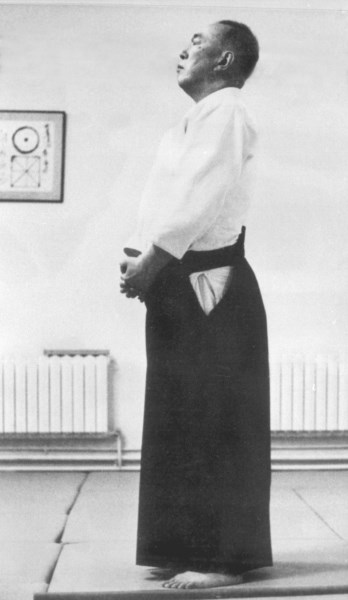
As for Tsuda sensei, he offered us a different image, a visualisation that allowed us to see things from a different point of view, a way of thinking that has always served as an orientation for me and allowed me to open up to another essential and yet simple dimension, a reorientation of which I had an imperative need. When he spoke of his masters – whether Japanese, such as Ueshiba Morihei O-sensei, Noguchi Haruchika sensei, creator of Seitai, Hosada sensei of the Kanze Kasetsu School, with whom he studied the recitation of Nō, or French, such as Marcel Granet and Marcel Mauss at the Sorbonne University – he explained that they had dug “wells of great depth”1 thanks to their intense and continuous research in their speciality. And yet, although they were working in very different fields, what each of them had discovered as they got closer to their source was that it was the same “water” that flowed there. Speaking of his work and his research in Aikido, Seitai and communication through his books, he himself told us, two years before his death, that he was beginning to feel moisture. The direction he was pointing in was not the accumulation of knowledge, techniques and know-how, but always the path of less, which allows the individual to wake up, to emerge from their torpor. He gives us an example of this in this paragraph from his fifth book2:
Everything takes place like the incubation of an egg. When the embryo becomes a chick, it breaks the shell and leaves. A new world opens up with the awakening of new sensations.’
To go deeper is not to repeat endlessly
Every partner, every situation, is an opportunity to meet and discover something new, something subtly different. It is this diversity that allows us to grow.
On the other hand, I remember my first years of Judo. I was barely twelve at the time, and although we practised the method known as “Japanese Judo-jujitsu”, which was very different from “modern Judo” – for example, there were no weight categories and everything was based on imbalance rather than strength – our teacher saw fit to align himself with the more modern trends promoted by Anton Geesink, the first non-Japanese to win the world championship title in 1961. He began to make us work on a “special”, i. e. a single technique, two at the most, for each of us. We had to repeat them tirelessly in order to win in the few inter-community competitions and to be able to take part in the Île-de-France tournaments. For him, it was a stimulus that was perfectly in line with modern teaching methods, but as for me, I was already aware of how much we were moving from martial arts to sport. I loved sport, especially running, and more particularly cross-country running, but what I loved about judo was disappearing.
In spite of everything, I continued at the club, and at the same time, above all, in what I called my “personal Dojo” with a judoka and karateka friend of mine: it was a space of about twenty square metres of which I was very proud because I had managed to set it up in a basement on tatamis that were extremely homemade. But it had all the features we needed for our practice, including photos of the masters in a Tokonoma, etc. It was there that we practised the “real” martial arts, in the nobility of the spirit of the art, but of course also with suppleness and rigour, comparing our recently acquired experience – I was just fifteen at the time and had been practising for four years. Our repertoire was to be found in the first books published, and we did not leave out any kata, even the most difficult ones, although they were not yet at our level, but what fascinated us was to discover the richness and finesse of this art, which had its roots in the experience of past centuries.
Aikido and the discovery of ki
Our judo teacher had told us about aikido and showed us some simple techniques. What was behind the techniques he was talking about and of which he had given us a glimpse? How could we progress in martial arts? These were the questions that plagued me when I wanted to resume training after the events of 1968. I had left the suburbs where I lived and taken up a lot of different arts, as well as various training in all kinds of martial arts, but all this only partly suited me. When I enrolled at the Montagne Sainte-Geneviève dojo in Paris with Plée sensei, I hoped to finally find something that would satisfy me. It is just after the Judo lessons, and thanks to the Aikido sessions led by Maroteaux sensei and his demonstrations and explanations on the importance of Ki in both Aikido and Jiu-Jitsu, that I felt the direction I needed to take. It was through him that I found the thread that led me to the man who became my Aikido, Katsugen Undo and Seitai master over his last ten years: “Tsuda sensei” – and for that I can never thank him enough.
In all the masters I met later, I tried to see and feel the Ki that was invisible yet present in each of them. Through my encounters at national and international workshops, I also rubbed shoulders with practitioners from different schools, always with an eye not to confront myself or discover new techniques, or even to show what I could do, but to feel the Ki in the people with whom I practised. The essential thing for me was to perceive what was driving them, superficially or more deeply, no matter whether it proved positive or negative in relation to my own practice. All of this allowed me to check how far I had got to, but also to feel how far I had come to appreciate the path travelled, and so to go deeper and further.
Tsuda sensei’s books, in their simplicity and depth, were not only theoretical guides, but also practical guides that I used in my daily life, and which, little by little, forced me to “let go” so that I could finally find myself again and confirm what was propelling and leading me.

Progressing to become or deepening to “be”
As long as we want to achieve a victory, whether over ourselves or over others, to gain advantages or comfort, we are basically following the same path – the path of acquisition, which focuses on the superficial, the container more than the content, the form more than the essence. Becoming aware of the path we are following – and the frustration that very often results – can lead us to reverse and begin to learn how to use dissatisfaction to seek out what is already there, waiting to be fulfilled, rather than try, in order to survive, to fill the gaps we feel in our character or physiological structure.
This is the path that Aikido offers us, an art of encounter, with a dimension that will surprise us as much as it will delight us, if we have the patience to discover it. To intensify sensation, not to fight against disappointment when it appears, but to accept it as a friend that helps us dig a little deeper in the direction we have ourselves decided to follow. To reawaken our intuition by merging with our partners and paying attention to every movement, to the flow of that inner energy that we need to discover and that is at our fingertips. To open up to our immanent humanity, without allowing ourselves to be dispossessed or invaded, because our sphere has become more perceptible, stronger, with a practice that is both realistic and, above all, without falsehood or complacency.
Going deeper means discovering an unknown world
It is when we are tired, depressed or sometimes just unwell that surprisingly unusual abilities come to the fore. Because we can no longer behave as we normally do, and provided we have worked in the direction of going deeper, then unknown abilities, different ways of doing things and understanding our surroundings emerge. Without us consciously noticing, our ego in that situation has the opportunity to submit to something it has never known. If we allow it to do so without fear, unsuspected possibilities then open up, the driving force of these being empathy and the consequence the desire to communicate. The need for action that arises from this situation propels us more or less quickly out of this difficult state, leading to an understanding of what we were looking for without being aware of it. The answers we find are often buried deep within ourselves. They are often very simple, such as “Why did I choose to practise Aikido?” or “Why do I keep digging despite the slowness and difficulty of this kind of path?”
The world we have access to is no different from the one we lived in, we need only add a new dimension, Ki. It is a fourth dimension, or a fifth if we think of time as the fourth dimension. If necessary, we can think of Ki in the same way we today conceive of gravity, or of anything else that is partly unknown to us at the moment, but I would not know how to define it because it is a “special” dimension. Tsuda sensei gave us a clue when he wrote in 1973, in the very first pages of his first book The Non-Doing:
‘Conveying the question of “ki” into the French vocabulary where every word must be defined and limited, is in itself contradictory, for “ki” is by nature suggestive and unlimited.’ 1 ‘In any case, the Western mind, with its intellectual and analytical tendency is incapable of admitting into its vocabulary a word as flexible as ki: infinitely large, infinitely small, extremely vague, extremely precise, very common, down-to-earth, technical, esoteric.’ 4
But after all, what we practise is called AI KI DO, is it not: the “Way of fusion and harmonisation of Ki”?
Article by Régis Soavi to be published in April 2025 in Self & Dragon Spécial Aikido n° 21.
- [cf. Tsuda Itsuo, The Non-Doing, Foreword (‘wells of exceptional depth’), 2013, Yume Editions (1st ed. in French, 1973, pub. Le Courrier du Livre (Paris), p. 12) (Translator’s note)]
- Tsuda Itsuo, The Dialogue of Silence, Chap. X, Yume Editions, 2018, p. 84 (1st ed. in French, 1979, pub. Le Courrier du Livre (Paris), p. 36)
- The Non-Doing, op. cit., Foreword, p. 13 (French ed.: p. 13)
- ibid., Chap. I, p. 16 (French ed.: p. 16)
Photo credits: ???Paul Bernas