

by Manon Soavi
Did you know that Morihei Ueshiba, one of the greatest budoka of the 20th century, would shout angrily whenever he saw his students practising: ‘No one here is doing aikido! Only the women are doing aikido!’1words reported by Guillaume Erard in « Entretien avec Henry Kono: Yin et Yang, moteur de l’Aïkido du fondateur » [‘Interview with Henry Kono: Yin and Yang, the Driving Force Behind the Founder’s Aikido’], 22 Apr. 2008 (French available online)?

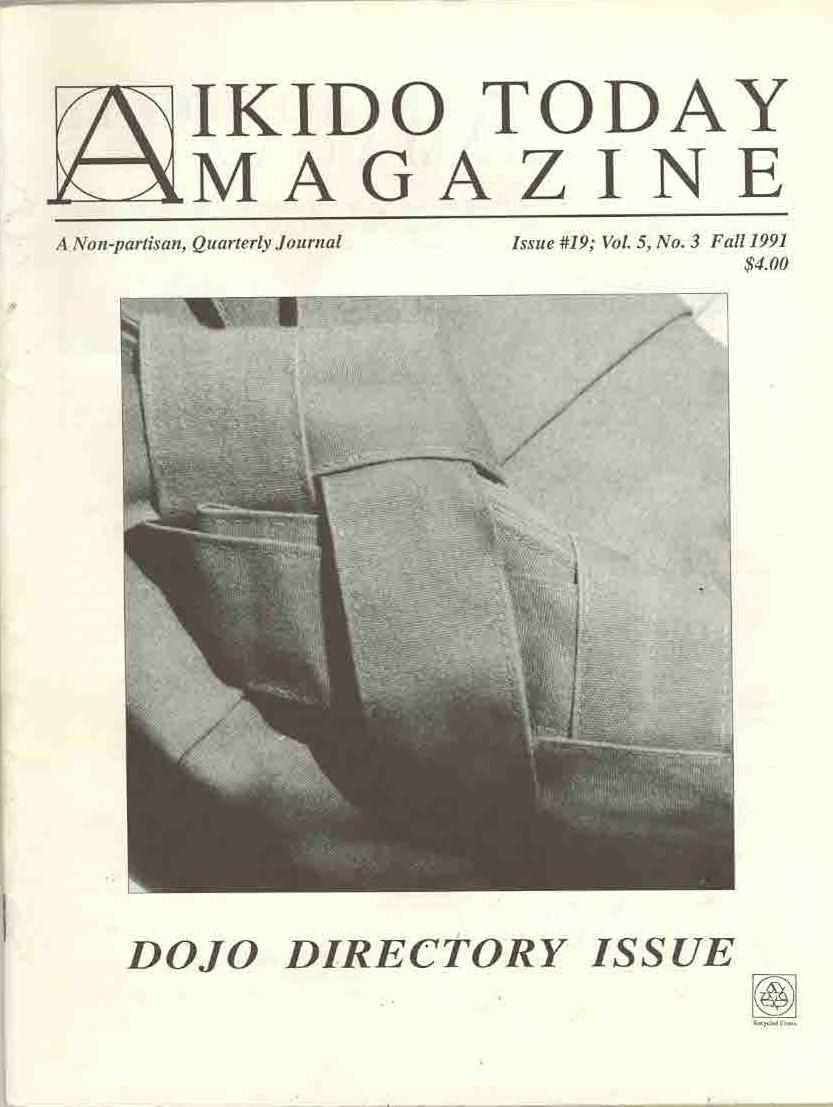
How could a Japanese man with a traditionalist view of the family and the place of women say such a thing and even claim that men are at a disadvantage in aikido because of their use of physical force2these words can be found – at least – in: ► Itsuo Tsuda, The Path of Less, 2014, Yume Editions, Chap. XVI, p. 157 (1st ed. in French: 1975, pub. Le Courrier du Livre (Paris), p. 148) ► Virgina Mayhew’s interview by Susan Perry pub. in Aikido Today #19, Vol. 5, No. 3, fall 1991 (French translation available online) ► Miyako Fujitani, ‘I am glad I have Aikido’, Magazine of Traditional Budo, n. 2, March 2019 (pdf link available online – at page bottom), p. 29 ► Mariye Takahashi, ‘Is Aikido the pratical self-defense for women ?’, Black Belt, Nov. 1964?
These remarks remain relevant today, since mainstream aikido still values strength. So why are these words, which shed light on the path developed by O-sensei, not better known?
This may be due to the silencing of the transmission of Ueshiba O-sensei’s female students. For, beyond the obvious injustice of rendering women invisible, silencing ways of doing things means erasing all memory of the gestures and ideas of the people who did those things. Our actions are nourished by the past, and the less we talk about women’s actions and how they operate, the more limited the range of possibilities is for future generations. We can see this clearly in aikido today: where are the women?
Men do not have to justify the need to be heard, but when it comes to women, we are obliged to justify the interest for everyone. However, men’s experiences cannot “count for everyone”; it does not work that way. Women’s experiences and ways of doing things are specific and different. That is why I am inviting you to discover a woman about whom very little is known, even though the path she followed would have justified her a place in the history of aikido.
Herstory, an militant history?
History is often mistakenly perceived as neutral and factual, when in reality it is a construct of those in power that influences the present. This is why Titiou Lecoq writes: ‘When working on women’s history, female historians are always suspected of being activists. Why should women’s history be militant? Isn’t the history we learn, which is masculine and non-mixed, also a form of militancy?’3Titiou Lecoq, « Tant qu’on ne cherche pas les femmes dans l’Histoire, on ne les trouve pas » [‘As Long as We Don’t Look for Women in History, We Won’t Find Them’], France Inter (French radio broadcast), 19 Sept. 2021 (available online)
The play on words her-story emphasises that history reflects male points of view: his-story. Herstory restores the active role of women in history. In her book The Great Forgotten Ones: Why History Erased Women, Titiou Lecoq explains that her aim ‘was not so much to feminise history as to demasculinise it. The approach is different. Demasculinising or devirilising implies the idea that there was a prior political process of masculinising society.’4Titiou Lecoq, « INTERVIEW: Pourquoi l’histoire a-t-elle effacé les femmes ? » [‘Interview: Why did History Erase Women?’], 7 June 2022, Revue Démocratie (French online review)
Lecoq cites French grammar5[In French, the standard gender is masculine, especially job names, and the plural of a list of items is traditionally masculine as long as at least one item is masculine] as an example of deliberate masculinisation6« Tant qu’on ne cherche pas les femmes dans l’Histoire, on ne les trouve pas », op. cit., as well as the fact that in the Middle Ages there were ‘female doctors, jugglers, goldsmiths, authors, illuminators and cathedral builders, and it was only at the end of this period that men forbade them from practising these professions.’ The masculinisation of society involved erasing women, their stories, their actions and their names.
A very obvious example of this erasure is that of Alice Guy, who invented cinema! While Méliès was interested in creating illusions and others used the camera to document their times, Alice Guy imagined telling fictional stories. In over twenty years, she made around a hundred films as a director, screenwriter and even producer. Yet the Lumière brothers and Méliès enjoyed great posterity despite having much shorter careers. Alice Guy was literally erased: many of her films were deliberately re-attributed to men in the registers, and many of her films were destroyed. She was not even mentioned in cinema encyclopaedias for a long time.
The story of Alice Guy is just a classic example of what happens to female creators. And if a work reaches us, historians question whether they really created it, when they do not outright dispute the existence of the person.
The delegitimisation of women is a form of symbolic violence that plays a major role in the mechanisms of male domination. This is why Aurore Evain advocates for the reintroduction of the term Matrimoine7[In French, patrimoine means heritage, and literally means ‘the inheritance of our fathers’. Matrimoine stands for women’s heritage.], because ‘[t]he symbolic power of language is immense[…]. Naming our matrimoine allows both women and men […] to recognise themselves in male AND female role models.’8Aurore Evain, « Vous avez dit “matrimoine” ? » [‘Did You Say “Matrimoine”?’], Mediapart blog, 25 Nov. 2017 (French available online)
The women’s heritage of aikido
What do we know about the her-story of aikido? Almost nothing. Once again, we need to “demasculinise” history in order to recover the memory of female aikidoka. This is why I wrote about Miyako Fujitani9Manon Soavi, ‘Miyako Fujitani, the “Matilda effect” of Aikido?’, Self&Dragon Spécial Aikido n° 17, April 2024, available online. Since I began my research on Fukiko Sunadomari, I have gone through phases of despondency and anger, as the potential seemed so interesting and yet there were no traces to be found.
Here is what little we know: Fukiko Sunadomari was born on 9th May 1914 into a family of devout followers of the Oomoto Kyō religion. In the late 1930s, she began studying naginata in the Jikishingake school under the guidance of Japan’s greatest expert – a woman –, Hideo Sonobe sensei.

In 1939, Sonobe sensei met Ueshiba O-sensei during a demonstration in Manchuria. She was enthusiastic about it and decided to send some of her advanced female students to learn aikido. This is how Fukiko began at the Hombu Dojo in the 1950s. Her two brothers (Kanemoto and Kanshu) had already begun practising under the guidance of Morihei Ueshiba.Fukiko ‘lived for many years in O-Sensei’s Wakamatsu Dojo in Shinjuku with his family and the live-in uchideshi.’10Stanley Pranin, Historical photo: Morihei Ueshiba, Aspiring Calligrapher!, 6 Nov. 2011, Aikido Journal, available online She held the position of Fujin Buchō (director of the women’s instructor section)11Stanley Pranin, The Aiki News Encyclopedia of Aikido, 1991, pub. Aiki News (Tokyo), p. 106, available online until O-sensei’s death in 1969. This tells us that there was a section for training female instructors! This raises many questions: why a separate class? How did it work, how many were there…?
A letter12Guillaume Erard, « Biographie d’André Nocquet, le premier uchi deshi étranger d’O-sensei Ueshiba Morihei » [‘Biography of André Nocquet, O-sensei Ueshiba Morihei’s First Foreign Uchi Deshi’], 2 Feb. 2013 (Fr. available online) written by Fukiko to André Nocquet’s family reveals that she was a key figure at the Hombu Dojo. She was involved in the dojo’s internal running and was close to the Ueshiba family. She was O-sensei’s confidante and personal assistant for twenty years, during which time he awarded her the rank of sixth dan. There is also a very short video of a demonstration on the roof of a building in Tokyo where O-sensei is seen demonstrating Ki no musubi with Fukiko.

As O-sensei’s assistant, Fukiko often happened to accompany him on trips to the Kansai region, where he taught aikido while visiting long-standing students and friends. During these trips, O-sensei would often choose Fukiko to be his demonstration partner, particularly when teaching women13‘I am glad I have Aikido’, op. cit., p. 26. Fukiko apparently had many unpublished photos from this period14Historical photo: Morihei Ueshiba, Aspiring Calligrapher!, op. cit..
According to aikido researcher Stanley Pranin, Fukiko accompanied O-sensei on a series of trips in the mid-1960s and took the opportunity to gather material for a biography. She took photographs and interviewed former students of Morihei Ueshiba, as well as members of the Oomoto religion who had known him.15ibid.
After O-sensei’s death, she continued her extensive research and co-wrote the first authorised biography, Aikido Kaiso Morihei Ueshiba, with her brother Kanemoto. Of course, she is only mentioned as a collaborator; her brother is the sole official author of the book!
In the mid-1980s, Fukiko wanted to pay tribute to O-sensei by building a small votive temple in his memory in Kumamoto16Simone Chierchini, ‘Paolo Corallini’s Traditional Aikido Dojo’, 31 May 2020, available online. To finance her project, she decided to sell some of the many original calligraphies by O-sensei that he had given her17ibid..
Fukiko Sunadomari passed away on 1st May 2006 in Fujisawa, at the age of 92.
Make history
Stanley Pranin stated:
[…] Fukiko Sensei’s testimony is very important to a deep understanding of Morihei’s history, character, and art.’18Historical photo: Morihei Ueshiba, Aspiring Calligrapher!, op. cit. (emphasis by M. Soavi)

So, where are these hours of interviews, these articles reporting her words? I have searched thoroughly through all of Pranin’s publications, including books, AikiNews magazines and Aikido Journal issues – both print and web versions. I found nothing. There is no trace of them.
Current Aikido Journal editor Josh Gold confirmed to me that there are no recordings, either digitised or on archive tapes.
Pranin wrote in a short article: ‘[Fukiko] was an outspoken person and distanced herself from the Ueshiba family following Morihei’s death. As such, her comments and recollections are not always suitable for publication, and we have long refrained from releasing transcripts of these recordings, even in edited form. Given time and resources, we hope to remedy this situation’.19ibid..
In 2011, he justified himself as follows: ‘These areas are very sensitive, otherwise, I would have already published certain documents and testimonies. Even though many decades separate us from some of the events in question, the sensitivities of key individuals are a matter of concern. This is something I have wrestled with for a long time, and still don’t have a good solution. I felt very hesitant to publish Koichi Tohei Sensei’s letter of resignation, for example. We’ll see how things play out.’20ibid..
Thus, with a gentle shift, almost without intention, the masculinisation of history continues. Women disappear one after another from the scene, leaving only prevailing male voices.
‘She must be his mistress’ – a strategy for discrediting women
Given Fukiko’s position, it is not surprising that rumours spread that she was “sleeping with the boss”. This is the oldest weapon used to silence women.
It is assumed that if O-sensei “burdened” himself with a woman, there must have been a romantic story behind it. Strangely enough, the same is not assumed of the young male uchideshi of the dojo. Nor is it assumed that O-sensei had a secret lover in Iwama!

We can hypothesise about Fukiko’s views. Based on Pranin’s comments and the few comments she left, it is clear that she was a mystic21Michi-o Hikitsushi sensei said of Fukiko that she ‘understands spiritual matters well’ – see Hikitsushi sensei’s online biography (In French) or his biography pub. in Aikido Magazine No. 40, Oct. 1988 (French trans. available online) like Ueshiba O-sensei. She often emphasised the importance of this aspect in O-sensei’s path. Did she criticise the beginnings of a desacralised, sporting – and ultimately very masculine – aikido that, in her opinion, did not correspond to the founder’s vision?

This aikido corresponds to Kisshōmaru Ueshiba’s efforts to expand his father’s art internationally. But for O-sensei, aikido was ‘a spiritual act’22Ellis Amdur, Hidden in Plain Sight: Tracing the Roots of Ueshiba Morihei’s Power, Chap. 13, 2018, Freelance Academy Press, p. 281: ‘[Ueshiba offered] not more spiritual lessons with which the world is uselessly glutted, but spiritual acts.’ (full quotation available online) and he himself stood on “Ame no Ukihashi, the celestial floating bridge”, that which connects the visible and invisible worlds. It was an art of universal love, recreating the bonds that unite us both as humans and to non-human living beings.
Could the West hear this? given that, as Isis Labeau-Caberia says, ‘[as a cosmovision, it] first set about destroying indigenous cosmovisions on the European continent itself – those of peasant, rural and “pagan” worlds; those of druids, bone-setters and witches – before pouring to the rest of the world’.23Isis Labeau-Caberia, « “La tête ne nous sauvera pas” (part. 1) : L’Occident est une cosmovision, la “raison” en est le mythe fondateur » [‘“The Head Alone Will Not Save Us” (Part 1): The West is a Worldview, and “Reason” is its Founding Myth’], 4 July 2023, blog La Griotte Vagabonde [The Wandering Female Griot] (available online). [Bold emphasis removed by M. Soavi.]
Elevating the intellect to the top and rejecting the body, emotions and spirituality: this artificial dualism was the matrix of the reification, domination and exploitation of everything that was not a “rational modern man”, i. e. non-human beings, women and non-white people, all of them being sent back to the belittled state of “Nature”.
In this context, aikido has become mainly a combat sport or a gold mine for gurus, when what we desperately need are spiritual but immanent practices for the body, stripped of all domination.
Other students of O-sensei criticised this new direction taken by the Aikikai, breaking away from the Ueshiba family: Kōichi Tōhei, Noriaki Inoue (O-sensei’s nephew), Itsuo Tsuda and Kanshu Sunadomari. However, we have no shortage of interviews with these famous practitioners.
There remains one difference: Fukiko was a woman with expertise who spoke to convey her truth, no more and no less than the others. But she was a woman… so they did not listen.

Was O-sensei referring to her in particular when he said that his ideal aikido was that of young girls24The Path of Less, op. cit., loc. cit.? Or when he shouted: ‘Only women practise Aikido here!’?
Through the fragments of the story of Morihei Ueshiba’s closest female disciple, perhaps even his best, we can discern a relationship of transmission from master to student, and even beyond that, a spiritual relationship. So how can we not suppose that Fukiko’s aikido must have been breathtaking? And how can we not regret the loss of this link to the founder’s aikido?
I hope that I have played a small part in demasculinising aikido and raising awareness of this extraordinary figure. I would like to take this opportunity to thank Fukiko’s sister-in-law for kindly providing me with the unpublished photos and press clippings presented here.
By doing so, she is helping to preserve a women heritage where each piece of the puzzle is important.
Notes
- 1words reported by Guillaume Erard in « Entretien avec Henry Kono: Yin et Yang, moteur de l’Aïkido du fondateur » [‘Interview with Henry Kono: Yin and Yang, the Driving Force Behind the Founder’s Aikido’], 22 Apr. 2008 (French available online) ↩︎
- 2these words can be found – at least – in: ► Itsuo Tsuda, The Path of Less, 2014, Yume Editions, Chap. XVI, p. 157 (1st ed. in French: 1975, pub. Le Courrier du Livre (Paris), p. 148) ► Virgina Mayhew’s interview by Susan Perry pub. in Aikido Today #19, Vol. 5, No. 3, fall 1991 (French translation available online) ► Miyako Fujitani, ‘I am glad I have Aikido’, Magazine of Traditional Budo, n. 2, March 2019 (pdf link available online – at page bottom), p. 29 ► Mariye Takahashi, ‘Is Aikido the pratical self-defense for women ?’, Black Belt, Nov. 1964 ↩︎
- 3Titiou Lecoq, « Tant qu’on ne cherche pas les femmes dans l’Histoire, on ne les trouve pas » [‘As Long as We Don’t Look for Women in History, We Won’t Find Them’], France Inter (French radio broadcast), 19 Sept. 2021 (available online) ↩︎
- 4Titiou Lecoq, « INTERVIEW: Pourquoi l’histoire a-t-elle effacé les femmes ? » [‘Interview: Why did History Erase Women?’], 7 June 2022, Revue Démocratie (French online review) ↩︎
- 5[In French, the standard gender is masculine, especially job names, and the plural of a list of items is traditionally masculine as long as at least one item is masculine] ↩︎
- 6« Tant qu’on ne cherche pas les femmes dans l’Histoire, on ne les trouve pas », op. cit. ↩︎
- 7[In French, patrimoine means heritage, and literally means ‘the inheritance of our fathers’. Matrimoine stands for women’s heritage.] ↩︎
- 8Aurore Evain, « Vous avez dit “matrimoine” ? » [‘Did You Say “Matrimoine”?’], Mediapart blog, 25 Nov. 2017 (French available online) ↩︎
- 9Manon Soavi, ‘Miyako Fujitani, the “Matilda effect” of Aikido?’, Self&Dragon Spécial Aikido n° 17, April 2024, available online ↩︎
- 10Stanley Pranin, Historical photo: Morihei Ueshiba, Aspiring Calligrapher!, 6 Nov. 2011, Aikido Journal, available online ↩︎
- 11Stanley Pranin, The Aiki News Encyclopedia of Aikido, 1991, pub. Aiki News (Tokyo), p. 106, available online ↩︎
- 12Guillaume Erard, « Biographie d’André Nocquet, le premier uchi deshi étranger d’O-sensei Ueshiba Morihei » [‘Biography of André Nocquet, O-sensei Ueshiba Morihei’s First Foreign Uchi Deshi’], 2 Feb. 2013 (Fr. available online) ↩︎
- 13‘I am glad I have Aikido’, op. cit., p. 26 ↩︎
- 14Historical photo: Morihei Ueshiba, Aspiring Calligrapher!, op. cit. ↩︎
- 15ibid. ↩︎
- 16
- 17ibid. ↩︎
- 18Historical photo: Morihei Ueshiba, Aspiring Calligrapher!, op. cit. (emphasis by M. Soavi) ↩︎
- 19ibid. ↩︎
- 20ibid. ↩︎
- 21
- 22
- 23Isis Labeau-Caberia, « “La tête ne nous sauvera pas” (part. 1) : L’Occident est une cosmovision, la “raison” en est le mythe fondateur » [‘“The Head Alone Will Not Save Us” (Part 1): The West is a Worldview, and “Reason” is its Founding Myth’], 4 July 2023, blog La Griotte Vagabonde [The Wandering Female Griot] (available online). [Bold emphasis removed by M. Soavi.] ↩︎
- 24The Path of Less, op. cit., loc. cit. ↩︎