

by Manon Soavi
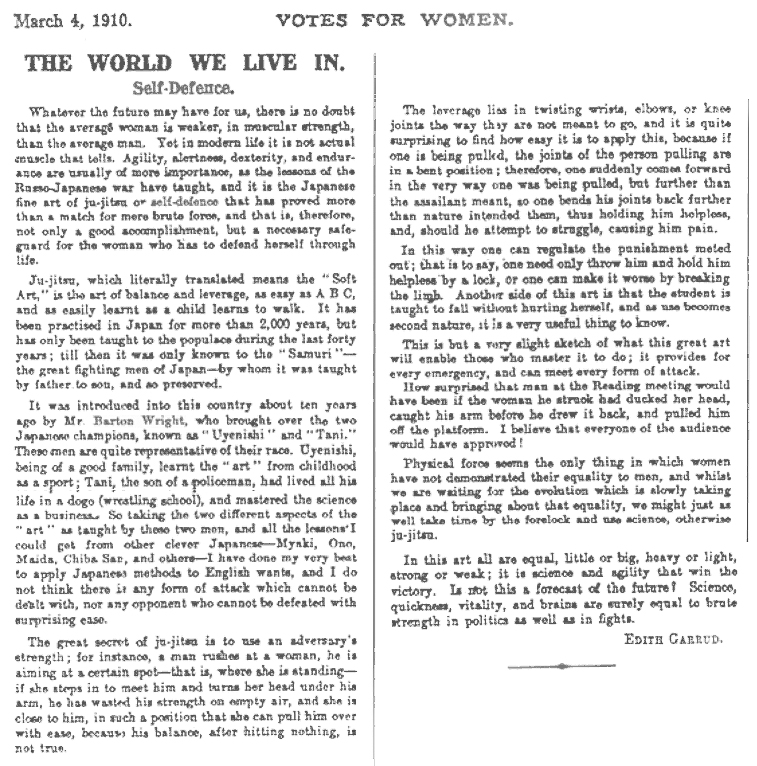
Our world is sick with violence (whether physical, verbal, psychological, symbolic, social, economic, etc.), sick with a dominant model based on competition, appropriation and fear that has been in place for centuries. From the powerful who own the world to our entertainment and media, violence is everywhere. The world often leaves us no choice: we either perpetrate violence or suffer it, or even both1this title is a reference to The World We Live In: Self-Defence by Edith Garrud (newspaper Votes for Women, 4 March 1910). For women, violence is often inherent in the very fact of being born female. Throughout our lives, we will be underestimated, mistreated and judged against the male model to which we are constantly compared. Martial arts are no exception to the rule: violence, condescension and sexist comparisons do exist. Much more than we want to admit.
Violence is therefore a festering wound that affects us all, with women unfortunately on the front line. While Aikidō is obviously not a solution to all the world’s problems, I believe that this art can be an exceptional tool for women to break free from the constraints imposed on them. It is a path that can lead us to overcome violence and escape the dualism of victim or perpetrator. To achieve this, I believe that the first step is to reclaim the issue of violence so that it is no longer seen as an inevitable fate.
Fate? Or political choices?
To do this work, we need to break free from certain deeply ingrained patterns of thinking. The historically narrow view that women have been subordinate to men since the dawn of time is no longer relevant. As some researchers have shown2cf. e. g. Marylène Patou-Mathis, Neanderthal, Une autre humanité [Neanderthal, Another Humanity], 2006, éd. Perrin (Paris), coll. Tempus; and Alison Macintosh, ‘Prehistoric women’s manual labor exceeded that of athletes through the first 5500 years of farming in Central Europe’, Science Advances, Vol. 3, No. 11, 29 Nov. 2017, during the thousands of years of prehistory, like other species in the animal kingdom, women and men gathered, hunted, cared for others, fought and used projectile weapons. As people became more sedentary, the status of women deteriorated throughout the world, but it was in Europe, during the Renaissance, that religion and political power brought about a decisive turning point in the history that shaped us. In her book In Defense of Witches, author Mona Chollet explores the immense violence of the witch hunts in Europe in the 15th and 16th centuries. These mass crimes, which have been largely ignored, not only killed thousands of women and children under the pretext of “witchcraft”, but also helped shape the world we live in today ‘by sometimes wiping out entire families, spreading terror, and mercilessly repressing certain behaviours and practices that are now considered intolerable’3Mona Chollet, In Defense of Witches: The Legacy of the Witch Hunts and Why Women Are Still on Trial, Introduction, ‘ “A Victim of The Moderns, Not of The Ancients” ’, pub. St. Martin’s Press, March 2022. [Our transl. from the original French: Sorcières, la puissance invaincue des femmes, 2018, pub. La découverte (Paris), p. 13] . The status of women was already difficult, but this historical episode marked a historic turning point in our world. Our European culture would establish itself as the dominant universal model, a consequence, among other things, of our conquests. In her book, Mona Chollet analyses the deep trauma that would remain with women and the indelible message that would be engraved and passed down from generation to generation, from woman to woman: submit! Do not rebel, for those who did so paid dearly.
Women of the 21st century, we are the heirs to this ultra-violent past, and the wound still festers, kept alive by the accumulation of violence today. In a number of countries, it is true that we no longer risk being burned and tortured – but that is because it is no longer necessary, as we have accepted the rules of the game and have even internalised violence to such an extent that we often no longer see it! And if we ever doubt, violence will always be there to remind us, in case we forget our place.

Women and violence
As a woman who practises and teaches martial arts (aikidō, jūjutsu, kenjutsu), I cannot help but feel concerned by this issue and seek answers. While yesterday’s society told women that they should not react, today’s society seems to oscillate between perpetuating this silence and immobility and suggesting that we become as aggressive as men (at work, in love, in combat, etc.). Are we then condemned, in order to liberate ourselves, to become as violent as men? Is this desirable? And can we compete on the same level?
Should we, like Hollywood, make the same action films but with female heroes to keep up with the times? Personally, while I do not doubt for a moment the power of women, I doubt that this is the right way to express it. So how can we find the right balance?
First, we must go back to the root cause: education. From childhood onwards, boys are allowed to occupy space, run, climb, kick a ball around, compete with each other, test their bodies and thus gain confidence in their developing bodies. Girls, on the other hand, are more or less excluded from this space. They are confined to more static games and cute, frivolous toys. Not to mention the clothes “so pretty” that hinder them. Their bodies are thus denied the experience of unfolding and discovering their power. We are conditioned to internalise any expression of violence and seek to please others. Fictional female role models will also show us the way.
As I have already said, I did not go to school and was not educated “like a girl”. I therefore remember my anger as a teenager at the lack of reaction from female characters in books and films. I did not understand why they were so submissive, so passive, or why they became schemers working in the shadows, using their charms to get revenge. As a result, I did not identify with the female characters at all, but always with the male characters, who took action, fought for great causes, and were free to do as they pleased.
As adults, women still find it very difficult to allow themselves to react to violence. I am not saying that victims are responsible for their assaults, absolutely not! But we are thus doubly punished, as Virginie Despentes says: ‘An ancestral, relentless political enterprise teaches women not to defend themselves. As usual, there is a double bind: we are made to understand that there is nothing more serious [than rape], and at the same time, that we must neither defend ourselves nor seek revenge.’4Virginie Despentes, King Kong Theory, ‘She’s so depraved, you can’t rape her’ (3rd Part), 2009, pub. Serpent’s Tail (London), p. 37. Trans. from the original French: 2006, pub. Grasset (Paris) I recently spoke with a young woman (an engineer and team leader in her company) about how difficult it is to break out of this pattern. She said that she was often afraid of her own violence if she reacted, so she often let the aggressor have his way, waiting a little longer (it may be “just” inappropriate gestures, heavy flirting or other ordinary violence) rather than reacting and having that reaction judged as disproportionate or hysterical.
Why is this the case? Is it fundamentally feminine? Philosopher Elsa Dorlin provides some answers by discussing a process she calls ‘the fabrication of defenceless bodies’5Elsa Dorlin, Se défendre : une philosophie de la violence [Defending Oneself: A Philosophy of Violence], 2017, pub. La Découverte (Paris), p. 21 or p. 66. This philosopher studies the ways in which bodies considered subordinate (slaves, colonised peoples, women, etc.) find their ability to defend themselves restricted, in the broadest sense of the term. For her, if women are “defenceless”, it is because of social forces that have been at work for centuries. We are taught that if we react, things will get worse, that it is inevitable that we will be attacked at some point, and that men will always be stronger. This male superiority is often nothing more than a fantasy.

I was “lucky” not to be seriously assaulted; so far, I have “only” experienced “minor” assaults. When I was a young girl, for example, I slept in a shared room in a building reserved for a summer music academy. In the middle of the night, a boy entered the room, whose door had no lock (which had shocked me when I arrived). He was drunk and came in shouting that he wanted to kiss us. Half awake, I heard him lean over the first bed where another girl was sleeping. She protested but was still more or less “groped”. I hear him approaching my bed, he leans over and gets my arm in his face. He is surprised, staggers and leaves the room after a few expletives. I was lucky, yes, and I did not use “Aikidō” to ward him off. But in my mind, I was certain that I was justified in reacting immediately, and that made all the difference. I am not advocating violence for violence’s sake, but the ability to exercise one’s capacity to react, to use the rage that rises within us when we are attacked. But we did not choose to be in this situation! The challenge then is to react effectively and, if possible, proportionately, but in that order of priority.
But practising an art such as Aikidō can be, like Jūjutsu practised by English feminists in the early 20th century, more than just a defensive art, but a “total art“ ‘because of its ability to create new practices of self that are political, physical and intimate transformations. By freeing the body from clothing that hinders movement, by deploying movements […] by exercising a body that inhabits, occupies the street, moves, balances’6ibid. and thus establishes another relationship with the world, another way of being. Little by little, our posture changes from ‘how can I defend myself without hurting anyone’ to ‘being myself’ and what means are at my disposal to maintain my integrity. Perhaps rage will be needed as a force for action, perhaps it will be enough to stand up and say ‘no’. It is our determination that will change everything.
Violence or coagulated energy
When we talk about violence, we are not usually referring to the violence of the wind or the violence of the feelings that pass through us. And yet, the word originally referred to willpower, strength (the force of the wind, the heat of the sun, etc.), even deriving from the Latin vis, which can mean life force or vitality! So why is this energy, this vitality, so often expressed through destruction? Tsuda Itsuo sensei explained:
[…] there are a great many people who, simply in order to deal with society, run around in circles in search of an easy solution, and never find the radical solution: the awakening of the being.’7Tsuda Itsuo, The Dialogue of Silence, Chap. VIII, Yume Editions, 2018, p. 68
Once we realise that blocking our energy and reactions traps us in the unbearable role of “victim” and can lead us to express our vitality by destroying others or ourselves, we can then take the next step: working to control violence. Stopping a hand, a word, looking the other person in the eye. Controlling does not necessarily mean restraining violence. It is not easy, but it also means assessing situations to know what the next step will be. We no longer hope that the other person will not approach us; we know that if we wait, it will be too late, and then the violence will be there. One of the tasks at hand is to be more sensitive, to feel our own state and that of others.
In our school, the tools for this awakening, which comes through the body, are Aikidō and Katsugen undō, which is part of Seitai. ‘The principle of Seitai is extremely simple: life always seeks to balance itself, despite the structured ideas we heap upon it. Life acts through our instincts and not our faculty of reason.’8ibid., p. 69 Thus, it is not a matter of external action or letting off steam, but rather a subtle balancing of our own energy. Through the involuntary movement that allows it to flow, it pacifies us from within.
For its part, the practice of Aikidō confronts us with the energy that comes to us from others. How do we deal with this, how do we react? In our school, the answer is harmonisation. Even if the other person is a danger, especially if the other person is a danger, harmonisation is necessary. As Ellis Amdur says, ‘There is, in fact, a naked intimacy in hand-to-hand combat […]. Expertise is not just skill at movement or technique – true expertise is the ability to be as un-barriered as a baby’9Ellis Amdur, Steal the Technique, KogenBudo blog, 21 Mar. 2021. Of course, harmonising does not mean giving up. It is a subtle process that leads to not really using force against force, but to guiding, to channelling that force elsewhere. It is through the areas of focus that are breathing, the development of sensation and non-doing that we practise. This is not a question of cheap non-violence. On the contrary, our dojos offer daily practice, and the intensity will gradually increase, always depending on tori’s ability to maintain these areas of focus, even when faced with attacks that become faster and more demanding. Women find a special place in this work, where they can exercise their abilities and gradually discover that ‘it is not so much a matter of learning to fight as of unlearning not to fight.’10Defending Oneself (op. cit.)
These two practices enable us to regain a more refined sensitivity. Often, in order to cope with things, we end up no longer feeling anything: neither suffering, nor the caress of the wind, nor, unfortunately, danger. Ellis Amdur puts it this way: ‘To truly survive in high-risk encounters, one has to develop an exquisite sensitivity to other people, both one’s own allies and one’s enemies. The development of kan [勘, intuition] is essential.’11Ellis Amdur, Senpai-Kohai: The Shadow Ranking System, KogenBudo blog, 21 Mar. 2021 This ability to sense others and listen to one’s intuition is essential in all aspects of our lives.
Aikidō is not some self-defence, it is much better than that, it is the possibility of rebalancing our relationship with the world. Reconciling with ourselves and the world by rediscovering our inner strength. This may seem very ambitious, but it is a possibility. I know a practitioner who, for years, following the violence she had suffered, had terrible nightmares. She would regularly wake up in the night screaming. When she reached a stage in Aikidō where the intensity of the exchanges increased, she began to react in her dreams. She still had nightmares, but she was no longer passive; she reacted in her dreams so that she would no longer be a victim. This “simple” fact was of paramount importance to her and her journey.

Female gaze
In 1975, film critic Laura Mulvey theorised the male gaze in cinema, characterised by the fact that the camera always has a male point of view, looking at women’s bodies as objects. Since then, some female filmmakers have spoken of a female gaze, which is not the opposite (viewing men’s bodies as objects) but seeks to place itself at the heart of the experience of individuals, particularly women. This monopoly of representation based on the male point of view, highlighted in cinema, can be found in almost all fields.
This is especially true in martial arts, which are seen as almost exclusively masculine because they are warrior arts. But history is written by the victors. As author Chimamanda Ngozi Adichie says, this is the danger of a single story: ‘Start the story with the arrows of the Native Americans, and not with the arrival of the British, and you have an entirely different story.’12Chimanda Ngozi Adichie: The danger of a single story (from 10’30”), UTube channel TED, 7 Oct. 2009 Sometimes, telling the story from the other point of view means repairing deep societal traumas.
As I said earlier, the film industry today shows us more and more female heroes who fight. Although I recognised a certain satisfaction of my teenage frustration in this, I quickly grew tired of it. These women fight “like men” and are not realistic. So they are still not really the kind of female role models I would have wanted when I was sixteen. In Aikidō, as in most fields, the over-representation of men gives us a masculine universe with its physical and mental characteristics as our horizon and model of practice. Women who want to persevere often have to prove that they can perform on the same level as their male counterparts.
I am not advocating a feminine way of practising Aikidō, but rather the possibility that there are other ways of practising that are equally respectable and respected. Moreover, if the idea of a feminine way of practising Aikidō seems so unbearable to us women, it is because we still value a certain perspective, a certain way of doing things. We have done so for so long that we have internalised the superiority of a model that is no longer even masculine, but simply THE model. In order to recognise our excellence, we must compete with this model, in the same way, on the same ground, otherwise it will be a despised sub-discipline. We forget to ask ourselves the fundamental question: why is this male model more justified, more universal? It is, incidentally, a contemporary Western male model, as other cultures have had other models.
This phenomenon can be found in all fields. For example, writer Tanizaki Jun’ichirō explored this issue of the Western monopoly on science:
‘I always think how different everything would be if we in the Orient had developed our own science. Suppose for instance that we had developed our own physics and chemistry: would not the techniques and industries based on them have taken a different form, would not our myriads, which would consequently have evolved along different paths, would we not our myriads of everyday gadgets, our medicines, the products of our industrial art – would they not have suited our national temper better than they do? In fact, our conception of physics itself, and event the principles of chemistry, would probably differ from that of Westerners’.13Tanizaki Jun’ichirō, In Praise of Shadows, 1977, Leete’s Island Books (Sedgwick, state of Maine), p. 7 (Trans. by Thomas J. Harper & Edward George Seidensticker from the original Japanese: 陰翳礼讃, In-ei Raisan, 1933)
The trend towards “situated knowledge” in science follows the same line of thinking. Initiated by women, this trend is based on work that describes and analyses how all scientific knowledge is “situated”, coloured by culture, historical context, and the position (social, gender, etc.) of researchers. According to this trend, all knowledge, even scientific knowledge, is partial, and claiming to have neutral and objective knowledge is an illusion. It is by multiplying points of view and positions, and by explaining and accepting our situated nature, that we can move towards more solid and reliable knowledge.
Another example is that Native Americans can teach us a different way of adapting to the environment than our own:
‘Unlike European peasants stooped to the grind of agriculture, anxiously accumulating grain against future want, the Indian appeared free because confident of his ability to bear hardship; leisured because tough’14Matthew Bunker Crawford, The World Beyond Your Head: On Becoming an Individual in the Age of Distraction, Introduction, ‘Individuality’, 2015, pub. Farrar, Straus and Giroux (New York), p. 19 rather than far-sighted. Would it be possible to live without worrying about the future?
Similarly, is it possible that there is another way to fight? If prehistoric women were capable of fighting, there were also the Celts, the Amazons of Amazonia, several traditions of female warriors in Africa (the Amazons of Dahomey, the Linguères of Senegal, or among the Zulus), and there were also some in China and Japan. Or even Native American women15Patrick Deval, Squaws, la mémoire oubliée [Squaws, The Forgotten Memory], 2014, pub. Hoëbeke (Paris), who could be chiefs, shamans, healers, or warriors. And then there were the women of the French Revolution, the anarchists, and the English suffragettes. And surely there were other forgotten cultures where women were the bearers of specific martial traditions, and there is no reason to think that they could not have been effective in this field, depending on the goals sought. I would give anything to see how they fought, how they took advantage of their physical and psychological characteristics.
Hino Akira Sensei recounts his encounter with Tai Chi Chuan and Shaolin Kung Fu:
I thought to myself, “It really exists!”. Although I am not tall, I was still a young man full of vigour, and an old granny had just surpassed my attack with her flexibility. I had just discovered that there really were principles that allowed gentleness to overcome strength. I was stunned, but I had just discovered one of the keys that would allow me to continue my search.’16Léo Tamaki & Frédérick Carnet, Budoka no Kokoro (in French),‘Hino Akira, the Tengu of Wakayama’, Oct. 2013, self-pub.
Why, in Aikidō, could we not also develop our own way of doing things? If Aikidō is unique, it is in its multiplicity, both Yin and Yang, masculine and feminine. It does not matter if a 45kg woman is unable to perform kokyū hō when faced with a ryōte-dori grip from a 70kg man; we are competent precisely because we do not find ourselves in that position! If we move well beforehand, or if as a last resort we headbutt or kick you know where… So why compare? Imagine an arena with a strict rule that tori must wait passively for uke to arrive and grab his wrists in a downward blocking manner. Could the 70-year-old Master Ueshiba in this situation have beaten the 40-year-old Master Ueshiba grabbing his wrists like that? Probably not if he had tried to do as the 40-year-old did. It was precisely because he had a different body, a very different feeling of attack, that he was capable of something else.
It was the same absurdity of comparison within a defined framework that enabled Anton Geesink, a 1.98m tall Dutchman weighing 115 kg, to defeat the Japanese in jūdō in 1961. But was it not absurd to get to that point?
The power of women lies in being women. As Abe Toyoko sensei, a 70-year-old emeritus teacher of Tendō-ryū, says:
‘The first [naginata] tournament I saw my teacher in, it was amazing. She walked her opponent all the way across the hall, from the east side to the west side, not using any technique, just her stance and spirit. Everyone, even the old teachers were enthralled. Then she moved to cut, just once. […] She won the match’. ‘To be like a woman is not simply to be soft. To be woman-like is to be as strong or as soft, as servile or as demanding as a situation calls for: to be appropriate and act with integrity. This […] is the heart of real budo.’17Ellis Amdur, Interview with Abe Toyoko of the Tendo-ryu, KogenBudo blog, 21 Mar. 2021
Paradoxically, it is by developing our specificity that we can create a completely different idea of an art, of a universal science. A multiple universal full of a diversity of colours and forms. An Aikidō that embodies the diversity of human beings in general.
Would you like to hear about the next article?
Article by Manon Soavi published in July 2020 in Self & Dragon Spécial Aikido n° 2.
Notes
- 1this title is a reference to The World We Live In: Self-Defence by Edith Garrud (newspaper Votes for Women, 4 March 1910)
- 2cf. e. g. Marylène Patou-Mathis, Neanderthal, Une autre humanité [Neanderthal, Another Humanity], 2006, éd. Perrin (Paris), coll. Tempus; and Alison Macintosh, ‘Prehistoric women’s manual labor exceeded that of athletes through the first 5500 years of farming in Central Europe’, Science Advances, Vol. 3, No. 11, 29 Nov. 2017
- 3Mona Chollet, In Defense of Witches: The Legacy of the Witch Hunts and Why Women Are Still on Trial, Introduction, ‘ “A Victim of The Moderns, Not of The Ancients” ’, pub. St. Martin’s Press, March 2022. [Our transl. from the original French: Sorcières, la puissance invaincue des femmes, 2018, pub. La découverte (Paris), p. 13]
- 4Virginie Despentes, King Kong Theory, ‘She’s so depraved, you can’t rape her’ (3rd Part), 2009, pub. Serpent’s Tail (London), p. 37. Trans. from the original French: 2006, pub. Grasset (Paris)
- 5Elsa Dorlin, Se défendre : une philosophie de la violence [Defending Oneself: A Philosophy of Violence], 2017, pub. La Découverte (Paris), p. 21 or p. 66
- 6ibid.
- 7Tsuda Itsuo, The Dialogue of Silence, Chap. VIII, Yume Editions, 2018, p. 68
- 8ibid., p. 69
- 9Ellis Amdur, Steal the Technique, KogenBudo blog, 21 Mar. 2021
- 10Defending Oneself (op. cit.)
- 11Ellis Amdur, Senpai-Kohai: The Shadow Ranking System, KogenBudo blog, 21 Mar. 2021
- 12Chimanda Ngozi Adichie: The danger of a single story (from 10’30”), UTube channel TED, 7 Oct. 2009
- 13Tanizaki Jun’ichirō, In Praise of Shadows, 1977, Leete’s Island Books (Sedgwick, state of Maine), p. 7 (Trans. by Thomas J. Harper & Edward George Seidensticker from the original Japanese: 陰翳礼讃, In-ei Raisan, 1933)
- 14Matthew Bunker Crawford, The World Beyond Your Head: On Becoming an Individual in the Age of Distraction, Introduction, ‘Individuality’, 2015, pub. Farrar, Straus and Giroux (New York), p. 19
- 15Patrick Deval, Squaws, la mémoire oubliée [Squaws, The Forgotten Memory], 2014, pub. Hoëbeke (Paris)
- 16Léo Tamaki & Frédérick Carnet, Budoka no Kokoro (in French),‘Hino Akira, the Tengu of Wakayama’, Oct. 2013, self-pub.
- 17Ellis Amdur, Interview with Abe Toyoko of the Tendo-ryu, KogenBudo blog, 21 Mar. 2021