

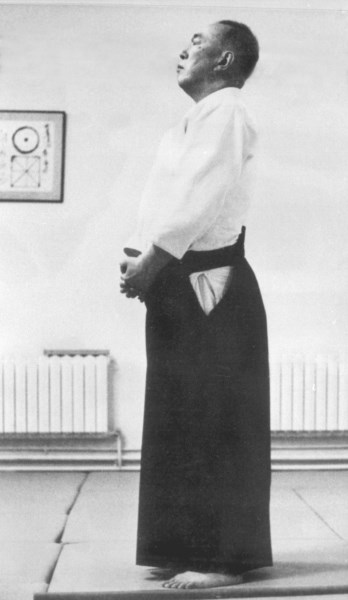
Born in 1914, Itsuo Tsuda would now be one hundred years old. This atypical character, fiercely independent, considered himself first and foremost a philosopher and he is a key figure of the Aikidō in France. He is the one who introduced Katsugen undō* in Europe in the early 70s.
Direct student of O-sensei Morihei Ueshiba during the last ten years of his life, Itsuo Tsuda did not consider important the sporty or martial art aspects of Aikidō, but rather the chance to make use of this art for inner search, for personal search. He qualified this dimension as “solitary practice” and devoted himself to pass it on in his books and in his teaching.
By beginning Aikidō at forty-five years of age, the ki and Non-Doing were the two aspects that mainly attracted him. These aspects were particularly tangible in a series of exercises preceding, during O-sensei Ueshiba sessions, the technique, which Itsuo Tsuda named after the expression “Respiratory Practice.”
O-sensei Ueshiba gave a lot of importance to these exercises that meant to him something completely different then warming up. Itsuo Tsuda in an interview with France Culture said:
‘For me what is important is what I do at the beginning: I sit, breathe, I breathe with the heaven and the earth, that’s all. Many people love aikido as a technique, don’t they? For me, the technique is simply the test to find out if I have evolved through breathing.’
In the technique that happens during the second part of the session there is no struggle, but an opportunity to develop sensitivity, the ability to fuse.
The voice of Itsuo Tsuda, who died in 1984, still resonates today through the nine books published in French and through his students. One of them, Régis Soavi, he has dedicated more than thirty years to Aikidō and Katsugen undō teaching. He is the technical adviser for the Itsuo Tsuda School .

— Good morning, Mr. Soavi, when you met Itsuo Tsuda in the 70s you were already engaged in the practice of martial arts. What made you decide to consecrate to the Aikido of Itsuo Tsuda?
— I had just started Aikidō when I met Itsuo Tsuda, my teacher was Roland Maroteaux. I met Tsuda during a workshop organized by this teacher. What struck me at first was his ability to dodge. During this workshop I saw my teacher, who was an actual budōka, attacking him with determination and at any time Tsuda was not there, he was dodging, he had created void in front of him. That was what shocked me. I had already experienced a lot of Jūdō, Jūjutsu and weapons and then, more or less at the same time, during my training as a professional Aikidōka, I worked with other teachers like, Master Noro, Master Tamura, Master Nocquet, as well as I took part of some workshops with Master K. Ueshiba, Yamaguchi sensei, etc.. At the time we were all a bit like Rōnins, we were going from a dojo to another trying to uncover the masters’ secrets. At first I was timidly interested of Master Tsuda, but the quality of this void, this emptiness that was moving around, it was very impressive and that was what made me decide: you have to go and see this master.
— What does represent for you the first part of the Aikidō practice that Itsuo Tsuda called “Respiratory Practice”?
— Master Tsuda used to say that it was the essence of Aikidō. At the beginning, when I was about twenty years old, I saw this part as a kind of respiratory warming up, not to mention muscle warming up. And then little by little I found out that it was something much more intimate! And after seven years, the Respiratory Practice had become the most important part of Aikidō for me. The rest was, as Tsuda said very well, a way to verify to what extent I was getting with my breathing.
— You speak about Aikidō proposing the translation “the way of the ki fusion”. How does this differ from the definition “the way of the harmony” that it is normally used?

— Now, “Aikidō” is an ideogram, there are no words therefore in itself. What I try to pass on through “the way of the ki fusion” is the direction we take. In Aikidō this fusion of feelings between people allows you to practise in another way. It completely differs from the idea of fighting. It is rather a complementary. I think Ueshiba had such a fusion capacity with the person who attacked, by anticipating his acts, his gestures. For me, harmony is insufficient as a translation, this may purely be aesthetic. The fusion turns into something deeper. When two metals come together into a fusion to become for example bronze, they become Bronze, it is not only harmonizing them, they become something different. And it is in this sense that I want to translate it with “the way of the ki fusion.” But this is purely ideograms interpretation.
— What role do you think the technique plays?
— It is essential. It is the base. For me, technique must be extremely precise. It is the technique that leads the breathing. The technique also means the body, the posture. If your posture is correct, if the positioning is right, then it is easy, breathing is better. when one is blocked, congested, closed or too open, too soft or too hard, nothing will really happen. The technique is there to allow through its precision to find the lines that help us breathing better, to get better into the fusion. It is also for this reason that I often ask to work slowly. It is no use doing something quickly and badly.

— Does the practice of Katsugen undō, you’ve discovered with Master Tsuda, affected your approach to Aikidō?
— I think if I had not practised Katsugen undō I would have not practise Aikidō the way I do today. We should never forget that Katsugen undō is something that normalizes the ground, the body. And only now I see Aikidō as a process of normalization of the body as well. The practise of Katsugen undō allows you to practise Aikidō in this way, it is for me a base, the basic. It develops in you the breathing, once we breathe better, we are more relaxed. Aspects like aggressiveness, competitiveness disappear, they fall by themselves. Instead of practising by hurting the others, one goes towards the normalization of the body, for example I usually show how, by twisting the arm in a certain way, during the mobilization, you allow your ki to get up to the third lumbar in fact the person’s body twists slightly on that point. Well, it is a process of normalization of the body through Aikidō, which I discovered because of the Katsugen undō practice. This applies to many other techniques, the way to get in, to reach the center, the hara, and so on. I’m not saying that you cannot find out if you only practise Aikidō, but Katsugen undō was an open door, it has allowed me to feel better, to understand better, to be more in the spirit… I think this was very important for Tsuda as well. He practised with Ueshiba for ten years. But when he started Aikidō he had already been practising for more than ten years Seitai and Katsugen undō. His terrain was thus in a certain condition, for example with regard to the flexibility – which is often lost when at forty-five years of age. And then the kind of spirit condition: for Tsuda was clear that we were not there to destroy ourselves, but rather to find a certain tone, and at the same time a balance. Aikidō should lead to a balance. And Katsugen undō task is the balance.
— you practise early in the morning, this may be surprising.
— Sessions during the week start at 6:45am while at the weekend they are at 8.00. I know we  live in a society where you go to bed very late and you get up very late too. In my case I really love the morning. One can be tired in the evening, people after working hours are stressed. Sessions of martial arts then very easily turned into a relief valve, and so on. Rather in the morning, competitiveness does not have too much importance … you get up, you are in the dojo, you can easily breathe, you start your day. Furthermore we are very lucky to be in a permanent dojo. One comes and it is like being at home, in an association but at home, the dojo are used only for this reason. There are gyms with more or less clean changing rooms where you can not even leave your watch otherwise they might stole it, and so on. So you come here in the morning, take a little coffee, tea, and then practise. And so the day begins and starts well, it is a real pleasure. Every morning I have a great pleasure to see people getting there and taking their time, we are in a world where we do not take our time anymore…
— Your sessions are designed for all without distinction of age and levels, you talk about a school without grades.
— Master Tsuda said: ‘There is no black belt for mental emptiness.’ With Ueshiba there was no national program for black belts. When Master Noguchi was teaching he was used to say “Forget, forget, when you will need it, it will come back naturally” It’s a little bit like this, the technique is important, but we do not repeat ten thousand times how to get attacked or some other staff. It makes no sense. Hierarchy, degrees, kyu, dan, and so on. For me this is not really important … And then in terms of age, why should we make a difference? Modern society created that difference, it has created the teenage (which by the way teenage is now up to forty years), the third and then the fourth age, and so on. All these categories do not correspond to anything. For me, when we talk about life within us we are all equal. Then, of course, it makes a difference, if I work with a six year old child it is not like when I work with a sixty years old person or somebody on their twenties.
— Other then passing on the bases, what can you really teach through Aikidō?
— Ah, not much, actually, on a given moment people are going to start their own search by themselves. So, since I’m older, and my own search is also a long-term one, I can give them some information, and then I can help them to better understanding through visualizations. It’s my way of teaching people today. I suggest visualizations, for example by saying this movement looks like when you place a baby in bed. At the same time people search, there are a number of people who I consider companions they are no longer students. As sensei, as a good craftsman with a greater seniority, I can say, ‘Look further, that is it’, by looking further, the body opens and the person says, ‘Oh, okay It is fine.’ It is very subtle. It is a kind of communication that I establish with my students. And then people go and search in that direction. We do not work on making the technique perfect, that does not exist. Aikidō is not going to become more effective, more aesthetic, and so on. But we will be closer to ourselves, I think that this is the most important thing.
Want to receive future articles? Subscribe to the newsletter
- Katsugen undō, translated as Regenerating Movement, is a technique developed by Haruchika Noguchi, creator of Seitai.