The event surrounding the publication of Itsuo Tsuda’s book Calligraphies de Printemps [Spring Calligraphies] was held on 18 and 19 November 2017 at Dojo Tenshin in Paris. The audience was able to enjoy nearly 100 reproductions of Itsuo Tsuda’s calligraphies and discover the 468-page book.
While no single practice is obviously a ready-made solution to the situation we are experiencing [March 2020 lockdown], continuing a daily practice often helps us to hold our inner course and keep our balance in an unstable situation full of unknowns.
The practical philosophy taught by Itsuo Tsuda is also a path to rediscovering our “inner freedom”. Current events impose severe external constraints on us: it is no longer possible to meet up to practise, or even to move around freely. Some people are also unable to do their jobs, preoccupied with financial difficulties, their loved ones, their health… In short, there is no shortage of reasons for concern and constraints. We are all affected in one way or another, but while recognising this fact, we can look within ourselves and around us for elements that will help us get through this period.
_Inner Peace_, calligraphy by Itsuo Tsuda
This can only be personal; some will need a programme, some will need to practise, even alone, some will need rest, there is no universal answer. It is an opportunity, despite everything, to draw on our inner resources and decide how we want to live in the moment, whatever it may be.
To do this, we have tools at our disposal: the Respiratory Practice, the Regenerative Movement, Itsuo Tsuda‘s nine books, Régis Soavi sensei’s articles, but also what we have discovered through this: the awakening of our inner strength.
It is not a question of overcoming fear or fleeing reality, but of facing the situation while maintaining inner calm. This is one of the meanings of budo for martial arts practitioners: overcoming difficulties while maintaining one’s integrity.
As Régis Soavi sensei reminds us in his latest article, our art teaches ‘freedom of mind, intuition, life force and all that goes with it – flexibility, mobility, resistance, the ability to re-centre oneself in order not to sink after a fall or in the face of difficulty.’1Régis Soavi, « Reishiki: a Music Score », review Yashima #07 (in French), March 2020
We invite you to read these words by Master Tsuda commenting on a sentence by his own master, Haruchika Noguchi:
‘I am free and without barriers. I detach myself from life and death. The same goes for old age and disease.. [H. N.]
The fixation of ideas that guides us in the organisation of life, can also work against us by imposing unpredictable constraints upon us. Freedom becomes a fixation that fetters us. The more freedom one has, the less one feels free. Freedom is a myth.
We struggle against constraints to acquire freedom. Freedom gained never fails to produce other constraints. There does not seem to be any definitive solution. For the freedom we seek is primarily a conditional freedom. We do not possess any idea of absolute and unconditional freedom.
For Noguchi, to be free and without barriers is unconditional. In fact, for his entire life he was anything but free, working fifty years without a day of respite, extremely busy schedules, unable to go on vacation as office workers do, roused at impossible hours by clients needing his help, seeing to the education of his live-in disciples until four in the morning, then a short sleep, etc. This is the opposite of the idea we have of freedom in the West. It is slavery, pure and simple.
For Noguchi it was work around the clock, without interruption. A heavy responsibility requiring that he remain available at all times.
When we think of the organisation of modern life, which increasingly discharges individuals of responsibility, with limited work hours, leave of absence and vacations, group protection, verbal concealment, etc., such unrelenting responsibility is unthinkable.
It was the same with Master Ueshiba, who said to his disciples: you can attack me anytime, anywhere; that included the hours of sleep as well. Availability around the clock.
How could they lead such intense lives, like deep-sea fish that endure great pressure, and also feel free? Let us restate this question as a reverse proposition: it is because they felt free that they could enjoy such intensity of life.
They were beings who belonged to a different dimension from ours, some would say. As for us, we are assailed by all kinds of fears: the fear of not being able to keep ourselves alive, the fear of lack, the fear of pain and most of all, the fear of death.
I detach myself from life and death, said Noguchi. I detach myself from human affairs, said Ueshiba.
Life in Europe is dominated by the Administration. One must not do anything that does not correspond to some administrative category. All these categories are a century old by now. It is not surprising that Aikido is classified as a combat sport, despite the spirit of the founder. Everything has to be stored in the drawers of an old wardrobe, shirts here, and socks there. But what exactly does the Administration take care of? Human affairs. There are no drawers for things that do not concern it. There is no place in Europe for Seitai or Aikido unless they are disguised as something else. If the Administration decides that Aikido is a handkerchief, it must be ironed, folded into quarters and put in the top left drawer. We cannot do anything about it.
Life, death, old age, and disease are all themes that keep the waltz of structures going, as well as the foxtrot of money. So they are extremely important.
But when one backs away from it all, what a relief! Then we can talk about real freedom without barriers.’2Itsuo Tsuda, One, pp. 24-6, 2016, Yume Editions
Notes
1
Régis Soavi, « Reishiki: a Music Score », review Yashima #07 (in French), March 2020
Continuation of Itsuo Tsuda’s correspondence, from which we are publishing a few letters, with the kind permission of Bernard and Andréine Bel. Link to read the first letter.
These are Itsuo Tsuda‘s replies, between 1972 and 1979, to a young couple who were beginning to practise the Regenerating Movement. In these letters, we follow their desire to share this discovery with those around them in their town.
This letter followed a letter in which we told Itsuo Tsuda about our stay in Saanen in July, during which we had a group of people practise the Regenerating Movement, including a large number of students of Yvon Achard, a yoga teacher in Grenoble. The group’s reaction had been enthusiastic. Itsuo Tsuda‘s reflection on the tendency of Westerners to lump everything together prompted us to exercise great caution. We were careful never to use this term, even though our sessions were identical in every way to those organised by Katsugen-Kai. It was also at this time that we decided never to accept money from participants: ‘among family and friends’… Andréine Bel Read more →
Here is the third of the Six Interviews of Itsuo Tsuda by André Libioulle, entitled ‘Breathing, a Living Philosophy’ and broadcasted on France Culture in the 1980s.
Q.: You know France very well, having worked before the 1940s with two extremely important figures, Marcel Granet and Marcel Mauss. Marcel Granet was a sinologist and Marcel Mauss a sociologist. What were the most important moments you spent with them?
I. T.: For five years, I attended these scholars’ courses, and it opened my eyes to unknown aspects of Western society. Mauss dealt with the sociology of different peoples, including the Polynesians, and so on. He had a very, very deep view of things, and he observed things that he called “total phenomena”, whereas in Western societies, things are always analytical, rational, and so on.
Q.: Yes, the idea of globality.
I. T.: Yes… and Granet also gave me the opportunity to view ancient Chinese society from a very, very different perspective from the usual; that is, transforming everything, using Western reasoning. .
Q.: After this French period, this Parisian period, you returned to Japan, and there you had another absolutely decisive encounter, with Master Ueshiba, the creator of Aikidō, and Master Noguchi.
I. T.: Master Noguchi enabled me to see things in a very concrete way. Through the things manifested by each individual, it is possible to see what is going on inside. It is completely different from the analytical approach, in which the head, the heart, the digestive organs each have their own specialization; and there’s the body on one hand and the psyche on the other, isn’t that so? Well, he made it possible to see the human being, that is, the concrete individual, in its totality.
Q.: So you worked there with Master Noguchi, and also with Master Ueshiba for several years.
I. T.: I worked with Master Ueshiba for ten years before coming to France. Well, he gave me the opportunity to be something other than… the individual trapped inside the skin. I visited the United States, and then I tried to see what the possibilities were, what I was going to do. I started by writing, and little by little, it took shape.
Q.: I believe The Non-Doing was published in 1973. It was the first book you published. Around what time did you return to France?
I. T.: 1970.
Itsuo Tsuda, ca 1970. Photo by Eva Rotgold
Q.: And then you decide to create l’École de la Respiration. That is quite a singular term! Can you tell us why you say “school”? Surely this was not a school in the traditional sense of the word?
I. T.: No, not at all (laughs). It’s the only name I could come up with to make people understand that there’s a whole… thing behind the breath. For the uninitiated, breathing is the work of the lungs. But here the word “breathing” takes on a greater and greater extent, doesn’t it?
Q.: Yes, so at l’École de la Respiration, people practise the Regenerating Movement. You described the Regenerating Movement as an exercise of the extrapyramidal motor system.
I. T.: Yes. The Regenerating Movement is not a discipline in the usual sense of the word.
Q.: The word extra-pyramidal may not be immediately comprehensible to our listeners. In any case, the term “extra-pyramidal” basically refers to an area of the brain, as compared to another considered to be the seat of voluntary movement.
I. T.: Yes. In humans, there are two motor tracts. One is the pyramidal motor system, which is the source of all voluntary movement. That’s what we learn in school, like the interweaving of the nervous systems, and so on.
Q.: It’s a term from physiology…
I. T.: …yes, that’s right. But for a long time we neglected the extra-pyramidal system, which supports this voluntary system, because we were afraid of leaving the voluntary system, and that is precisely what Master Noguchi started to do. When he himself began, he was a little surprised because the body starts to move on its own. When you believe that the whole body obeys your will, it is strange, isn’t it? But the truth is, we do not control all the body’s movements. If that were necessary, what would we do when we’re asleep?
Q.: There is a whole area of our activity that is covered by the voluntary system. But that system does not govern all our activity. There is an area that is beyond the reach of the will.
I. T.: There’s a Japanese doctor who says that voluntary movement accounts for only three per cent of our total bodily movement. But for Noguchi, nothing is voluntary. That’s (laughs) really strong.
Q.: In short, the action of the extra-pyramidal system is somehow superimposed on the action of the pyramidal system.
I. T.: Yes.
Q.: You’ve specified that the Regenerating Movement exists in two forms…
I. T.: … Yes…
Q.: … on the one hand, in all individuals, it exists as a form of natural bodily reaction, for example, yawning, sneezing, restlessness during sleep. And then there is another form, developed about fifty years ago by Master Noguchi. Master Noguchi, it should be pointed out, is the creator of the so-called “Seitai” method.
I. T.: He embarked on this career by pure chance. It was the time of the great earthquake of 1924 that hit the entire Tōkyō area. He was twelve at the time. He was very interested in that sort of thing, he had fun with it. But the whole region was devastated, and there were people who were homeless and wandering around; diarrhoea was spreading, and so on. He saw a woman crouched down in great pain. So he rushed over to her and simply applied his hand…
Q.: … applied his hand to the spine…
I. T.: … and then she said, “thank you, child”, or anyway, she smiled at him. That was the starting point of his career. The very next day, people started coming to see him. Starting on that day, he was no longer able to leave this path. This is what we practise now under the name of “yuki”: you put your hand on the spine or the head and then exhale through your hand, and that’s it. Well, when you see it done, at first glance, it doesn’t seem like much. But as you concentrate on it, you feel that it’s working inside you.
Q.: So yuki is one of the elements of the technique developed by Master Noguchi. There’s something that surprises me a little about the technique you’re describing: Seitai, as you explain, is a technique used to provoke something spontaneous. Isn’t that a little paradoxical?
I. T.: Seitai is a word that Noguchi coined later. In the beginning, by force of circumstance, he simply became… a healer. He practised therapeutics. But, around 1950, there, he abandoned this notion of healing, of therapeutics; he rejected all that and created the notion of “Seitai”, meaning “normalised terrain”. When the terrain is normalised, problems disappear on their own.
Q.: Perhaps we could temporarily summarise the Regenerating Movement with two important elements: the exercise of the extrapyramidal motor system. This exercise is not really a technique. In fact you say, “at l’École de la Respiration, we work without knowledge, without technique and without purpose”. As for the second important element, the Regenerating Movement is a spontaneous movement that virtually exists in all individuals, and we cannot say that the Movement is provoked; it becomes activated in individuals.
Here is the first of the Six interviews of Itsuo Tsuda by André Libioulle, entitled ‘Breathing, a Living Philosophy’ and broadcasted on France Culture in the 1980s.
To read and/or to listen to.
BROADCAST N° 1
Q: L’École de la Respiration was created by Itsuo Tsuda in Paris in 1973. However, the word “school” is not entirely appropriate and Master Tsuda never intended it to be a closed, exclusive teaching centre. On the contrary, his views remain entirely open. He is interested in other breathing disciplines and above all in the field of thought related to breathing.
Concretely, L’École de la Respiration is a ”Dōjō”, a particular kind of space in the East, which refers less to the material place itself than to the energetic space. […] Of course, movement is an individual matter; it is to be found in the inner space specific to each person. However, it is created through a certain state of relaxation and a whole atmosphere conducive to meditation. That’s why, for example, it is recommended that the Regenerating Movement be practised with the eyes closed. The dōjō is a spiritual more than a physical space, and therefore not a school in the usual sense. Itsuo Tsuda?
I. T.: It is not a school in the usual sense of the word. As I have written and published books under the imprint of “L’École de la Respiration (“the school of breathing”), I applied this name to the association. The association is independent from me. I am a guest, I am not the boss, and insofar as the association requires my presence, I accept, provided that the members carry out this personal endeavour themselves. I am not there as a boss who gives orders; that’s something you have to understand.
Q.: It is a “school”, in inverted commas, that is open to everyone. The Regenerating Movement is practised here “without knowledge, without technique and without purpose”. That’s a bit of a paradox for a school, isn’t it?
I. T.: Yes. Well, people have to be well motivated. Otherwise we refuse them. For example people who ask for therapy, etc., or who come with other intentions, we refuse. What we are doing is to exercise the extrapyramidal, that’s all. But we can’t throw ourselves into it all at once, can we? we don’t know what it is. When I give the workshop, I start by explaining the thing. Not explaining the extrapyramidal system in anatomical terms, but in relation to the life one leads in the Western context, and bring people back into another context that is natural. Which doesn’t mean that I’m against Westernization, it’s an irreversible thing. Japan is now westernised. But while accepting this conditioning, if you are determined, if you are motivated, you can get out of it and breathe freely, feel full and free.
Q.: Imagine someone entering L’École de la respiration: what can he expect? How will things work, concretely, in practice?
I. T.: They arrive and they sit roughly in a circle and I start to give a sort of talk. And there are people who don’t understand at all. At first almost no one does. But there are those who are attracted, who stay. But their heads are full of questions. And I refuse to answer. I say: “Wait a minimum of a year, two years if possible”. At the end of a year or two, the body changes, evolves and then they no longer know what to say and the questions have evaporated.
Q.: The people who come are not sick people, I mean they’re people who simply have a need for personal development, a need to feel better about themselves, usually..
I. T.: Well, the motivations are diverse. But what I ask for is practice without purpose. There is a psychiatrist who was attracted precisely because it is marked “without purpose”, because he knows from his own experience that this is extremely important. But for others it makes no sense; a practice without a goal is completely… crazy! That is one of the conditions that I insist upon. Otherwise people come and ask me all sorts of things and they go nowhere, they’re just banging their heads against the wall.
Q.: So at a certain point, people stop asking questions. What has happened inside them, what has changed so that all of a sudden, all the intellectual questions are resolved?
I. T.: Well, the body has evolved, sensations have evolved, so we don’t see the same thing from the same perspective. Before starting, such and such a thing is important; people think it’s absolutely necessary to ask me questions. But after a year or two, it becomes so obvious that they no longer need to ask questions.
Q.: But in the first stage, there’s a breathing practice, there are preparatory movements for another more fundamental movement that you call the Regenerating Movement. How does the preparation work?
I. T.: To tell the truth, you don’t need any preparation if you’re sensitive and not very complicated. But modern life doesn’t always allow you to be uncomplicated, so we need a bit of stimulus to get us going. You don’t need a memory, it’s something that arises from within, and it comes of its own accord.
Q.: So it’s more like an immediate, spontaneous reaction on the part of the person, and everyone has a particular reaction, everyone has a singular organic reaction that is unique to him or her.
I. T.: We can’t create a model for the Regenerating Movement, because each individual has his or her own movement and the movement of the same individual differs every day. That’s what they are going to find out for themselves. The difficulty is that people arrive with a head full of imaginings and it’s a real problem to get rid of these. They know thirty-six thousand methods that they mix up with the Regenerating Movement and which distort everything. I make sure that people don’t mix everything up, that’s the greatest difficulty.
Q.: Initially, it seems that people find it hardest simply to feel, to live in contact with their sensations. That’s what the Regenerating Movement brings.
I. T.: People say, “We’re not in the Middle Ages anymore”. Well, what’s the difference between the Middle Ages and now? Gestation still takes nine months; that hasn’t changed. Only, in the Middle Ages there was neither radio nor television. Only the means have changed. But the body, on the contrary, has become weaker. There are many people who are neither completely alive nor completely dead. They are in a kind of twilight,, without feeling. What we’re doing is not adding something extra, but going “back to the source”, which allows us to really feel what’s happening every day, at every moment. That’s what has been completely neglected. All we do is schedule, plan things with a view to what’s going to happen in a year’s time, in three years’ time, and so on. But what are you doing now, what are you feeling now? That we do not know.
Q.: Master Tsuda, the people who come to you come because they feel the need, let us say, for a personal evolution. But people come to work on themselves and they come with spontaneous body tendencies. In several of your books, you’ve mentioned a concept known as “taiheki“.
I. T.: It’s a concept that is also quite difficult to explain. In our modern lives, the body’s activities become increasingly specialised. Some people need their eyesight, their hearing, their brains, and so on. Athletes need their muscles. Because of this specialisation, we are more or less deformed. The channelling of energy becomes specialised. We cannot all of a sudden change direction. We’re always on the same channel.
Q.: You talk about the polarisation of energy…
I. T.: … Yes, polarisation if you like; channelling. And we think we can control all that, but it’s difficult indeed. That’s why we need to normalise the terrain, so that we can use all our pawns, if you will. For example, one woman told me that before doing the Movement, she didn’t know whether her feet were hot or cold, she had to take off her shoes and then touch her feet with her hand so she could say, “ah! yes, my feet are hot or cold”. But now she doesn’t need to do that anymore, she can feel directly. Sensation doesn’t work in most people.
Q.: Most people are desensitised…
I. T.: … desensitised either in the feet or in the legs, etc.
Q.: And by being desensitised, people are cut off from themselves.
I. T.: Yes, they are fragmented, they are compartmentalised. They see the world through this very, very narrow perspective.
Q.: Your desire is to put people in touch with themselves, with their sensations, and thereby even with “ki”’, that notion that evades all concepts, a moving notion: qualitative, not quantitative. The truth of science is quantitative, but the truth of the Movement is always particular, always concrete.
I. T.: We come into the world with no knowledge, with no explanation. How is it that a newborn baby can turn white milk into yellow poo? The baby has no knowledge. Well, at that very moment, the absence of knowledge allows everything to work. We have to be able to get to that point. Except with adults, the problem presents itself in a different way, because we cannot imitate a baby. If there are a lot of things that come to the surface of the conscious mind, that’s precisely why we are in the state of “heart of pure sky”. When we are very busy, we don’t even think about it. That is the return to the source, which is different from what happens with a newborn.
Q.: Will the people who come to you later become practitioners of the
Regenerating Movement, or is it just a practice they follow for the sake of their own well being?
I. T.: That’s up to them, isn’t it? I don’t say anything. If they want to do it, they do it, that’s all. But if people aren’t truly motivated, things just fall apart. And if they’re really motivated, little by little their horizons open up. So, as to how far they will go, for the moment I can’t say.
The following notes serve to trace the origins and important moments in the preparation and conduct of the Misogi ceremony on January 1st as practised in the dōjōs of the Itsuo Tsuda School. They cannot replace the oral transmission and experience of the ceremony; they are guidelines, not a set of mandatory instructions. To help convey the atmosphere of these moments, it seemed appropriate to present these notes by drawing on the three rhythms of Japanese tradition, jo – ha – kyū, which Tsuda Itsuo discusses in his books:
‘By studying Noh theatre, I experienced the three rhythms: jo – slow, ha – normal, and kyu – fast. […]
[…]
Jo means introduction, ha rupture, change, and kyu means fast.
[…]
[…] fruits grow gradually (jo), ripen as we watch (ha), and suddenly fall from the branches (kyu).’1Tsuda Itsuo, The Science of the Particular, Chap. XVII (end), 2016, Yume Editions, p. 143-4
Origin and preparations (jo)
Life in our School’s dōjōs is punctuated by several cycles. Between the cycle that begins with the creation of the dōjō and the daily cycle of Aikidō sessions, there is the multi-weekly cycle of Katsugen Undō sessions, the seasonal cycle of seminars, and the annual cycle of the Misogi of January 1st.
The search for inner freedom in the practice of Aikidō and Seitai
by Andrea Quartino
Restrictions on freedom of movement are easing [May 2020 lockdown], although the timing and manner remain uncertain. For those who practise Aikidō in a dojo of the Itsuo Tsuda School, the day when they will be able to resume practising does not seem to be near. Beyond the different opinions on the cause of the emergency, the restrictions decided by governments should not limit our ability to judge. It is normal to maintain a critical view of the effectiveness and consequences of such measures while applying them.
Seitai founder Noguchi Haruchika did not shy away from talking about freedom during a period such as that experienced by Japan during the Second World War, when markedly nationalist and militaristic tendencies prevailed to such an extent that the word “freedom” was banned. Of course, he could count on the fact that he had several representatives of the ruling class among his clients.
The end of the war for Italy on 25 April 1945 was a relief for everyone, as was the fall of fascism, even for those who shared that ideology. The same relief was felt by many Japanese.1Tsuda Itsuo, Heart of Pure Sky (posth.), ‘Booklet no. 183’ (end), Yume Editions, 2025. See also Itsuo Tsuda. Calligraphies de printemps [Itsuo Tsuda, Spring Calligraphies], Yume Editions, 2017, p. 399 It was not only the return of peace and more or less formal freedom, but also the end of a climate of constant tension, which was felt everywhere and to which no one was immune. Allowing for the necessary differences, and net of the perplexities aroused by the war metaphors used by many when talking about the effort to contain the contagion, anyone with a modicum of sensitivity cannot fail to feel how everything and everyone is permeated by mistrust and fear, whether caused by the virus or by the penalties imposed for violating the rules. It is a very heavy oppression, and we too will feel relief when and if it ends.
‘When [Master Noguchi] heard about the cessation of hostilities on the radio, he suddenly felt a heavy burden lifted from his shoulders and an unexpected release of tension throughout his body.
His breathing deepened, revealing a deep calm in his mind. This calm brought a surge of fresh energy and inside his skin he felt a new world was beginning.
“Why did I talk so much about freedom during the war?” he said, “it was just words. On the contrary, I was just stuck in my attitude. The more I tried to fight the trend, the more I became locked into a narrow frame of mind, unable to breathe deeply.” ’2Tsuda Itsuo, One, Chap. IX, Yume Editions, 2016, p. 67. The following lines state that ‘[a] truly free man does not discuss freedom, just as a healthy man does not think about health.’ These very words seem to be echoed by Chinese poet Bai Juyi’s verses: ‘Those who speak do not know. Those who know do not speak.’ Tsuda also traced these verses in three of his calligraphies (see Itsuo Tsuda, Calligraphies de printemps (op. cit.), p. 284), quoted them verbatim in The Non-Doing (Chap. XVII, 2013, Yume Editions, p. 180), and evoked them in The Way of the Gods (‘I work in the hope […] another kind of freedom.’, Chap. VII, Yume Editions, 2021, pp. 53–4).
Why was this freedom nothing more than a word for Noguchi? Had he perhaps changed his opinion about the nature of the wartime regime? It is unlikely, but that is beside the point. The question is what we mean by freedom.
Tsuda Itsuo returns repeatedly in his books to the idea of freedom
For Tsuda, modern man ‘has fought some tough battles to acquire his right as a Man. He has obtained some liberties and keeps on struggling to acquire more. But one day he finds that these liberties only concern material conditions external to him.’3Tsuda Itsuo, The Non-Doing, Chap. I, Yume Editions, 2013, p. 15 So human beings often fight for freedoms in the plural, which are conditioned. ‘The fixation of ideas that guides us in the organisation of life, can also work against us by imposing unpredictable constraints upon us. Freedom becomes a fixation that fetters us. The more freedom one has, the less one feels free. Freedom is a myth.’ ‘We struggle against constraints to acquire freedom. Freedom gained never fails to produce other constraints. There does not seem to be any definitive solution. For the freedom we seek is primarily a conditional freedom. We do not possess any idea of absolute and unconditional freedom.’4One, op. cit., Chap. III, p. 24
“Conditional freedom”, almost an oxymoron, if this phrase were not used in law language. We are conditioned by the linear time of clocks, by the social organisation of work and by the market that urges us, with increasingly sophisticated and invasive advertising techniques, to satisfy needs that are mostly induced. Among the abundance of things on offers, available online or otherwise, ‘we find everything except desire. So we choose the chef’s recommendation, the advice of people who aren’t paying for the meal, the seductions of advertising, the clamour of the opinion leaders.’ ‘Certainly we have the freedom to choose, but it is a negative freedom: the freedom to accept or reject what on offer. As for the positive freedom, that of creating, we have neither the intuition nor continuity to enjoy it.’5Tsuda Itsuo, The Science of the Particular, Chap. IX, Yume Editions, 2015, p. 76
Masters Tsuda Itsuo and Noguchi Haruchika
Tsuda points out the possibility of “letting go” of everything that is apparent freedom, choices imposed on us by the market, consumable goods, marketable goods, however difficult this may be for civilised man, who is afraid of losing everything if he renounces his possessiveness. By letting go, we can ‘finally see the All that is ours; the sky, the earth, the sun, the mountains and rivers, without our having to put them in our pocket.’ We may feel ‘the desire to know true freedom.’ ‘Nothing external, such as money, honour and power, can bring us true Freedom, which is an inner sensation and does not depend on any material or objective condition. One can feel free under the worst kind of duress, and a prisoner at the pinnacle of happiness.’ 6Tsuda Itsuo, The Dialogue of Silence, Yume Editions, 2018, pp. 85-6
The deep desire for another kind of freedom arises together with an inner conviction, which in reality is rediscovered, found again because it has been in every human being since the beginning, since conception. But its rediscovery is not possible as long as we remain on the “path of acquisition” that is the norm in our society, where ‘[a]ll these accumulations weigh heavily on our destiny.’
‘In the way of less, we move in a diametrically opposite direction. We gradually get rid of all that is unnecessary to life. We feel more free because we no longer impose prohibitions or rules on ourselves for living well. We live simply, without being torn this way and that by false ideas.
We do not have to be anti-social or anarchists to feel free. Liberation does not require destruction. Freedom does not depend on conditioning, environment or situation. Freedom is a very personal thing. It arises from deep conviction on the part of the individual.
This conviction is a natural thing that exists in all human beings right from the start. It is not a product thrown together after the fact. But it will remain veiled for as long as we live in a climate of dependency. It isn’t worth it, says Noguchi, to help people who do not want to stand on their own two feet. If we release them, they fall down again.’7One, op. cit., Chap. VI, p. 47
It was this awareness that led Noguchi, when he found another freedom, a deeper breathing and calm at the end of the Second World War, to give up therapy and devote himself to awakening people, allowing each individual to rediscover their inner freedom in the times and ways that suit them.
How can practising arts such as Aikidō and Katsugen undō guide us in rediscovering our individual freedom?
One answer can be found in the words of Taichi Master Gu Meisheng:
‘Can “true naturalness” only be acquired through long and diligent practice? Are you like a child? Because only children are spontaneously natural and free at the same time. In fact, if you have not become like a child again, you are neither free nor natural. […] Usually, for an ordinary person, the body is an obstacle, not a driving force from which spiritual momentum can be drawn. Yet, thanks to very long training combined with diligent and rigorous practice, it is possible to liberate this ordinary person and allow them to act with wonderful, creative spontaneity. Then neither the body, nor the outside world, nor the many ties that bind him to the world constitute an obstacle for him. I first experienced this feeling of freedom in 1970 when I was in prison, and this freedom grew progressively throughout my imprisonment.’8La vision du Dao du professeur Gu Meisheng (video), no longer available – words probably inspired by this part 5 (French) video at the end (‘when I was in prison, in the 1970s’)
The words of Master Gu, who was imprisoned during the Chinese Cultural Revolution, apply equally to Tai Chi, Aikidō and Katsugen undō, and echo those of Tsuda when he says that one can be free even under the greatest constraints. And if the constraints we live under today are not those of a prison, they are nonetheless an opportunity to rediscover our inner freedom9The title refers to the passage from Dante Alighieri‘s Divine Comedy, ‘He goes seeking freedom’, in originale « Libertà va cercando », even giving ourselves the chance to practise alone when there is no dojo available. This discovery is not exclusive to great masters such as Master Gu, Master Noguchi or Master Tsuda, and although it is an individual quest that is pursued through continuous practice, we can begin here and now to be free as human beings, because “being free makes others free”10cf. the video and interview Manon Soavi, Being Free Makes Others Free.
Andrea Quartino
Notes
1
Tsuda Itsuo, Heart of Pure Sky (posth.), ‘Booklet no. 183’ (end), Yume Editions, 2025. See also Itsuo Tsuda. Calligraphies de printemps [Itsuo Tsuda, Spring Calligraphies], Yume Editions, 2017, p. 399
2
Tsuda Itsuo, One, Chap. IX, Yume Editions, 2016, p. 67. The following lines state that ‘[a] truly free man does not discuss freedom, just as a healthy man does not think about health.’ These very words seem to be echoed by Chinese poet Bai Juyi’s verses: ‘Those who speak do not know. Those who know do not speak.’ Tsuda also traced these verses in three of his calligraphies (see Itsuo Tsuda, Calligraphies de printemps (op. cit.), p. 284), quoted them verbatim in The Non-Doing (Chap. XVII, 2013, Yume Editions, p. 180), and evoked them in The Way of the Gods (‘I work in the hope […] another kind of freedom.’, Chap. VII, Yume Editions, 2021, pp. 53–4).
3
Tsuda Itsuo, The Non-Doing, Chap. I, Yume Editions, 2013, p. 15
On 12 and 13 October 2018, the recently renovated Bodai dojo in Rome hosted the event One Book – One Exhibition, which attracted a good turnout, interest and favourable reviews.
On the evening of 12 October, in front of a large number of visitors, the presentation of the book Itsuo Tsuda, Spring Calligraphies (Yume Editions, 2017) took place in the enveloping atmosphere of the exhibition of 87 calligraphies in photographic reproduction. The original calligraphy The Tiger was also exhibited for the occasion.
During Saturday, we received several visitors: among friends, connoisseurs and experts in Japanese culture, we were delighted to welcome aikidoka, journalist and blogger Paolo Bottoni, who wrote an article on his blog about Master Tsuda‘s calligraphy.
In total, around 80 people came to Bodai Dojo.
For everyone, including us, the organisers, it was an opportunity to come into direct and simultaneous contact with almost all of Master Tsuda‘s calligraphies: an unforgettable and richly rewarding experience!
For those who have not had the chance to discover this book and the entire body of Master Tsuda‘s work, you can find them in Rome at the Bodai Dojo, as well as on the Yume Editions website.
The exhibition ‘Spring Calligraphies’ is coming to Rome in October!
Scheduled in Dojo Bodai (Rome) on Friday 12 and Saturday 13 October 2018 is the event One Book – One Exhibition.
Following on from previous previews in Paris and Milan, the event once again offers the Roman public the opportunity to see the book Calligrafie di Primavera [Spring Calligraphies] and the rich photographic exhibition dedicated to Itsuo Tsuda‘s calligraphy that inspired the book published by Yume Editions in 2018.
On 18 and 19 May 2018, we presented the book entitled Itsuo Tsuda, Calligrafie di primavera [Itsuo Tsuda, Spring Calligraphies] in our dojo in Milan. We exhibited more than 80 high-quality photographic reproductions of Master Itsuo Tsuda’s calligraphy (chosen from the 116 featured in the book) as well as three original calligraphy pieces.
An article, photos and two videos to relive the event!
Continuation of the interview with Régis Soavi, who tells us about his discovery of Itsuo Tsuda‘s calligraphies.
Putting up a piece of calligraphy rather than a photo of a master has another advantage, which I understood later: it avoids a certain “cult of personality”. Instead of putting up a photo of Master Ueshiba, I could have put up one of my master, Itsuo Tsuda… but then that would imply something about “a Gr-ow-ate Maaaaaster” who IS, and that also goes in the direction of religions where there are saints, paintings of saints, statues of saints… We have this in Buddhism, and in Christianity too, of course…
But this way, we no longer have the same resonance, because these are photos of people, of “characters”.
Spring Calligraphies is the first monograph devoted to the calligraphic work of philosopher and writer Itsuo Tsuda, bringing together 113 calligraphies and the research we have been able to conduct to date.
To mark its publication, an exhibition based on the photos in the book will be held at Tenshin Dojo in Paris on November 18 and 19, 2017. An opening reception will be held on November 18 at 6:30 p.m. Anyone interested in discovering the work of Itsuo Tsuda is cordially invited to attend.
The dojo is open and admission is free. Welcome !
In the meantime, we wanted to share with you a few lines about the origins and behind-the-scenes story of this adventure, which began more than thirty-three years ago.Read more →
‘Chouang Tzu, the great Chinese philosopher, said 2,500 years ago: “True human beings breathe from their heels, whereas ordinary people breathe from their throat.”
Who breathes from their heels nowadays? People breathe from their chest, their shoulders or their throat. The world is full of these invalids who ignore themselves.’1Tsuda Itsuo, The Non-Doing, Chap. I, 2013, Yume Editions (Paris), p. 15
This is how Tsuda sensei begins his first book, published in 1973, setting the tone by quoting the philosopher who most accompanied him throughout his life.
Tsuda sensei was a relentless researcher and a man of great culture. Throughout his life, he worked tirelessly to enable human beings to free themselves from what burdens and hinders them. Starting from his personal quest for freedom of thought, it was ultimately a philosophical understanding of human beings that emerged through his practices: Aikido, Seitai, Nō… And Tsuda sensei spread this philosophy of human beings, this path, primarily through his books2nine books (plus one posthumous) published in French between 1973 and 1984 – still available[ – then in English from 2013 to 2025]and his teaching in dojos over a period of ten years. But there was a more secret medium that he took up in the last years of his life: calligraphy.
‘If I have to give my Aikido a goal, it will be to learn to sit, stand up, move forward and backward.’1Tsuda Itsuo, The Path of Less, Chap. XVIII, 2014, Yume Editions, p. 174 (1st ed. in French: 1975, Le Courrier du Livre (Paris), p. 166Tsuda I.
Movement: coordination, posture
To move correctly, you need to be stable, and stability issues cannot be resolved through learning. Stability must come from balance, which itself comes from the involuntary system. Human beings have the unique ability to stand upright with only the tiny surface area of their two feet as support. If it were just a matter of standing still, that would be fine, but we move around, and what is more, we are able to talk, think, move our arms in all directions, as well as our head and fingers, all while remaining perfectly stable. Involuntary muscle coordination takes care of everything. If we lose our balance without being able to hold on to anything, our body tries by all means to regain the lost balance, and often succeeds by shifting weight from one leg to the other, finding extremely precise points of support that we would have had difficulty finding using only our voluntary system. Tsuda Itsuo recounts a personal anecdote about his learning of Aikido that I find edifying in his book The Science of the Particular:Read more →
Notes
1
Tsuda Itsuo, The Path of Less, Chap. XVIII, 2014, Yume Editions, p. 174 (1st ed. in French: 1975, Le Courrier du Livre (Paris), p. 166
Talking to my students about the masters I have known is obviously part of my teaching. Some were so important that I cannot simply dismiss them and claim that I made it on my own. The masters I have known left their mark on me, shaping me and, above all, opening my mind to fields I knew nothing about, or which I sometimes suspected existed but could not reach.
Are the Masters of the past masters of life?
I have always felt it was important not to turn these masters into supermen, geniuses or gods. I have always considered these masters to be much better than that. Idols create an illusion, lulling us to sleep and impoverishing idolaters, preventing them from progressing and spreading their wings. In this regard, Tsuda sensei, now a master of the past, wrote in his eighth book, The Way of the Gods:
‘Mr Ueshiba planted signposts pointing the way, and I am very grateful to him. He left some excellent carrots to eat which I am trying to assimilate, to digest. Once digested, these carrots become Tsuda, who is far from excellent. That is inevitable. But it is necessary that carrots become something other than carrots, otherwise, on their own, they will rot, uselessly.
It is not for me to worship, deify or idolise Mr Ueshiba. Like everyone else, he had strengths and weaknesses. He had extraordinary abilities but he had weaknesses, especially vis-à-vis his students. He was fooled by them because of considerations that were a little too human.’1Tsuda Itsuo, The Way of the Gods, Chap. XVIII, 2021, Yume Editions (Paris), p. 144 (1st ed. in French: 1982, Le Courrier du Livre (Paris), p. 156–7)Read more →
Notes
1
Tsuda Itsuo, The Way of the Gods, Chap. XVIII, 2021, Yume Editions (Paris), p. 144 (1st ed. in French: 1982, Le Courrier du Livre (Paris), p. 156–7)
Escape route: a clever and indirect way of getting out of a difficult situation.
These are the definitions given by the [French] Larousse dictionary. Synonyms for escape route include: sidestep, exit, evasion, and even way out. Is this not the meaning we should give to ukemis, which, in fact, in Aikido, are simply intelligent responses to throws?
Ukemis, a way out
As we saw in a previous issue about ukemis, falling in our art is never considered a defeat but rather a way of surpassing oneself. It is also, sometimes, simply a means of escaping from a situation that in reality could be dangerous, even fatal if accompanied by certain atemis, or if there is a risk of hitting a vital spot at the end of the movement. Similarly, although throwing may seem like a constraint during a session, it always leaves a way out for Uke, a means for them to regain their integrity, which is what Ukemi is for. During the years of training, one of the essential requirements for everyone is to perfect their falls, as they will be used to improve their responses to Tori’s throwing techniques.
Training should not be confused with fighting; without controlled falls, it is dangerous to throw someone unless you are willing to risk an accident and its possible consequences, which is not at all the purpose of practising on the tatami mats. Whether the throws are short, as in Koshi-nage, or longer, as in Kokyū-nage, they always leave Uke the possibility of escaping the technique unharmed. Only throws with strict control, for example to the ground, leave no ambiguity as to the fact that there is no escape, but if we only work in this way, we might as well practice Jūjutsu, for which this is the rule, and which is perfectly suited to combat. In my opinion, Aikido is not about seeking efficiency but rather about deepening one’s physical, psycho-sensory, and human skills in order to rediscover the fullness of the body and its entire capabilities.
Projecting means distancing
When someone has the bad habit of “sticking” to others, of being so close during a conversation that you feel oppressed, you have only one desire: to distance them by any means necessary. Only our social side, or even propriety, sometimes prevents us from doing so. If we do not push them away, we try to distance ourselves from them, we create space. In the same way, projecting is distancing the other person, it is allowing ourselves to reclaim the space that has been invaded, or even stolen or destroyed during an incursion into our living sphere – all the more so during a confrontation. It is a matter of rediscovering Ma-ai, that perception of space-time whose understanding and, above all, physical sensation is the basis of our teaching and which is so essential to the exercise of our freedom of movement, our freedom to be. It is recovering your breath, perhaps breathing more calmly, possibly regaining a reorganised mind, a lucidity that may have been disturbed by an attack that triggered a response technique that has become instinctive and intuitive as a result of training. It also means, of course, the possibility of making the attacker aware of the futility and danger of continuing in the same direction.
Treating the illness
Aikido leads us to have a different relationship with combat, which is more about clarity of mind in the situation than a violent and immediate reflex response to an attack. It is this attitude that can be described as wisdom, acquired through years of working on the body, which is the result.
The aggressor is seen in a way as someone who has lost control of themselves, often simply for social or educational reasons. A down-and-out, a misfit, an ill person in the psychological sense of the term as it were, who unfortunately can be harmful to society and those around them, who at best only disturbs the harmony of relationships between people, and at worst causes immeasurable damage to others. It is not a question of punishing the “ill” person, nor of excusing the illness on the grounds of societal contamination, but of finding a way out of the situation without becoming contaminated oneself. Aikido is a training for everyone, and its role is broader than many people generally think. It often brings relief, even peace, to our own psychological difficulties or habits. Through rigorous and enjoyable learning, it allows us to rediscover our inner strength and the right path, so that we can face these kinds of problems.
During training, if the throw comes at the end of the technique, it is never an end in itself. It could sometimes be considered a signature move, and a release for both Tori and Uke.
A good throw requires excellent technique, but above all, good coordination of breathing between partners. It is important never to force a practitioner to fall at all costs. Even at the last moment, we must be able to sense whether our partner is capable of performing a correct fall or not, otherwise an accident will occur and we will be responsible for it. It all depends on the partner’s level and their state “here and now”; if the slightest tension or fear manifests itself at the very last moment, it is imperative to sense it, feel it, and allow our Uke to relax so that they can fall safely. Sometimes it is better to abandon the idea of throwing and instead offer an effective yet gentle grounding technique, even if the ego of some will always remain unsatisfied at not having been able to show off as brilliantly as they would have liked. But it is by doing so that we will have enabled beginners to continue without fear. It is thanks to the confidence they will have gained with their partners that they will be encouraged to persevere. They will have realised that they are valued for their true worth, that their difficulties and their level are respected, and that their fear is not a handicap to practice. On the contrary, it allows them to overcome what they believed to be their incapacities and limitations. They are pleased to see that they are not guinea pigs at the service of the more advanced, but that with a little effort, they will be able to catch up with them or even surpass them if they so desire.
The most experienced members must be there to show the newer ones that falling is enjoyable when the projection is performed by someone who is technically capable of doing so in a way that combines gentleness and harmony, and therefore safety. Tsuda sensei recounts how O-sensei Ueshiba Morihei acted during the sessions he led:
‘If, when he was over eighty, Master Ueshiba, who was small of stature, would throw a band of robust young assailants as easily as if they were packets of cigarettes, this extraordinary force was in no way physical strength but respiration. Stroking his white beard he would lean over them anxiously and ask if he had not hurt them. The attackers did not realize what had happened to them. Suddenly they were lifted up as if on a cushion of air, and they saw the ground above them and the sky below before they landed. People trusted him absolutely knowing that he would never harm anybody.’1Tsuda Itsuo, The Non-Doing, Chap. I, 2013, Yume Editions (Paris), p. 21 (1st ed. in French: 1977, pub. Le Courrier du Livre (Paris), p. 18)
O-sensei’s behaviour towards his students should serve as an example to everyone, regardless of their level, because it leads us not towards renunciation or self-effacement, but towards wisdom, as expressed by Lao Tzu:
‘the sage is square but not cutting […], // Sharp but not injurious, // Straight but not overreaching, // Bright […] but not dazzling.’2Lao Tzu, Tao Te Ching, Chap. 58, trans. Ellen Marie Chen
Projection or brutality
Today’s Aikido seems to oscillate between two main trends, one leaning towards competition and a sporting vision, the other seeking ways to strengthen itself, drawing on ancient combat techniques such as Jūjutsu for an effectiveness that is no longer recognised.
Today’s Aikido seems to oscillate between two main trends, one leaning towards competition and a sporting vision, the other seeking ways to strengthen itself, drawing on ancient combat techniques such as Jūjutsu for an effectiveness that is no longer recognised.
Why turn Aikido dojos into places for training in street fighting, where effectiveness becomes the ultimate benchmark? The dojo is another world that must be entered as if it were a completely different dimension, because that is what it is, even if few students are aware of it. If throws have become nothing more than constraints, where is the harmony emphasised by the founder and his closest students, and which we still claim to uphold today? I have too often seen practitioners asserting their ego by crushing Uke at the end of a technique, even though their partner had offered almost no resistance up to that point. Or others, putting up ultimate resistance when the technique is already finished from a tactical point of view, in terms of the positioning and posture of both partners, forcing Tori to apply a severe and unnecessary throw, which therefore becomes very risky for Uke if they are not at a sufficient level.
What about demonstrations prepared under the auspices of self-proclaimed masters, which the internet bombards us with, complete with contortions and somersaults, all accompanied by viewers’ comments?
Whereas the project supported by the practice of Aikido is of a completely different nature, living under the daily constraints imposed by the behaviours generated by the type of society we live in, and practising martial arts to learn to “endure them without complaint,” or learning how to coerce others in order to recover the few crumbs of power left to us – is this not completely absurd?
A champagne cork
As he often does in his books, Tsuda sensei recounts his experience and practice with O-sensei Ueshiba Morihei. Here is another excerpt:
‘There is an exercise that involves letting your wrist get caught by the opponent, who grabs and blocks it with both hands. And then you flip the opponent backwards, breathing from the belly. When the wrist is blocked by someone very strong, it is impossible to move. This exercise is designed to increase the power of respiration.
One day Mr Ueshiba, smiling, presented me with two fingers of his left hand to do this exercise. I had never seen anyone do it with two fingers. I seized them with all my ability. And then oof! I was thrown into the air like a champagne cork. It was not strength, because I felt no physical resistance. I was simply carried away by a gust of air. It was really pleasant and nothing about it could be compared with what the other practitioners did.
[…]
Another time when he was standing, he beckoned me to come. I went and stood in front of him but he continued talking to everyone. This went on for quite some time, and I was wondering if I should stay or withdraw, when suddenly I was swept away by a cushion of air and found myself on the ground in a tremendous fall. All I was aware of was his powerful kiai and his right hand, after tracing a circle, heading for my face. I had not been touched. We could offer any psychological or parapsychological explanation for this, but all would be false. Before I had time to react with any reflex whatsoever, I had already been thrown. The famous air cushion is the only explanation.’3Tsuda Itsuo, The Path of Less, Chap. XV, 2014, Yume Editions, p. 148–9 (1st ed. in French: 1975, Le Courrier du Livre, p. 140)
‘Talking about decontraction when one is talking about Aikido seems to confuse many people. They are sufficiently tense and need to be even more so in order to feel good. What they seek is physical exertion and nothing else.
My Aikido is classified as soft Aikido. There are those who love it. There are those who prefer hard Aikido. I’ve heard people’s reflections. Someone said: “The real Aikido is hard Aikido.” He had a broken wrist and as a result was blocked for a month. To each his own.
Personally, I stop right away when I feel that an opponent is too stiff to be able to fall properly. I know how to repair broken wrists, and even broken ribs. I know how to repair because I have respect for the living organism. I avoid breakage. Those who prefer breakage will easily find teachers.’4ibid., Chap. XVI, p.156 (1st ed. in French: p. 148)
Is the power of breathing comparable to the force of coercion? Which direction should we take? It is up to each individual to decide which direction to follow; no one should force us, regardless of the good reasons given.
‘Ki belongs to the realm of feeling, not to that of knowledge.’1Tsuda Itsuo, The Non-Doing, Chap. II, 2013, Yume Editions (Paris), p. 27 (1re ed. in French, 1973). Tsuda Itsuo
As soon as you mention ki, you are dismissed as a mystic, a kind of crackpot: ‘It’s not scientific; no instrument or machine is capable of proving or demonstrating that ki exists.’ I completely agree. Indeed, if we consider ki to be a super-powerful energy, a kind of magic capable of throwing people across the room or killing them with just a shout, as was believed with kiai, we risk expecting miracles and quickly becoming disappointed.
Is ki an Eastern philosophy?
What is this “Eastern” philosophy that we supposedly do not have access to? Is there a specific domain reserved for a select few adepts, a handful of hand-picked disciples, or is this knowledge available to everyone, and what is more, without complicating our lives? I mean by leading a normal life, without being part of an elite group with access to secret knowledge, without having special, hidden practices that are doled out sparingly, but more simply by having a job, children, etc. When you practice Aikido, you are obviously engaged in both philosophical and practical research, but it is an “exoteric” rather than “esoteric” research.
Tsuda Itsuo wrote nine books, thus creating a bridge between East and West to enable us to better understand the teachings of Japanese and Chinese masters, to make them more concrete, simpler, and accessible to all. You do not have to be Eastern to understand and feel what it is all about. But it is true that in the world we live in, we are going to have to make a little effort. We need to break out of our habitual behaviours and references. We need to develop a different kind of attention, a different kind of concentration. It is not a question of starting from scratch, but of orienting ourselves differently, of directing our attention (our ki) in a different way.
First, we must abandon the very Cartesian idea that ki is one single entity, when in fact it is multiple. We must also accept that our bodies are capable of sensing things that are difficult to explain rationally, but which are part of our daily lives, such as sympathy, antipathy, and empathy. Cognitive science attempts to dissect all this using mirror neurons and other processes, but this does not explain everything, and sometimes even complicates matters.
In any case, there is an answer to every situation, but we cannot analyse everything we do at every moment in terms of the past, present, future, politics, or the weather. Answers arise independently of reflection; they arise spontaneously from our involuntary responses. Whether these answers are good or bad, analysis will tell us after the fact.
Ki in the West
The West was familiar with ki in the past; it was called pneuma, spiritus, prana, or simply vital breath. Today, this seems rather outdated. Japan has retained a very simple use of this word, which can be found in a multitude of expressions, which I will quote below, taking a passage from a book by my master.
But in Aikido, what is ki?
If any school can and should talk about ki, it is the Itsuo Tsuda School, not because we claim exclusivity, but simply because my master based all his teaching on ki, which he translated as breathing. That is why he spoke of a ‘School of Respiration’2ibid., Chap I, p. 17: ‘By the word respiration, I do not mean the simple bio-chemical process of oxygen merging with haemoglobin. Respiration is all at once vitality, action, love, a sense of communion, intuition, premonition, and movement.’3ibid., p. 16
Aikido is not a art of fighting, nor even a form of self-defence. What I discovered with my master was the importance of coordinating my breathing with my partner as a means of achieving a fusion of sensitivity in any situation. Tsuda Itsuo explained to us through his writings what his master Ueshiba Morihei had taught him. To convey this to us in a more concrete way, during what he called “the first part” – solitary practice, which we would now call Taisō – he would say KA when inhaling and MI when exhaling. Sometimes he would explain to us: ‘KA is the root of the Japanese word for fire, kasai, and MI is the root of the word for water, mizu.’4[see e. g.Tsuda Itsuo, The Science of the Particular, chap. XVIII, 2015, Yume Editions, p. 152–3 (1st ed. in French, 1976, p. 157–8)]. The alternation of inhalation and exhalation, their union, creates kami, which can be translated as the divine. ‘But be careful,’ he would tell us, ‘we are not talking about the God of Christianity or of any other religion – if you are lacking reference points, we could say that it is God the universe, God nature, or simply life.’
In the dojo, there was a drawing in Indian ink by Master Ueshiba containing fourteen very simple shapes and which we called Futomani because O-sensei had said that it had been dictated to him by Ame-no-Minaka-nushi: the Celestial Center. Tsuda Itsuo explains this in his book The Dialogue of Silence5Tsuda Itsuo, The Dialogue of Silence, chap. XII, 2018, Yume Editions, p. 106–7 (1st ed. in French, 1979, p. 157–8). Thanks to this, I gained a better understanding of the directions ki took when it had a form.
drawing by Master Ueshiba
Reconnecting, rediscovering the links with what already exists deep within us
The founder spoke of Haku no budo and Kon no budo: kon being the essential soul that must not be stifled, but, he said, we must not neglect the haku soul, which ensures the unity of the physical being.6[see e. g.The Dialogue of Silence (op. cit.), chap. XII, p. 100–2; or The Way of the Gods (2021, same author & publisher), Chap XIII, p. 103–4]
Once again, we are talking about unity.
If our practice is called Ai-ki-do – “the way of unifying ki” – it is because the word ki has meaning.
Practical experience will allow us to understand this better than long speeches. And yet we must try to explain, try to convey this important message, because without it our art risks becoming a fight where “may the strongest, the most skilled, or the most cunning win,” or an esoteric, mystical, elitist, even sectarian dance.
And yet we know ki well; we can sense it from a distance. For example, when we walk down a small street at night and suddenly feel a presence, a gaze on our back, and yet there is no one there! Then suddenly we notice a cat watching us from a nearby rooftop. Just a cat, or a curtain that flutters surreptitiously. The gaze carries a very strong ki that everyone can feel, even from behind.
One of the practices of Seitai-dō called Yuki consists of placing your hands on your partner’s back and circulating ki. This is not about laying hands on someone who is, on the face of it, not sick to heal them, but about accepting to visualise the circulation of ki, this time as a fluid, like flowing water. At first, neither person feels anything, or very little. But then, little by little, they discover the world of sensation. You could say that it is a dimension in its own right, in all its simplicity. It is simple, it is free, it is not linked to any religion, it can be done at any age, and when you begin to feel this flow of ki, the practice of Aikido becomes so much easier. The kokyū hō exercise, for example, cannot be done without kokyū, and therefore without ki, unless it becomes an exercise in muscular strength, a way of defeating an opponent.
I would never have been able to discover the Aikido that my master taught if I had not willingly and stubbornly sought it out. In sensitive research, through all aspects of daily life, to understand, feel, and expand that understanding without ever giving up.
Atmosphere
Ki is also atmosphere, so in order to practice, you need a place that allows ki to flow between people. In my opinion, this place, the dojo, should, whenever possible, be “dedicated” to a particular practice or school. Tsuda Itsuo believed that entering the dojo was a sacred act, which is why we bowed when stepping onto the tatami mats. It is not a sad place where people ‘should wear a scowling constipated expression. On the contrary, we must maintain a spirit of peace, communion and joy.’7Tsuda Itsuo, Heart of Pure Sky (posth.), ’Booklet n°3 – Respiratory Practice in Aikido’, 2025, Yume Editions, p. 102 (1st ed. in French, 2014)
The atmosphere of the dojo is nothing like that of a club or a multi-sports hall that is rented for a few hours a week and used, for reasons of profitability, by different groups that have nothing to do with each other. The kind of place, the kind of gym where you go, train, then take a shower and say goodbye; at best, you might have a beer at the local bar to chat a little with each other. When you know about ki, when you start to feel it, and especially when you want to discover what lies behind this word, a place like the dojo is really something else entirely. Imagine a quiet place in a small Parisian passageway at the end of the 20th arrondissement. You cross a small garden and on the first floor of a very simple building is “The Dojo.”8[more of which in Yann Allégret, On the wach for the right moment, pub. online (Feb. 2014)]
Dojo
You can come every day if you want, because there is a session every morning at quarter to seven: you are at home. You have your kimono on a hanger in the changing rooms, the session lasts about an hour, then you have breakfast with your partners in the adjoining area, or you rush off to work. On Saturdays and Sundays, you can sleep in, with sessions at eight o’clock.
Explaining ki is difficult, which is why only experience allows us to discover it. And for that, we must create the conditions that allow for this discovery. The dojo is one of the elements that greatly facilitates the search in this direction. It reconnects circuits, but also unties the bonds that constrain us and obfuscate our vision of the world.
Little by little, the work will be done, the knots will be untied, and if we accept that they are untied, we can say that the ki begins to flow more freely again. At that moment, it flows as vital energy; it is possible to feel it, visualise it, and in a way, make it conscious. Unnecessary tensions that cannot be released cause our bodies to stiffen. To make this as clear as possible, we could say that it is a bit like a garden hose that is blocked. It risks bursting upstream. The stiffening of the body forces it to react for its own survival. This triggers unconscious reactions that act on the involuntary nervous system. To avoid these blockages, micro-leaks of this vital energy occur, and sometimes even larger leaks, for example in the arms, at the koshi, and mainly at the joints. The immediate consequence is that people are no longer able to practice with fluidity, and it is strength that compensates for the lack. Parts of the body stiffen and begin to react like bandages or casts to prevent these losses of vital force. This is why it is so important to work on feeling the ki, on making it circulate. At first, visualisation allows us to do this, but as we deepen our breathing (the sensation, sensitivity to ki), if we remain focused on flexible practice, if we empty our minds, we can discover, see, and feel the direction of ki, its circulation. This knowledge allows us to use it, and the practice of Aikido becomes easy. We can begin to practice non-resistance: non-doing.
Women’s natural sensitivity to ki
Women generally have greater sensitivity to ki, or more accurately, they retain it more if they do not distort themselves too much in order to defend themselves in this male-dominated world where everything is governed by the criteria and needs of masculinity, the image of women that is conveyed, and the economy. Their sensitivity stems from the need to keep their bodies flexible so that they can give birth naturally and care for newborns. This flexibility cannot be acquired in gyms, weight rooms, or fitness centres; rather, it is a tenderness, a gentleness that can be firm and unwavering when necessary. Newborns need our full attention, but they cannot say ‘I’m hungry, I’m thirsty, or I’m tired,’ or ‘Mom, you’re too nervous, calm down, and tell Dad to speak more softly, it scares me.’
Thanks to their natural sensitivity, they sense the child’s needs, they intuitively know what to do, and ki flows between mother and child. When the father, who is always very rational, does not understand, the mother senses and therefore knows. Even if she is not a mother, even if she is a young woman with no experience, it is the body that reacts, it is the body that has this natural sensitivity to ki, and that is why, I think, there are so many women in our School. It is because ki is at the centre of our practice that nothing can be done without it. We focus our sensitivity in this direction and thus we can see the world and people not only on the level of appearances but much further, in their depth, what is behind the form, what structures it, or what drives it.
Some examples by Tsuda Itsuo, taken from The Non-Doing
‘“The most difficult thing to understand in the Japanese language is the word ‘ki’.”
It is true that the Japanese use the word many hundreds of times a day, without thinking about it, yet it is practically, and I would also say theoretically, impossible to find an equivalent in European languages.
While the word itself, taken out of context, remains untranslatable, it is nevertheless possible to translate current expressions of which it forms a part. Here are a few examples:
ki ga chiisai: literally, his/her ki is small. He (she) worries too much about nothing.
ki ga okii: his/her ki is big; he/she does not worry about petty things.
ki ga shinai: I do not have the ki to do… I do not want to. Or, it is too much for me.
ki ga suru: there is ki for… I have a hunch, a feeling, I sense intuitively…
waru-gi wa nai: he/she does not have bad ki, he/she is not a bad person or does not have bad intentions.
ki-mochi ga ii: the condition of ki is good; I feel well.
ki ni naru: it attracts my ki, I cannot free my mind from this idea. Something strange, not normal, is holding my attention, in spite of myself.
ki ga au: our ki matches, we are on the same wavelength.
ki o komeru: to concentrate ki. In the matter of concentration, nowhere else have I seen it taken to such heights as in Japan. […]
[…]
Ki-mochi no mondai: it is conditioned by the state of ki. It is not the object, the tangible result that counts, but the action, the intention.
[…]
One could give examples of several hundred more expressions which use the word ki.
Most Japanese themselves are incapable of explaining what ki is, yet they know instinctively when to use the word and when not.’9The Non-Doing (op. cit.), Chap. II, p. 25–7
Tsuda Itsuo started practising Aikido at the age of forty-five. He was not athletic, but his mere presence transformed the entire atmosphere of the dojo. I would like to tell you a story about one of the exercises I did in the 1970s, when my master was already over sixty years old. When I passed through the gate to the courtyard at the back of which the dojo was located, I would stop for a moment, close my eyes, and try to sense whether “he” was there. At first, it did not work very well; it was just random guesses, strokes of luck. Little by little, I understood: I should not try to know. So I began to “empty” myself, to stop thinking, and it came. Every morning, I knew whether he had arrived or not. I could feel his presence as soon as I approached the dojo.
From that moment on, something changed in me. I had finally understood a small part of his teaching, and above all, I had verified that ki was not part of the irrational, that it was concrete, and that its perception was accessible to everyone since it had been accessible to me.
We are pleased to present a restored version of the video of Master Tsuda reciting Nō.
During the 1981 summer workshop in Coulonges-sur-l’Autize, Master Itsuo Tsuda recites an excerpt from a Nō play. Before beginning, Master Tsuda introduces the story.
Here is the transcript of the presentation:
‘It’s related to a legend. Once upon a time, there was a young monk who was on a pilgrimage, and every time he stopped in a village, he stayed with someone who had a little girl, and then, as a joke, her father would say, “Hey, this monk will be your future husband!”
The girl grew up believing this promise. One day, as the monk was passing by, she said, “When are you going to marry me?”
The monk was terrified. He fled the house because he was forbidden to marry, and the girl chased him over hill and dale. Finally, the monk crossed a river and she turned into a snake.
The monk found refuge in the Dōjō-Ji temple, explaining this story to the monks of the temple, who decided to grant him asylum. So they said to him: “Hide in the bell.”
The bell was a huge room that could hide several people, so he hid inside it.
The snake arrived and searched everywhere for him. Finally, it wrapped itself around the bell and struck it with its tail, melting the bell and burning the monk.
So the Waki said, “Don’t be struck by this event,” and some time later, they wanted to rebuild the bell.
Since then, on the day the bell was inaugurated, the monks have forbidden women from entering the temple grounds.
A young female dancer arrives and asks to see the bell. “No, it’s forbidden for women!—Yes, but I’m a dancer and I’d still like to celebrate this inauguration with my dance.”
Finally, she was allowed to enter.
So, on stage, she wears a large, big hat, like this, and then she starts to dance. It is a somewhat frenetic, very jerky dance that shows a hysterical intensity.
Meanwhile, there is a large bell hanging from the ceiling. Just before, there is a rope that attaches it to a ring, behind the choir, and a few minutes before, the choir members untie the knot and wait like that; there are three or four of them, it’s very heavy.
And then this dancer arrives in the middle of the stage.
Finally, she stands under the bell and then yep! She jumps, at the same time as the bell falls. So the bell is there, pofff! As if the dancer had been absorbed by the bell.
It’s difficult because if there’s even a fraction of a second’s delay, the actor falls and the bell arrives after him… or if you jump too early, you hit your head. It’s very difficult. It has to give the effect of absorption.
And then in the bell, the actor changes his mask, switches for another creature. He wears a demon mask and demon clothes. And then, after the bell, he is in a demon costume. He begins the second act.
This is the moment when the dancer arrives.
She dances and comes to the center of the stage, and suddenly she jumps and the bell falls.’
My master Tsuda Itsuo, quoting Ueshiba O-sensei, wrote in his second book: ‘Aikido is an art whereby people unite and become separate again (musunde hanatsu)’ 1.
This was a very present aspect of his teaching, but he never used the terms awase and musubi. He spoke to us in French, he spoke about something greater than ourselves. He invited us to empty our minds in order to perceive something. Sometimes he would say: ‘God (in the sense of kami) is talking all the time, but we humans can’t tune in, so we don’t hear anything. Or we only hear sounds like a scrambled radio. But God speaks clearly’. So for him, it was up to us to put ourselves in a state where we could “receive”. The Itsuo Tsuda School’s aikido is based on what he called the fusion of sensitivity, so on fusing with the partner: faced with an attack, there is a response, but for our response to be adequate, we have to fuse with the partner. During the sessions I talk, for example, about merging and harmonising with the partner, feeling their centre – then we are bound by something, nothing is foreign to us any more. Today I am starting to go a bit further in the practice of aikido and I feel much more what Tsuda sensei meant about the link that unites us with the Universe. You really feel yourself like a link between this Universe and your partner, and you realise it circulates, that everything returns to the Universe.
The Respiratory Practice: a Musubi practice
The Respiratory Practice2 we do at the beginning of the session puts us in a “state of mind” that allows us to receive, to create this link between the Universe and ourselves. We do not really know what the Universe is. It is not the stars, it is not a black hole, etc. It is something else. For the Respiratory Practice we stay as close as possible to the teachings of Ueshiba O-sensei; Tsuda sensei was very precise about this.
For example, we do the vibration of the soul, Tama-no-hireburi, three times, each time with a different rhythm (slow, medium, fast) and only while breathing in. The first time we evoke Ame-no-minaka-nushi, the Centre of the Universe. I sometimes say this is an “invocation-evocation”. Ueshiba O-sensei used to say that it should be evoked three times during the vibration of the soul: the person leading the session says it out loud and then you evoke twice more internally. I heard this from Tsuda sensei, but nowhere else.
Tama-no-hireburi (vibration of the soul) by Régis Soavi sensei
So when we evoke Ame-no-minaka-nushi, as Ueshiba O-sensei used to say, we place ourselves at the Centre of the Universe. Centre of the Universe does not mean “Centre of the World”, nor “me and others”, nor something religious. It is somehow elusive, but at the same time extremely concrete. In any case, it does not encumber us, it is the Centre of the Universe and we can be there.
Then the second time we evoke Kuni-toko-tachi, the Eternal Earth, for me it is human, it is matter. The first is immaterial, the second becomes concrete, it is matter.
Then the third Kami evoked-invoked is Amaterasu, the sun goddess, life, what animates us. I sometimes tell the story of the cave where Amaterasu took refuge and of the rock door3. Ueshiba O-sensei often told it and Tsuda sensei also quoted it. It is life which had shut itself away in a dark cave and which has re-emerged. It is important to open the rock door inside us. We have closed ourselves off, we have become rigid, we cannot hear anything, and then one day we open up a little bit.
Aikido gives us a breath of air, something that allows us to breathe a little better. Then, with this breath, we can open up more and perhaps hear better what the Kami have to say to us, what the Universe has to say to us. I am not religious at all, but every morning I recite the Norito, as Tsuda sensei did, as Ueshiba O-sensei did. Every morning, at the beginning of each session, at quarter to seven, I recite the Norito, then I do the vibration of the soul, and I have been doing this for over forty years. And little by little I discover something, I go a little further, I am more permeable.
Awase: practising with the same partner can help you harmonise with the other person.
Straight from the first part of the session, which is an individual practice, it is important to get into a certain state of mind. The harmonisation work continues in the second part, where we practise with a partner. To facilitate this, in our school we work with the same partner throughout the session. Of course, we could change for each technique, but if you want to harmonise, it is difficult to do so in just five or ten minutes with each person. For those who have been doing it for twenty or thirty years, this is fine… But if you are just starting out, say for the first ten years, it is also reassuring to stay with the same partner, so that you have time to harmonise and become imbued with the other person. Thus you can feel them, the first few contacts can sometimes be a bit difficult. But with the same technique, a second, then a third, you can go a little further, get closer to your centre, breathe the “fragance” of your partner better. Tsuda sensei used to talk about discovering the inner landscape of somebody, but it is more difficult to discover the inner landscape of seven or eight people in the same session. Sometimes, particularly at the end of a session, I ask people to change partners, especially during Free Movement. But of course we change every session – they are not partners for life!
The Non-Doing
Uke has a role to play, without being violent, they must be sincere in their attack because without this energy, Tori will be in the “Doing” and not in the “Non-Doing”. In aikido, I often see very gentle Ukes and Tori happily slaughtering their Uke. This is not my principle at all. When I talk about attack, I mean when Uke does a Shomen, a Yokomen, a Tsuki or a seizure, it is important that an energy comes out of it, he or she “does”. Tori, on the other hand, diverts it, lets the energy that expresses itself in the gripping of the wrist or the striking pass, he moves to the side and transforms it, then it is “Non-Doing”. Tori does not respond to the attack, they let that energy, that ki, flow, they go beyond the attack. Of course, Tori does not foolishly wait to be hit! Non-Doing does not mean doing nothing.
I also assume that when someone attacks another person, it is because they do not feel good about themselves… When you feel good about yourself, when you are alive, you have no desire to go and attack others. It would not even occur to you. It is because you do not feel good about yourself that this happens. We live in a violent world, and we have been brought up to react in line with this violence – we have to defend ourselves against this, against that… It has made us sick. By practising aikido, when you are Tori, you are “healing” this violence. This violence, which is in the other person, which is expressed by the role and firmness of Uke, one guides it to transform it into something positive and liberating.
Almost thirty years ago, I decided to use the term Ame-no-uki-hashi ken to refer to the work with weapons that we do in workshops and sometimes in regular practice. The ken, the sword, is a representation of the celestial floating bridge: Ame-no-uki-hashi. We speak of a celestial floating bridge when we see the katana with the cutting edge facing upwards, and we also speak of a celestial floating boat when the cutting edge is facing the other way, downwards. It is quite curious because it is both the bridge and the boat… It is what unites heaven and earth, the conscious and the unconscious, the Universe and us. When we work with weapons, they are an extension of ourselves, beyond our skin, something that allows us to go a little further, to discover our sphere too.
Ame-no-uki-hashi: being on the celestial floating bridge, this was an image used by Ueshiba O-sensei and passed on to us by Tsuda sensei. To be on the blade of the sword is to be in a state of attention that could even be described as “divine”, where a different perception can occur. I do not want to get into a discussion about whether or not weapons should be used in aikido, it does not matter. I work with weapons because it forces us to be in a state of extreme concentration while maintaining relaxation. They also help me to make the ki lines visible in a more obvious way, both those of my partner and those that come from myself. For example, when I place two bokken on my centre in a demonstration, I show that the strength comes from the hara and not just from the muscles.
Weapons make ki lines visible, the strength comes from the hara (Régis Soavi sensei)
Kokyū Hō: breathing
Traditionally with Tsuda sensei, the session always began with the Respiratory Practice, then we did the exercise he called Solfège4, then we worked on techniques and at the end there was always Kokyū Hō in suwari wasa.
For Tsuda sensei, Kokyū Hō was an opportunity to do just one thing: breathe. He gave us, among other things, the visualisation of opening the arms as the lotus flower opens. There is no more technique, just a person grabbing you, and then you breathe through them, circulating the ki through your arms, through your partner. Whatever the partner’s resistance, we open up to it and achieve the fusion of sensitivity between ours and theirs.
For me, every Kokyū Hō is different, with every person. There is no particular technique, but there are lines that spread out from the hara, it is like a kind of sun that shines and you can follow each ray of sunlight to find that hara, something ignites and the person falls to the left, to the right and you do the immobilisation. For me, this is a special moment of deep breathing. When I talk about deep breathing, I am obviously talking about ki, meaning that when you breathe deeply the ki starts to circulate in a different way.
Awase beyond the tatami: taking care of the baby, the height of martial arts
‘Knowing how to treat babies well is for me the height of martial arts’ 5. When Tsuda sensei wrote this sentence, he was relating aikido to the way of looking after a baby in Noguchi Haruchika sensei’s Seitai. He also said that taking care of a baby is like having a sword over your head; as soon as you make a mistake, “snip” the sword falls.
If we draw a parallel with aikido, the baby is both much more demanding than the master and at the same time much more gentle; in Seitai, taking care of the baby means having constant attention, it means abandoning yourself. The greatest masters talk about the importance of abandoning yourself, it is central to martial arts. Awase, this fusion we talk about, is also accepting to abandon yourself. With a baby, it is all a question of sensation, we are in a constant fusion of sensitivity, like when a mother knows if her baby is crying because it has to pee or if it is hungry or tired. In the same way, but in reverse, for the samurai facing their adversary, the art was to discover in the other the moment when their breathing would become irregular, the moment when they would be able to strike. It means calling on all our abilities.
Taking care of a baby is discovering a world of sensitivity, for example through the art of giving a hot bath in Seitai. Knowing how to put a baby into the water when it breathes out and how to take it out of the water when it breathes in, when you are able to look after a baby in this way you are also in martial arts. Touching a baby, changing a baby in the rhythm of its breathing, putting a baby to sleep and laying it down without waking it up… Of course, it is much more flamboyant to pull out your katana and pretend to cut off a head! But for me, it is so much more difficult and important to put to bed a baby who has fallen asleep in your arms, to be able to take your hands out from under the baby without waking it up, that is art! With an aikido partner, you can “cheat”, you can use a little shoulder pressure, you can push… but with a baby, you cannot cheat. There is fusion or there is not. I learnt a lot from my babies, I think I learnt as much from them as I did from Tsuda sensei, although in a different way.
Musubi and awase: the beginning
It is generally believed that one must begin by learning the techniques and that after many years of work one can grasp awase and musubi. In our school, the Respiratory Practice and the fusion of sensitivity are at the beginning and inseparable from the rest. All our research is done through breath, “ki”. This direction allows us to deepen the research in simplicity rather than acquisition, and in this sense we meet Ueshiba O-sensei’s definition: ‘Aikido is Misogi’.
A Series of exercises done individually that precede the technique, cf. ‘The Itsuo Tsuda School, Meeting the Breathing’, an article by Régis Soavi published in July 2014 in Dragon Magazine Spécial H. S. Aikido n° 5 (on the theme: individual work), pp. 6–12
Myth described in the Kojiki
[French solfège literally reads music theory, and more precisely the basics of music theory. The solfège exercise contains indeed many fundamentals of Tsuda’s aikido but also refers to a “tuning” moment between the partners, akin to the moment before a concert when the musicians tune their instruments – for the sake of harmony. (Translator’s Note)]
In his teaching, Tsuda Itsuo sensei insisted on visualisation which, linked to breathing, is a means of discovering the path of ki no nagare, the flow of ki. Breathing and visualisation are tools for deepening our perception of this flow and taking advantage of its benefits in everyday life.
Imagination or visualisation
Imagination produces no tangible results other than disillusionment and disappointment when you return to reality. Visualisation, on the other hand, is not a mental process, a kind of wandering of the mind, but involves the whole body. Few people can tell the difference until they have experienced the two processes separately and verified their reality. Visualisation is both action and non-action, anticipating and waiting for the right moment. It requires the utmost relaxation and concentration, but there is no difficulty in finding them because visualisation is based on the felt foundation of experienced unity.
Every culture develops its own understanding of the world, its own philosophy. Over the centuries, our Western culture has developed an analytical approach, leading to great precision and attention to detail. This interesting approach is clearly visible in science and technology, but also in martial arts. This quest for precision is also what drives human beings to excel, to become better at their discipline, as some top-level practitioners have already shown us. At that stage, it is not just about the detail of the gesture, it is also about understanding how the human being works, both physically and psychologically. Although important and necessary, it is the same direction, when becoming exclusive, which prevents us from reaching unity; if detail and control become too present, we lose the whole and in particular the perception of the flow of ki.
Others, such as Japanese culture, also pay great attention to detail, but have retained a more present conception of the links between living things and therefore of the whole. In his book Jamais seul [Never Alone], biologist Marc-André Selosse proposes a change of perspective on this subject: we have now broadened our understanding of living things with the notions of extended phenotypes or ‘holobionts’. But M.-A. Selosse goes even further, saying that we can see the world as an ‘ocean of microbes’ where larger, multi-cellular structures are “floating”’ 1 (plants, animals), and also have the ecologist’s vision of an ‘ocean of interactions’ where ‘[e]ach “organism” (this is also true of each microbe) is a node in a colossal network of interactions. The ecologist sees living organisms as this network, where what we call organisms are in fact no more than points between which these interactions are articulated.’ 2
M.-A. Selosse notes that this is a vision of the world already held by certain non-Western cultures, which ‘have a perception more focused on interactions and incorporate us into a whole with what surrounds us. […] [p]erhaps it is time to get rid of the avatars that Western individualism projects onto our biological… and everyday worldview. Western science has transposed a philosophy based on the individual into a biology based on the organism: beyond the successes achieved, the real breakthrough would now be to restore interaction to its central place.’ 3
Ki no nagare, which translates as flow, circulation of ki, is perhaps one way of understanding this ocean of interactions. I believe that the essence of Aikido lies in the physical, tangible understanding of this notion of the flow of ki. Because even a very small river can give a large river a different direction. Who is at the origin of the change, who acts on the other? It can take years, even centuries, to resolve such a question.
Breathing and visualisation are tools that enable us to deepen our perception of this circulation.
The Art of Non-Acting
Through an art such as Aikido, we can experience this sensation of ki no nagare in a very concrete and subtle way, and gradually discover that ki no nagare goes hand in hand with the spirit of Non-doing. You position yourself while accepting “to go with it”, without deciding to influence the direction in a voluntarist way, all while remaining a strong centre well in its place, without boasting nor taking advantage of the situation. This is the position of the “wise man” in the Taoist sense, as evoked by Zhuangzi in the story of the swimmer at the Lüliang Falls who maintained himself perfectly in a place where no animal could swim and who explained: ‘I let myself be caught up by the whirlpools and lifted up by the updraft, I follow the movements of the water without acting on my own behalf.’ 4Wei wu wei, literally “acting in non-acting”, is based on the sensation of flow, interaction or ki no nagare.
It is perhaps driven by an indefinable inner sensation, and because we have sensed this direction that we have chosen the path of Aikido, whatever our past life which, depending on circumstances, may have been different or even the opposite. Aikido opens up a different perspective to those who ask questions about their surroundings and their day-to-day lives.
Yet there are moments when everything stops, regardless of our daily routine. It is when everything comes to a halt that we sometimes become aware of ourselves, of who we really are and of certain faculties that are now discredited in so-called modern society. It can be an incident, an accident that happens unexpectedly, a fight, an emotional shock that we had not foreseen and that could turn out badly, or a twist of fate that strikes us and that we do not understand at all. And then you get the feeling that everything is falling apart, that nothing is worth anything any more, that all your efforts are pointless, futile and derisory. This can be the start of a deep depression, which some people only come out of with medical help.
But it can also be the starting point for a different direction in our lives, like a step backwards that will take us forward. And it was this kind of change of direction that I personally realised when I met my sensei, Tsuda Itsuo.
My experience over the years has shown me that by practising seriously, on a daily basis, doors opened and infinitely precise sensations guided me towards dimensions that I did not know about, or that I had forgotten – like many of us – from my childhood, or that I was no longer able to feel.
Intuition is one of these discoveries, and visualisation is its vehicle and its driving force. Not the perception of something becoming or some kind of premonition, but rather the perception of the relations between things; unchanging at times, if not hidden, at least invisible without this state of sensitivity.
Through an art such as Aikido, we can experience this sensation of ki no nagare very concretely and finely.
Conscious visualisation
Harmonising with your partner is obviously an essential part of Aikido practice, but Tsuda sensei‘s teaching took us much further. His insistence on making us work on visualisation every morning, despite our difficulties and laziness, gradually produced results for those who wanted to continue along this path. I remember once, during Kokyu Hō, I found myself trapped in the shoulders against a formidable partner who was determined not to let go; to be more specific, without any aggressiveness but with implacable determination. Suddenly, without my having seen or heard anything, I noticed that my partner lifted himself off the ground and fell back to my side without me having to make the slightest effort. I turned around and Tsuda sensei was standing behind me, looking as if nothing had happened and smiling mockingly, revealing a hint of irony. During his demonstrations, he never hesitated to make us feel how difficult, if not impossible, it was to resist this flow, as powerful as it was gentle, that he managed to bring out during the technique, leaving us both amazed and amused. Many times I felt like a child playing with his grandfather.
The beauty of visualisation is that it can begin consciously as a daily task and then move on to the unconscious level, sometimes very quickly, even if not permanently. The advantage of using visualisation is that by allowing the ki to flow in a direction other than the one blocked by the opponent, we find ourselves in a state of non-combativeness, non-aggressiveness and the desire to merge with the other person. It is perhaps here, in this territory with no map nor landmark, but which is nonetheless very concrete, that we will find the roots of the universal love of which O Sensei speaks.
Drawing by Ueshiba Morihei sensei representing his inner Aikido landscape and given by himself to Tsuda sensei
Here is a passage from one of Tsuda sensei’s books which I find enlightening and significant in terms of the development he sought to encourage in his students:
‘We often talk in Aikido about the flow of ki, ki no nagare, which psychologically speaking would correspond to visualisation. But the flow of ki has a content that is richer and more concrete than visualisation. It involves the idea that something actually comes out of the body, hands or eyes to trace the path we will then follow. Hence it eliminates the absolute separation between what is inside and what is outside.
Truth to tell, isn’t such a separation a fictitious idea invented for intellectual convenience? A human being cannot live for even a moment completely separated from the outside.
It also establishes the extension of the voluntary system outside of the conventional framework of the voluntary muscles. If there were no flow of ki, Aikido would simply be a kind of exercise or a dance.
The difficulty in this matter is that the flow of ki is unseen, whereas you can feel and verify the existence of muscles, for example.’ 5
‘Given that the flow of ki implies movement in space and also in time, it can take a premonitory appearance. Mr Ueshiba used to say that he saw the image of his opponents falling before it happened. It would be at once prescient and controlled. This remark leads us to the revolutionary idea that one can act upon the future with certainty, and it comes at the very moment when science, abdicating its absolutism, admits uncertainty as a rigorous truth. With the flow of ki, the future may become as concrete as the present.
Neither the flow of ki nor the ability to anticipate the future are the exclusive preserve of Aikido. On a more general level, they can exist in everyone. If I take a pencil from the table, there is flow of ki to the pencil. Let’s say that the flow of ki in this action is not very intense. It does not engage my whole person. In times where occupations were more traditional and less cluttered with innovations, this natural ability was more intense. All the same, there was more concentration in the accomplishment of an act. There was joy and disappointment because there was a real sense of anticipation. Today, with advances in technology and the more highly developed economic environment, we do not know where we stand. Perhaps the occupation you learn now will no longer be valid in years to come. Youth is flooded with possibilities to choose from, but none of these are stable. Young people are on the lookout for all sorts of things, without being able to fully engage in anything.’ 6
Tsuda sensei was above all an intellectual in the best sense of the word, a philosopher of the older generation who, thanks to his clear view of the society around him, was not content to criticise or praise it, but knew how to find the substance of the questions and make connections, both between ancient civilisations, their cultures and customs, and with examples of what he observed in his own time, following the thread that he himself had found thanks to his masters, both Eastern and Western.
Curious about everything he sensed would be useful to his teaching, he found examples that used to speak to us and that still do when we reread his books, such as his interest in the work of Constantin Stanislavsky7 whose teaching, based on the emotional relationship and the actors’ own experience, influenced the famous New York Actor Studio course run by Lee Strasberg and Elia Kazan, and which Tsuda sensei found significant in terms of his conception and understanding of the message he was trying to convey. This allowed him to be exhaustive, and even lapidary in this sentence about visualisation as seen by the director:
‘[He] put to good use the effects for the actor of recreating a psychological situation.
If the situation created is perfectly accepted and carried out, there is flow of ki. Whether the gesture is performed with an intense visualisation of the situation or a head full of abstract ideas, hypotheses or theories, the gesture is the same but the result is not the same. This is what makes the difference between the actor and the ham.’ 8
I started Judo-jujitsu, as it was called at the time, in 1962 and our teacher presented it to us as “the way of suppleness”, the use of the opponent’s strength. I was nearly twelve years old and I loved the techniques, the imbalance, the falls, which could also be a way of overcoming the technique we had undergone. Our instructor used to talk to us about hara, posture, and we knew that he himself was learning Aikido and that he had the rank of “black skirt”, which was very impressive for us. The events of 1968 turned me towards street fighting techniques, kobudō, and different tactics. However, in 1972 I wanted to take up judo again, and I signed up with Plée sensei on rue de la Montagne-Sainte-Geneviève. You could practise judo, karate or aikido for the price of a single membership fee, which was ideal for training. But judo had changed: weight categories, working on a special to win a fight – I was very disappointed. One evening after the session I stayed to watch Aikido, Maroteaux sensei was leading the session and I was immediately won over.
In Aikido I have found much more than an art, I have found a very rich “Path” which, like any other path, only needs to be explored further. Each day’s session allows me to discover a new aspect, to feel that I can go much further, that I am just on the edge of something much broader, as if an ocean were opening up before me. Beyond the pleasure I get from it, I think it is important to bear witness to its existence.
Which aspect speaks to you most: martial, mystical, health, spirituality?
There is no separation for me between all these things, they are interdependent.
Why are you creating dojos rather than practising in gymnasiums?
I understand your question, it would be so much easier to use existing facilities – nothing to do, not even cleaning, everything would be taken care of by the management. We would be entitled to complain if it is not clean enough, to grumble if something is not right, and in any case we would just be temporary passers-by. For me, on the other hand, the dojo is of crucial importance. Firstly, because it is a dedicated place and therefore provides a different atmosphere, free from the constraints of the authorities, a place where you feel at home, where you have the freedom to organise yourself as you wish, where you are responsible for everything that happens. Being put into this situation is what makes us understand what a dojo is, it changes the game, it allows a practice that goes beyond training and leads individuals towards autonomy and responsibility. But the main reason is that from the perspective of KI the place becomes charged, in the same way as an old house, an ancient theatre or certain temples. This charge allows us to feel that another world is possible, even within the one we live in.
You set up several dojos and other venues as soon as the 80s. The Floreal Garden1 – a place for children –, then several painting workshops, as well as a music school – Music in the bushes2. Why all these places? What do they have in common?
My desire has always been to encourage the freedom of bodies and minds, with the aim of bringing them together. To be successful, this work requires a very broad vision, free of ideology, free of mind-numbing systems, free of competition, always in search of sensitivity – which seems to have become a disease or a defect in our society – and spontaneity – among other things. To create a kindergarten to provide the basis for an education in freedom, thereby encouraging non-schooling; to create “painting-expression workshops”3 in the spirit of Arno Stern’s work, which are like bubbles and liberate human beings from the neurotic sclerosis that surrounds them; to give adults and children the chance to develop a passion for music – particularly classical music – thanks to a notation known as “plain music”4, which allows them to play immediately and to discover the pleasure of playing without having to endure the rigidification of the mind and body organised by the specialists of music theory and music teaching in general. All in the service of the human being and the possibility of harmonious development of body and mind.
Régis Soavi has been teaching every morning for over forty years. Tenshin Dojo, Paris
You cultivate a position of non-master, do you not? By being both the sensei, the one who shows the way, the one who takes responsibility for teaching, and at the same time an ordinary member of the association, who takes part in the day-to-day tasks and worries as much about the heating as about a leak or DIY.
I can see that you understand my position very well. This attitude is a necessity for me, there is no question of me losing myself, abused by a false power that I would have acquired by taking advantage of subterfuges and pretence but which would flatter my ego. My search in this direction stems from Non-Doing and concerns all aspects of my life. It is and has been a long and hazardous process, ‘without fixed reference’ as Tsuda sensei wrote5. This orientation is an instrument, an essential tool to enable the members of the associations to move towards their own freedom, their own autonomy through the activity in the dojo. To sum up my thoughts, I would like to quote a 19th century philosopher whom I have appreciated for a very long time and whose importance has always seemed to me to be undervalued in our society:
‘No man can recognize his own human worth, nor in consequence realize his full development, if he does not recognize the worth of his fellow men, and in co-operation with them, realize his own development through them. No man can emancipate himself, unless at the same time he emancipates those around him. My freedom is the freedom of all; for I am not really free – free not only in thought, but in deed – if my freedom and my right do not find their confirmation and sanction in the liberty and right of all men my equals.’ 6
What was Tsuda Itsuo like and what struck you about him?
He was a man of great simplicity and at the same time great finesse. The fact that he also spoke and wrote French perfectly allowed us to communicate in a way that I could not find anywhere else with a Japanese master. He was also an intellectual in the best sense of the word; his knowledge of the East and the West enabled him to get across a certain type of message about the body and freedom of thought, particularly in his books, which is still unequalled today. He met Ueshiba Morihei in 1955 as Nocquet sensei’s translator and began practising in 1959, when he was already forty-five. He was his student for ten years, but as he was already a Seitai practitioner and translated O-sensei’s words for French and American foreigners, he was able to grasp the depth of what he said as well as the importance of posture, mind and above all breath (Ki) in the first part of Aikido, which seems to have been forgotten today – to my great sadness.
How can one find the balance between teaching and personal practice?
Quite simply, I have been practising Aikido for fifty years, every morning at 6.45am for an hour and a half, 365 days a year. Of course, I also practise Katsugen Undo (which Tsuda sensei translated as Regenerative Movement) there too – I could say – every day, if only, at the very least, through the Seitai hot bath7. As far as teaching goes, I have workshops about once a month, whether in Paris, Toulouse, Milan or Rome.
Have there been any changes in your practice or teaching?
Of course! How could it be otherwise? If we practise sincerely, the practice extends to all aspects of our lives. I find it hard to understand people who have given up or go in search of other arts because they find Aikido repetitive. Is life, when fully lived, repetitive? Every moment of my practice provokes changes, evolutions and even upheavals that have led me to question myself and go deeper. This is what gives me joy in my Aikido practice. Even the most difficult moments, and perhaps those more than others, have been vectors of transformation and enrichment.
Your master, Tsuda Itsuo, once gave you a koan, did he not?
Yes, but I find it difficult to tell the exact circumstances. First of all, I must explain that Tsuda sensei knew how to talk to people’s subconscious. Whenever he did this, it was a way of giving them a helping hand, but he hardly ever spoke about it. He said that Noguchi sensei did it routinely because it was part of the Seitai techniques. One day, following a discussion, he said to me ‘Bon courage’, a fairly banal phrase, but the tone he used, obviously relying on the ‘breathing intermission’, overwhelmed me and made me react, giving me an inner strength I had not suspected.
Another time it was more important because it was then that he gave me the koan. As I was telling him about my difficulties with work (how to earn a living for my family and myself, etc.) and how to find a way to continue practising, or even to set up a dojo since I was going to leave Paris for a few years and be 800 kms away, he began by explaining to me that in the Rinzai Zen school (I had just read The Zen Teachings of Master Lin-chi8 and he knew it) the master gives his disciples koans they have to solve. Suddenly he said to me ‘Impossible’, ‘here you go’! Then he left quickly, leaving me stunned and completely dumbfounded. I have to say that at first I thought it was absurd and ridiculous. He had already given me a direction for my practice some time before, when he specifically chose the calligraphy entitled MU9 as a gift from my Parisian students. But this time I was shocked, I did not understand. Mu seemed to me a real koan, already known, listed, acceptable, but ‘impossible’ did not make sense. Why say that to me? It was over the years that the ‘answer’ became obvious.
What role does Katsugen Undo play in your practice?
Oh, it is of prime importance, but to answer your question, here is an anecdote. We were at a restaurant with Tsuda sensei, when Noguchi Hirochika – Noguchi sensei’s first son – who was sitting next to me suddenly asked me: ‘Katsugen Undo, what does it mean to you?’ My answer was as immediate as it was spontaneous: ‘It is the minimum’, I replied, and I have not changed my opinion since. Tsuda sensei really liked this answer and he used it in some of his lectures during workshops. The ‘minimum’ to maintain balance, to allow our involuntary system to function correctly so that we no longer need to worry about our health, no longer need to be afraid of illness.
Does Aikido without Katsugen Undo make sense to you?
Yes, of course, although it all depends on how you practise. It is just a shame not to take advantage of what can make us independent, of what can awaken our intuition, our attention, our ability to concentrate and free our mind.
You have been contributing to Dragon Magazine for many years now. What do you get out of it?
It allows me to get a message across and at the same time forces me to be as clear as possible about the teaching of my master Tsuda sensei, and therefore about our school. It is also a way of stepping out of the shadows while keeping things simple, without advertising or making a fuss. The fact that I regularly read articles by my contemporaries as well as young teachers brings me a lot and allows me to see and understand the different directions in which Aikido is heading and their reasons for being, even when I do not agree with them.
Is writing important in Budō?
Writing is always important because it is one of the bases of communication – ‘words fly away, but the written letter remains’. However, without real practice there is a risk that it will remain in the realm of ideas and only satisfy the intellect, in which case the target is missed.
Have other masters also left their mark on you?
I am lucky enough to belong to an era when it was possible to meet a large number of first-generation sensei. The 70s were very rich in this respect, and we went from training course to training course, listening attentively to their words and postures to get the best out of what each of them had to offer. I would therefore like to express my gratitude to all those who taught me, my master Tsuda Itsuo sensei, Noro Masamichi sensei, Tamura Nobuyoshi sensei, André Nocquet sensei, as well as those I had the opportunity to meet. I prefer to mention them in alphabetical order so as not to suggest anything about the importance they have had on my practice: Hikitsuchi Michio sensei, Kobayashi Hirokazu sensei, Shirata Rinjiro sensei, Sugano Seiichi sensei, Ueshiba Kisshomaru sensei, as well as – although I have never practised Karate – Kase Taiji sensei, or Mochizuki Hiroo sensei whom I met thanks to Tsuda sensei and who left an indelible mark on me. I cannot forget Rolland Maroteaux sensei, who was my first Aikido teacher and who introduced me to my main mentor: Tsuda Itsuo sensei.
Régis Soavi
Subscribe to our newsletter
Interwiew with Régis Soavi published in April 2023 in Self & Dragon Spécial Aikido n° 13.
Notes :
[French: Le Jardin Floréal. The premisses of this Toulousian association, which was closed, were brought to life again in 2018 by Association The Edge of the Forest (Fr: La Lisière)].
[French: La Musique Buissonnière. “The bushes” refer to the off-road (buissonnier) places where children who used to play truant preferred to go for their learning – probably a preference for the shade and berries over the chairs and chalks. L’école buissonnière (lit. “off-road school”) translates as “truancy from school”.]
[Many English versions of the Rinzai-roku are available on the above link (French 1st ed.: Les Entretiens de Lin-tsi, Paul Demiéville, 1972, pub. Fayard (Paris))]
“nothing” or “non-existence”, a term used in Taoism to express emptiness
When we try to unbalance a person we know instinctively where we must touch, be it physically or psychologically. In most cases, we must reach the person’s centre in order to weaken them or make them vulnerable.
The vision of Seitai
It is hard to reach the centre of the partner’s sphere when the rim is powerful because all actions seem to bounce off the surface or slip as if on a smooth layer, elastic and capable of deforming itself without losing its density, therefore without being penetrated nor reached in any way. Everything depends on the way each of the partners will know how to use their central energy, their ki, and will succeed in doing so, be it in the role of Tori as well as in that of Uke.
Needless to say that other factors just as important, like determination, the urge to win, form an integral part of this sphere and can change the outcome, because ki is not an energy, that is to say, a kind of electricity or magnetism, as Western people are used to consider it nowadays. Ki is the result of multifactorial components which, having taken a certain form, becomes tangible even if it is hardly analysable and nearly unmeasurable except through its effects.
In all cases, one of the core elements of the action carried out will be the posture; not only the physical posture, but its energy balance, its tensions, coagulations, the areas where they are stuck, imprisoned, along with its relations – as well positive as negative – with the rest of the body and the resulting consequences. A science of human behaviour based on physical observation, sensitivity to the flows that go through the body and anatomical knowledge is of prime importance when needed in the practice of quite a lot of occupations. All the same, even for a dilettante or an amateur, such a science can help us understand those around us or get out of trouble when necessary.
One of the goals of that science – Seitai – is to gain a better understanding of human beings in their movement in general and unconscious movement in particular. It is a high-quality instrument which has already provided evidence of its value in Japan as well as in Europe and can be hardly neglected when we practice a martial art. Though it had been taught in France for over a decade by Tsuda sensei through the practice of Katsugen Undo, his conferences and the publication of his books, the ignorance of Seitai originator Noguchi sensei’s work in Western countries was a hindrance to its diffusion.
Today, Seitai calls for more recognition, in order to enable anyone taking interest in it to find elements that will bring them a better understanding, at least theoretical. It is thus important that Seitai becomes known to be better understood and accepted. That is why, from time to time, I modestly give to interested people a few indications, especially on Taihekis, which present – even if in a somewhat caricatural manner – a kind of charting of the human territory as regards ki, its circulation as well as its passageways, bridges, entry and exit points, etc.
One can better understand Taihekis and Seitai by practising Katsugen Undo, which is at the basis of the return to the physical balance and sensitivity that are required to approach this field of knowledge in a practical way. One can also, at least intellectually, go straight to the information source, by reading or rereading the books Tsuda sensei wrote in French – the basic principle being summarised in this “definition” he himself used to give:
‘The aim of Seitai is to regulate the circuit of vital energy, which is polarised in each individual, and thus to normalize the person’s sensitivity.
The philosophy underlying Seitai is based on the principle that a human being is an indivisible Whole, which distinguishes it clearly from the Western science of the human, founded on an analytical principle.’ 1
Letting the right action emerge
An athletic body
Some people have a body with harmonious proportions, large and square shoulders, long legs, they look extremely steady, for many people they represent an example of the ideal human being – woman or man. But if we observe their behaviour just as they move, they tend to lean forward (this is one of the characteristics of type 5 people, who belong to the “pulmonary” or “forwards-backwards” group).
As a consequence, when they have to bend, they propel their behind backward and sometimes press their hands on their knees to compensate. We can easily recognise them because, even motionless, they often cross hands in their back in order to remain balanced; this is not a habit, it is a need for rebalancing. This is clearly the sign of a pelvis which lacks balance and solidity, the centre, the Hara remains vulnerable despite all the efforts. During an encounter or a training, it is yet enough, if we have taken the time to observe properly, to take advantage of the moment when the partner is moving – and thus leaning forward – to enter under the third point of the belly, about two fingers under the navel, and suck them or let them slide above us, regardless of the chosen technique.
This sounds simple when we read it but, though this is only one aspect of things, discovering and understanding postures are probably among the elements that have the greatest importance. At the beginning, during the learning phase of martial arts, some knowledge is needed to be able to perform the techniques on a concrete level; nevertheless it is through a training based on sensation and breathing that we acquire the ability to seize the right moment and be “in it”. Moreover, the work of observing partners, if we know about postures, can only be good for us; it can be a decisive plus in the case of a competition or if we have to determine whether there is real danger or merely intimidation.
Feeling the lines of equilibrium
Sumotoris
Sumotoris, with their corpulence, their very low posture, the way they move, seem to be ideal examples of stability and balance, at least physically. Though their training emphasises certain tendencies they already have and reinforces their abilities in the direction of solidity, it might deform others for the sake of prospective success.
Anyway, from the point of view of Taihekis, they cannot escape their basic tendency. Of course there are Sumotoris of all types, but some tendencies, some Taihekis are more represented than others. In the case of Sumotoris belonging to the vertical2 groups, there are few of type 1 because this kind of deformation quickly causes their elimination. The reason is that from their very early age they turn out to be quite incompetent, even when they are strong physically they are very easily destabilised. The main cause of this lies in the way they approach action. They always follow an idea of a preconceived fight or they follow their perception of the fight as it progresses, and thus they are always late and surprised by the action of their opponent.
On the other hand, type 2 sumotoris, when they have observed their opponents’ most recent fights properly, when they are well guided, can define a strategy which, if not disturbed by imponderables, can lead them to victory. They have an excellent knowledge of physiology and body anatomy as well motionless as in motion, which enables them when they want to unbalance their opponent to do it with best chance of success, because the ground has been well prepared at least theoretically. They also rely on the logic and thinking stemming from the previous fights because this is what guides them – rarely sensation or intuition. Once they have become Yokozunas, they retire and dedicate themselves to writing books, articles about their life, their training, or else use their reputation in order to support righteous deeds, etc.
Sumo. Photo by Yann Allegret, passage from Dohyô.
Twisting for winning
For some people, unbalancing means winning, by charging and then taking advantage thanks to a direct frontal attack. It seems to be the best solution if not the only possibility occurring to their mind, and in no case can they resist it. These persons always ready to fight, to react, are generally very physical in their reactions. When they react with attacks or psychological replies, for instance little insidious sentences, one can easily see that they twist, their pelvis no longer being in the same direction than the central line of their face. One can also notice that, in order to prepare for immediate action, their body shows a torsion that strengthens their fulcrums. This torsion, when permanent, is an obstacle to free movement for the person who has it and must bear it. If one fails to normalise it, a way out could be managing to use it, say, in a work or an activity that requires a good sense of competition. The people with this type of deformation suffer the consequences in spite of themselves. They show an almost permanent tension and therefore a lot of difficulties to relax and take their time. This leads to difficult relationships with others because they eternally feel in competition.
Having a knowledge of Seitai and more precisely of Taihekis enables us to understand this type of behavioural tendencies better. It makes it possible to know when and how to take action without falling into the trap of rivalry that these people try to set up around themselves in order to prepare for defence and consequently to attack. Individuals of this kind belong to the “twisted” group and everything is based on their having unconsciously a sensation of great weakness that they will never admit. Basically they feel in danger permanently, that is why they consider the best defence to be immediate attack, because it surprises the opponent and is meant to leave no occasion for reply.
Ueshiba Morihei O-sensei, destabilising through the gaze
An archetype of the human being
Sometimes, a little sentence or a few well-placed words can change a situation – for better or for worse. If one can breathe deeply and concentrate ki in the lower abdomen, by taking action at the right moment one can bring down a whole building and transform what seemed to be an impregnable fortress into a funfair cardboard-paste decor. Abdominal respiration is part of the secrets available to all practitioners provided they direct their attention to it and keep training in that direction. According to Seitai, people whose energy naturally concentrates in the lower part of the body, at the risk of coagulating in absence of normalisation, are classified either in so-called “twisted” group (mainly3 type 7) or in the “pelvic” group.
I would like to elaborate on those within this group (type 9 people4) who have a tendency to close the pelvis – namely the area at the level of the iliac bones – because they represent a tendency which, for Tsuda sensei, stands at the origin of humanity. In these historically very distant times, survival from a physical perspective was paramount but sensitivity as well as intuition were also indispensable qualities. These qualities, precisely, enable type 9 people to be one step ahead of others in case of danger because their intuition makes them feel whether they should answer an act of threat or if it is merely a provocation, moreover they know whether this provocation will be followed by an action or if it will deflate at the slightest breeze.
‘Intuition cannot be replaced by either knowledge or intelligence. Intuition does not generalize. In many cases, it is knowledge and intelligence which distort intuition.’ 5
A person of this type being present in a human group never leaves anyone indifferent, even if one is unable to know or perceive easily why that is so. These persons behave in a way that sometimes surprises most people, either because of their rigidity – for they can very easily become dig in their heels – or because of their concentration power which is most unusual in our world where dispersion and superficiality are the norm.
‘When they concentrate, they do not concentrate just a part of their physical or mental functions. They concentrate their whole being.’ 6
Their concentration can be perceived through the intensity of their gaze, which is already extremely destabilising in itself; we need only see again the few movies that we know about O-sensei – who belonged himself to type 9 – to be persuaded.
The posture of Sumotoris when about to fight is highly suitable for a type 9 person since ‘[t]here is a big difference whether the pelvis is open or closed with the persons of this type. They can squat right down without raising their heels off the ground, and can stay in this position for a long time: it is their position of relaxation. When they stand up, the weight shifts from the outer edges of the feet to the root of the big toes. This is their position of tension.’ 7
Sensitivity and intuition
Aikido leads us to stability and balance. Although by means of different exercises, Seitai also appears as a way following the same direction. The combination of both – Aikido as a martial art and Seitai through Katsugen Undo as proposed by Tsuda sensei – has allowed our School to continue in this direction, back to simple yet essential sensitivity, in a world being more about insensitivity and stiffening for sake of protectiveness. Only by recovering our intuition and getting our receptivity active again can we be actors of our life.
In our everyday lives it is often difficult to take the time. Take the time to go to the dojo, to practice, to breathe. Take the time to let other types of relationships with the world and another inner power than the one given by money or domination develop. Sometimes we have read articles and books, we have listened to very interesting speeches on body practices as means of emancipation, on dojos as tools to discover relationships of mutual aid, a way of “commoning”, other ways of acting, possibilities of feeling “Non-doing” as a regime of action etc. But… But we lack time. One session per week, sometimes two. Although the dojo is open every day, the world grabs us as soon as we set foot outside the dojo. Problems and small worries monopolize us. Work, children, debts, the car, the ecological disaster, wars, taxes… we feel swallowed up.
Sometimes we are also in small groups, few in number, dojos that are still fragile and it is difficult to really feel other ways of doing things. The way of acting and thinking of our society constantly invites itself to the dojo, often due to the lack of experience of those who make the group. Or it is theoretical rigidity that reigns, controlling the slightest sweep and thus losing the basic idea of a rediscovery of freedom. The momentum runs out of steam. What’s the point, we don’t have time. We lack time.
Of course, we lack it because we do not take it. We do not “stop” time. It is precisely to “stop time” that a workshop like our school’s summer workshop was born. Stop the race, at least for a few moments and “lose our heads so as to inhabit our bodies” as Françoise d’Eaubonne wrote1.
Mas-d’Azil, the meeting
The first summer workshop of our school was born in July 1985, when Régis Soavi created with a few students a first dojo in Toulouse. The walls were not even finished yet, the ceiling was not painted, and yet, they were already practicing. They were only a dozen on the tatami for this workshop, coming from Toulouse, Paris and Milan. Two other summer workshops will follow in Toulouse, in 86 and 87.
The first summer workshop, 1985, in Toulouse. Walls and ceilings are not finished.Régis Soavi in Toulouse in 1985.1987 summer workshop, Toulouse
However, being in the city, the lack of accommodation, the stifling heat, all of this did not make the situation ideal. Régis Soavi and his partner Tatiana are then about to go in search of a “place” in the countryside to organize a summer workshop there.
They take their car and set off on the roads of Ariège, acting as they were used to with the situationist drift, which they practiced in Paris for ten years. They also act according to the mode of action of Non-doing, where it is a question of orienting oneself in a direction and perceiving how “something” reacts. What some also call “situational action”, that is to say, in perfect alignment with the present moment. To do this, we must let go of our “reason”. Accept and act in a “flow” if we wish. This is illustrated by the famous story of the swimmer of Zhuangzi:
‘Confucius admired the Lü-leang Falls. The water fell from a height of three hundred feet and then rushed down foaming for forty leagues. Neither turtles nor crocodiles could stay there, but Confucius saw a man swimming there. He thought it was an unfortunate man seeking death and told his disciples to go along the bank to come to his aid.
But a few hundred paces further on, the man came out of the water and, his hair disheveled, began to walk along the bank singing.
Confucius caught up with him and questioned him: “I took you for a ghost, but up close, you look like a living person. Tell me: do you have a method for staying afloat like that?”
— “No,” replied the man, “I don’t. I started from the given, I developed a natural and I reached necessity. I let myself be caught up in the whirlpools and rise up in the ascending current, I follow the movements of the water without acting on my own account.
— What do you mean by: starting from the given, developing a natural, reaching necessity?” asked Confucius.
The man replied: “I was born in these hills and felt at home there: that is the given. I grew up in the water and gradually felt at ease there: that is the natural. I do not know why I act as I do: that is the necessity.” ’ 2
Sinologist Billeter comments on this passage (which speaks of acting in Non-doing, of course) by noting that ‘The art consists of drawing on these data, of developing through exercise a naturalness that allows one to respond to the currents and whirlpools of water, in other words, to act in a necessary way, and to be free by this very necessity. There is no doubt that these currents and whirlpools are not only those of water. They are all the forces that act within a reality in perpetual transformation, outside of us as well as within us.’ 3
Developing a naturalness that allows one to follow the currents and whirlpools while going in the direction one wants is something that needs to be practiced, as the swimmer says. By practicing with one’s body and also by agreeing to “follow” rather than “choose”.
After three weeks of searching the region, Régis and Tatiana realize that they cannot find the right place. They are staying at the campsite with their two little girls and things are starting to get long, so they decide to go back to Toulouse. On the morning of their departure, Régis has a coffee at the village bar and the owner tells him about Mas-d’Azil, advising him to go and see this village.
So they decide to make one last visit, on the day of their departure. When they arrive at Mas-d’Azil, they realize that this village, less than ten kilometres from where they have been camping for three weeks, they have already been there ten years earlier.
Mas-d’Azil, the cave is at the back on the leftMas-d’Azil
Ten years ago, while returning from Spain, Régis and Tatiana had noticed the circular flight of a bird of prey in the sky, which had been “following” them for a while. As they continued on their way, they saw the raptor land on a signpost at the intersection of a road: “Le Mas-d’Azil”. They had then taken this road, intrigued, which had brought them to a village, enclosed in a rocky relief at the foot of the Pyrenees, crossed by a tumultuous river and dominated by a very beautiful prehistoric cave.
The prehistoric cave of Mas-d’AzilThe river crosses the cave
That day, ten years later, Régis and Tatania encounter the same village with astonishment! From there on things go very quickly, in two hours the municipal officials welcome the idea of a workshop with open arms. Although small in size, the village is a cantonal capital, it has a gymnasium, two hotels, a campsite, a post office, shops and at the time a furniture factory still in business.
It will also turn out that Mas-d’Azil has a long history of resistance, in addition to being a high place of prehistory (which gives its name to an era: the Azilian). After the Reformation, it served as a refuge for Protestants. Protestant resistance lasted there for more than a hundred years. The most famous event was the month-long siege and the fierce resistance that the city put up against the royal army of Louis XIII, a thousand against fifteen thousand. But nestled in the rocky relief and protected by solid battlements, the inhabitants, despite many deaths, defeated the army and its cannons.
The siege and battle of Mas-d’Azil
Even today, although the number of inhabitants has fallen with the rural exodus of the twentieth century, it is a place where many of those called “neorurals” meet and settle. Kokopeli, an environmental association that distributes royalty-free and reproducible seeds, with the aim of preserving seed and vegetable biodiversity, is also established there.
Mas-d’Azil is not the perfect place, it does not meet a specification, but it is here.
A transformation
From 1988, the summer workshop took place in the municipal gymnasium. For the first workshop, there were only about fifteen participants. The facilities were fairly minimal.
The gymnasium was little equipped at the beginningA fairly old gymnasium
But as the years went by, the participants, including Régis Soavi, carried out work, developments and improvements. The number of participants increased, to around a hundred today.
The fifteen or so people who voluntarily arrive a week in advance to prepare for the workshop temporarily set a square of tatami in order to practice in the morning during the preparation week. However, for the moment it is “just” tatami in the middle of a gymnasium. The idea is to transform this place into a dojo for the first day of the workshop.
Régis Soavi describes this transformation as follows: ‘When we arrive, nothing is ready. Everything has to be done.
The gym as we find it every year
The gym is dirty, there are tags, broken windows. But since people are used to practicing in a dojo, they want to recreate dojo. Master Ueshiba said: “where I am, there is dojo”. For that, we need tatami, it has to be clean. That is why a certain number of people come a week in advance, erase the tags, repair, repaint. We go and get the tatami by truck. People do all this because they are interested, they want the workshop to be pleasant, for there to be a certain atmosphere. It is a whole bunch of little details, we put curtains, a coat rack here, we have to screw there. It takes a whole week to install everything.
And so, for the first session of the workshop. Now, it is ready.
Now we can devote ourselves, concentrate on the practices (Aikido and Katsugen undo), for 15 days. But all this agitation is needed before, this bubbling, this pressure too, and finally everything is ready.
We are ready.
The dojo is ready
This is how we recreate “dojo”, the sacralised space. The sacred is not the religious, it is something we feel with the body. It is very clear. When we arrive at the beginning of the week, it is a mere gym with wall bars, equipment, concrete on the ground. During a week, through our preparation activity, we bring ki, ki, yet more ki. Thus at some point it “becomes” a sacred space. But it is we ourselves who bring the sacred into the place.
Besides, it is not because we would have a magnificent wooden dojo, with a Japanese bridge and bamboo in front of the door, that it would necessarily be a sacred space. It could just be an artificial space.’ 4
Régis Soavi, demonstration during an Aikido session, summer workshop
The summer workshop: the irreversible ephemeral
The summer workshop is therefore a bit like an interlude. A moment when time stops and when time stretches at the same time. We live it and it changes something in us. This is why we can say that the summer workshop is not intended to make another world emerge, but rather to directly experience another relationship with the world. An experience which, even if ephemeral, is no less irreversible. Everyone remains free about what to do with this experience.
Régis Soavi : ‘During the workshop too, everything is organized by the practitioners themselves, breakfasts together, cleaning, we are close to what was done in Japan with the Uchideshi, the boarding students who took care of everything. It is a bit like this state of mind. There is no one paid, there is no staff. We are not in an administrative organization. Everyone gives the best of themselves. It allows, as in the dojos throughout the year, to deploy one’s abilities or, sometimes, to discover them. There are a good number of people who arrived at the dojo and did not know how to hammer a nail. As soon as something was asked, it was “whoa! We need to sweep, I don’t know how to sweep! Make coffee, I don’t know how to make coffee! How do you do it?”
Little by little, they discover the pleasure of doing things by themselves, of being capable. Some have discovered abilities that they did not suspect they had. We discover this because there is this collective daily life, as in the dojos, which is a little different from daily life at home, it is a “collective home”.’ 5
It is therefore through concrete experimentation, in the situation, that we experiment another way of being and interacting. Because subverting our way of making society means attacking a whole that makes a system. As Miguel Benasayag describes it, it is first of all ‘a social organization, an economic project, a myth, which configures a type of relationship to the world, to oneself, to one’s body, a certain way of desiring, loving, evaluating one’s life…’ It is also ‘attacking a very concrete system, which can be summarized by the image of the modern European city with its walls, its relationships to space and time, its modes of circulation, work, commerce, which again induce a certain way of feeling, thinking and acting, and whose influence goes beyond the strictly urban perimeter.’ 6
Creating another situation means very concretely allowing another way of being in the world to emerge. In our society we tend to think that a situation is determined by an external perimeter, in the case of the summer workshop we could say: the number of days, the number of sessions, the number of people, the geographical location etc. However, according to philosopher Miguel Benasayag, taking up Rodolpho Kush, a situation is characterized first as an intensity. Taking the example of the forest, he explains that what makes a forest is not the perimeter, the number of trees etc. What makes a forest is an intensity: the trees, the animals, the mosses, the drops of water, the mushrooms and he points out that intensity attracts what feeds it… To paraphrase this example I will also say that the summer workshop is an intensity. An intensity made of the place, of the people who meet, who organize themselves, who practice, of the bodies that move, of the practice of yuki etc.
Beginning of the Katsugen undo session (Regenerative Movement)
Françoise d’Eaubonne wrote in a letter: ‘We have to lose our heads so as to inhabit our bodies’. Itsuo Tsuda said: ‘empty your head’. The summer workshop is this intensity where at a certain point, fatigue helping, the work of the involuntary in the body is done more deeply, the “head” finally lets go a little. Leaving a little free rein to the needs of the body, to its involuntary movement. Inhabiting one’s body leads to another way of feeling, thinking and acting. The predominance is no longer in the external principles of modernity (rationality, progress, utilitarianism, abstract universalism), we return to the dimension of immediate and unreflective knowledge of ourselves.
Régis Soavi : ‘For people who are arriving for the first time, a workshop is a first step. We rediscover that our body moves and that it moves involuntarily. It has nothing to do with a workshop where we would go to recharge our batteries to better start again. No. It is a start. Then it is a regular practice. In the dojos we practice Katsugen undo (Regenerative Movement) two to three times a week, we can also practice alone at home. But we have to re-train this involuntary system that we have blocked a lot.’
‘The summer workshop is also a mix, there are people from all over Europe, we discover people through the practice of Aikido and Katsugen undo. Through sensation.
It moves a lot! Some meet people, they arrive alone and leave in two! Some arrive in two and leave alone! Because sometimes it highlights problems that were kept under wraps. We tried to hold on, to silence, but now with the workshop, with the practice of Katsugen undo which awakens our body, we clearly feel that it is no longer possible to hold. When the will to control finally lets go, it emerges, that is all. What is unbearable is finally felt as such. But somehow, it is a liberation. Katsugen undo is a liberation, nothing else.’ 7
Why talk about life force while the topic seems old-fashioned (it is considered today as a kind of ideological remnant from the 60’s), or remains apparently in the privileged field of a small quantity of people looking for mysterious effects?
If physical force remains for many reasons and in many cases an important area, it is not a permanent and inalterable state. There are many factors that we must take into account: the person’s age, health, mental state, social situation, world outlook, etc. The same applies to the so-called mental force, or more commonly speaking, the strength of character.
The spectacular
It has always been a dream for young people to have the body of a god or a goddess, the state of the body being clearly supposed to be reflected by its appearance. A way for evaluating someone’s health status, strength or power is her/his figure. Statues from ancient Greece or Rome would provide as many models. The focus was on aesthetic of shapes and proportions. The same applies today, but models have changed, since they now belong mainly to trendy circles of the “celeb society”: actors, high-level athletes, models, etc. Even when they have not been retouched, the images of these new models we are being offered dangle before us a completely unreal world of innocent young people, bubbling with health, hopping, and performing “exploits” with utmost ease. ‘The whole life of societies in which prevail modern conditions of production announces itself as a huge accumulation of spectacles. All what was directly experienced has moved away in a representation’ (1). In this world of sham, no wonder we are considered troublemakers when presenting other values than those acted by advertisements devoted to Economy and a few people’s will to power – all of this at the expense of majority.
Tsuda Itsuo showing the ventral points during a conference
A society issue
2019 society is not the XXth century society, and even less the XIXth century society. At that time physical force had a natural – would I dare say primitive – aspect but it is no longer the case. If, for instance, medical breakthroughs in the West could save people and enabled to extend lifetime, as a backlash they made many people dependant on treatments and drugs, thereby creating a society of assisted persons whose life force seems to have sorely weakened. Pharmaceutical companies are not shy about producing profusely more and more substances, new molecules, supposed to make life easier.
One of the examples that recently caused a scandal is that of drug-addicts on prescription. Opiate-based painkillers, through the addiction they generate, have not just brought already two million people to dependence, but also hundreds of thousands to addiction, not knowing any more how to get their dose, and even – dramatically – more than forty-eight thousand people to death in the US in 2017 (2).
In some countries, sports medicine too has drugged athletes without hesitation for decades in order to get their country a medal.
Records are continually surpassed in sports, as well as in any place where competition is raging, but it seems difficult to win – or even just to be selected – without having body and medicine specialists in one’s technical staff.
Natural physical strength alone does not suffice any longer, more, much more is required today. Food supplements are being offered, cocktails of ever more sophisticated substances to exceed natural human limits and even sometimes simply to be always in shape, or at least to appear so, and when the consequences of treatments – or rather the ill-treatment – of the body occur it is already too late to turn back.
Human Ecology
A part of the new generation becoming aware of the state of the planet could be the trigger for a more global awareness. The absolute necessity to reconsider not only the production of consumer products but also the patterns of this production should – if pushed a bit further – lead society to understand this imperative need for a change of orientation.
If technology has convenient aspects, should we give up thinking by ourselves and follow the tracks pre-printed by software, algorithms, or web-browsers? Western medicine, which is no science but an art, has progressed a lot in understanding and treating certain human diseases, but is it a reason to give up our free will and place ourselves in its hands without seeking to understand or feel what works best for us? Society over-feeds us with recommendations which, if they do not make us laugh anymore, often leave us indifferent: ‘Eat move’, ‘Eat five fruits and vegetables a day’, ‘Watch out your cholesterol level, eat low-fat products’, ‘Respect scrupulously the number of sleeping hours’, etc. The modern human being comes to follow directives from people who think for him about his health, his work, his relationships, everything is prepared, pre-digested, for the sake of our well-being, in order to realise what writers like Ievgueni Zamiatine, as soon as 1920, Aldous Huxley in 1932, or George Orwell in 1949 had described in their so-called anticipation novels, that is, “an ideal world”. Are we already living in the world Huxley predicted in his 1961 conference?
‘There will be, in the next generation or so, a pharmacological method of making people love their servitude, and producing dictatorship without tears, so to speak, producing a kind of painless concentration camp for entire societies, so that people will in fact have their liberties taken away from them, but will rather enjoy it’ (3).
Far from me the idea of carrying forward reactionary or backward-looking ideologies which tend to bring their solutions with the blow of ‘there is only to’ or advocating the resurgence of patriarchal or racist values which fortunately are – or hopefully should be – exceeded. The steps to be taken belong to a completely different dimension. It is nothing less than recovering human values and this seems to be the real revolution. Aikido carries this hope, but we must not take the wrong direction.
Respiration Ka Mi: activation of life force
Life force
Popular expressions such as “intestinal fortitude” or “to have guts” express well how important this region of the body was considered by most people who lived not so long ago. Courage did not originate in reflexion but rather in action from the bottom of the body.
Life force was a field well-known to martial arts masters and all of them paid the greatest attention to make it one of the main matters in their teachings, if not their backbone. All those who had the opportunity to know the first generation masters after O-Sensei know that the value of Nocquet sensei, Tamura sensei, Yamaguchi sensei or Noro sensei, as well as so many others, did not originate in their – obviously flawless – technical quality but rather in their presence as a mere reflection of their personality, their life force.
Tsuda Itsuo sensei, an Aikido master, also belonged to this generation but he was also one of the first generation masters after Noguchi Haruchika sensei in the art of Seitai, a field on which he wrote quite significantly ever since his first book The Non-Doing, from which I have taken a few excerpts.
‘From the point of view of Seitai, the abdomen is not merely a container for various digestive organs, as we are taught in anatomy. Already known in Europe under its Japanese name of “hara”, the belly is the source and storage centre of the vital energy.’ (4)
‘[L]ife acts as a force which gives cohesion to the elements we absorb. […] This cohesive force is what we call “ki”. […] Seitai is not interested in the details of the anatomical structure but in the way each person’s behaviour reveals the condition of this cohesive force.As it is, this cohesion is spontaneously searching for balance and it manifests itself in two diametrically opposite ways: in excess or in deficit. When ki, cohesive force or vital energy, is in excess, the organism automatically rejects this excess in order to regain its balance. The confusing thing is that this rejection, far from being simple, takes many different and complex forms. We can see its manifestations in the way a person speaks, makes gestures or acts. On the contrary, when ki is in deficit, the organism acts to fill the deficiency, by attracting towards itself the ki of others, i.e. their attention.’ (5)
In Seitai, there is a way to perceive the state of the koshi and life force, namely just by checking the elasticity of the third ventral point which lies approximately two fingers under the navel. If the point is positive, that is, if one feels it bouncing when pressed on, then everything is right, one will recover rapidly in case of difficulty or disease; on the other hand, if the fingers go deep and come back only slowly, if the belly is soft to the touch, then the body is in difficult condition and this lack of tonicity reveals the state of life force. I prefer to give no more details, so as to prevent sumptuousness or ill-informed handymen from beginning to touch everything. Anyway you can try on yourself, but not on others even if they agree, the risk of disrupting their biological rhythm and therefore their health is too great, it is no use playing the sorcerer’s apprentice.
Life force is what makes us rise again after sinking. It is what enables us to bring to reality projects that sometimes seem unrealizable.
Representation of the hara, Basilica Saint-Sernin in Toulouse, France
The Seitai technique: an orientation
Seitai provides in our daily life the tools we lack to take care of our life force. Practising Katsugen Undo (Regenerating movement), as well as the suitable Taisos according to Taihekis (bodily habits), or first aid techniques is just the visible part of it, its essence is to be found in its philosophy of life and understanding of human being. All attention given to the education of young parents, the baby care, how to make the ki circulate, to respect everyone as an individual rather than referring to general standards, all this makes it a science of the particular, as Tsuda Itsuo sensei liked to qualify it in his so-entitled book.
If workshops are occasions for me to provide practical indications which enable people to recover a good health condition and get their life force back when weakened, I am always relying on the individuals’ capacity to react, to understand that this implies a need for a different path, instead of dismissing their ability in favour of a technique, an idol, or a guru.
Without life force, physical force labours in finding a way out, it goes round and eventually disturbs the individual her/himself who does not know how to find her/his balance any more.
Life force has no moral standards, it can indeed be used in a relevant or irrelevant way but if it is gone, it is no use discussing about the value of the aims to be reached or about the prospects society is offering to us.
There are lots of questions about its nature, its origin, even its domestication. Some wish they could measure it thanks to highly developed technological devices, like for example, sophisticated electrodes capable of recording the subtle answers emitted by the brain. Unfortunately, or rather fortunately – considering the high risks of manipulation –, that seems impossible for the time being. Life force is of a totally different nature, one can understand it when one recovers the sensation of ki in one’s own body. But what is ki? In order to rediscover it, Tsuda sensei offers us a clue in a few words:
‘Ki is the motor of all instinctive and intuitive manifestations of living beings. Animals do not try to justify their actions, but manage to maintain a biological balance in nature. In man, the extraordinary development of the intellect threatens to destroy all biological equilibrium, to the point of total destruction of every living being.’ (6)
Aikido: an art to awaken life force
Aikido is easily at the heart of many polemics about its refusal of competition, its ideal of non-violence, its lack of modernity, even its alleged inefficiency. It seems to me that it is precisely time to affirm the values of our art – and they are numerous. In the practice of Aikido, what is determining is not physical force, it is rather the ability to use it; similarly, as far as technique is concerned, the most important thing is adapting it to the concrete situation, and this is impossible without our life force been awakened. To be put in situation on the tatamis day after day, session after session, if without concession and at the same time without brutality, opens our eyes and enables us to develop and find again what animates the human being, namely a force, a vitality too often allowed to atrophy. The power that can be developed but also the tranquillity, the inner quietness that can be found again are the visible manifestation of it, the reflection of what is called Kokoro in Japan.
No need to compare with other practices because, whatever criticism is made of it, even if Aikido merely helped to allow the awakening, the maintenance or improvement of life force, would it not have fulfilled its duty to practitioners? Would it not be relevant to consider it one of the main martial arts?
Life force is at the heart of all disciplines since the origin of time and, if all martial arts evolve, it remains the essential element to their practice.
Article by Régis Soavi published in October 2019 in Dragon Magazine Spécial Aikido n° 26.
Notes:
Guy Debord, La société du spectacle [The Society of the Spectacle], éd° Buchet-Chastel (Paris), 1969, p. 9
« Médicaments antidouleurs : overdose sur ordonnance » [‘Pain-Relieving Drugs: Prescription Overdose’], newspaper Le Monde, 16 October 2018
Aldous Huxley, speech pronounced in 1961 in California Medical School of San Francisco (available online on https://ahrp.org/1961-aldous-huxleys-eerie-prediction-at-tavistock-group-california-medical-school/)
Tsuda Itsuo, The Non-Doing, Yume Editions, 2013 (1973), p. 191
Starting with a theme taken from I Ching hexagram K’an (the Abysmal), Régis Soavi writes in this article about Aikido as a Misogi pratice.
Misogi 禊 is widely practised among shintoists. It consists of an ablution, sometimes under a waterfall, in a stream, or in the sea and allows a purification of the body at both physical and psychical levels. In a broader sense, Misogi encompasses a whole process of spiritual awakening. Misogi is also a way to relieve the being of what overwhelms him, so to allow him to wake up to life. Water has always been considered one of its essential elements.
Like water, Aikido is a way to achieve Misogi
Founder of Aikido O Sensei Morihei Ueshiba kept on telling his students that the practice of this Art is above all a Misogi.
Aikido is one of the Japanese martial arts for which the main character, the very nature, is, like water, fluidity. The teaching brought by Itsuo Tsuda Sensei who was during ten years a direct student of the Founder Morihei Ueshiba has definitely confirmed it. Although his words seem to have largely been forgotten, he kept on repeating that in Aikido there is no fighting, its just the art of uniting and separating1Itsuo Tsuda, The Path of Less, 2014, Chap. XIX, Yume Editions, p. 182 (1st ed. in French, 1976, p. 174–5). However, when you watch an Aikido session, it seems that two people are fighting each other. In fact one of them plays the role of the assaillant, but in real he is a partner, facing him there is no aggressiveness, you wont see any malicious gesture, no violence, even if the response to the attack may be impressive because of its efficiency.
Overall, the Aikido practised in the Itsuo Tsuda School is an Art of great fluidity, an art in which sensitivity and caring for the partner have the main part, and it is always through the smoothness of a first part practised individually that an Aikido session begins.Far from starting with warm-up exercices, an Aikido session begins with smooth, slow but still invigorating exercises. Breathing coordination is essential, as it allows us to harmonize with Ki, and thereby to take a step forward to discover a world with an additional dimension, the “World of Ki”.
This world is not a revelation, it is more what comes to light, what appears clearly when one recovers one’s sensitivity, when rigidity vanishes into thin air and that the living appears through. It is often women who first understand the importance of such a way of practising. That is why so many women practise in our school because they have experienced the bitter taste of sexist oppression in our society and they find in this art a way, a path, far beyond the simple martial art.
Ki, a driving force
Ai, 合 Union, Harmony
Ki, 気 Vital energy, Life
Do, 道 Path, Way, Tao
Ki is not a concept, a mystical energy nor a sort of mental illusion. We can feel Ki. In fact everybody knows what it is, even if, in Western countries nowadays, we do not give it a name. Learning to feel it, to recognize it, to make the most of it, is necessary for who wants to practise a martial art, and even more if you practise Aikido. In Aikido, if you dont focus on Ki, only the empty form of its contents remains, this form becomes quickly a fight, a struggle in which the strongest, or the most cunning will manage to defeat his partner. We are really far away from the founder’s teaching for whom it was an art of peace, an art in which there is neither winner, nor defeated. Each movement of the partner is accompanied by a complementary movement from the other partner, like the water that marries each roughness, every nook, leaving nothing behind or separate.
Calligraphy by Itsuo Tsuda
If the beginnings are usually tough, its because people have lost part of their mobility and mostly because they have become hard so to be protected from the world around. They have built a carapace, an armour, certainly protective, but which has become a second nature and an invisible prison. To have Ki flow in our body again, so to recover fluidity, and follow a teaching based on sensitivity enables us to understand physically the Yin and the Yang.
Bathing in a sea of Ki
Exercices and basic or advanced techniques have not only in common the breath which is nothing but the materialization or even better the visualisation of Ki, but they also allow to become aware of our body, physically and of our sphere of ki, which the Indians call the AURA, and that we have today practically forgotten almost everywhere.What modern science and in particular neuroscience has been discovering for a few years is only a small part of what everyone can discover on his own and put into practice in his daily life simply through the practice of Aikido as Itsuo Tsuda Sensei taught it.He would repeat over and over again that Aïkido as presented by his Master Morihei Ueshiba is the union of Ka the inspiration, the ascending force, the square, the weft and Mi, the exhalation, the downward force, the cercle, the chain.Ka being in Japanese a prononciation for 火 fire (which appears for example as a radical in the word Kasai 火災, wild fire) and Mi the first syllable of Mizu 水 water, the whole forming the word KAMI 神 which means divine in the sense of the divine nature of all things. Itsuo Tsuda would add that ‘in this gloss one mustn’t see a similar value to that of a scientific etymology. It comes from punning, the use of which is common among mystics’. 2Itsuo Tsuda, The Science of the Particular, 2015, Chap. XVIII, Yume Editions, p. 153 (1st ed. in French, 1976, p. 137)
I have never seen such fluid movements as when he wanted us to feel a technique he showed to us. Moreover, in his dojo there used to be no accidents, nobody injured, everything would be in a flow of Ki both respectful and generous but at the same time firm and rigorous, that I can hardly find today in the sports halls where aikidokas have their trainings.
The dojo, an essential place
Do we really need a special place to practise Aikido? If we talk about the surface we need for falls, we could lay tatamis anywhere, from the moment we are sheltered from bad weather.
In his book Heart of Pure Sky, Itsuo Tsuda gives us his extremely clear view of what should be a dojo, he who was Japanese was in the best position to give us a glimpse:
‘Concretely, L’École de la Respiration is a “Dojo”, a particular kind of space in the East, which refers less to the material place itself than to the energetic space.’3Itsuo Tsuda, Heart of Pure Sky (posth.), ‘Interviews on France Culture radio’, ‘Broadcast no. 1’, 2025, Yume Editions, p. 13 (1st ed. in French, 2014)
Régis Soavi
‘As I have already said, the dojo is not simply a space carved out and reserved for certain exercises. It is a place where the space-time is different from that of a secular place. The atmosphere there is particularly intense. We enter it by bowing to sanctify ourselves and we go out by bowing to desacralise ourselves.
Spectators are admitted, provided they respect the atmosphere[…]. They must not gratuitously parody the practice with words and gestures.
I am told that in France [or in Italy], we come upon dojos that are simply gymnasiums or sports clubs. So be it. As for me, I want my dojo to be a dojo, and not a club with a boss and his regulars, so as not to disturb the sincerity of the practitioners. This does not mean that they should wear a scowling constipated expression. On the contrary, we must maintain a spirit of peace, communion and joy.’4ibid., ‘Early Writings’, ‘Booklet n°3 – Respiratory Practice in Aikido’, p. 102
A sacred space therefore and yet fundamentally non religious, a secular space, a space of great simplicity where the freedom to be as we are exists, beyond the social. And not what we have become with all the compromises we had to accept in order to survive in society. This freedom remains inside us, deep within us in our intimate heart, our Kokoro 心 as Japanese language talks so well about it, and is only asking for a chance to be revealed.
The Seitai principles, which could even be described as “Seitai philosophy” – a way of seeing and thinking about the world – were developed by Haruchika Noguchi (1911-1976) in the first half of the twentieth century. In brief (!), Seitai is a “method” or a “philosophy” that includes Seitai sōhō, Taisōs, Katsugen undō, Katsugen sōhō, and Yukihō. These are practices that complement, permeate each other, and form the breadth of Haruchika Noguchi’s Seitai thinking. We can also mention the study of Taihekis (postural tendencies), the use of the hot bath, the education of the subconscious, the importance of birth, illness and death…
An art of living from beginning to end.
Today, unfortunately, the term “Seitai” is overused and means anything and everything. Some manual therapy practitioners too easily lay claim to Seitai (Itsuo Tsuda would say it takes twenty years to train a Seitai sōhō technician!). As for the charlatans who offer to transform you in a few sessions…, let’s not talk about it! The magnitude of the art of living, the global understanding of the human being in Seitai seem far away. If all there is left is a technique to be applied to patients, the essence is lost. If all there is left of Katsugen undō is a moment to “recharge your batteries”, the essence is lost.
Haruchika Noguchi and Itsuo Tsuda both went much further than that in their understanding of the human being. And the seeds they sowed, the clues they left for humans to evolve are important. Can we then speak of a way, of Seitai-dō (道 dō/tao)? Because that is a radical change of perspective, an upheaval, a totally different horizon opening up.
Let us go back in history…
The meeting with Haruchika Noguchi: the individual as a whole
Itsuo Tsuda met Haruchika Noguchi around 1950. The approach to the human being as proposed in Seitai interested him from the very beginning. The sharp observation of individuals taken in their indivisible entirety/complexity, which Itsuo Tsuda found in Noguchi, was an extension of what had already captured his interest during his studies in France with Marcel Mauss (anthropologist) and Marcel Granet (sinologist). Itsuo Tsuda then began to follow Noguchi’s teaching and continued for more than twenty years. He had the sixth dan of Seitai.
‘Master Noguchi enabled me to see things in a very concrete way. Through the things manifested by each individual, it is possible to see what is going on inside. It is completely different from the analytical approach, in which the head, the heart, the digestive organs each have their own specialization; and there’s the body on one hand and the psyche on the other, isn’t that so? Well, he made it possible to see the human being, that is, the concrete individual, in its totality.’ 1Itsuo Tsuda, Interviews on France Culture radio, “Master Tsuda explains the Regenerating Movement”, Broadcast N° 3, early 1980s (Heart of Pure Sky, 2025, Yume Editions (Paris), p. 23 (1st ed. in French, 2014, p. 24))
Illness as a balance factor
All the more as it was precisely in the 1950s that Haruchika Noguchi, who had very early discovered his capacity as a healer, decided to give up therapeutics. He then created the concept of Seitai, i. e. “normalized terrain”.
‘the word “terrain” referring to the whole that makes up the individual, the psychic and the physical, whereas in the West we always divide things into psychic and then physical.’2Itsuo Tsuda, ibid., Broadcast N° 4, p. 28 (1st ed. p. 29)
The change of perspective with regard to illness was crucial in this reorientation of Noguchi.
‘Illness is natural, the bodys effort to recover lost balance. […]
[…]
It is good that illness exists, but people must avoid becoming enslaved to it. This is how Noguchi happened to conceive of the notion of Seitai, the normalisation of the terrain, if you will. Diseases are not to be treated; it is useless to cure them.
If the terrain is normalised, illness disappears of its own accord. And moreover, one becomes more vigorous than before. Farewell to therapeutics. The fight against illness is over.’3Itsuo Tsuda, The Dialogue of Silence, Chap. IX, 2018, Yume Editions (Paris), p. 75–76 (1st ed. in French, 1979)
Abandoning therapy also goes hand in hand with the desire to get out of the dependence relation that binds the patient to the therapist. Noguchi wanted to allow individuals to become aware of their ignored capacities, he wished to awaken them to the fulfilment of their own being. During the twenty years they followed each other, the two men spent long moments talking about philosophy, art, etc., and Noguchi found in Tsuda‘s vast intellectual culture the substance to nourish and expand his observations and personal reflections. Thus a relation which was enriching for both developed between them.
Itsuo Tsuda was the editor of the magazine Zensei, published by the Seitai Institute, and he actively participated in the studies led by Noguchi on Taihekis (postural tendencies). A text by Haruchika Noguchi published in the magazine Zensei of January 1978 reveals that it was Itsuo Tsuda who advanced the hypothesis – validated by Noguchi – that type nine (closed basin) would be the archetype of the primitive being.4About Taihekis, consult Itsuo Tsuda, The Non-Doing, 2014, Yume Editions (Paris) (1st ed. in French, 1973)
The development of Katsugen undō (Regenerating Movement) by Noguchi particularly interested Itsuo Tsuda, who immediately understood the importance of this tool, especially as regards to the possibility it gives to individuals to regain their autonomy, without needing to depend any more on any specialist. While recognizing and admiring the precision and the deep capacity of the Seitai technique, Tsuda considered that the spreading of Katsugen undō was more important than the teaching of the technique. He therefore initiated groups of Regenerating Movement (Katsugen Kai) in a great many places in Japan.
Itsuo Tsuda favoured the spread of Katsugen undō in Europe as a gateway to Seitai.
Today, even in Japan, Seitai sōhō has taken an orientation that brings it closer to therapy. One problem: one technique to apply. Katsugen undō becomes a kind of “light” gymnastics for well-being and relaxation. This is far from the awakening of the living, of the autonomous capacity of the body to react that Haruchika Noguchi‘s Seitai is meant to be.
The yuki exercise, which is the alpha and omega of Seitai, is practised at every Katsugen undō session. Thus, although Tsuda did not teach the technique of Seitai sōhō, he transmitted its essence, the simplest act, this “non-technique” that yuki is. The one that serves us every day, the one that gradually sensitizes the hands, the body. This physical sensation, that is real, that can be experienced by all, is today too often considered a special technique, reserved for an elite. We forget that it is a human and instinctive act. The practice of mutual Katsugen undō (with a partner) is also getting lost, even in the groups that followed Tsuda‘s teaching. What a pity! Because through yuki and mutual Katsugen undō, the body rediscovers sensations, those that do not go through mental analysis. This dialogue in silence, which makes us discover the other from the inside and which therefore brings us back to ourselves, to our inner being. Yuki and Katsugen undō are for us essential tools, recommended by Haruchika Noguchi, on the path towards normal terrain.
But time goes by and things get distorted, like words of wisdom of some people become religious oppressions… Little by little Katsugen undō is nothing more than a moment to “recharge”, relax and above all not change anything in one’s life, in one’s stability. Seitai, a method to lose weight after childbirth… While it is a life orientation, a global thinking. The huge step Haruchika Noguchi took in moving away from the idea of therapeutics is a major advance in the history of mankind. His global understanding of the individual, the sensitivity to ki, sufficiently recovering sensitivity and a center in oneself from where to listen to one’s own body and act freely.
It is not even about opposing methods, theories or civilizations. It is purely and simply about the evolution of humanity.
Itsuo Tsuda, Interviews on France Culture radio, “Master Tsuda explains the Regenerating Movement”, Broadcast N° 3, early 1980s (Heart of Pure Sky, 2025, Yume Editions (Paris), p. 23 (1st ed. in French, 2014, p. 24))
2
Itsuo Tsuda, ibid., Broadcast N° 4, p. 28 (1st ed. p. 29)
The fall in our art – Ukemi – is more than a liberation, mere consequence of an action. It is the Yin or Yang of a whole, the Tao. In practice, at the end of the technique, Tori emanates a yang energy: if he wants to avoid injuring his partner, Tori lets him absorb this yang energy and transfer it to the fall.
Breathing during the fall
Aikido is an art where there is no loser, an art dedicated to human beings, to the intuition of humans, to their adaptability, and going beyond the contradiction brought by a technique by means of the fall is nothing else than adaptability to it.
Not to teach a beginner how to fall would amount to putting him in a situation of handicap from the start and risking discouragement, or to shaping a spirit of resentment, or even of revenge.
There are different attitudes among beginners, those who hurl themselves at the risk of getting hurt, and those who, because of fear, contract when about to fall and who of course take a bad fall and suffer painful consequences if you force them. My answer to this problem is softness and time…
When surprised by a noise, an act, the first reaction is to breathe in and block the breath, this is a reflex and vital functioning that prepares the answer and therefore the action. Surprise starts a series of biomechanical processes which are totally involuntary, it is already too late for reasoning. It is by breathing out that the solution to the problem will come. If there is no risk after all, or if the reaction is exaggerated and the risk minor, one drops the blocking and the breath is released in a natural way (ha, the usual sigh of relief). If there is danger, whether great or small, we are ready for action, ready to act thanks to the breath, thanks to breathing out. Problems occur when, for instance, we do not know what to do, when the solution does not arise immediately, we remain blocked in inspiration, with our lungs full of air, unable to move. It is a disaster! It is approximately the same pattern that occurs when we are a beginner, our partner is performing a technique and the logical answer that will enable us to get free, and thus to fix up this contentious problem is the Ukemi. But if one is afraid to fall, if one has not had the technical training of many forward and backward rollings done in a slow, nice and easy way, one remains with lungs blown up like a soccer ball, and if the technique is completed, one ends up on the floor, with more or less damage done.
Bouncing painfully on the tatamis like the aforesaid ball would then be the least harm. Learning to let go as soon as absolutely necessary, not falling before by caution, as this impairs Tori’s sensation and gives him a false idea of the value of his technique and often of himself. Grasping the right moment to breathe out and land softly on the tatamis without any air left in the lungs. Then as for the clapped falls, which one does when more advanced, it will be enough to breathe out faster and let oneself go so that the body finds the right receiving position by itself.
Training the old way!
My own training through Judo in the early sixties, in Parisian suburbs, was very different. To us school youngsters, Judo was a way to expend our energy and canalize what otherwise ended badly, that is turned into struggles and other kinds of street fights. The training, twice a week, required two essential things: absolute respect to our teacher and learning how to fall. It was still a time when our teacher transmitted the « Japanese » Judo without weight categories. In spite of Anton Geesink’s recent victory at the Olympic Games, he would define himself as a traditionalist. Falls were one of the lessons foundations: rolling forward, backward, sideways, we used to spend about twenty minutes practising that before performing the techniques, and sometimes, when he would not find us focused enough, too much scattered, he would say: ‘Turn your kimonos inside out so you won’t dirty them’ and we would go out for a series of forward falls, in the small paved blind alley in front of the dojo. Afterwards, we were not afraid to fall anymore, well, that is, those who still wanted to continue!
The world has changed, society has evolved, would nowadays parents agree to trust such a “barbarian” with their progeny, besides there are rules, protective laws, insurances.
Bob – that was his name – felt a responsibility for our training, and teaching us how to fall whatever the circumstances and on any sort of ground was part of his values and his duty was to retransmit them to us.
Bodies have changed, through food, lack of exercise, over-intellectualisation; how can we pass on the message that learning physically how to fall is a necessity, provided that the results of it will be ascertained only several years later. What benefit is to be expected of it, what profitability, nowadays everything is accounted for, there is no time to lose.
It is the philosophy of Aikido which attracts new practitioners, so that’s where our chance lies to pass on the message of this necessity.
Dualism
Aikido, by nature and above all because of the orientation O-sensei Ueshiba Morihei gave to it, carries a vision of the fall completely different from that of Boxing or Judo for instance, where falling is losing. To an external viewer, and that is what falsely gives a certain character to our art, it seems that Tori is the winner when Uke falls on the tatamis. It is psychologically difficult to admit that this is not at all so. Society gives us but rarely any examples of behaviour other than this Manichean dualism ‘Either you win or you lose’. And it is logical, at first sight, not to understand and to see only that. In order to understand the matter differently, one must practice, and practice with another conception in mind, which can only be given by the teacher. Tsuda Itsuo sensei provides an example of this pedagogy in his book The Path of Less:
‘In Aikido, when there is a flow of Ki from A, who is performing the technique, towards object B, opponent C, who is grasping A by the wrist, is thrown in the same direction. C is pulled in and joins the main current that goes from A to B.
I have often used this psychological mise-en-scene, for example, with the phrase “I’m already there”. When the opponent grabs your wrists and blocks your movement, as in the exercise of sitting Kokyu, one is inclined to think that this is a pushing exercise. If you push the opponent, it immediately produces resistance in that person. Push against push, they struggle. It becomes a sort of sitting sumo.
In the phrase “I’m already there”, there is no struggle. One simply moves, pivots on one knee to make an about turn, the opponent is driven by the flow of Ki and flipped into his side. It takes very little for this exercise to become a struggle. As soon as the idea of winner and loser gets mixed up in it, exaggerated efforts are made to obtain a result, all to the detriment of overall harmony. One pushes, the other resists, bending excessively low and squeezing the wrists to prevent being pushed. Such a practice will not benefit either one. The idea is too mechanical.
[…] The idea of throwing provokes resistance. […] Nonetheless, to forget the opponent while knowing he’s there is not easy. The more we try to forget, the more we think about it. It’s the joy in the flow of Ki that makes me forget everything.’ (1)
Imbalance serving the purpose of balance
Balance is definitely not rigidity, that is why falling as the consequence of a technique may perfectly enable us to rebalance ourselves. It is necessary to learn how to fall correctly, not only in order to enable Tori to be free of any fear for his partner, because Tori knows him and anticipates that his capacities will enable him to come out of this situation as well as a cat does in difficult conditions. But also and simply because thanks to the fall, we get rid of fears our own parents or grandparents have sometimes instilled in us with their “precautionism” of the kind ‘Be careful, you’ll fall down.’ invariably followed by ‘You’ll hurt yourself’. This Pavlovian impregnation has often led us to rigidity and in any case to a certain apprehension as regards falling, dropping down.
The French word chuter (to fall) has obviously a negative connotation, while in Japanese the most commonly accepted translation of the term Ukemi is receiving with the body, and we understand here that there is a world of difference. Once more the language shows us that the concepts, the reactions, differ profoundly, and it underlines the importance of the message we have to convey to people beginning Aikido. Without being especially a linguist, nor even a translator of Japanese, the understanding of our art also involves the study of Eastern civilisations, their philosophies, their artistic tastes, their codes. In my opinion, extracting Aikido from its context is not possible, despite its value of universality, we have to go and look in the direction of its roots, and therefore in that of the ancient texts.
One of the basis of Aikido can be found in ancient China, more precisely in Taoism. In an interview with G. Erard, Kono sensei reveals one of the secrets of Aikido that seems to me essential although quite forgotten today: he had asked Ueshiba Morihei: ‘O-sensei, how come we don’t do what you do?’ O-sensei had answered smiling: ‘I understand Yin and Yang. You don’t!’ (2)
To project in order to harmonize
Tori, and this is something peculiar to our art, can guide the partner’s fall so that the latter may benefit from the action. Tsuda Itsuo tells us about what he used to feel when he was projected by O-sensei:
‘What I can say from my own experience, is that with Mr Ueshiba, my pleasure was so great that I always wanted to ask for more. I never felt any effort on his part. It was so natural that not only did I feel no constraint, but I fell without knowing it. I have experienced the surge of great waves on the beach that topple a,d sweep one away. There is, of course, pleasure, but with Mr Ueshiba it was something else. There was serenity, greatness, Love.’ (3)
There is a will, conscious or not, to harmonize the partner’s body. In this case it may be called projection. It is thus relevant to say that Aikido is not anymore in martiality but rather in the harmonization of mankind. In order to realize this we need to leave behind us any idea of superiority, of power over another, or even any vindictive attitude, and to have the desire to give the partner a hand in order to allow him self-realization, without him needing to thank anybody. The fusion of sensibility with the partner is indispensable to achieve this, it is this same fusion which guides us, enables us to know our partner’s level and to release at the right moment if they are a beginner, or to support their body if the moment is adequate for going beyond, to allow them to fall further, faster, or higher. In any case pleasure is present.
The involuntary
We cannot calculate the direction of the fall, its speed, its power, nor even its angle of landing. Everything happens at the level of the involuntary or the unconscious if we prefer, but which unconscious are we referring to? It is an unconscious devoid of what cluttered it up, of what prevented it from being free, that is why O-sensei would so often recall that Aikido is a Misogi, practising Aikido is realizing this cleaning of body and spirit.
When we practise this way, there is no accident in the dojo, this is the path Tsuda Itsuo sensei had adopted and the indications he was giving were leading us in this direction. This makes his School a particular School. Other paths are not only possible, but certainly match even more, or better, the expectations of many practitioners. I read many articles in magazines or blogs which take pride of violence or the ability to solve conflicts through violence and toughening up. To me, it does not seem to be the way indicated by O-sensei Ueshiba Morihei, nor by the masters I was fortunate to meet, and particularly Tsuda sensei, Noro sensei, Tamura sensei, Nocquet sensei, or others through their interviews, such as Kono sensei.
Ukemi enables us to understand better physically the principles which rule our art, which guide us beyond our small self, our small mind, to glimpse something greater than us, to be one with nature which we are part of.
Article by Régis Soavi published in October 2018 in Dragon Magazine Spécial Aikido n° 22.
Notes:
Tsuda Itsuo, The Path of Less, pub. Yume Editions (Paris), pp. 171–2
Guillaume Érard, Entretien avec Henry Kono: Yin et Yang, moteur de l’Aikido du fondateur [Interview with Henry Kono: Yin & Yang, the Drinving Force of Founder’s Aikido], 22 April 2008, www.guillaumeerard.fr
This seems to be a recurring question in the dojos and one which divides practitioners, teachers, as well as commentators in more or less all schools. Since no definitive answer can be given, one turns to the story of martial arts, to social requirements, to the history of the origin of human beings, to the cognitive sciences, etc. entrusting them to provide an answer which, even if it does not solve the problem, will at least have the merit of justifying what is claimed.
Aikijutsu has become a dō
From the moment it has dropped the suffix jutsu to become a dō, Aikijutsu has acknowledged itself as an art of peace, a way of harmony on the same basis as Shodō (the way of calligraphy) or also Kadō (the way of flowers). By adopting the word that means the path, the way, has it become for this an easier path? Or in the contrary does it compel us to ask ourselves questions, to look again at our own course, to make an effort of introspection? Does an art of peace necessarily have a compliant side, is it a weak art, an art of acceptance, in which cheaters may gain a reputation at little expense?
It is certainly an art that has managed to adapt to the new realities of our time. But do we have to foster the illusion of an easy self-defence, within everyone’s reach, suiting any budget, with no need to get involved in the least bit? Can you really believe or make people believe that with one or two hours of practice a week, furthermore excluding holidays (clubs are often closed), one can become a great warrior or acquire wisdom and be able to solve any problem thanks to one’s calm, peace of mind or charisma?
Does the solution then lie in strength, muscular work and the violent arts?
If a direction exists at all, it can be found in my opinion, and despite what I have just said, in Aikido.
A School without grades
Tsuda Itsuo never gave grades to any of his students and, when somebody had a question about that, he used to answer: ‘There is no such thing as a black belt in mental emptiness’. One might say that these words had ended all discussion. Having served as an interpreter between O-sensei Ueshiba Morihei and André Nocquet when the latter had come to Japan as a learner, Tsuda Itsuo later acted as an intermediary when French or American foreigners showed up at the Hombu Dōjō to start learning Aikido. This allowed him, since he translated the students’ questions and the master’s answers, to have access to what was underlying the practice, to what made it something universal, to what made it an art beyond pure martiality. He talked to us about O-sensei’s posture, about his amazing spontaneity, about his deep gaze which seemed to pierce him to the very depths of his being. Tsuda Itsuo never tried to imitate his master whom he considered inimitable. He was immediately interested in what inspired this incredible man capable of the greatest gentleness as well as of the greatest power. That is why, when he arrived in France, he tried to pass on to us what for him was the essential, the secret of Aikido, the concrete perception of ki. What he had discovered, and later summarized in the initial sentence of his first book: ‘Since the very day when I had the revelation of “ki”, of breath (I was over forty years old at the time), the desire to express the inexpressible, to communicate what cannot be communicated had kept growing in me.’1Tsuda Itsuo, The Non-Doing, Yume Editions, 2013, p. 9
For ten years he travelled Europe to make us Westerners, who very often had a Cartesian, dualistic frame of mind, discover that there is another dimension in life. That this dimension is not esoteric but exoteric as he liked to say.
A School with its own specificity
There is obviously a variety of motivations leading people to start this practice. If I think of the people who practice in our School (the Itsuo Tsuda School), apart from a few of them, there are not many who came for the martial aspect. On the other hand, many of them did not see anything martial about it at first sight, even though at each session I show how the techniques could be effective if performed with precision, and dangerous if used in a violent way. The martial aspect arises from the posture, the breathing, the ability to concentrate, the truthfulness of the act of attacking. Dealing with a learner, it is essential to respect the partner’s level, and to practice known forms.
But the discovery one can make by practising known forms goes far beyond that. It is about making something else grow, revealing what lies deep within individuals, freeing oneself from the underpinning influence exerted by the past and sometimes even by the future, on our gestures, on the whole of our movements, physical as well as mental. Indeed in our dojo everybody realizes that.
The session starts at 6:45am. The fact of coming to practice so early in the morning (O-sensei and Tsuda Sensei always started their own sessions at 6.30) has neither to do with an ascesis nor with a discipline. Some practitioners arrive around 6 every morning, to share some coffee or tea, and to enjoy this moment before the session (a pre-session so to speak), sometimes so rich thanks to the exchanges that we can have between us. It is a moment of pleasure, of conversation about the practice, as well as about everyday life sometimes, and we share it with the others in an extremely concrete way and not in the virtual way that society tends to suggest us.
Of course all this may appear regressive or useless, but it avoids the aspect of easy entertainment and does not encourage clientelism, which does not mean that it does not exist, but in that way there is less of it and with time it evolves. This is because people change, they are transformed, or more precisely they find themselves again, they retrieve unused capacities that they sometimes thought they had lost or often, more simply, had forgotten.
Yin the feminine: understanding
There are so many women in our School that equality is not respected, men are outnumbered, by a narrow margin of course, but that has always been the case. I would not want to speak on behalf of women but what can one do? As far as I know they do not form a separate world, unknown to men.
As a matter of fact, for many men, maybe it is so!… Nevertheless I think all a man has do is to take into account his yin side, without being afraid of it, to find and understand what brings men and women closer and what separates them. Is it a matter of personal affinity, is it a research due to my experience during the events of May 68 and to this blossoming of feminism which revealed itself once again in those days, or maybe more simply is it the fact that I have three daughters, who, by the way, practice Aikido all three of them: the result, whatever the reasons, is that I have always encouraged women to take their legitimate place in the dojos of our School. They take the same responsibilities as men and there is of course no disparity in level, neither in studying nor in teaching. It is really a pity to have to clarify things like that, but unfortunately they cannot be taken for granted in this world.
Despite everything, women scarcely take the floor, or I should even say take up the pen in martial arts magazines. It would be interesting to read articles written by women, or to devote space in Dragon magazine special Aikido to the female perspective on martial arts and on our art in particular. Do they have nothing to say or does the male world take up all the space? Or else maybe these sectarian disputes on the efficiency of Aikido bore them, for women seek and often find, so it seems to me, another dimension, or in any case something else, thanks to this art? Tsuda Itsuo Sensei gives us an idea of this “something else”, which is perhaps closer to O-sensei’s search, in this passage of his book The Path of Less:
‘Do people see Mr Ueshiba as a man completely made of steel? I had quite the opposite impression. He was a serene man, capable of extraordinary concentration, but very permeable in other ways, inclined to outbursts of ringing laughter, with an inimitable sense of humour. I had the opportunity of touching his biceps. I was amazed. The tenderness of a newborn. The opposite of hardness in every way one could imagine.
This may seem odd, but his ideal Aikido was that of girls. Due to the nature of their physique, girls are unable to contract their shoulders as hard as boys can. Therefore their Aikido is more flowing and natural.’ 2Tsuda Itsuo, The Path of Less, Yume Editions, 2014, p. 157
Yang the masculine: fighting
We are educated to competition from early childhood; under the pretext of emulation, school tends to go in the same direction, all this to prepare us for the world of work. They teach us that the world is tough, that we absolutely need to gain our place in the sun, to learn to defend ourselves against other people, but are we so sure about that? Would our desire in fact not tend to guide us in a different direction? And what do we do to achieve this goal? Could Aikido be one of the instruments for this revolution in social values, habits, should it and above all should we do the necessary effort so that the roots of this evil corroding our modern societies may regenerate and become healthy again? In the past there have been examples of societies in which competition did not exist, or hardly existed in the way it does today, societies in which sexism was absent too, even though you cannot present them as ideal societies. Reading the writings on matriarchy in the Trobriand islands by the great anthropologist Bronislaw Malinowsky, discovering his analysis, may help find new leads, and perhaps even remedies to these problems of civilization which have so often been denounced.
Tao, the union: a path for the fulfilment of the human being
The path, in essence, not that I am an idealist, justifies itself and takes all its value by the fact that it normalizes the terrain of individuals. For those who follow it, it adjusts their tensions, restores balance, and it is appeasing for it allows a different relationship to life. Is it not that what so many “civilized” people are desperately seeking and what in the end is to be found deep inside the human being?
The path is not a religion, furthermore it is what separates it from religion that makes it a space of freedom, within the dominant ideologies. According to me the way of thinking that seems closest to this is agnosticism, a philosophical current which is little known, or rather known in a superficial way, but which allows to integrate all the different schools. In Aikido there is quite a number of rituals that are kept up even though their real origin (the source O-sensei drew from) is not understood or there are sometimes other rituals that other masters found through ancient practices as Tamura sensei himself did. Those rituals have often been associated to religion whereas the fact could be checked that it is the religions which have taken over all these ancient rituals to use them as instruments serving their own power, and way too often they are used for the domination and the enslavement of people.
A means: the respiratory practice
The first part of the session in O-sensei Ueshiba Morihei’s Aikido, far from being a warming up, consisted of movements the depth of which it is primordial to retrieve. It is neither to get an intellectual satisfaction, nor out of some fundamentalist concern and even less to gain “higher powers” that we continue them, but in order to return to the path that O-sensei had taken. Some exercises, like Funakogi undo (the so-called rower’s movement) or Tama-no-hirebori (vibration of the soul), have a very great value, and if they are practised with the necessary attention, they can allow us to feel beyond the physical body, beyond our sensation, limited as it is, to discover something greater, much greater than ourselves. It is an unlimited nature which we take part in, in which we are immersed, which is fundamentally and inextricably linked to us, and yet which we find it so hard to reach or even sometimes to feel. This notion that I made mine is not the result of a mystical relationship with the universe, but rather of a mental and physical opening which many modern physicists have reached through a theoretical approach and are trying to verify. It is something that you can neither learn by watching Youtube videos, nor by consulting books of ancient wisdom, despite their undeniable importance. It is something you discover in a purely corporal way, in an absolutely and fully physical way, even though this dimension is expanded to an unusual extent. Little by little all the practitioners who agree to look in this direction find it. It is not related to a physical condition, nor to age and obviously not to sex or nationality.
Education
Almost all psychologists consider that the essential part of what will guide us in our adult life takes place during our childhood and more precisely in our early childhood.
The good as well as the bad experiences. Therefore particular care should be taken in education to preserve the innate nature of the child as much as possible. In no way does this mean letting the child do whatever he wants, making him a king or becoming his slave; the world is there and surrounds him, so he needs reference points. But very quickly, often shortly after birth, sometimes after a few months, the baby is put in the care of persons outside the family. What happened to his parents? He no longer recognizes his mother’s voice, her smell, her movement. It is the first trauma and we are told: ‘He will get over it’. Sure, unfortunately it is not the last trauma, far from it. Then comes the day care center, followed by kindergarten, primary school, junior high, and finally the baccalaureate before perhaps university for at least three, four, five, six years or even more.
But what can you do? ‘That’s life.’ I am told. Each of these places in which the child will be spending his time in the name of education and learning is a mental prison. From basic knowledge to mass culture, when will he be respected as an individual full of the imagination that characterizes childhood? He will be taught to obey, he will learn to cheat. He will be taught to be with the others, he will learn competition. He will receive grades, this will be called emulation, and this psychological disaster will be experienced by top as well as by bottom of the class students.
In the name of what totalitarian ideology are all children and young people given an education that breeds fear of repression, submission, decommitment and disillusionment? Today’s society in wealthy countries does not propose anything really new: work and free time are only synonyms of the roman ideal of bread and circus games, the slavery of the ancient times is only turned into our modern wage employment. A somewhat improved state of slavery? Perhaps… with spectacular brain washing, guaranteed without invoice, thanks to the advertising for products that is pushed on us, with its corollary: the hyper-consumption of goods both useless and detrimental.
The practice of Aikido for children and teenagers is the opportunity to go off the grids proposed by the world around them. It is thanks to the concentration required by the technique, a calm and quiet breathing, the non-competitive aspect, the respect for differences, that they can keep or, if necessary, retrieve their inner strength. A peaceful strength, not aggressive, but full and rich of the imagination and the desire to make the world better.
A practical philosophy, or rather, a philosophical practice
The particular character of the Itsuo Tsuda School derives from the fact that we are more interested in individuality than in the dissemination of an art or a series of techniques. It is neither about creating an ideal person, nor about guiding anyone towards something, towards a lifestyle, with a certain amount of gentleness, a certain amount of kindness or wisdom, of balancing ability or exaltation, etc. It is about awakening the human being and allowing him to live fully in the acceptance of what he is in the world surrounding him, without destroying him. This spirit of openness can do nothing other than waking up the strength pre-existing in each of us. This philosophy leads us to independence, to autonomy, but not to isolation, on the contrary: through the discovery of the Other, it brings us to the understanding of what this person is, also perhaps beyond what the person has become. This whole process of learning, or rather this reappropriation of oneself, takes time, continuity, sincerity, in order to realize more clearly the direction in which one wishes to go.
What lies beyond, what lies behind
I am interested in today is what lies behind or more precisely what lies deep inside Aikido. When you take a train you have an objective, a destination, with Aikido it is a little bit as if the train changed objective as you moved further, as if the direction became at the same time different, and more precise. As for the objective, it pulls away despite the fact that you think you have come closer. And this is where you have to recognize that the object of our journey is the journey itself, the landscapes we discover, which become more refined and reveal themselves to us.
Interview of Régis Soavi about Katsugen Undō (or Regenerating Movement), a practice made by Noguchi Noguchi and spread in Europe by Itsuo Tsuda. Article by Monica Rossi publisehd in the review Arti d’Oriente (#4, May 2000).
Part 1
‘After reading the books of Tsuda Itsuo (1914-1984), I was fascinated by his arguments, which range freely from the subject of Aikido to that of children and the way they are born, illness, or his memories of Ueshiba Morihei and Noguchi Haruchika, and I wanted to know more. I continued to have a sensation of something beyond my understanding.
So I began to ask, what exactly is this Regenerating Movement (Katsugen Undo) that Tsuda spoke of, a spontaneous movement of the body that seemed able to rebalance it without needing to intoxicate it with medication; an ancient concept but still revolutionary, above all in our society. I was unable to get any satisfactory answers to my questions: those who have practiced the Regenerating Movement couldn’t describe it or explain; the answer was always: “You should try it yourself in order to understand; the first time, it will probably unsettle you a bit.” So I decided to try it. In Milan, the school that refers to the teachings of Itsuo Tsuda is the “Scuola della Respirazione”. There, one can practice Aikido and the Regenerating Movement ( in separate sessions ). But, in order to go to the sessions of Movement, one must first participate in a week-end course conducted by Régis Soavi, who has continued the work of Tsuda in Europe.
One often tends to consider the spirit of an art as a mental process, a path that should be consciously taken, or rules to observe. All this because in the West we live in a world of separation, division. On one side there is spirit, on the other side body, on one side the conscious, on the other the unconscious, this is what is supposed to make us civilized beings while this separation actually generates inner conflicts. Conflicts which are strengthened by the systems of prohibition set up in order to protect society, to protect ourselves against ourselves.
The practice of Aikido leads us to the reunification of the human being.
Towards the reunification of human being, this is the Path we head for through practising Aikido. This reunification is necessary in a world where the human being is objectified, where the human being becomes both a consumer and a commodity. Without realizing the way taken, the civilized person executes life instead of living it. This society that leads us to consumption leaves little room for inner work, it leads us to search outside for what lies inside. To buy what we already have, to search for solutions to all our problems outside ourselves, as if other people had better solutions. This leads to the individual being cared for and supported by the different protection systems, which are at the same time social, ideological or health care, thus increasing supply and creating an ideal market for dream-sellers of any kind, charlatans, gurus and co.
Today I have heard that a new practice has just been created: “Respirology”, and as usual, customers abused by the power of words will certainly flock. Should we, in the name of body and mind normalization, of people getting back into shape, change the name of our art into: “Aikido therapy”?
The spirit of Aikido cannot be taught
I do not believe it can be told that there is a specific spirit of Aikido but rather that Aikido must be the reflection of something much greater that we, little human beings, have difficulties to realize during our life.
The spirit of an art cannot be taught, it is rather a transmission, but an Aikido without a spirit, what would it be: a struggle, a fight, a kind of brawl without head nor tail. Teaching the technique without transmitting anything of the spirit is quite possible, but then, it happens to be a totally different thing. It may be self-defence or a wellness technique.
Like in any martial art, we have the Rei, the salute, which is obviously the most immediately visible expression of it, but what is most important will be transmitted through the teacher’s posture. By posture I mean an extremely complex set of signs that students will find recognizable: of course the physical aspect, dynamics, precision, etc., but also the way of conveying a message, the attention given to each practitioner according to thousands of factors that the teacher must perceive. It is through developing intuition that one can get the greatest and finest pedagogy, and so provide the elements needed by practitioners to deepen their art, to better understand its roots.
The spirit of Aikido cannot be learnt
The spirit of Aikido cannot be learnt, it is discovered, it does not change us, it enables us to recover our human roots, to join what is best in human being.
‘Aikido is the art of learning in depth, the art of knowing oneself.’
The Aikido founder’s desire was to bring human beings closer, to him the world was like a big family:
‘In Aikido, training is not meant to become stronger or beat the opponent. No. It helps to get the spirit of placing oneself at the centre of the Universe and contribute to world peace, bring all human beings to form a big family.’
A hymn to joy
O-sensei used to say: ‘Always practice Aikido in a vibrant and joyful manner’.
We do not talk about joy often enough, our world incites us to sadness, to react violently to events, to criticize the systems’ failures, to see other people’s flaws, to be competitive. But all this eventually makes us grumpy, harsh and spoils our pleasure of living, quite simply.
Joy is a sensation that I consider sacred. The joy of living, of feeling fully alive in everything we do, or don not do. Joy enables us to experience in a totally different way what many people consider as constraints, to consider them as opportunities allowing us to go further, to deepen what my master used to call respiration.
Joy leads us little by little to inner freedom, which is the only freedom that is worth discovering, as so well told by the Taji Quan master Gu Meisheng (1926-2003) who discovered it in Chinese prisons during Mao’s era.
It enables us to get out of the conventions that different systems impose on us.
Aikido is the art of learning in depth, the art of knowing oneself
The spirit of Aikido is to be found in nature, not in a nature external to the human being but rather in the human being as a part of nature, as nature.
‘The practice of Aikido is an act of faith, a belief in the power of non-violence. It is not a type of rigid discipline or empty asceticism. It is a path that follows the principles of nature, principles which must be applied to daily life. Aikido must be practised from the moment you get up to welcome the day until the moment you withdraw for the night.’
To start every morning in the dojos quiet with a two or three minute meditation in order to refocus, to concentrate. Then switch to the Respiratory Practice, as Tsuda sensei named it, and which O-sensei Ueshiba Morihei used to do at every session. It is then possible to turn to the second part, the practice with a partner, the pleasure of communication through technique, the Ka Mi respiration and all of this very early in the morning while many people outside have just emerged from sleep.
When nothing is planned, when we are devoid of any thought, in these sublime moments when fusion with the partner takes place, then we are in the spirit of Aiki.
Like in Zen, it is suggested to us to live here and now, to be no different from what we are, but to look with lucidity at what we have become.
The transmission of the spirit
In order to understand the spirit of Aikido, one must, in my opinion, dive into the past, not only that of Japan but also, and maybe even mostly, that of ancient China. Go and search for the thinkers, philosophers, poets who enriched reflexion and gave weight to the Oriental way of thinking.It is thanks to my master Tsuda Itsuo that I dug in this direction: not that he gave lectures on philosophy or held seminars on the matter, he who only spoke with parsimony, but on the other hand he bequeathed to us through his books a reflexion on the East and the West, bridging the gap between these two worlds which seemed antinomic.
The immense culture of this master whom I was fortunate enough to know had flabbergasted me at the time but little by little I was able to enter the understanding of his message and philosophical work which had nourished me. But this man I had admired had also left traces I could see without understanding them, other signs in the way Zen masters did: he left calligraphies. As in this art nowadays called Zenga he transmitted a teaching to us through ideograms, maxims by Zhuangzi, Laozi, Bai Juyi, or folk proverbs. Each of these calligraphies introduces us to a story, a text, an art which actually enables us to go further in the understanding of this spirit which underlies our practice.
Awakening the inner force
‘There are forces in us but they remain latent, dormant. They must be awakened, activated’, wrote Nocquet sensei in an article published in 1987. To me this sentence echoes Tsuda sensei’s calligraphy The dragon gets out of the pond where it remained asleep, talent shows through. In both cases, these masters were referring to ki and they incite us to search in this direction.
Without the concrete sensation of ki we miss the point. How can we talk about the spirit of Aikido without making it a sequence of rules to observe, other than by following, rediscovering the foundations of the human being. Our modern, industrial society makes life so easy for us that we move no more, we get around too easily, in the cities we just have to cover a few meters to find food instead of running, hunting or cultivating. Aikido enables us to spend this excessive energy which otherwise would make us sick. But this is not only about the physical, motor aspect, its our whole body which needs to recover, normalize itself. Our mind, overloaded with useless information, also needs to rest, to find peace in the middle of the surrounding agitation.
The spirit of Aikido is Aikido
The spirit of Aikido just lies in practice and little by little it comes to be discovered. And this discovery is real enjoyment. Beginners, when becoming aware of its importance, get fully involved in this art of ours. That is often the moment when difficulties to explain what we do begin. We feel like talking about it, inviting friends to participate at least to a session.
We try to make what we feel understood. Other people witness our enthusiasm but do not come to understand what it is about. And the answers we get to our explanations, to what we try to hand down are often rather disappointing. They may vary from: ‘Ah yes, me too, I practised Yoga last year during my holiday at Club Med. But I don’t have time to do a stuff like this, you see, I really don’t have time.’ to ‘Yes, your stuff is nice but it racks brains, I practice Californo-Australian self-defence, you know, and it’s really efficient’. To move from a world to another requires to be ready, ready to just discover what you do not know yet but have sensed. We start practising because we have read a book, an article, and we have been shocked, we said to ourselves: ‘Strange guy but I like what he tells, I like this spirit, it’s close to me, to what I think’.
An art to normalize the individual
It is the spirit of the practice, quite often, that makes us go on for many years, and seldom physical or technical achievements which anyway will be limited by ageing. The only ageless thing is ki, attention, respiration as Tsuda sensei used to call it. This can be deepened without any limit and thats why there have been great masters.
If you awaken your sensibility, if you have persistence, and if you are well guided; if the teaching is not limited to surface but enables us to dig deeper, to open by ourselves doors that we did not suspect, then everything is possible. When I say everything is possible I mean that everyone becomes responsible for oneself, for one’s life, for the quality of one’s life.
As Yamaoka Tesshū says: ‘Unity of body and mind can do everything. If a snail wants to ascend mount Fuji then it will succeed.’
No seeking for reputation, no attempting to become something but rather seeking to be, thanks to self fulfilment. Pacifying internal tensions, unifying body and mind which quite often work in the wrong way if not one against the other. Heres the deep meaning of the research we can do in the practice of martial arts.
Article by Régis Soavi (about the spirit of Aikido) published in October 2017 in Dragon Magazine Spécial Aikido n° 18.
Quotations are from O-sensei Ueshiba Morihei’s collected talks, some through the book: The Art of Peace, teachings of the Founder of Aikido, compiled and translated by John Stevens, pub. Shambhala.



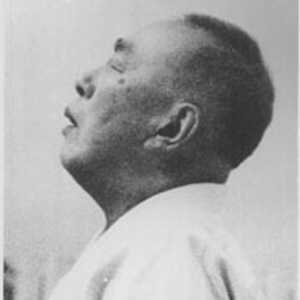


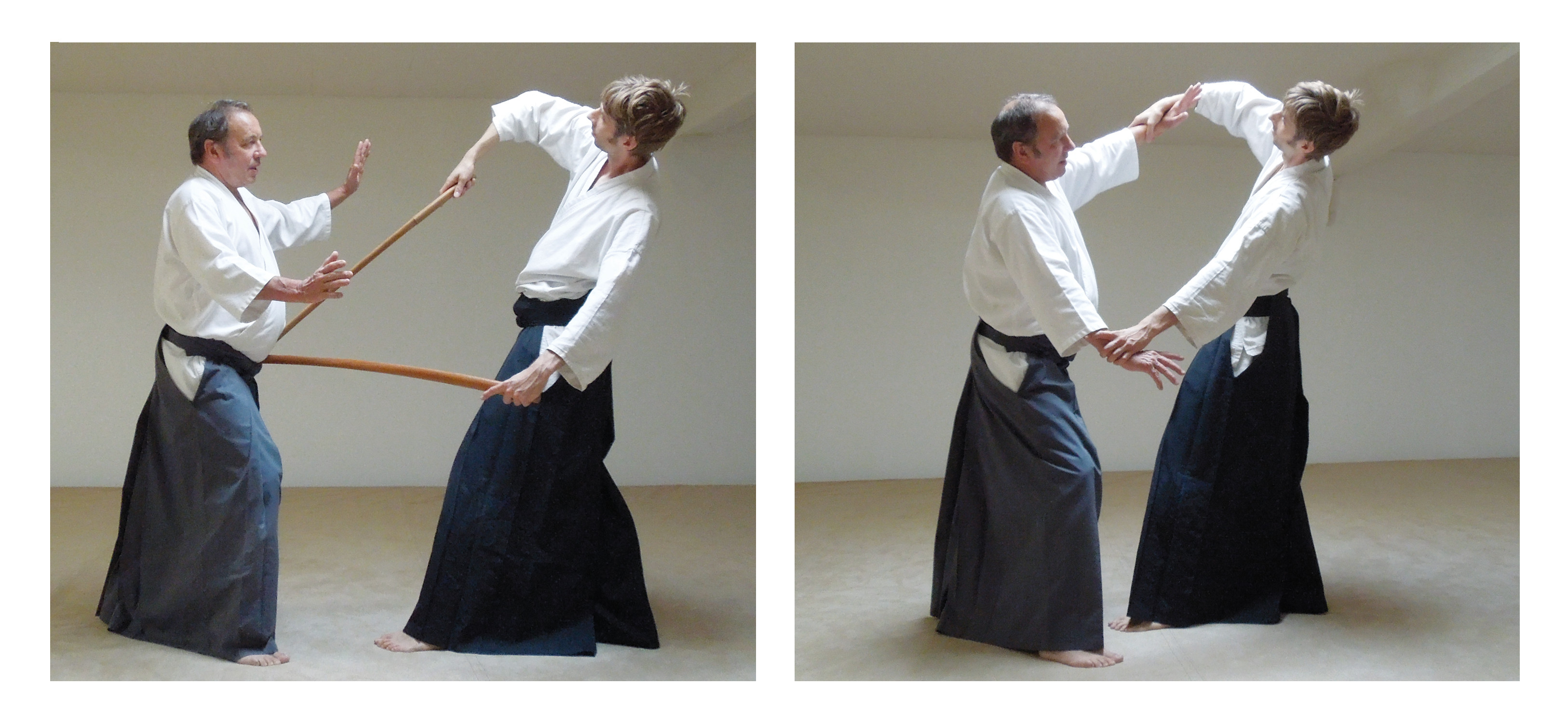


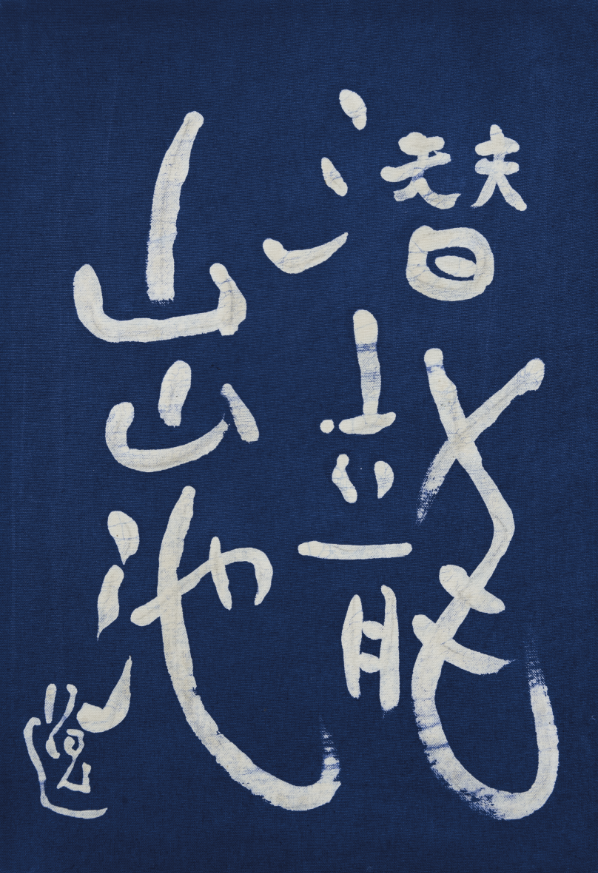


 The Aikido founder’s desire was to bring human beings closer, to him the world was like a big family: