by Régis Soavi
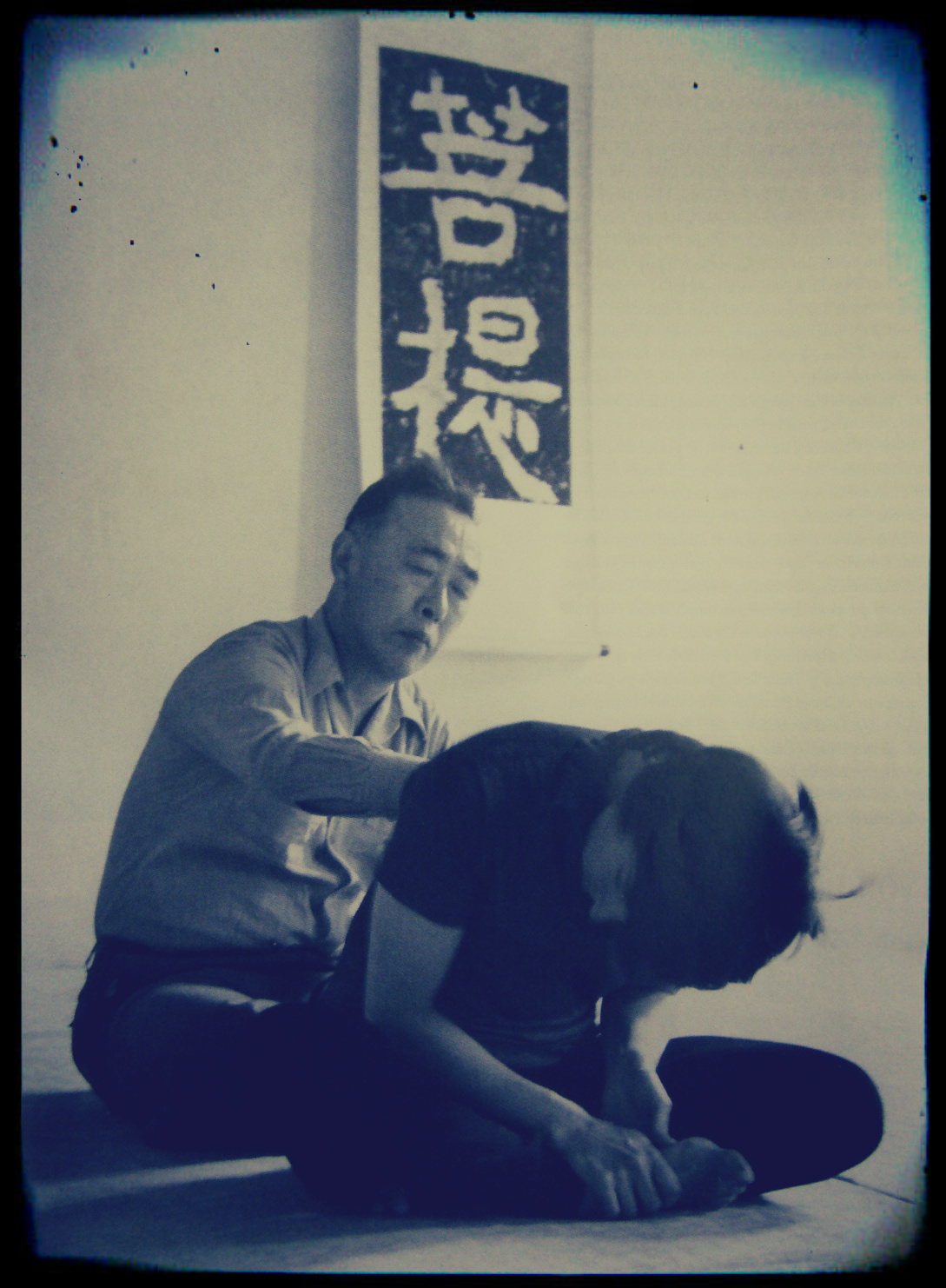
In almost all dōjōs, it is customary to refer to the few exercises that precede a class as “preparation” or “warm-up”. But what if it were not gymnastics, nor physical education, but something else entirely! Tsuda sensei wrote that his master, Ueshiba Morihei, was furious when, even back then, and although he had never given it a name, his young pupils referred to this part as preparatory exercises or a warm-up.1[see e. g. Tsuda Itsuo, The Science of the Particular, Chap. XVII, 2016, Yume Editions, p. 141]
A first part!
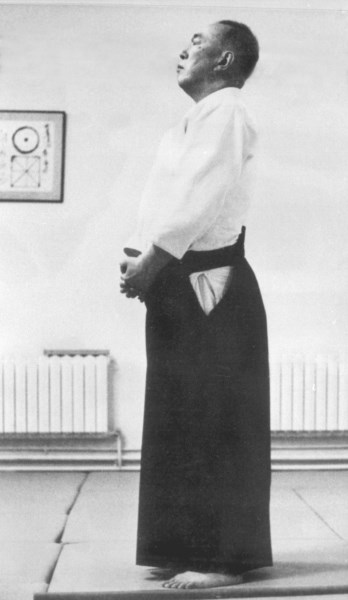
For O-sensei, this first part of the session was an essential and inseparable part of his practice as a whole. This is why, for want of a better term, Tsuda sensei called it the ‘Respiratory Practice’ when he had to discuss or describe it with his students. In the first chapter of his first book, The Non-Doing, he explains his choice of the word ‘respiration’ – which, for him, would be a key term for conveying a message to westerners – writing:
The West too seems to have known them, as reflected in the words psyche, soul-breath, or anima and their derivatives âme2Âme: French word for soul. (T.N.), animate, animosity, animal, or spiro which gives us spirit, inspiration, aspiration, and respiration.’3Tsuda Itsuo, The Non-Doing, 2023, Yume Editions, Chap. I, p. 16 (1st ed. in French: 1973, pub. Le Courrier du Livre (Paris), p. 14)]
These breathing exercises and the circulation of our “vital energy” or ki are still of paramount importance to me today.

Repetition
I cannot really describe what sets our School apart from other places, nor can I advocate for it. Ultimately, it is up to each individual to form their own opinion about what they receive and how they feel. Every teacher in every school or group, based on their training, background and studies, will have their own method and their own teaching style that suits them and their students. Some use new techniques, draw on other cultures, seek out different teaching methods, or take a more modern approach to learning psychology. Nothing should be disparaged; everything is possible and everything is justified in principle to enable us to live out our practice to the fullest and to convey the essential: “the universality of O-sensei’s message of peace”.
One criticism that could be levelled at “the Itsuo Tsuda School” is that it is rather repetitive and conservative. Indeed, the first part of the practice that we do every morning has not changed since my master began teaching it in the early 1970s. Having never grown tired of it myself, I have never felt the need to change anything about it in over fifty years of daily practice, either for myself or for my students. It is precisely this repetition that enables us to improve our breathing and, consequently, to understand the principles that underpin all the movements in our practice.

The foundations of this work
This first part follows its own logical sequence, and I do not think it necessary to describe every movement in detail. However, a few points need to be clarified, particularly what makes it different from what most aikidokas are generally familiar with.
After the salute to the kamiza, there is a few minutes of meditation in seiza, followed by the person leading the session reciting the Norito Misogi no harae. We then begin with an exercise aimed at releasing all accumulated tension from the solar plexus region. This movement is derived from Katsugen Undō and was introduced by Tsuda sensei, stemming from the teachings of his Seitai master, Noguchi Haruchika sensei. As for the rest, all the exercises that follow were taught for many years by O-sensei.
I am not claiming a return to the origins or a unique authenticity that has been hidden until now in the face of alleged distortions caused by poor teaching. It is well known that O-sensei varied the exercises in this first part. However, as far as we know, there were a few that never varied. The Salute to the Eight Directions, or Funakogi undō4often translated as “rowing motion” and Tama-no-hireburi5Tsuda sensei translated it as “vibration of the soul”, are among these. These last two have specific rhythms and precise breathing patterns, as well as a particular set of rules regarding which direction to face and how many times they should be performed. It would be tedious, and perhaps even risky, to describe these exercises in an article, as they must be taught directly from teacher to pupil on the tatami mats.
The most important thing about all other movements is not the number of times they are performed, the speed or the strength, but rather the intensity of the vibration felt throughout the body at that moment. The same applies to the kiai let out by the person leading the session at the end of the First part. Again, it is not the power of the shout, of the sound or its intensity that is important, but rather the nature of the act, the depth of the breath, the precision of the timing and the concentration required, all which, when executed accurately, transform the action into an appropriate response and a process of normalising the body. Each exercise during this part must be performed in a specific state of consciousness. They must be performed with as much concentration as if our life, or at least our health, depended on it. And at the same time, relaxation is essential for them to proceed smoothly. The best possible attitude is to be both focused and free of thought, which requires a few years of practice, but, above all, perseverance.
The need for a suitable setting
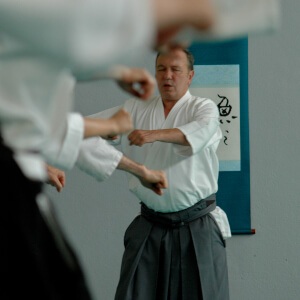
I cannot stress enough the importance of the atmosphere when considering practising the respiratory practice in a style similar to that of our School. The atmosphere in a dedicated dōjō is of a completely different nature compared to that found in a club or a gym. If, moreover, a tokonoma6a niche used to display a kakejiku has been created in this dedicated space, featuring a kakejiku7a scroll frame for a calligraphic work or a painting and an ikebana8a Japanese floral arrangement, it will be easier to maintain concentration and observe silence. Thus, it will be easier to absorb and immerse oneself in an environment that fosters this pursuit. This environment enables one to discover how to perform these movements and sequences, which, much like a never-superficial choreography, cause the body to move in a way that makes it more receptive to the perception of internal flows, rendering it more supple as well as more responsive. It is simply a matter of retracing the path of the old sensei and understanding why those who guided us – all those I have known or met briefly during courses or gatherings – followed many of these “rites” without question in their youth, yet seeking answers within themselves.
The Discovery of Yin and Yang
It is in The Way of the Gods that Tsuda sensei recounts this warning from Mrs Nakanishi9Mrs. Nakanishi, a Shinto priestess, taught Kotodama to Master Ueshiba, a grand master in the art of kotodama10kotodama is the understanding of the spiritual power attributed to sounds:
Aikido, conceived as a sacred movement by Mr Ueshiba, is disappearing to make way for athletic Aikido, a combat sport, more in accordance with the demands of civilised people.’11Tsuda Itsuo, The Way of the Gods, 2021, Yume Editions, Chap. XVII, p. 133 (1st ed. in French: 1982, pub. Le Courrier du Livre (Paris), p. 128)
These comments from these two great masters, Nakanishi sensei and Tsuda sensei, could easily have discouraged me. Yet it was precisely this sort of remark that spurred me on and drove me forward. It is precisely in this First part that one can discover Yin and Yang, for it is a “solitary” practice. Provided we remain focused on perceiving what we feel, nothing can disturb us; it is like an inner current that gradually translates into terms of Yin and Yang. This is a fundamentally non-mental, empirical approach, and the effects are perceived immediately by the whole body.
Our aikidō then transforms, and we move into another dimension with a broader psychophysical perspective. We actually feel the circulation of Ki as different flows with a specific nature – positive or negative, Yin or Yang – in our own limbs and throughout our entire posture. These currents transform and alternate, sometimes shift from Yin to Yang, circulate from one side to the other, turn or stop unexpectedly and ultimately guide all our movements while we are barely aware of them. This does not happen overnight, but it has given meaning to my practice of aikidō; it has enabled me to persevere and to overcome moments of discouragement, difficult phases, those times when one feels stuck, without any spring in one’s step. It is also thanks to these daily routines, to all these actions, that our bodies regenerate and come to perceive others not merely through their physical or social appearance, but rather through what they radiate from within – something that is not merely psychological, but of an entirely different order, of a different nature.
From solitary practice to osmosis
This represents a significant qualitative transformation that is not meant to be a pipe dream, for it is out of the ordinary, and because this transformation opens up possibilities for understanding our universe and our humanity in all their complexity. Unlike the virtual worlds presented to us through technology and societal interactions in our daily lives, we begin to perceive the real world and its true nature. In some ways, it is not so different from our everyday lives; yet it is also completely different.
Each exercise in this First part is linked to our breathing; each movement is connected to inhaling or exhaling. Tsuda sensei would say “Ka” as he inhaled and “Mi” as he exhaled. He explained that when we unite our breathing, we realise “Ka” and “Mi”, which together form “Kami”, which can be translated as God. This is not a god in the religious or even mystical sense, but rather, life in all its manifestations. The martial aspect does not disappear, but is simply transcended. This helps us to better understand why Tsuda sensei wrote:
‘Aikido, the way of coordination of ki, is an art of “fusing ki”, so it’s a martial form of osmosis’.12The Non-Doing (op. cit.), Chap. VI, pp. 66–67 (1st ed. in French: p. 62)

Aikidō: religion or philosophy ?
The moment one ritualises any part of the practice of a martial art, accusations of religiosity or mysticism arise. Reishiki, salutes, concentration, various meditations – all become suspect, as does everything that makes that art one peaceful and respectful of humanity. In the light of scientific materialism and today’s knowledge, it is difficult to explain why a ritualised practice is of such interest, as it defies the notion of progress.
Nevertheless, the world of research is pressing ahead with current studies to gain a more detailed understanding of how our environment works. However, such work must be tinged with scientism to be accepted. For example, we may end up attaching sensors, made from lie detectors, to plants to understand their language, while still being unable to explain why some people have “green fingers”. We try to replicate nature in every way for the benefits it brings to humankind, without understanding how nature produces these results itself. We analyse, divide and dissect in order to identify the active ingredient in a substance, failing to realise that it is the whole that creates that component. If even one part or element is missing, or if the rhythm is interrupted, the result will be entirely different and may even contradict what we had hoped to find or what we had previously discovered. Just as we have no need for religions that shackle us to dogma, so too do we have no need for ideologies that restrict our freedoms or, worse still, enslave us. Even if some of these new beliefs or doctrines, sometimes supposedly validated by science, were designed for our “good”, for our present or future “happiness”, they are worth no more in my eyes than the chimeras of the past. One form of alienation is as bad as another.
For many of us, the quest for unity of being remains the ultimate value, and to find it, the Respiratory Practice remains a valuable tool, readily at our disposal. The ancient gods may be dead as representations and images projected by humanity, but the energy attributed to them, which animates us, is still there. We can feel it, rediscover it, and use it within ourselves.
Maintaining health
‘Health is a state of complete physical, mental and social well-being and not merely the absence of disease or infirmity.’13World Health Organization’s health definition (available online)
This is the WHO’s definition, which we in the West accept as self-evident. It is often taken at face value, along with its corollaries and implications: that we must fight disease and eliminate microbes and viruses; that we must correct nature which is so imperfect; that we must support and protect human beings; and so on. This doctrine becomes so absolute that it produces results contrary to those hoped for. Notably, “people are becoming weaker”. Rather than allowing the body to flourish naturally, we force it to protect itself from anything that could potentially be harmful, or we shield it. We do this in the name of conceptual imperatives regarding health that are supposedly scientific or medical. We reinforce theoretical education on how the body functions and on hygiene without grasping their basics, and we standardise the appearance of young boys and girls to the detriment of their actual health. The result falls far short of society’s expectations, but the conditioning remains, and will continue to do so for a long time.
The Respiratory Practice, accessible to everyone regardless of background or physical condition, may be the answer when we discover the weight of oppression on our own body and its influence on our mind and thinking, consequently affecting our actions.
Simple movements
This is a purification process that can begin. Just as with the planet, when we need to clean up the environment, it is important to halt a process, to stop using the same patterns of behaviour, to stop doing ‘more of the same’14Paul Watzlawick, John H. Weakland, Richard Fisch Change. Principles of Problem Formation and Problem Resolution, W. W. Norton & Company, Chap. 3, 1974. The simple movements associated with breathing, “the circulation of ki” bring visible results right from the start of this slow process of reconstruction that often astonish those around the practitioners, whatever their age or physical condition. The real difficulty lies in maintaining consistency rather than in the efforts themselves, which are in fact extremely modest. It is even possible to limit oneself to this First part if one wishes or if circumstances require it; the resulting sense of well-being will be no less, as the “body-mind” unity rediscovered is the true gift that our deepest nature has always sought.
Would you like to hear about the next article?
Article by Régis Soavi published in October 2021 in Self & Dragon Spécial Aikido n° 7.
Notes
- 1[see e. g. Tsuda Itsuo, The Science of the Particular, Chap. XVII, 2016, Yume Editions, p. 141]
- 2Âme: French word for soul. (T.N.)
- 3Tsuda Itsuo, The Non-Doing, 2023, Yume Editions, Chap. I, p. 16 (1st ed. in French: 1973, pub. Le Courrier du Livre (Paris), p. 14)]
- 4often translated as “rowing motion”
- 5Tsuda sensei translated it as “vibration of the soul”
- 6a niche used to display a kakejiku
- 7a scroll frame for a calligraphic work or a painting
- 8a Japanese floral arrangement
- 9Mrs. Nakanishi, a Shinto priestess, taught Kotodama to Master Ueshiba
- 10kotodama is the understanding of the spiritual power attributed to sounds
- 11Tsuda Itsuo, The Way of the Gods, 2021, Yume Editions, Chap. XVII, p. 133 (1st ed. in French: 1982, pub. Le Courrier du Livre (Paris), p. 128)
- 12The Non-Doing (op. cit.), Chap. VI, pp. 66–67 (1st ed. in French: p. 62)
- 13World Health Organization’s health definition (available online)
- 14Paul Watzlawick, John H. Weakland, Richard Fisch Change. Principles of Problem Formation and Problem Resolution, W. W. Norton & Company, Chap. 3, 1974





 live in a society where you go to bed very late and you get up very late too. In my case I really love the morning. One can be tired in the evening, people after working hours are stressed. Sessions of martial arts then very easily turned into a relief valve, and so on. Rather in the morning, competitiveness does not have too much importance … you get up, you are in the dojo, you can easily breathe, you start your day. Furthermore we are very lucky to be in a permanent dojo. One comes and it is like being at home, in an association but at home, the dojo are used only for this reason. There are gyms with more or less clean changing rooms where you can not even leave your watch otherwise they might stole it, and so on. So you come here in the morning, take a little coffee, tea, and then practise. And so the day begins and starts well, it is a real pleasure. Every morning I have a great pleasure to see people getting there and taking their time, we are in a world where we do not take our time anymore…