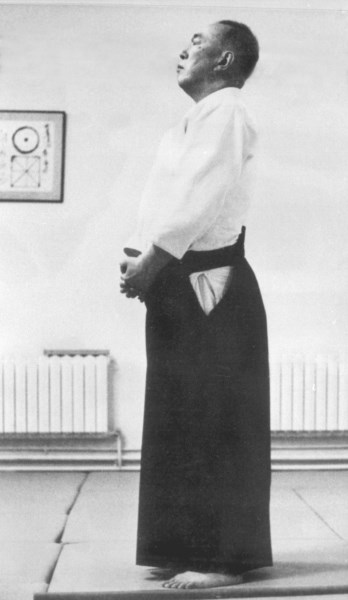
Tag Archives: Pratique Respiratoire

An Art of Uniting and Separating

by Régis Soavi

My master Tsuda Itsuo, quoting Ueshiba O-sensei, wrote in his second book: ‘Aikido is an art whereby people unite and become separate again (musunde hanatsu)’ 1.

regis_soavi_Aikido 1 This was a very present aspect of his teaching, but he never used the terms awase and musubi. He spoke to us in French, he spoke about something greater than ourselves. He invited us to empty our minds in order to perceive something. Sometimes he would say: ‘God (in the sense of kami) is talking all the time, but we humans can’t tune in, so we don’t hear anything. Or we only hear sounds like a scrambled radio. But God speaks clearly’. So for him, it was up to us to put ourselves in a state where we could “receive”. The Itsuo Tsuda School’s aikido is based on what he called the fusion of sensitivity, so on fusing with the partner: faced with an attack, there is a response, but for our response to be adequate, we have to fuse with the partner. During the sessions I talk, for example, about merging and harmonising with the partner, feeling their centre – then we are bound by something, nothing is foreign to us any more. Today I am starting to go a bit further in the practice of aikido and I feel much more what Tsuda sensei meant about the link that unites us with the Universe. You really feel yourself like a link between this Universe and your partner, and you realise it circulates, that everything returns to the Universe.

The Respiratory Practice: a Musubi practice

The Respiratory Practice2 we do at the beginning of the session puts us in a “state of mind” that allows us to receive, to create this link between the Universe and ourselves. We do not really know what the Universe is. It is not the stars, it is not a black hole, etc. It is something else. For the Respiratory Practice we stay as close as possible to the teachings of Ueshiba O-sensei; Tsuda sensei was very precise about this.

For example, we do the vibration of the soul, Tama-no-hireburi, three times, each time with a different rhythm (slow, medium, fast) and only while breathing in. The first time we evoke Ame-no-minaka-nushi, the Centre of the Universe. I sometimes say this is an “invocation-evocation”. Ueshiba O-sensei used to say that it should be evoked three times during the vibration of the soul: the person leading the session says it out loud and then you evoke twice more internally. I heard this from Tsuda sensei, but nowhere else.

Awase Musubi
Tama-no-hireburi (vibration of the soul) by Régis Soavi sensei

So when we evoke Ame-no-minaka-nushi, as Ueshiba O-sensei used to say, we place ourselves at the Centre of the Universe. Centre of the Universe does not mean “Centre of the World”, nor “me and others”, nor something religious. It is somehow elusive, but at the same time extremely concrete. In any case, it does not encumber us, it is the Centre of the Universe and we can be there.

Then the second time we evoke Kuni-toko-tachi, the Eternal Earth, for me it is human, it is matter. The first is immaterial, the second becomes concrete, it is matter.

Then the third Kami evoked-invoked is Amaterasu, the sun goddess, life, what animates us. I sometimes tell the story of the cave where Amaterasu took refuge and of the rock door3. Ueshiba O-sensei often told it and Tsuda sensei also quoted it. It is life which had shut itself away in a dark cave and which has re-emerged. It is important to open the rock door inside us. We have closed ourselves off, we have become rigid, we cannot hear anything, and then one day we open up a little bit.

Aikido gives us a breath of air, something that allows us to breathe a little better. Then, with this breath, we can open up more and perhaps hear better what the Kami have to say to us, what the Universe has to say to us. I am not religious at all, but every morning I recite the Norito, as Tsuda sensei did, as Ueshiba O-sensei did. Every morning, at the beginning of each session, at quarter to seven, I recite the Norito, then I do the vibration of the soul, and I have been doing this for over forty years. And little by little I discover something, I go a little further, I am more permeable.

Awase: practising with the same partner can help you harmonise with the other person.

Straight from the first part of the session, which is an individual practice, it is important to get into a certain state of mind. The harmonisation work continues in the second part, where we practise with a partner. To facilitate this, in our school we work with the same partner throughout the session. Of course, we could change for each technique, but if you want to harmonise, it is difficult to do so in just five or ten minutes with each person. For those who have been doing it for twenty or thirty years, this is fine… But if you are just starting out, say for the first ten years, it is also reassuring to stay with the same partner, so that you have time to harmonise and become imbued with the other person. Thus you can feel them, the first few contacts can sometimes be a bit difficult. But with the same technique, a second, then a third, you can go a little further, get closer to your centre, breathe the “fragance” of your partner better. Tsuda sensei used to talk about discovering the inner landscape of somebody, but it is more difficult to discover the inner landscape of seven or eight people in the same session. Sometimes, particularly at the end of a session, I ask people to change partners, especially during Free Movement. But of course we change every session – they are not partners for life!

The Non-Doing

Uke has a role to play, without being violent, they must be sincere in their attack because without this energy, Tori will be in the “Doing” and not in the “Non-Doing”. In aikido, I often see very gentle Ukes and Tori happily slaughtering their Uke. This is not my principle at all. When I talk about attack, I mean when Uke does a Shomen, a Yokomen, a Tsuki or a seizure, it is important that an energy comes out of it, he or she “does”. Tori, on the other hand, diverts it, lets the energy that expresses itself in the gripping of the wrist or the striking pass, he moves to the side and transforms it, then it is “Non-Doing”. Tori does not respond to the attack, they let that energy, that ki, flow, they go beyond the attack. Of course, Tori does not foolishly wait to be hit! Non-Doing does not mean doing nothing.

I also assume that when someone attacks another person, it is because they do not feel good about themselves… When you feel good about yourself, when you are alive, you have no desire to go and attack others. It would not even occur to you. It is because you do not feel good about yourself that this happens. We live in a violent world, and we have been brought up to react in line with this violence – we have to defend ourselves against this, against that… It has made us sick. By practising aikido, when you are Tori, you are “healing” this violence. This violence, which is in the other person, which is expressed by the role and firmness of Uke, one guides it to transform it into something positive and liberating.

Working with weapons: Ame-no-uki-hashi ken

Ame no uki ashi ken_2
Outdoor weapon session, summer workshop (Mas d’Azil), Régis Soavi sensei

Almost thirty years ago, I decided to use the term Ame-no-uki-hashi ken to refer to the work with weapons that we do in workshops and sometimes in regular practice. The ken, the sword, is a representation of the celestial floating bridge: Ame-no-uki-hashi. We speak of a celestial floating bridge when we see the katana with the cutting edge facing upwards, and we also speak of a celestial floating boat when the cutting edge is facing the other way, downwards. It is quite curious because it is both the bridge and the boat… It is what unites heaven and earth, the conscious and the unconscious, the Universe and us. When we work with weapons, they are an extension of ourselves, beyond our skin, something that allows us to go a little further, to discover our sphere too.

Ame-no-uki-hashi: being on the celestial floating bridge, this was an image used by Ueshiba O-sensei and passed on to us by Tsuda sensei. To be on the blade of the sword is to be in a state of attention that could even be described as “divine”, where a different perception can occur. I do not want to get into a discussion about whether or not weapons should be used in aikido, it does not matter. I work with weapons because it forces us to be in a state of extreme concentration while maintaining relaxation. They also help me to make the ki lines visible in a more obvious way, both those of my partner and those that come from myself. For example, when I place two bokken on my centre in a demonstration, I show that the strength comes from the hara and not just from the muscles.
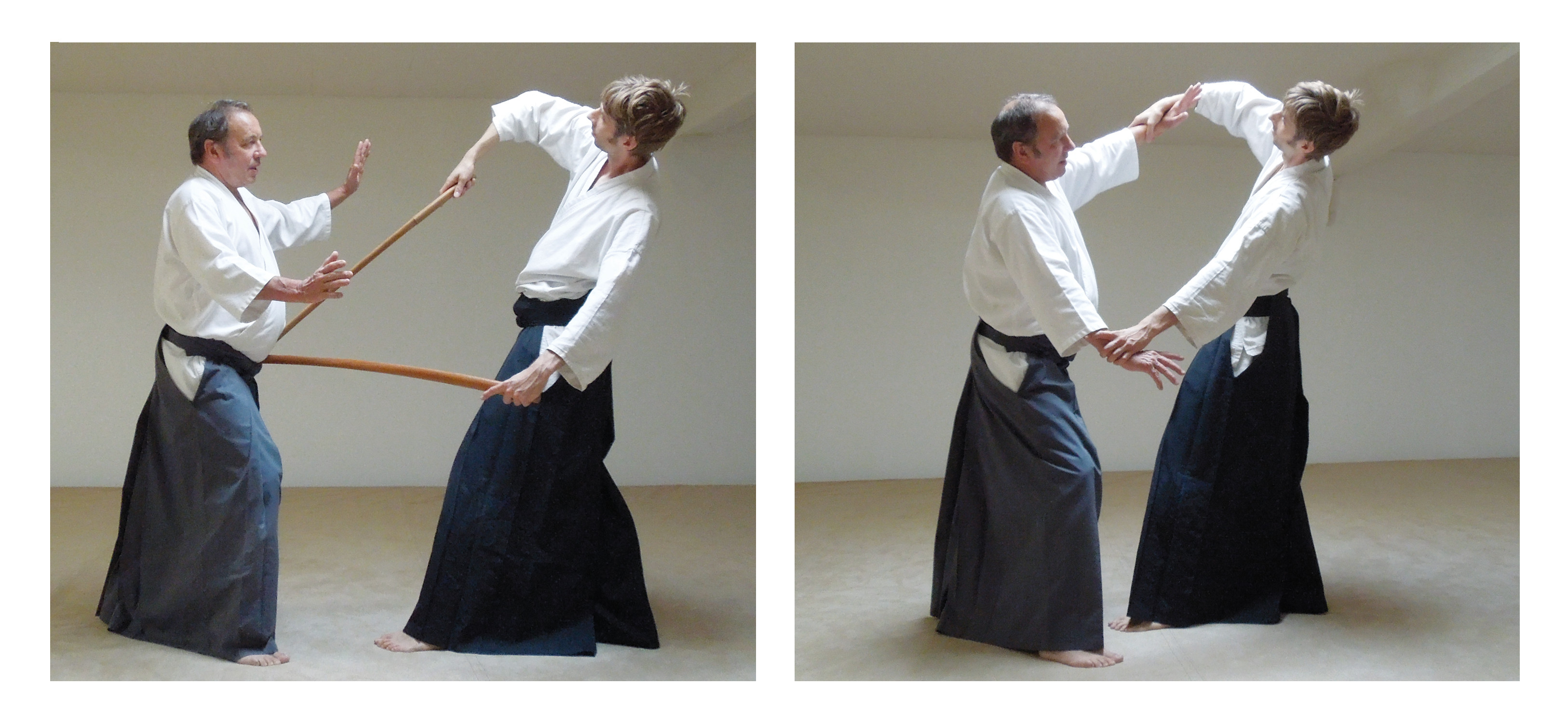
demostration_2 bokken
Weapons make ki lines visible, the strength comes from the hara (Régis Soavi sensei)

Kokyū Hō: breathing

Traditionally with Tsuda sensei, the session always began with the Respiratory Practice, then we did the exercise he called Solfège4, then we worked on techniques and at the end there was always Kokyū Hō in suwari wasa.

For Tsuda sensei, Kokyū Hō was an opportunity to do just one thing: breathe. He gave us, among other things, the visualisation of opening the arms Kokyu Ho vertical as the lotus flower opens. There is no more technique, just a person grabbing you, and then you breathe through them, circulating the ki through your arms, through your partner. Whatever the partner’s resistance, we open up to it and achieve the fusion of sensitivity between ours and theirs.

For me, every Kokyū Hō is different, with every person. There is no particular technique, but there are lines that spread out from the hara, it is like a kind of sun that shines and you can follow each ray of sunlight to find that hara, something ignites and the person falls to the left, to the right and you do the immobilisation. For me, this is a special moment of deep breathing. When I talk about deep breathing, I am obviously talking about ki, meaning that when you breathe deeply the ki starts to circulate in a different way.

Awase beyond the tatami: taking care of the baby, the height of martial arts

‘Knowing how to treat babies well is for me the height of martial arts’ 5. When Tsuda sensei wrote this sentence, he was relating aikido to the way of looking after a baby in Noguchi Haruchika sensei’s Seitai. He also said that taking care of a baby is like having a sword over your head; as soon as you make a mistake, “snip” the sword falls.

If we draw a parallel with aikido, the baby is both much more demanding than the master and at the same time much more gentle; in Seitai, taking care of the baby means having constant attention, it means abandoning yourself. The greatest masters talk about the importance of abandoning yourself, it is central to martial arts. Awase, this fusion we talk about, is also accepting to abandon yourself. With a baby, it is all a question of sensation, we are in a constant fusion of sensitivity, like when a mother knows if her baby is crying because it has to pee or if it is hungry or tired. In the same way, but in reverse, for the samurai facing their adversary, the art was to discover in the other the moment when their breathing would become irregular, the moment when they would be able to strike. It means calling on all our abilities.

Taking care of a baby is discovering a world of sensitivity, for example through the art of giving a hot bath in Seitai. Knowing how to put a baby into the water when it breathes out and how to take it out of the water when it breathes in, when you are able to look after a baby in this way you are also in martial arts. Touching a baby, changing a baby in the rhythm of its breathing, putting a baby to sleep and laying it down without waking it up… Of course, it is much more flamboyant to pull out your katana and pretend to cut off a head! But for me, it is so much more difficult and important to put to bed a baby who has fallen asleep in your arms, to be able to take your hands out from under the baby without waking it up, that is art! With an aikido partner, you can “cheat”, you can use a little shoulder pressure, you can push… but with a baby, you cannot cheat. There is fusion or there is not. I learnt a lot from my babies, I think I learnt as much from them as I did from Tsuda sensei, although in a different way.

Musubi and awase: the beginning

It is generally believed that one must begin by learning the techniques and that after many years of work one can grasp awase and musubi. In our school, the Respiratory Practice and the fusion of sensitivity are at the beginning and inseparable from the rest. All our research is done through breath, “ki”. This direction allows us to deepen the research in simplicity rather than acquisition, and in this sense we meet Ueshiba O-sensei’s definition: ‘Aikido is Misogi’.

Régis Soavi

Article by Régis Soavi published in October 2014 in Dragon Magazine Spécial Aikido n° 6.

Subscribe to our newsletter

Notes :
  1. Tsuda Itsuo, The Path of Less, Chap. XIX, 2014, Yume Editions, p. 182 (1st ed. in French, 1975, pub. Le Courrier du Livre (Paris), pp. 174–175)
  2. A Series of exercises done individually that precede the technique, cf.The Itsuo Tsuda School, Meeting the Breathing’, an article by Régis Soavi published in July 2014 in Dragon Magazine Spécial H. S. Aikido n° 5 (on the theme: individual work), pp. 6–12
  3. Myth described in the Kojiki
  4. [French solfège literally reads music theory, and more precisely the basics of music theory. The solfège exercise contains indeed many fundamentals of Tsuda’s aikido but also refers to a “tuning” moment between the partners, akin to the moment before a concert when the musicians tune their instruments – for the sake of harmony. (Translator’s Note)]
  5. Tsuda Itsuo, Facing Science, 2023, Yume Editions, Chap. III, p. 23 (1st ed. in French, 1983, pub. Le Courrier du Livre (Paris), p. 24)

Meeting the Breathing

itsuo tsuda respiration

Born in 1914, Itsuo Tsuda would now be one hundred years old. This atypical character, fiercely independent, considered himself first and foremost a philosopher and he is a key figure of the Aikidō in France. He is the one who introduced Katsugen undō* in Europe in the early 70s.

Direct student of O-sensei Morihei Ueshiba during the last ten years of his life, Itsuo Tsuda did not consider important the sporty or martial art aspects of Aikidō, but rather the chance to make use of this art for inner search, for personal search. He qualified this dimension as “solitary practice” and devoted himself to pass it on in his books and in his teaching.

By beginning Aikidō at forty-five years of age, the ki and Non-Doing were the two aspects that mainly attracted him. These aspects were particularly tangible in a series of exercises preceding, during O-sensei Ueshiba sessions, the technique, which Itsuo Tsuda named after the expression “Respiratory Practice.”

O-sensei Ueshiba gave a lot of importance to these exercises that meant to him something completely different then warming up. Itsuo Tsuda in an interview with France Culture said:

‘For me what is important is what I do at the beginning: I sit, breathe, I breathe with the heaven and the earth, that’s all. Many people love aikido as a technique, don’t they? For me, the technique is simply the test to find out if I have evolved through breathing.’

In the technique that happens during  the second part of the session there is no struggle, but an opportunity to develop sensitivity, the ability to fuse.

The voice of Itsuo Tsuda, who died in 1984, still resonates today through the nine books published in French and through his students. One of them, Régis Soavi, he has dedicated more than thirty years to Aikidō and Katsugen undō teaching. He is the technical adviser for the Itsuo Tsuda  School .

itsuo tsuda aikido

— Good morning, Mr. Soavi, when you met Itsuo Tsuda in the 70s you were already engaged in the practice of martial arts. What made you decide to consecrate to the Aikido of Itsuo Tsuda?

I had just started Aikidō when I met Itsuo Tsuda, my teacher was Roland Maroteaux. I met Tsuda during a workshop organized by this teacher. What struck me at first was his ability to dodge. During this workshop I saw my teacher, who was an actual budōka, attacking him with determination and at any time Tsuda was not there, he was dodging, he had created void in front of him. That was what shocked me. I had already experienced a lot of Jūdō, Jūjutsu and weapons and then, more or less at the same time, during my training as a professional Aikidōka, I worked with other teachers like, Master Noro, Master Tamura, Master Nocquet, as well as I took part of some workshops with Master K. Ueshiba, Yamaguchi sensei, etc.. At the time we were all a bit like Rōnins, we were going from a dojo to another trying to uncover the masters’ secrets. At first I was timidly interested of Master Tsuda, but the quality of this void, this emptiness that was moving around, it was very impressive and that was what made me decide: you have to go and see this master.

— What does represent for you the first part of the Aikidō practice that Itsuo Tsuda called “Respiratory Practice”?

Master Tsuda used to say that it was the essence of Aikidō. At the beginning, when I was about twenty years old, I saw this part as a kind of respiratory warming up, not to mention muscle warming up. And then little by little I found out that it was something much more intimate! And after seven years, the Respiratory Practice had become the most important part of Aikidō for me. The rest was, as Tsuda said very well, a way to verify to what extent I was getting with my breathing.

— You speak about Aikidō proposing the translation “the way of the ki fusion”. How does this differ from the definition “the way of the harmony” that it is normally used?

regis soavi

Now, “Aikidō” is an ideogram, there are no words therefore in itself. What I try to pass on through  “the way of the ki fusion” is the direction we take. In Aikidō this fusion of feelings between people allows you to practise in another way. It completely differs from the idea of fighting. It is rather a complementary. I think Ueshiba had such a fusion capacity with the person who attacked, by anticipating his acts, his gestures. For me, harmony is insufficient as a translation, this may purely be aesthetic. The fusion turns into something deeper. When two metals come together into a fusion to become for example bronze, they become Bronze, it is not only harmonizing them, they become something different. And it is in this sense that I want to translate it with “the way of the ki fusion.” But this is purely ideograms interpretation.

— What role do you think the technique plays?

It is essential. It is the base. For me, technique must be extremely precise. It is the technique that leads the breathing. The technique also means the body, the posture. If your posture is correct, if the positioning is right, then it is easy, breathing is better. when one is blocked, congested, closed or too open, too soft or too hard, nothing will really happen. The technique is there to allow through its precision to find the lines that help us breathing better, to get better into the fusion. It is also for this reason that I often ask to work slowly. It is no use doing something quickly and badly.

regis soavi aikido

— Does the practice of Katsugen undō, you’ve discovered with Master Tsuda, affected your approach to Aikidō?

I think if I had not practised Katsugen undō I would have not practise Aikidō the way I do today. We should never forget that Katsugen undō is something that normalizes the ground, the body. And only now I see Aikidō as a process of normalization of the body as well. The practise of Katsugen undō allows you to practise Aikidō in this way, it is for me a base, the basic. It develops in you the breathing, once we breathe better, we are more relaxed. Aspects like aggressiveness, competitiveness disappear, they fall by themselves. Instead of practising by hurting the others, one goes towards the normalization of the body, for example I usually show how, by twisting the arm in a certain way, during the mobilization, you allow your ki to get up to the third lumbar in fact the person’s body twists slightly on that point. Well, it is a process of normalization of the body through Aikidō, which I discovered because of the Katsugen undō practice. This applies to many other techniques, the way to get in, to reach the center, the hara, and so on. I’m not saying that you cannot find out if you only practise Aikidō, but Katsugen undō was an open door, it has allowed me to feel better, to understand better, to be more in the spirit… I think this was very important for Tsuda as well. He practised with Ueshiba for ten years. But when he started Aikidō he had already been practising for more than ten years Seitai and Katsugen undō. His terrain was thus in a certain condition, for example with regard to the flexibility – which is often lost when at forty-five years of age. And then the kind of spirit condition: for Tsuda was clear that we were not there to destroy ourselves, but rather to find a certain tone, and at the same time a balance. Aikidō should lead to a balance. And Katsugen undō task is the balance.

— you practise early in the morning, this may be surprising.

Sessions during the week start at 6:45am while at the weekend they are at 8.00. I know we regis soavi aikidolive in a society where you go to bed very late and you get up very late too. In my case I really love the morning. One can be tired in the evening, people after working hours are stressed.  Sessions of martial arts then very easily turned into a relief valve, and so on. Rather in the morning, competitiveness does not have too much importance … you get up, you are in the dojo, you can easily breathe, you start your day. Furthermore we are very lucky to be in a permanent dojo. One comes and it is like being at home, in an association but at home, the dojo are used only for this reason. There are gyms with more or less clean changing rooms where you can not even leave your watch otherwise they might stole it, and so on. So you come here in the morning, take a little coffee, tea, and then practise. And so the day begins and starts well, it is a real pleasure. Every morning I have a great pleasure to see people getting there and taking their time, we are in a world where we do not take our time anymore…

— Your sessions are designed for all without distinction of age and levels, you talk about a school without grades.

Master Tsuda said: ‘There is no black belt for mental emptiness.’ With Ueshiba there was no national program for black belts. When Master Noguchi was teaching he was used to say  “Forget, forget, when you will need it, it will come back naturally” It’s a little bit like this, the technique is important, but we do not repeat ten thousand times how to get attacked or some other staff. It makes no sense. Hierarchy, degrees, kyu, dan, and so on. For me this is not really important … And then in terms of age, why should we make a difference? Modern society created that difference, it has created the teenage (which by the way teenage is now up to forty years), the third and then the fourth age, and so on. All these categories do not correspond to anything. For me, when we talk about life within us we are all equal. Then, of course, it makes a difference, if I work with a six year old child it is not like when I work with a sixty years old person or somebody on their twenties.

— Other then passing on the bases, what can you really teach through Aikidō?

Ah, not much, actually, on a given moment people are going to start their own search by themselves. So, since I’m older, and my own search is also a long-term one, I can give them some information, and then I can help them to better understanding through visualizations. It’s my way of teaching people today. I suggest visualizations, for example by saying this movement looks like when you place a baby in bed. At the same time people search, there are a number of people who I consider companions they are no longer students. As sensei, as a good craftsman with a greater seniority, I can say, ‘Look further, that is it’, by looking further, the body opens and the person says, ‘Oh, okay It is fine.’ It is very subtle. It is a kind of communication that I establish with my students. And then people go and search in that direction. We do not work on making the technique perfect, that does not exist. Aikidō is not going to become more effective, more aesthetic, and so on. But we will be closer to ourselves, I think that this is the most important thing.

Want to receive future articles? Subscribe to the newsletter

Abonnez-vous à notre newsletter

Simple as Breath

itsuo tsuda aikido

An interview with Régis Soavi.

Our appointment is at 6:45 AM, in Milan’s Chinese quarter. The place: a former garage, transformed into a traditional, spartan-looking dojo where, once inside, you are told gently but firmly to remove your shoes. The participants arrive little by little, sleepy-faced; they murmur their greetings as though reluctant to disturb the pale atmosphere of the Milanese dawn.

I had been invited to an aikido session by Régis Soavi, during one of the periodic courses he conducts in Italy. Régis Soavi teaches and transmits the message of Itsuo Tsuda (1914-1984), a direct disciple of master Ueshiba. I had read a few of Tsuda’s books; he was Japanese and lived in France. His books are strange. They cannot be classed with “martial arts” books, or as “essays”, or with “stories”. In Tsuda’s school, we find the convergence of two fundamental experiences: Aikido and Katsugen undo (Regenerating Movement). I wanted to speak more in depth of that, with Régis Soavi.

Who Itsuo Tsuda was

You were a direct student of Master Tsuda. Tell me a bit about him.

He was very simple. We called him Mr. Tsuda. I myself only began to address him as “Master” in his last years. He wished to be considered above all as a philosopher and writer. His quest was of a personal nature. When you met him, you realized at once that he had a strong personality, but at the same time, he seemed to be an Oriental like any other. If you were to come across him in the street, you’d never realize he was an expert in Martial Arts, he just seemed to be an ordinary Japanese. In any case, on the tatami, he was a real discovery. Tsuda addressed himself to each person individually, he never generalized. In the morning, after aikido, we would have coffee together and he would tell stories, speaking to all who were there; but we understood that, each time, he wished to reach certain people in particular. He was characterized above all by his simplicity.

I’m looking at Tsuda’s biography: ‘At 16, he rebelled against his father’s wish for him to inherit the family patrimony; he left his family to wander, in search of freedom of thought. Later, reconciled with his father, he came to France in 1934, where he studied under Marcel Granet and Marcel Mauss until 1940, when he returned to Japan. After 1950, he became interested in Japanese culture, studying the recitation of “Noh” with Master Hosada, the “Seitai” with Master Haruchika Noguchi, and Aikido with Master Morihei Ueshiba. Itsuo Tsuda returned to Europe in 1970, to disseminate the practice of “Regenerating Movement” and his ideas about the “Ki”.’ What did Itsuo Tsuda do during the Second World War?

In 1940 he was mobilized and had to return to Japan, on the last boat to go through the Suez Canal. The canal was then closed. He was enrolled in the army, where he worked in an administrative capacity. He never fought. Right after the war, he worked for Air France as an interpreter. That is how he met Master Ueshiba. A French Judoka, André Noquet, came to Japan to discover the practice of Aikido, and as he spoke no Japanese, he needed an interpreter. He found Tsuda, who until then knew nothing about Aikido, but he was deeply interested at once.

Did Tsuda know Ueshiba first, or Noguchi?

Noguchi. He was about 30 when he first met Noguchi, and 45 when he encountered Ueshiba.

What was the meaning of his refusal to accept the family heritage?

His father came from a family of Samourai, who became factory owners and business heads at the Meiji modernization. Tsuda did not want to work in the family business. He wanted to live his own life. At first it was very difficult; he even worked for a time in a chemical factory. Then, when he had reconciled with his father, he decided to study in France. Tsuda was very fond of France.

Aikido

For you, is Aikido a martial art?

No, you already know the answer. Aikido is a non-martial art; it is the practice of non-doing. Master Ueshiba, in another epoch, could have responded that Aikido is a martial art. Still, if I say it is not a martial art, then people respond, ‘Oh, it’s a dance then’. That is why I define Aikido as a “non-martial art”. In any case it is something quite different; That is why Ueshiba called it ai-ki-do. The term is often translated as “The Way of Harmony”, but a more appropriate definition is “The Way of Fusion of Ki”. Two people can undergo what we call fusion. They do more than simply harmonize. From two, they become One, then two again. Habitually in martial arts, two adversaries confront each other and only one remains. But in Aikido we have the fusion of sensitivity. In our school, he who attacks, attacks; the other becomes one with him: he accepts and absorbs the attacker and from two creates one. He acts in such a way that the other begins to be a part of him. In this way he disarms the attack, which no longer works.

Does that mean that one learns to take responsibility for the other as well? Or to put it differently, in a relation between two people, does the will of one of them suffice to modify the quality of that relation?

One learns to take one’s own responsibility. In our school, the attacker will help the other who is not yet able to create the state of fusion; he makes it possible. If he were to attack brutally, the beginner would be unable to create this fusion; but if he acts as a guide, he helps the other rediscover his own capacity for movement. He already has that capacity. If, when crossing a street, a car suddenly arrives, we jump to the side. It’s the art of avoidance. These capacities manifest themselves spontaneously, in certain exceptional circumstances. Here, we reintroduce them, so that they become more natural, so that they are present in every moment of our lives.

You practice early every morning. Why?

Master Ueshiba practised early in the morning, Master Tsuda as well; I continue to practice early in the morning. That is the first reason. The second reason is that only those who are very determined, very well motivated, come in the morning, because to be here at this time, you must get up at around 5:30 AM. In the morning we are fresher than at the end of the day and it’s easier to practice “non-doing”, at least for beginners. We are also more “involuntary” – still a bit half asleep, we are not yet entirely into our “social being” that we use during the day, to encounter others and go about our work: smile when we should, or not; say ‘thank you’, etc. In the morning we arrive at the dojo still clean, not very structured yet, and there is something more authentic there.

How is your Aikido different from that of other schools?

There is no difference, it is Aikido. I do not know what is done these days in other organizations, at Aikikai for example; I left them 20 years ago. I do believe that certain things have been forgotten; for instance, the first part of the “Respiratory Practice” that Master Ueshiba did every morning, and that we have preserved. In other schools, some forms of this have been maintained, but a large part has been lost. I think that those schools have adapted themselves more to Occidentals and to our epoch; as for myself, I prefer to remain more traditional.In our Aikido sessions, there is a first part, where we practice alone for about 20 minutes, and a second where we practice in pairs: one partner attacks, and the other executes the technique. The techniques are the same as those practised at Aikikai or with Master Kobayoshi, or any other master. The difference is in our approach, which gives much more importance to the role of the partner. We take the other person completely into account, and for that, I feel that our practice of Katsugen Undo has played a fundamental role.

The Regenerating Movement

itsuo tsuda

What is Katsugen Undo?

In our school there are two practices, united through a common spirit: Aikido, of which we have just spoken, and the Regenerating Movement, which Tsuda learned from Master Noguchi – a ‘movement that permits a return to the source’. This is what allows us to better understand the aspect of “non-doing” in Aikido.

Often, when people arrive from other dojos, I see that they “possess” a technique: they respond to the attacks in a certain way, but there is no spontaneity. Everything is calculated, inculcated, schooled, and ordered.

The regenerating movement is supposed to bring the individual back to a state of spontaneity?

Yes, it is the art of spontaneity par excellence.

It is derived from Noguchi’s “Seitai”, if I have understood correctly?

Yes.

What does Seitai mean?

It means a “natural condition”; “Seitai Soho”, for example, is a technique used to “Seitai-ise” the individual, that is, to give him the possibility of a return to a natural condition. Katsugen Undo, on the other hand, is the movement of the extrapyramidal motor system, the involuntary movement that is activated spontaneously, and that, in itself, acts to take us to a condition of seitai. It is not a method of acquisition, on the contrary, it is a Way of detachment. We do not acquire greater flexibility; rather, we free ourselves from rigidity. We acquire nothing; rather, we lose things, we free ourselves from what hampers us. This is important in Aikido as well. Aikido is not a Way of “acquiring” techniques, or of “obtaining” results, but rather a Way of coming back to simple things. On this subject Master Tsuda spoke of ‘becoming a child again, but without puerility’.

Did Ueshiba know of Seitai? How did Seitai and Aikido come together?

It was Tsuda who united them. I do not believe that Ueshiba knew of Seitai. However, Master Noguchi once went to see a demonstration by Master Ueshiba, of which he said, ‘It’s good’. In Japan, that is sufficient.

The Ki

Did Noguchi create the discipline of Seitai, or did a tradition already exist that he perpetuated?

No, he created it. Initially, Noguchi was a healer, until his “discovery” of involuntary movement. One day, he realized that people fell ill, and came to see him; he would allow the ki to circulate, they would recover and go off. Then they would fall ill again and come back to see him…. Any other therapist would have been happy to observe that, as they would be guaranteed a steady clientele. But Noguchi started from a different point of view: ‘What good is it to heal them since they just fall ill again? Every time they fall ill, they depend on me.’ To him it was absurd. He had discovered that, with Katsugen Undo, there was no more need for someone to heal us. The body does not need anyone, it does everything all by itself.

Can we say then, that our ki heals us?

No, ki does not heal us. Ki activates the vital capacities of the individual, but we are already full of ki! If our body works normally, we need nothing else. If I have some microbes in my body, the body creates a fever and produces home-made antibiotics, antibodies, etc. Noguchi did nothing but activate the life force, when the individual was too weak. What is even more interesting is that the individual can activate his life force on his own, with no need for another person, no need to ask someone else to do it for him.

Does this method work to cure people?

We are not cured. If we break a bone, once the bone is back in place, what makes it knit back together? It is not medicine, it is not doctors, and it is not the ki either. Even if we do nothing the bones knit, simply because we are alive! If we find this capacity again, the whole body will function in this way.

And with cancer, what happens? Is it more difficult to find a normal function when the cells have gone crazy?

In the case of cancer, it is a matter of a certain corporal laziness: the body is so damaged that it is near death. But there are people who survive a cancer. How does that happen? That is not my domain, as I am not a therapist; I do not attempt to cure people. But it is clear that there are people who have not allowed their bodies to do their work normally; for every little problem, they take medicine. Today, that is how it is as well, for giving birth and for pregnancy. From the beginning of life, we are medicalised, hospitalised, even though these are natural events, where life manifests its workings in us.

Can we say then that it is our ideas that have become ill?

Not only our ideas. It all goes together. But what is new with Noguchi, is the possibility to awaken oneself if one wishes it . It’s not a question of awakening each person at any price, nor of proposing a great new method that will cure everyone. It can be useful only to those who wish to go in a certain direction. The others, the lazy ones, do not belong here. In this society, there is already an infinite number of specialists to take care of them: doctors,priests, psychoanalysts, gurus, etc. As for me, I prefer to live my own life totally. I prefer that no one need to take care of me.

In our magazine, we have begun a discussion about the ki, about the way each Oriental discipline interprets and uses it. It would be interesting to hear your point of view.

Ki is an untranslatable word today. The ki has a thousand forms; good ki, bad ki… it is indefinable. When we enter a certain place, with a certain atmosphere, one can say we feel a certain sort of ki. But what seems a pleasant sort of ki to some can be quite disagreeable to others. In Aikido, there is, effectively, the ki of the attack which is to come. Sometimes, walking along the street, we can feel something at the nape of the neck. We turn, see no-one, but then notice, up on a roof, a cat observing us. We have felt the ki of the cat’s look. How can we explain that? We can observe it, but as for explaining it… “To be in harmony with the ki.” But which ki? It is not simple.

I remember one of your conferences where you said that when something hurts it is natural to put one’s hand on the painful spot. For example, if we have a headache we naturally put our hand to our head, and that is already a way of using the ki.

Yes, the “laying on of hands” is yuki. When you have a headache, you put on your hand, and the ki circulates. In this way, the ki is concentrated. The ki is already there, it circulates already, but we concentrate it. When we have something wrong somewhere, we lay our hands on the spot without thinking of it, it happens spontaneously. When, on the contrary, we do yuki with someone, it adds a certain concentration, a direction.

So in your school you do yuki with each other?

When we practice the regenerating movement, we also practice the exercise of yuki. All the same, rather than “doing” yuki, it is a matter of a rediscovery. We come back to something everyone already knows, from when we were children.

The translation of yuki?

”Joyful ki”.

The perception of the sacred dimension

regis soavi aikido

Does Seitai contain a reference, close or remote, to a religious tradition, as does Aikido?

Neither discipline adheres to a religious belief.

But Ueshiba was so deeply influenced by the sect Oomoto-kyō (a Shintoist religious group), that in his thoughts, Aikido and his religious practice are not always easy to distinguish.

But Aikido in itself is not at all religious. It does fit into a sacred tradition, that yes. Ueshiba had without doubt a very strong relation to what is sacred. Master Tsuda also considered the dojo to be a sacred place. After all, what is the dojo? It is a place where we practice the Way. And the Way is represented in Japanese by the ideogram of Tao. One does not practice the Way just anywhere. A place consecrated to that practice is necessary.

But what is the sacred dimension for you?

I cannot give a precise definition. People do say, “The sacred dimension, yes, but religion, no!” One particularity of our school is that we don’t practice before a picture of Ueshiba or of Tsuda, but before a calligraphy. The calligraphy that hangs in this dojo, for example, is “Mu”, the Void.

Is it the same in each dojo?

No. In Toulouse, there is a calligraphy that signifies ““The dragon emerges from the pond, where he had been asleep”.” At Avezzano the calligraphy signifies “Bodai”, that is, the state of illumination.

What is the meaning of this custom?

To practice before a calligraphy creates a different atmosphere than would a picture. Personally, to stand before a calligraphy that signifies “The Void”, gives me a feeling of plenitude. To practice before a picture of someone, even if he is the founder of the school, seems to me to indicate a religious attachment or devotion. Ueshiba did not practice before a photograph. A calligraphy is by nature “void”. Also, I find it important that those who come to the dojo to practice, understand the sacred aspect, but at the same time, that there are no gods to venerate here.We are not concerned with peoples’ religious or political beliefs. At the same time, this space is not only physical. It is not a gymnasium, where one trains, sweats, and showers. It is a permanent dojo, where we practice only Aikido and the regenerating movement.

I think that people are also interested in the cultural, philosophical and religious origins of the discipline they practice. In the Chinese tradition, for instance, the classical martial arts were born, or in any case, greatly developed, in the Buddhist and Taoist monasteries.

Everything began in religion. Art in Europe began in religion. Today, it is publicity which gives its impetus to art. Publicity is the new religion. Ueshiba himself said that Aikido is not a religion, but that it sheds light on religion, allowing a better understanding of it. In fact, he himself recited the “Norito” before a little altar, either Buddhist or Shintoist, or even before an image of Jesus.

Why do you recite the “Norito”, a Shintoist invocation, before each session?

It is not Shintoist. I do not know what it is. I say that it is not Shintoist because it is something older, something which has since been adopted by Shintoism. Master Ueshiba spoke in this case, of “Kotodama”.

What is “Kotodama”?

It is a resonance.

Like a mantra?

If you like. Shintoism has its source in ancient traditions, in the same way that Christianity has integrated earlier traditions like Easter (originally a Hebrew celebration) and Christmas (the Roman “Saturnalia”, the Celtic and Nordic “Yule”).

What is the “Norito” exactly?

It is a short text. It takes just a few minutes to recite.

Do you teach the meaning of the words to the participants?

No. What is important is the vibration, the resonance.

And people accept participating in something they do not understand?

Yes.

But do you yourself understand the meaning of the text?

No. It is my inner sensation that is important to me. We do so many things that we feel, but do not understand.

Everyone already knows what they need

From the person who begins to practice a martial art, a great deal of confidence in the master is always required. The disciple supposes that one day he will understand, and that he will obtain some results. He hopes to see some visible effects, the proof that what he is doing works, even if it’s perhaps not immediate.

We always behave according to reason. We do something, then we understand, then we change, etc. But with Master Tsuda we discovered something different. I practised Aikido with other masters before him, I have known different forms, different schools, but with Tsuda, I discovered the “non-form”: in fact, the form exists, but it is very vague. With Tsuda, the orientation changed. In the practice as he taught it, one comes back to oneself. The sensation of coming back to myself is what led me to abandon the other things I did; federation Aikido, Jujitsu, etc.One no longer needs explanations. I think that those who come here feel that. They rediscover sensation, and don’t need one to explain that we do this for this reason and that for that reason… They feel, they see, they understand deep inside, they discover; that’s what counts for them.In any event, today, the consequences of knowledge are harmful. The more things we discover, the more problems are raised. I don’t want to say we should know nothing, or learn nothing, but we must have confidence in what is instinctive for humans: in women’s intuition when they care for their newborn babies, for example. When a woman takes a newborn into her arms, she does not wonder, ‘Is he hungry, is he wet, is he sleepy?’ She already knows what the baby needs, intuitively. She has always known. When she was a child herself, she did not need to use that knowledge, but when she becomes a mother, she uses it, that is all.People do feel these things, but generally this sort of perception stops at the unconscious level, and doesn’t emerge into our consciousness. So, officially, we say, ‘I don’t know’, but deep down, we already do know it all.

Individual responsability

regis soavi stage été

How can you define what Master Tsuda’s school proposes?

Simply, to provide, for the individual, a place where one can discover oneself to be autonomous and responsible. For example, here in Milan, the dojo is named Scuola de la Respirazione, and it is the members who manage it and share all the responsibility. Naturally, there are people who come to the courses looking for solutions to their problems, but that is not what we propose- just as we don’t propose an ideal model that one can copy to lead one’s life. That’s why our practice of Aikido is suited to individuals who are very different one from another; it is not at all a matter of “one style, one school”. We are all different individuals who practice together, to return to what we have at the deepest level inside us; he who comes here, doesn’t come to be taken care of by others. He comes to discover something which must be of service to him in his daily life, and which, otherwise, would be of no value.

Some concrete examples, of the way your practice can come into play in daily life?

The individuals find themselves less stressed; they take more time for themselves and are more concentrated. Be careful, it is not a “miraculous” method, that makes everyone become handsome, intelligent, rich and generous. It can serve you at work, in your relations with others, in your relationship with your own children, but it is not a panacea.

There are those who begin to practice martial arts to become stronger, but then discover something else, other values. One can, for example, learn to give way instead of responding aggressively to an attack, as in Tai Chi. To take the example of Tai Chi Chuan, one lets the adversary “enter” instead of opposing him in a block, and then one goes in the same direction, taking advantage of his movement. This attitude can also be applied to human relationships outside of the gymnasium.

Certainly, instead of having aggressive relationships with others, we can enter into a certain harmony with them, and so find something more authentic. Today, relations among people are too superficial. We don’t take care of our children anymore: we put them in child care centres, then in school, then they do their military service… To get back in touch is important- or to return to the pleasure of working, doing work because it interests us. That does not mean we should all act in the same way. For each of us, different things are important. We must respect each person’s rhythm. Some take a hundred years to discover the simplest things; others find them right away, but without putting them to use: they hastily discover piles of things, then disappear.

The important thing is that it has been useful to them.

The important thing is that there exist places like this, where those who are seeking something, can come to find it.

But perhaps what is even more important is that, once one has found that something, one begins to give. Once having found it, one can then serve someone else.

I agree, but there are so many people who live only to give: they give, and they give. In the end, the others cannot take anymore. It is like feeding a baby: ‘here is a spoonful for mama, a spoonful for papa, a spoonful for little sister’ – the baby finally bursts out crying, he cannot take anymore. Parents do that “for our own good”. But dictators also do things “for the good of the nation”. What can we do for the good of others? Piles of things.

It is an expression of ecocentrism.

Certainly. There are also people who give to others to avoid doing things themselves, or for themselves. I am rather mistrustful of that. But it is true that when one gives in the right way, a balanced way, we can feel that, and then it is something authentic.

That is why in certain martial arts influenced by Zen Buddhism, one seeks to eliminate the ego…

But it is not possible to eliminate the ego. One can say that we should not be egoistic, or egocentric. However, the “little me” represents the unity of our personality. The important thing is that it not become the “boss”.

Once the session is finished, the participants at the Scuola de la Respirazione set up a large, low table, around which they breakfast together, seated on tatamis on the floor. Although it is now well past 8 o’clock and everyone is wide awake, their voices remain quiet, as if they wished to postpone for a little bit more, the entry into the daily rhythm and hullabuloo of the town, to keep in themselves for as long as possible, that other rhythm, interior and peaceful.

An interview with Régis Soavi, by Monica Rossi, published in February 1999 in Arti d’Oriente n° 2