

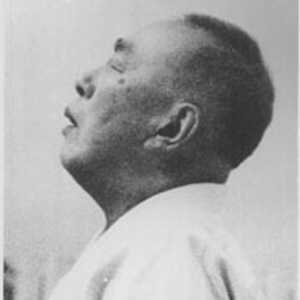
Here is the second of the Six Interviews of Itsuo Tsuda by André Libioulle, entitled ‘Breathing, a Living Philosophy’ and broadcasted on France Culture in the 1980s.
To read and/or to listen to.
(back to Broadcast N° 1)
BROADCAST N° 2
Q.: In this second week, we’re going to take a closer look at the books published by Itsuo Tsuda. They are all published by the “Courrier du Livre” in Paris, and there are currently six: The Non-Doing, The Path of Less, The Science of the Particular, a work entitled One, The Dialogue of Silence and recently The Unstable Triangle. They pertain to breathing and areas of thought related to breathing […]
The West has separated body and soul into clear-cut concepts. It has often aspired to the elevation of the soul but underestimated the body, considering it a place of temptation. For Plato, the soul is cramped inside its envelope of flesh, a prisoner of the body, but for a man like Itsuo Tsuda, it appears that the body is the prisoner of the soul. A soul that constantly manipulates abstractions and cuts itself off from the impulse of life. Increasingly, human beings live at a cerebral level. Society’s hopes rest on the intensive exploitation of the intellectual capacities, which it considers the privilege of human beings. But this cerebral hypertrophy creates a gap that is a source of imbalance between sensations, the body as life, as energy, as momentum, and the constructed, conceptualized, cerebralised world. Breathing is unification, a return to the self and, if we relax the separation between body and soul, if the soul ceases to be an abstraction, then it is everywhere; it is inside the body as well as outside it.
Well, the “ki”, that notion that we’ve touched upon in previous broadcasts, introduces us to the idea of unity. That’s what we’re going to try to understand now. It seems, Itsuo Tsuda, that the first step towards understanding ki is to recognise sensation in ourselves. This means not abstracting, not imagining ourselves as experiencing a sensation, but really being the sensation.
I. T.: There is a principle recognised in Chinese medicine: cold head and hot feet. Right now, the meaning is the other way round: hot head and cold feet. We don’t even feel our feet anymore. And then the head becomes hotter and hotter. There is a whole factor that contributes to this: Westernisation. But we can’t turn back. It is a longstanding tendency. And besides, there are obvious benefits that come from Westernization. But though it may help us at the material level, it puts us in a rather precarious position at an individual level. Individuals increasingly become prisoners of carefully-planned structures; they can no longer feel alive, feel themselves.
Q.: Moreover, you write that Europeans need to understand before they act. They do not jump straight into action.
I. T.: I don’t do things in the same way as things are done in Japan. Often in Japan we don’t explain things, we rush straight into the experience, and it’s up to each individual to learn the lesson, isn’t it? Well, in the West that doesn’t work. We need to understand things first. But understanding is not enough. No matter how many times I explain swimming to people who listen, it doesn’t help them dive into the water. If you have never experienced contact with water, you can fill your head with all sorts of explanations, but it’s of no use.
Q.: But people might argue: ‘what is the use of being close to my sensations? What’s in it for me ?’
I. T.: Well, precisely, there is the notion of “Seitai”, which Noguchi created after the war. At the moment, people think in dualistic terms: “there is good, and there is evil. Evil must be fought. Once we have fought evil, we will be left with the good”. But in fact, that is not the way we search; we normalise the terrain. This is what he called “Seitai”: the well-harmonised body. In the West, we try to find the cause; we try to exterminate the cause. Yet no sooner have we finished with one cause than others spring up. But that is the method that conforms to the mental structure. However, Noguchi presented this vision that is quite different, which transcends everything. If your organism is normalised, the same problem becomes less important. In the West we say: there is such-and-such a problem. It is defined, it does not change volume, it remains as is. You have to attack it in such-and-such a way, etc.
Q.: So, in short, for the West, there is an anatomical type of knowledge, a discursive type of knowledge, in which we distinguish between cause and effect, in order to act on one element or another. The notion introduced by Seitai is different. It is the notion of sensation. But if I understand correctly, it is a notion from which knowledge is not excluded. But it is another type of knowledge, an intuitive, a qualitative knowledge, let’s say, compared to the Western notion of measurement or quantification.
I. T.: The same problem increases or decreases in importance, depending on how it feels. A bottle is half empty or half full. But quantitatively, it’s exactly the same. However, the sensation differs, depending on the case. Then all it takes is one little thing to change the way people behave. If you say to yourself: ‘That’s it, I’m done for,’ from that moment on you can’t go any further. But if you say to yourself: ‘I’ve already taken three steps forward’, then you’re ready to take a fourth step, aren’t you?
Q.: Don’t you think there’s a notion presented by the West, that of totality or of wholeness but understood as an assembly of parts? With quality, we are also dealing with something global, but without the idea of assembly.
I. T.: In Seitai, we do not look at an individual as an assembly of different parts. That is the basic idea. An individual is an individual – total, yes? But, each is different in terms of movement, breathing, sensitivity. That’s what matters to us.
Q.: You’ve mentioned Master Noguchi several times. Could we not try to understand what globality and unity mean for an individual through a few examples from the practice of Master Noguchi, since Master Noguchi practised therapeutics? He was the creator of the Seitai method. What was his work like? What enabled him to grasp concrete, spontaneous things?
I. T.: For example, everyone has their own biological speed, which determines their behaviour, gait, movements etc. We think of it in a completely detached, objective way, so much per minute etc., etc., but for Noguchi, well, it is a concrete thing. Everything comes from this biological speed that is inherent in the individual. Without this notion of speed, he can do nothing. But this…
Q: … so here, the notion of speed has nothing to do with the notion of rapidity for example…
I. T.: … no, no …
Q.: … as we understand it? It is something else…?
I. T.: Yes. Contact must be established with the biological speed of that particular person. It’s not a general, objective speed. For example, a kid arrives screaming and crying because he’s broken his arm. The parents say, “It’s impossible to touch him, he just keeps crying…”. But Noguchi has already touched him. “Ah, well, then it’s because he doesn’t dare to cry in front of the master.” No, it’s not that. He touched the child at his biological speed, the speed of the child’s breathing, which is unique to him. That way, the child doesn’t feel the contact, it’s part of him, and that is so important.
Q.: You wrote that Master Noguchi, through observation and touch, was able to draw from the individual something like the notion of an unconscious movement.
I. T.: Yes, for him all movements are one hundred per cent unconscious. We believe just the opposite. We think we are the masters of ourselves, when in fact we can’t do very much, and we try to restrain ourselves. We remain composed in front of others, and so on. And then, one day the brakes fail, and then we wonder how that happened. For Noguchi, everything is unconscious, we are not the masters of ourselves.
Q.: Did Master Noguchi make a distinction between unconscious movement and posture?
I. T.: … but the posture is the realization of the unconscious movement.
Q.: So posture can be observed by everyone… from the outside, without any preparation, whereas unconscious movement requires preparation.
I. T.: If we envisage posture in a military sense, for example, “at attention”, then everyone tries to do more or less the same thing. But when you’re “at ease”, everyone is different.
Q.: What is the relationship between breathing and unconscious movement?
I. T.: There are people, for example, who have their breath cut short. When that happens, breathing comes from higher and higher up. Nowadays people breathe from the top of their lungs and finally, when they become weak, they breathe through the nose. What we’re doing is lowering the breath, so that we can breathe from the belly, or, if you like, from the feet. Without practice it is difficult to explain.
Q.: The concept of breathing is much broader than the notion of a simple biochemical operation. Breathing is life, it’s ki…, it is vitality, it is soul…
I. T.: Yes …
[end of Broadcast N° 2/6]
continue with Broadcast N° 3
Would you like to hear about the next article?