

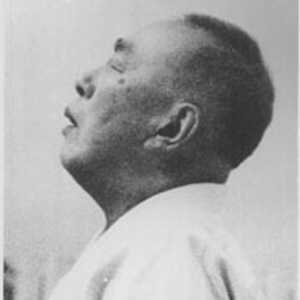
Here is the first of the Six interviews of Itsuo Tsuda by André Libioulle, entitled ‘Breathing, a Living Philosophy’ and broadcasted on France Culture in the 1980s.
To read and/or to listen to.
BROADCAST N° 1
Q: L’École de la Respiration was created by Itsuo Tsuda in Paris in 1973. However, the word “school” is not entirely appropriate and Master Tsuda never intended it to be a closed, exclusive teaching centre. On the contrary, his views remain entirely open. He is interested in other breathing disciplines and above all in the field of thought related to breathing.
Concretely, L’École de la Respiration is a ”Dōjō”, a particular kind of space in the East, which refers less to the material place itself than to the energetic space. […] Of course, movement is an individual matter; it is to be found in the inner space specific to each person. However, it is created through a certain state of relaxation and a whole atmosphere conducive to meditation. That’s why, for example, it is recommended that the Regenerating Movement be practised with the eyes closed. The dōjō is a spiritual more than a physical space, and therefore not a school in the usual sense. Itsuo Tsuda?
I. T.: It is not a school in the usual sense of the word. As I have written and published books under the imprint of “L’École de la Respiration (“the school of breathing”), I applied this name to the association. The association is independent from me. I am a guest, I am not the boss, and insofar as the association requires my presence, I accept, provided that the members carry out this personal endeavour themselves. I am not there as a boss who gives orders; that’s something you have to understand.
Q.: It is a “school”, in inverted commas, that is open to everyone. The Regenerating Movement is practised here “without knowledge, without technique and without purpose”. That’s a bit of a paradox for a school, isn’t it?
I. T.: Yes. Well, people have to be well motivated. Otherwise we refuse them. For example people who ask for therapy, etc., or who come with other intentions, we refuse. What we are doing is to exercise the extrapyramidal, that’s all. But we can’t throw ourselves into it all at once, can we? we don’t know what it is. When I give the workshop, I start by explaining the thing. Not explaining the extrapyramidal system in anatomical terms, but in relation to the life one leads in the Western context, and bring people back into another context that is natural. Which doesn’t mean that I’m against Westernization, it’s an irreversible thing. Japan is now westernised. But while accepting this conditioning, if you are determined, if you are motivated, you can get out of it and breathe freely, feel full and free.
Q.: Imagine someone entering L’École de la respiration: what can he expect? How will things work, concretely, in practice?
I. T.: They arrive and they sit roughly in a circle and I start to give a sort of talk. And there are people who don’t understand at all. At first almost no one does. But there are those who are attracted, who stay. But their heads are full of questions. And I refuse to answer. I say: “Wait a minimum of a year, two years if possible”. At the end of a year or two, the body changes, evolves and then they no longer know what to say and the questions have evaporated.
Q.: The people who come are not sick people, I mean they’re people who simply have a need for personal development, a need to feel better about themselves, usually..
I. T.: Well, the motivations are diverse. But what I ask for is practice without purpose. There is a psychiatrist who was attracted precisely because it is marked “without purpose”, because he knows from his own experience that this is extremely important. But for others it makes no sense; a practice without a goal is completely… crazy! That is one of the conditions that I insist upon. Otherwise people come and ask me all sorts of things and they go nowhere, they’re just banging their heads against the wall.
Q.: So at a certain point, people stop asking questions. What has happened inside them, what has changed so that all of a sudden, all the intellectual questions are resolved?
I. T.: Well, the body has evolved, sensations have evolved, so we don’t see the same thing from the same perspective. Before starting, such and such a thing is important; people think it’s absolutely necessary to ask me questions. But after a year or two, it becomes so obvious that they no longer need to ask questions.
Q.: But in the first stage, there’s a breathing practice, there are preparatory movements for another more fundamental movement that you call the Regenerating Movement. How does the preparation work?
I. T.: To tell the truth, you don’t need any preparation if you’re sensitive and not very complicated. But modern life doesn’t always allow you to be uncomplicated, so we need a bit of stimulus to get us going. You don’t need a memory, it’s something that arises from within, and it comes of its own accord.
Q.: So it’s more like an immediate, spontaneous reaction on the part of the person, and everyone has a particular reaction, everyone has a singular organic reaction that is unique to him or her.
I. T.: We can’t create a model for the Regenerating Movement, because each individual has his or her own movement and the movement of the same individual differs every day. That’s what they are going to find out for themselves. The difficulty is that people arrive with a head full of imaginings and it’s a real problem to get rid of these. They know thirty-six thousand methods that they mix up with the Regenerating Movement and which distort everything. I make sure that people don’t mix everything up, that’s the greatest difficulty.
Q.: Initially, it seems that people find it hardest simply to feel, to live in contact with their sensations. That’s what the Regenerating Movement brings.
I. T.: People say, “We’re not in the Middle Ages anymore”. Well, what’s the difference between the Middle Ages and now? Gestation still takes nine months; that hasn’t changed. Only, in the Middle Ages there was neither radio nor television. Only the means have changed. But the body, on the contrary, has become weaker. There are many people who are neither completely alive nor completely dead. They are in a kind of twilight,, without feeling. What we’re doing is not adding something extra, but going “back to the source”, which allows us to really feel what’s happening every day, at every moment. That’s what has been completely neglected. All we do is schedule, plan things with a view to what’s going to happen in a year’s time, in three years’ time, and so on. But what are you doing now, what are you feeling now? That we do not know.
Q.: Master Tsuda, the people who come to you come because they feel the need, let us say, for a personal evolution. But people come to work on themselves and they come with spontaneous body tendencies. In several of your books, you’ve mentioned a concept known as “taiheki“.
I. T.: It’s a concept that is also quite difficult to explain. In our modern lives, the body’s activities become increasingly specialised. Some people need their eyesight, their hearing, their brains, and so on. Athletes need their muscles. Because of this specialisation, we are more or less deformed. The channelling of energy becomes specialised. We cannot all of a sudden change direction. We’re always on the same channel.
Q.: You talk about the polarisation of energy…
I. T.: … Yes, polarisation if you like; channelling. And we think we can control all that, but it’s difficult indeed. That’s why we need to normalise the terrain, so that we can use all our pawns, if you will. For example, one woman told me that before doing the Movement, she didn’t know whether her feet were hot or cold, she had to take off her shoes and then touch her feet with her hand so she could say, “ah! yes, my feet are hot or cold”. But now she doesn’t need to do that anymore, she can feel directly. Sensation doesn’t work in most people.
Q.: Most people are desensitised…
I. T.: … desensitised either in the feet or in the legs, etc.
Q.: And by being desensitised, people are cut off from themselves.
I. T.: Yes, they are fragmented, they are compartmentalised. They see the world through this very, very narrow perspective.
Q.: Your desire is to put people in touch with themselves, with their sensations, and thereby even with “ki”’, that notion that evades all concepts, a moving notion: qualitative, not quantitative. The truth of science is quantitative, but the truth of the Movement is always particular, always concrete.
I. T.: We come into the world with no knowledge, with no explanation. How is it that a newborn baby can turn white milk into yellow poo? The baby has no knowledge. Well, at that very moment, the absence of knowledge allows everything to work. We have to be able to get to that point. Except with adults, the problem presents itself in a different way, because we cannot imitate a baby. If there are a lot of things that come to the surface of the conscious mind, that’s precisely why we are in the state of “heart of pure sky”. When we are very busy, we don’t even think about it. That is the return to the source, which is different from what happens with a newborn.
Q.: Will the people who come to you later become practitioners of the
Regenerating Movement, or is it just a practice they follow for the sake of their own well being?
I. T.: That’s up to them, isn’t it? I don’t say anything. If they want to do it, they do it, that’s all. But if people aren’t truly motivated, things just fall apart. And if they’re really motivated, little by little their horizons open up. So, as to how far they will go, for the moment I can’t say.
[end of Broadcast N° 1/6]
continue with Broadcast N° 2
Would you like to hear about the next article?

‘Is biological and cultural extinction underway?’
[Sept. 21] Marc-André Selosse is a biologist and professor at the Natural History Museum and teaches at several universities in France and abroad. His research focuses on mutually beneficial associations (symbiosis), and his teaching focuses on plants, microbes, ecology and evolution. In 2020, just before the first lockdown, Tenshin dōjō (Paris) was due to host him for a lecture on microbiota. Due to circumstances, this lecture could not take place, but we hope to be able to make this invitation a reality as soon as possible. In the meantime, we invite you to (re)discover his fascinating work through two videos and the article we wrote about his book Never Alone (in French) and its points of convergence with Seitai.
Marc-André Selosse : ‘Is biological and cultural extinction underway?’
[excerpt]
‘The biological microbiota within us is in poor health, it is shrinking and directly affecting our health: we suffer from these “diseases of modernity”, which affect our immune system (allergies, asthma, autoimmune diseases, etc.), our nervous system (Alzheimer’s, Parkinson’s, autism, etc.), and our metabolism (diabetes, obesity, etc.). We have observed that the microbiota is less diverse in sick individuals than in healthy individuals. By 2025, these diseases of modernity, linked to the decline of our microbiota, will affect 1 in 4 Europeans.’
To continue, click on the video:
Presentation at the symposium organised by the Fondation pour la Biodiversité Fromagère [Foundation for Cheese Biodiversity] on 14 September 2021 as part of the Mondial du Fromage [World Cheese Fair] in Tours (France).
Marc-André Selosse, Medicine in the Face of Evolution
Marc-André Selosse answers questions from the Yvelines Medical Council
What binds us together: microbiota and human terrain
by Fabien R. (February 2020)
Since the dawn of civilisation, microbes have shaped our diet, enabling food (bread, cheese, wine, vegetables, etc.) to be preserved and consumed. Domesticated empirically for thousands of years, the microorganisms involved in these processes were only identified relatively recently, less than 200 years ago.
And it is only even more recently that scientists have begun to study the microbiota, i. e. all the bacteria, fungi, viruses, etc. that are harboured by a host organism (e. g. a human being) and live in a specific environment of that host, such as the skin or stomach.
Most of us are unaware that our lives depend on a close association, called symbiosis, that we naturally establish with tens of billions of bacteria that populate the surface of our bodies and even the depths of our intestines. We consider ourselves to be above and independent of all this microbial influence, with the notable exception of people with colds, who often hear the phrase, ‘Ah, but don’t give me your germs!’ The microbiota is therefore considered, at best, only for or in terms of its pathogenic potential.
This now outdated but still omnipresent view of microbes as harmful has profoundly influenced our relationship with nature, our bodies and, more broadly, life itself. Whether it be pesticides in agriculture or antibacterial soaps and disinfectant gels on our skin, these products indiscriminately eliminate both beneficial and harmful microorganisms, creating conditions that impoverish the soil – both in our fields and in our mucous membranes.
These hygienist actions, repeated over time, starting at birth, prevent the human immune system from maturing, so that later on it will no longer be able to recognise the body of which it is a part, or will have disproportionate reactions. Our era is also one of autoimmune diseases and allergies.1Marc-André Selosse, Jamais seul — Ces microbes qui construisent les plantes, les animaux et les civilisations [Never Alone — The Microbes That Build Plants, Animals and Civilisations], 2017, pub. Actes Sud (Arles, France), p. 185
The Seitai principles, in the work of Haruchika Noguchi2See the work of Itsuo Tsuda (9 volumes), available from pub. Courrier du Livre (Paris), and Haruchika Noguchi, 3 books in English available from Zensei Publishing, start from a radical point of view: intuitive rather than analytical. Based on his thirty years of experience as a healer, H. Noguchi abandoned the idea of therapy in the 1950s because he had observed that it weakened individuals’ bodies and made them dependent on the practitioner. This led him to consider health in a completely different way, acknowledging that the body’s reactions are manifestations of an organism responding to restore its balance.
‘Illness is natural, the body’s effort to recover lost balance.’ ‘It is good that illness exists, but people must avoid becoming enslaved to it. This is how Noguchi happened to conceive of the notion of Seitai, the normalisation of the terrain, if you will.’ 3Itsuo Tsuda, The Dialogue of Silence, Chap. IX, Yume Editions, 2018 (1979), pp. 75 & 76
This rebalancing is the work of the involuntary system; it does not depend on our will. It causes symptoms that involve the microbiota. For example, the flows that expel harmful germs from the body (colds, diarrhoea)4Never Alone (op. cit.), p. 156, the regulatory function of fever, or the antibiotic function of iron deficiency in pregnant women.5 See the blog article Marc-André Selosse: La disparition silencieuse des SVT [M.-A S.: The Quiet Disappearance of Earth and Life Sciences], Café pédagogique [Pedagogical Coffee], 7 May 2019

The Seitai philosophy has the distinctive feature of viewing human beings as an indivisible whole. There is no separation between the psychological and the physical. The word seitai (整体) translates as ‘normalised terrain’. H. Noguchi‘s concept of terrain is comprehensive. It partly overlaps with the concept of microbiota. For us, the latter is like the soil surrounding the roots of a tree; it is Nature living in harmony and collaboration within each of us, without us even being aware of it. That is why we are never alone.
Whether we consider microbes to be harmful and fight them, or take advantage of their help and collaborate with them naturally, is a question of inner orientation. Favouring excessive hygiene or promoting what Mr. Selosse calls ‘clean dirt’6Never Alone (op. cit.), p. 156 and p. 197 is part of this same choice. The expression ‘cultivating one’s garden’7ibid., p. 169 takes on a new and concrete meaning. It all depends on us.
Where instinct has disappeared, scientific discoveries must be made available. Although self-taught, H. Noguchi was fully aware of the science of his time. This fuelled his reflections and intuitions. In this same spirit, we are honoured to welcome Prof. Marc-André Selosse, who will present the latest discoveries on the human microbiota and engage in a discussion with the audience.

Notes
- 1Marc-André Selosse, Jamais seul — Ces microbes qui construisent les plantes, les animaux et les civilisations [Never Alone — The Microbes That Build Plants, Animals and Civilisations], 2017, pub. Actes Sud (Arles, France), p. 185
- 2
- 3Itsuo Tsuda, The Dialogue of Silence, Chap. IX, Yume Editions, 2018 (1979), pp. 75 & 76
- 4Never Alone (op. cit.), p. 156
- 5See the blog article Marc-André Selosse: La disparition silencieuse des SVT [M.-A S.: The Quiet Disappearance of Earth and Life Sciences], Café pédagogique [Pedagogical Coffee], 7 May 2019
- 6Never Alone (op. cit.), p. 156 and p. 197
- 7ibid., p. 169

What Binds Us Together: Microbiota and Human Terrain
On 30 November 2022, Tenshin dōjō in Paris will welcome biologist Marc-André Selosse for a lecture entitled: The Human Microbiota: From Our Bodies to Our Civilisations.
Here we offer you a reading of his book Never Alone (in French) and its points of convergence with Seitai.
What binds us together: microbiota and human terrain
Since the dawn of civilisation, microbes have shaped our diet, enabling food (bread, cheese, wine, vegetables, etc.) to be preserved and consumed. Domesticated empirically for thousands of years, the microorganisms involved in these processes were only identified relatively recently, less than 200 years ago.
And it is only even more recently that scientists have begun to study the microbiota, i. e. all the bacteria, fungi, viruses, etc. that are harboured by a host organism (e. g. a human being) and live in a specific environment of that host, such as the skin or stomach.
Most of us are unaware that our lives depend on a close association, called symbiosis, that we naturally establish with tens of billions of bacteria that populate the surface of our bodies and even the depths of our intestines. We consider ourselves to be above and independent of all this microbial influence, with the notable exception of people with colds, who often hear the phrase, ‘Ah, but don’t give me your germs!’ The microbiota is therefore considered, at best, only for or in terms of its pathogenic potential.
This now outdated but still omnipresent view of microbes as harmful has profoundly influenced our relationship with nature, our bodies and, more broadly, life itself. Whether it be pesticides in agriculture or antibacterial soaps and disinfectant gels on our skin, these products indiscriminately eliminate both beneficial and harmful microorganisms, creating conditions that impoverish the soil – both in our fields and in our mucous membranes.
These hygienist actions, repeated over time, starting at birth, prevent the human immune system from maturing, so that later on it will no longer be able to recognise the body of which it is a part, or will have disproportionate reactions. Our era is also one of autoimmune diseases and allergies.1Marc-André Selosse, Jamais seul — Ces microbes qui construisent les plantes, les animaux et les civilisations [Never Alone — The Microbes That Build Plants, Animals and Civilisations], 2017, pub. Actes Sud (Arles, France), p. 185
The Seitai principles, in the work of Haruchika Noguchi2See the work of Itsuo Tsuda (9 volumes), available from pub. Courrier du Livre (Paris), and Haruchika Noguchi, 3 books in English available from Zensei Publishing, start from a radical point of view: intuitive rather than analytical. Based on his thirty years of experience as a healer, H. Noguchi abandoned the idea of therapy in the 1950s because he had observed that it weakened individuals’ bodies and made them dependent on the practitioner. This led him to consider health in a completely different way, acknowledging that the body’s reactions are manifestations of an organism responding to restore its balance.
‘Illness is natural, the body’s effort to recover lost balance.’ ‘It is good that illness exists, but people must avoid becoming enslaved to it. This is how Noguchi happened to conceive of the notion of Seitai, the normalisation of the terrain, if you will.’ 3Itsuo Tsuda, The Dialogue of Silence, Chap. IX, Yume Editions, 2018 (1979), pp. 75 & 76
This rebalancing is the work of the involuntary system; it does not depend on our will. It causes symptoms that involve the microbiota. For example, the flows that expel harmful germs from the body (colds, diarrhoea)4Never Alone (op. cit.), p. 156, the regulatory function of fever, or the antibiotic function of iron deficiency in pregnant women.5 See the blog article Marc-André Selosse: La disparition silencieuse des SVT [M.-A S.: The Quiet Disappearance of Earth and Life Sciences], Café pédagogique [Pedagogical Coffee], 7 May 2019
The Seitai philosophy has the distinctive feature of viewing human beings as an indivisible whole. There is no separation between the psychological and the physical. The word seitai (整体) translates as ‘normalised terrain’. H. Noguchi‘s concept of terrain is comprehensive. It partly overlaps with the concept of microbiota. For us, the latter is like the soil surrounding the roots of a tree; it is Nature living in harmony and collaboration within each of us, without us even being aware of it. That is why we are never alone.
Whether we consider microbes to be harmful and fight them, or take advantage of their help and collaborate with them naturally, is a question of inner orientation. Favouring excessive hygiene or promoting what Mr. Selosse calls ‘clean dirt’6Never Alone (op. cit.), p. 156 and p. 197 is part of this same choice. The expression ‘cultivating one’s garden’7ibid., p. 169 takes on a new and concrete meaning. It all depends on us.
Where instinct has disappeared, scientific discoveries must be made available. Although self-taught, H. Noguchi was fully aware of the science of his time. This fuelled his reflections and intuitions. In this same spirit, we are honoured to welcome Prof. Marc-André Selosse, who will present the latest discoveries on the human microbiota and engage in a discussion with the audience.
Notes
- 1Marc-André Selosse, Jamais seul — Ces microbes qui construisent les plantes, les animaux et les civilisations [Never Alone — The Microbes That Build Plants, Animals and Civilisations], 2017, pub. Actes Sud (Arles, France), p. 185
- 2
- 3Itsuo Tsuda, The Dialogue of Silence, Chap. IX, Yume Editions, 2018 (1979), pp. 75 & 76
- 4Never Alone (op. cit.), p. 156
- 5See the blog article Marc-André Selosse: La disparition silencieuse des SVT [M.-A S.: The Quiet Disappearance of Earth and Life Sciences], Café pédagogique [Pedagogical Coffee], 7 May 2019
- 6Never Alone (op. cit.), p. 156 and p. 197
- 7ibid., p. 169

The Philosophy of Non-Doing. Meeting with Manon Soavi
[Jun. 23] Interview with Manon Soavi for the release of Itsuo Tsuda, The Anarchist Master — The Art of Living Utopia, published by L’Originel (Obernai, France). Interview conducted by Jean Rivest for the Réseau Vox Populi channel in Montreal on 20 May 2023.

Manon Soavi is an aikidōka and martial arts teacher in the Itsuo Tsuda School in Paris. Her entire childhood was steeped in the philosophy of Non-doing developed by Itsuo Tsuda, whom her parents met in the 1970s. This philosophy, along with the practice of Aikidō and Seitai (the Regenerative Movement), became an integral part of their daily lives. Manon Soavi never attended school, and began practising Aikidō at the age of six and studying classical piano at the age of eleven. As an adult, Manon Soavi complemented her martial arts practice with Japanese sword and jūjutsu; she also worked as a concert pianist and accompanist for over ten years. At the same time, she began teaching Aikidō and the philosophy of Non-doing herself. Today, she devotes herself entirely to passing on this knowledge.
Itsuo Tsuda, The Anarchist Master — The Art of Living Utopia. Published (in French) by L’Originel – Charles Antoni1reunified since 2025 within French publisher L’Originel (Obernai) (2022, France).
Would you like to hear about the next article?
Notes
- 1reunified since 2025 within French publisher L’Originel (Obernai)

I Go Rediscovering Freedom
The search for inner freedom in the practice of Aikidō and Seitai
by Andrea Quartino
Restrictions on freedom of movement are easing [May 2020 lockdown], although the timing and manner remain uncertain. For those who practise Aikidō in a dojo of the Itsuo Tsuda School, the day when they will be able to resume practising does not seem to be near. Beyond the different opinions on the cause of the emergency, the restrictions decided by governments should not limit our ability to judge. It is normal to maintain a critical view of the effectiveness and consequences of such measures while applying them.
Seitai founder Noguchi Haruchika did not shy away from talking about freedom during a period such as that experienced by Japan during the Second World War, when markedly nationalist and militaristic tendencies prevailed to such an extent that the word “freedom” was banned. Of course, he could count on the fact that he had several representatives of the ruling class among his clients.
The end of the war for Italy on 25 April 1945 was a relief for everyone, as was the fall of fascism, even for those who shared that ideology. The same relief was felt by many Japanese.1Tsuda Itsuo, Heart of Pure Sky (posth.), ‘Booklet no. 183’ (end), Yume Editions, 2025. See also Itsuo Tsuda. Calligraphies de printemps [Itsuo Tsuda, Spring Calligraphies], Yume Editions, 2017, p. 399 It was not only the return of peace and more or less formal freedom, but also the end of a climate of constant tension, which was felt everywhere and to which no one was immune. Allowing for the necessary differences, and net of the perplexities aroused by the war metaphors used by many when talking about the effort to contain the contagion, anyone with a modicum of sensitivity cannot fail to feel how everything and everyone is permeated by mistrust and fear, whether caused by the virus or by the penalties imposed for violating the rules. It is a very heavy oppression, and we too will feel relief when and if it ends.
“Why did I talk so much about freedom during the war?” he said, “it was just words. On the contrary, I was just stuck in my attitude. The more I tried to fight the trend, the more I became locked into a narrow frame of mind, unable to breathe deeply.” ’2Tsuda Itsuo, One, Chap. IX, Yume Editions, 2016, p. 67. The following lines state that ‘[a] truly free man does not discuss freedom, just as a healthy man does not think about health.’ These very words seem to be echoed by Chinese poet Bai Juyi’s verses: ‘Those who speak do not know. Those who know do not speak.’ Tsuda also traced these verses in three of his calligraphies (see Itsuo Tsuda, Calligraphies de printemps (op. cit.), p. 284), quoted them verbatim in The Non-Doing (Chap. XVII, 2013, Yume Editions, p. 180), and evoked them in The Way of the Gods (‘I work in the hope […] another kind of freedom.’, Chap. VII, Yume Editions, 2021, pp. 53–4).
Why was this freedom nothing more than a word for Noguchi? Had he perhaps changed his opinion about the nature of the wartime regime? It is unlikely, but that is beside the point. The question is what we mean by freedom.
Tsuda Itsuo returns repeatedly in his books to the idea of freedom
For Tsuda, modern man ‘has fought some tough battles to acquire his right as a Man. He has obtained some liberties and keeps on struggling to acquire more. But one day he finds that these liberties only concern material conditions external to him.’3Tsuda Itsuo, The Non-Doing, Chap. I, Yume Editions, 2013, p. 15 So human beings often fight for freedoms in the plural, which are conditioned. ‘The fixation of ideas that guides us in the organisation of life, can also work against us by imposing unpredictable constraints upon us. Freedom becomes a fixation that fetters us. The more freedom one has, the less one feels free. Freedom is a myth.’ ‘We struggle against constraints to acquire freedom. Freedom gained never fails to produce other constraints. There does not seem to be any definitive solution. For the freedom we seek is primarily a conditional freedom. We do not possess any idea of absolute and unconditional freedom.’4One, op. cit., Chap. III, p. 24
“Conditional freedom”, almost an oxymoron, if this phrase were not used in law language. We are conditioned by the linear time of clocks, by the social organisation of work and by the market that urges us, with increasingly sophisticated and invasive advertising techniques, to satisfy needs that are mostly induced. Among the abundance of things on offers, available online or otherwise, ‘we find everything except desire. So we choose the chef’s recommendation, the advice of people who aren’t paying for the meal, the seductions of advertising, the clamour of the opinion leaders.’ ‘Certainly we have the freedom to choose, but it is a negative freedom: the freedom to accept or reject what on offer. As for the positive freedom, that of creating, we have neither the intuition nor continuity to enjoy it.’5Tsuda Itsuo, The Science of the Particular, Chap. IX, Yume Editions, 2015, p. 76

Tsuda points out the possibility of “letting go” of everything that is apparent freedom, choices imposed on us by the market, consumable goods, marketable goods, however difficult this may be for civilised man, who is afraid of losing everything if he renounces his possessiveness. By letting go, we can ‘finally see the All that is ours; the sky, the earth, the sun, the mountains and rivers, without our having to put them in our pocket.’ We may feel ‘the desire to know true freedom.’ ‘Nothing external, such as money, honour and power, can bring us true Freedom, which is an inner sensation and does not depend on any material or objective condition. One can feel free under the worst kind of duress, and a prisoner at the pinnacle of happiness.’ 6Tsuda Itsuo, The Dialogue of Silence, Yume Editions, 2018, pp. 85-6
The deep desire for another kind of freedom arises together with an inner conviction, which in reality is rediscovered, found again because it has been in every human being since the beginning, since conception. But its rediscovery is not possible as long as we remain on the “path of acquisition” that is the norm in our society, where ‘[a]ll these accumulations weigh heavily on our destiny.’
This conviction is a natural thing that exists in all human beings right from the start. It is not a product thrown together after the fact. But it will remain veiled for as long as we live in a climate of dependency. It isn’t worth it, says Noguchi, to help people who do not want to stand on their own two feet. If we release them, they fall down again.’7One, op. cit., Chap. VI, p. 47
It was this awareness that led Noguchi, when he found another freedom, a deeper breathing and calm at the end of the Second World War, to give up therapy and devote himself to awakening people, allowing each individual to rediscover their inner freedom in the times and ways that suit them.
How can practising arts such as Aikidō and Katsugen undō guide us in rediscovering our individual freedom?
One answer can be found in the words of Taichi Master Gu Meisheng:
‘Can “true naturalness” only be acquired through long and diligent practice? Are you like a child? Because only children are spontaneously natural and free at the same time. In fact, if you have not become like a child again, you are neither free nor natural. […] Usually, for an ordinary person, the body is an obstacle, not a driving force from which spiritual momentum can be drawn. Yet, thanks to very long training combined with diligent and rigorous practice, it is possible to liberate this ordinary person and allow them to act with wonderful, creative spontaneity. Then neither the body, nor the outside world, nor the many ties that bind him to the world constitute an obstacle for him. I first experienced this feeling of freedom in 1970 when I was in prison, and this freedom grew progressively throughout my imprisonment.’8La vision du Dao du professeur Gu Meisheng (video), no longer available – words probably inspired by this part 5 (French) video at the end (‘when I was in prison, in the 1970s’)
The words of Master Gu, who was imprisoned during the Chinese Cultural Revolution, apply equally to Tai Chi, Aikidō and Katsugen undō, and echo those of Tsuda when he says that one can be free even under the greatest constraints. And if the constraints we live under today are not those of a prison, they are nonetheless an opportunity to rediscover our inner freedom9The title refers to the passage from Dante Alighieri‘s Divine Comedy, ‘He goes seeking freedom’, in originale « Libertà va cercando », even giving ourselves the chance to practise alone when there is no dojo available. This discovery is not exclusive to great masters such as Master Gu, Master Noguchi or Master Tsuda, and although it is an individual quest that is pursued through continuous practice, we can begin here and now to be free as human beings, because “being free makes others free”10cf. the video and interview Manon Soavi, Being Free Makes Others Free.
Andrea Quartino
Notes
- 1Tsuda Itsuo, Heart of Pure Sky (posth.), ‘Booklet no. 183’ (end), Yume Editions, 2025. See also Itsuo Tsuda. Calligraphies de printemps [Itsuo Tsuda, Spring Calligraphies], Yume Editions, 2017, p. 399
- 2Tsuda Itsuo, One, Chap. IX, Yume Editions, 2016, p. 67. The following lines state that ‘[a] truly free man does not discuss freedom, just as a healthy man does not think about health.’ These very words seem to be echoed by Chinese poet Bai Juyi’s verses: ‘Those who speak do not know. Those who know do not speak.’ Tsuda also traced these verses in three of his calligraphies (see Itsuo Tsuda, Calligraphies de printemps (op. cit.), p. 284), quoted them verbatim in The Non-Doing (Chap. XVII, 2013, Yume Editions, p. 180), and evoked them in The Way of the Gods (‘I work in the hope […] another kind of freedom.’, Chap. VII, Yume Editions, 2021, pp. 53–4).
- 3Tsuda Itsuo, The Non-Doing, Chap. I, Yume Editions, 2013, p. 15
- 4One, op. cit., Chap. III, p. 24
- 5Tsuda Itsuo, The Science of the Particular, Chap. IX, Yume Editions, 2015, p. 76
- 6Tsuda Itsuo, The Dialogue of Silence, Yume Editions, 2018, pp. 85-6
- 7One, op. cit., Chap. VI, p. 47
- 8La vision du Dao du professeur Gu Meisheng (video), no longer available – words probably inspired by this part 5 (French) video at the end (‘when I was in prison, in the 1970s’)
- 9The title refers to the passage from Dante Alighieri‘s Divine Comedy, ‘He goes seeking freedom’, in originale « Libertà va cercando »
- 10cf. the video and interview Manon Soavi, Being Free Makes Others Free

The Session of Katsugen Undô #6
In this sixth part, Régis Soavi describes a session of Katsugen undō (translated as Regenerative Movement).
Subtitles available in French, English, Italian and Spanish. To activate the subtitles, click on this icon

Would you like to hear about the next article?
Some additional information
Seitai was developed by Haruchika Noguchi (1911-1976) in Japan. Katsugen Undo (or Regenerating Movement) is an exercise of the extrapyramidal motor system that is part of Seitai. Itsuo Tsuda (1914-1984), who introduced Katsugen Undo in Europe in the 70s, would write about it: ‘The human body is endowed with a natural ability to readjust its condition […]. This ability[…] is the responsibility of the extrapyramidal motor system.’ 1Itsuo Tsuda, One, Chap. VI, 2016, Yume Editions, p. 46 (1st ed. in French: 1978, Le Courrier du Livre (Paris)
Excerpts from the video on Yuki
It’s simplicity itself. We always want to add lots of things because when it’s too simple, we feel like it’s not working.
We’ll invite people to do two or three exercises. One exercise will relax the solar plexus area. Here, we exhale deeply. It’s like a kind of artificial yawn. So it’s a voluntary exercise. A kind of artificial yawn. We relax the solar plexus area.
One of the second exercises we do, for example to trigger individual movement, would be “spinal rotation.” Well, here it’s about regaining a little flexibility. I see people today with aging bodies, their spine is completely blocked, they can no longer turn around. They have to turn their whole body to look behind them. Whereas all they need to do is rotate their spine. But very often, even in people in their thirties, the spine is blocked. So this is an exercise that relaxes the body. That’s the second exercise.
And the third exercise, which is a little more complicated, involves putting your thumbs inside your closed fists and pulling everything back. Okay. It’s difficult to show you like this, you really need someone to show you more precisely. That’s why there are organized workshops. That’s for individual movement.
And then what do we do? Nothing! We do nothing. We let the body trigger the movement. If we do the individual movement, it’s very simple. You can do it anywhere. It can be very discreet. It’s not about starting to scream… It’s not something that’s very visible. It’s extremely discreet. There is no noise during a movement session. Sometimes there are slight noises, almost nothing. So that’s the individual movement.
And then in the dojos, during the week, that is, two or three times a week, depending on the dojo, we practice the mutual movement. So there we simply do the plexus exercise and add a few concentration exercises, such as breathing through the hands, Yuki, the activation chain, all of which allow the bodies to be ready to let the movement be triggered. However, the triggering itself will be done by activating the second points of the head. I can’t demonstrate it like that. By activating the second points of the head, in a way, the voluntary system will go into rest mode. And it is the involuntary system that will take over, that will lead.
So what does that mean? It doesn’t mean that suddenly we’re brainless and don’t understand anything anymore. When we eat, for example, it’s the digestive system that suddenly, when it was quiet and doing nothing, suddenly starts to activate. All kinds of gastric juices are produced, the stomach starts working, the intestines work harder, etc. That doesn’t mean we stop thinking. At most, we feel a little drowsy. The drowsiness that comes with digestion, or when we’ve eaten well, we feel a little… ah, there it is. Because the involuntary digestive system has been activated. It’s not because this digestive system has been activated that there is nothing else. Here too, when we do the regenerative movement, the voluntary movement is at rest, we don’t think about it anymore, we close our eyes, we let the body move according to its needs.
And then, because the body is in an involuntary state, it can do things that it doesn’t usually do, or that it has somewhat neglected. And so it starts to move. That’s why we do it in a dojo, because it does things that can sometimes seem incongruous. For example, if you do movements like this on the subway, people might think, “Oh dear, that guy’s a bit weird…” But in the dojo, we’re relaxed, our eyes are closed, no one is watching us, it’s a bit like being at home. The movement we practise in the dojo is a training. We often say it’s training for the extrapyramidal motor system, but it’s not just that. It’s training because our bodies have weakened, because we have trouble reacting, so we retrain ourselves. It’s a bit like someone who can no longer walk. At a certain point, even the smallest step is difficult: going from the kitchen to the bathroom is difficult for them. So from the moment they start walking again, their body will start to function better. It’s the same thing with involuntary movement.
And at some point, of course, since this is training, it’s within a given time frame. We also have to stop that time at some point. That is to say, during the session, we did the training, we let the movement be triggered, then we stop the movement. Here again, there is an exercise very similar to the first one to stop the individual movement. We stop the movement. Then we lie down for a few minutes. And we come back, we resume the voluntary system, which will act again.
So we let the individual movement act completely as it needed to, on its own, for a certain amount of time, and then we return to our normal daily life. And so, the body will now regain its involuntary abilities. We will allow the involuntary to work more than before in everyday life. Because the body will say, “Hey, I need this,” and it will trigger another type of work. So again, there are exercises that allow the involuntary system to be trained, and then there is everyday life. We are not in the involuntary state all the time. We work, we do a lot of things with the voluntary system. But since the involuntary system works underneath, the body remains normal.
Notes
- 1Itsuo Tsuda, One, Chap. VI, 2016, Yume Editions, p. 46 (1st ed. in French: 1978, Le Courrier du Livre (Paris)

At the Core of Movement – the Involuntary
by Régis Soavi
‘If I have to give my Aikido a goal, it will be to learn to sit, stand up, move forward and backward.’1Tsuda Itsuo, The Path of Less, Chap. XVIII, 2014, Yume Editions, p. 174 (1st ed. in French: 1975, Le Courrier du Livre (Paris), p. 166 Tsuda I.
Movement: coordination, posture
To move correctly, you need to be stable, and stability issues cannot be resolved through learning. Stability must come from balance, which itself comes from the involuntary system. Human beings have the unique ability to stand upright with only the tiny surface area of their two feet as support. If it were just a matter of standing still, that would be fine, but we move around, and what is more, we are able to talk, think, move our arms in all directions, as well as our head and fingers, all while remaining perfectly stable. Involuntary muscle coordination takes care of everything. If we lose our balance without being able to hold on to anything, our body tries by all means to regain the lost balance, and often succeeds by shifting weight from one leg to the other, finding extremely precise points of support that we would have had difficulty finding using only our voluntary system. Tsuda Itsuo recounts a personal anecdote about his learning of Aikido that I find edifying in his book The Science of the Particular:Read more
Notes
- 1Tsuda Itsuo, The Path of Less, Chap. XVIII, 2014, Yume Editions, p. 174 (1st ed. in French: 1975, Le Courrier du Livre (Paris), p. 166

The Art of the Hot Bath in Seitai
by Régis Soavi
While the West has almost entirely converted to the shower, despite the importance the bath has had over the centuries, the East and in particular Japan seems to be taking the same direction. In spite of a renewed interest due to a fashion that has touched the young Japanese, it turns out that the elderly are, almost solely, the only people who retain an attachment to what could be called “an ancestral way of life”. In Seitai, what makes the bath special is that Noguchi Haruchika sensei had made it one of the elements of the terrain normalisation and it was part of the training for the uchi deshi.

Tsuda Itsuo senseï
It is Tsuda Itsuo sensei who, thanks to his books and especially in his fourth volume entitled One, introduced the Seitai hot bath practice in Europe as soon as the early seventies. A seitai technician, who had studied and worked with Noguchi Haruchika sensei during more than twenty years, he started as soon as he arrived from Japan to make known what he translated by the Regenerating Movement: Katsugen Undo.
It was already a bit of a revolution to make a little group of French and Swiss people experience this “exercise of the involuntary system”, to have them admit that it was possible to practice – as he recommended – ‘with no knowledge, no technic, no aim’, but Tsuda sensei did not stop there. He started a long work of education, but also of clarification, which encouraged students to think and experiment by themselves instead of following beaten tracks, ideas or protocols. At the beginning, to concretise this immense work, he published booklets of a few photocopied pages which we used to call “Mr Tsuda‘s notebooks”. It is these notebooks, which we would discover more or less every month, which later became the chapters of his books.
It is on the occasion of a Regenerating Movement workshop, during one of his conferences he would call ‘little causeries,’ that he started to talk about the hot bath. We had no idea of what he taught us, many of us visualized something that was closer to a sauna or hammam. As usual with what he would make us discover, it took him years to get his message through. To admit that a bath did not merely consist in washing oneself to be clean but could have other qualities, as well as other consequences, did not appear to us, young French people, as something obvious.
The bath in daily life
‘Seitai, the normal terrain, means that we constantly maintain the feeling of well-being we have after a hot bath’ 1 Tsuda sensei used to tell us. To apprehend Seitai, I therefore had to discover this sensation, keystone of the understanding, and this would at least pass through the discovery of the hot bath!
In Europe, there are no or very few Sento2, Ofuro3, and even less Onsen4, and discovering the Japanese hot bath was already not a simple thing, but understanding what makes the Seitai bath something special, that turned out to be a challenge. In order to have the chance to be introduced with simplicity to the art of the hot bath, one needs to know someone who has already had the opportunity not only to discover it, for instance during a stay in Japan, but also and especially to have made it a daily practice.
What difference is there between a “normal” bath and the hot bath, in particular in Seitai? In the West the purpose of the bath is often washing, or, at best, relaxation, rarely is it precise regarding temperature, but in general it is rather mild and one can lounge in it and stay in the water for a rather long time. In this kind of bath, the water cools down rather quickly of course, but this is not a problem because at the moment when we find it too lukewarm we get out of the bath and that’s it. One of the basic elements to understand the Seitai vision of the bath is obviously the hot bath as it is practised in Japan, and for a Japanese it is way much simpler from the beginning. But this is not enough because the Seitai bath has many specificities which distinguish it from the traditional Japanese bath. Noguchi sensei himself often regretted the lack of understanding his students would show when he gave conferences about the Seitai bath in which he explained its purposes and beneficial effects.
An abyss of details, particularities, divide these two ways of taking the bath. The preparation of the Seitai hot bath requires an attention, which we – many of us – have lost the habit of exerting, and which, for what concerns us, does not usually apply to the bath anyway. The concentration required for its preparation can from the start discourage many people who are no longer accustomed to making use of this capacity outside their work, or who only resort to it during their youth when they are studying. Many students show a lot of enthusiasm at the beginning, but they rapidly get tired of the repetitive aspect and often quickly find another topic of interest that better satisfies their superficial and light side, acquired in a world that often favours this aspect only.
The bath – user guide
It is almost impossible in France to have a ready for use bathtub, always full with lukewarm water, that we would only need to warm up, as it exists in Japan. The first move therefore consists in filling it with hot water, and according to the room temperature, the tension, the tiredness we feel, the atmosphere of the house, the quantity will differ to allow us, after adding a little cold water, to obtain the desired temperature. We do not a priori and peremptorily adjust the thermostat according to an idea or a protocol. The bath temperature is never an objective value. Although it is measurable, it still remains entirely subjective and depends on each person’s feeling, on their own perception when they enter the bath. It is a knowledge that expresses itself in the form of sensations, that builds up, and develops gradually as one discovers what the hot bath is. The first times, if only as a security measure not to risk burning oneself, it is necessary to dip a hand into the water to feel if the temperature suits us, but it is extremely difficult to know, even approximately, if it is right or not, the main thing, which is experience, is lacking. If one is not accompanied in this discovery it turns out rather difficult and often, the first times, the bath is somehow a failure, even though it was pleasurable, it relaxed us, refreshed us, and even invigorated us.

Temperature!
It is the first information we look for as a neophyte and I was no exception. In addition Tsuda sensei carefully avoided making it easy for us, he would simply write:
‘The sensation of heat differs according to the individual,’ 5
‘The hot bath causes the blood channelled to the brain to flow to other parts of the body, but the effects can be risky for Europeans, who are not used to it.’ 6
‘The bath thermometer, even if it is true and accurate, has the following defects: the temperature rises quickly but falls slowly; it only shows the temperature of one area of the bath. There is nothing better than a good sensitive hand.’ 7
‘What a lot of harm I would cause if, for example, I declared it essential to take the bath at such-and-such a temperature! We are flooded by rubbish science that removes any chance we have of exercising our ability to focus our attention and to feel.’ 8
My personal bath temperature is generally around 43°C to 44°C though it can, sometimes, still vary by 1 to 2 degrees higher or lower depending on the day. This, I could observe over the years when I was still a neophyte, because I would control each bath with one of the thermometers I had tested. I kept the one that seemed the most accurate and the closest to my sensation. I continued to verify the accuracy of my sensation with respect to the bath heat during almost twenty years, among other things by measuring the bath temperature when I considered that it was ready, that there was nothing to add, neither hot nor cold water. Even today each time I need to do a “technical bath” for someone of my family, I am particularly careful both to the temperature and to the way to enter or get out, as well as to the duration. For this, only one instrument, the concentration nourished by the sensation which is itself fostered by experience.
Experience
It is in the last two chapters of his ninth book Facing Science that Tsuda Itsuo sensei reports in a few lines one of the conversations I had with him about the Seitai hot bath before publishing two of my letters on the topic. The title of these chapters ‘Experience is the mother of intuition’ had at that time touched me very much and I am still moved and grateful for the trust he expressed towards me given the few words he wrote as a header and at the end of the text9.
Entering “this world of the hot bath” has not been simple and it would be too long to explain here all the processes, the experimentations, as well as the verifications I made during this period of time, on the way to enter, the moment to get out, as well as to find the right temperature, the one that fitted my body temperature at a given moment, and what the consequences were on my organism, my sensibility.
The starting point of my research on this path consisted in finding the way to stimulate my organism, so as to allow it to normalize. The hot bath belongs to the techniques used in Seitai to make the body’s terrain become more sensitive. I therefore started as an autodidact, and mainly on myself, by following the few observations and recommendations from Tsuda sensei. I needed a bit more than three years taking the bath every day, this means it was necessary to prepare about a thousand two hundred baths, not counting those I prepared for my partner, before reaching something convincing, something that allowed me to verify by myself that what I discovered was reliable, and that I could rely on my sensations, on my intuition. Sensei’s reactions and reflexions, which he made about the anecdotes I would tell him on this matter, in the morning or when I was driving him home after the aikido session, were particularly valuable to me. In this way I could check that it was valid and my master, Tsuda Itsuo confirmed to me his attachment to the development of this research by publishing these few lines on my experience in 1983.
Children
I had practised the Regenerating Movement and Aikido with Tsuda sensei for almost ten years, and my sensitivity had developed a lot, when Manon my first daughter was born. Thanks to my experience with the bath, I was ready to accompany her for her first bath after birth. Tsuda sensei writes about this:
‘The first bath after birth should be regulated according to the temperature of the mother’s womb, to which the newborn had been accustomed, so we begin at 37 degrees and go up to 38 degrees. The temperature can be increased by another half degree. We need to be careful not to clean the vernix all at once, that is, the layer of fat that covers the baby, for it continues to protect him after birth. It is better for it to disappear by itself after a week of soap-free baths, without too much washing.’ 10
I accompanied her as I later did for my other children, until their adolescence, an age when, having acquired the capacity through daily experience, they started to prepare their bath by themselves and for themselves. It is essential in Seitai, when one wants to use the hot bath, to do it in the respect of the biological speed of the individual, and especially of course for a child. Tsuda sensei explained to us that Noguchi Haruchika sensei, to solve the problems when his children were too nervous, anxious, had a cold or had to go through an infant disease, used the variation and modulation of the bath temperature, its duration, as well as the way to enter into the water. This is of utmost importance in the case of babies, hence Tsuda sensei explained:
‘What matters is not so much the bath temperature as how to dip the body in the bath. The decisive moment is when the baby is put in the hot water, because one is making use of the reaction of the musculature, produced by the body temperature change in moving from the open air to the bath water. The body contracts temporarily on contact with hot water and gradually expands. We must choose the precise moment, when induced relaxation is not yet complete so that contraction resumes, to take the baby out of the bath.’ 11
The vocation of Seitai is to allow individuals to live fully without having to worry about their health, to go through diseases, life accidents, to react in an adequate manner to all that directly or indirectly touches us. Restoring the body’s good condition, recovering a good sensitivity, all this starts early, very early. Acting so that children, as soon as they are born, can maintain the balance in the functioning of their body is not an easy task, the Seitai hot bath if correctly used can be of great help for parents who already know it for themselves and have understood how to use it.
Therefore, the hot bath is a kind of gymnastics that affects the entire being, rather than a cleansing of the body.’ 12
Without a personal research in this domain it is impossible to understand what I am talking about, the concrete sensation of the bath itself, as well as the after-bath sensation, will always be missing. This knowledge cannot be only theoretical, else one could say this would correspond to knowing all about swimming without ever dipping a foot into the water, and intending to teach other people to swim.
In Seitai, to each situation corresponds a precise bath, if we are very tired, if we have eaten or drunk too much, if we are chilled or have caught a cold. There is no user guide, it all depends on the age, health state, the period we are going through and a thousand other details, all of which have their importance. In Seitai, there is no science of the general but only a science of the particular, Sensei would tell us.

A vademecum for the bath
Once again there is no manual that would allow to take the bath with 100 % guaranteed results, with complete safety and impeccable reliability. It all depends on they way to prepare it and on the state of mind. If one is presumptuous, or absent-minded, better not to try, else it is at your own risk! It is almost impossible and even dangerous to give advice to someone who is not used to the bath. It is most often the less competent persons who try to teach the hot bath “vademecum”. Presenting themselves as knowledgeable they discuss their ideas on the topic article after article, or on the social networks, give recipes supposed to solve all health issues, all difficulties. They even indicate all the so-called precautions that have to be taken with “The Hot Bath”, unfortunately forgetting most of the time some notions of utmost importance. The consequences can be serious, and accidents, even not severe, can sometimes turn out worrying for people who have no habit of the hot bath. Yet, it is most of the time a matter of having a bit of common sense and not playing the jack-of-all-trades or the careless pretentious.
The foot-bath
There are a lot of technical baths in Seitai: the leg-bath, the bath in case of food poisoning, the bath to eliminate an excess of alcoholic drink, the bath in case of brain fatigue, the bath to balance the baby’s nutrition, etc.
Here is an example of technical bath which Tsuda Sensei revealed to us with the purpose to allow us an approach of this know-how:
‘Foot-baths, whose principle I have explained, are starting to become widely used among practitioners. It is a matter of soaking your feet to above ankle depth in a bath that is 2 degrees warmer than a usual bath, which makes it unbearably hot for a normal body. After two minutes, we take our feet out and dry them. They have become red. When a person has a cold, one foot remains pale. We re-soak it in the bath, adding hot water before, until it also turns red.’ 13
When you read it for the first time you may think that the aim of the technique is to cure the cold whereas once more, according to the Seitai approach, it is a matter of stimulating the body to go through the cold, speeding up the bodily reactions so that you get out of the cold stronger and in better health when it is finished. This technique seems very simple, but if you reread the short text with care before starting you will realize that, though it is precise, there are a lot of unknown details which are far from trivial and require some thought before you make the attempt. Nevertheless you will realize later, after having made a lot of experiences, that it is not so complicated when sensitivity is our guide.

Seitai, a special understanding of hygiene
The vision Seitai has of hygiene is indeed different but more modern from a certain point of view, in spite of its anteriority, than the one disseminated in most media. A conception of cleanliness which meets not only ecology but also the leading studies on symbiosis, like those collected by M.-A. Selosse, which have led him to the notion of “clean filth”. Here are two extracts:
‘The reconciliation with the microbial world flies in the face of our codes of cleanliness.’ And offends ‘education and good manners. But here cleanliness (a social code) no longer overlaps hygiene (the medical practice which optimizes health). Yesterday, one thought wrongly that there was no hygiene without sterilization, which led to a counter-productive vision of cleanliness regarding diseases related to modernity like diabetes, overweight, allergies.’ 14
‘The hygienist theory then encounters the notion of “clean filth”: a certain degree of contamination is necessary for a good development and a good functioning of the immune system.’ 15
The hot bath in the first place affects the skin. It is important to realize that the skin is the largest organ of the human body, it accounts for 16% of its total weight, it is not just ‘a kind of leathery bag that contains the body’ 16, a mere shell with a complex makeup, it interacts with the environment and has vital functions.
The epidermis includes immune cells and that’s where you find the cutaneous microbiota, filled with billions of micro-organisms. The hot water stimulates the immune system of the skin without attacking it with etching or bactericidal reagents like those in shower gels or other detersive soaps. The heat stimulates sweating so much so that we even sweat in water, which facilitates the activity of the autonomic nervous system and the elimination of toxins and other impurities through the sweat ducts. Facilitating discharge through sweating also eliminates bacterial macerations and therefore unpleasant body odours.
Modern living conditions – work, transport, excessive mediatisation, thus stress of all kinds – cause tensions in individuals which are prone to make everybody sick. The suggested answer is often medicalisation. Against sleeplessness sleeping pills are proposed, against nervousness tranquilisers, to deal with apathy stimulant drugs, with depression euphoriants, etc. The hot bath as Seitai understands it is not a cure-all, it is an opportunity to regulate the body, a tool to retrieve one’s balance, one’s autonomy, thanks to the relaxation and at the same time the stimulation of the whole body. The well-being that one then feels comes from the relaxation brought by the energy circulating afresh, and from the clarity of mind one feels because the “head” is cleared of the concerns which accumulate in everyday life. One then discovers what it means “the sensation of after the hot bath” of which Noguchi Haruchika sensei and Tsuda sensei would talk, this sensation being one of the keys, one of the impalpable but major instruments for who wants to have an approach not only intellectual but more concrete and practical of Seitai.
The hot bath in everyday life
The hot bath is always a huge pleasure, everyone in the family expects it, when the time comes, no one would want to skip it, much to the contrary, the opportunity is so great and yet so simple, to relax, to recover after the fatigue and the tensions which are hard to escape from during the day. The children are never reluctant at taking it, all the more so if they know it since birth, but whatever one may think, it is more than a daily habit, for them too it is part of a rebalancing moment which they intuitively feel.
The bath often becomes an axis in the family life, a moment unlike any other thanks to which everybody gets together for this activity regardless of age or occupations. It is for example around bath time that rituals are renewed, as well as a certain type of communication between parents and children; it’s a moment when they can get together outside social contingencies imposed by society and its codes.
The bath is generally prepared in the evening, without haste, and everybody after washing comes to dive into the hot water. The ones to go first will be those who take it the hottest, for it is easier to cool the water than to warm it in the present conditions of Western urban life. Yet each person has her own suitable bath temperature, which is different from that of the others, even if the difference is very small, a few tenth of a degree sometimes, but the satisfaction of this need of the body that we feel requires an adjustment which is very precise, though subjective. Since the temperature of the water tends to decrease, one often has to warm the bath in order to get the satisfaction.
Sometimes also at the end of one’s bath, one gets out and adds some burning hot water which is mixed in the bathtub to prepare a “reactivation:” as the body has cooled down, when you get into the water again, the difference of temperature between the air and the water which the skin feels is all the greater, one stays just a few minutes and one comes out of the water again.
This method is well known in Seitai because it stimulates the organism much more and it can be used to help the body go through an illness or a little accident of daily life. Still, it is better not to do too many reactivations and not too hot ones, because if one thinks that in this way the reactions will be stronger and therefore more efficient, this is a mistake. Too much power often impairs the strength of the reaction that we had hoped for and it sometimes turns it into an opposite reaction. Everyone already knows his own habits, his own tendencies regarding the heat of the bath, but one is sometimes surprised by the bath one has prepared for oneself. That is why it can happen that even afterwards one should think to oneself: ‘ah, but today I really felt like a much hotter bath’ or ‘it’s strange but I need a relaxing bath these days, I take it really mild.’
Studying Seitai
The art of the bath was part of the study of Seitai for Noguchi sensei’s uchi deshi. The student had to prepare his master’s bath so that it was ready when he would come back after his trips, lectures or encounters outside home. This does not seem so difficult if one does not know the conditions the student had to face.
First he did not know when Noguchi sensei would come back from the visits he made in town because his hours were never the same, he did not know either if his day had been difficult or rather pleasant and so if he was tired, tense or relaxed. He had to anticipate the moment when he would be back to have time to prepare the bath, which in particular required at the time to fuel a wood stove especially designed to warm the water and bring it to the right temperature. He had to guess in what mood he would be, with no information at all, to know what the temperature of the water was without a thermometer. How could he manage?
Or give up everything “because it was too hard”?
All these reactions would be perfectly understandable, especially if you know what Noguchi sensei’s final recommendation was: the most difficult, the worst from a certain point of view, the student did not have the right to touch the bath water, even with the tip of a finger. That was so whatever the difficulties, the conditions, the need to check etc.
What was left for him to do? One single solution to continue on this path: use and develop his intuition.
‘The art of the hot bath in Seitai’, an article by Régis Soavi published in October 2021 in Yashima #13.
Would you like to hear about the next article? Subscribe to the newsletter:
-
- Tsuda Itsuo, One, Chap. XIV, Yume Editions, 2017, p. 105 (1st ed. in French, 1978, pub. Le Courrier du Livre (Paris), p. 103)
- Japanese public bath
- Refers to the Japanese bath but also to the bath tub
- Japanese hot-spring bath
- Tsuda Itsuo, One, ibid., pp. 104–105 (1st ed., p. 103)
- Ibid., p. 106 (1st ed., p. 104)
- Ibid., p. 109 (1st ed., p. 107)
- Ibid., p. 105 (1st ed., p. 103)
- Tsuda Itsuo, Facing Science, Chap. XIX & XX, Yume Editions, 2023, pp. 145–158 (1st ed. in French, 1983, pub. Le Courrier du Livre (Paris), pp. 140–152)
- Tsuda Itsuo, One, ibid., p. 108 (1st ed., p. 107)
- Ibid., p. 109 (1st ed., p. 107)
- Ibid., p. 108 (1st ed., p. 106)
- Ibid., p. 107 (1st ed., p. 106)
- Marc-André Selosse, « L’Homme augmenté… grâce aux microbiotes » [‘Humans augmented… thanks to microbiota’], Pour la science Hors-Série [For Science Special Issue] n° 105 (pp. 58–65, available online), Nov.–Dec. 2019, p. 62
- Marc-André Selosse, Jamais seul [Never Alone], pub. Actes Sud (Arles, France), June 2017, p. 186
- Noguchi Haruchika, Colds and their benefits, Zensei Publishing Company, 1986, p. 105 (available online). (Compiled and translated from edited transcripts of lectures delivered in the 1960s.)

To Live Seitai
by Régis Soavi
Seitai: philosophy or therapy?

Seitai 整体, and its corollary Katsugen undō2Katsugen Undō 活元 運動: translated as Regenerating Movement by Tsuda Itsuo., are recognised in Japan since the sixties by the Ministry of Education (today Ministry of Education, Culture, Sports, Science and Technology) as a movement of education. They are not recognised as a therapy – which would rather be recognised by the Ministry of Health. The ambiguity between the two, however, is still being maintained by a great many of its disclosers.
Since the publication in the seventies of Tsuda Itsuo’s work, Seitai makes many dream among those interested in New Age, Orientalist techniques or else. At times one becomes a technician overnight, at times one adds ‘appealing ingredients’ as Tsuda sensei himself would write. It is time to put things into order, to try and clarify all this, and to that end we need only refer to Tsuda Itsuo’s teaching as well as the original texts from the creator of this teaching, this science of the human being, this philosophy.
Noguchi Haruchika 野口 晴哉 sensei

This Japanese man, founder of the Seitai Institute3Seitai Kyōkai 整体 協会., is the author of about thirty books, three of which have been translated into English. He is also the discoverer of the techniques that enable the triggering of the Regenerating Movement as an exercise of the “involuntary system”4More precisely, it is an exercise of the extrapyramidal motor system.. As a young boy, he discovers he has a capacity which he believes unique and “extra-ordinary”: that of “healing people”. He discovers this capacity during the big 1923 earthquake which devastates Tōkyō city, by relieving a female neighbour who suffers from dysentery, simply by putting his hand on her back. Rumour spreads very fast, and people hurry to his parents’ address in order to receive care. All he does is to lay his hands on the people, who go home relieved of their aches. He then starts a career as a healer – he is only twelve years old – and his reputation increases so much that, at the age of fifteen, he opens his first dōjō right in Tōkyō.
But Noguchi sensei wonders: what is the force acting when he lays his hands and why does he alone have this power? Instead of taking advantage of what he thinks to be a gift and collecting the related profits, he searches, asks himself questions, starts studying on his own.
For years, he will look for solutions to problems raised by his clients through the techniques coming from acupuncture of ancient traditional Chinese medicine which he studies with his uncle, from Japanese medicines (kanpō 漢方), various shiatsu, kuatsu, and even Western style anatomy, etc. His reputation is so wide that he is known and recognised internationally. For that matter, he will meet later many therapists including some who are already – or will become – well-known, like Oki Masahiro, creator of Oki-dō Yoga, or Kishi Akinobu sensei, creator of Sei-ki Shiatsu, or even, better known in France, Moshé Feldenkrais, with whom he will exchange many times. Yet, he has already understood that this force he feels in himself does not belong to him as an individual, but that it exists in all human beings – that is what he will call later the cohesive force of life.
Seitai: a global view

In the fifties, Noguchi sensei changes his orientation completely. Through his practical experience and personal studies, he comes to the conclusion that no healing method can save the human being. He drops therapeutics, conceives the idea of Seitai as well as Katsugen Undō. Back then, he already declares: ‘Health is a natural thing which requires no artificial intervention. Therapeutics reinforces links of dependence. Diseases are not things to be cured, but opportunities to be used in order to activate the organism and restore its equilibrium’ – as many themes he will take up again later in his books5Noguchi Haruchika, Colds and their benefits, Zensei Publishing Company, 1986. (Compiled and translated from edited transcripts of lectures delivered in the 1960s.).. So he decides to stop healing people and spread Katsugen Undō, as well as Yuki6Yuki 愉氣: action of concentrating the attention which activates the individual’s life force., which is not the prerogative of a minority but a human and instinctive act.
The findings of Noguchi Haruchika sensei lead to see Seitai as a philosophy – and thus not as a therapy – and he himself would define it as such in his books7Noguchi Haruchika, Order, Spontaneity and the Body, Zensei Publishing Company, 1984. (1st ed. in Japanese, 1976.). This does not mean that what he was doing and teaching did not have consequences on health, quite the opposite since his field of competence was in the service of persons and consisted in enabling individuals to live fully. Despite this, a certain number of people, in his time as much as today, were disturbed by such a drastic opinion and this brought about a confusion between fields for those who would see and understand only according to their own opinion. As a result, they favoured the support to people at the cost of the awakening of the being.
The technicity of this very great master was unanimously recognised in Japan, he even had been president of the Manual Therapists Association during the prewar period. But his work, that he would consider an accompaniment, a guide, a Seitai orientation, would go much further than healing people who came to see him; it was rather a matter of enabling each person to retrieve their inner life force – and in this he was incredibly efficient.
He explains that very often it is the Kokoro8Kokoro 心: heart and mind, ability of the man for reasoning, understanding and willing, not opposite to his bodily side, but as what animates it. that is affected, disturbed, and that driving this Kokoro in the right direction is enough for the person to retrieve the health that had been lost. Making Ki flow in the right direction was his favourite technique; this may seem rather easy, but reality is quite different. One does not become a Seitai guide overnight, it is not about trying to stimulate an area or another using conjuring tricks but about understanding, feeling where the problem comes from in order to allow Ki to flow in the right direction and make life work. Noguchi sensei had an extraordinary intuition and the quality of his sensations, the sharpness of his observation made him a really remarkable person – and even one whom some of his contemporaries would consider formidable in some respects because of his extreme perspicacity.

A dream
Health has become a technological dream. From the 19th century concept, summarized so well by Jules Romain in his play Knock, according to which every healthy person is considered as a person unaware that they are sick, we have shifted into the 20th century concept which claimed it would eradicate diseases thanks to pharmaceutical chemistry and rays. As for the 21st century, it proposes to solve all problems with genetics or transhumanism.
The analysis claims to become more and more thorough, we have shifted from dissection to sequencing. By cutting up the human being into increasingly smaller pieces, down to cells and now genes and even smaller, we are losing sight of the whole, we are moving away from the notion of the individual (from the Latin individuum: what is indivisible) and, as a curious consequence, we are compelled to treat the human being in general and no longer in particular. The human being appears like a collection of parts. Each part of the body has its own specialist, including the psyche of course, and all these specialists take care of their clients’ symptoms. For ideological or even religious reasons, when the expected result is lacking with classical medicine, we turn to what are called alternative medicines. These can be ancestral methods of great value as well as small fiddles. We can find around us lots of recipes promulgated on the internet, and forwarded by our friends and acquaintances, each thinking they have the solution to all our problems of health, energy, or simply to an ordinary disorder.
The symptom
We persist in removing the symptom, because it is the symptom that disturbs us. Of course, we cannot deny its importance, it is the sign, often the indicator, of a problem that had not yet been perceived. But it is also and above all the expression of the work done by our organism to solve this difficulty. Often, body problems are misunderstood and we want to solve them as fast as possible without really seeking the root cause. We need only make the symptom disappear to satisfy everyone, to think we are cured, even though most of the time we have simply put the problem aside and, even sometimes, prevented the body from reacting.
The body has its reasons that reason does not know

There is no perfect nor immutable body, the body moves continuously from the outside as well as from the inside, life itself wants it so. But we really must take into account that this movement or rather these movements come also as a result of our corporal tendencies, themselves resulting from our birth, genes, as well as from the way we use our body through work, sports, martial arts, thus in general through every activity, whatever. For instance, a recurring phenomenon in martial arts and more generally in sports is to feel pain in one or both knees. The most common answer to it would be to treat pain where it occurs, anaesthetize it, prevent swelling, etc. Actually, in such a case as in so many others, one is just forgetting or even denying that this is a natural response of the body to a much broader issue, a posture problem or a misuse of the body.
Noguchi Haruchika left us a most precious tool which enables better understanding of human beings according to the polarization of energy (Ki) in the different regions of the body. This tool, the Taiheki9Taiheki 体癖: corporal habits. concept, makes possible for us to perceive the individual through their unconscious movement according to their corporal habits and what results from them. Noguchi sensei used an animal-type comparison system designed in his early researches as a careful observation of human movement, which he reduced for purpose of teaching to six groups comprising as a whole twelve main tendencies. Each of the five first groups is in relation to a lumbar vertebra and a corporal system (urinary, pelvic, pulmonary, etc.) while the last one rather describes a general state of the body.These tendencies, resulting from ki coagulation and stagnation, are caused by the stiffening or flabbiness of the body when it can no longer regenerate, recover from the fatigues imposed on it.
Let us take an example so as to make things concrete: many persons tend to lean more on one leg rather than on the other. This tendency may result, among other things, either from what is known in Seitai as lateralism, or from torsion, which like other corporal deformations are absolutely involuntary, just being the result, the response of the body trying to maintain its equilibrium.
In the case of a torsion, the support leg is used to prepare to spring, to attack or to defend oneself – in any case to win. If lateralism is involved, we are rather dealing with a condition resulting from digestive or sentimental tendencies with a deformation occurring at the second lumbar level, a condition inclining to concert, to diplomacy. In both examples, the same leg will be used as a supporting point, thus constantly bearing most of the weight and so getting tired and tending to wear out more and become rigid. This dissymmetry affects the whole body and, obviously in the first place, particularly the spinal column. Through swelling resulting from a liquid supply, or through pain, even often through both reactions, the body tries to relieve the knee that bears the heaviest tribute, preventing us from using it until healing is completed, that is, the whole body equilibrium is restored. If this development is impeded through bringing down the swelling and removing the pain, the body, which has become insensitive, will go on leaning on the same side and the situation will get worse. The body will try by all means to retrieve its equilibrium, first by renewing the knee problems as soon as sensitivity has been recovered there, then gradually the hips will start compensating the lack of flexibility and finally it will be the back, that is the spinal column, with all the resulting consequences one may imagine.
Is back pain not considered the most common problem in our civilization, maybe even as “the evil of the century”? Is bearing pain silently to be taken as the solution to it? This is not the point of view of Seitai but, on the other hand, preserving balance from the beginning, from birth, consists in accepting little disturbances and guiding in daily life the body in the right direction, day after day. If one has ignored the manifestations of one’s own body, it becomes necessary to go through a corporal relearning, a slow but deep equilibrium restoration. If, on the other hand, one does not accept one’s own body’s work, one will then have to accept progressive desensitization, progressive stiffening and its consequences: some sort of Robotization or weakening and inability to react.
To live Seitai
According to Noguchi sensei, beginning to take care of children at birth was already late. The months of pregnancy, the delivery, the first cares given to the baby were fully part of his concern about the child’s future life as well. In his books, Tsuda Itsuo sensei provides us with many indications about pregnancy, delivery, breastfeeding, nutrition, weaning, first steps, etc., particularly in volume four entitled One. Seitai does not set rules to be followed in every occurrence, it is not about figuring out the right solution to the problems of early childhood, childhood, or adolescence, as in childcare or pedagogy books. Seitai deals with the manifestations of life with no preconception, it here again makes it possible to guide parents while, at the same time, enabling them to develop their intuition thanks to a dialogue in silence with the baby and later with the small child. For those who have not had the chance – or sometimes the possibility – to let their body work according to their own needs, are there still possibilities to retrieve a healthy state? This is where the practice of Katsugen Undō comes in.
It is a most simple practice beginning with an indispensable condition: not to think. Tsuda sensei used to refer to this condition as ‘clearing the head’. In The Science of the Particular, he explains what he means by using this expression:
The notion of individual in Seitai
For Noguchi H. sensei, there is no human being divided into parts but always a single body.
In the light of the most recent discoveries, one becomes aware, for instance through the fascias theory, of the interaction between the various parts of the body, even when sometimes extremely far from one another. Some of these theories made possible to rehabilitate ancestral techniques from distant countries, which had not so far been understood in their depth and had very often got little respect from Western medical science. Other discoveries, mentioned particularly by M.-A. Selosse in his book Never Alone11Marc-André Selosse, Jamais seul [Never Alone], pub. Actes Sud (Arles, France), June 2017., have emphasized the symbiotic dimension of the individual, the interaction that takes place between bacteria and the body: the human being is no longer considered separate, modern biology gets obvious insight on his nature as a symbiont. Once more – once again should I say –, one is compelled to consider the whole of the individual.
However, in spite of experiencing a time when technologico-scientific discoveries have considerably increased knowledge about human beings, there is little change from the Seitai perspective, they remain the same as sixty or seventy years ago; the causes disturbing them, disturbing their Kokoro are different but human beings themselves have remained the same. Unfortunately, it can be seen that many bodies and minds are more fragile today, when ideologies about health have designed individuals deeply dependent on all kinds of specialists, thus generating a certain type of alienation which might be difficult to understand or analyze by anyone lacking an overview of society. The abyss to the bottom of which we are heading calls for a recovery of everyone at the individual level and this is perhaps where the Seitai orientation may enlighten us: by providing the individual with a unique tool in order to recover their autonomy, to re-appropriate their own life and live it fully. That is why the practice of Katsugen Undō and Yuki are the two activities proposed by the Itsuo Tsuda School – for they are the Alpha and Omega of the practice of Seitai.
Would you like to hear about the next article? Subscribe to the newsletter:
Article by Régis Soavi published in Yashima #7 in July 2020.
Notes
- 1Tsuda Itsuo, The Non-Doing, 2013, Yume Editions, Chap. VII, p. 73. (1st ed. in French, 1973, pub. Le Courrier du Livre (Paris), pp. 68-9.)
- 2Katsugen Undō 活元 運動: translated as Regenerating Movement by Tsuda Itsuo.
- 3Seitai Kyōkai 整体 協会.
- 4More precisely, it is an exercise of the extrapyramidal motor system.
- 5Noguchi Haruchika, Colds and their benefits, Zensei Publishing Company, 1986. (Compiled and translated from edited transcripts of lectures delivered in the 1960s.).
- 6Yuki 愉氣: action of concentrating the attention which activates the individual’s life force.
- 7Noguchi Haruchika, Order, Spontaneity and the Body, Zensei Publishing Company, 1984. (1st ed. in Japanese, 1976.)
- 8Kokoro 心: heart and mind, ability of the man for reasoning, understanding and willing, not opposite to his bodily side, but as what animates it.
- 9Taiheki 体癖: corporal habits.
- 10Tsuda Itsuo, The Science of the Particular, 2015, Yume Editions, p. 159. (1st ed. in French, 1976, pub. Le Courrier du Livre (Paris), p. 143.)
- 11Marc-André Selosse, Jamais seul [Never Alone], pub. Actes Sud (Arles, France), June 2017.

The unity of the body #5
In this fifth part, Régis Soavi discusses a central principle in Seitai philosophy: the unity of the body.
Subtitles available in French, English, Italian and Spanish. To activate the subtitles, click on this icon
Would you like to hear about the next article?
Some additional information
Seitai was developed by Haruchika Noguchi (1911-1976) in Japan. Katsugen Undo (or Regenerating Movement) is an exercise of the extrapyramidal motor system that is part of Seitai. Itsuo Tsuda (1914-1984), who introduced Katsugen Undo in Europe in the 70s, would write about it: ‘The human body is endowed with a natural ability to readjust its condition […]. This ability[…] is the responsibility of the extrapyramidal motor system.’ 1Itsuo Tsuda, One, Chap. VI, 2016, Yume Editions, p. 46 (1st ed. in French: 1978, Le Courrier du Livre (Paris)
Excerpts from the video on Yuki
‘The current trend is that there are all kinds of programmes where people give you things to do, whether it’s exercise, food, fasting… all kinds of mental manipulation, mental exercises or other things to make people feel good.
But in fact, human beings are completely different. Sometimes it only takes one tiny thing to make everything better or worse. Sometimes just one number, one number can completely determine the quality of your life. If, for example, you see -4000 euros in your bank account, all of a sudden… ‘Ha!’, your heart can stop. It’s ridiculous. How can your heart stop because you saw a number? It’s absurd. And yet, that’s how it is.
So what matters, in my opinion, is the harmony of the body. It’s a balance that we’re going to find, always the same. Every time we talk about Seitai, every time we talk about what happens in relation to regenerative movement, etc., we have to think in terms of balance. That’s what a human being is: a balance. They are not separate. Of course, if there is a serious problem in one part of the body, the being, the individual, is out of balance, but they will not only suffer in that part of the body. They suffer throughout their entire body. So here again, it is balance that is decisive.
Notes
- 1Itsuo Tsuda, One, Chap. VI, 2016, Yume Editions, p. 46 (1st ed. in French: 1978, Le Courrier du Livre (Paris)

Seitai
The Seitai principles, which could even be described as “Seitai philosophy” – a way of seeing and thinking about the world – were developed by Haruchika Noguchi (1911-1976) in the first half of the twentieth century. In brief (!), Seitai is a “method” or a “philosophy” that includes Seitai sōhō, Taisōs, Katsugen undō, Katsugen sōhō, and Yukihō. These are practices that complement, permeate each other, and form the breadth of Haruchika Noguchi’s Seitai thinking. We can also mention the study of Taihekis (postural tendencies), the use of the hot bath, the education of the subconscious, the importance of birth, illness and death…
An art of living from beginning to end.
Today, unfortunately, the term “Seitai” is overused and means anything and everything. Some manual therapy practitioners too easily lay claim to Seitai (Itsuo Tsuda would say it takes twenty years to train a Seitai sōhō technician!). As for the charlatans who offer to transform you in a few sessions…, let’s not talk about it! The magnitude of the art of living, the global understanding of the human being in Seitai seem far away. If all there is left is a technique to be applied to patients, the essence is lost. If all there is left of Katsugen undō is a moment to “recharge your batteries”, the essence is lost.
Haruchika Noguchi and Itsuo Tsuda both went much further than that in their understanding of the human being. And the seeds they sowed, the clues they left for humans to evolve are important. Can we then speak of a way, of Seitai-dō (道 dō/tao)? Because that is a radical change of perspective, an upheaval, a totally different horizon opening up.
Let us go back in history…
The meeting with Haruchika Noguchi: the individual as a whole
Itsuo Tsuda met Haruchika Noguchi around 1950. The approach to the human being as proposed in Seitai interested him from the very beginning. The sharp observation of individuals taken in their indivisible entirety/complexity, which Itsuo Tsuda found in Noguchi, was an extension of what had already captured his interest during his studies in France with Marcel Mauss (anthropologist) and Marcel Granet (sinologist). Itsuo Tsuda then began to follow Noguchi’s teaching and continued for more than twenty years. He had the sixth dan of Seitai.
‘Master Noguchi enabled me to see things in a very concrete way. Through the things manifested by each individual, it is possible to see what is going on inside. It is completely different from the analytical approach, in which the head, the heart, the digestive organs each have their own specialization; and there’s the body on one hand and the psyche on the other, isn’t that so? Well, he made it possible to see the human being, that is, the concrete individual, in its totality.’ 1Itsuo Tsuda, Interviews on France Culture radio, “Master Tsuda explains the Regenerating Movement”, Broadcast N° 3, early 1980s (Heart of Pure Sky, 2025, Yume Editions (Paris), p. 23 (1st ed. in French, 2014, p. 24))
Illness as a balance factor
All the more as it was precisely in the 1950s that Haruchika Noguchi, who had very early discovered his capacity as a healer, decided to give up therapeutics. He then created the concept of Seitai, i. e. “normalized terrain”.
‘the word “terrain” referring to the whole that makes up the individual, the psychic and the physical, whereas in the West we always divide things into psychic and then physical.’2Itsuo Tsuda, ibid., Broadcast N° 4, p. 28 (1st ed. p. 29)
The change of perspective with regard to illness was crucial in this reorientation of Noguchi.
If the terrain is normalised, illness disappears of its own accord. And moreover, one becomes more vigorous than before. Farewell to therapeutics. The fight against illness is over.’3Itsuo Tsuda, The Dialogue of Silence, Chap. IX, 2018, Yume Editions (Paris), p. 75–76 (1st ed. in French, 1979)

A path towards autonomy
Abandoning therapy also goes hand in hand with the desire to get out of the dependence relation that binds the patient to the therapist. Noguchi wanted to allow individuals to become aware of their ignored capacities, he wished to awaken them to the fulfilment of their own being. During the twenty years they followed each other, the two men spent long moments talking about philosophy, art, etc., and Noguchi found in Tsuda‘s vast intellectual culture the substance to nourish and expand his observations and personal reflections. Thus a relation which was enriching for both developed between them.
Itsuo Tsuda was the editor of the magazine Zensei, published by the Seitai Institute, and he actively participated in the studies led by Noguchi on Taihekis (postural tendencies). A text by Haruchika Noguchi published in the magazine Zensei of January 1978 reveals that it was Itsuo Tsuda who advanced the hypothesis – validated by Noguchi – that type nine (closed basin) would be the archetype of the primitive being.4About Taihekis, consult Itsuo Tsuda, The Non-Doing, 2014, Yume Editions (Paris) (1st ed. in French, 1973)
The development of Katsugen undō (Regenerating Movement) by Noguchi particularly interested Itsuo Tsuda, who immediately understood the importance of this tool, especially as regards to the possibility it gives to individuals to regain their autonomy, without needing to depend any more on any specialist. While recognizing and admiring the precision and the deep capacity of the Seitai technique, Tsuda considered that the spreading of Katsugen undō was more important than the teaching of the technique. He therefore initiated groups of Regenerating Movement (Katsugen Kai) in a great many places in Japan.

Itsuo Tsuda favoured the spread of Katsugen undō in Europe as a gateway to Seitai.
Today, even in Japan, Seitai sōhō has taken an orientation that brings it closer to therapy. One problem: one technique to apply. Katsugen undō becomes a kind of “light” gymnastics for well-being and relaxation. This is far from the awakening of the living, of the autonomous capacity of the body to react that Haruchika Noguchi‘s Seitai is meant to be.
The yuki exercise, which is the alpha and omega of Seitai, is practised at every Katsugen undō session. Thus, although Tsuda did not teach the technique of Seitai sōhō, he transmitted its essence, the simplest act, this “non-technique” that yuki is. The one that serves us every day, the one that gradually sensitizes the hands, the body. This physical sensation, that is real, that can be experienced by all, is today too often considered a special technique, reserved for an elite. We forget that it is a human and instinctive act. The practice of mutual Katsugen undō (with a partner) is also getting lost, even in the groups that followed Tsuda‘s teaching. What a pity! Because through yuki and mutual Katsugen undō, the body rediscovers sensations, those that do not go through mental analysis. This dialogue in silence, which makes us discover the other from the inside and which therefore brings us back to ourselves, to our inner being. Yuki and Katsugen undō are for us essential tools, recommended by Haruchika Noguchi, on the path towards normal terrain.
But time goes by and things get distorted, like words of wisdom of some people become religious oppressions… Little by little Katsugen undō is nothing more than a moment to “recharge”, relax and above all not change anything in one’s life, in one’s stability. Seitai, a method to lose weight after childbirth… While it is a life orientation, a global thinking. The huge step Haruchika Noguchi took in moving away from the idea of therapeutics is a major advance in the history of mankind. His global understanding of the individual, the sensitivity to ki, sufficiently recovering sensitivity and a center in oneself from where to listen to one’s own body and act freely.
It is not even about opposing methods, theories or civilizations. It is purely and simply about the evolution of humanity.
See also:
- practising Katsugen undō
- biography of Itsuo Tsuda
- biography of Haruchika Noguchi
Notes
- 1Itsuo Tsuda, Interviews on France Culture radio, “Master Tsuda explains the Regenerating Movement”, Broadcast N° 3, early 1980s (Heart of Pure Sky, 2025, Yume Editions (Paris), p. 23 (1st ed. in French, 2014, p. 24))
- 2Itsuo Tsuda, ibid., Broadcast N° 4, p. 28 (1st ed. p. 29)
- 3Itsuo Tsuda, The Dialogue of Silence, Chap. IX, 2018, Yume Editions (Paris), p. 75–76 (1st ed. in French, 1979)
- 4About Taihekis, consult Itsuo Tsuda, The Non-Doing, 2014, Yume Editions (Paris) (1st ed. in French, 1973)

Seitai and daily life #4
Why is practising Katsugen Undo important in our life? Régis Soavi, who has been teaching and introducing people to Katsugen Undo for forty years now, gives a brief answer and provides an overview of the impact that an individual gives on their daily life when orienting themselves according to Seitai.
Subtitles available in French, English, Italian and Spanish. To activate the subtitles, click on this icon
Would you like to hear about the next article?
Some additional information
Seitai was developed by Haruchika Noguchi (1911-1976) in Japan. Katsugen Undo (or Regenerating Movement) is an exercise of the extrapyramidal motor system that is part of Seitai. Itsuo Tsuda (1914-1984), who introduced Katsugen Undo in Europe in the 70s, would write about it: ‘The human body is endowed with a natural ability to readjust its condition […]. This ability[…] is the responsibility of the extrapyramidal motor system.’ 1Itsuo Tsuda, One, Chap. VI, 2016, Yume Editions, p. 46 (1st ed. in French: 1978, Le Courrier du Livre (Paris)
Excerpts from the video
‘We no longer see things in the same way. Obviously, our relationship with illness changes completely. Once we understand that illness is a response from the body, that illness as a symptom is a response from the body, we accept the symptoms and get through the illness. It changes everything. You are no longer dependent on the doctor or therapist; you no longer need them. You realise that lots of things are returning to normal. Before, you always had pain here and there, you had trouble digesting, you couldn’t sleep – and now, little by little, it’s all disappearing.
That doesn’t mean that afterwards we are an elite… a super elite… no, not at all! But when we have small problems that arise, they are resolved more quickly. So in terms of health, we react more quickly. Our immune system works faster. Skin reactions are faster. Digestive reactions are faster. Our minds also open up. We no longer see things in the same way. And there are things that no longer seem acceptable to us. We can no longer accept that children, women or foreigners are treated like animals… Something inside us changes. We are no longer the same. Our outlook on life changes. That’s why, after a while, people who knew us before look at us and say, “Hey, it’s funny, you’ve changed…” They don’t really know how to put it… Well, yes, we have changed. We haven’t changed. We’ve found ourselves, that’s all. We’ve found ourselves inside.’
Notes
- 1Itsuo Tsuda, One, Chap. VI, 2016, Yume Editions, p. 46 (1st ed. in French: 1978, Le Courrier du Livre (Paris)

Yuki #3
Sequel of interviews where Régis Soavi, who has been teaching and introducing people to Katsugen Undo for forty years now, gets back to basics about Seitai and Katsugen Undo. In this third video, the concept of Yuki is explored.
Subtitles available in French, English, Italian and Spanish. To activate the subtitles, click on this icon
Some additional information
Seitai was developed by Haruchika Noguchi (1911-1976) in Japan. Katsugen Undo (or Regenerating Movement) is an exercise of the extrapyramidal motor system that is part of Seitai. Itsuo Tsuda (1914-1984), who introduced Katsugen Undo in Europe in the 70s, would write about it: ‘The human body is endowed with a natural ability to readjust its condition […]. This ability[…] is the responsibility of the extrapyramidal motor system.’ 1Itsuo Tsuda, One, Chap. VI, 2016, Yume Editions, p. 46 (1st ed. in French: 1978, Le Courrier du Livre (Paris)
Excerpts from the video on Yuki
‘There is natural Yuki. The Yuki that mothers naturally do on their stomachs. There is natural Yuki, which is very simple: when a friend is in pain, you place your hand on their back, and that is natural Yuki. Sometimes we add a few words.
There is natural Yuki, when you have a headache, you put your hand on your head. If you have a very bad headache, you put both hands on your head. But not everyone puts their hands there, precisely. Some people put their hands like this, some put them like that, and that’s natural Yuki. That’s precisely why you can’t teach Yuki. You can’t say, “If you have a headache, put your hands like this and do Yuki, circulate the ki.” “Oh yes, but that doesn’t work for me.” — Oh yes, yes, that’s the technique. — When I have a headache, I do it like this — And I do it like this — And I do it like this, there, that feels good.”
And then there is Yuki as an exercise.
Yuki’s exercise is a specific moment. We do it during Katsugen Undo sessions. At a certain point during the session, there is Yuki. So first we bow to each other. The bowing between two people is the coordination of breathing. Then, one of the two turns their left side toward the other. One hand behind, you see, at eye level, and one hand in front. Then the person lies down, we put our hands on their back and circulate the ki. In this case, it is the exercise to rediscover Yuki. During the movement sessions, it lasts 5 minutes, up to maybe 8 minutes. We all do it together. It is both an exercise that allows us to become aware of ourselves and to make the other person aware. It is not learning, it is discovery. We discover and we deepen our understanding.
Yuki is circulating ki. But ki has no form. Well, here it takes on a form. Ki has no form, ki is atmosphere… the concept of ki is very vague. But here, because there is an action, it has a form. Some people want to associate it with energy, we talk about vital energy. I don’t really like that. I don’t really like that term. “Energy” immediately makes us think of electricity, etc. Or psychic energy that bursts forth, etc. And that’s not what this is about.
Yuki is an experience. It is first and foremost an experience.
he first time I encountered Yuki was because — I remember we were at a café with my master Itsuo Tsuda. It was in the early 1970s, and during a conversation, he simply placed his hand on my back and said, “Yuki is this.” That changed everything.’
Notes
- 1Itsuo Tsuda, One, Chap. VI, 2016, Yume Editions, p. 46 (1st ed. in French: 1978, Le Courrier du Livre (Paris)

Health condition according to Seitai #2
Sequel of interviews where Régis Soavi, who has been teaching and introducing people to Katsugen Undō for forty years now, gets back to basics about Seitai and Katsugen Undō. This second video tackles the notion of health according to Seitai.
Subtitles available in French, English, Italian and Spanish. To activate the subtitles, click on this icon
Would you like to hear about the next article?
Some additional information
Seitai was developed by Haruchika Noguchi (1911-1976) in Japan. Katsugen Undo (or Regenerating Movement) is an exercise of the extrapyramidal motor system that is part of Seitai. Itsuo Tsuda (1914-1984), who introduced Katsugen Undō in Europe in the 70s, would write about it: ‘The human body is endowed with a natural ability to readjust its condition […]. This ability[…] is the responsibility of the extrapyramidal motor system.’ 1Itsuo Tsuda, One, Chap. VI, 2016, Yume Editions, p. 46 (1st ed. in French: 1978, Le Courrier du Livre (Paris)
Régis Soavi starts practising martials arts with Judo when he is twelve. He then studies Aikidō, especially alongside Masters Tamura, Nocquet and Noro. He meets Tsuda Itsuo sensei in 1973 and will follow him until his death in 1984. With the permission of the latter, Régis Soavi becomes a professional teacher and disseminates his Aikidō and Katsugen Undō throughout Europe.
Notes
- 1Itsuo Tsuda, One, Chap. VI, 2016, Yume Editions, p. 46 (1st ed. in French: 1978, Le Courrier du Livre (Paris)

Seitai and Katsugen Undo #1
Many thing are being said and circulated on the internet about Seitai and Katsugen Undō (Regenerating Movement). In this round of interviews, Régis Soavi, who has been teaching and introducing people to Katsugen Undō for forty years now, gets back to basics to address the question: ‘What are Seitai and Katsugen Undō?’
Subtitles available in French, English, Italian and Spanish. To activate the subtitles, click on this icon
Would you like to hear about the next article?
Some additional information
Seitai was developed by Haruchika Noguchi (1911-1976) in Japan. Katsugen Undō (or Regenerating Movement) is an exercise of the extrapyramidal motor system that is part of Seitai. Itsuo Tsuda (1914-1984), who introduced Katsugen Undō in Europe in the 70s, would write about it: ‘The human body is endowed with a natural ability to readjust its condition […]. This ability[…] is the responsibility of the extrapyramidal motor system.’ 1Itsuo Tsuda, One, Chap. VI, 2016, Yume Editions, p. 46 (1st ed. in French: 1978, Le Courrier du Livre (Paris)
Régis Soavi starts practising martials arts with Jūdō when he is twelve. He then studies Aikidō, especially alongside Masters Tamura, Nocquet and Noro. He meets Tsuda Itsuo sensei in 1973 and will follow him until his death in 1984. With the permission of the latter, Régis Soavi becomes a professional teacher and disseminates his Aikidō and Katsugen Undō throughout Europe.
Notes
- 1Itsuo Tsuda, One, Chap. VI, 2016, Yume Editions, p. 46 (1st ed. in French: 1978, Le Courrier du Livre (Paris)

Hello Illness #2
Continuation of Régis Soavi Interview’s about Katsugen Undō (or Regenerating Movement), a practice made by Haruchika Noguchi and spread in Europe by Itsuo Tsuda. An article by Monica Rossi, published in Arti d’Oriente #4, May 2000.
You can read part 1 here.
Part 2
– How can one define Yuki?
– Letting the Ki circulate.
– How can Yuki help to activate the Movement?
– It helps, in the case where one has done the three exercises, or the exercises for Mutual Movement (activation through stimulation of the second pair of points on the head; that is another way to activate the Movement). Yuki helps because it activates; It’s very important for me to say that Yuki is fundamentally different from what we often hear spoken of, because when we do Yuki, we clear our heads, we don’t cure anyone, we don’t look for anything. We are simply concentrated in the act. There is no intention, and that is primordial. In the statutes of the dojo, in fact, it is underlined that we practice without a goal”.

Hello Illness #1
Interview of Régis Soavi about Katsugen Undō (or Regenerating Movement), a practice made by Noguchi Noguchi and spread in Europe by Itsuo Tsuda. Article by Monica Rossi publisehd in the review Arti d’Oriente (#4, May 2000).
Part 1
‘After reading the books of Tsuda Itsuo (1914-1984), I was fascinated by his arguments, which range freely from the subject of Aikido to that of children and the way they are born, illness, or his memories of Ueshiba Morihei and Noguchi Haruchika, and I wanted to know more. I continued to have a sensation of something beyond my understanding.
So I began to ask, what exactly is this Regenerating Movement (Katsugen Undo) that Tsuda spoke of, a spontaneous movement of the body that seemed able to rebalance it without needing to intoxicate it with medication; an ancient concept but still revolutionary, above all in our society. I was unable to get any satisfactory answers to my questions: those who have practiced the Regenerating Movement couldn’t describe it or explain; the answer was always: “You should try it yourself in order to understand; the first time, it will probably unsettle you a bit.” So I decided to try it. In Milan, the school that refers to the teachings of Itsuo Tsuda is the “Scuola della Respirazione”. There, one can practice Aikido and the Regenerating Movement ( in separate sessions ). But, in order to go to the sessions of Movement, one must first participate in a week-end course conducted by Régis Soavi, who has continued the work of Tsuda in Europe.


#4 The Idea of the Body in Japanese Culture and its Dismantlement
End of #1,2 and 3 The Idea of the Body in Japanese Culture and its Dismantlement
by Hiroyuki Noguchi, published in 20041
Part 4/4
The Philosophy of Kata
It is the way we view our own bodies – whether consciously or unconsciously – that decides which perceptual experiences we choose to value. In trying to achieve those experiences, we then establish the ways in which we use and move our bodies. In short, each and every motion made by a human being is a reflection of his or her own idea of the body. This is not limited to visible physical movement. For example, while it is true that our breathing is restricted by the structure of our respiratory organs, exactly what we consider a “deep breath” is determined by each individual’s view of the body. Similarly, while the act of eating cannot deviate from the structure of the human digestive system, it is our idea of the body that dictates exactly what feeling we consider “satisfying”, and when we feel we have had enough. And whereas our physical balance is affected by the force of gravity on the structure of our bodies, exactly what bodily sensation we choose to call “stable” depends on each person’s concept of the body.
Therefore, if a group of people possesses a distinct way of moving or using the body, it follows that they must share a common view of the body. The formal way of sitting in Japan, called Seiza, may generate nothing but a sense of restriction to most Westerners. For the Japanese however, sitting in Seiza traditionally brought a sense of peace to the mind. This way of sitting with both knees bent results in a sense of complete immobility. It halts the mind from intending any following motion, and in fact, executing sudden movements from this position is quite difficult. Sitting in Seiza forces one to enter into a state of complete receptivity, and it is in this position that the Japanese wrote, played music, and ate. In times of sadness, of prayer, and even of resolve, Read more

#3 The Idea of the Body in Japanese Culture and its Dismantlement
continuation of #1 and #2. The Idea of the Body in Japanese Culture and its Dismantlement
by Hiroyuki Noguchi, published in 20041
Part 3/4
The Idea of the Body in Asceticism

With the arrival of Buddhism fifteen hundred years ago, the era of kings, symbolized by the great tombs, came to an end, and Japan was ushered into a new era, ruled by religion. As with the Meiji Restoration, the lifestyles of the Japanese people were dramatically transformed. Curiously enough though, in contrast with the Meiji Restoration, the changes that occurred with Buddhism’s arrival actually seemed to clarify the distinct nature of Japan’s culture.
Fortunately for Japan, Buddhism was not transmitted directly from India, coming through China instead. During its travels in China, Buddhism had no choice but to merge with the antecedents of China’s indigenous Taoism, such as the various practices of mysticism including fangshu, and the philosophies of Lao-Tzu and Chuang-Tzu. These practices, which were later integrated into Taoism, all involved ascetic practices for the purpose of cultivating longevity. Therefore the Buddhism that arrived to Japan was one already baptized by the Chinese, meaning that it was characterized by a strong emphasis on Taoist-like ascetic practices [Sekiguchi, (1967)].Read more

#2 The Idea of the Body in Japanese Culture and its Dismantlement
continuation of #1 The Idea of the Body in Japanese Culture and its Dismantlement
by Hiroyuki Noguchi, published in 20041
Part 2/4
Perceiving Life in All Things

Among the policies of Westernization that drove the disassembly of traditional Japanese culture was the calendar change, issued in 1873. With this, the Meiji government decided to abolish the lunar-solar calendar that had been used for twelve hundred years and replace it with the Gregorian, or solar calendar. Actual use of the new calendar was implemented only twenty-three days after issuing the order, and as such, caused great confusion amongst the general population. But more importantly, it had an enormous impact on the Japanese people’s fundamental sense of the seasons and cycles of life. The old calendar was commonly called the “farmer’s calendar” because of its close ties to the cycles of agricultural activities [Fujii, (1997)]. It was calculated not only through astronomy, but was based on a deep understanding of the life cycles of plants and creatures of the land, with further adjustments made according to observations of the heavenly planets. It can be said that the switch from the old to the new calendar was in essence a switch from a life-cycle-centered time order to an objective time order based on the Western science of astronomy.
The old calendar marked New Year’s Day at the first signs of spring, symbolized by the blooming of plum blossoms and the bush warbler’s song; the second month with the cherry blossoms; the third month with the peach. Time was kept according to the cycles of nature-life activities, which basically do not act in regular time intervals, as do the planets and stars. For this reason, a gap will inevitably occur over time between a life-cycle-based calendar and an objective planetary time order.Read more

#1 The Idea of the Body in Japanese Culture and its Dismantlement
by Hiroyuki Noguchi published in 20041.
In four sections: 1 The scenario of death in modern society. 2 Perceiving life in all things. 3 The idea of the body in asceticism. 4 The philosophy of Kata
Part 1/4
At the heart of a culture lies a certain view of the body, and this view decides which perceptual experiences the culture chooses to value. In trying to achieve those experiences, certain principles for moving and handling the body are established, and these principles then set the standards for the mastery of essential skills that penetrate through all fields of art, creating a rich foundation from which the culture can flourish. The culture of traditional Japan, which disintegrated at the hands of the Meiji Restoration, indeed possessed such a structure. The idea of the body, the shared perceptual experiences, and the principles of movement that existed in traditional Japanese culture were radically different from those that arrived from the West and have been blindly disseminated by the Japanese government ever since the Meiji Restoration.
This paper discusses the feeble underpinnings of modern Japan as a culture built upon the destruction of its own traditions, and explores the possibility of giving birth to a new culture by looking into the structure of its lost traditional culture.
The Scenery of Death in Modern Society
There is a national policy in Japan that has continued without pause to this day, for nearly one hundred and forty years since the Meiji Restoration in l868. This is the policy of Westernization, which has led to the continuing disintegration of the traditional Japanese view of life and body, as a whole. By accepting this policy, the Japanese people did gain the practical lifestyles of a modernized society filled to the brim with Western scientific technology. At the same time, however, they have, by their own hands, effectively dismantled and obliterated a culture with a 2000-year tradition. It is still not known who actually instigated the most drastic social reform that ever occurred in Japan’s history; of which class they belonged to, or what their objectives were [Oishi, (1977)]. In any case, the Meiji Restoration was triggered by the opening of Japan’s ports to foreign trade in 1854, when the Tokugawa Shogunate, succumbing to military pressure by the United States and European countries, made the decision to end its 200-year policy of isolation. This decision by the Shogunate caused chaos throughout the nation. Samurai, angered by the cowardly stance of the Shogunate, rose in rebellion, while the exportation of raw silk led to economic turmoil caused by drastic rises in prices. As a result of internal and external pressure, Tokugawa Yoshinobu, then Shogun, had no choice but to surrender his power in 1867.
The new Meiji administration established an Emperor system based on the constitutional monarchy of Prussia, deploying State Shinto, a nationalistic form of Shintoism, in place of Christianity – the core of Western culture – and quickly proceeded to recreate the nation. While politics, economics, and industry went through reforms based on Western models, the policy of modernization. Westernization, and scientific progress would also extend to the lifestyles of the general population.
On the surface, this policy of Westernization seemed to be a measure for guiding the people of Japan to adjust to their new government, constructed in the short span of just two years after the collapse of the Shogunate. In reality, however, it aimed to reject and dismantle every aspect of traditional Japanese culture through the unyielding glorification of Western civilization. The policy consisted of three main factors – agitation, governmental orders and regulations, and information control – none of which permitted room for traditional culture to coexist with the new order.
It was the imperial and royal families who first adopted Western lifestyles, as though setting an example for the rest of the nation, inciting a sense of yearning amongst the people for all things Western. Thus the emperor – the symbol of Japan – came to serve also as the symbol of Westernization. The media followed, spreading shallow words glorifying Western civilization and boycotting tradition. Their slogan, “Bunmei Kaika” (the blooming of civilization), resounded throughout the nation.
Even the historically adored wild cherry trees were cut down and used as firewood all over the country, because they stood as a reminder of the former feudal system.

And instead, Someiyoshino, an artificially created hybrid cherry tree, was prized because it was a product of “science”: it flourishes in most any type of soil condition, blooms gloriously and almost simultaneously, and possesses a sense of uniform beauty, where its flowers bloom before any leaves appear on its branches. But like all other artificially bred plants, the Someiyoshino has no scent; it did not inherit the intense scent of the wild cherry. And while the life span of wild cherries is said to be three hundred, sometimes five hundred years, Someiyoshino lasts for only seventy or eighty [Horibe, (2003)]. This uniformly beautiful, artificial cherry, deprived of scent and longevity by human hands, was planted all across the nation, and would eventually be designated as the national flower of Japan. If the birth of modern Western civilization could be compared to the blooming of a flower rooted in the soil of the traditional cultures of the West, then modernity in Japan is an artificial flower that did not come from any real soil. The fate of the cherry trees suggests the true nature of the emergence of an artificial and deformed modernity in this country.
Naturally, the destruction of wild cherries was only a small part of the monumental changes taking place. Perhaps the most significant of the Restoration’’destructive activities was the government order to separate Shinto and Buddhism. This act, which was carried out in order to establish State Shinto, triggered the anti-Buddhist movement, leading to the destruction of historically valuable Buddhist temples, statues, and tea huts throughout the nation.
Even staging of the traditional theater art, Noh, was prohibited after the Restoration, forcing almost all Noh actors to switch occupations or terminate their careers.
Amidst such an atmosphere of total rejection of anything traditional, the Westernization of clothing was popularized, first through military and government uniforms. At the same time, Western food culture was introduced through hospital meals, and Western architecture through public facilities. Wearing neckties and clothes with buttons, eating beef, drinking cow’s milk, entering buildings with one’s shoes on such things never done by the people of Japan in its two thousand years of history became the first tests of loyalty imposed by the Meiji government.
The government proceeded to issue increasing numbers of prohibitions and orders to switch trade or leave public service. For example, with the decision to introduce Western medicine as the official medicinal practice of Japan, the government devoted enormous effort into eradicating the long-standing practice of Chinese medicine. Resistance by doctors of Chinese medicine was strong, and in the end, it took more than forty years until this effort was finally realized. During this time, in order to decide which of the two was superior, a hospital was established in order to gather data on the effectiveness of both medicines on the disease, beriberi. The result of the so-called East-West beriberi competition however, was an equal match, and conflicts between the two schools intensified – even lea-ding to the attempted assassination of Sohaku Asada, famous doctor of Chinese medicine and leader of the resistance [Fukagawa, (1956)]. Here is where we see the shameless scheming nature of the Meiji government’s policy of Westernization. A look at the newspaper articles in those days reveal series of irrational writings such as, ‘Compared to the ugly black liquids prepared by doctors of Chinese medicine, look how beautiful the snow-white powders of Western medicine are!’ Practitioners of Chinese medicine were forced to fight such unfair accusations spread by the media.
The introduction of Western medicine sought to accomplish more than the Westernization of medicinal practices. It was by nature, an anti-Shogunate policy. For example, the preserving of acupuncture practices, which did not exist in Western medicine, seemed from the outside to be a salvation measure for the blind, who were traditionally relegated to this line of work. However, the practice of acupuncture recognized by the Shogunate was Japanese acupuncture, the system of which was created after a thorough scrutiny and revamping of Chinese acupuncture. So it was Japanese acupuncture that was prohibited, and those who practiced it were ordered to switch to Chinese acupuncture instead [Machida, (1985)]. In other words, the policy of Westernization was characterized by the complete rejection of Japanese tradition, and anything of foreign origin was valued and welcomed.
Students of various fields such as architecture, cooking, and medicine, were all forced to learn Western theories if they desired to acquire official trade licenses, newly required by the government. It was through the establishment of such systems that the government attempted to cut off the transmission of experiential knowledge and thereby end the tradition of the apprenticeship system. For example, by imposing the study of Western architectural theory – based on the metric system – on Japanese architects, the government effectively obstructed the passing of knowledge from master carpenters, who based their building art on the traditional Japanese scale system, to their apprentices.

The traditional architectural methods of Japan, which enabled construction of the world’s largest wooden structure with no less than a thousand years’ lifespan, were based on an entirely different theoretical system from Western architectural methods. Riding the wave of Western theory worship, the Japanese government, however, has continued to force the Westernization of architecture to this day, without due investigation or recognition of the value of its country’s traditional methods. In 1959, the government officially adopted a resolution proposed by the Architectural Institute of Japan, to prohibit the construction of wooden architecture. Six years later it issued an order that forbid use of the traditional Japanese scale system [Matsuura, (2002)]. Japan’s building codes promote the construction of concrete structures that are advantageous in making fortresses out of cities, and this is leading to the disappearance of wooden structures, born from this land and climate, which have upheld the lifestyle of the Japanese for two thousand years. As a result, the magnificent forests of Japan are now in deterioration.
Governmental control of information also occurred within the new educational system, established in 1872. With its curriculum constructed entirely on Western theories, the educational system became a stronghold for the process of Westernization. The biased education system, which again glorified Western studies, would lead the intellect and sensitivities of the Japanese people towards ignorance of, and disdain for, their own traditional culture.
Even such subjects as art, music, and physical education, designed to cultivate students’ aesthetic sensibilities – not to mention more general subjects – played a major role in dismantling traditional culture and spurring the process of Westernization.
The curriculum of art introduced the brilliant colors of the West, while traditional Japanese colors were thoroughly forgotten; their principles of harmony left untaught. The traditional Japanese rich sensitivity for colors is obvious when we look at kimonos or the traditional mountings used for calligraphy and painting. A book of sample dye colors from kimono makers in the Edo period reveals one hundred shades of grey and forty eight shades of brown, each with a name of its own [Nagasaki, (2001)]. The dye-makers’ ability to create such an enormous variety of colors through the use of plant materials is a testament to their superb skills. But more astonishing is the fact that clothes-makers and even consumers were able to distinguish all of these shades. To the Japanese, colors were something that seeped into the materials; they worked to enhance the inherent quality of the raw material. The new colors that arrived from the West, on the other hand, coated over raw materials. This encounter shocked and confused the subtle sensitivity toward colors that the Japanese had held until then. One hundred and forty years later, the result of such education is demonstrated in the vulgar sense of colors seen in the cities of modern Japan. On the streets, store signs and handout pamphlets show no sign of subtlety. It is as if the use of loud and flashy colors alone could suffice in imitating the Western sense of colors. Such education has surely squandered more than a few fine talents out of which excellent Japanese paintings could have been born [Nakamura, (2000)].

Meanwhile, music education disarranged the traditional concept of sound. The Japanese sense of sound was developed through religion. Sound created through deep and focused intensity was considered to have the power to cleanse impurities. The Ki-ai techniques handed down by Shinto priests and mountain ascetics, the chanting of Buddhist monks, and even the act of cleaning were all religious practices, or music, based on the mystery of sound. The use of the hataki – a duster made of paper and stick – broom originates from Shinto rituals, which invited the Divine by purifying the surrounding environment through the use of sound. They were not used for the purpose of achieving sanitary cleanliness. The sound of the Noh-kan (bamboo flute used in Noh drama) was for resting the dead, the Shino-bue (reed flute) for inviting the dead to visit this world. The sense of depth held by sound in traditional Japanese culture was based on a sensitivity towards sound that was entirely different from that found in Western music. Yet music education in schools taught only Western music, with its theory based on an equally tempered scale that is essentially an exception among all other music born on this planet, and students who sang according to the traditional Japanese scales were looked down upon as being tone-deaf.
Physical education likewise dismantled traditional ways of moving the body (explained later in this article), teaching only exercises and movements based on the mechanics of movement transmitted from the West. This resulted in the creation of great disparity between perceptions of the body held by old and new generations, making transmission of the body-culture from pa-rent to child unduly difficult. As a consequence, today there are countless adults who cannot even use chopsticks properly, let alone sit in the traditional form of Seiza.

The one hundred and forty years of biased education has forced the Japanese intellect to be utilized solely for translating, interpreting, and imitating Western civilization. Certainly, du-ring those years, Japan has produced high-quality electronic goods, and automobiles that were jokingly called “mobile living rooms”, but those things have nothing to do with Japanese culture. They are rather simple expressions of the shock experienced by the Japanese in encountering the modem civilization of the West. In other words, those things are copies of the image of modem civilization reflected in the Japanese eye. That strange and exaggeratedly soft car seat and suspension is a simulation of the sweet soft feeling the Japanese people, who up to that point had never sat on anything but hard Tatami mats, felt when they sat in Western-style sofas for the very first time. The excessively pragmatic electronic products, filled with more conveniences than the average person can handle, is an expression of the impact felt by the Japanese as they were blinded by the brilliantly bright light of the electric bulb, after living so long under the wavering light of old Japanese candles.
The lengthy closed-door policy of Japan warped its encounter with Western civilization. Lacking any common denominators with modern societies of the West, the Japanese had turned their tremendous sense of disparity into glorification and worship, as a means of self-protection.
Since the Meiji Restoration, Japan has been quite successful in dismantling its own traditional culture. However, it has not been able to create any kind of new culture through the assimilation of Western civilization. This is of course only natural, for culture cannot be born from imitation and yearning alone. Blinded by that brilliant image of modern civilization, the Japanese were not able to meet with the actual culture, which gave birth to, supported, and managed that very civilization. In other words, they never truly understood the traditional sensitivities of the Western people, and therein lies the tragedy of today’s Japan. Of course, there is no way to transplant a culture. The culture of a country, nurtured through the accumulation of experiences over centuries of tradition, belongs to the land from which it was born, and to that land only. It does not permit absorption or imitation by another. Scientific thought, founded on pragmatism, objectivism, and positivism, which Japan so avidly attempted to emulate since the Restoration, must then also have been an inevitable product of the culture – the land and spirit – of Western countries. Japanese scientists who participate in international academic gatherings for the first time are always startled to find that Western scientists mention God without any hesitation during discussions. This is because in Japan, being a scientist necessarily means being a materialist and atheist at the same time. For post-Restoration Japan, science was virtue and also religion or faith.
Modern Japan has thus become an anomaly in world history – a pure product of “modernity”, established without ever possessing a foundation of true culture. It is a nation, in which experiments of the most extreme “modernity” occur.
After all, “culture” is nothing but the ability to make the world in which we live one of richness and beauty. It is the perceptual ability to convert and recompose objective time-space into human time-space. Through the discovering and sharing of this ability, “culture” enables the people belonging to its land to appear in all of their beauty. Yet, at the same time, it comes with the dangerous potential for self-destruction because, by nature, its existence and value cannot be perceived by those who live within it, those whose very lives are supported by it.
It is the scenery of birth and death that symbolizes, most directly, the culture of any country. The scenery of death in today’s Japan is a mechanical one. Its background is the hospital, where people are detained by life-support systems. Behind the closed doors of their waiting rooms, doctors call this the “spaghetti syndrome”. This is the scene we find in geriatric wards, where our elders are restrained with belts around their arms and legs so as to prevent them from their unconscious attempts to pull off the numerous catheters attached to their bodies. What we see here is not the sacred image of one greeting the final chapter of his or her life. It is not the image of transmission from parent to child of the final and most profound word, the drawing of one’s “final breath”, which throughout history was considered one of the most important activities in human life. In a mere thirty minutes after death, salesmen from funeral services appear in front of the surviving family. In recent years, merchants asking for organ transplants will arrive beforehand. It is this empty, “scientific” image of death that symbolizes our nation’s modernity, and this has come to be because modern society separates body from life, body from character, body from self. Our “freedom-loving” modern government may not govern its citizens’ lives, but it does govern its citizens’ bodies. While they do recognize freedom in most other aspects, not one “developed” country recognizes freedom of choice when it comes to medical treatment. If our bodies were considered inseparable from the lives that we lead, then choosing methods of medical treatment, birthing, and dying, would naturally be an issue belonging to each individual’s ideology and thought. Modern nations, however, have implemented Western medicine, which considers body and life to be of separate spheres, as their official form of medicine. Thus, they try to control birth, medical treatment, and death, or in other words, our bodies. In Western medical science, the body is only a tool: a machine to be used by its owner’s will. Therefore receiving medical treatment is no different from repairing broken machinery, and death becomes merely the production of waste material. Hospitals have already turned into processing facilities for industrial waste, with organ transplants serving as part of their recycling business. Anybody who senses something strange about this mechanical image of death that is now the norm in the hospitals of Japan will realize immediately that science in itself can never become “culture.
As we greet the 21st Century, perhaps the time has come to reconsider the disintegration of our traditional culture that began with the Meiji Restoration. Time passed can never be reclaimed, but at least we must come to understand our past to the point that we are able to genuinely mourn its loss. We should look back now at our lost culture so that we can move forward towards the shaping of the new culture that is to come.
[end of Part 1/4]
Next chapter: #2 Perceiving Life in All Things
Would you like to hear about the next article?
1Journal of Sport and Health Science, Vol. 2, 8-24, 2004 (available online: cir.ni, pdf)
Pictures:
- “Cherry Tree” from Cherry and Maple, Color Painting of Gold-Foil Paper Shimizu, Christine: L’art japonais, Flammarion https://commons.wikimedia.org/wiki/File:Cherry-tree.jpg
- Stillfried & Andersen. Views and costumes of Japan d’après des négatifs de Raimund von Stillfried, Felice Beato & al. Ca 1877-1878.
- idem
- Genthe, Arnold, 1869-1942, photographer. Arnold Genthe Collection (Library of Congress). Negatives and transparencies. http://www.loc.gov/pictures/item/agc1996015771/PP/
#2 Breathing, a Living Philosophy
Here is the second of the Six Interviews of Itsuo Tsuda by André Libioulle, entitled ‘Breathing, a Living Philosophy’ and broadcasted on France Culture in the 1980s.
To read and/or to listen to.
(back to Broadcast N° 1)
BROADCAST N° 2
Q.: In this second week, we’re going to take a closer look at the books published by Itsuo Tsuda. They are all published by the “Courrier du Livre” in Paris, and there are currently six: The Non-Doing, The Path of Less, The Science of the Particular, a work entitled One, The Dialogue of Silence and recently The Unstable Triangle. They pertain to breathing and areas of thought related to breathing […]
The West has separated body and soul into clear-cut concepts. It has often aspired to the elevation of the soul but underestimated the body, considering it a place of temptation. For Plato, the soul is cramped inside its envelope of flesh, a prisoner of the body, but for a man like Itsuo Tsuda, it appears that the body is the prisoner of the soul. A soul that constantly manipulates abstractions and cuts itself off from the impulse of life. Increasingly, human beings live at a cerebral level. Society’s hopes rest on the intensive exploitation of the intellectual capacities, which it considers the privilege of human beings. But this cerebral hypertrophy creates a gap that is a source of imbalance between sensations, the body as life, as energy, as momentum, and the constructed, conceptualized, cerebralised world. Breathing is unification, a return to the self and, if we relax the separation between body and soul, if the soul ceases to be an abstraction, then it is everywhere; it is inside the body as well as outside it.
Well, the “ki”, that notion that we’ve touched upon in previous broadcasts, introduces us to the idea of unity. That’s what we’re going to try to understand now. It seems, Itsuo Tsuda, that the first step towards understanding ki is to recognise sensation in ourselves. This means not abstracting, not imagining ourselves as experiencing a sensation, but really being the sensation.
I. T.: There is a principle recognised in Chinese medicine: cold head and hot feet. Right now, the meaning is the other way round: hot head and cold feet. We don’t even feel our feet anymore. And then the head becomes hotter and hotter. There is a whole factor that contributes to this: Westernisation. But we can’t turn back. It is a longstanding tendency. And besides, there are obvious benefits that come from Westernization. But though it may help us at the material level, it puts us in a rather precarious position at an individual level. Individuals increasingly become prisoners of carefully-planned structures; they can no longer feel alive, feel themselves.
Q.: Moreover, you write that Europeans need to understand before they act. They do not jump straight into action.
I. T.: I don’t do things in the same way as things are done in Japan. Often in Japan we don’t explain things, we rush straight into the experience, and it’s up to each individual to learn the lesson, isn’t it? Well, in the West that doesn’t work. We need to understand things first. But understanding is not enough. No matter how many times I explain swimming to people who listen, it doesn’t help them dive into the water. If you have never experienced contact with water, you can fill your head with all sorts of explanations, but it’s of no use.
Q.: But people might argue: ‘what is the use of being close to my sensations? What’s in it for me ?’
I. T.: Well, precisely, there is the notion of “Seitai”, which Noguchi created after the war. At the moment, people think in dualistic terms: “there is good, and there is evil. Evil must be fought. Once we have fought evil, we will be left with the good”. But in fact, that is not the way we search; we normalise the terrain. This is what he called “Seitai”: the well-harmonised body. In the West, we try to find the cause; we try to exterminate the cause. Yet no sooner have we finished with one cause than others spring up. But that is the method that conforms to the mental structure. However, Noguchi presented this vision that is quite different, which transcends everything. If your organism is normalised, the same problem becomes less important. In the West we say: there is such-and-such a problem. It is defined, it does not change volume, it remains as is. You have to attack it in such-and-such a way, etc.
Q.: So, in short, for the West, there is an anatomical type of knowledge, a discursive type of knowledge, in which we distinguish between cause and effect, in order to act on one element or another. The notion introduced by Seitai is different. It is the notion of sensation. But if I understand correctly, it is a notion from which knowledge is not excluded. But it is another type of knowledge, an intuitive, a qualitative knowledge, let’s say, compared to the Western notion of measurement or quantification.
I. T.: The same problem increases or decreases in importance, depending on how it feels. A bottle is half empty or half full. But quantitatively, it’s exactly the same. However, the sensation differs, depending on the case. Then all it takes is one little thing to change the way people behave. If you say to yourself: ‘That’s it, I’m done for,’ from that moment on you can’t go any further. But if you say to yourself: ‘I’ve already taken three steps forward’, then you’re ready to take a fourth step, aren’t you?
Q.: Don’t you think there’s a notion presented by the West, that of totality or of wholeness but understood as an assembly of parts? With quality, we are also dealing with something global, but without the idea of assembly.
I. T.: In Seitai, we do not look at an individual as an assembly of different parts. That is the basic idea. An individual is an individual – total, yes? But, each is different in terms of movement, breathing, sensitivity. That’s what matters to us.
Q.: You’ve mentioned Master Noguchi several times. Could we not try to understand what globality and unity mean for an individual through a few examples from the practice of Master Noguchi, since Master Noguchi practised therapeutics? He was the creator of the Seitai method. What was his work like? What enabled him to grasp concrete, spontaneous things?
I. T.: For example, everyone has their own biological speed, which determines their behaviour, gait, movements etc. We think of it in a completely detached, objective way, so much per minute etc., etc., but for Noguchi, well, it is a concrete thing. Everything comes from this biological speed that is inherent in the individual. Without this notion of speed, he can do nothing. But this…
Q: … so here, the notion of speed has nothing to do with the notion of rapidity for example…
I. T.: … no, no …
Q.: … as we understand it? It is something else…?
I. T.: Yes. Contact must be established with the biological speed of that particular person. It’s not a general, objective speed. For example, a kid arrives screaming and crying because he’s broken his arm. The parents say, “It’s impossible to touch him, he just keeps crying…”. But Noguchi has already touched him. “Ah, well, then it’s because he doesn’t dare to cry in front of the master.” No, it’s not that. He touched the child at his biological speed, the speed of the child’s breathing, which is unique to him. That way, the child doesn’t feel the contact, it’s part of him, and that is so important.
Q.: You wrote that Master Noguchi, through observation and touch, was able to draw from the individual something like the notion of an unconscious movement.
I. T.: Yes, for him all movements are one hundred per cent unconscious. We believe just the opposite. We think we are the masters of ourselves, when in fact we can’t do very much, and we try to restrain ourselves. We remain composed in front of others, and so on. And then, one day the brakes fail, and then we wonder how that happened. For Noguchi, everything is unconscious, we are not the masters of ourselves.
Q.: Did Master Noguchi make a distinction between unconscious movement and posture?
I. T.: … but the posture is the realization of the unconscious movement.
Q.: So posture can be observed by everyone… from the outside, without any preparation, whereas unconscious movement requires preparation.
I. T.: If we envisage posture in a military sense, for example, “at attention”, then everyone tries to do more or less the same thing. But when you’re “at ease”, everyone is different.
Q.: What is the relationship between breathing and unconscious movement?
I. T.: There are people, for example, who have their breath cut short. When that happens, breathing comes from higher and higher up. Nowadays people breathe from the top of their lungs and finally, when they become weak, they breathe through the nose. What we’re doing is lowering the breath, so that we can breathe from the belly, or, if you like, from the feet. Without practice it is difficult to explain.
Q.: The concept of breathing is much broader than the notion of a simple biochemical operation. Breathing is life, it’s ki…, it is vitality, it is soul…
I. T.: Yes …
[end of Broadcast N° 2/6]
continue with Broadcast N° 3
Would you like to hear about the next article?

Listen to Itsuo Tsuda’s books #2
Part #2 : Katsugen Undō
Actor and writer Yan Allegret has read some extracts from Itsuo Tsuda‘s books, live Saturday, 8 February 2014, in a tea-library in Blois, le Liberthé.
The regenerating movement is not something we acquire from the exterior. It points the way to a deeper discovery of oneself. This way is not a straight way leading to paradise, but a twisting path.

Discovering Aikido and Katsugen Undo, the Art of the Non-Doing
What are Aïkido and the Regenerating Movement? How can we use them to live in daily life? Those are the subjects dealt with by Régis Soavi who was a direct disciple of Master Itsuo Tsuda,himself a student of Master Ueshiba and Master Noguchi. Article of Francesca Giomo.
About the Aïkido the only thing I knew was the name, before I was invited to take part in four sessions of practise of this “non-martial” art at the Scuola della Respirazione, Fioravanti Street in Milan.
The sessions for beginners were on Mondays evenings at seven, with no theory at all, only practise. First one watched the technique being demonstrated by the more experienced students, then one “performed” it directly.
The Aïkido we’re going to talk about, the Aïkido I was introduced to, is that of Master Itsuo Tsuda, a student of the founder, Morihei Ueshiba. Régis Soavi is presently continuing the research started by Master Tsuda, teaching in several dojos in Europe, for example at the Scuola della Respirazione in Milano. Tsuda’s work, during his life-time, also included the Regenerating Movement (Katsugen undo), devised by Haruchika Noguchi, which is also practised, besides Aïkido, at the dojo in Milan. Those are the two practises Régis Soavi tells us about in the interview that follows.
– What is Aïkido? Can it be defined as a martial art?
Aïkido is a non-martial art. The origin of Aïkido is in fact a martial art called Ju Jitsu. Master Ueshiba’s vision transformed this martial art into an art of harmony and fusion between persons. That is why we no longer have a martial art as was originally the case, but a non-martial art.
– So, it was Master Ueshiba who created Aïkido?
Yes, it was Ueshiba, who died in 1969. But an important fact to be aware of is that at the basis of Aïkido there was Ju Jitsu, because then you understand how Ueshiba changed the spirit of it, with Aïkido. Aï-ki-do means way (do) of the harmony (aï) of Ki, way of the fusion of Ki. The direction he took in fact transformed a martial art into something else. In Aïkido, one cannot, for example, talk about defending oneself, but rather about fusing.
– Ueshiba is the founder of Aïkido, but the teaching at the Scuola della Respirazione refers to Master Tsuda.
Yes, Tsuda died in 1984. Through his books, he passed on Ueshiba’s message: Ueshiba was Tsuda’s master for ten years, just as Tsuda was mine later. After Ueshiba’s death, different Aïkido schools developed. Some of them chose to go back to a Ju Jitsu type of martial art, others have turned Aïkido into a sport. We are seeking to understand what Ueshiba actually said.
– Master Tsuda met Master Ueshiba rather late in life. Did he practise any martial arts before that?
Tsuda was an intellectual. He had never practised any martial arts. He had studied in France with Marcel Granet and Marcel Mauss, he was interested in Ki. He started his research in that direction and first discovered Katsugen Undo, then later Aïkido. Thanks to Ueshiba, Tsuda saw how one could use Ki in a martial art. He was forty-five when he started, without ever having done any karate or judo or any other martial art before.
– It is not easy for a westerner to understand what Ki is
Everybody talks about it nowadays. Just think of Taï Chi Chuan, Qi Qong… Everybody knows about it from a mental point of view, yet very few people have a physical experience of it. But that is something you cannot explain. It’s up to everyone to feel it, there is no explanation for it. We are not interested in explaining what Ki is, what we’re interested in is only the way to use it. It’s a bit like explaining what love is. Nowadays, one can analyse the smell of women, that of men etc… But that isn’t enough, otherwise it means we’re only animals… One cannot explain love, love is the meeting of two human beings and it doesn’t happen because the man has a beard, etc…etc… It is also like that with Ki.
– Since we’re talking about the practise of Aïkido, what are the different moments of a session?
An Aïkido session is a special moment in the day. I practise everyday, there is a sacred aspect one can retrieve in that. At the beginning of the session, there are ritual gestures: it is not important to know what they mean, but it is essential to make them, it brings about something. Also there is the norito (a text of shintoist origin recited in Japanese) which is a recitation of purification. Nobody knows what the words mean, but when the recitation is good, there is a vibration in it which is active.This may seem very mystical. But if someone listens to lieder by Schubert, for example, sung by a good singer, and doesn’t know German, he doesn’t understand anything, but as he listens to the singing, something sad or something cheerful happens, it produces an effect. It is the same if you attend a No theatre performance, you don’t understand anything, it’s in Japanese, but the gestures and the movements create effects. And this is not mystical but real.
– When we watched the part of the session towards the end, when free movement is done, the succession of attacks and « fusions » made me feel as if we were watching an improvisation.
Yes, it was in fact an improvisation.
– Does one need a particular technique to do the free movement?
Even though it is an improvisation, there are gestures which are a bit like a ritual. You cannot attack at random, but, in a way, it depends on your partner’s posture, let us put it that way. The “attacker”’s gestures correspond with the posture of the person he is “attacking”. But in the case of an improvisation, as when musicians improvise together, there is always a harmony, otherwise it generates chaos. So one goes beyond technique and one creates harmony. Everybody can do it. Everyone does it at his own level. One does it more slowly at the beginning, with a technique one knows. One doesn’t invent anything completely new.
– What is the significance of respiration in Aïkido?
When talking about respiration in this context, it is Ki we’re talking about. One mustn’t think in terms of respiration through the lungs. It’s a respiration of the body that enables you to be more in harmony. When one is acting it’s expiration, when one is receiving it’s inspiration. When one starts practising, the pulmonary respiration becomes more ample. The whole body is breathing and becomes more elastic and supple, Ki flows more easily. In that sense, respiration helps making people more supple, it helps finding a rhythm in the practise, because if someone is not breathing correctly, after five minutes he has no strength left. That is why one practises slowly at the beginning of sessions, to allow for the harmonization of gestures through respiration. So gestures become harmonized through respiration.
-At the beginning of the session, the master breathes in a very particular, very strong way, what does this correspond to exactly?
This type of respiration is done to breathe out completely, to empty. There is a very common and widespread deformation as far as respiration is concerned. In fact people nowadays have a tendency always to retain a little air, they don’t breathe fully. They hold their breath so as to be always ready to defend themselves, to act in reply. In the end, as they are never really empty, their respiration cannot be deep and their breath is short. So at the beginning of the session one first lets out all the air, in that way thoughts also come out. They become empty, new.
-On what does Aïkido have an action from a physical point of view? What sort of muscular response does it require from the body?
It’s the same as in daily life, normally you use all your muscles, in Aïkido also. It is true, though, that some Aïkido schools have been trying to make the body become stronger. Our School doesn’t want to do that. We do not want to become stronger, only less weak. The muscles don’t have to become stronger to do something special. In Aïkido, one moves normally and one makes everyday life movements such as running, turning, normal gestures which, however, are done with a special attention.
-Is it possible to transfer this “special attention€ to one’s own daily life?
Of course, otherwise Aïkido is useless. Some people come here to become stronger, to defend themselves, but no. Aïkido is there to make people more sensitive, and therefore it is useful in daily life. One regains a certain suppleness. If the respiration was too short and high before, it gradually becomes calmer. Something that helps you in your relationships with children, at work… That is where Aïkido really is useful, in daily life.
– You always practise very early in the morning, why is that?
As far as I am concerned, in the Itsuo Tsuda School, I practise early in the morning but not all those who practise Aïkido do the same. I like the morning best because then one is more in the dimension of the involuntary, in a condition which enables the body to wake up and to prepare for the day.
– At the Scuola della Respirazione one also practises Katsugen Undo, the Regenerating Movement. What are its origins?
It was a discovery Master Noguchi made. At the beginning, Noguchi was a healer. He used to pass on Ki to people so that they would get better. But at one time he discovered that the human being’s capacity to cure itself was something inborn, which, however, wasn’t functioning any more, or not so well. It was Noguchi who discovered that when one does Yuki, that is to say one passes on Ki through the hands, people’s bodies move all by themselves and this enables the body to restore its balance. Noguchi therefore found that some movements enable the body to awaken its capacity to cure itself. This discovery gave birth to the Regenerating Movement or Katsugen Undo, an exercise which enables the body to rouse capacities it doesn’t know it has.Tsuda introduced the Regenerating Movement in France and I took an interest in it because I found the connection there is between Aïkido and the Regenerating Movement. I realized the existence of such links, by the fact that when the body is healthy and retrieves its capacities, Aïkido cannot go in the direction of fighting other people any longer, on the contrary the desire to act in such a way disappears. So, the Regenerating Movement is very important, in my opinion it is difficult to practise Aïkido in our school without knowing it.
– The only way to start practising the Regenerating Movement is to come to one of the seminars you hold every other month?
During seminars, I give talks, I explain and I show the « techniques » which allow one to get into the state where the movement may occur. I come again every other month so that the persons who practise regularly may continue on the « right path ». A lot of people may very easily deviate, perhaps because in the Regenerating Movement there is in fact nothing to do, just be there, close your eyes, empty your head. Some people think it’s better to have music during sessions etc, etc… But the path is what is the most simple.
– Is the Regenerating Movement something we already have, but have forgotten about?
Not really. The Regenerating Movement is a normal human activity, what we have forgotten is letting our body live all by itself. We have lost faith in our own body, in our capacities, as if after a traumatic experience. The Regenerating Movement enables one to retrieve all that: if before there were things I couldn’t do, now I can do them. I have only trained my capacity for action, nothing else. It’s a capacity of the extrapyramidal motor system, the involuntary system. When trained, it regains its ability to restore its own balance. That is the capacity we already have. Even people who don’t practise the Regenerating Movement know how to regain their own balance: someone who is tired goes to bed, and while he is asleep, his body moves, that is the body’s capacity to restore its balance. The Regenerating Movement is something everybody still has a little, but the capacity to let the movement occur weakens and, by training the extrapyramidal, one retrieves it.
– What is the extrapyramidal motor system?
It is the involuntary system, which allows the body to restore its balance. But the Regenerating Movement also has an action on the immune system, which does not depend on the extrapyramidal system but is also an involuntary faculty of the body.Our body’s movement isn’t something we can learn, we can only discover it and accept it. The Regenerating Movement has an action on many things, for example the capacity to maintain body temperature, but it’s different for each person, no movement is identical to another, no reaction to another, because each person is different.
-Dealing with people he doen’t know, the master needs to have a special sensibility to understand which movement each participant needs to do?
No, because the master cannot do the movement for the “student”, the movement is something spontaneous, so everybody has to find his own movement. The training of the involuntary system must, to start with, give a free hand to the involuntary. So, during the seminar, I explain, I show exercises, I just do “Yuki”. I may sometimes help someone empty his head thanks to a few technique, but then the movement occurs all by itself. It’s the same thing as when a person is scratching, she knows where and how to do it, without anybody telling her anything.
– What does Yuki and doing Yuki mean?
Yuki means ‘joyful Ki’ and to do Yuki is ‘to pass on joyful Ki’, but that is an interpretation… To do it, you lay your hands on the other person’s body.
– We are talking about restoring the body’s balance, but the Regenerating Movement isn’t a therapy, but exercises which allow for something to wake up…
Yes, because a therapy implies that one is concerned with the symptom of the illness and that one is taking a responsability regarding that. It isn’t the case here. Here we just let the body do what it has to do. If people have problems and need something, one can do yuki and this rouses the capacity of the rest of the body. So it isn’t a therapy. There are therapeutic consequences, we can say that.
– Can anybody practise the Regenerating Movement?
No. It is not recommended to people who have had transplants, because if a person has had transplants, it means she has in her body a part coming from somebody else. With the practise of the Regenerating Movement, her body will tend to reject that part which doesn’t belong to it. In fact, people with transplants must take medicines so that their bodies accept the foreign element. The Regenerating Movement activates the body’s capacities to restore its balance, so it works in the direction of expelling any foreign element. It may be alright, though, if the transplant comes from the person’s own body, for example if skin has been taken from one part of a person’s body to another. We also refuse people taking very strong medicines, like cortisone etc… because this type of medicine goes towards desensibilizing the persons, whereas the Regenerating Movement makes them retrieve a more vivid sensitivity.
– How many years do you need to practise to conduct a Regenerating Movement session?
Talking about years doesn’t mean anything. It is the practitioners themselves who conduct the sessions. One year of practise is enough. Of course the respiration of the person who conducts the session must be calm enough, and she must be in the right state of mind, warm, simple, not disturbing for the others. In fact, it is only the practitioners’ involuntary which is at work.
-Aren’t there things that may happen during a session, on an emotive level, coming from the most fragile persons?
Nothing of the sort happens, because one finds out that the Regenerating Movement is really something natural. It would be like saying that someone who is scratching an itch is making himself bleed. People have tensions inside themselves but the Regenerating Movement doesn’t make them come out, it makes them melt. If something has no reason to be there any more, it just melts.
-To allow the Regenerating Movement to occur, one must first free one’s head from thoughts, have a blank mind, but how does that come about?
To empty your head, you first drop the thoughts that come into your mind. An empty mind means that if there are thoughts, they go away. The mind needs to be active in any case, but the thoughts are not important. At the beginning it’s a bit difficult, but after some time, you don’t worry about that any more and gradually everything goes without saying.
Article of Francesca Giomo, published in the webzine “Terranauta” on 04/01/2006.
Would you like to hear about the next article?