

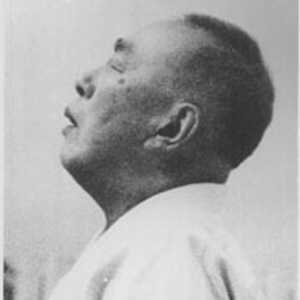
Here is the third of the Six Interviews of Itsuo Tsuda by André Libioulle, entitled ‘Breathing, a Living Philosophy’ and broadcasted on France Culture in the 1980s.
To read and/or to listen to.
(back to Broadcast N° 2)
BROADCAST N° 3
Q.: You know France very well, having worked before the 1940s with two extremely important figures, Marcel Granet and Marcel Mauss. Marcel Granet was a sinologist and Marcel Mauss a sociologist. What were the most important moments you spent with them?
I. T.: For five years, I attended these scholars’ courses, and it opened my eyes to unknown aspects of Western society. Mauss dealt with the sociology of different peoples, including the Polynesians, and so on. He had a very, very deep view of things, and he observed things that he called “total phenomena”, whereas in Western societies, things are always analytical, rational, and so on.
Q.: Yes, the idea of globality.
I. T.: Yes… and Granet also gave me the opportunity to view ancient Chinese society from a very, very different perspective from the usual; that is, transforming everything, using Western reasoning. .
Q.: After this French period, this Parisian period, you returned to Japan, and there you had another absolutely decisive encounter, with Master Ueshiba, the creator of Aikidō, and Master Noguchi.
I. T.: Master Noguchi enabled me to see things in a very concrete way. Through the things manifested by each individual, it is possible to see what is going on inside. It is completely different from the analytical approach, in which the head, the heart, the digestive organs each have their own specialization; and there’s the body on one hand and the psyche on the other, isn’t that so? Well, he made it possible to see the human being, that is, the concrete individual, in its totality.
Q.: So you worked there with Master Noguchi, and also with Master Ueshiba for several years.
I. T.: I worked with Master Ueshiba for ten years before coming to France. Well, he gave me the opportunity to be something other than… the individual trapped inside the skin. I visited the United States, and then I tried to see what the possibilities were, what I was going to do. I started by writing, and little by little, it took shape.
Q.: I believe The Non-Doing was published in 1973. It was the first book you published. Around what time did you return to France?
I. T.: 1970.

Q.: And then you decide to create l’École de la Respiration. That is quite a singular term! Can you tell us why you say “school”? Surely this was not a school in the traditional sense of the word?
I. T.: No, not at all (laughs). It’s the only name I could come up with to make people understand that there’s a whole… thing behind the breath. For the uninitiated, breathing is the work of the lungs. But here the word “breathing” takes on a greater and greater extent, doesn’t it?
Q.: Yes, so at l’École de la Respiration, people practise the Regenerating Movement. You described the Regenerating Movement as an exercise of the extrapyramidal motor system.
I. T.: Yes. The Regenerating Movement is not a discipline in the usual sense of the word.
Q.: The word extra-pyramidal may not be immediately comprehensible to our listeners. In any case, the term “extra-pyramidal” basically refers to an area of the brain, as compared to another considered to be the seat of voluntary movement.
I. T.: Yes. In humans, there are two motor tracts. One is the pyramidal motor system, which is the source of all voluntary movement. That’s what we learn in school, like the interweaving of the nervous systems, and so on.
Q.: It’s a term from physiology…
I. T.: …yes, that’s right. But for a long time we neglected the extra-pyramidal system, which supports this voluntary system, because we were afraid of leaving the voluntary system, and that is precisely what Master Noguchi started to do. When he himself began, he was a little surprised because the body starts to move on its own. When you believe that the whole body obeys your will, it is strange, isn’t it? But the truth is, we do not control all the body’s movements. If that were necessary, what would we do when we’re asleep?
Q.: There is a whole area of our activity that is covered by the voluntary system. But that system does not govern all our activity. There is an area that is beyond the reach of the will.
I. T.: There’s a Japanese doctor who says that voluntary movement accounts for only three per cent of our total bodily movement. But for Noguchi, nothing is voluntary. That’s (laughs) really strong.
Q.: In short, the action of the extra-pyramidal system is somehow superimposed on the action of the pyramidal system.
I. T.: Yes.
Q.: You’ve specified that the Regenerating Movement exists in two forms…
I. T.: … Yes…
Q.: … on the one hand, in all individuals, it exists as a form of natural bodily reaction, for example, yawning, sneezing, restlessness during sleep. And then there is another form, developed about fifty years ago by Master Noguchi. Master Noguchi, it should be pointed out, is the creator of the so-called “Seitai” method.
I. T.: He embarked on this career by pure chance. It was the time of the great earthquake of 1924 that hit the entire Tōkyō area. He was twelve at the time. He was very interested in that sort of thing, he had fun with it. But the whole region was devastated, and there were people who were homeless and wandering around; diarrhoea was spreading, and so on. He saw a woman crouched down in great pain. So he rushed over to her and simply applied his hand…
Q.: … applied his hand to the spine…
I. T.: … and then she said, “thank you, child”, or anyway, she smiled at him. That was the starting point of his career. The very next day, people started coming to see him. Starting on that day, he was no longer able to leave this path. This is what we practise now under the name of “yuki”: you put your hand on the spine or the head and then exhale through your hand, and that’s it. Well, when you see it done, at first glance, it doesn’t seem like much. But as you concentrate on it, you feel that it’s working inside you.
Q.: So yuki is one of the elements of the technique developed by Master Noguchi. There’s something that surprises me a little about the technique you’re describing: Seitai, as you explain, is a technique used to provoke something spontaneous. Isn’t that a little paradoxical?
I. T.: Seitai is a word that Noguchi coined later. In the beginning, by force of circumstance, he simply became… a healer. He practised therapeutics. But, around 1950, there, he abandoned this notion of healing, of therapeutics; he rejected all that and created the notion of “Seitai”, meaning “normalised terrain”. When the terrain is normalised, problems disappear on their own.
Q.: Perhaps we could temporarily summarise the Regenerating Movement with two important elements: the exercise of the extrapyramidal motor system. This exercise is not really a technique. In fact you say, “at l’École de la Respiration, we work without knowledge, without technique and without purpose”. As for the second important element, the Regenerating Movement is a spontaneous movement that virtually exists in all individuals, and we cannot say that the Movement is provoked; it becomes activated in individuals.
[end of Broadcast N° 3/6]
continue with Broadcast N° 4:
Would you like to hear about the next article?