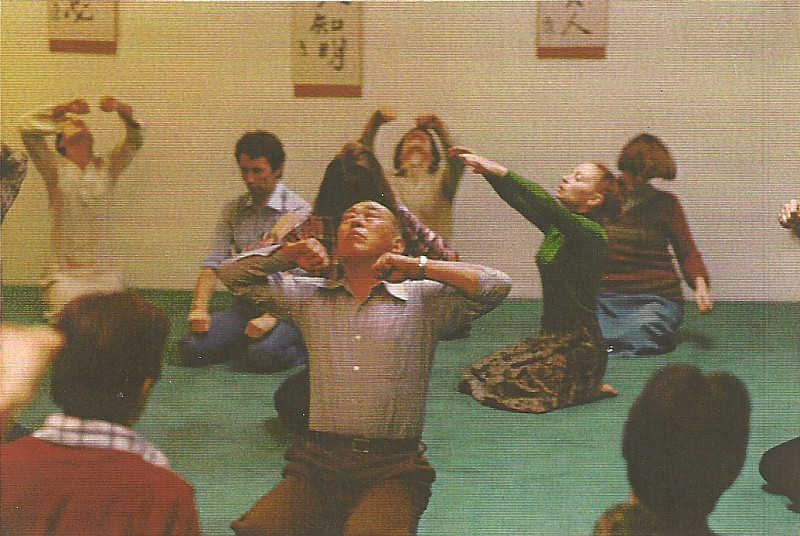
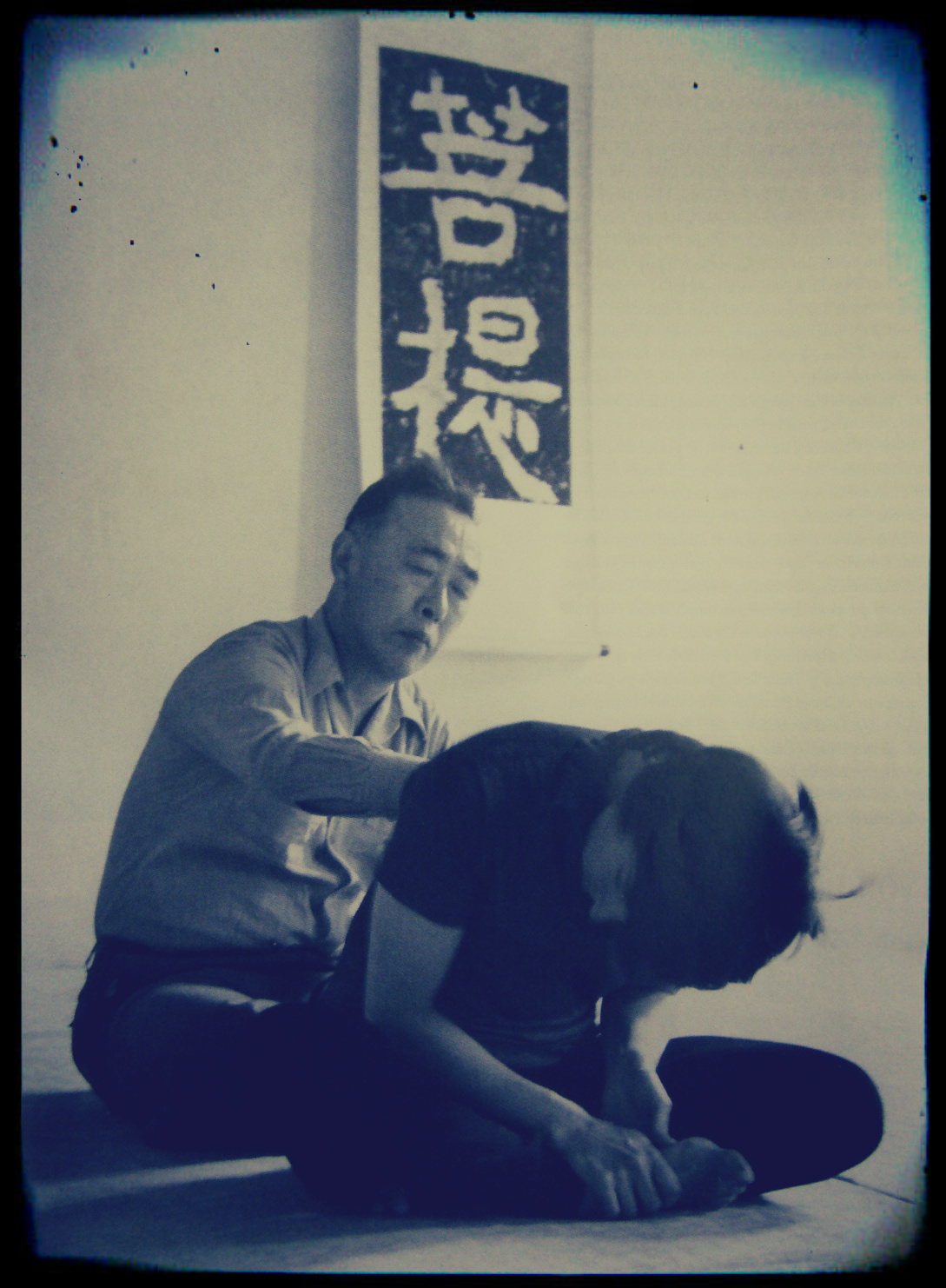
Continuation of Itsuo Tsuda’s correspondence, from which we are publishing a few letters, with the kind permission of Bernard and Andréine Bel. Link to read the first letter.
These are Itsuo Tsuda‘s replies, between 1972 and 1979, to a young couple who were beginning to practise the Regenerating Movement. In these letters, we follow their desire to share this discovery with those around them in their town.
This letter followed a letter in which we told Itsuo Tsuda about our stay in Saanen in July, during which we had a group of people practise the Regenerating Movement, including a large number of students of Yvon Achard, a yoga teacher in Grenoble. The group’s reaction had been enthusiastic. Itsuo Tsuda‘s reflection on the tendency of Westerners to lump everything together prompted us to exercise great caution. We were careful never to use this term, even though our sessions were identical in every way to those organised by Katsugen-Kai. It was also at this time that we decided never to accept money from participants: ‘among family and friends’… Andréine Bel Read more →
Here is the third of the Six Interviews of Itsuo Tsuda by André Libioulle, entitled ‘Breathing, a Living Philosophy’ and broadcasted on France Culture in the 1980s.
Q.: You know France very well, having worked before the 1940s with two extremely important figures, Marcel Granet and Marcel Mauss. Marcel Granet was a sinologist and Marcel Mauss a sociologist. What were the most important moments you spent with them?
I. T.: For five years, I attended these scholars’ courses, and it opened my eyes to unknown aspects of Western society. Mauss dealt with the sociology of different peoples, including the Polynesians, and so on. He had a very, very deep view of things, and he observed things that he called “total phenomena”, whereas in Western societies, things are always analytical, rational, and so on.
Q.: Yes, the idea of globality.
I. T.: Yes… and Granet also gave me the opportunity to view ancient Chinese society from a very, very different perspective from the usual; that is, transforming everything, using Western reasoning. .
Q.: After this French period, this Parisian period, you returned to Japan, and there you had another absolutely decisive encounter, with Master Ueshiba, the creator of Aikidō, and Master Noguchi.
I. T.: Master Noguchi enabled me to see things in a very concrete way. Through the things manifested by each individual, it is possible to see what is going on inside. It is completely different from the analytical approach, in which the head, the heart, the digestive organs each have their own specialization; and there’s the body on one hand and the psyche on the other, isn’t that so? Well, he made it possible to see the human being, that is, the concrete individual, in its totality.
Q.: So you worked there with Master Noguchi, and also with Master Ueshiba for several years.
I. T.: I worked with Master Ueshiba for ten years before coming to France. Well, he gave me the opportunity to be something other than… the individual trapped inside the skin. I visited the United States, and then I tried to see what the possibilities were, what I was going to do. I started by writing, and little by little, it took shape.
Q.: I believe The Non-Doing was published in 1973. It was the first book you published. Around what time did you return to France?
I. T.: 1970.
Itsuo Tsuda, ca 1970. Photo by Eva Rotgold
Q.: And then you decide to create l’École de la Respiration. That is quite a singular term! Can you tell us why you say “school”? Surely this was not a school in the traditional sense of the word?
I. T.: No, not at all (laughs). It’s the only name I could come up with to make people understand that there’s a whole… thing behind the breath. For the uninitiated, breathing is the work of the lungs. But here the word “breathing” takes on a greater and greater extent, doesn’t it?
Q.: Yes, so at l’École de la Respiration, people practise the Regenerating Movement. You described the Regenerating Movement as an exercise of the extrapyramidal motor system.
I. T.: Yes. The Regenerating Movement is not a discipline in the usual sense of the word.
Q.: The word extra-pyramidal may not be immediately comprehensible to our listeners. In any case, the term “extra-pyramidal” basically refers to an area of the brain, as compared to another considered to be the seat of voluntary movement.
I. T.: Yes. In humans, there are two motor tracts. One is the pyramidal motor system, which is the source of all voluntary movement. That’s what we learn in school, like the interweaving of the nervous systems, and so on.
Q.: It’s a term from physiology…
I. T.: …yes, that’s right. But for a long time we neglected the extra-pyramidal system, which supports this voluntary system, because we were afraid of leaving the voluntary system, and that is precisely what Master Noguchi started to do. When he himself began, he was a little surprised because the body starts to move on its own. When you believe that the whole body obeys your will, it is strange, isn’t it? But the truth is, we do not control all the body’s movements. If that were necessary, what would we do when we’re asleep?
Q.: There is a whole area of our activity that is covered by the voluntary system. But that system does not govern all our activity. There is an area that is beyond the reach of the will.
I. T.: There’s a Japanese doctor who says that voluntary movement accounts for only three per cent of our total bodily movement. But for Noguchi, nothing is voluntary. That’s (laughs) really strong.
Q.: In short, the action of the extra-pyramidal system is somehow superimposed on the action of the pyramidal system.
I. T.: Yes.
Q.: You’ve specified that the Regenerating Movement exists in two forms…
I. T.: … Yes…
Q.: … on the one hand, in all individuals, it exists as a form of natural bodily reaction, for example, yawning, sneezing, restlessness during sleep. And then there is another form, developed about fifty years ago by Master Noguchi. Master Noguchi, it should be pointed out, is the creator of the so-called “Seitai” method.
I. T.: He embarked on this career by pure chance. It was the time of the great earthquake of 1924 that hit the entire Tōkyō area. He was twelve at the time. He was very interested in that sort of thing, he had fun with it. But the whole region was devastated, and there were people who were homeless and wandering around; diarrhoea was spreading, and so on. He saw a woman crouched down in great pain. So he rushed over to her and simply applied his hand…
Q.: … applied his hand to the spine…
I. T.: … and then she said, “thank you, child”, or anyway, she smiled at him. That was the starting point of his career. The very next day, people started coming to see him. Starting on that day, he was no longer able to leave this path. This is what we practise now under the name of “yuki”: you put your hand on the spine or the head and then exhale through your hand, and that’s it. Well, when you see it done, at first glance, it doesn’t seem like much. But as you concentrate on it, you feel that it’s working inside you.
Q.: So yuki is one of the elements of the technique developed by Master Noguchi. There’s something that surprises me a little about the technique you’re describing: Seitai, as you explain, is a technique used to provoke something spontaneous. Isn’t that a little paradoxical?
I. T.: Seitai is a word that Noguchi coined later. In the beginning, by force of circumstance, he simply became… a healer. He practised therapeutics. But, around 1950, there, he abandoned this notion of healing, of therapeutics; he rejected all that and created the notion of “Seitai”, meaning “normalised terrain”. When the terrain is normalised, problems disappear on their own.
Q.: Perhaps we could temporarily summarise the Regenerating Movement with two important elements: the exercise of the extrapyramidal motor system. This exercise is not really a technique. In fact you say, “at l’École de la Respiration, we work without knowledge, without technique and without purpose”. As for the second important element, the Regenerating Movement is a spontaneous movement that virtually exists in all individuals, and we cannot say that the Movement is provoked; it becomes activated in individuals.
Here is the first of the Six interviews of Itsuo Tsuda by André Libioulle, entitled ‘Breathing, a Living Philosophy’ and broadcasted on France Culture in the 1980s.
To read and/or to listen to.
BROADCAST N° 1
Q: L’École de la Respiration was created by Itsuo Tsuda in Paris in 1973. However, the word “school” is not entirely appropriate and Master Tsuda never intended it to be a closed, exclusive teaching centre. On the contrary, his views remain entirely open. He is interested in other breathing disciplines and above all in the field of thought related to breathing.
Concretely, L’École de la Respiration is a ”Dōjō”, a particular kind of space in the East, which refers less to the material place itself than to the energetic space. […] Of course, movement is an individual matter; it is to be found in the inner space specific to each person. However, it is created through a certain state of relaxation and a whole atmosphere conducive to meditation. That’s why, for example, it is recommended that the Regenerating Movement be practised with the eyes closed. The dōjō is a spiritual more than a physical space, and therefore not a school in the usual sense. Itsuo Tsuda?
I. T.: It is not a school in the usual sense of the word. As I have written and published books under the imprint of “L’École de la Respiration (“the school of breathing”), I applied this name to the association. The association is independent from me. I am a guest, I am not the boss, and insofar as the association requires my presence, I accept, provided that the members carry out this personal endeavour themselves. I am not there as a boss who gives orders; that’s something you have to understand.
Q.: It is a “school”, in inverted commas, that is open to everyone. The Regenerating Movement is practised here “without knowledge, without technique and without purpose”. That’s a bit of a paradox for a school, isn’t it?
I. T.: Yes. Well, people have to be well motivated. Otherwise we refuse them. For example people who ask for therapy, etc., or who come with other intentions, we refuse. What we are doing is to exercise the extrapyramidal, that’s all. But we can’t throw ourselves into it all at once, can we? we don’t know what it is. When I give the workshop, I start by explaining the thing. Not explaining the extrapyramidal system in anatomical terms, but in relation to the life one leads in the Western context, and bring people back into another context that is natural. Which doesn’t mean that I’m against Westernization, it’s an irreversible thing. Japan is now westernised. But while accepting this conditioning, if you are determined, if you are motivated, you can get out of it and breathe freely, feel full and free.
Q.: Imagine someone entering L’École de la respiration: what can he expect? How will things work, concretely, in practice?
I. T.: They arrive and they sit roughly in a circle and I start to give a sort of talk. And there are people who don’t understand at all. At first almost no one does. But there are those who are attracted, who stay. But their heads are full of questions. And I refuse to answer. I say: “Wait a minimum of a year, two years if possible”. At the end of a year or two, the body changes, evolves and then they no longer know what to say and the questions have evaporated.
Q.: The people who come are not sick people, I mean they’re people who simply have a need for personal development, a need to feel better about themselves, usually..
I. T.: Well, the motivations are diverse. But what I ask for is practice without purpose. There is a psychiatrist who was attracted precisely because it is marked “without purpose”, because he knows from his own experience that this is extremely important. But for others it makes no sense; a practice without a goal is completely… crazy! That is one of the conditions that I insist upon. Otherwise people come and ask me all sorts of things and they go nowhere, they’re just banging their heads against the wall.
Q.: So at a certain point, people stop asking questions. What has happened inside them, what has changed so that all of a sudden, all the intellectual questions are resolved?
I. T.: Well, the body has evolved, sensations have evolved, so we don’t see the same thing from the same perspective. Before starting, such and such a thing is important; people think it’s absolutely necessary to ask me questions. But after a year or two, it becomes so obvious that they no longer need to ask questions.
Q.: But in the first stage, there’s a breathing practice, there are preparatory movements for another more fundamental movement that you call the Regenerating Movement. How does the preparation work?
I. T.: To tell the truth, you don’t need any preparation if you’re sensitive and not very complicated. But modern life doesn’t always allow you to be uncomplicated, so we need a bit of stimulus to get us going. You don’t need a memory, it’s something that arises from within, and it comes of its own accord.
Q.: So it’s more like an immediate, spontaneous reaction on the part of the person, and everyone has a particular reaction, everyone has a singular organic reaction that is unique to him or her.
I. T.: We can’t create a model for the Regenerating Movement, because each individual has his or her own movement and the movement of the same individual differs every day. That’s what they are going to find out for themselves. The difficulty is that people arrive with a head full of imaginings and it’s a real problem to get rid of these. They know thirty-six thousand methods that they mix up with the Regenerating Movement and which distort everything. I make sure that people don’t mix everything up, that’s the greatest difficulty.
Q.: Initially, it seems that people find it hardest simply to feel, to live in contact with their sensations. That’s what the Regenerating Movement brings.
I. T.: People say, “We’re not in the Middle Ages anymore”. Well, what’s the difference between the Middle Ages and now? Gestation still takes nine months; that hasn’t changed. Only, in the Middle Ages there was neither radio nor television. Only the means have changed. But the body, on the contrary, has become weaker. There are many people who are neither completely alive nor completely dead. They are in a kind of twilight,, without feeling. What we’re doing is not adding something extra, but going “back to the source”, which allows us to really feel what’s happening every day, at every moment. That’s what has been completely neglected. All we do is schedule, plan things with a view to what’s going to happen in a year’s time, in three years’ time, and so on. But what are you doing now, what are you feeling now? That we do not know.
Q.: Master Tsuda, the people who come to you come because they feel the need, let us say, for a personal evolution. But people come to work on themselves and they come with spontaneous body tendencies. In several of your books, you’ve mentioned a concept known as “taiheki“.
I. T.: It’s a concept that is also quite difficult to explain. In our modern lives, the body’s activities become increasingly specialised. Some people need their eyesight, their hearing, their brains, and so on. Athletes need their muscles. Because of this specialisation, we are more or less deformed. The channelling of energy becomes specialised. We cannot all of a sudden change direction. We’re always on the same channel.
Q.: You talk about the polarisation of energy…
I. T.: … Yes, polarisation if you like; channelling. And we think we can control all that, but it’s difficult indeed. That’s why we need to normalise the terrain, so that we can use all our pawns, if you will. For example, one woman told me that before doing the Movement, she didn’t know whether her feet were hot or cold, she had to take off her shoes and then touch her feet with her hand so she could say, “ah! yes, my feet are hot or cold”. But now she doesn’t need to do that anymore, she can feel directly. Sensation doesn’t work in most people.
Q.: Most people are desensitised…
I. T.: … desensitised either in the feet or in the legs, etc.
Q.: And by being desensitised, people are cut off from themselves.
I. T.: Yes, they are fragmented, they are compartmentalised. They see the world through this very, very narrow perspective.
Q.: Your desire is to put people in touch with themselves, with their sensations, and thereby even with “ki”’, that notion that evades all concepts, a moving notion: qualitative, not quantitative. The truth of science is quantitative, but the truth of the Movement is always particular, always concrete.
I. T.: We come into the world with no knowledge, with no explanation. How is it that a newborn baby can turn white milk into yellow poo? The baby has no knowledge. Well, at that very moment, the absence of knowledge allows everything to work. We have to be able to get to that point. Except with adults, the problem presents itself in a different way, because we cannot imitate a baby. If there are a lot of things that come to the surface of the conscious mind, that’s precisely why we are in the state of “heart of pure sky”. When we are very busy, we don’t even think about it. That is the return to the source, which is different from what happens with a newborn.
Q.: Will the people who come to you later become practitioners of the
Regenerating Movement, or is it just a practice they follow for the sake of their own well being?
I. T.: That’s up to them, isn’t it? I don’t say anything. If they want to do it, they do it, that’s all. But if people aren’t truly motivated, things just fall apart. And if they’re really motivated, little by little their horizons open up. So, as to how far they will go, for the moment I can’t say.
Subtitles available in French, English, Italian and Spanish.To activate the subtitles, click on this icon. Then click on the icon to select the subtitle language.
Would you like to hear about the next article?
Subscribe to our newsletter
Some additional information
Seitai was developed by Haruchika Noguchi (1911-1976) in Japan. Katsugen Undo (or Regenerating Movement) is an exercise of the extrapyramidal motor system that is part of Seitai. Itsuo Tsuda (1914-1984), who introduced Katsugen Undo in Europe in the 70s, would write about it: ‘The human body is endowed with a natural ability to readjust its condition […]. This ability[…] is the responsibility of the extrapyramidal motor system.’ 1Itsuo Tsuda, One, Chap. VI, 2016, Yume Editions, p. 46 (1st ed. in French: 1978, Le Courrier du Livre (Paris)
Excerpts from the video on Yuki
It’s simplicity itself. We always want to add lots of things because when it’s too simple, we feel like it’s not working.
We’ll invite people to do two or three exercises. One exercise will relax the solar plexus area. Here, we exhale deeply. It’s like a kind of artificial yawn. So it’s a voluntary exercise. A kind of artificial yawn. We relax the solar plexus area.
One of the second exercises we do, for example to trigger individual movement, would be “spinal rotation.” Well, here it’s about regaining a little flexibility. I see people today with aging bodies, their spine is completely blocked, they can no longer turn around. They have to turn their whole body to look behind them. Whereas all they need to do is rotate their spine. But very often, even in people in their thirties, the spine is blocked. So this is an exercise that relaxes the body. That’s the second exercise.
And the third exercise, which is a little more complicated, involves putting your thumbs inside your closed fists and pulling everything back. Okay. It’s difficult to show you like this, you really need someone to show you more precisely. That’s why there are organized workshops. That’s for individual movement.
And then what do we do? Nothing! We do nothing. We let the body trigger the movement. If we do the individual movement, it’s very simple. You can do it anywhere. It can be very discreet. It’s not about starting to scream… It’s not something that’s very visible. It’s extremely discreet. There is no noise during a movement session. Sometimes there are slight noises, almost nothing. So that’s the individual movement.
And then in the dojos, during the week, that is, two or three times a week, depending on the dojo, we practice the mutual movement. So there we simply do the plexus exercise and add a few concentration exercises, such as breathing through the hands, Yuki, the activation chain, all of which allow the bodies to be ready to let the movement be triggered. However, the triggering itself will be done by activating the second points of the head. I can’t demonstrate it like that. By activating the second points of the head, in a way, the voluntary system will go into rest mode. And it is the involuntary system that will take over, that will lead.
So what does that mean? It doesn’t mean that suddenly we’re brainless and don’t understand anything anymore. When we eat, for example, it’s the digestive system that suddenly, when it was quiet and doing nothing, suddenly starts to activate. All kinds of gastric juices are produced, the stomach starts working, the intestines work harder, etc. That doesn’t mean we stop thinking. At most, we feel a little drowsy. The drowsiness that comes with digestion, or when we’ve eaten well, we feel a little… ah, there it is. Because the involuntary digestive system has been activated. It’s not because this digestive system has been activated that there is nothing else. Here too, when we do the regenerative movement, the voluntary movement is at rest, we don’t think about it anymore, we close our eyes, we let the body move according to its needs.
And then, because the body is in an involuntary state, it can do things that it doesn’t usually do, or that it has somewhat neglected. And so it starts to move. That’s why we do it in a dojo, because it does things that can sometimes seem incongruous. For example, if you do movements like this on the subway, people might think, “Oh dear, that guy’s a bit weird…” But in the dojo, we’re relaxed, our eyes are closed, no one is watching us, it’s a bit like being at home. The movement we practise in the dojo is a training. We often say it’s training for the extrapyramidal motor system, but it’s not just that. It’s training because our bodies have weakened, because we have trouble reacting, so we retrain ourselves. It’s a bit like someone who can no longer walk. At a certain point, even the smallest step is difficult: going from the kitchen to the bathroom is difficult for them. So from the moment they start walking again, their body will start to function better. It’s the same thing with involuntary movement.
And at some point, of course, since this is training, it’s within a given time frame. We also have to stop that time at some point. That is to say, during the session, we did the training, we let the movement be triggered, then we stop the movement. Here again, there is an exercise very similar to the first one to stop the individual movement. We stop the movement. Then we lie down for a few minutes. And we come back, we resume the voluntary system, which will act again.
So we let the individual movement act completely as it needed to, on its own, for a certain amount of time, and then we return to our normal daily life. And so, the body will now regain its involuntary abilities. We will allow the involuntary to work more than before in everyday life. Because the body will say, “Hey, I need this,” and it will trigger another type of work. So again, there are exercises that allow the involuntary system to be trained, and then there is everyday life. We are not in the involuntary state all the time. We work, we do a lot of things with the voluntary system. But since the involuntary system works underneath, the body remains normal.
Notes
1
Itsuo Tsuda, One, Chap. VI, 2016, Yume Editions, p. 46 (1st ed. in French: 1978, Le Courrier du Livre (Paris)
He was born in Ueno, a district of Tōkyō, in September 1911. It all began at the age of three or four when he was surprised to find that he had relieved someone’s toothache simply by placing his hands on them. He was a child, and his hands moved toward the target without him realising what he was doing. He accomplished his first feat at the age of twelve, when he cured his neighbours who were suffering from dysentery after the great earthquake that struck the Tōkyō area in 1923. From that age on, he began to receive people who asked him to heal them. At the time, he had no knowledge, not even basic knowledge, of anatomy or medicine. As a teenager, he began to realise the consequences of his actions. At first, like almost all healers, he believed that he had an exceptional power that only he possessed. He found his calling but did not stop there; he continued on. He taught himself all Eastern and Western therapeutic methods. At the age of fifteen, he opened a dojo in Iriya. At seventeen, he formulated Precepts of Full Life (Zensei Kun), which provide a better understanding of his thinking. In 1930, he wrote Reflections on Integral Life, a surprising text for a young man who was only nineteen at the time.
In this article, starting from an I Chin hexagram (䷯ jǐng: the well), Régis Soavi discusses with us how the practices of Aikido and Regenerating Movement can be instruments of searching and deepening into oneself.
The dojo is, intrinsically, the well where all practitioners of martial arts in search for the Way, Tao, come to feed themselves. Contrary to rings or gyms, it offers a place for peace that is necessary, perhaps essential, to deepen human values.
dojo Scuola della respirazione, Milan
Today we live at the speed of light. Communication has never been so fast. Waves loaded with bits and micro-bits circulate continuously around our planet, carrying more information that our brain can store. Social networks have replaced knowledge with a superficial veneer that may, seemingly, be fit to meet up with our social appearance. In the sixties, members of the Situationist International castigated the pseudo-intellectuals who would feed on magazines such as Le Nouvel Observateur or L’Express1Le Nouvel Observateur (today L’Obs) and L’Express are weekly French general information magazines. They are among the most prominent ones in terms of audience and circulation, and stand at the political centre in the French media landscape. [Translators’ note] to fuel their society conversations or their writings: what would they say about the democratisation that is now offered to each and everyone of us as a chance to become the new Monsieur Jourdain from Molière’s Bourgeois Gentilhomme? Better than deepening anything, ‘Jack of all trades, master of none’ seems to be the motto of our times.
Martial arts tend apparently to be going the same direction. Many are those who are interested in the spectacular pictures broadcasted by media that present the fictive abilities of martial actors who, though highly skilled in their profession, mainly look for a rendering that is both superficial and commercial.
The image of the well in ancient China should make us wonder about the trends that govern our daily life. Whereas water used to be drawn from the well using a bucket and a pole, it was indeed the repetition of such an act that enabled the village life, and the provided food was considered as unlimited. What if we took a leaf out of this ancient book?
When we practice an art such as Aikido, it is not about accumulating ever more numerous techniques, nor blissfully repeating what is being taught, but rather about beginning a search, about reorienting oneself towards something more profound in order to abandon the superficial, the superfluous, that disappointed us so much and that we can no longer bear.
Régis Soavi
Many of those who were, at first, extremely enthusiastic to start a true work with their body get weary of repeating, in an all-too-often schoolish manner, or get misled by the latest trend. This is how some people collect methods and go from one art to another, from Yoga to Tai chi, from Karate to Capoeiera, sometimes thinking that one of them is superior to the other, as so nicely explained by any trendy youtuber making up the news the way they like.
In view of all these characters who live only to influence their followers and earn a living on their backs thanks to the number of “likes” and to the ads they generate, is it not time to search deep into oneself? To take time to think rather than passively consume someone else’s thought? To move one’s own body to rediscover a lost harmony rather than search a virtual complement to the routine that stems from the poverty of one’s daily life?
The dojo as a place for searching has all the characteristics of the well: it is both a place for training, because one draws from it everyday, and at the same time (and maybe even more) it is a place for conviviality where the social gets rid of what prevents it from being true, that is to say, from being as close as possible to the profound nature of individuals. A place where sociability escapes conventions, a place where we can talk to each other, physically get in contact with each other in a simple manner, with all the difficulties potentially involved for who is not ready.
All the arduousness resides in not remaining at the surface of the practice, in not being content with surfing onto an ocean of images that have become virtual or wading on the strand – without getting too wet, please – but in absorbing what one finds out therein, in letting go of what encumbers us so as to be free to explore its depths.In his book The Non-Doing, my master Itsuo Tsuda delivers us with simplicity an insight into his own research and the work he had developed in Europe:
Itsuo Tsuda
‘What am I in comparison with the greatness of the Universal Love of Master Ueshiba, or with the technique of the Non-doing of Master Noguchi, or the unfathomable refinement of Master Kanze Kasetsu, actor of the Noh theatre? I have known them all; two of them are dead and now only Master Noguchi is still alive. Their influence keeps on working in me. They are natural masters. I am simply a being who is beginning to wake up, who is seeking and going through an evolution.
An extraordinary continuity of sustained efforts is what marks out the works of these masters. I feel as though I am finding wells of exceptional depth in barren land. Where the work of categorization halts, is merely their starting point. They have drilled much deeper. They have reached the streams of water, the source of life.
However, these wells are not interconnected, although the water found in them is the same. My task is to draw up a map of the territory, and there, to find a common langage.’ 2Itsuo Tsuda, The Non-Doing, 2013, Yume Editions (Paris), p. 12
This language, Itsuo Tsuda will find it in the art of writing (he defined himself as a writer-philosopher, as attested by his funeral stele in Père Lachaise cemetery), in the teaching of a certain form of Aikido that is grounded in breathing and the deepening of the sensation of Ki, and finally in making known Katsugen undō (Regenerating Movement). Through his work, his writings, his teaching, he will manage to create a bridge between East and West.
What threatens who practices martial arts – and more specifically Aikido – is the boredom due to repetition, search for efficacy, polishing one’s technique, and all this at the expense of the depth of the art and the culture that underlies it. As a matter of fact, our time is no longer under the same imperatives as were previous centuries; while it is still useful to be able to react in case of agression or difficulties, what will be determinant is our inner force and the awakening of our instinct, more than our fighting capacity. Aikido remains a bodily practice, where rigour, dynamics, know-how, are of the utmost importance, but its philosophical aspect cannot be overlooked. This aspect is in no way contradictory, quite the contrary, one of my former masters Masamichi Noro had himself understood it very well when he created this new art that is Ki no Michi (the way of Ki) at the end of the seventies. The search in Aikido is something difficult and can sometimes even be pernicious, because it is not about confronting with other combatants, it is not meditation or dance either – and I can say so because I have an immense respect for these arts, there again the wells are different, but the search goes the same direction.
To go and search towards the development of human capacities, of the culture beyond what is known, to question oneself and question the ideas of the world, to move forward to make our society move forward. Maybe one day to get finally out of barbarism and obscurantism. We just need to read again Umberto Eco‘s conference3Umberto Eco, Costruire il nemico e altri scritti occasionali [Creating the Enemy & Other Occasional Wiritings], 2011, ed. Bompiani (Milano). The conference Creating the Enemy was given in Bologna on 15 May 2008 and its full text is availble online (in Italian) on how the human being creates themselves enemies to understand that, more than ever, we need to know the other to better understand him or her.
Aikido as an art of the Non-Doing is a gateway to what many people are looking for: realising oneself, with no oversized ego, but in simplicity, and with the pleasure of an authentically lived experience.
Le Nouvel Observateur (today L’Obs) and L’Express are weekly French general information magazines. They are among the most prominent ones in terms of audience and circulation, and stand at the political centre in the French media landscape. [Translators’ note]
2
Itsuo Tsuda, The Non-Doing, 2013, Yume Editions (Paris), p. 12
3
Umberto Eco, Costruire il nemico e altri scritti occasionali [Creating the Enemy & Other Occasional Wiritings], 2011, ed. Bompiani (Milano). The conference Creating the Enemy was given in Bologna on 15 May 2008 and its full text is availble online (in Italian)
In this fifth part, Régis Soavi discusses a central principle in Seitai philosophy: the unity of the body.
Subtitles available in French, English, Italian and Spanish.To activate the subtitles, click on this icon. Then click on the icon to select the subtitle language.
Would you like to hear about the next article?
Subscribe to our newsletter
Some additional information
Seitai was developed by Haruchika Noguchi (1911-1976) in Japan. Katsugen Undo (or Regenerating Movement) is an exercise of the extrapyramidal motor system that is part of Seitai. Itsuo Tsuda (1914-1984), who introduced Katsugen Undo in Europe in the 70s, would write about it: ‘The human body is endowed with a natural ability to readjust its condition […]. This ability[…] is the responsibility of the extrapyramidal motor system.’ 1Itsuo Tsuda, One, Chap. VI, 2016, Yume Editions, p. 46 (1st ed. in French: 1978, Le Courrier du Livre (Paris)
Excerpts from the video on Yuki
‘The current trend is that there are all kinds of programmes where people give you things to do, whether it’s exercise, food, fasting… all kinds of mental manipulation, mental exercises or other things to make people feel good.
But in fact, human beings are completely different. Sometimes it only takes one tiny thing to make everything better or worse. Sometimes just one number, one number can completely determine the quality of your life. If, for example, you see -4000 euros in your bank account, all of a sudden… ‘Ha!’, your heart can stop. It’s ridiculous. How can your heart stop because you saw a number? It’s absurd. And yet, that’s how it is.
So what matters, in my opinion, is the harmony of the body. It’s a balance that we’re going to find, always the same. Every time we talk about Seitai, every time we talk about what happens in relation to regenerative movement, etc., we have to think in terms of balance. That’s what a human being is: a balance. They are not separate. Of course, if there is a serious problem in one part of the body, the being, the individual, is out of balance, but they will not only suffer in that part of the body. They suffer throughout their entire body. So here again, it is balance that is decisive.
Notes
1
Itsuo Tsuda, One, Chap. VI, 2016, Yume Editions, p. 46 (1st ed. in French: 1978, Le Courrier du Livre (Paris)
The Seitai principles, which could even be described as “Seitai philosophy” – a way of seeing and thinking about the world – were developed by Haruchika Noguchi (1911-1976) in the first half of the twentieth century. In brief (!), Seitai is a “method” or a “philosophy” that includes Seitai sōhō, Taisōs, Katsugen undō, Katsugen sōhō, and Yukihō. These are practices that complement, permeate each other, and form the breadth of Haruchika Noguchi’s Seitai thinking. We can also mention the study of Taihekis (postural tendencies), the use of the hot bath, the education of the subconscious, the importance of birth, illness and death…
An art of living from beginning to end.
Today, unfortunately, the term “Seitai” is overused and means anything and everything. Some manual therapy practitioners too easily lay claim to Seitai (Itsuo Tsuda would say it takes twenty years to train a Seitai sōhō technician!). As for the charlatans who offer to transform you in a few sessions…, let’s not talk about it! The magnitude of the art of living, the global understanding of the human being in Seitai seem far away. If all there is left is a technique to be applied to patients, the essence is lost. If all there is left of Katsugen undō is a moment to “recharge your batteries”, the essence is lost.
Haruchika Noguchi and Itsuo Tsuda both went much further than that in their understanding of the human being. And the seeds they sowed, the clues they left for humans to evolve are important. Can we then speak of a way, of Seitai-dō (道 dō/tao)? Because that is a radical change of perspective, an upheaval, a totally different horizon opening up.
Let us go back in history…
The meeting with Haruchika Noguchi: the individual as a whole
Itsuo Tsuda met Haruchika Noguchi around 1950. The approach to the human being as proposed in Seitai interested him from the very beginning. The sharp observation of individuals taken in their indivisible entirety/complexity, which Itsuo Tsuda found in Noguchi, was an extension of what had already captured his interest during his studies in France with Marcel Mauss (anthropologist) and Marcel Granet (sinologist). Itsuo Tsuda then began to follow Noguchi’s teaching and continued for more than twenty years. He had the sixth dan of Seitai.
‘Master Noguchi enabled me to see things in a very concrete way. Through the things manifested by each individual, it is possible to see what is going on inside. It is completely different from the analytical approach, in which the head, the heart, the digestive organs each have their own specialization; and there’s the body on one hand and the psyche on the other, isn’t that so? Well, he made it possible to see the human being, that is, the concrete individual, in its totality.’ 1Itsuo Tsuda, Interviews on France Culture radio, “Master Tsuda explains the Regenerating Movement”, Broadcast N° 3, early 1980s (Heart of Pure Sky, 2025, Yume Editions (Paris), p. 23 (1st ed. in French, 2014, p. 24))
Illness as a balance factor
All the more as it was precisely in the 1950s that Haruchika Noguchi, who had very early discovered his capacity as a healer, decided to give up therapeutics. He then created the concept of Seitai, i. e. “normalized terrain”.
‘the word “terrain” referring to the whole that makes up the individual, the psychic and the physical, whereas in the West we always divide things into psychic and then physical.’2Itsuo Tsuda, ibid., Broadcast N° 4, p. 28 (1st ed. p. 29)
The change of perspective with regard to illness was crucial in this reorientation of Noguchi.
‘Illness is natural, the bodys effort to recover lost balance. […]
[…]
It is good that illness exists, but people must avoid becoming enslaved to it. This is how Noguchi happened to conceive of the notion of Seitai, the normalisation of the terrain, if you will. Diseases are not to be treated; it is useless to cure them.
If the terrain is normalised, illness disappears of its own accord. And moreover, one becomes more vigorous than before. Farewell to therapeutics. The fight against illness is over.’3Itsuo Tsuda, The Dialogue of Silence, Chap. IX, 2018, Yume Editions (Paris), p. 75–76 (1st ed. in French, 1979)
Abandoning therapy also goes hand in hand with the desire to get out of the dependence relation that binds the patient to the therapist. Noguchi wanted to allow individuals to become aware of their ignored capacities, he wished to awaken them to the fulfilment of their own being. During the twenty years they followed each other, the two men spent long moments talking about philosophy, art, etc., and Noguchi found in Tsuda‘s vast intellectual culture the substance to nourish and expand his observations and personal reflections. Thus a relation which was enriching for both developed between them.
Itsuo Tsuda was the editor of the magazine Zensei, published by the Seitai Institute, and he actively participated in the studies led by Noguchi on Taihekis (postural tendencies). A text by Haruchika Noguchi published in the magazine Zensei of January 1978 reveals that it was Itsuo Tsuda who advanced the hypothesis – validated by Noguchi – that type nine (closed basin) would be the archetype of the primitive being.4About Taihekis, consult Itsuo Tsuda, The Non-Doing, 2014, Yume Editions (Paris) (1st ed. in French, 1973)
The development of Katsugen undō (Regenerating Movement) by Noguchi particularly interested Itsuo Tsuda, who immediately understood the importance of this tool, especially as regards to the possibility it gives to individuals to regain their autonomy, without needing to depend any more on any specialist. While recognizing and admiring the precision and the deep capacity of the Seitai technique, Tsuda considered that the spreading of Katsugen undō was more important than the teaching of the technique. He therefore initiated groups of Regenerating Movement (Katsugen Kai) in a great many places in Japan.
Itsuo Tsuda favoured the spread of Katsugen undō in Europe as a gateway to Seitai.
Today, even in Japan, Seitai sōhō has taken an orientation that brings it closer to therapy. One problem: one technique to apply. Katsugen undō becomes a kind of “light” gymnastics for well-being and relaxation. This is far from the awakening of the living, of the autonomous capacity of the body to react that Haruchika Noguchi‘s Seitai is meant to be.
The yuki exercise, which is the alpha and omega of Seitai, is practised at every Katsugen undō session. Thus, although Tsuda did not teach the technique of Seitai sōhō, he transmitted its essence, the simplest act, this “non-technique” that yuki is. The one that serves us every day, the one that gradually sensitizes the hands, the body. This physical sensation, that is real, that can be experienced by all, is today too often considered a special technique, reserved for an elite. We forget that it is a human and instinctive act. The practice of mutual Katsugen undō (with a partner) is also getting lost, even in the groups that followed Tsuda‘s teaching. What a pity! Because through yuki and mutual Katsugen undō, the body rediscovers sensations, those that do not go through mental analysis. This dialogue in silence, which makes us discover the other from the inside and which therefore brings us back to ourselves, to our inner being. Yuki and Katsugen undō are for us essential tools, recommended by Haruchika Noguchi, on the path towards normal terrain.
But time goes by and things get distorted, like words of wisdom of some people become religious oppressions… Little by little Katsugen undō is nothing more than a moment to “recharge”, relax and above all not change anything in one’s life, in one’s stability. Seitai, a method to lose weight after childbirth… While it is a life orientation, a global thinking. The huge step Haruchika Noguchi took in moving away from the idea of therapeutics is a major advance in the history of mankind. His global understanding of the individual, the sensitivity to ki, sufficiently recovering sensitivity and a center in oneself from where to listen to one’s own body and act freely.
It is not even about opposing methods, theories or civilizations. It is purely and simply about the evolution of humanity.
Itsuo Tsuda, Interviews on France Culture radio, “Master Tsuda explains the Regenerating Movement”, Broadcast N° 3, early 1980s (Heart of Pure Sky, 2025, Yume Editions (Paris), p. 23 (1st ed. in French, 2014, p. 24))
2
Itsuo Tsuda, ibid., Broadcast N° 4, p. 28 (1st ed. p. 29)
Why is practising Katsugen Undo important in our life? Régis Soavi, who has been teaching and introducing people to Katsugen Undo for forty years now, gives a brief answer and provides an overview of the impact that an individual gives on their daily life when orienting themselves according to Seitai.
Subtitles available in French, English, Italian and Spanish. To activate the subtitles, click on this icon. Then click on the icon to select the subtitle language.
Would you like to hear about the next article?
Subscribe to our newsletter
Some additional information
Seitai was developed by Haruchika Noguchi (1911-1976) in Japan. Katsugen Undo (or Regenerating Movement) is an exercise of the extrapyramidal motor system that is part of Seitai. Itsuo Tsuda (1914-1984), who introduced Katsugen Undo in Europe in the 70s, would write about it: ‘The human body is endowed with a natural ability to readjust its condition […]. This ability[…] is the responsibility of the extrapyramidal motor system.’ 1Itsuo Tsuda, One, Chap. VI, 2016, Yume Editions, p. 46 (1st ed. in French: 1978, Le Courrier du Livre (Paris)
Excerpts from the video
‘We no longer see things in the same way. Obviously, our relationship with illness changes completely. Once we understand that illness is a response from the body, that illness as a symptom is a response from the body, we accept the symptoms and get through the illness. It changes everything. You are no longer dependent on the doctor or therapist; you no longer need them. You realise that lots of things are returning to normal. Before, you always had pain here and there, you had trouble digesting, you couldn’t sleep – and now, little by little, it’s all disappearing.
That doesn’t mean that afterwards we are an elite… a super elite… no, not at all! But when we have small problems that arise, they are resolved more quickly. So in terms of health, we react more quickly. Our immune system works faster. Skin reactions are faster. Digestive reactions are faster. Our minds also open up. We no longer see things in the same way. And there are things that no longer seem acceptable to us. We can no longer accept that children, women or foreigners are treated like animals… Something inside us changes. We are no longer the same. Our outlook on life changes. That’s why, after a while, people who knew us before look at us and say, “Hey, it’s funny, you’ve changed…” They don’t really know how to put it… Well, yes, we have changed. We haven’t changed. We’ve found ourselves, that’s all. We’ve found ourselves inside.’
Notes
1
Itsuo Tsuda, One, Chap. VI, 2016, Yume Editions, p. 46 (1st ed. in French: 1978, Le Courrier du Livre (Paris)
Sequel of interviews where Régis Soavi, who has been teaching and introducing people to Katsugen Undō for forty years now, gets back to basics about Seitai and Katsugen Undō. This second video tackles the notion of health according to Seitai.
Subtitles available in French, English, Italian and Spanish.To activate the subtitles, click on this icon. Then click on the icon to select the subtitle language.
Would you like to hear about the next article?
Subscribe to our newsletter
Some additional information
Seitai was developed by Haruchika Noguchi (1911-1976) in Japan. Katsugen Undo (or Regenerating Movement) is an exercise of the extrapyramidal motor system that is part of Seitai. Itsuo Tsuda (1914-1984), who introduced Katsugen Undō in Europe in the 70s, would write about it: ‘The human body is endowed with a natural ability to readjust its condition […]. This ability[…] is the responsibility of the extrapyramidal motor system.’ 1Itsuo Tsuda, One, Chap. VI, 2016, Yume Editions, p. 46 (1st ed. in French: 1978, Le Courrier du Livre (Paris)
Régis Soavi starts practising martials arts with Judo when he is twelve. He then studies Aikidō, especially alongside Masters Tamura, Nocquet and Noro. He meets Tsuda Itsuo sensei in 1973 and will follow him until his death in 1984. With the permission of the latter, Régis Soavi becomes a professional teacher and disseminates his Aikidō and Katsugen Undō throughout Europe.
Notes
1
Itsuo Tsuda, One, Chap. VI, 2016, Yume Editions, p. 46 (1st ed. in French: 1978, Le Courrier du Livre (Paris)
Many thing are being said and circulated on the internet about Seitai and Katsugen Undō (Regenerating Movement). In this round of interviews, Régis Soavi, who has been teaching and introducing people to Katsugen Undō for forty years now, gets back to basics to address the question: ‘What are Seitai and Katsugen Undō?’
Subtitles available in French, English, Italian and Spanish.To activate the subtitles, click on this icon. Then click on the icon to select the subtitle language.
Would you like to hear about the next article?
Subscribe to our newsletter
Some additional information
Seitai was developed by Haruchika Noguchi (1911-1976) in Japan. Katsugen Undō (or Regenerating Movement) is an exercise of the extrapyramidal motor system that is part of Seitai. Itsuo Tsuda (1914-1984), who introduced Katsugen Undō in Europe in the 70s, would write about it: ‘The human body is endowed with a natural ability to readjust its condition […]. This ability[…] is the responsibility of the extrapyramidal motor system.’ 1Itsuo Tsuda, One, Chap. VI, 2016, Yume Editions, p. 46 (1st ed. in French: 1978, Le Courrier du Livre (Paris)
Régis Soavi starts practising martials arts with Jūdō when he is twelve. He then studies Aikidō, especially alongside Masters Tamura, Nocquet and Noro. He meets Tsuda Itsuo sensei in 1973 and will follow him until his death in 1984. With the permission of the latter, Régis Soavi becomes a professional teacher and disseminates his Aikidō and Katsugen Undō throughout Europe.
Notes
1
Itsuo Tsuda, One, Chap. VI, 2016, Yume Editions, p. 46 (1st ed. in French: 1978, Le Courrier du Livre (Paris)
Continuation of Régis Soavi Interview’s about Katsugen Undō (or Regenerating Movement), a practice made by Haruchika Noguchi and spread in Europe by Itsuo Tsuda. An article by Monica Rossi, published in Arti d’Oriente #4, May 2000.
– It helps, in the case where one has done the three exercises, or the exercises for Mutual Movement (activation through stimulation of the second pair of points on the head; that is another way to activate the Movement). Yuki helps because it activates; It’s very important for me to say that Yuki is fundamentally different from what we often hear spoken of, because when we do Yuki, we clear our heads, we don’t cure anyone, we don’t look for anything. We are simply concentrated in the act. There is no intention, and that is primordial. In the statutes of the dojo, in fact, it is underlined that we practice without a goal”.
Interview of Régis Soavi about Katsugen Undō (or Regenerating Movement), a practice made by Noguchi Noguchi and spread in Europe by Itsuo Tsuda. Article by Monica Rossi publisehd in the review Arti d’Oriente (#4, May 2000).
Part 1
‘After reading the books of Tsuda Itsuo (1914-1984), I was fascinated by his arguments, which range freely from the subject of Aikido to that of children and the way they are born, illness, or his memories of Ueshiba Morihei and Noguchi Haruchika, and I wanted to know more. I continued to have a sensation of something beyond my understanding.
So I began to ask, what exactly is this Regenerating Movement (Katsugen Undo) that Tsuda spoke of, a spontaneous movement of the body that seemed able to rebalance it without needing to intoxicate it with medication; an ancient concept but still revolutionary, above all in our society. I was unable to get any satisfactory answers to my questions: those who have practiced the Regenerating Movement couldn’t describe it or explain; the answer was always: “You should try it yourself in order to understand; the first time, it will probably unsettle you a bit.” So I decided to try it. In Milan, the school that refers to the teachings of Itsuo Tsuda is the “Scuola della Respirazione”. There, one can practice Aikido and the Regenerating Movement ( in separate sessions ). But, in order to go to the sessions of Movement, one must first participate in a week-end course conducted by Régis Soavi, who has continued the work of Tsuda in Europe.
Here is the second of the Six Interviews of Itsuo Tsuda by André Libioulle, entitled ‘Breathing, a Living Philosophy’ and broadcasted on France Culture in the 1980s.
Q.: In this second week, we’re going to take a closer look at the books published by Itsuo Tsuda. They are all published by the “Courrier du Livre” in Paris, and there are currently six: The Non-Doing, The Path of Less, The Science of the Particular, a work entitled One, The Dialogue of Silence and recently The Unstable Triangle. They pertain to breathing and areas of thought related to breathing […]
The West has separated body and soul into clear-cut concepts. It has often aspired to the elevation of the soul but underestimated the body, considering it a place of temptation. For Plato, the soul is cramped inside its envelope of flesh, a prisoner of the body, but for a man like Itsuo Tsuda, it appears that the body is the prisoner of the soul. A soul that constantly manipulates abstractions and cuts itself off from the impulse of life. Increasingly, human beings live at a cerebral level. Society’s hopes rest on the intensive exploitation of the intellectual capacities, which it considers the privilege of human beings. But this cerebral hypertrophy creates a gap that is a source of imbalance between sensations, the body as life, as energy, as momentum, and the constructed, conceptualized, cerebralised world. Breathing is unification, a return to the self and, if we relax the separation between body and soul, if the soul ceases to be an abstraction, then it is everywhere; it is inside the body as well as outside it.
Well, the “ki”, that notion that we’ve touched upon in previous broadcasts, introduces us to the idea of unity. That’s what we’re going to try to understand now. It seems, Itsuo Tsuda, that the first step towards understanding ki is to recognise sensation in ourselves. This means not abstracting, not imagining ourselves as experiencing a sensation, but really being the sensation.
I. T.: There is a principle recognised in Chinese medicine: cold head and hot feet. Right now, the meaning is the other way round: hot head and cold feet. We don’t even feel our feet anymore. And then the head becomes hotter and hotter. There is a whole factor that contributes to this: Westernisation. But we can’t turn back. It is a longstanding tendency. And besides, there are obvious benefits that come from Westernization. But though it may help us at the material level, it puts us in a rather precarious position at an individual level. Individuals increasingly become prisoners of carefully-planned structures; they can no longer feel alive, feel themselves.
Q.: Moreover, you write that Europeans need to understand before they act. They do not jump straight into action.
I. T.: I don’t do things in the same way as things are done in Japan. Often in Japan we don’t explain things, we rush straight into the experience, and it’s up to each individual to learn the lesson, isn’t it? Well, in the West that doesn’t work. We need to understand things first. But understanding is not enough. No matter how many times I explain swimming to people who listen, it doesn’t help them dive into the water. If you have never experienced contact with water, you can fill your head with all sorts of explanations, but it’s of no use.
Q.: But people might argue: ‘what is the use of being close to my sensations? What’s in it for me ?’
I. T.: Well, precisely, there is the notion of “Seitai”, which Noguchi created after the war. At the moment, people think in dualistic terms: “there is good, and there is evil. Evil must be fought. Once we have fought evil, we will be left with the good”. But in fact, that is not the way we search; we normalise the terrain. This is what he called “Seitai”: the well-harmonised body. In the West, we try to find the cause; we try to exterminate the cause. Yet no sooner have we finished with one cause than others spring up. But that is the method that conforms to the mental structure. However, Noguchi presented this vision that is quite different, which transcends everything. If your organism is normalised, the same problem becomes less important. In the West we say: there is such-and-such a problem. It is defined, it does not change volume, it remains as is. You have to attack it in such-and-such a way, etc.
Q.: So, in short, for the West, there is an anatomical type of knowledge, a discursive type of knowledge, in which we distinguish between cause and effect, in order to act on one element or another. The notion introduced by Seitai is different. It is the notion of sensation. But if I understand correctly, it is a notion from which knowledge is not excluded. But it is another type of knowledge, an intuitive, a qualitative knowledge, let’s say, compared to the Western notion of measurement or quantification.
I. T.: The same problem increases or decreases in importance, depending on how it feels. A bottle is half empty or half full. But quantitatively, it’s exactly the same. However, the sensation differs, depending on the case. Then all it takes is one little thing to change the way people behave. If you say to yourself: ‘That’s it, I’m done for,’ from that moment on you can’t go any further. But if you say to yourself: ‘I’ve already taken three steps forward’, then you’re ready to take a fourth step, aren’t you?
Q.: Don’t you think there’s a notion presented by the West, that of totality or of wholeness but understood as an assembly of parts? With quality, we are also dealing with something global, but without the idea of assembly.
I. T.: In Seitai, we do not look at an individual as an assembly of different parts. That is the basic idea. An individual is an individual – total, yes? But, each is different in terms of movement, breathing, sensitivity. That’s what matters to us.
Q.: You’ve mentioned Master Noguchi several times. Could we not try to understand what globality and unity mean for an individual through a few examples from the practice of Master Noguchi, since Master Noguchi practised therapeutics? He was the creator of the Seitai method. What was his work like? What enabled him to grasp concrete, spontaneous things?
I. T.: For example, everyone has their own biological speed, which determines their behaviour, gait, movements etc. We think of it in a completely detached, objective way, so much per minute etc., etc., but for Noguchi, well, it is a concrete thing. Everything comes from this biological speed that is inherent in the individual. Without this notion of speed, he can do nothing. But this…
Q: … so here, the notion of speed has nothing to do with the notion of rapidity for example…
I. T.: … no, no …
Q.: … as we understand it? It is something else…?
I. T.: Yes. Contact must be established with the biological speed of that particular person. It’s not a general, objective speed. For example, a kid arrives screaming and crying because he’s broken his arm. The parents say, “It’s impossible to touch him, he just keeps crying…”. But Noguchi has already touched him. “Ah, well, then it’s because he doesn’t dare to cry in front of the master.” No, it’s not that. He touched the child at his biological speed, the speed of the child’s breathing, which is unique to him. That way, the child doesn’t feel the contact, it’s part of him, and that is so important.
Q.: You wrote that Master Noguchi, through observation and touch, was able to draw from the individual something like the notion of an unconscious movement.
I. T.: Yes, for him all movements are one hundred per cent unconscious. We believe just the opposite. We think we are the masters of ourselves, when in fact we can’t do very much, and we try to restrain ourselves. We remain composed in front of others, and so on. And then, one day the brakes fail, and then we wonder how that happened. For Noguchi, everything is unconscious, we are not the masters of ourselves.
Q.: Did Master Noguchi make a distinction between unconscious movement and posture?
I. T.: … but the posture is the realization of the unconscious movement.
Q.: So posture can be observed by everyone… from the outside, without any preparation, whereas unconscious movement requires preparation.
I. T.: If we envisage posture in a military sense, for example, “at attention”, then everyone tries to do more or less the same thing. But when you’re “at ease”, everyone is different.
Q.: What is the relationship between breathing and unconscious movement?
I. T.: There are people, for example, who have their breath cut short. When that happens, breathing comes from higher and higher up. Nowadays people breathe from the top of their lungs and finally, when they become weak, they breathe through the nose. What we’re doing is lowering the breath, so that we can breathe from the belly, or, if you like, from the feet. Without practice it is difficult to explain.
Q.: The concept of breathing is much broader than the notion of a simple biochemical operation. Breathing is life, it’s ki…, it is vitality, it is soul…
The correspondence of a writer, a philosopher, often reveals itself beyond peculiar general views. Such is the case with this correspondence of Itsuo Tsuda from which we publish a few letters, courtesy of Bernard and Andréine Bel.
It reveals answers given by Itsuo Tsuda, between 1972 and 1979, to this young couple as they began practising the Regenerating Movement. Through these letters we will follow their desire to make this discovery widely known.
[For a history of Geneva dōjō Katsugen Kai, please read here.]
Continuation and end of the article published in the journal “Question de” in 1975, written by Claudine Brelet (anthropologist, international expert and French woman of letters) and student of Itsuo Tsuda.
Second Part
— Can one ‘fusion’ respiration and visualization?
— Indeed, visualization is one of the aspects of ki. Visualization plays an important and vital role in aikido. It is a mental act that produces physical effects. Visualization is part of the aspect of ‘attention’ of ki. When attention is localized, for example it stops at the wrist, breathing becomes shallow, disrupted… we forget the rest of the body.Read more →
This coverage was published in the journal Question de [Topics of] in 1975. Claudine Brelet (anthropologist, international expert and a French woman of letters) who wrote this press coverage and did the interview and was one of the first students of Itsuo Tsuda.
First Part
At the fringes of Bois de Vincennes, in the rear of a garden in the suburbs of Paris, there is a particular At the fringes of Bois de Vincennes, in the rear of a garden in the suburbs of Paris, there is a particular dojo. Dojo, meaning, a place for practising the Art of breathing and martial arts. It is not a gym. It rather is a sacred place where ‘space-time’ is different from that of a profane place.We salute when we enter to sanctify ourselves and when we leave to desacralize.Read more →
Writer and director Yan Allégret is interested in aikido and traditional Japanese culture since 20 years. He practiced in France and Japan and became interested in the concept of a dojo: what makes at some point a space “the place where we practice the way.”
6 am. People leave home and head for a place. On foot, by car, by subway. Outside, the streets of Paris are still sleepy, almost deserted. Dawn is near. Those outside have not put on the armour needed for the working day ahead. There is something in the wind. At the break of dawn it feels like walking in a twilight zone.
It is in this gap we find Tenshin dojo of the Itsuo Tsuda school. In this place dedicated to Aikido and Katsugen undo, the sessions are daily. Every weekday morning, a session at 6:45 am, on weekends at 8am, regardless the weather or holidays, except January 1, the day of the ceremony of purification of the dojo. Dawn influence practice. At all times this porosity was considered in the Japanese tradition. Just read the Fushi Kaden from Zeami, creator of the Noh theater, to understand how the traditional arts were on the lookout for the “right moment” (taking into account time, weather, temperature, the quality of silence, etc.) to perfect their art. Walking towards the dojo at 6:30, we will realize, practising in the morning creates a relief. The mental capacity is not yet assailed by concerns of family and social life. The mind has not yet taken control. We come as a white sheet at 120, rue des Grands-Champs in the 20th arrondissement.
The association Tenshin is established here since 1992. It was founded by a group of people wishing to follow the teaching of Itsuo Tsuda, transmitted by Régis Soavi. Itsuo Tsuda was a student of Morihei Ueshiba and Haruchika Noguchi (founder of aikido and katsugen undo). Concerning Régis Soavi the current Sensei, he was a direct student of Master Tsuda. The dojo is not affiliated to any federation. He follows his path, independent and autonomous, with continuity and patience.
When passing the doorstep, we feel that we enter “into something”. A mixed form of density and simplicity emerges from the place. In Japanese, one would say, the “ki” of the place is palpable, the space is silent. People are gathered around a cup of coffee, accompanied by the Sensei. On the other side the space with the tatamis, yet at sleep.
A void at work
The dojo is vast. All the walls are white. The central tokonoma includes a calligraphy of master Tsuda. Portraits of founders (Ueshiba for Aikido, Noguchi for Katsugen Undo and Tsuda for the dojo) are located on the opposite wall.It is 6:45. The session will begin. The mats were left to rest since the previous day. The space is not rented for other courses because of profitability. One begins to understand what this “something” is we felt entering. A void is at work. Another crucial element in the Japanese tradition: the importance of a linked emptiness.
Between sessions, the space is left to recharge, to relax, like a human body. You should have seen the place, naked and silent like a beast at rest, to understand the reality of this fact. Practitioners sit in seiza, silence falls and the session begins. The person conducting faces the calligraphy, a bokken in hand, then sits. We salute a first time. Then comes the recitation of the norito, a Shinto invocation, by the person conducting. Master Ueshiba began each session accordingly. Mr. Tsuda, customary of Western mentality, did not deem it necessary to translate this invocation. He insisted only on the vibration that emanates from it by the work of the breathing. Of course, the sacred dimension is present. But no religion so far, no mystical “Japanese style” Westerners are sometimes fond of. No. Here it is much simpler.
Beyond the combat
Hearing the norito, we feel resonating something in the space that facilitates concentration, the return towards oneself. As one can be touched by a song without the need to understand the words.
Thereupon follows the “breathing exercises,” a series of movements done alone. Master Tsuda kept this part of the work of Master Ueshiba that wrongly could be considered as a warming up. The term warming up is restrictive. It engages the body only and assumes that true practice begins after. In both cases, this is false. One movement can infinitely be deepened and involves, if you work in this direction, the totality of our being.
Then comes the work in couple. We choose a partner, one day a beginner, the next day a black belt. Any form of hierarchy predominates. We work around four to five aikido techniques per session. The Sensei demonstrates a technique, then everyone tries it with his or her partner.What emerges from practice, is the importance of breathing and attention to what circulates between the partner and yourself. A circulation, when taking the premise of a fight as a starting point, that leads beyond. A beyond the combat.
It isn’t no doubt by chance that Régis Soavi uses the term “fusion of sensitivity” to speak about aikido. “The way of fusion of ki”.
The art of uniting and separating
On the tatami, no brutal confrontation. But no weak condescension either. The aikido practiced is flexible, clear, fluid. We see hakamas describing arabesques in the air, we hear laughter, sounds of falls, we see very slow movements, then suddenly without a word, partners accelerate and seem drawn into a dance until the fall frees.
We think back to the words of Morihei Ueshiba: ‘Aikido is the art of uniting and separating.’
There is no passing grade. No examination. No dan or kyu. Instead, wearing hakama and black belt. Beginners, meanwhile, are in white kimonos and white belt. The time just to wear the hakama is decided by the practitioners theirselves, after talking with elders or the Sensei. To choose to wear the hakama involves to assume freedom, but also responsibility. Because we know that beginners take more easily as a model those who wear the traditional black skirt. The issue of grade is turned inside out. The key is not outside. It is our own feeling we must sharpen, to recognize the right moment. Of course, mistakes can be made, the hakama is put on too early or too late. But the work has begun. It is obvious that we must seek inside. As for the black belt, the Sensei gives it to the practitioner the day he thinks the person is ready to wear it, the latter never being informed of this decision. And that’s all. The person wears the black belt. No blah-blah. The symbol is taken for what it is: a symbol and nothing more. The path has no end.
A special atmosphere
Seeing the Sensei demonstrating the free movements, in which techniques are linked spontaneously we think again about a term often used in the literature and the teaching of Itsuo Tsuda: “The non-doing”. And this is what probably brings this special atmosphere in the dojo at dawn, the smell of flowers at the tokonoma and the emptiness. A path of non-doing.The session ends. Silence returns. We greet the calligraphy and the Sensei. He leaves. The practitioners leave the space or fold their hakama on the tatami.
Around 8:30, we find ourselves around breakfast. We seek to learn more about how the dojo functions. For this lively place is both alive and financially independent, considerable energy is invested by practitioners. Some have chosen to dedicate much of their lives to it. They are a bit like Japanese Uchi Deshi, internal students. In addition to the practice, they manage the spine of the dojo, then taken in turns by the other practitioners that could be involved as external students. Everyone involved is encouraged to take initiatives and to take responsibility.
Work with less
An elder summarizes the instructions received: “Aikido. Katsugen undo. And the dojo.” The life of a dojo is a job in itself, an unique opportunity to practice out of the tatamis what one learns on the tatamis. Rather than a refuge, a greenhouse, the picture is rather that of an open field in the middle of the city, in which we lay fallow at dawn, where we clear weeds to allow gradually its place to other blooms.Before leaving we look at the empty space with tatamis one last time. It seems to breathe. The day dawned and the city is now in a fast and noisy rhythm. It awaits us. We leave the dojo and walk away with a wisp of a smile.
In a world of unbridled accumulation and filling up, there are places where you can work with less. This one makes part of it.
What are Aïkido and the Regenerating Movement? How can we use them to live in daily life? Those are the subjects dealt with by Régis Soavi who was a direct disciple of Master Itsuo Tsuda,himself a student of Master Ueshiba and Master Noguchi. Article of Francesca Giomo.
About the Aïkido the only thing I knew was the name, before I was invited to take part in four sessions of practise of this “non-martial” art at the Scuola della Respirazione, Fioravanti Street in Milan.
The sessions for beginners were on Mondays evenings at seven, with no theory at all, only practise. First one watched the technique being demonstrated by the more experienced students, then one “performed” it directly.
The Aïkido we’re going to talk about, the Aïkido I was introduced to, is that of Master Itsuo Tsuda, a student of the founder, Morihei Ueshiba. Régis Soavi is presently continuing the research started by Master Tsuda, teaching in several dojos in Europe, for example at the Scuola della Respirazione in Milano. Tsuda’s work, during his life-time, also included the Regenerating Movement (Katsugen undo), devised by Haruchika Noguchi, which is also practised, besides Aïkido, at the dojo in Milan. Those are the two practises Régis Soavi tells us about in the interview that follows.
– What is Aïkido? Can it be defined as a martial art?
Aïkido is a non-martial art. The origin of Aïkido is in fact a martial art called Ju Jitsu. Master Ueshiba’s vision transformed this martial art into an art of harmony and fusion between persons. That is why we no longer have a martial art as was originally the case, but a non-martial art.
– So, it was Master Ueshiba who created Aïkido?
Yes, it was Ueshiba, who died in 1969. But an important fact to be aware of is that at the basis of Aïkido there was Ju Jitsu, because then you understand how Ueshiba changed the spirit of it, with Aïkido. Aï-ki-do means way (do) of the harmony (aï) of Ki, way of the fusion of Ki. The direction he took in fact transformed a martial art into something else. In Aïkido, one cannot, for example, talk about defending oneself, but rather about fusing.
– Ueshiba is the founder of Aïkido, but the teaching at the Scuola della Respirazione refers to Master Tsuda.
Yes, Tsuda died in 1984. Through his books, he passed on Ueshiba’s message: Ueshiba was Tsuda’s master for ten years, just as Tsuda was mine later. After Ueshiba’s death, different Aïkido schools developed. Some of them chose to go back to a Ju Jitsu type of martial art, others have turned Aïkido into a sport. We are seeking to understand what Ueshiba actually said.
– Master Tsuda met Master Ueshiba rather late in life. Did he practise any martial arts before that?
Tsuda was an intellectual. He had never practised any martial arts. He had studied in France with Marcel Granet and Marcel Mauss, he was interested in Ki. He started his research in that direction and first discovered Katsugen Undo, then later Aïkido. Thanks to Ueshiba, Tsuda saw how one could use Ki in a martial art. He was forty-five when he started, without ever having done any karate or judo or any other martial art before.
– It is not easy for a westerner to understand what Ki is
Everybody talks about it nowadays. Just think of Taï Chi Chuan, Qi Qong… Everybody knows about it from a mental point of view, yet very few people have a physical experience of it. But that is something you cannot explain. It’s up to everyone to feel it, there is no explanation for it. We are not interested in explaining what Ki is, what we’re interested in is only the way to use it. It’s a bit like explaining what love is. Nowadays, one can analyse the smell of women, that of men etc… But that isn’t enough, otherwise it means we’re only animals… One cannot explain love, love is the meeting of two human beings and it doesn’t happen because the man has a beard, etc…etc… It is also like that with Ki.
– Since we’re talking about the practise of Aïkido, what are the different moments of a session?
An Aïkido session is a special moment in the day. I practise everyday, there is a sacred aspect one can retrieve in that. At the beginning of the session, there are ritual gestures: it is not important to know what they mean, but it is essential to make them, it brings about something. Also there is the norito (a text of shintoist origin recited in Japanese) which is a recitation of purification. Nobody knows what the words mean, but when the recitation is good, there is a vibration in it which is active.This may seem very mystical. But if someone listens to lieder by Schubert, for example, sung by a good singer, and doesn’t know German, he doesn’t understand anything, but as he listens to the singing, something sad or something cheerful happens, it produces an effect. It is the same if you attend a No theatre performance, you don’t understand anything, it’s in Japanese, but the gestures and the movements create effects. And this is not mystical but real.
– When we watched the part of the session towards the end, when free movement is done, the succession of attacks and « fusions » made me feel as if we were watching an improvisation.
Yes, it was in fact an improvisation.
– Does one need a particular technique to do the free movement?
Even though it is an improvisation, there are gestures which are a bit like a ritual. You cannot attack at random, but, in a way, it depends on your partner’s posture, let us put it that way. The “attacker”’s gestures correspond with the posture of the person he is “attacking”. But in the case of an improvisation, as when musicians improvise together, there is always a harmony, otherwise it generates chaos. So one goes beyond technique and one creates harmony. Everybody can do it. Everyone does it at his own level. One does it more slowly at the beginning, with a technique one knows. One doesn’t invent anything completely new.
– What is the significance of respiration in Aïkido?
When talking about respiration in this context, it is Ki we’re talking about. One mustn’t think in terms of respiration through the lungs. It’s a respiration of the body that enables you to be more in harmony. When one is acting it’s expiration, when one is receiving it’s inspiration. When one starts practising, the pulmonary respiration becomes more ample. The whole body is breathing and becomes more elastic and supple, Ki flows more easily. In that sense, respiration helps making people more supple, it helps finding a rhythm in the practise, because if someone is not breathing correctly, after five minutes he has no strength left. That is why one practises slowly at the beginning of sessions, to allow for the harmonization of gestures through respiration. So gestures become harmonized through respiration.
-At the beginning of the session, the master breathes in a very particular, very strong way, what does this correspond to exactly?
This type of respiration is done to breathe out completely, to empty. There is a very common and widespread deformation as far as respiration is concerned. In fact people nowadays have a tendency always to retain a little air, they don’t breathe fully. They hold their breath so as to be always ready to defend themselves, to act in reply. In the end, as they are never really empty, their respiration cannot be deep and their breath is short. So at the beginning of the session one first lets out all the air, in that way thoughts also come out. They become empty, new.
-On what does Aïkido have an action from a physical point of view? What sort of muscular response does it require from the body?
It’s the same as in daily life, normally you use all your muscles, in Aïkido also. It is true, though, that some Aïkido schools have been trying to make the body become stronger. Our School doesn’t want to do that. We do not want to become stronger, only less weak. The muscles don’t have to become stronger to do something special. In Aïkido, one moves normally and one makes everyday life movements such as running, turning, normal gestures which, however, are done with a special attention.
-Is it possible to transfer this “special attention€ to one’s own daily life?
Of course, otherwise Aïkido is useless. Some people come here to become stronger, to defend themselves, but no. Aïkido is there to make people more sensitive, and therefore it is useful in daily life. One regains a certain suppleness. If the respiration was too short and high before, it gradually becomes calmer. Something that helps you in your relationships with children, at work… That is where Aïkido really is useful, in daily life.
– You always practise very early in the morning, why is that?
As far as I am concerned, in the Itsuo Tsuda School, I practise early in the morning but not all those who practise Aïkido do the same. I like the morning best because then one is more in the dimension of the involuntary, in a condition which enables the body to wake up and to prepare for the day.
– At the Scuola della Respirazione one also practises Katsugen Undo, the Regenerating Movement. What are its origins?
It was a discovery Master Noguchi made. At the beginning, Noguchi was a healer. He used to pass on Ki to people so that they would get better. But at one time he discovered that the human being’s capacity to cure itself was something inborn, which, however, wasn’t functioning any more, or not so well. It was Noguchi who discovered that when one does Yuki, that is to say one passes on Ki through the hands, people’s bodies move all by themselves and this enables the body to restore its balance. Noguchi therefore found that some movements enable the body to awaken its capacity to cure itself. This discovery gave birth to the Regenerating Movement or Katsugen Undo, an exercise which enables the body to rouse capacities it doesn’t know it has.Tsuda introduced the Regenerating Movement in France and I took an interest in it because I found the connection there is between Aïkido and the Regenerating Movement. I realized the existence of such links, by the fact that when the body is healthy and retrieves its capacities, Aïkido cannot go in the direction of fighting other people any longer, on the contrary the desire to act in such a way disappears. So, the Regenerating Movement is very important, in my opinion it is difficult to practise Aïkido in our school without knowing it.
– The only way to start practising the Regenerating Movement is to come to one of the seminars you hold every other month?
During seminars, I give talks, I explain and I show the « techniques » which allow one to get into the state where the movement may occur. I come again every other month so that the persons who practise regularly may continue on the « right path ». A lot of people may very easily deviate, perhaps because in the Regenerating Movement there is in fact nothing to do, just be there, close your eyes, empty your head. Some people think it’s better to have music during sessions etc, etc… But the path is what is the most simple.
– Is the Regenerating Movement something we already have, but have forgotten about?
Not really. The Regenerating Movement is a normal human activity, what we have forgotten is letting our body live all by itself. We have lost faith in our own body, in our capacities, as if after a traumatic experience. The Regenerating Movement enables one to retrieve all that: if before there were things I couldn’t do, now I can do them. I have only trained my capacity for action, nothing else. It’s a capacity of the extrapyramidal motor system, the involuntary system. When trained, it regains its ability to restore its own balance. That is the capacity we already have. Even people who don’t practise the Regenerating Movement know how to regain their own balance: someone who is tired goes to bed, and while he is asleep, his body moves, that is the body’s capacity to restore its balance. The Regenerating Movement is something everybody still has a little, but the capacity to let the movement occur weakens and, by training the extrapyramidal, one retrieves it.
– What is the extrapyramidal motor system?
It is the involuntary system, which allows the body to restore its balance. But the Regenerating Movement also has an action on the immune system, which does not depend on the extrapyramidal system but is also an involuntary faculty of the body.Our body’s movement isn’t something we can learn, we can only discover it and accept it. The Regenerating Movement has an action on many things, for example the capacity to maintain body temperature, but it’s different for each person, no movement is identical to another, no reaction to another, because each person is different.
-Dealing with people he doen’t know, the master needs to have a special sensibility to understand which movement each participant needs to do?
No, because the master cannot do the movement for the “student”, the movement is something spontaneous, so everybody has to find his own movement. The training of the involuntary system must, to start with, give a free hand to the involuntary. So, during the seminar, I explain, I show exercises, I just do “Yuki”. I may sometimes help someone empty his head thanks to a few technique, but then the movement occurs all by itself. It’s the same thing as when a person is scratching, she knows where and how to do it, without anybody telling her anything.
– What does Yuki and doing Yuki mean?
Yuki means ‘joyful Ki’ and to do Yuki is ‘to pass on joyful Ki’, but that is an interpretation… To do it, you lay your hands on the other person’s body.
– We are talking about restoring the body’s balance, but the Regenerating Movement isn’t a therapy, but exercises which allow for something to wake up…
Yes, because a therapy implies that one is concerned with the symptom of the illness and that one is taking a responsability regarding that. It isn’t the case here. Here we just let the body do what it has to do. If people have problems and need something, one can do yuki and this rouses the capacity of the rest of the body. So it isn’t a therapy. There are therapeutic consequences, we can say that.
– Can anybody practise the Regenerating Movement?
No. It is not recommended to people who have had transplants, because if a person has had transplants, it means she has in her body a part coming from somebody else. With the practise of the Regenerating Movement, her body will tend to reject that part which doesn’t belong to it. In fact, people with transplants must take medicines so that their bodies accept the foreign element. The Regenerating Movement activates the body’s capacities to restore its balance, so it works in the direction of expelling any foreign element. It may be alright, though, if the transplant comes from the person’s own body, for example if skin has been taken from one part of a person’s body to another. We also refuse people taking very strong medicines, like cortisone etc… because this type of medicine goes towards desensibilizing the persons, whereas the Regenerating Movement makes them retrieve a more vivid sensitivity.
– How many years do you need to practise to conduct a Regenerating Movement session?
Talking about years doesn’t mean anything. It is the practitioners themselves who conduct the sessions. One year of practise is enough. Of course the respiration of the person who conducts the session must be calm enough, and she must be in the right state of mind, warm, simple, not disturbing for the others. In fact, it is only the practitioners’ involuntary which is at work.
-Aren’t there things that may happen during a session, on an emotive level, coming from the most fragile persons?
Nothing of the sort happens, because one finds out that the Regenerating Movement is really something natural. It would be like saying that someone who is scratching an itch is making himself bleed. People have tensions inside themselves but the Regenerating Movement doesn’t make them come out, it makes them melt. If something has no reason to be there any more, it just melts.
-To allow the Regenerating Movement to occur, one must first free one’s head from thoughts, have a blank mind, but how does that come about?
To empty your head, you first drop the thoughts that come into your mind. An empty mind means that if there are thoughts, they go away. The mind needs to be active in any case, but the thoughts are not important. At the beginning it’s a bit difficult, but after some time, you don’t worry about that any more and gradually everything goes without saying.
Article of Francesca Giomo, published in the webzine “Terranauta” on 04/01/2006.



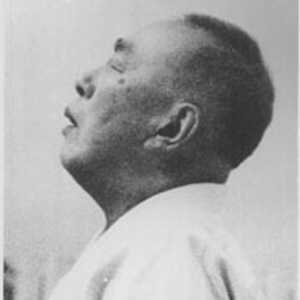


 .
. to select the subtitle language.