Tag Archives: ki

Ki, a dimension in its own right

by Régis Soavi

Ki belongs to the realm of feeling, not to that of knowledge.’1Tsuda Itsuo, The Non-Doing, Chap. II, 2013, Yume Editions (Paris), p. 27 (1re ed. in French, 1973). Tsuda Itsuo

As soon as you mention ki, you are dismissed as a mystic, a kind of crackpot: ‘It’s not scientific; no instrument or machine is capable of proving or demonstrating that ki exists.’ I completely agree. Indeed, if we consider ki to be a super-powerful energy, a kind of magic capable of throwing people across the room or killing them with just a shout, as was believed with kiai, we risk expecting miracles and quickly becoming disappointed.Ki une dimension a part entiere

Is ki an Eastern philosophy?

What is this “Eastern” philosophy that we supposedly do not have access to? Is there a specific domain reserved for a select few adepts, a handful of hand-picked disciples, or is this knowledge available to everyone, and what is more, without complicating our lives? I mean by leading a normal life, without being part of an elite group with access to secret knowledge, without having special, hidden practices that are doled out sparingly, but more simply by having a job, children, etc. When you practice Aikido, you are obviously engaged in both philosophical and practical research, but it is an “exoteric” rather than “esoteric” research.

Tsuda Itsuo wrote nine books, thus creating a bridge between East and West to enable us to better understand the teachings of Japanese and Chinese masters, to make them more concrete, simpler, and accessible to all. You do not have to be Eastern to understand and feel what it is all about. But it is true that in the world we live in, we are going to have to make a little effort. We need to break out of our habitual behaviours and references. We need to develop a different kind of attention, a different kind of concentration. It is not a question of starting from scratch, but of orienting ourselves differently, of directing our attention (our ki) in a different way.

First, we must abandon the very Cartesian idea that ki is one single entity, when in fact it is multiple. We must also accept that our bodies are capable of sensing things that are difficult to explain rationally, but which are part of our daily lives, such as sympathy, antipathy, and empathy. Cognitive science attempts to dissect all this using mirror neurons and other processes, but this does not explain everything, and sometimes even complicates matters.

In any case, there is an answer to every situation, but we cannot analyse everything we do at every moment in terms of the past, present, future, politics, or the weather. Answers arise independently of reflection; they arise spontaneously from our involuntary responses. Whether these answers are good or bad, analysis will tell us after the fact.

Ki in the West

The West was familiar with ki in the past; it was called pneuma, spiritus, prana, or simply vital breath. Today, this seems rather outdated. Japan has retained a very simple use of this word, which can be found in a multitude of expressions, which I will quote below, taking a passage from a book by my master.

But in Aikido, what is ki?

If any school can and should talk about ki, it is the Itsuo Tsuda School, not because we claim exclusivity, but simply because my master based all his teaching on ki, which he translated as breathing. That is why he spoke of a ‘School of Respiration’2ibid., Chap I, p. 17: ‘By the word respiration, I do not mean the simple bio-chemical process of oxygen merging with haemoglobin. Respiration is all at once vitality, action, love, a sense of communion, intuition, premonition, and movement.’3ibid., p. 16

Aikido is not a art of fighting, nor even a form of self-defence. What I discovered with my master was the importance of coordinating my breathing with my partner as a means of achieving a fusion of sensitivity in any situation. Tsuda Itsuo explained to us through his writings what his master Ueshiba Morihei had taught him. To convey this to us in a more concrete way, during what he called “the first part” – solitary practice, which we would now call Taisō – he would say KA when inhaling and MI when exhaling. Sometimes he would explain to us: ‘KA is the root of the Japanese word for fire, kasai, and MI is the root of the word for water, mizu.’4[see e. g. Tsuda Itsuo, The Science of the Particular, chap. XVIII, 2015, Yume Editions, p. 152–3 (1st ed. in French, 1976, p. 157–8)]. The alternation of inhalation and exhalation, their union, creates kami, which can be translated as the divine. ‘But be careful,’ he would tell us, ‘we are not talking about the God of Christianity or of any other religion – if you are lacking reference points, we could say that it is God the universe, God nature, or simply life.’

In the dojo, there was a drawing in Indian ink by Master Ueshiba containing fourteen very simple shapes and which we called Futomani because O-sensei had said that it had been dictated to him by Ame-no-Minaka-nushi: the Celestial Center. Tsuda Itsuo explains this in his book The Dialogue of Silence5Tsuda Itsuo, The Dialogue of Silence, chap. XII, 2018, Yume Editions, p. 106–7 (1st ed. in French, 1979, p. 157–8). Thanks to this, I gained a better understanding of the directions ki took when it had a form.

Dessin exécuté par Maître Ueshiba
drawing by Master Ueshiba

Reconnecting, rediscovering the links with what already exists deep within us

The founder spoke of Haku no budo and Kon no budo: kon being the essential soul that must not be stifled, but, he said, we must not neglect the haku soul, which ensures the unity of the physical being.6[see e. g. The Dialogue of Silence (op. cit.), chap. XII, p. 100–2; or The Way of the Gods (2021, same author & publisher), Chap XIII, p. 103–4]

Once again, we are talking about unity.

If our practice is called Ai-ki-do – “the way of unifying ki” – it is because the word ki has meaning.

Practical experience will allow us to understand this better than long speeches. And yet we must try to explain, try to convey this important message, because without it our art risks becoming a fight where “may the strongest, the most skilled, or the most cunning win,” or an esoteric, mystical, elitist, even sectarian dance.

And yet we know ki well; we can sense it from a distance. For example, when we walk down a small street at night and suddenly feel a presence, a gaze on our back, and yet there is no one there! Then suddenly we notice a cat watching us from a nearby rooftop. Just a cat, or a curtain that flutters surreptitiously. The gaze carries a very strong ki that everyone can feel, even from behind.

One of the practices of Seitai-dō called Yuki consists of placing your hands on your partner’s back and circulating ki. This is not about laying hands on someone who is, on the face of it, not sick to heal them, but about accepting to visualise the circulation of ki, this time as a fluid, like flowing water. At first, neither person feels anything, or very little. But then, little by little, they discover the world of sensation. You could say that it is a dimension in its own right, in all its simplicity. It is simple, it is free, it is not linked to any religion, it can be done at any age, and when you begin to feel this flow of ki, the practice of Aikido becomes so much easier. The kokyū hō exercise, for example, cannot be done without kokyū, and therefore without ki, unless it becomes an exercise in muscular strength, a way of defeating an opponent.

I would never have been able to discover the Aikido that my master taught if I had not willingly and stubbornly sought it out. In sensitive research, through all aspects of daily life, to understand, feel, and expand that understanding without ever giving up.

Atmosphere

Ki is also atmosphere, so in order to practice, you need a place that allows ki to flow between people. In my opinion, this place, the dojo, should, whenever possible, be “dedicated” to a particular practice or school. Tsuda Itsuo believed that entering the dojo was a sacred act, which is why we bowed when stepping onto the tatami mats. It is not a sad place where people ‘should wear a scowling constipated expression. On the contrary, we must maintain a spirit of peace, communion and joy.’7Tsuda Itsuo, Heart of Pure Sky (posth.), ’Booklet n°3 – Respiratory Practice in Aikido’, 2025, Yume Editions, p. 102 (1st ed. in French, 2014)

The atmosphere of the dojo is nothing like that of a club or a multi-sports hall that is rented for a few hours a week and used, for reasons of profitability, by different groups that have nothing to do with each other. The kind of place, the kind of gym where you go, train, then take a shower and say goodbye; at best, you might have a beer at the local bar to chat a little with each other. When you know about ki, when you start to feel it, and especially when you want to discover what lies behind this word, a place like the dojo is really something else entirely. Imagine a quiet place in a small Parisian passageway at the end of the 20th arrondissement. You cross a small garden and on the first floor of a very simple building is “The Dojo.”8[more of which in Yann Allégret, On the wach for the right moment, pub. online (Feb. 2014)]

Dojo
Dojo

You can come every day if you want, because there is a session every morning at quarter to seven: you are at home. You have your kimono on a hanger in the changing rooms, the session lasts about an hour, then you have breakfast with your partners in the adjoining area, or you rush off to work. On Saturdays and Sundays, you can sleep in, with sessions at eight o’clock.

Explaining ki is difficult, which is why only experience allows us to discover it. And for that, we must create the conditions that allow for this discovery. The dojo is one of the elements that greatly facilitates the search in this direction. It reconnects circuits, but also unties the bonds that constrain us and obfuscate our vision of the world.

Little by little, the work will be done, the knots will be untied, and if we accept that they are untied, we can say that the ki begins to flow more freely again. At that moment, it flows as vital energy; it is possible to feel it, visualise it, and in a way, make it conscious. Unnecessary tensions that cannot be released cause our bodies to stiffen. To make this as clear as possible, we could say that it is a bit like a garden hose that is blocked. It risks bursting upstream. The stiffening of the body forces it to react for its own survival. This triggers unconscious reactions that act on the involuntary nervous system. To avoid these blockages, micro-leaks of this vital energy occur, and sometimes even larger leaks, for example in the arms, at the koshi, and mainly at the joints. The immediate consequence is that people are no longer able to practice with fluidity, and it is strength that compensates for the lack. Parts of the body stiffen and begin to react like bandages or casts to prevent these losses of vital force. This is why it is so important to work on feeling the ki, on making it circulate. At first, visualisation allows us to do this, but as we deepen our breathing (the sensation, sensitivity to ki), if we remain focused on flexible practice, if we empty our minds, we can discover, see, and feel the direction of ki, its circulation. This knowledge allows us to use it, and the practice of Aikido becomes easy. We can begin to practice non-resistance: non-doing.

Women’s natural sensitivity to ki

Women generally have greater sensitivity to ki, or more accurately, they retain it more if they do not distort themselves too much in order to defend themselves in this male-dominated world where everything is governed by the criteria and needs of masculinity, the image of women that is conveyed, and the economy. Their sensitivity stems from the need to keep their bodies flexible so that they can give birth naturally and care for newborns. This flexibility cannot be acquired in gyms, weight rooms, or fitness centres; rather, it is a tenderness, a gentleness that can be firm and unwavering when necessary. Newborns need our full attention, but they cannot say ‘I’m hungry, I’m thirsty, or I’m tired,’ or ‘Mom, you’re too nervous, calm down, and tell Dad to speak more softly, it scares me.’2011-07-20 at 08-21-28

Thanks to their natural sensitivity, they sense the child’s needs, they intuitively know what to do, and ki flows between mother and child. When the father, who is always very rational, does not understand, the mother senses and therefore knows. Even if she is not a mother, even if she is a young woman with no experience, it is the body that reacts, it is the body that has this natural sensitivity to ki, and that is why, I think, there are so many women in our School. It is because ki is at the centre of our practice that nothing can be done without it. We focus our sensitivity in this direction and thus we can see the world and people not only on the level of appearances but much further, in their depth, what is behind the form, what structures it, or what drives it.

Some examples by Tsuda Itsuo, taken from The Non-Doing

‘“The most difficult thing to understand in the Japanese language is the word ‘ki’.”
It is true that the Japanese use the word many hundreds of times a day, without thinking about it, yet it is practically, and I would also say theoretically, impossible to find an equivalent in European languages.
While the word itself, taken out of context, remains untranslatable, it is nevertheless possible to translate current expressions of which it forms a part. Here are a few examples:
ki ga chiisai: literally, his/her ki is small. He (she) worries too much about nothing.
ki ga okii: his/her ki is big; he/she does not worry about petty things.
ki ga shinai: I do not have the ki to do… I do not want to. Or, it is too much for me.
ki ga suru: there is ki for… I have a hunch, a feeling, I sense intuitively…
waru-gi wa nai: he/she does not have bad ki, he/she is not a bad person or does not have bad intentions.
ki-mochi ga ii: the condition of ki is good; I feel well.
ki ni naru: it attracts my ki, I cannot free my mind from this idea. Something strange, not normal, is holding my attention, in spite of myself.
ki ga au: our ki matches, we are on the same wavelength.
ki o komeru: to concentrate ki. In the matter of concentration, nowhere else have I seen it taken to such heights as in Japan. […]
[…]
Ki-mochi no mondai: it is conditioned by the state of ki. It is not the object, the tangible result that counts, but the action, the intention.
[…]
One could give examples of several hundred more expressions which use the word ki.

Most Japanese themselves are incapable of explaining what ki is, yet they know instinctively when to use the word and when not.’9The Non-Doing (op. cit.), Chap. II, p. 25–7

Tsuda Itsuo started practising Aikido at the age of forty-five. He was not athletic, but his mere presence transformed the entire atmosphere of the dojo. I would like to tell you a story about one of the exercises I did in the 1970s, when my master was already over sixty years old. When I passed through the gate to the courtyard at the back of which the dojo was located, I would stop for a moment, close my eyes, and try to sense whether “he” was there. At first, it did not work very well; it was just random guesses, strokes of luck. Little by little, I understood: I should not try to know. So I began to “empty” myself, to stop thinking, and it came. Every morning, I knew whether he had arrived or not. I could feel his presence as soon as I approached the dojo.

From that moment on, something changed in me. I had finally understood a small part of his teaching, and above all, I had verified that ki was not part of the irrational, that it was concrete, and that its perception was accessible to everyone since it had been accessible to me.

Régis Soavi

Would you like to hear about the next article?

Subscribe to our newsletter

Article by Régis Soavi (on ki 気) published in January 2017 in Dragon Magazine Spécial Aikido n° 15.

Notes

Seizing, an art of detachment

by Régis Soavi

Seizing in itself is not the difficulty, it is the coagulation of ki in the wrist, the arms or around the body that causes a problem and blocks us, and it is through detachment that we can get free of it. The way to achieve this is visualization. Tsuda sensei provides us with an example in his second book The Path of Less:

Aide-mémoire Itsuo Tsuda saisie
Drawing by Master Tsuda showing different types of seizures.

Aikido for me is an art of becoming a child again. […] It takes art to become a child without being childish.[…]] John, for example, tackles me from behind. I want to crouch down to sit, but he prevents me from doing so. He has biceps twice as big as mine and weighs almost 200 pounds (90 kilos). I cannot move, he is holding me so tightly. What should I do? Throw him before I sit down? I try but I cannot do it because he is too heavy and too strong.

So I become a child. I see a wondrous seashell on the beach and bend down to pick it up. I forget John, who is still grasping me from behind. (There is an important technical detail here: I move one foot forward to make two sides of a triangle with the other foot, because it is more concentrated that way.) There is flow of ki, starting with me and moving towards the seashell, whereas before, the ki was frozen at the thought of John. John’s 200 pounds become very light, and he falls forward over my shoulders.How is it that with different ideas, we obtain opposite results, while the situation remains the same?

The idea of throwing provokes resistance. In the child’s gesture, there is the joy of picking up the shell that makes one forget the enemy’s presence.’ (1)

Grabbing, appropriating

There are many ways of seizing and it is the intention put into it that is often determinant. Some of them can be considered as superficial or even unharmful, others more dangerous, like for instance those which carry a mark of appropriation or others which can sometimes be insidious and insistent.

The scenography which allows training in Aikido considers seizing as the result of an act manifesting itself with some kind of aggressivity. This act in itself is already an attempt to appropriate the other person, so as to use him in some way, rob him, destroy him, destroy his person or personality, setting apart the well-founded cases which are not of our concern in this example. What I am talking about is the abuse of a power, whether it be real or unreal, known or desired, over the other, this other person being presumed unable to react when faced to such a display of strength.

Assuming power

In the animal world, the power of an individual or clan in the bosom of a larger group of the same kind matches quite definite criteria, generally in relation to reproduction, preservation or to the defense of a species. As a consequence, it is borne and finally accepted by the whole group; in case of any attempt to contest, genetic or merely ancestral rituals are meant to clarify the situation.

In human societies, particularly in ours which would like itself to be more modern in some respect, the need for assuming power over the other person seems to me more like a dysfunction, or even a disease, which are fully created by the behaviours induced by civilization. Uncertainty about one’s own power, as well as the conditionings exerted by all those already installed in the bosom of society bring about frustration and lead human beings to try to reconquer their power through words or even acts, trying where this power does not lie, where they vill not find it, that is in the other person who anyway does not detain it. But on the other hand, it forces them mentally to take all the risks implied by this vain hope. The arising of such aggressivity is often due to a lack or deficit of one’s own power, whether admitted or not, that one tries to make up. Pressure undergone and felt, hence experienced as such, sometimes since early childhood brings in people the will to reappropriate what they feel intimately robbed of, deprived of, or even what they just lost. It makes them dangerous persons, merely due to their frustration. We can all understand and feel that kind of thing when helplessly faced to an administration, or when put under power by somebody against whom there is apparently no possible opposition. From that point, there is just one step to becoming aggressive, which some people take, while others manage to be reasonable, resign themselves because they have already accepted this state of domination out of habit and they daily undergo it. If a few people are only hardly moved, it is because they have already overcome these difficulties and are not damaged in their own power, never having lost it or having already recovered it.

Prisoner

‘It’s a case of the biter bit’ says the proverb and this reversal of perspective is indeed what happens when seizing. We forget too easily that the one who is seizing becomes prisoner of what he has seized. He canot get rid of it without risking to lose something in the process he has initiated. His freedom, if he has any at all, is now transferred to the one he thought he could detain or retain. He becomes a jailer to the other person, who will only think of getting free, who will put all his strength, intelligence, sometimes all his craftiness or even perfidiousness into it, because he is totally within his right and nobody can blame him for it. Our society generates this type of alienating behaviour in which both persons try to free themselves, one against the other, instead of moving to another dimension which would be more human, intelligent, and respectful of the this other person. Wanting to change these behaviours might seem utopic, yet if Aikido exists and continues to be an art at the service of mankind, it is maybe to assert and demonstrate that, like others have already stated, other relations are possible between people and we aikidokas are not the only ones who wish to continue in this direction.

Respiration, an answer to a specific situation

It is through ventral respiration and the calmness it brings about that one can find the immediate solution to some difficult situations. To prepare for that, it is not absolutely necessary to be an outstanding technician, or someone brave as a blizzard, or a very competent analyst but on the other hand there is need to recover this force which has taken refuge at the very bottom of our body, of our kokoro, or which even sometimes has been scattered in multiple defense systems. Trying to find a defensive solution in violent martial arts when faced with the awareness of our weakness, real or assumed, is just dodging the issue, seeking an alternative, or worse, forging ahead regardless. Aikido, by its philosophy, suggests another direction but if this fails to be heard and above all understood, it may well cause Aikido to lose its justification, its singularity.

Attacks in Aikido are just a way of setting a situation in order to enable practitioners to solve a problem, or even a conflict, which by the way puts them in opposition more with themselves than to with their partners. Seizings, for instance, often represent attempts to immobilize the body, therefore to block the other’s movement, through imprisonment of the wrists, arms, trunk, keikogi or any other part which can be grabbed for this purpose. Sometimes, however, seizings may follow on from an attempt to strike that has failed. They are seldom solely a matter of blocking; considered in the perspective of a fight, they should almost always be followed by an Atemi or a final immobilization. They are only the first act, the first scene of a play which is much longer, if one may say so. It might seem paradoxical but it is through working on seizings that one will discover detachment.

Sensibility, instinct

Quite before seizing or hitting materializes, our sensibility is touched by something invisible even though very physical. This may be inexplicable as scientific knowledge currently stands, but this is something we know well, and even sometimes very well. That is what makes us move, dodge, although we have seen nothing but simply felt it in an indefinable way. In order to give a clearer example, one which everybody has been able to verify in one way or another, in different circumstances, I would like to write about gazing. Gazing carries an energy, an extremely concrete Ki that our instinct can perceive. Have you not ever experienced, while taking a walk one evening or one night, feeling something indescribable behind you as if someone was gazing at you, watching you; you turn around, nobody there, and still the sensation lingers? The sensation, if you are not at peace, can turn into anxiety or perhaps trigger an “irrational-since-there’s-nobody” fear, when at the angle of the street behind a half-opened curtain you suddenly discover somebody observing you – or on an overhanging roof a cat watching you. The gaze of cats, and of animals in general, as well as the gaze of humans when intently observing something or somebody, carries an extremely powerful Ki. Our instinct can feel it, but it all depends on our state of mind at that moment. If we are talking with a friend, if we are lost in our thoughts after a love encounter for instance, our instinct, if not well-prepared, will have difficulty feeling this kind of things. The same obviously applies when we are worried, frightened or anguished, in this case all our being is somehow weakened, it loses its instinctive abilities.

Discovering the direction taken by Ki

Aikido enables us to re-discover and conduct our instinctive abilities. It is thanks to a slow work on ourselves and our sensations that will appear again what we have often let go to sleep, rocked as we were by the comfort due to modern society which may seem so reassuring to us.The work based on seizing corresponds, like everything we do in Aikido, to a process of renewed learning and to a training of the body as a whole so that there will no longer be any separation between body and spirit. First of all, when our partner gets closer, there is no question of waiting kindly for him to seize us as requested, our whole body must feel the directions followed by the different parts of his body: arms, legs, his bearing points, all of this without looking, without observing, because it would already be too late. With unexperienced beginners, if the exercise is done slowly enough, they will be able to discover the routes taken by their partner’s Ki, the force lines. Since they work without any risk, they start again trusting the reactions and sensations of their bodies. During sessions, I do not only show the techniques, I am constantly on the move, serving as Uke to one person, as Tori to another; without blocking them, I make them feel the direction their body must take by putting myself in the situation, making ki more material, by materializing the force lines, visualizing the openings they can use, while allowing them to act and respond as they will.

Discovering the Non-doing

Seizing can be a first step on the path that leads to what Lao Tseu and Chouang Tseu would name Wu wei, the Non-acting, and it was the basis of my master Tsuda Itsuo’s teaching. How to teach what cannot be taught, how to show the invisible, how to guide a beginner or even an experienced practitioner towards what is the essence of the practice in our School? What is difficult to explain with words is easily understood when we let sensation guide us. To do so we have to take a few steps backward. To let go of our acquiring and piling up habits, those consumer reflexes of people always ready to fill up their trolleys with various products, techniques which are more or less modern, fashionable or old style, miraculous, easy and effortless, or even tough but efficient. Advertising is today the source of many illusions, luring its clients with colourful wonders of a world that has become so virtual. When will the new Wii console enable us to practice Aikido with enhanced reality glasses and a partner whose potentiometer can be adjusted depending on our level, our shape, or our mood?

But maybe I am behind and it already exists.

Seizing with Ki

Young children know and naturally use a certain way of seizing which is extremely efficient. It is a seizure devoid of any useless contraction. When they seize a toy they put all their ki into the act and when they let go of this toy they do it with complete indifference, there is no more Ki in it. On the other hand they have an incredible capacity when they do not want to let go of what they have seized and are holding tight in their small hand. If this is something dangerous, their parents must sometimes unfold their fingers one by one, though their hand is so small and devoid of any true muscular strength as adults mean it. They know in a manner completely unconscious how to use Ki, they do not need to learn, unfortunately they often lose this ability for the benefit of what is reasonable and most of the time education and schooling are responsible for this.

To learn again how to seize like a small child, without tension, and thus discover natural prehension. I often give as an example the way birds alight on a branch: they have skin micro-sensors in the middle of their paws which inform receptors which, thanks to these indications, stimulate reflex functions at the level of the involuntary, and give the order to their fingers to close as soon as they touch the branch. This manner of seizing avoids contortions, failures, and enables a very subtle adequacy of the members to the place caught (they catch). A quality seizure is a seizure which uses the palm of the hand as first contact, then the fingers close up on the object, the limb, the Keikogi. If we act in this way, seizing is faster, without any excessive tensions, and it has remarkable efficiency, allowing therefore a good quality work with a partner.

The only seizures which respect the other one’s freedom are light but powerful, like for instance that of a small child who wants to take along one of his parents to look at a small frog he’s just seen in the tall grass and is curious about, or like that of two beings, friends or lovers, bound by tenderness and respectful of each other.

Régis Soavi

Would you like to hear about the next article?

Subscribe to our newsletter

Article by Régis Soavi published in April 2019 in Self & Dragon Spécial Aikido n° 24.

(1) Tsuda Itsuo, The Path of Less, p. 175, Yume Editions, Paris, 2015 (trans. from La Voie du dépouillement, Le Courrier du Livre, 1975)

Misogi

Starting with a theme taken from I Ching hexagram K’an (the Abysmal), Régis Soavi writes in this article about Aikido as a Misogi pratice.


Misogi 禊 is widely practised among shintoists. It consists of an ablution, sometimes under a waterfall, in a stream, or in the sea and allows a purification of the body at both physical and psychical levels. In a broader sense, Misogi encompasses a whole process of spiritual awakening. Misogi is also a way to relieve the being of what overwhelms him, so to allow him to wake up to life. Water has always been considered one of its essential elements.

Like water, Aikido is a way to achieve Misogi

Founder of Aikido O Sensei Morihei Ueshiba kept on telling his students that the practice of this Art is above all a Misogi.

Aikido is one of the Japanese martial arts for which the main character, the very nature, is, like water, fluidity. The teaching brought by Itsuo Tsuda Sensei who was during ten years a direct student of the Founder Morihei Ueshiba has definitely confirmed it. Although his words seem to have largely been forgotten, he kept on repeating that in Aikido there is no fighting, it’s just the art of uniting and separating1Itsuo Tsuda, The Path of Less,  2014, Chap. XIX, Yume Editions, p. 182 (1st ed. in French, 1976, p. 174–5). However, when you watch an Aikido session, it seems that two people are fighting each other. In fact one of them plays the role of the assaillant, but in real he is a partner, facing him there is no aggressiveness, you won’t see any malicious gesture, no violence, even if the response to the attack may be impressive because of its efficiency.

Overall, the Aikido practised in the Itsuo Tsuda School is an Art of great fluidity, an art in which sensitivity and caring for the partner have the main part, and it is always through the smoothness of a first part practised individually that an Aikido session begins.Far from starting with warm-up exercices, an Aikido session begins with smooth, slow but still invigorating exercises. Breathing coordination is essential, as it allows us to harmonize with Ki, and thereby to take a step forward to discover a world with an additional dimension, the “World of Ki”.

This world is not a revelation, it is more what comes to light, what appears clearly when one recovers one’s sensitivity, when rigidity vanishes into thin air and that the living appears through. It is often women who first understand the importance of such a way of practising. That is why so many women practise in our school because they have experienced the bitter taste of sexist oppression in our society and they find in this art a way, a path, far beyond the simple martial art.

Ki, a driving force

Ai, 合 Union, Harmony
Ki, 気 Vital energy, Life

Do, 道 Path, Way, Tao

Ki is not a concept, a mystical energy nor a sort of mental illusion. We can feel Ki. In fact everybody knows what it is, even if, in Western countries nowadays, we do not give it a name. Learning to feel it, to recognize it, to make the most of it, is necessary for who wants to practise a martial art, and even more if you practise Aikido. In Aikido, if you don’t focus on Ki, only the empty form of its contents remains, this form becomes quickly a fight, a struggle in which the strongest, or the most cunning will manage to defeat his partner. We are really far away from the founder’s teaching for whom it was an art of peace, an art in which there is neither winner, nor defeated. Each movement of the partner is accompanied by a complementary movement from the other partner, like the water that marries each roughness, every nook, leaving nothing behind or separate.

misogi
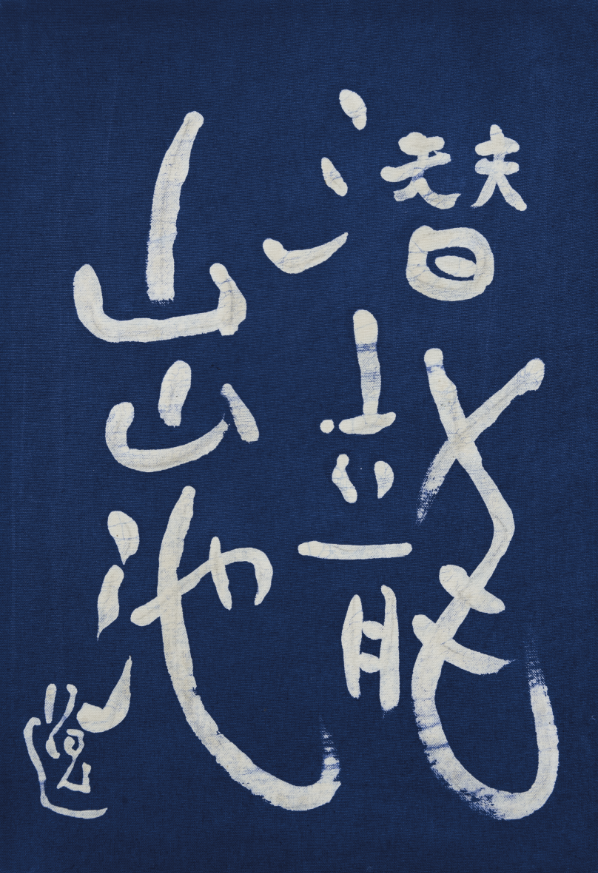
Calligraphy by Itsuo Tsuda

If the beginnings are usually tough, it’s because people have lost part of their mobility and mostly because they have become hard so to be protected from the world around. They have built a carapace, an armour, certainly protective, but which has become a second nature and an invisible prison. To have Ki flow in our body again, so to recover fluidity, and follow a teaching based on sensitivity enables us to understand physically the Yin and the Yang.

Bathing in a sea of Ki

Exercices and basic or advanced techniques have not only in common the breath which is nothing but the materialization or even better the visualisation of Ki, but they also allow to become aware of our body, physically and of our sphere of ki, which the Indians call the AURA, and that we have today practically forgotten almost everywhere.What modern science and in particular neuroscience has been discovering for a few years is only a small part of what everyone can discover on his own and put into practice in his daily life simply through the practice of Aikido as Itsuo Tsuda Sensei taught it.He would repeat over and over again that Aïkido as presented by his Master Morihei Ueshiba is the union of Ka the inspiration, the ascending force, the square, the weft and Mi, the exhalation, the downward force, the cercle, the chain.Ka being in Japanese a prononciation for 火 fire (which appears for example as a radical in the word Kasai 火災, wild fire) and Mi the first syllable of Mizu 水 water, the whole forming the word KAMI 神 which means divine in the sense of the divine nature of all things. Itsuo Tsuda would add that ‘in this gloss one mustn’t see a similar value to that of a scientific etymology. It comes from punning, the use of which is common among mystics’. 2Itsuo Tsuda, The Science of the Particular, 2015, Chap. XVIII, Yume Editions, p. 153 (1st ed. in French, 1976, p. 137)

I have never seen such fluid movements as when he wanted us to feel a technique he showed to us. Moreover, in his dojo there used to be no accidents, nobody injured, everything would be in a flow of Ki both respectful and generous but at the same time firm and rigorous, that I can hardly find today in the sports halls where aikidokas have their trainings.

The dojo, an essential place

Do we really need a special place to practise Aikido? If we talk about the surface we need for falls, we could lay tatamis anywhere, from the moment we are sheltered from bad weather.

In his book Heart of Pure Sky, Itsuo Tsuda gives us his extremely clear view of what should be a dojo, he who was Japanese was in the best position to give us a glimpse:

‘Concretely, L’École de la Respiration is a “Dojo”, a particular kind of space in the East, which refers less to the material place itself than to the energetic space.’3Itsuo Tsuda, Heart of Pure Sky (posth.), ‘Interviews on France Culture radio’, ‘Broadcast no. 1’, 2025, Yume Editions, p. 13 (1st ed. in French, 2014)

misogi eau
Régis Soavi
‘As I have already said, the dojo is not simply a space carved out and reserved for certain exercises. It is a place where the space-time is different from that of a secular place. The atmosphere there is particularly intense. We enter it by bowing to sanctify ourselves and we go out by bowing to desacralise ourselves.
Spectators are admitted, provided they respect the atmosphere[…]. They must not gratuitously parody the practice with words and gestures.

I am told that in France [or in Italy], we come upon dojos that are simply gymnasiums or sports clubs. So be it. As for me, I want my dojo to be a dojo, and not a club with a boss and his regulars, so as not to disturb the sincerity of the practitioners. This does not mean that they should wear a scowling constipated expression. On the contrary, we must maintain a spirit of peace, communion and joy.’4ibid., ‘Early Writings’, ‘Booklet n°3 – Respiratory Practice in Aikido’, p. 102

A sacred space therefore and yet fundamentally non religious, a secular space, a space of great simplicity where the freedom to be as we are exists, beyond the social. And not what we have become with all the compromises we had to accept in order to survive in society. This freedom remains inside us, deep within us in our intimate heart, our Kokoro 心 as Japanese language talks so well about it, and is only asking for a chance to be revealed.

Régis Soavi

Would you like to hear about the next article?

Subscribe to our newsletter

Notes

Yuki #3

Sequel of interviews where Régis Soavi, who has been teaching and introducing people to Katsugen Undo for forty years now, gets back to basics about Seitai and Katsugen Undo. In this third video, the concept of Yuki is explored.

Subtitles available in French, English, Italian and Spanish. To activate the subtitles, click on this icon. Then click on the icon to select the subtitle language.

Subscribe to our newsletter

Some additional information

Seitai was developed by Haruchika Noguchi (1911-1976) in Japan. Katsugen Undo (or Regenerating Movement) is an exercise of the extrapyramidal motor system that is part of Seitai. Itsuo Tsuda (1914-1984), who introduced Katsugen Undo in Europe in the 70s, would write about it: ‘The human body is endowed with a natural ability to readjust its condition […]. This ability[…] is the responsibility of the extrapyramidal motor system.’ 1Itsuo Tsuda, One, Chap. VI, 2016, Yume Editions, p. 46 (1st ed. in French: 1978, Le Courrier du Livre (Paris)

Excerpts from the video on Yuki

‘There is natural Yuki. The Yuki that mothers naturally do on their stomachs. There is natural Yuki, which is very simple: when a friend is in pain, you place your hand on their back, and that is natural Yuki. Sometimes we add a few words.

There is natural Yuki, when you have a headache, you put your hand on your head. If you have a very bad headache, you put both hands on your head. But not everyone puts their hands there, precisely. Some people put their hands like this, some put them like that, and that’s natural Yuki. That’s precisely why you can’t teach Yuki. You can’t say, “If you have a headache, put your hands like this and do Yuki, circulate the ki.” “Oh yes, but that doesn’t work for me.” — Oh yes, yes, that’s the technique. — When I have a headache, I do it like this — And I do it like this — And I do it like this, there, that feels good.”

And then there is Yuki as an exercise.

Yuki’s exercise is a specific moment. We do it during Katsugen Undo sessions. At a certain point during the session, there is Yuki. So first we bow to each other. The bowing between two people is the coordination of breathing. Then, one of the two turns their left side toward the other. One hand behind, you see, at eye level, and one hand in front. Then the person lies down, we put our hands on their back and circulate the ki. In this case, it is the exercise to rediscover Yuki. During the movement sessions, it lasts 5 minutes, up to maybe 8 minutes. We all do it together. It is both an exercise that allows us to become aware of ourselves and to make the other person aware. It is not learning, it is discovery. We discover and we deepen our understanding.

Yuki is circulating ki. But ki has no form. Well, here it takes on a form. Ki has no form, ki is atmosphere… the concept of ki is very vague. But here, because there is an action, it has a form. Some people want to associate it with energy, we talk about vital energy. I don’t really like that. I don’t really like that term. “Energy” immediately makes us think of electricity, etc. Or psychic energy that bursts forth, etc. And that’s not what this is about.

Yuki is an experience. It is first and foremost an experience.

he first time I encountered Yuki was because — I remember we were at a café with my master Itsuo Tsuda. It was in the early 1970s, and during a conversation, he simply placed his hand on my back and said, “Yuki is this.” That changed everything.’

Notes

  • 1
    Itsuo Tsuda, One, Chap. VI, 2016, Yume Editions, p. 46 (1st ed. in French: 1978, Le Courrier du Livre (Paris)

Hello Illness #2

Continuation of Régis Soavi Interview’s about Katsugen Undo (or Regenerating Movement), a practice made by Haruchika Noguchi and spread in Europe by Itsuo Tsuda. An article by Monica Rossi, published in Arti d’Oriente #4, May 2000.

You can read part 1 here.

Part #2

– How can one define Yuki?

– Letting the Ki circulate.

– How can Yuki help to activate the Movement?

– It helps, in the case where one has done the three exercises, or the exercises for Mutual Movement (activation through stimulation of the second pair of points on the head; that is another way to activate the Movement). Yuki helps because it activates; It’s very important for me to say that Yuki is fundamentally different from what we often hear spoken of, because when we do Yuki, we clear our heads, we don’t cure anyone, we don’t look for anything. We are simply concentrated in the act. There is no intention, and that is primordial. In the statutes of the dojo, in fact, it is underlined that we practice “without a goal””.

Read more

# 2 Breathing, a Living Philosophy

respiration philosophie vivante

Here is the second of the Six Interviews of Itsuo Tsuda ‘Breathing, a Living Philosophy’ by André Libioulle, broadcast published on France Culture in the 1980s.


BROADCAST N° 2

Q.: During the second week we will talk more in dept about the books published by Itsuo Tsuda. All these works published by the “Courrier du Livre” in Paris, are currently six: “The Non-Doing”, “The Path of Less”, “The Science of the Particular”, a book with the title “One”, “The Dialogue of the Silence” and recently “The Unstable Triangle”. They relate to breathing and the field of thought in relation to it. […]

The concepts of soul and body has always been separated into clear-cut by the west. They have often talked about the elevation of the individual’s soul as much as underestimating the body, considered as related to temptation. If for Plato, the soul is cramped in its carnal envelope, a prisoner of the body, for a man like Itsuo Tsuda the body appears to be the captive of the soul. A soul who constantly manipulates abstractions and cuts the vital impulse.The man more and more lives in the brain. The hopes of the society is based on the intensive exploitation of intellectual capacity in which it is seen the privilege of the human being. But this hypertrophicity of the brain creates a gap that is the source of the imbalance between the sensations, the body as life, as energy, as momentum, and the world built, conceptualized cerebrated. Breathing is unification, return to self, if you release the separation body and soul, if the soul ceases to be an abstraction, then it is everywhere, it is in the body as well as outside.

So… “ki”, the concept of which we gave already a hint during the previous broadcasting, introduces us to the idea of unity. This is what we will try to understand now. So, Itsuo Tsuda, it seems that the first step, towards the understanding of ki, it is whether we feel the sensation. That is to say not to abstract it, not to imagine about living a sensation but really and truly feeling it.

I. T.: There is a principle we recognize in Chinese medicine, it is: cold head and warm feet. Currently it is exactly the other way around: hot head and cold feet. We do not even feel our feet. And the head heats up more and more. There is quite a contributing factor to it: this is Westernization. But we can not turn back. This is a trend that has been going on since long time already. But we also have the obvious benefits that come from Westernization. But if that is only on a material level it does not helps us, it places us in a precarious state as individuals. Individuals become increasingly prisoners of well-planned structures, they can not feel alive themselves anymore.

Q.: Europeans elsewhere, you write, need to understand before acting. They do not engage immediately in action.

I. T.: What I am doing here, it is not precisely the same as what we would do in Japan. Often in Japan we do not explain, we found ourselves immediately into the experience path, it’s up to everyone to learn the lesson, isn’t it. Well, in the West this does not work. We need to understand first. But understanding is not enough. I have explained those people who were listening the explanation about swimming, but this does not allow people to be able to dive into the water. If we have not felt the first touch of the water, one can fill his head with all sorts of explanations, but it is useless.

Q.: But people will perhaps argue about this, “but why do I need to be able to feel? Why is that so important for me?”

I. T.: Well, this is the concept of “Seitai” precisely that one that Noguchi created after the war. At the moment people think in a dualistic way: “here – that is good, that is bad. We must fight the evil. When we have fought the evil, we will have the good. “But in fact, we do not search this: we normalize the terrain. That’s what he called “Seitai”: a well harmonized body. In the West we keep on finding the cause, we try to exterminate the cause. But as soon as we finished with the cause, here there are other causes that arise. But that’s the method that complies with this mental structure. But Noguchi brought this view which is quite different, which transcends all. If your organism is normalized, the problem itself becomes less important. In the West we say: there is such a problem. That’s a way of defining it, it does not change volume, it’s still there. We must attack this way etc.

Q.: So there is in fact for the West an anatomical way of understanding, discursive kind, in which we distinguish cause and effect and in order to be able to act on a particular item. The concept introduced by the Seitai is a different concept. It is the notion of sensation. But this is the notion, if I understand, in which knowledge is not excluded. But it is another type of knowledge, intuitive knowledge, qualitative I would say, in relation to the Western notion of measure or quantification.

I. T.: The same problem increases or decreases importance depending on sensation. A bottle is half empty or half full. But the quantity is exactly the same. But the sensation is different in both cases. So just a little nothing can change human behaviour. If one says, “that’s it, I’m done,” from that moment on one can no longer move forward. While if I say “I have already made three steps forward,” then I’am ready to make a fourth step, isn’t it.

Q. Do you not think that there is a notion that is brought by the West, which is about the total or the global but understood as an assembly of parts? With the quality we are also in something global, but without this assembly idea.

I. T.: In Seitai, we do not look at a person as an assembly of various parts. That’s the basic idea. A person is an individual, total, isn’t it. But everyone is different, in its movement, in his breath, in his sensitivity. That’s what matters to us.

Q.: You talked about Master Noguchi repeatedly. Could we try to understand what the whole is, the unit in an individual through some examples of the practice of Master Noguchi, Noguchi was a therapist, wasn’t he. He is the creator of the Seitai method. So how is his job? What enabled him to understand those concrete things, spontaneously?

I. T.: For example, each one has its own biological speed, which determines the behaviour, actions, movements etc. It is viewed in a quite detached way, objective, as per minute etc., etc., but for Noguchi, well that’s something concrete. Everything comes from that biological speed that is inherent in the individual. Without this notion of speed he can do nothing. But this…

Q: … so there, the notion of speed has nothing to do with the notion of rapidity, for example …

I. T.: … no, no …

Q.: … as we know it, it’s something else …

I. T.: No. We need to create the contact with the biological speed of that particular person. No need to apply a general and objective speed. Well, for example, there is a kid who comes while crying, he is crying because he broke his arm. Parents say: “It is impossible to touch him, he keeps on crying and crying …”. But Noguchi has already touched him. “Ah, ah good then it is because he does not dare to cry in front of a master.” No it’s not that. He touched him at a , biological speed, the breathing speed of the child, which is peculiar to him. At that time, the kid does not feel the contact, it’s part of him, and that it’s so important.[Read extracts from books Itsuo Tsuda]

Q.: You wrote that Master Noguchi could identify the individual through observation and by touch, something like the notion of an unconscious movement.

I. T.: Yes, for him, all the movements are unconscious hundred percent. We believe precisely the opposite. We believe we are the masters of ourselves, but we can not do much, and we try to hold us, to behave in front of others, etc. And then one day the brake is released, and then we wonder where it comes from. For Noguchi everything is unconscious, we are not masters of ourselves.

Q.: Did Mr. Noguchi made a distinction between the unconscious movement and posture …

I. T.: … but the posture is the realization of the unconscious movement.Q. So the posture, it is observable by everyone … from the outside, without preparation, while the unconscious movement itself, requires preparation.

I. T.: Posture, if you think about the military way, for example, “Attention!” etc., so everybody tries to do pretty much the same. But when one is at rest, everyone is different.

Q.: What is the relationship there between breathing and unconscious movement?

I. T.: There are some people who are breathless, for example. So when this happen, respiration rises higher and higher. So, people breathe from the top of the lungs and then finally when their breath weakens it goes through the nose. What we do it is to go lower, right, so we can breathe with our belly, or, if one’s wants, with the feet. Without the practice it is quite difficult to explain that.

Q.: The idea of ??breathing is a concept much broader than a simple biochemical deal. Breathing is life, it is ki …, the “souffle” , the soul …

I. T.: yes …

Kokyu disclosure of the unity of being

By Régis Soavi

In one of his books Itsuo Tsuda gives us his views on kokyu:

CouvTsuda_PathOfLess_Mini“In learning a Japanese art, the question of “kokyu” always arises, strictly speaking, the equivalent of actual respiration. But the word also means to have a knack for doing something, to know the trick. When there is no “kokyu”, we cannot do a thing properly.  A cook needs “kokyu” to use his knife well, and a worker his tools. “Kokyu” cannot be explained; it is acquired.When I was young, I saw a labourer working with his screwdriver on very rusty machinery.  I tried to unscrew a piece of the machine, but in vain; it was too rusty. For the labourer, it posed no problem; he unscrewed it with ease, not because he was stronger but because he had “kokyu”.When we acquire “kokyu” it seems that tools, machines, materials, until then “indomitable”, suddenly become docile and obey our commands with no resistance.Ki, kokyu, respiration, intuition are themes that are pivotal to the arts and crafts of Japan. It constitutes a professional secret, not because people want to keep it like a patent, or a recipe for earning their living, but because it cannot be passed on intellectually. Respiration is the final word, the ultimate secret of learning. Only the best disciples gain access to it, after years of sustained effort.A martial arts master whom dogs bark at is not a good master, they say. The French know how to silence dogs by sliding a piece of sugar in their mouths. That’s the trick, that’s “the thing”, but it is not kokyu, respiration, which is something else entirely.”

Itsuo Tsuda, The Path of less, Yume Editions, Paris, 2014, p. 33-34.

I discovered kokyu with my master Itsuo Tsuda.aikido kokyuPreviously, it was to me just the name of a technique, with Itsuo Tsuda this notion became much more concrete, firstly by the orientation of his practice. He said: “To me technique is simply a test of knowing whether I’ve evolved in my breathing.” Thus our attention was brought directly to kokyu. There couldn’t be aikido and breathing. Aikido is breathing. And then, from his first books on, Itsuo Tsuda illuminates us in terms I didn’t knew; almost too simple and yet so difficult to achieve.

When I attacked him it was crystal clear, regardless the strength I put in he remained both, relaxed and powerful.He made us use visualization to teach us kokyu. E.g. for kokyu ho he said: “It is the lotus flower opening.” Today few people have seen the lotus flower, so I speak of a daisy. Visualization should talk to us, directed to us. For it to act, it must be anchored in the concrete life of each person.

So sometimes to help someone to get beyond a partner that is holding the wrists to prevent him or her to move, I say, “You welcome a friend you haven’t seen for years, who steps out of the train, take him in your arms!” Then the person forgets the other and ki, instead of being coagulated, flows in the given direction, the person raises the arms without any effort. The power of visualization is colossal.

Sure, posture is essential, I would even say primordial. If the body stiffens to become an impeccable posture; it’s screwed. If it is too flabby; it’s screwed. If the third lumbar is wrongly positioned: it’s screwed. With the practice of aikido and katsugen undo I see that my students are gradually recovering. Ki begins to flow without blockage, without disruption, it is the discovery of unforced abdominal breathing, but clear and limpid, from the kokyu. In my view, without kokyu, all the work in aikido is only intended to strengthen the body, it is a work of hardening.kokyu ho régis soavi

With the deepening of breath little by little the needlessness disappears, we do not need to work on flexibility or strength, stiffness and our ideas of strength and weakness are leaving. So ki circulates better.For this direction, the respiratory practice we do in the beginning of the sessions is important.You can not teach kokyu, but you can guide individuals to discover it.If we practice kokyu ho every morning at the end of each session, it is precisely to make people sensitive and also to improve our posture. As our posture and the way we behave refines and improves, we are able to help the normalization of the terrain of our partner. If you breathe deeply from the hara to the hara of the partner, you revitalize the channels through which ki flows, you enable these circuits to function better, and the other understands (feels) with his entire body what it is about.It is not about looking at the demonstration and working harder and harder, but rather about being pervaded with this kokyu feeling of the other. I often say: to work on the kokyu we must start by listening. We listen to the other, not with the ears but with the whole of our body, we feel the breathing, the ki, of the other. It’s like a perfume. We listen to the inner movement, so the feeling becomes more accurate and we can guide him or her to a better posture, towards a release of tension.

It is also the work of senior practitioners to encourage this discovery. By bathing the other in breath, they help them to feel it, by dint of being soaked with “something”.

In the practice of katsugen undo Tsuda Sensei introduced in Europe, first comes the awareness  by the breathing, by the movement of ki. Tsuda wrote: “In the regenerating movement (katsugen undo), we do the opposite of the tradition: we begin with the supreme secret, straight off1.”

Kokyu is no more magical than ki is an energy. As soon as we launch ourselves into an explanation, even if  we let know that it will be approximately, big chance we blow it.The ancient tales, such as those recorded by the Brothers Grimm, can show us an aspect of kokyu powers. As in fairy tales, it can transform toads into a prince or princess and grow people more beautiful by the simple fact of transforming their posture. This posture, the result of many years of contraction, weakness, or attempts of correction. When the posture finds back something natural, it is the return to the source, to the root of being.regis soavi aikido

The discovery of kokyu leads us to different behaviors in everyday life. This respiration, far from being seen as in “New Age”, awakens in the individuals’ daily life forgotten qualities, lost simplicity, and intuition finally found. It is what can be admirable in the work of a craftsman and an artist, but it is also what surprises those who do not know it. Because we did not understand nor felt what is behind this entirety in the performed act: kokyu is a revelation of the unity of being.

Itsuo Tsuda has guided us in that direction, leaving us free to go further or stay put. This freedom was fundamental in his teaching.

It is said that sometimes when the posture, the breathing, the coordination was perfect, Ueshiba O Sensei exclaimed “Kami Wasa”. God-technique? Supreme realization? Couldn’t we talk about kokyu or Non-Doing in the greatest simplicity? Like a child who drops a toy to take another, in the same way as he aspires us to take him in our arms for protection.A small child has kokyu. “The baby is as big as the universe, but treated poorly fades quickly”2, Tsuda Sensei wrote in his last book. Isn’t it our duty to enable him to preserve it? And to us  adults, it to regain?

Aikido is not made for fighting, but to allow a better harmony between people.I breathe deeply, I listen to the body of the other, in his or her body I visualize the flow of ki, I hear and clearly understand it, so I let ki passing into the body of the other. This circulation brings us fullness, the feeling of being fully alive, everything disappears, there is nothing but the present moment with its sensations, its colors, its music.

Article written by Régis Soavi on the subject of kokyu, published in Dragon Magazine(Special Aikido No. 10) in October 2015.

Want to receive future articles? Subscribe to the newsletter

Abonnez-vous à notre newsletter

1) Itsuo Tsuda, The Path of less, Yume Editions, Paris, 2014, p. 332) Itsuo Tsuda, Face à la science, Éditions Le Courrier du livre, Paris, 1983, p. 152.