Continuation of Itsuo Tsuda’s correspondence, from which we are publishing a few letters, with the kind permission of Bernard and Andréine Bel. Link to read the first letter.
These are Itsuo Tsuda‘s replies, between 1972 and 1979, to a young couple who were beginning to practise the Regenerating Movement. In these letters, we follow their desire to share this discovery with those around them in their town.
This letter followed a letter in which we told Itsuo Tsuda about our stay in Saanen in July, during which we had a group of people practise the Regenerating Movement, including a large number of students of Yvon Achard, a yoga teacher in Grenoble. The group’s reaction had been enthusiastic. Itsuo Tsuda‘s reflection on the tendency of Westerners to lump everything together prompted us to exercise great caution. We were careful never to use this term, even though our sessions were identical in every way to those organised by Katsugen-Kai. It was also at this time that we decided never to accept money from participants: ‘among family and friends’… Andréine Bel Read more →
Here is the third of the Six Interviews of Itsuo Tsuda by André Libioulle, entitled ‘Breathing, a Living Philosophy’ and broadcasted on France Culture in the 1980s.
Q.: You know France very well, having worked before the 1940s with two extremely important figures, Marcel Granet and Marcel Mauss. Marcel Granet was a sinologist and Marcel Mauss a sociologist. What were the most important moments you spent with them?
I. T.: For five years, I attended these scholars’ courses, and it opened my eyes to unknown aspects of Western society. Mauss dealt with the sociology of different peoples, including the Polynesians, and so on. He had a very, very deep view of things, and he observed things that he called “total phenomena”, whereas in Western societies, things are always analytical, rational, and so on.
Q.: Yes, the idea of globality.
I. T.: Yes… and Granet also gave me the opportunity to view ancient Chinese society from a very, very different perspective from the usual; that is, transforming everything, using Western reasoning. .
Q.: After this French period, this Parisian period, you returned to Japan, and there you had another absolutely decisive encounter, with Master Ueshiba, the creator of Aikidō, and Master Noguchi.
I. T.: Master Noguchi enabled me to see things in a very concrete way. Through the things manifested by each individual, it is possible to see what is going on inside. It is completely different from the analytical approach, in which the head, the heart, the digestive organs each have their own specialization; and there’s the body on one hand and the psyche on the other, isn’t that so? Well, he made it possible to see the human being, that is, the concrete individual, in its totality.
Q.: So you worked there with Master Noguchi, and also with Master Ueshiba for several years.
I. T.: I worked with Master Ueshiba for ten years before coming to France. Well, he gave me the opportunity to be something other than… the individual trapped inside the skin. I visited the United States, and then I tried to see what the possibilities were, what I was going to do. I started by writing, and little by little, it took shape.
Q.: I believe The Non-Doing was published in 1973. It was the first book you published. Around what time did you return to France?
I. T.: 1970.
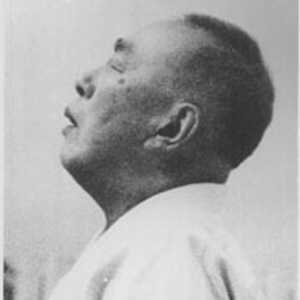
Itsuo Tsuda, ca 1970. Photo by Eva Rotgold
Q.: And then you decide to create l’École de la Respiration. That is quite a singular term! Can you tell us why you say “school”? Surely this was not a school in the traditional sense of the word?
I. T.: No, not at all (laughs). It’s the only name I could come up with to make people understand that there’s a whole… thing behind the breath. For the uninitiated, breathing is the work of the lungs. But here the word “breathing” takes on a greater and greater extent, doesn’t it?
Q.: Yes, so at l’École de la Respiration, people practise the Regenerating Movement. You described the Regenerating Movement as an exercise of the extrapyramidal motor system.
I. T.: Yes. The Regenerating Movement is not a discipline in the usual sense of the word.
Q.: The word extra-pyramidal may not be immediately comprehensible to our listeners. In any case, the term “extra-pyramidal” basically refers to an area of the brain, as compared to another considered to be the seat of voluntary movement.
I. T.: Yes. In humans, there are two motor tracts. One is the pyramidal motor system, which is the source of all voluntary movement. That’s what we learn in school, like the interweaving of the nervous systems, and so on.
Q.: It’s a term from physiology…
I. T.: …yes, that’s right. But for a long time we neglected the extra-pyramidal system, which supports this voluntary system, because we were afraid of leaving the voluntary system, and that is precisely what Master Noguchi started to do. When he himself began, he was a little surprised because the body starts to move on its own. When you believe that the whole body obeys your will, it is strange, isn’t it? But the truth is, we do not control all the body’s movements. If that were necessary, what would we do when we’re asleep?
Q.: There is a whole area of our activity that is covered by the voluntary system. But that system does not govern all our activity. There is an area that is beyond the reach of the will.
I. T.: There’s a Japanese doctor who says that voluntary movement accounts for only three per cent of our total bodily movement. But for Noguchi, nothing is voluntary. That’s (laughs) really strong.
Q.: In short, the action of the extra-pyramidal system is somehow superimposed on the action of the pyramidal system.
I. T.: Yes.
Q.: You’ve specified that the Regenerating Movement exists in two forms…
I. T.: … Yes…
Q.: … on the one hand, in all individuals, it exists as a form of natural bodily reaction, for example, yawning, sneezing, restlessness during sleep. And then there is another form, developed about fifty years ago by Master Noguchi. Master Noguchi, it should be pointed out, is the creator of the so-called “Seitai” method.
I. T.: He embarked on this career by pure chance. It was the time of the great earthquake of 1924 that hit the entire Tōkyō area. He was twelve at the time. He was very interested in that sort of thing, he had fun with it. But the whole region was devastated, and there were people who were homeless and wandering around; diarrhoea was spreading, and so on. He saw a woman crouched down in great pain. So he rushed over to her and simply applied his hand…
Q.: … applied his hand to the spine…
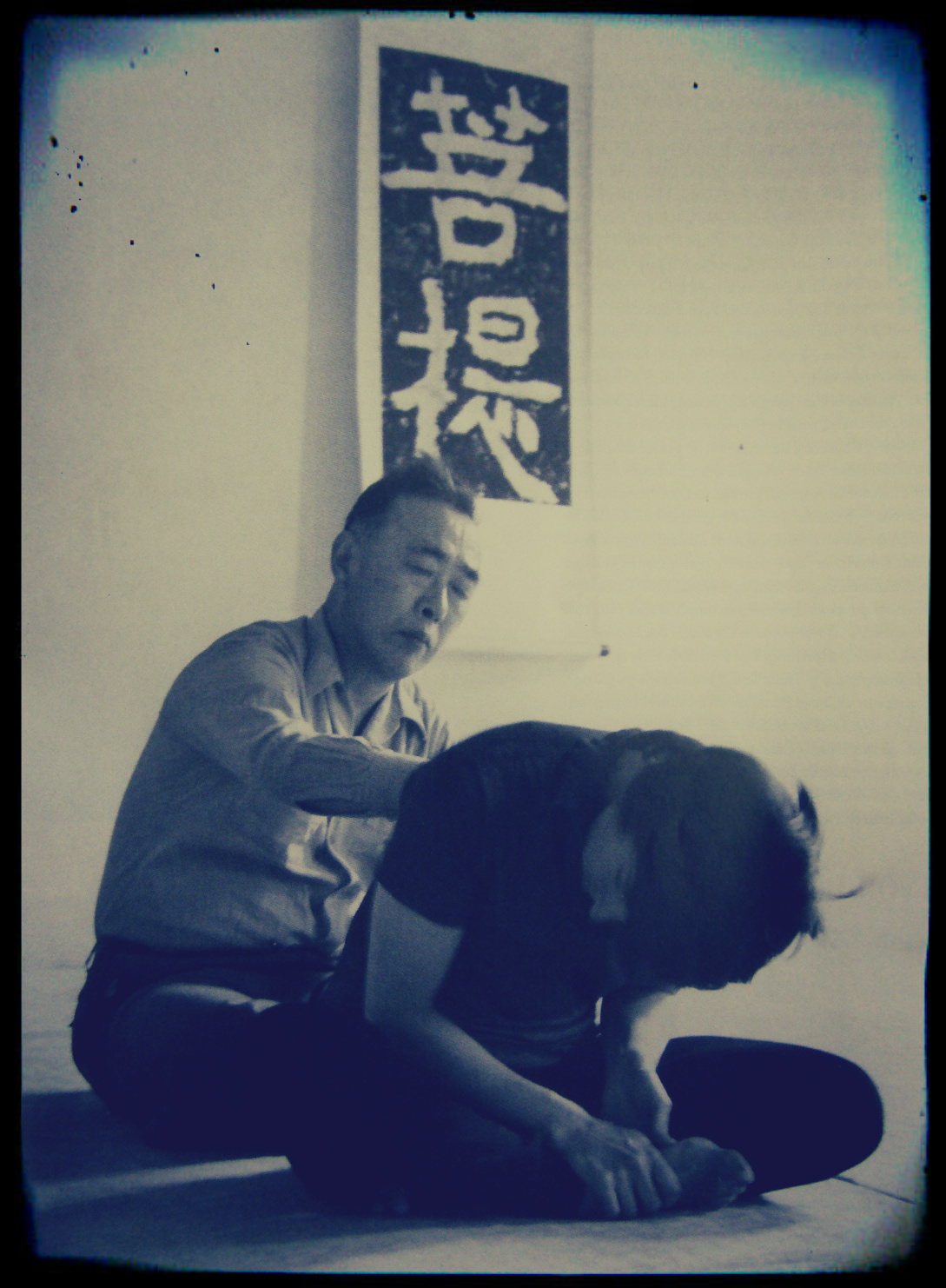
I. T.: … and then she said, “thank you, child”, or anyway, she smiled at him. That was the starting point of his career. The very next day, people started coming to see him. Starting on that day, he was no longer able to leave this path. This is what we practise now under the name of “yuki”: you put your hand on the spine or the head and then exhale through your hand, and that’s it. Well, when you see it done, at first glance, it doesn’t seem like much. But as you concentrate on it, you feel that it’s working inside you.
Q.: So yuki is one of the elements of the technique developed by Master Noguchi. There’s something that surprises me a little about the technique you’re describing: Seitai, as you explain, is a technique used to provoke something spontaneous. Isn’t that a little paradoxical?
I. T.: Seitai is a word that Noguchi coined later. In the beginning, by force of circumstance, he simply became… a healer. He practised therapeutics. But, around 1950, there, he abandoned this notion of healing, of therapeutics; he rejected all that and created the notion of “Seitai”, meaning “normalised terrain”. When the terrain is normalised, problems disappear on their own.
Q.: Perhaps we could temporarily summarise the Regenerating Movement with two important elements: the exercise of the extrapyramidal motor system. This exercise is not really a technique. In fact you say, “at l’École de la Respiration, we work without knowledge, without technique and without purpose”. As for the second important element, the Regenerating Movement is a spontaneous movement that virtually exists in all individuals, and we cannot say that the Movement is provoked; it becomes activated in individuals.
Here is the first of the Six interviews of Itsuo Tsuda by André Libioulle, entitled ‘Breathing, a Living Philosophy’ and broadcasted on France Culture in the 1980s.
To read and/or to listen to.
BROADCAST N° 1
Q: L’École de la Respiration was created by Itsuo Tsuda in Paris in 1973. However, the word “school” is not entirely appropriate and Master Tsuda never intended it to be a closed, exclusive teaching centre. On the contrary, his views remain entirely open. He is interested in other breathing disciplines and above all in the field of thought related to breathing.
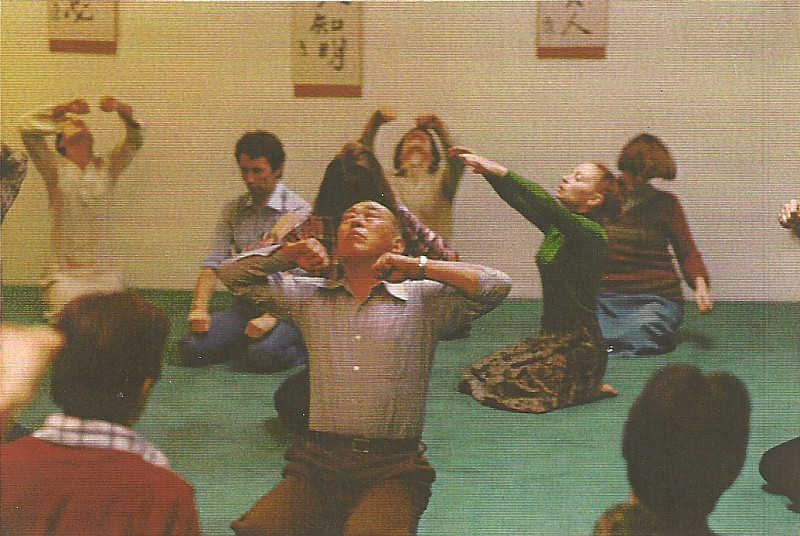
Concretely, L’École de la Respiration is a ”Dōjō”, a particular kind of space in the East, which refers less to the material place itself than to the energetic space. […] Of course, movement is an individual matter; it is to be found in the inner space specific to each person. However, it is created through a certain state of relaxation and a whole atmosphere conducive to meditation. That’s why, for example, it is recommended that the Regenerating Movement be practised with the eyes closed. The dōjō is a spiritual more than a physical space, and therefore not a school in the usual sense. Itsuo Tsuda?
I. T.: It is not a school in the usual sense of the word. As I have written and published books under the imprint of “L’École de la Respiration (“the school of breathing”), I applied this name to the association. The association is independent from me. I am a guest, I am not the boss, and insofar as the association requires my presence, I accept, provided that the members carry out this personal endeavour themselves. I am not there as a boss who gives orders; that’s something you have to understand.
Q.: It is a “school”, in inverted commas, that is open to everyone. The Regenerating Movement is practised here “without knowledge, without technique and without purpose”. That’s a bit of a paradox for a school, isn’t it?
I. T.: Yes. Well, people have to be well motivated. Otherwise we refuse them. For example people who ask for therapy, etc., or who come with other intentions, we refuse. What we are doing is to exercise the extrapyramidal, that’s all. But we can’t throw ourselves into it all at once, can we? we don’t know what it is. When I give the workshop, I start by explaining the thing. Not explaining the extrapyramidal system in anatomical terms, but in relation to the life one leads in the Western context, and bring people back into another context that is natural. Which doesn’t mean that I’m against Westernization, it’s an irreversible thing. Japan is now westernised. But while accepting this conditioning, if you are determined, if you are motivated, you can get out of it and breathe freely, feel full and free.
Q.: Imagine someone entering L’École de la respiration: what can he expect? How will things work, concretely, in practice?
I. T.: They arrive and they sit roughly in a circle and I start to give a sort of talk. And there are people who don’t understand at all. At first almost no one does. But there are those who are attracted, who stay. But their heads are full of questions. And I refuse to answer. I say: “Wait a minimum of a year, two years if possible”. At the end of a year or two, the body changes, evolves and then they no longer know what to say and the questions have evaporated.
Q.: The people who come are not sick people, I mean they’re people who simply have a need for personal development, a need to feel better about themselves, usually..
I. T.: Well, the motivations are diverse. But what I ask for is practice without purpose. There is a psychiatrist who was attracted precisely because it is marked “without purpose”, because he knows from his own experience that this is extremely important. But for others it makes no sense; a practice without a goal is completely… crazy! That is one of the conditions that I insist upon. Otherwise people come and ask me all sorts of things and they go nowhere, they’re just banging their heads against the wall.
Q.: So at a certain point, people stop asking questions. What has happened inside them, what has changed so that all of a sudden, all the intellectual questions are resolved?
I. T.: Well, the body has evolved, sensations have evolved, so we don’t see the same thing from the same perspective. Before starting, such and such a thing is important; people think it’s absolutely necessary to ask me questions. But after a year or two, it becomes so obvious that they no longer need to ask questions.
Q.: But in the first stage, there’s a breathing practice, there are preparatory movements for another more fundamental movement that you call the Regenerating Movement. How does the preparation work?
I. T.: To tell the truth, you don’t need any preparation if you’re sensitive and not very complicated. But modern life doesn’t always allow you to be uncomplicated, so we need a bit of stimulus to get us going. You don’t need a memory, it’s something that arises from within, and it comes of its own accord.
Q.: So it’s more like an immediate, spontaneous reaction on the part of the person, and everyone has a particular reaction, everyone has a singular organic reaction that is unique to him or her.
I. T.: We can’t create a model for the Regenerating Movement, because each individual has his or her own movement and the movement of the same individual differs every day. That’s what they are going to find out for themselves. The difficulty is that people arrive with a head full of imaginings and it’s a real problem to get rid of these. They know thirty-six thousand methods that they mix up with the Regenerating Movement and which distort everything. I make sure that people don’t mix everything up, that’s the greatest difficulty.
Q.: Initially, it seems that people find it hardest simply to feel, to live in contact with their sensations. That’s what the Regenerating Movement brings.
I. T.: People say, “We’re not in the Middle Ages anymore”. Well, what’s the difference between the Middle Ages and now? Gestation still takes nine months; that hasn’t changed. Only, in the Middle Ages there was neither radio nor television. Only the means have changed. But the body, on the contrary, has become weaker. There are many people who are neither completely alive nor completely dead. They are in a kind of twilight,, without feeling. What we’re doing is not adding something extra, but going “back to the source”, which allows us to really feel what’s happening every day, at every moment. That’s what has been completely neglected. All we do is schedule, plan things with a view to what’s going to happen in a year’s time, in three years’ time, and so on. But what are you doing now, what are you feeling now? That we do not know.
Q.: Master Tsuda, the people who come to you come because they feel the need, let us say, for a personal evolution. But people come to work on themselves and they come with spontaneous body tendencies. In several of your books, you’ve mentioned a concept known as “taiheki“.
I. T.: It’s a concept that is also quite difficult to explain. In our modern lives, the body’s activities become increasingly specialised. Some people need their eyesight, their hearing, their brains, and so on. Athletes need their muscles. Because of this specialisation, we are more or less deformed. The channelling of energy becomes specialised. We cannot all of a sudden change direction. We’re always on the same channel.
Q.: You talk about the polarisation of energy…
I. T.: … Yes, polarisation if you like; channelling. And we think we can control all that, but it’s difficult indeed. That’s why we need to normalise the terrain, so that we can use all our pawns, if you will. For example, one woman told me that before doing the Movement, she didn’t know whether her feet were hot or cold, she had to take off her shoes and then touch her feet with her hand so she could say, “ah! yes, my feet are hot or cold”. But now she doesn’t need to do that anymore, she can feel directly. Sensation doesn’t work in most people.
Q.: Most people are desensitised…
I. T.: … desensitised either in the feet or in the legs, etc.
Q.: And by being desensitised, people are cut off from themselves.
I. T.: Yes, they are fragmented, they are compartmentalised. They see the world through this very, very narrow perspective.
Q.: Your desire is to put people in touch with themselves, with their sensations, and thereby even with “ki”’, that notion that evades all concepts, a moving notion: qualitative, not quantitative. The truth of science is quantitative, but the truth of the Movement is always particular, always concrete.
I. T.: We come into the world with no knowledge, with no explanation. How is it that a newborn baby can turn white milk into yellow poo? The baby has no knowledge. Well, at that very moment, the absence of knowledge allows everything to work. We have to be able to get to that point. Except with adults, the problem presents itself in a different way, because we cannot imitate a baby. If there are a lot of things that come to the surface of the conscious mind, that’s precisely why we are in the state of “heart of pure sky”. When we are very busy, we don’t even think about it. That is the return to the source, which is different from what happens with a newborn.
Q.: Will the people who come to you later become practitioners of the
Regenerating Movement, or is it just a practice they follow for the sake of their own well being?
I. T.: That’s up to them, isn’t it? I don’t say anything. If they want to do it, they do it, that’s all. But if people aren’t truly motivated, things just fall apart. And if they’re really motivated, little by little their horizons open up. So, as to how far they will go, for the moment I can’t say.
Here is the second of the Six Interviews of Itsuo Tsuda by André Libioulle, entitled ‘Breathing, a Living Philosophy’ and broadcasted on France Culture in the 1980s.
Q.: In this second week, we’re going to take a closer look at the books published by Itsuo Tsuda. They are all published by the “Courrier du Livre” in Paris, and there are currently six: The Non-Doing, The Path of Less, The Science of the Particular, a work entitled One, The Dialogue of Silence and recently The Unstable Triangle. They pertain to breathing and areas of thought related to breathing […]
The West has separated body and soul into clear-cut concepts. It has often aspired to the elevation of the soul but underestimated the body, considering it a place of temptation. For Plato, the soul is cramped inside its envelope of flesh, a prisoner of the body, but for a man like Itsuo Tsuda, it appears that the body is the prisoner of the soul. A soul that constantly manipulates abstractions and cuts itself off from the impulse of life. Increasingly, human beings live at a cerebral level. Society’s hopes rest on the intensive exploitation of the intellectual capacities, which it considers the privilege of human beings. But this cerebral hypertrophy creates a gap that is a source of imbalance between sensations, the body as life, as energy, as momentum, and the constructed, conceptualized, cerebralised world. Breathing is unification, a return to the self and, if we relax the separation between body and soul, if the soul ceases to be an abstraction, then it is everywhere; it is inside the body as well as outside it.
Well, the “ki”, that notion that we’ve touched upon in previous broadcasts, introduces us to the idea of unity. That’s what we’re going to try to understand now. It seems, Itsuo Tsuda, that the first step towards understanding ki is to recognise sensation in ourselves. This means not abstracting, not imagining ourselves as experiencing a sensation, but really being the sensation.
I. T.: There is a principle recognised in Chinese medicine: cold head and hot feet. Right now, the meaning is the other way round: hot head and cold feet. We don’t even feel our feet anymore. And then the head becomes hotter and hotter. There is a whole factor that contributes to this: Westernisation. But we can’t turn back. It is a longstanding tendency. And besides, there are obvious benefits that come from Westernization. But though it may help us at the material level, it puts us in a rather precarious position at an individual level. Individuals increasingly become prisoners of carefully-planned structures; they can no longer feel alive, feel themselves.
Q.: Moreover, you write that Europeans need to understand before they act. They do not jump straight into action.
I. T.: I don’t do things in the same way as things are done in Japan. Often in Japan we don’t explain things, we rush straight into the experience, and it’s up to each individual to learn the lesson, isn’t it? Well, in the West that doesn’t work. We need to understand things first. But understanding is not enough. No matter how many times I explain swimming to people who listen, it doesn’t help them dive into the water. If you have never experienced contact with water, you can fill your head with all sorts of explanations, but it’s of no use.
Q.: But people might argue: ‘what is the use of being close to my sensations? What’s in it for me ?’
I. T.: Well, precisely, there is the notion of “Seitai”, which Noguchi created after the war. At the moment, people think in dualistic terms: “there is good, and there is evil. Evil must be fought. Once we have fought evil, we will be left with the good”. But in fact, that is not the way we search; we normalise the terrain. This is what he called “Seitai”: the well-harmonised body. In the West, we try to find the cause; we try to exterminate the cause. Yet no sooner have we finished with one cause than others spring up. But that is the method that conforms to the mental structure. However, Noguchi presented this vision that is quite different, which transcends everything. If your organism is normalised, the same problem becomes less important. In the West we say: there is such-and-such a problem. It is defined, it does not change volume, it remains as is. You have to attack it in such-and-such a way, etc.
Q.: So, in short, for the West, there is an anatomical type of knowledge, a discursive type of knowledge, in which we distinguish between cause and effect, in order to act on one element or another. The notion introduced by Seitai is different. It is the notion of sensation. But if I understand correctly, it is a notion from which knowledge is not excluded. But it is another type of knowledge, an intuitive, a qualitative knowledge, let’s say, compared to the Western notion of measurement or quantification.
I. T.: The same problem increases or decreases in importance, depending on how it feels. A bottle is half empty or half full. But quantitatively, it’s exactly the same. However, the sensation differs, depending on the case. Then all it takes is one little thing to change the way people behave. If you say to yourself: ‘That’s it, I’m done for,’ from that moment on you can’t go any further. But if you say to yourself: ‘I’ve already taken three steps forward’, then you’re ready to take a fourth step, aren’t you?
Q.: Don’t you think there’s a notion presented by the West, that of totality or of wholeness but understood as an assembly of parts? With quality, we are also dealing with something global, but without the idea of assembly.
I. T.: In Seitai, we do not look at an individual as an assembly of different parts. That is the basic idea. An individual is an individual – total, yes? But, each is different in terms of movement, breathing, sensitivity. That’s what matters to us.
Q.: You’ve mentioned Master Noguchi several times. Could we not try to understand what globality and unity mean for an individual through a few examples from the practice of Master Noguchi, since Master Noguchi practised therapeutics? He was the creator of the Seitai method. What was his work like? What enabled him to grasp concrete, spontaneous things?
I. T.: For example, everyone has their own biological speed, which determines their behaviour, gait, movements etc. We think of it in a completely detached, objective way, so much per minute etc., etc., but for Noguchi, well, it is a concrete thing. Everything comes from this biological speed that is inherent in the individual. Without this notion of speed, he can do nothing. But this…
Q: … so here, the notion of speed has nothing to do with the notion of rapidity for example…
I. T.: … no, no …
Q.: … as we understand it? It is something else…?
I. T.: Yes. Contact must be established with the biological speed of that particular person. It’s not a general, objective speed. For example, a kid arrives screaming and crying because he’s broken his arm. The parents say, “It’s impossible to touch him, he just keeps crying…”. But Noguchi has already touched him. “Ah, well, then it’s because he doesn’t dare to cry in front of the master.” No, it’s not that. He touched the child at his biological speed, the speed of the child’s breathing, which is unique to him. That way, the child doesn’t feel the contact, it’s part of him, and that is so important.
Q.: You wrote that Master Noguchi, through observation and touch, was able to draw from the individual something like the notion of an unconscious movement.
I. T.: Yes, for him all movements are one hundred per cent unconscious. We believe just the opposite. We think we are the masters of ourselves, when in fact we can’t do very much, and we try to restrain ourselves. We remain composed in front of others, and so on. And then, one day the brakes fail, and then we wonder how that happened. For Noguchi, everything is unconscious, we are not the masters of ourselves.
Q.: Did Master Noguchi make a distinction between unconscious movement and posture?
I. T.: … but the posture is the realization of the unconscious movement.
Q.: So posture can be observed by everyone… from the outside, without any preparation, whereas unconscious movement requires preparation.
I. T.: If we envisage posture in a military sense, for example, “at attention”, then everyone tries to do more or less the same thing. But when you’re “at ease”, everyone is different.
Q.: What is the relationship between breathing and unconscious movement?
I. T.: There are people, for example, who have their breath cut short. When that happens, breathing comes from higher and higher up. Nowadays people breathe from the top of their lungs and finally, when they become weak, they breathe through the nose. What we’re doing is lowering the breath, so that we can breathe from the belly, or, if you like, from the feet. Without practice it is difficult to explain.
Q.: The concept of breathing is much broader than the notion of a simple biochemical operation. Breathing is life, it’s ki…, it is vitality, it is soul…
The correspondence of a writer, a philosopher, often reveals itself beyond peculiar general views. Such is the case with this correspondence of Itsuo Tsuda from which we publish a few letters, courtesy of Bernard and Andréine Bel.
It reveals answers given by Itsuo Tsuda, between 1972 and 1979, to this young couple as they began practising the Regenerating Movement. Through these letters we will follow their desire to make this discovery widely known.
[For a history of Geneva dōjō Katsugen Kai, please read here.]
Continuation and end of the article published in the journal “Question de” in 1975, written by Claudine Brelet (anthropologist, international expert and French woman of letters) and student of Itsuo Tsuda.
Second Part
— Can one ‘fusion’ respiration and visualization?
— Indeed, visualization is one of the aspects of ki. Visualization plays an important and vital role in aikido. It is a mental act that produces physical effects. Visualization is part of the aspect of ‘attention’ of ki. When attention is localized, for example it stops at the wrist, breathing becomes shallow, disrupted… we forget the rest of the body.Read more →
This coverage was published in the journal Question de [Topics of] in 1975. Claudine Brelet (anthropologist, international expert and a French woman of letters) who wrote this press coverage and did the interview and was one of the first students of Itsuo Tsuda.
First Part
At the fringes of Bois de Vincennes, in the rear of a garden in the suburbs of Paris, there is a particular At the fringes of Bois de Vincennes, in the rear of a garden in the suburbs of Paris, there is a particular dojo. Dojo, meaning, a place for practising the Art of breathing and martial arts. It is not a gym. It rather is a sacred place where ‘space-time’ is different from that of a profane place.We salute when we enter to sanctify ourselves and when we leave to desacralize.Read more →