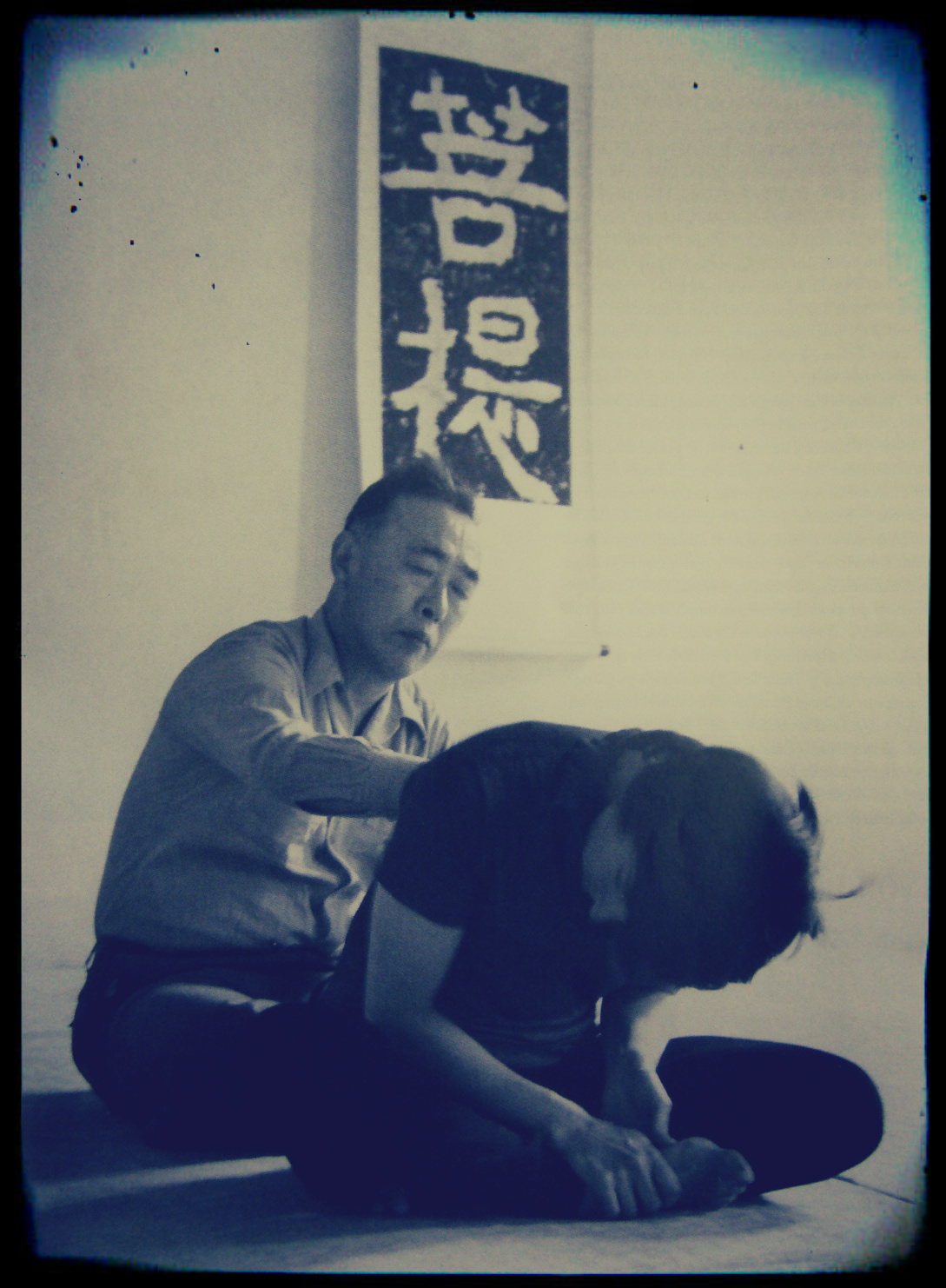
Here is the third of the Six Interviews of Itsuo Tsuda by André Libioulle, entitled ‘Breathing, a Living Philosophy’ and broadcasted on France Culture in the 1980s.
Q.: You know France very well, having worked before the 1940s with two extremely important figures, Marcel Granet and Marcel Mauss. Marcel Granet was a sinologist and Marcel Mauss a sociologist. What were the most important moments you spent with them?
I. T.: For five years, I attended these scholars’ courses, and it opened my eyes to unknown aspects of Western society. Mauss dealt with the sociology of different peoples, including the Polynesians, and so on. He had a very, very deep view of things, and he observed things that he called “total phenomena”, whereas in Western societies, things are always analytical, rational, and so on.
Q.: Yes, the idea of globality.
I. T.: Yes… and Granet also gave me the opportunity to view ancient Chinese society from a very, very different perspective from the usual; that is, transforming everything, using Western reasoning. .
Q.: After this French period, this Parisian period, you returned to Japan, and there you had another absolutely decisive encounter, with Master Ueshiba, the creator of Aikidō, and Master Noguchi.
I. T.: Master Noguchi enabled me to see things in a very concrete way. Through the things manifested by each individual, it is possible to see what is going on inside. It is completely different from the analytical approach, in which the head, the heart, the digestive organs each have their own specialization; and there’s the body on one hand and the psyche on the other, isn’t that so? Well, he made it possible to see the human being, that is, the concrete individual, in its totality.
Q.: So you worked there with Master Noguchi, and also with Master Ueshiba for several years.
I. T.: I worked with Master Ueshiba for ten years before coming to France. Well, he gave me the opportunity to be something other than… the individual trapped inside the skin. I visited the United States, and then I tried to see what the possibilities were, what I was going to do. I started by writing, and little by little, it took shape.
Q.: I believe The Non-Doing was published in 1973. It was the first book you published. Around what time did you return to France?
I. T.: 1970.
Itsuo Tsuda, ca 1970. Photo by Eva Rotgold
Q.: And then you decide to create l’École de la Respiration. That is quite a singular term! Can you tell us why you say “school”? Surely this was not a school in the traditional sense of the word?
I. T.: No, not at all (laughs). It’s the only name I could come up with to make people understand that there’s a whole… thing behind the breath. For the uninitiated, breathing is the work of the lungs. But here the word “breathing” takes on a greater and greater extent, doesn’t it?
Q.: Yes, so at l’École de la Respiration, people practise the Regenerating Movement. You described the Regenerating Movement as an exercise of the extrapyramidal motor system.
I. T.: Yes. The Regenerating Movement is not a discipline in the usual sense of the word.
Q.: The word extra-pyramidal may not be immediately comprehensible to our listeners. In any case, the term “extra-pyramidal” basically refers to an area of the brain, as compared to another considered to be the seat of voluntary movement.
I. T.: Yes. In humans, there are two motor tracts. One is the pyramidal motor system, which is the source of all voluntary movement. That’s what we learn in school, like the interweaving of the nervous systems, and so on.
Q.: It’s a term from physiology…
I. T.: …yes, that’s right. But for a long time we neglected the extra-pyramidal system, which supports this voluntary system, because we were afraid of leaving the voluntary system, and that is precisely what Master Noguchi started to do. When he himself began, he was a little surprised because the body starts to move on its own. When you believe that the whole body obeys your will, it is strange, isn’t it? But the truth is, we do not control all the body’s movements. If that were necessary, what would we do when we’re asleep?
Q.: There is a whole area of our activity that is covered by the voluntary system. But that system does not govern all our activity. There is an area that is beyond the reach of the will.
I. T.: There’s a Japanese doctor who says that voluntary movement accounts for only three per cent of our total bodily movement. But for Noguchi, nothing is voluntary. That’s (laughs) really strong.
Q.: In short, the action of the extra-pyramidal system is somehow superimposed on the action of the pyramidal system.
I. T.: Yes.
Q.: You’ve specified that the Regenerating Movement exists in two forms…
I. T.: … Yes…
Q.: … on the one hand, in all individuals, it exists as a form of natural bodily reaction, for example, yawning, sneezing, restlessness during sleep. And then there is another form, developed about fifty years ago by Master Noguchi. Master Noguchi, it should be pointed out, is the creator of the so-called “Seitai” method.
I. T.: He embarked on this career by pure chance. It was the time of the great earthquake of 1924 that hit the entire Tōkyō area. He was twelve at the time. He was very interested in that sort of thing, he had fun with it. But the whole region was devastated, and there were people who were homeless and wandering around; diarrhoea was spreading, and so on. He saw a woman crouched down in great pain. So he rushed over to her and simply applied his hand…
Q.: … applied his hand to the spine…
I. T.: … and then she said, “thank you, child”, or anyway, she smiled at him. That was the starting point of his career. The very next day, people started coming to see him. Starting on that day, he was no longer able to leave this path. This is what we practise now under the name of “yuki”: you put your hand on the spine or the head and then exhale through your hand, and that’s it. Well, when you see it done, at first glance, it doesn’t seem like much. But as you concentrate on it, you feel that it’s working inside you.
Q.: So yuki is one of the elements of the technique developed by Master Noguchi. There’s something that surprises me a little about the technique you’re describing: Seitai, as you explain, is a technique used to provoke something spontaneous. Isn’t that a little paradoxical?
I. T.: Seitai is a word that Noguchi coined later. In the beginning, by force of circumstance, he simply became… a healer. He practised therapeutics. But, around 1950, there, he abandoned this notion of healing, of therapeutics; he rejected all that and created the notion of “Seitai”, meaning “normalised terrain”. When the terrain is normalised, problems disappear on their own.
Q.: Perhaps we could temporarily summarise the Regenerating Movement with two important elements: the exercise of the extrapyramidal motor system. This exercise is not really a technique. In fact you say, “at l’École de la Respiration, we work without knowledge, without technique and without purpose”. As for the second important element, the Regenerating Movement is a spontaneous movement that virtually exists in all individuals, and we cannot say that the Movement is provoked; it becomes activated in individuals.
Here is the first of the Six interviews of Itsuo Tsuda by André Libioulle, entitled ‘Breathing, a Living Philosophy’ and broadcasted on France Culture in the 1980s.
To read and/or to listen to.
BROADCAST N° 1
Q: L’École de la Respiration was created by Itsuo Tsuda in Paris in 1973. However, the word “school” is not entirely appropriate and Master Tsuda never intended it to be a closed, exclusive teaching centre. On the contrary, his views remain entirely open. He is interested in other breathing disciplines and above all in the field of thought related to breathing.
Concretely, L’École de la Respiration is a ”Dōjō”, a particular kind of space in the East, which refers less to the material place itself than to the energetic space. […] Of course, movement is an individual matter; it is to be found in the inner space specific to each person. However, it is created through a certain state of relaxation and a whole atmosphere conducive to meditation. That’s why, for example, it is recommended that the Regenerating Movement be practised with the eyes closed. The dōjō is a spiritual more than a physical space, and therefore not a school in the usual sense. Itsuo Tsuda?
I. T.: It is not a school in the usual sense of the word. As I have written and published books under the imprint of “L’École de la Respiration (“the school of breathing”), I applied this name to the association. The association is independent from me. I am a guest, I am not the boss, and insofar as the association requires my presence, I accept, provided that the members carry out this personal endeavour themselves. I am not there as a boss who gives orders; that’s something you have to understand.
Q.: It is a “school”, in inverted commas, that is open to everyone. The Regenerating Movement is practised here “without knowledge, without technique and without purpose”. That’s a bit of a paradox for a school, isn’t it?
I. T.: Yes. Well, people have to be well motivated. Otherwise we refuse them. For example people who ask for therapy, etc., or who come with other intentions, we refuse. What we are doing is to exercise the extrapyramidal, that’s all. But we can’t throw ourselves into it all at once, can we? we don’t know what it is. When I give the workshop, I start by explaining the thing. Not explaining the extrapyramidal system in anatomical terms, but in relation to the life one leads in the Western context, and bring people back into another context that is natural. Which doesn’t mean that I’m against Westernization, it’s an irreversible thing. Japan is now westernised. But while accepting this conditioning, if you are determined, if you are motivated, you can get out of it and breathe freely, feel full and free.
Q.: Imagine someone entering L’École de la respiration: what can he expect? How will things work, concretely, in practice?
I. T.: They arrive and they sit roughly in a circle and I start to give a sort of talk. And there are people who don’t understand at all. At first almost no one does. But there are those who are attracted, who stay. But their heads are full of questions. And I refuse to answer. I say: “Wait a minimum of a year, two years if possible”. At the end of a year or two, the body changes, evolves and then they no longer know what to say and the questions have evaporated.
Q.: The people who come are not sick people, I mean they’re people who simply have a need for personal development, a need to feel better about themselves, usually..
I. T.: Well, the motivations are diverse. But what I ask for is practice without purpose. There is a psychiatrist who was attracted precisely because it is marked “without purpose”, because he knows from his own experience that this is extremely important. But for others it makes no sense; a practice without a goal is completely… crazy! That is one of the conditions that I insist upon. Otherwise people come and ask me all sorts of things and they go nowhere, they’re just banging their heads against the wall.
Q.: So at a certain point, people stop asking questions. What has happened inside them, what has changed so that all of a sudden, all the intellectual questions are resolved?
I. T.: Well, the body has evolved, sensations have evolved, so we don’t see the same thing from the same perspective. Before starting, such and such a thing is important; people think it’s absolutely necessary to ask me questions. But after a year or two, it becomes so obvious that they no longer need to ask questions.
Q.: But in the first stage, there’s a breathing practice, there are preparatory movements for another more fundamental movement that you call the Regenerating Movement. How does the preparation work?
I. T.: To tell the truth, you don’t need any preparation if you’re sensitive and not very complicated. But modern life doesn’t always allow you to be uncomplicated, so we need a bit of stimulus to get us going. You don’t need a memory, it’s something that arises from within, and it comes of its own accord.
Q.: So it’s more like an immediate, spontaneous reaction on the part of the person, and everyone has a particular reaction, everyone has a singular organic reaction that is unique to him or her.
I. T.: We can’t create a model for the Regenerating Movement, because each individual has his or her own movement and the movement of the same individual differs every day. That’s what they are going to find out for themselves. The difficulty is that people arrive with a head full of imaginings and it’s a real problem to get rid of these. They know thirty-six thousand methods that they mix up with the Regenerating Movement and which distort everything. I make sure that people don’t mix everything up, that’s the greatest difficulty.
Q.: Initially, it seems that people find it hardest simply to feel, to live in contact with their sensations. That’s what the Regenerating Movement brings.
I. T.: People say, “We’re not in the Middle Ages anymore”. Well, what’s the difference between the Middle Ages and now? Gestation still takes nine months; that hasn’t changed. Only, in the Middle Ages there was neither radio nor television. Only the means have changed. But the body, on the contrary, has become weaker. There are many people who are neither completely alive nor completely dead. They are in a kind of twilight,, without feeling. What we’re doing is not adding something extra, but going “back to the source”, which allows us to really feel what’s happening every day, at every moment. That’s what has been completely neglected. All we do is schedule, plan things with a view to what’s going to happen in a year’s time, in three years’ time, and so on. But what are you doing now, what are you feeling now? That we do not know.
Q.: Master Tsuda, the people who come to you come because they feel the need, let us say, for a personal evolution. But people come to work on themselves and they come with spontaneous body tendencies. In several of your books, you’ve mentioned a concept known as “taiheki“.
I. T.: It’s a concept that is also quite difficult to explain. In our modern lives, the body’s activities become increasingly specialised. Some people need their eyesight, their hearing, their brains, and so on. Athletes need their muscles. Because of this specialisation, we are more or less deformed. The channelling of energy becomes specialised. We cannot all of a sudden change direction. We’re always on the same channel.
Q.: You talk about the polarisation of energy…
I. T.: … Yes, polarisation if you like; channelling. And we think we can control all that, but it’s difficult indeed. That’s why we need to normalise the terrain, so that we can use all our pawns, if you will. For example, one woman told me that before doing the Movement, she didn’t know whether her feet were hot or cold, she had to take off her shoes and then touch her feet with her hand so she could say, “ah! yes, my feet are hot or cold”. But now she doesn’t need to do that anymore, she can feel directly. Sensation doesn’t work in most people.
Q.: Most people are desensitised…
I. T.: … desensitised either in the feet or in the legs, etc.
Q.: And by being desensitised, people are cut off from themselves.
I. T.: Yes, they are fragmented, they are compartmentalised. They see the world through this very, very narrow perspective.
Q.: Your desire is to put people in touch with themselves, with their sensations, and thereby even with “ki”’, that notion that evades all concepts, a moving notion: qualitative, not quantitative. The truth of science is quantitative, but the truth of the Movement is always particular, always concrete.
I. T.: We come into the world with no knowledge, with no explanation. How is it that a newborn baby can turn white milk into yellow poo? The baby has no knowledge. Well, at that very moment, the absence of knowledge allows everything to work. We have to be able to get to that point. Except with adults, the problem presents itself in a different way, because we cannot imitate a baby. If there are a lot of things that come to the surface of the conscious mind, that’s precisely why we are in the state of “heart of pure sky”. When we are very busy, we don’t even think about it. That is the return to the source, which is different from what happens with a newborn.
Q.: Will the people who come to you later become practitioners of the
Regenerating Movement, or is it just a practice they follow for the sake of their own well being?
I. T.: That’s up to them, isn’t it? I don’t say anything. If they want to do it, they do it, that’s all. But if people aren’t truly motivated, things just fall apart. And if they’re really motivated, little by little their horizons open up. So, as to how far they will go, for the moment I can’t say.
[Sept. 21] Marc-André Selosse is a biologist and professor at the Natural History Museum and teaches at several universities in France and abroad. His research focuses on mutually beneficial associations (symbiosis), and his teaching focuses on plants, microbes, ecology and evolution. In 2020, just before the first lockdown, Tenshin dōjō (Paris) was due to host him for a lecture on microbiota. Due to circumstances, this lecture could not take place, but we hope to be able to make this invitation a reality as soon as possible. In the meantime, we invite you to (re)discover his fascinating work through two videos and the article we wrote about his book Never Alone (in French) and its points of convergence with Seitai.
Marc-André Selosse : ‘Is biological and cultural extinction underway?’
[excerpt]
‘The biological microbiota within us is in poor health, it is shrinking and directly affecting our health: we suffer from these “diseases of modernity”, which affect our immune system (allergies, asthma, autoimmune diseases, etc.), our nervous system (Alzheimer’s, Parkinson’s, autism, etc.), and our metabolism (diabetes, obesity, etc.). We have observed that the microbiota is less diverse in sick individuals than in healthy individuals. By 2025, these diseases of modernity, linked to the decline of our microbiota, will affect 1 in 4 Europeans.’
To continue, click on the video:
Presentation at the symposium organised by the Fondation pour la Biodiversité Fromagère [Foundation for Cheese Biodiversity] on 14 September 2021 as part of the Mondial du Fromage [World Cheese Fair] in Tours (France).
Marc-André Selosse, Medicine in the Face of Evolution
Marc-André Selosse answers questions from the Yvelines Medical Council
What binds us together: microbiota and human terrain
Since the dawn of civilisation, microbes have shaped our diet, enabling food (bread, cheese, wine, vegetables, etc.) to be preserved and consumed. Domesticated empirically for thousands of years, the microorganisms involved in these processes were only identified relatively recently, less than 200 years ago.
And it is only even more recently that scientists have begun to study the microbiota, i. e. all the bacteria, fungi, viruses, etc. that are harboured by a host organism (e. g. a human being) and live in a specific environment of that host, such as the skin or stomach.
Most of us are unaware that our lives depend on a close association, called symbiosis, that we naturally establish with tens of billions of bacteria that populate the surface of our bodies and even the depths of our intestines. We consider ourselves to be above and independent of all this microbial influence, with the notable exception of people with colds, who often hear the phrase, ‘Ah, but don’t give me your germs!’ The microbiota is therefore considered, at best, only for or in terms of its pathogenic potential.
This now outdated but still omnipresent view of microbes as harmful has profoundly influenced our relationship with nature, our bodies and, more broadly, life itself. Whether it be pesticides in agriculture or antibacterial soaps and disinfectant gels on our skin, these products indiscriminately eliminate both beneficial and harmful microorganisms, creating conditions that impoverish the soil – both in our fields and in our mucous membranes.
These hygienist actions, repeated over time, starting at birth, prevent the human immune system from maturing, so that later on it will no longer be able to recognise the body of which it is a part, or will have disproportionate reactions. Our era is also one of autoimmune diseases and allergies.1Marc-André Selosse, Jamais seul — Ces microbes qui construisent les plantes, les animaux et les civilisations [Never Alone — The Microbes That Build Plants, Animals and Civilisations], 2017, pub. Actes Sud (Arles, France), p. 185
The Seitai principles, in the work of Haruchika Noguchi2See the work of Itsuo Tsuda (9 volumes), available from pub. Courrier du Livre (Paris), and Haruchika Noguchi, 3 books in English available from Zensei Publishing, start from a radical point of view: intuitive rather than analytical. Based on his thirty years of experience as a healer, H. Noguchi abandoned the idea of therapy in the 1950s because he had observed that it weakened individuals’ bodies and made them dependent on the practitioner. This led him to consider health in a completely different way, acknowledging that the body’s reactions are manifestations of an organism responding to restore its balance.
‘Illness is natural, the body’s effort to recover lost balance.’ ‘It is good that illness exists, but people must avoid becoming enslaved to it. This is how Noguchi happened to conceive of the notion of Seitai, the normalisation of the terrain, if you will.’ 3Itsuo Tsuda, The Dialogue of Silence, Chap. IX, Yume Editions, 2018 (1979), pp. 75 & 76
This rebalancing is the work of the involuntary system; it does not depend on our will. It causes symptoms that involve the microbiota. For example, the flows that expel harmful germs from the body (colds, diarrhoea)4Never Alone (op. cit.), p. 156, the regulatory function of fever, or the antibiotic function of iron deficiency in pregnant women.5 See the blog article Marc-André Selosse: La disparition silencieuse des SVT [M.-A S.: The Quiet Disappearance of Earth and Life Sciences], Café pédagogique [Pedagogical Coffee], 7 May 2019
photo by Jérémie Logeay
The Seitai philosophy has the distinctive feature of viewing human beings as an indivisible whole. There is no separation between the psychological and the physical. The word seitai (整体) translates as ‘normalised terrain’. H. Noguchi‘s concept of terrain is comprehensive. It partly overlaps with the concept of microbiota. For us, the latter is like the soil surrounding the roots of a tree; it is Nature living in harmony and collaboration within each of us, without us even being aware of it. That is why we are never alone.
Whether we consider microbes to be harmful and fight them, or take advantage of their help and collaborate with them naturally, is a question of inner orientation. Favouring excessive hygiene or promoting what Mr. Selosse calls ‘clean dirt’6Never Alone (op. cit.), p. 156 and p. 197 is part of this same choice. The expression ‘cultivating one’s garden’7ibid., p. 169 takes on a new and concrete meaning. It all depends on us.
Where instinct has disappeared, scientific discoveries must be made available. Although self-taught, H. Noguchi was fully aware of the science of his time. This fuelled his reflections and intuitions. In this same spirit, we are honoured to welcome Prof. Marc-André Selosse, who will present the latest discoveries on the human microbiota and engage in a discussion with the audience.
Notes
1
Marc-André Selosse, Jamais seul — Ces microbes qui construisent les plantes, les animaux et les civilisations [Never Alone — The Microbes That Build Plants, Animals and Civilisations], 2017, pub. Actes Sud (Arles, France), p. 185
2
See the work of Itsuo Tsuda (9 volumes), available from pub. Courrier du Livre (Paris), and Haruchika Noguchi, 3 books in English available from Zensei Publishing
Subtitles available in French, English, Italian and Spanish.To activate the subtitles, click on this icon. Then click on the icon to select the subtitle language.
Would you like to hear about the next article?
Subscribe to our newsletter
Some additional information
Seitai was developed by Haruchika Noguchi (1911-1976) in Japan. Katsugen Undo (or Regenerating Movement) is an exercise of the extrapyramidal motor system that is part of Seitai. Itsuo Tsuda (1914-1984), who introduced Katsugen Undo in Europe in the 70s, would write about it: ‘The human body is endowed with a natural ability to readjust its condition […]. This ability[…] is the responsibility of the extrapyramidal motor system.’ 1Itsuo Tsuda, One, Chap. VI, 2016, Yume Editions, p. 46 (1st ed. in French: 1978, Le Courrier du Livre (Paris)
Excerpts from the video on Yuki
It’s simplicity itself. We always want to add lots of things because when it’s too simple, we feel like it’s not working.
We’ll invite people to do two or three exercises. One exercise will relax the solar plexus area. Here, we exhale deeply. It’s like a kind of artificial yawn. So it’s a voluntary exercise. A kind of artificial yawn. We relax the solar plexus area.
One of the second exercises we do, for example to trigger individual movement, would be “spinal rotation.” Well, here it’s about regaining a little flexibility. I see people today with aging bodies, their spine is completely blocked, they can no longer turn around. They have to turn their whole body to look behind them. Whereas all they need to do is rotate their spine. But very often, even in people in their thirties, the spine is blocked. So this is an exercise that relaxes the body. That’s the second exercise.
And the third exercise, which is a little more complicated, involves putting your thumbs inside your closed fists and pulling everything back. Okay. It’s difficult to show you like this, you really need someone to show you more precisely. That’s why there are organized workshops. That’s for individual movement.
And then what do we do? Nothing! We do nothing. We let the body trigger the movement. If we do the individual movement, it’s very simple. You can do it anywhere. It can be very discreet. It’s not about starting to scream… It’s not something that’s very visible. It’s extremely discreet. There is no noise during a movement session. Sometimes there are slight noises, almost nothing. So that’s the individual movement.
And then in the dojos, during the week, that is, two or three times a week, depending on the dojo, we practice the mutual movement. So there we simply do the plexus exercise and add a few concentration exercises, such as breathing through the hands, Yuki, the activation chain, all of which allow the bodies to be ready to let the movement be triggered. However, the triggering itself will be done by activating the second points of the head. I can’t demonstrate it like that. By activating the second points of the head, in a way, the voluntary system will go into rest mode. And it is the involuntary system that will take over, that will lead.
So what does that mean? It doesn’t mean that suddenly we’re brainless and don’t understand anything anymore. When we eat, for example, it’s the digestive system that suddenly, when it was quiet and doing nothing, suddenly starts to activate. All kinds of gastric juices are produced, the stomach starts working, the intestines work harder, etc. That doesn’t mean we stop thinking. At most, we feel a little drowsy. The drowsiness that comes with digestion, or when we’ve eaten well, we feel a little… ah, there it is. Because the involuntary digestive system has been activated. It’s not because this digestive system has been activated that there is nothing else. Here too, when we do the regenerative movement, the voluntary movement is at rest, we don’t think about it anymore, we close our eyes, we let the body move according to its needs.
And then, because the body is in an involuntary state, it can do things that it doesn’t usually do, or that it has somewhat neglected. And so it starts to move. That’s why we do it in a dojo, because it does things that can sometimes seem incongruous. For example, if you do movements like this on the subway, people might think, “Oh dear, that guy’s a bit weird…” But in the dojo, we’re relaxed, our eyes are closed, no one is watching us, it’s a bit like being at home. The movement we practise in the dojo is a training. We often say it’s training for the extrapyramidal motor system, but it’s not just that. It’s training because our bodies have weakened, because we have trouble reacting, so we retrain ourselves. It’s a bit like someone who can no longer walk. At a certain point, even the smallest step is difficult: going from the kitchen to the bathroom is difficult for them. So from the moment they start walking again, their body will start to function better. It’s the same thing with involuntary movement.
And at some point, of course, since this is training, it’s within a given time frame. We also have to stop that time at some point. That is to say, during the session, we did the training, we let the movement be triggered, then we stop the movement. Here again, there is an exercise very similar to the first one to stop the individual movement. We stop the movement. Then we lie down for a few minutes. And we come back, we resume the voluntary system, which will act again.
So we let the individual movement act completely as it needed to, on its own, for a certain amount of time, and then we return to our normal daily life. And so, the body will now regain its involuntary abilities. We will allow the involuntary to work more than before in everyday life. Because the body will say, “Hey, I need this,” and it will trigger another type of work. So again, there are exercises that allow the involuntary system to be trained, and then there is everyday life. We are not in the involuntary state all the time. We work, we do a lot of things with the voluntary system. But since the involuntary system works underneath, the body remains normal.
Notes
1
Itsuo Tsuda, One, Chap. VI, 2016, Yume Editions, p. 46 (1st ed. in French: 1978, Le Courrier du Livre (Paris)
He was born in Ueno, a district of Tōkyō, in September 1911. It all began at the age of three or four when he was surprised to find that he had relieved someone’s toothache simply by placing his hands on them. He was a child, and his hands moved toward the target without him realising what he was doing. He accomplished his first feat at the age of twelve, when he cured his neighbours who were suffering from dysentery after the great earthquake that struck the Tōkyō area in 1923. From that age on, he began to receive people who asked him to heal them. At the time, he had no knowledge, not even basic knowledge, of anatomy or medicine. As a teenager, he began to realise the consequences of his actions. At first, like almost all healers, he believed that he had an exceptional power that only he possessed. He found his calling but did not stop there; he continued on. He taught himself all Eastern and Western therapeutic methods. At the age of fifteen, he opened a dojo in Iriya. At seventeen, he formulated Precepts of Full Life (Zensei Kun), which provide a better understanding of his thinking. In 1930, he wrote Reflections on Integral Life, a surprising text for a young man who was only nineteen at the time.
‘Seitai deals, above all, with the individual in his or her individuality, and not with an average person created out of statistics.
Life itself is invisible, but in manifesting itself in individuals, it creates an infinite variety of different combinations.’1Tsuda Itsuo, The Non-Doing, 2013, Yume Editions, Chap. VII, p. 73. (1st ed. in French, 1973, pub. Le Courrier du Livre (Paris), pp. 68-9.) (Tsuda Itsuo)
Seitai Kyōkai in Tōkyō. Session of Katsugen Undō around 1980.
Seitai 整体, and its corollary Katsugen undō2Katsugen Undō 活元 運動: translated as Regenerating Movement by Tsuda Itsuo., are recognised in Japan since the sixties by the Ministry of Education (today Ministry of Education, Culture, Sports, Science and Technology) as a movement of education. They are not recognised as a therapy – which would rather be recognised by the Ministry of Health. The ambiguity between the two, however, is still being maintained by a great many of its disclosers.
Since the publication in the seventies of Tsuda Itsuo’s work, Seitai makes many dream among those interested in New Age, Orientalist techniques or else. At times one becomes a technician overnight, at times one adds ‘appealing ingredients’ as Tsuda sensei himself would write. It is time to put things into order, to try and clarify all this, and to that end we need only refer to Tsuda Itsuo’s teaching as well as the original texts from the creator of this teaching, this science of the human being, this philosophy.
Noguchi Haruchika 野口 晴哉 sensei
Noguchi Haruchika sensei (1911–1976), founder of Seitai.
This Japanese man, founder of the Seitai Institute3Seitai Kyōkai 整体 協会., is the author of about thirty books, three of which have been translated into English. He is also the discoverer of the techniques that enable the triggering of the Regenerating Movement as an exercise of the “involuntary system”4More precisely, it is an exercise of the extrapyramidal motor system.. As a young boy, he discovers he has a capacity which he believes unique and “extra-ordinary”: that of “healing people”. He discovers this capacity during the big 1923 earthquake which devastates Tōkyō city, by relieving a female neighbour who suffers from dysentery, simply by putting his hand on her back. Rumour spreads very fast, and people hurry to his parents’ address in order to receive care. All he does is to lay his hands on the people, who go home relieved of their aches. He then starts a career as a healer – he is only twelve years old – and his reputation increases so much that, at the age of fifteen, he opens his first dōjō right in Tōkyō.
But Noguchi sensei wonders: what is the force acting when he lays his hands and why does he alone have this power? Instead of taking advantage of what he thinks to be a gift and collecting the related profits, he searches, asks himself questions, starts studying on his own.
For years, he will look for solutions to problems raised by his clients through the techniques coming from acupuncture of ancient traditional Chinese medicine which he studies with his uncle, from Japanese medicines (kanpō漢方), various shiatsu, kuatsu, and even Western style anatomy, etc. His reputation is so wide that he is known and recognised internationally. For that matter, he will meet later many therapists including some who are already – or will become – well-known, like Oki Masahiro, creator of Oki-dō Yoga, or Kishi Akinobu sensei, creator of Sei-ki Shiatsu, or even, better known in France, Moshé Feldenkrais, with whom he will exchange many times. Yet, he has already understood that this force he feels in himself does not belong to him as an individual, but that it exists in all human beings – that is what he will call later the cohesive force of life.
Seitai: a global view
Régis Soavi
In the fifties, Noguchi sensei changes his orientation completely. Through his practical experience and personal studies, he comes to the conclusion that no healing method can save the human being. He drops therapeutics, conceives the idea of Seitai as well as Katsugen Undō. Back then, he already declares: ‘Health is a natural thing which requires no artificial intervention. Therapeutics reinforces links of dependence. Diseases are not things to be cured, but opportunities to be used in order to activate the organism and restore its equilibrium’ – as many themes he will take up again later in his books5Noguchi Haruchika, Colds and their benefits, Zensei Publishing Company, 1986. (Compiled and translated from edited transcripts of lectures delivered in the 1960s.).. So he decides to stop healing people and spread Katsugen Undō, as well as Yuki6Yuki 愉氣: action of concentrating the attention which activates the individual’s life force., which is not the prerogative of a minority but a human and instinctive act.
The findings of Noguchi Haruchika sensei lead to see Seitai as a philosophy – and thus not as a therapy – and he himself would define it as such in his books7Noguchi Haruchika, Order, Spontaneity and the Body, Zensei Publishing Company, 1984. (1st ed. in Japanese, 1976.). This does not mean that what he was doing and teaching did not have consequences on health, quite the opposite since his field of competence was in the service of persons and consisted in enabling individuals to live fully. Despite this, a certain number of people, in his time as much as today, were disturbed by such a drastic opinion and this brought about a confusion between fields for those who would see and understand only according to their own opinion. As a result, they favoured the support to people at the cost of the awakening of the being.
The technicity of this very great master was unanimously recognised in Japan, he even had been president of the Manual Therapists Association during the prewar period. But his work, that he would consider an accompaniment, a guide, a Seitai orientation, would go much further than healing people who came to see him; it was rather a matter of enabling each person to retrieve their inner life force – and in this he was incredibly efficient.
He explains that very often it is the Kokoro8Kokoro 心: heart and mind, ability of the man for reasoning, understanding and willing, not opposite to his bodily side, but as what animates it. that is affected, disturbed, and that driving this Kokoro in the right direction is enough for the person to retrieve the health that had been lost. Making Ki flow in the right direction was his favourite technique; this may seem rather easy, but reality is quite different. One does not become a Seitai guide overnight, it is not about trying to stimulate an area or another using conjuring tricks but about understanding, feeling where the problem comes from in order to allow Ki to flow in the right direction and make life work. Noguchi sensei had an extraordinary intuition and the quality of his sensations, the sharpness of his observation made him a really remarkable person – and even one whom some of his contemporaries would consider formidable in some respects because of his extreme perspicacity.
Tsuda Itsuo (19141984). He introduced Seitai in Europe in the 70s after having been studying with Noguchi sensei for twenty years.
A dream
Health has become a technological dream. From the 19th century concept, summarized so well by Jules Romain in his play Knock, according to which every healthy person is considered as a person unaware that they are sick, we have shifted into the 20th century concept which claimed it would eradicate diseases thanks to pharmaceutical chemistry and rays. As for the 21st century, it proposes to solve all problems with genetics or transhumanism.
The analysis claims to become more and more thorough, we have shifted from dissection to sequencing. By cutting up the human being into increasingly smaller pieces, down to cells and now genes and even smaller, we are losing sight of the whole, we are moving away from the notion of the individual (from the Latin individuum: what is indivisible) and, as a curious consequence, we are compelled to treat the human being in general and no longer in particular. The human being appears like a collection of parts. Each part of the body has its own specialist, including the psyche of course, and all these specialists take care of their clients’ symptoms. For ideological or even religious reasons, when the expected result is lacking with classical medicine, we turn to what are called alternative medicines. These can be ancestral methods of great value as well as small fiddles. We can find around us lots of recipes promulgated on the internet, and forwarded by our friends and acquaintances, each thinking they have the solution to all our problems of health, energy, or simply to an ordinary disorder.
The symptom
We persist in removing the symptom, because it is the symptom that disturbs us. Of course, we cannot deny its importance, it is the sign, often the indicator, of a problem that had not yet been perceived. But it is also and above all the expression of the work done by our organism to solve this difficulty. Often, body problems are misunderstood and we want to solve them as fast as possible without really seeking the root cause. We need only make the symptom disappear to satisfy everyone, to think we are cured, even though most of the time we have simply put the problem aside and, even sometimes, prevented the body from reacting.
The body has its reasons that reason does not know
Noguchi Hirochika, Seitai founder’s elder son, with Régis Soavi, during his visit in Paris in November 1981
There is no perfect nor immutable body, the body moves continuously from the outside as well as from the inside, life itself wants it so. But we really must take into account that this movement or rather these movements come also as a result of our corporal tendencies, themselves resulting from our birth, genes, as well as from the way we use our body through work, sports, martial arts, thus in general through every activity, whatever. For instance, a recurring phenomenon in martial arts and more generally in sports is to feel pain in one or both knees. The most common answer to it would be to treat pain where it occurs, anaesthetize it, prevent swelling, etc. Actually, in such a case as in so many others, one is just forgetting or even denying that this is a natural response of the body to a much broader issue, a posture problem or a misuse of the body.
Noguchi Haruchika left us a most precious tool which enables better understanding of human beings according to the polarization of energy (Ki) in the different regions of the body. This tool, the Taiheki9Taiheki 体癖: corporal habits. concept, makes possible for us to perceive the individual through their unconscious movement according to their corporal habits and what results from them. Noguchi sensei used an animal-type comparison system designed in his early researches as a careful observation of human movement, which he reduced for purpose of teaching to six groups comprising as a whole twelve main tendencies. Each of the five first groups is in relation to a lumbar vertebra and a corporal system (urinary, pelvic, pulmonary, etc.) while the last one rather describes a general state of the body.These tendencies, resulting from ki coagulation and stagnation, are caused by the stiffening or flabbiness of the body when it can no longer regenerate, recover from the fatigues imposed on it.
Let us take an example so as to make things concrete: many persons tend to lean more on one leg rather than on the other. This tendency may result, among other things, either from what is known in Seitai as lateralism, or from torsion, which like other corporal deformations are absolutely involuntary, just being the result, the response of the body trying to maintain its equilibrium.
In the case of a torsion, the support leg is used to prepare to spring, to attack or to defend oneself – in any case to win. If lateralism is involved, we are rather dealing with a condition resulting from digestive or sentimental tendencies with a deformation occurring at the second lumbar level, a condition inclining to concert, to diplomacy. In both examples, the same leg will be used as a supporting point, thus constantly bearing most of the weight and so getting tired and tending to wear out more and become rigid. This dissymmetry affects the whole body and, obviously in the first place, particularly the spinal column. Through swelling resulting from a liquid supply, or through pain, even often through both reactions, the body tries to relieve the knee that bears the heaviest tribute, preventing us from using it until healing is completed, that is, the whole body equilibrium is restored. If this development is impeded through bringing down the swelling and removing the pain, the body, which has become insensitive, will go on leaning on the same side and the situation will get worse. The body will try by all means to retrieve its equilibrium, first by renewing the knee problems as soon as sensitivity has been recovered there, then gradually the hips will start compensating the lack of flexibility and finally it will be the back, that is the spinal column, with all the resulting consequences one may imagine.
Is back pain not considered the most common problem in our civilization, maybe even as “the evil of the century”? Is bearing pain silently to be taken as the solution to it? This is not the point of view of Seitai but, on the other hand, preserving balance from the beginning, from birth, consists in accepting little disturbances and guiding in daily life the body in the right direction, day after day. If one has ignored the manifestations of one’s own body, it becomes necessary to go through a corporal relearning, a slow but deep equilibrium restoration. If, on the other hand, one does not accept one’s own body’s work, one will then have to accept progressive desensitization, progressive stiffening and its consequences: some sort of Robotization or weakening and inability to react.
To live Seitai
According to Noguchi sensei, beginning to take care of children at birth was already late. The months of pregnancy, the delivery, the first cares given to the baby were fully part of his concern about the child’s future life as well. In his books, Tsuda Itsuo sensei provides us with many indications about pregnancy, delivery, breastfeeding, nutrition, weaning, first steps, etc., particularly in volume four entitled One. Seitai does not set rules to be followed in every occurrence, it is not about figuring out the right solution to the problems of early childhood, childhood, or adolescence, as in childcare or pedagogy books. Seitai deals with the manifestations of life with no preconception, it here again makes it possible to guide parents while, at the same time, enabling them to develop their intuition thanks to a dialogue in silence with the baby and later with the small child. For those who have not had the chance – or sometimes the possibility – to let their body work according to their own needs, are there still possibilities to retrieve a healthy state? This is where the practice of Katsugen Undō comes in.
It is a most simple practice beginning with an indispensable condition: not to think. Tsuda sensei used to refer to this condition as ‘clearing the head’. In The Science of the Particular, he explains what he means by using this expression:
‘Clear the head! We understand the need for it today, when the head has become a trash bin in which fermentation continues twenty-four hours a day to produce worry about the present and fear of the future.
What do we mean by “clearing the head”? Of course not a comatose state in which consciousness is lost. It is a state in which the consciousness ceases to be disrupted by a stream of ideas. Instead of excessive cerebralisation, life begins to stir in parts of the body that were previously dormant.’10Tsuda Itsuo, The Science of the Particular, 2015, Yume Editions, p. 159. (1st ed. in French, 1976, pub. Le Courrier du Livre (Paris), p. 143.)
The notion of individual in Seitai
For Noguchi H. sensei, there is no human being divided into parts but always a single body.
In the light of the most recent discoveries, one becomes aware, for instance through the fascias theory, of the interaction between the various parts of the body, even when sometimes extremely far from one another. Some of these theories made possible to rehabilitate ancestral techniques from distant countries, which had not so far been understood in their depth and had very often got little respect from Western medical science. Other discoveries, mentioned particularly by M.-A. Selosse in his book Never Alone11Marc-André Selosse, Jamais seul [Never Alone], pub. Actes Sud (Arles, France), June 2017., have emphasized the symbiotic dimension of the individual, the interaction that takes place between bacteria and the body: the human being is no longer considered separate, modern biology gets obvious insight on his nature as a symbiont. Once more – once again should I say –, one is compelled to consider the whole of the individual.
However, in spite of experiencing a time when technologico-scientific discoveries have considerably increased knowledge about human beings, there is little change from the Seitai perspective, they remain the same as sixty or seventy years ago; the causes disturbing them, disturbing their Kokoro are different but human beings themselves have remained the same. Unfortunately, it can be seen that many bodies and minds are more fragile today, when ideologies about health have designed individuals deeply dependent on all kinds of specialists, thus generating a certain type of alienation which might be difficult to understand or analyze by anyone lacking an overview of society. The abyss to the bottom of which we are heading calls for a recovery of everyone at the individual level and this is perhaps where the Seitai orientation may enlighten us: by providing the individual with a unique tool in order to recover their autonomy, to re-appropriate their own life and live it fully. That is why the practice of Katsugen Undō and Yuki are the two activities proposed by the Itsuo Tsuda School – for they are the Alpha and Omega of the practice of Seitai.
More precisely, it is an exercise of the extrapyramidal motor system.
5
Noguchi Haruchika, Colds and their benefits, Zensei Publishing Company, 1986. (Compiled and translated from edited transcripts of lectures delivered in the 1960s.).
6
Yuki 愉氣: action of concentrating the attention which activates the individual’s life force.
7
Noguchi Haruchika, Order, Spontaneity and the Body, Zensei Publishing Company, 1984. (1st ed. in Japanese, 1976.)
8
Kokoro 心: heart and mind, ability of the man for reasoning, understanding and willing, not opposite to his bodily side, but as what animates it.
In this fifth part, Régis Soavi discusses a central principle in Seitai philosophy: the unity of the body.
Subtitles available in French, English, Italian and Spanish.To activate the subtitles, click on this icon. Then click on the icon to select the subtitle language.
Would you like to hear about the next article?
Subscribe to our newsletter
Some additional information
Seitai was developed by Haruchika Noguchi (1911-1976) in Japan. Katsugen Undo (or Regenerating Movement) is an exercise of the extrapyramidal motor system that is part of Seitai. Itsuo Tsuda (1914-1984), who introduced Katsugen Undo in Europe in the 70s, would write about it: ‘The human body is endowed with a natural ability to readjust its condition […]. This ability[…] is the responsibility of the extrapyramidal motor system.’ 1Itsuo Tsuda, One, Chap. VI, 2016, Yume Editions, p. 46 (1st ed. in French: 1978, Le Courrier du Livre (Paris)
Excerpts from the video on Yuki
‘The current trend is that there are all kinds of programmes where people give you things to do, whether it’s exercise, food, fasting… all kinds of mental manipulation, mental exercises or other things to make people feel good.
But in fact, human beings are completely different. Sometimes it only takes one tiny thing to make everything better or worse. Sometimes just one number, one number can completely determine the quality of your life. If, for example, you see -4000 euros in your bank account, all of a sudden… ‘Ha!’, your heart can stop. It’s ridiculous. How can your heart stop because you saw a number? It’s absurd. And yet, that’s how it is.
So what matters, in my opinion, is the harmony of the body. It’s a balance that we’re going to find, always the same. Every time we talk about Seitai, every time we talk about what happens in relation to regenerative movement, etc., we have to think in terms of balance. That’s what a human being is: a balance. They are not separate. Of course, if there is a serious problem in one part of the body, the being, the individual, is out of balance, but they will not only suffer in that part of the body. They suffer throughout their entire body. So here again, it is balance that is decisive.
Notes
1
Itsuo Tsuda, One, Chap. VI, 2016, Yume Editions, p. 46 (1st ed. in French: 1978, Le Courrier du Livre (Paris)
The Seitai principles, which could even be described as “Seitai philosophy” – a way of seeing and thinking about the world – were developed by Haruchika Noguchi (1911-1976) in the first half of the twentieth century. In brief (!), Seitai is a “method” or a “philosophy” that includes Seitai sōhō, Taisōs, Katsugen undō, Katsugen sōhō, and Yukihō. These are practices that complement, permeate each other, and form the breadth of Haruchika Noguchi’s Seitai thinking. We can also mention the study of Taihekis (postural tendencies), the use of the hot bath, the education of the subconscious, the importance of birth, illness and death…
An art of living from beginning to end.
Today, unfortunately, the term “Seitai” is overused and means anything and everything. Some manual therapy practitioners too easily lay claim to Seitai (Itsuo Tsuda would say it takes twenty years to train a Seitai sōhō technician!). As for the charlatans who offer to transform you in a few sessions…, let’s not talk about it! The magnitude of the art of living, the global understanding of the human being in Seitai seem far away. If all there is left is a technique to be applied to patients, the essence is lost. If all there is left of Katsugen undō is a moment to “recharge your batteries”, the essence is lost.
Haruchika Noguchi and Itsuo Tsuda both went much further than that in their understanding of the human being. And the seeds they sowed, the clues they left for humans to evolve are important. Can we then speak of a way, of Seitai-dō (道 dō/tao)? Because that is a radical change of perspective, an upheaval, a totally different horizon opening up.
Let us go back in history…
The meeting with Haruchika Noguchi: the individual as a whole
Itsuo Tsuda met Haruchika Noguchi around 1950. The approach to the human being as proposed in Seitai interested him from the very beginning. The sharp observation of individuals taken in their indivisible entirety/complexity, which Itsuo Tsuda found in Noguchi, was an extension of what had already captured his interest during his studies in France with Marcel Mauss (anthropologist) and Marcel Granet (sinologist). Itsuo Tsuda then began to follow Noguchi’s teaching and continued for more than twenty years. He had the sixth dan of Seitai.
‘Master Noguchi enabled me to see things in a very concrete way. Through the things manifested by each individual, it is possible to see what is going on inside. It is completely different from the analytical approach, in which the head, the heart, the digestive organs each have their own specialization; and there’s the body on one hand and the psyche on the other, isn’t that so? Well, he made it possible to see the human being, that is, the concrete individual, in its totality.’ 1Itsuo Tsuda, Interviews on France Culture radio, “Master Tsuda explains the Regenerating Movement”, Broadcast N° 3, early 1980s (Heart of Pure Sky, 2025, Yume Editions (Paris), p. 23 (1st ed. in French, 2014, p. 24))
Illness as a balance factor
All the more as it was precisely in the 1950s that Haruchika Noguchi, who had very early discovered his capacity as a healer, decided to give up therapeutics. He then created the concept of Seitai, i. e. “normalized terrain”.
‘the word “terrain” referring to the whole that makes up the individual, the psychic and the physical, whereas in the West we always divide things into psychic and then physical.’2Itsuo Tsuda, ibid., Broadcast N° 4, p. 28 (1st ed. p. 29)
The change of perspective with regard to illness was crucial in this reorientation of Noguchi.
‘Illness is natural, the bodys effort to recover lost balance. […]
[…]
It is good that illness exists, but people must avoid becoming enslaved to it. This is how Noguchi happened to conceive of the notion of Seitai, the normalisation of the terrain, if you will. Diseases are not to be treated; it is useless to cure them.
If the terrain is normalised, illness disappears of its own accord. And moreover, one becomes more vigorous than before. Farewell to therapeutics. The fight against illness is over.’3Itsuo Tsuda, The Dialogue of Silence, Chap. IX, 2018, Yume Editions (Paris), p. 75–76 (1st ed. in French, 1979)
Abandoning therapy also goes hand in hand with the desire to get out of the dependence relation that binds the patient to the therapist. Noguchi wanted to allow individuals to become aware of their ignored capacities, he wished to awaken them to the fulfilment of their own being. During the twenty years they followed each other, the two men spent long moments talking about philosophy, art, etc., and Noguchi found in Tsuda‘s vast intellectual culture the substance to nourish and expand his observations and personal reflections. Thus a relation which was enriching for both developed between them.
Itsuo Tsuda was the editor of the magazine Zensei, published by the Seitai Institute, and he actively participated in the studies led by Noguchi on Taihekis (postural tendencies). A text by Haruchika Noguchi published in the magazine Zensei of January 1978 reveals that it was Itsuo Tsuda who advanced the hypothesis – validated by Noguchi – that type nine (closed basin) would be the archetype of the primitive being.4About Taihekis, consult Itsuo Tsuda, The Non-Doing, 2014, Yume Editions (Paris) (1st ed. in French, 1973)
The development of Katsugen undō (Regenerating Movement) by Noguchi particularly interested Itsuo Tsuda, who immediately understood the importance of this tool, especially as regards to the possibility it gives to individuals to regain their autonomy, without needing to depend any more on any specialist. While recognizing and admiring the precision and the deep capacity of the Seitai technique, Tsuda considered that the spreading of Katsugen undō was more important than the teaching of the technique. He therefore initiated groups of Regenerating Movement (Katsugen Kai) in a great many places in Japan.
Itsuo Tsuda favoured the spread of Katsugen undō in Europe as a gateway to Seitai.
Today, even in Japan, Seitai sōhō has taken an orientation that brings it closer to therapy. One problem: one technique to apply. Katsugen undō becomes a kind of “light” gymnastics for well-being and relaxation. This is far from the awakening of the living, of the autonomous capacity of the body to react that Haruchika Noguchi‘s Seitai is meant to be.
The yuki exercise, which is the alpha and omega of Seitai, is practised at every Katsugen undō session. Thus, although Tsuda did not teach the technique of Seitai sōhō, he transmitted its essence, the simplest act, this “non-technique” that yuki is. The one that serves us every day, the one that gradually sensitizes the hands, the body. This physical sensation, that is real, that can be experienced by all, is today too often considered a special technique, reserved for an elite. We forget that it is a human and instinctive act. The practice of mutual Katsugen undō (with a partner) is also getting lost, even in the groups that followed Tsuda‘s teaching. What a pity! Because through yuki and mutual Katsugen undō, the body rediscovers sensations, those that do not go through mental analysis. This dialogue in silence, which makes us discover the other from the inside and which therefore brings us back to ourselves, to our inner being. Yuki and Katsugen undō are for us essential tools, recommended by Haruchika Noguchi, on the path towards normal terrain.
But time goes by and things get distorted, like words of wisdom of some people become religious oppressions… Little by little Katsugen undō is nothing more than a moment to “recharge”, relax and above all not change anything in one’s life, in one’s stability. Seitai, a method to lose weight after childbirth… While it is a life orientation, a global thinking. The huge step Haruchika Noguchi took in moving away from the idea of therapeutics is a major advance in the history of mankind. His global understanding of the individual, the sensitivity to ki, sufficiently recovering sensitivity and a center in oneself from where to listen to one’s own body and act freely.
It is not even about opposing methods, theories or civilizations. It is purely and simply about the evolution of humanity.
Itsuo Tsuda, Interviews on France Culture radio, “Master Tsuda explains the Regenerating Movement”, Broadcast N° 3, early 1980s (Heart of Pure Sky, 2025, Yume Editions (Paris), p. 23 (1st ed. in French, 2014, p. 24))
2
Itsuo Tsuda, ibid., Broadcast N° 4, p. 28 (1st ed. p. 29)
Why is practising Katsugen Undo important in our life? Régis Soavi, who has been teaching and introducing people to Katsugen Undo for forty years now, gives a brief answer and provides an overview of the impact that an individual gives on their daily life when orienting themselves according to Seitai.
Subtitles available in French, English, Italian and Spanish. To activate the subtitles, click on this icon. Then click on the icon to select the subtitle language.
Would you like to hear about the next article?
Subscribe to our newsletter
Some additional information
Seitai was developed by Haruchika Noguchi (1911-1976) in Japan. Katsugen Undo (or Regenerating Movement) is an exercise of the extrapyramidal motor system that is part of Seitai. Itsuo Tsuda (1914-1984), who introduced Katsugen Undo in Europe in the 70s, would write about it: ‘The human body is endowed with a natural ability to readjust its condition […]. This ability[…] is the responsibility of the extrapyramidal motor system.’ 1Itsuo Tsuda, One, Chap. VI, 2016, Yume Editions, p. 46 (1st ed. in French: 1978, Le Courrier du Livre (Paris)
Excerpts from the video
‘We no longer see things in the same way. Obviously, our relationship with illness changes completely. Once we understand that illness is a response from the body, that illness as a symptom is a response from the body, we accept the symptoms and get through the illness. It changes everything. You are no longer dependent on the doctor or therapist; you no longer need them. You realise that lots of things are returning to normal. Before, you always had pain here and there, you had trouble digesting, you couldn’t sleep – and now, little by little, it’s all disappearing.
That doesn’t mean that afterwards we are an elite… a super elite… no, not at all! But when we have small problems that arise, they are resolved more quickly. So in terms of health, we react more quickly. Our immune system works faster. Skin reactions are faster. Digestive reactions are faster. Our minds also open up. We no longer see things in the same way. And there are things that no longer seem acceptable to us. We can no longer accept that children, women or foreigners are treated like animals… Something inside us changes. We are no longer the same. Our outlook on life changes. That’s why, after a while, people who knew us before look at us and say, “Hey, it’s funny, you’ve changed…” They don’t really know how to put it… Well, yes, we have changed. We haven’t changed. We’ve found ourselves, that’s all. We’ve found ourselves inside.’
Notes
1
Itsuo Tsuda, One, Chap. VI, 2016, Yume Editions, p. 46 (1st ed. in French: 1978, Le Courrier du Livre (Paris)
Sequel of interviews where Régis Soavi, who has been teaching and introducing people to Katsugen Undo for forty years now, gets back to basics about Seitai and Katsugen Undo. In this third video, the concept of Yuki is explored.
Subtitles available in French, English, Italian and Spanish. To activate the subtitles, click on this icon. Then click on the icon to select the subtitle language.
Subscribe to our newsletter
Some additional information
Seitai was developed by Haruchika Noguchi (1911-1976) in Japan. Katsugen Undo (or Regenerating Movement) is an exercise of the extrapyramidal motor system that is part of Seitai. Itsuo Tsuda (1914-1984), who introduced Katsugen Undo in Europe in the 70s, would write about it: ‘The human body is endowed with a natural ability to readjust its condition […]. This ability[…] is the responsibility of the extrapyramidal motor system.’ 1Itsuo Tsuda, One, Chap. VI, 2016, Yume Editions, p. 46 (1st ed. in French: 1978, Le Courrier du Livre (Paris)
Excerpts from the video on Yuki
‘There is natural Yuki. The Yuki that mothers naturally do on their stomachs. There is natural Yuki, which is very simple: when a friend is in pain, you place your hand on their back, and that is natural Yuki. Sometimes we add a few words.
There is natural Yuki, when you have a headache, you put your hand on your head. If you have a very bad headache, you put both hands on your head. But not everyone puts their hands there, precisely. Some people put their hands like this, some put them like that, and that’s natural Yuki. That’s precisely why you can’t teach Yuki. You can’t say, “If you have a headache, put your hands like this and do Yuki, circulate the ki.” “Oh yes, but that doesn’t work for me.” — Oh yes, yes, that’s the technique. — When I have a headache, I do it like this — And I do it like this — And I do it like this, there, that feels good.”
And then there is Yuki as an exercise.
Yuki’s exercise is a specific moment. We do it during Katsugen Undo sessions. At a certain point during the session, there is Yuki. So first we bow to each other. The bowing between two people is the coordination of breathing. Then, one of the two turns their left side toward the other. One hand behind, you see, at eye level, and one hand in front. Then the person lies down, we put our hands on their back and circulate the ki. In this case, it is the exercise to rediscover Yuki. During the movement sessions, it lasts 5 minutes, up to maybe 8 minutes. We all do it together. It is both an exercise that allows us to become aware of ourselves and to make the other person aware. It is not learning, it is discovery. We discover and we deepen our understanding.
Yuki is circulating ki. But ki has no form. Well, here it takes on a form. Ki has no form, ki is atmosphere… the concept of ki is very vague. But here, because there is an action, it has a form. Some people want to associate it with energy, we talk about vital energy. I don’t really like that. I don’t really like that term. “Energy” immediately makes us think of electricity, etc. Or psychic energy that bursts forth, etc. And that’s not what this is about.
Yuki is an experience. It is first and foremost an experience.
he first time I encountered Yuki was because — I remember we were at a café with my master Itsuo Tsuda. It was in the early 1970s, and during a conversation, he simply placed his hand on my back and said, “Yuki is this.” That changed everything.’
Notes
1
Itsuo Tsuda, One, Chap. VI, 2016, Yume Editions, p. 46 (1st ed. in French: 1978, Le Courrier du Livre (Paris)
Sequel of interviews where Régis Soavi, who has been teaching and introducing people to Katsugen Undō for forty years now, gets back to basics about Seitai and Katsugen Undō. This second video tackles the notion of health according to Seitai.
Subtitles available in French, English, Italian and Spanish.To activate the subtitles, click on this icon. Then click on the icon to select the subtitle language.
Would you like to hear about the next article?
Subscribe to our newsletter
Some additional information
Seitai was developed by Haruchika Noguchi (1911-1976) in Japan. Katsugen Undo (or Regenerating Movement) is an exercise of the extrapyramidal motor system that is part of Seitai. Itsuo Tsuda (1914-1984), who introduced Katsugen Undō in Europe in the 70s, would write about it: ‘The human body is endowed with a natural ability to readjust its condition […]. This ability[…] is the responsibility of the extrapyramidal motor system.’ 1Itsuo Tsuda, One, Chap. VI, 2016, Yume Editions, p. 46 (1st ed. in French: 1978, Le Courrier du Livre (Paris)
Régis Soavi starts practising martials arts with Judo when he is twelve. He then studies Aikidō, especially alongside Masters Tamura, Nocquet and Noro. He meets Tsuda Itsuo sensei in 1973 and will follow him until his death in 1984. With the permission of the latter, Régis Soavi becomes a professional teacher and disseminates his Aikidō and Katsugen Undō throughout Europe.
Notes
1
Itsuo Tsuda, One, Chap. VI, 2016, Yume Editions, p. 46 (1st ed. in French: 1978, Le Courrier du Livre (Paris)
Many thing are being said and circulated on the internet about Seitai and Katsugen Undō (Regenerating Movement). In this round of interviews, Régis Soavi, who has been teaching and introducing people to Katsugen Undō for forty years now, gets back to basics to address the question: ‘What are Seitai and Katsugen Undō?’
Subtitles available in French, English, Italian and Spanish.To activate the subtitles, click on this icon. Then click on the icon to select the subtitle language.
Would you like to hear about the next article?
Subscribe to our newsletter
Some additional information
Seitai was developed by Haruchika Noguchi (1911-1976) in Japan. Katsugen Undō (or Regenerating Movement) is an exercise of the extrapyramidal motor system that is part of Seitai. Itsuo Tsuda (1914-1984), who introduced Katsugen Undō in Europe in the 70s, would write about it: ‘The human body is endowed with a natural ability to readjust its condition […]. This ability[…] is the responsibility of the extrapyramidal motor system.’ 1Itsuo Tsuda, One, Chap. VI, 2016, Yume Editions, p. 46 (1st ed. in French: 1978, Le Courrier du Livre (Paris)
Régis Soavi starts practising martials arts with Jūdō when he is twelve. He then studies Aikidō, especially alongside Masters Tamura, Nocquet and Noro. He meets Tsuda Itsuo sensei in 1973 and will follow him until his death in 1984. With the permission of the latter, Régis Soavi becomes a professional teacher and disseminates his Aikidō and Katsugen Undō throughout Europe.
Notes
1
Itsuo Tsuda, One, Chap. VI, 2016, Yume Editions, p. 46 (1st ed. in French: 1978, Le Courrier du Livre (Paris)
Interview of Régis Soavi about Katsugen Undō (or Regenerating Movement), a practice made by Noguchi Noguchi and spread in Europe by Itsuo Tsuda. Article by Monica Rossi publisehd in the review Arti d’Oriente (#4, May 2000).
Part 1
‘After reading the books of Tsuda Itsuo (1914-1984), I was fascinated by his arguments, which range freely from the subject of Aikido to that of children and the way they are born, illness, or his memories of Ueshiba Morihei and Noguchi Haruchika, and I wanted to know more. I continued to have a sensation of something beyond my understanding.
So I began to ask, what exactly is this Regenerating Movement (Katsugen Undo) that Tsuda spoke of, a spontaneous movement of the body that seemed able to rebalance it without needing to intoxicate it with medication; an ancient concept but still revolutionary, above all in our society. I was unable to get any satisfactory answers to my questions: those who have practiced the Regenerating Movement couldn’t describe it or explain; the answer was always: “You should try it yourself in order to understand; the first time, it will probably unsettle you a bit.” So I decided to try it. In Milan, the school that refers to the teachings of Itsuo Tsuda is the “Scuola della Respirazione”. There, one can practice Aikido and the Regenerating Movement ( in separate sessions ). But, in order to go to the sessions of Movement, one must first participate in a week-end course conducted by Régis Soavi, who has continued the work of Tsuda in Europe.
‘The kokoro that resides deep within man, has invaluable faculties; its possibilities are so endless and inexhaustible that even if we put together all the ki and we make it concentrated we will never end being incapable or helpless. Everything begins to change, not just the body, when the ki focuses and concentrates in the kokoro. Those who practice it told me after the changes experienced.
Haruchika Noguchi (Photo: Seitai Kyokai)
Many associate the word kokoro to willpower, but it in fact it does not have its own virtue; on the other hand, instead of pretending to achieve something by willpower force if we simply visualize that we are going to get there, our wish comes true. Anyone knowing how to use his kokoro will see the realization of his wishes.
Since the dawn of time up to now, human being has invented countless things. Here is a table. It has not been around forever, it was created by the use of visualization. Visualization always precedes what will then exist; the word comes just after. If we proceed in this order, step by step, without deviation and with firmness, our wish will be fulfilled. Only then the various worlds in which humanity evolves will widen further. Mankind is like that.Read more →
Continuation and end of the article published in the journal “Question de” in 1975, written by Claudine Brelet (anthropologist, international expert and French woman of letters) and student of Itsuo Tsuda.
Second Part
— Can one ‘fusion’ respiration and visualization?
— Indeed, visualization is one of the aspects of ki. Visualization plays an important and vital role in aikido. It is a mental act that produces physical effects. Visualization is part of the aspect of ‘attention’ of ki. When attention is localized, for example it stops at the wrist, breathing becomes shallow, disrupted… we forget the rest of the body.Read more →




 .
. to select the subtitle language.