The following notes serve to trace the origins and important moments in the preparation and conduct of the Misogi ceremony on January 1st as practised in the dōjōs of the Itsuo Tsuda School. They cannot replace the oral transmission and experience of the ceremony; they are guidelines, not a set of mandatory instructions. To help convey the atmosphere of these moments, it seemed appropriate to present these notes by drawing on the three rhythms of Japanese tradition, jo – ha – kyū, which Tsuda Itsuo discusses in his books:
‘By studying Noh theatre, I experienced the three rhythms: jo – slow, ha – normal, and kyu – fast. […]
[…]
Jo means introduction, ha rupture, change, and kyu means fast.
[…]
[…] fruits grow gradually (jo), ripen as we watch (ha), and suddenly fall from the branches (kyu).’1Tsuda Itsuo, The Science of the Particular, Chap. XVII (end), 2016, Yume Editions, p. 143-4
Origin and preparations (jo)
Life in our School’s dōjōs is punctuated by several cycles. Between the cycle that begins with the creation of the dōjō and the daily cycle of Aikidō sessions, there is the multi-weekly cycle of Katsugen Undō sessions, the seasonal cycle of seminars, and the annual cycle of the Misogi of January 1st.
The opening of a new place to practise is always a joy, which is why we are delighted that a new dojo is opening in Pescara, a city located in the Abruzzo region on the Adriatic coast. Manola D. P., who, together with a group of people, was behind the creation of the Bodaï dojo in Rome, is now opening this second venue, after 18 years of travelling the 200 kilometres between Pescara and Rome to practise and keep the dojo alive.
On this occasion, we wanted to share with you some thoughts and photos that put the history of our school’s dojos into perspective. With a selection of photos illustrating how dojos are both places and concrete spaces, imbued with years of daily practice. Places carried by the energy and direction given by our sensei Régis Soavi for over forty years. And at the same time, places that are built by the will of the members themselves, by themselves and for themselves.
Let’s start by taking a look at what the premises in Pescara currently look like, and although it may seem discouraging, if you look further down at what the dojos looked like before the members started work, you’ll see that everything is fine!
Pescara
To accompany this look back at the dojos that have already gone through the creation stage, here are some thoughts from my book The Anarchist Master, Itsuo Tsuda.
Excerpts from Chapter 8 Creating Situations: ‘Itsuo Tsuda, like Chuang Tzu, the Mamá Kogui, and the Situationists, also creates “situations” that enable and encourage the discovery of the philosophy of Non-Doing. It is not entirely certain that he thought of it in these terms, but his attachment to certain things – showing the importance he attached to them, the power he gave to these possibilities, to these situations – seems interesting to me, which is why I will highlight several of them.’
‘When he arrived in Paris, Itsuo Tsuda wanted to create a dojo very quickly. For the work he came to do in the West, he needed this tool, this place: a dojo, not a gym or a club. We could stop at the idea that Itsuo Tsuda, a Japanese man in his late fifties, was a traditionalist and that dojo is a Japanese cultural concept – there are dojos for kyudo, kendo, karate, etc. Nevertheless, Tsuda does not create Japanese dojos in the strict sense of the term. He imbues these places with a function of self-emancipation.’
Yuki Hō, Toulouse, since 1983
Dojo Yuki Ho en 1983
Dojo Yuki Ho en 1983
Dojo Yuki Ho 2022
‘The dojo is not a place of consumption, nor is it solely for personal practice. In Japan, it is inseparable from the concept of uchideshi, or live-in students. These students live on site and take care of everything, sweeping the floors, preparing the master’s bath, cooking, gardening, etc. This teaching by immersion, by sharing a collective life with the master’s family but also with the other uchideshi, is a strong element of Japanese culture. The basic principle is that it is the student who wants to learn and not the teacher who seeks to impart knowledge. In Japan, they talk about “stealing the teaching”: the whole positioning is therefore reversed.’
Tenshin, Paris, since 1985
En 1992 d'anciens bureaux
Dojo Tenshin Paris 2022
Dojo Tenshin espace de pratique
et de culture
‘From this culture, Itsuo Tsuda retained the “total teaching” aspect of lived experience and working together. Of course, there would be no uchideshi, as Tsuda never wanted to mimic traditions or engage in Japonism. On the contrary, he extracted the essence of these traditions and, although stripped of their local colours, sought ways to reuse them in the contemporary world. The dojo is open every day, with a session at 6:30 in the morning and two evenings a week. Throughout the year, without interruption, the sessions are led by Tsuda and the members themselves.’
Scuola della respirazione, Milano, since 1983
Le garage avant les travaux
Dans les années 90
l'intérieur
2022
Dojo Scuola della Respirazione Milano
’For the dojo is a place for individual and collective experimentation, for practising autonomy, where, like the uchideshi, everyone takes responsibility for different aspects of daily life in the dojo – discussing, deciding, DIY, gardening, repairs, leading sessions. It is a matter of moving away from the logic of dependence and the “ease” of relying on experts. As the philosopher Ivan Illich points out, individuals have forgotten how to recognise their own needs and, “intoxicated by the belief in better decision-making, they find it difficult to decide for themselves and soon lose confidence in their own power to do so”. (Ivan Illich, La Convivialité, pub. Seuil (Paris), 1973, p. 126.)’
Bodai, Roma, since 2004
Le local avant les travaux en 2004
Dojo Bodai 2022
‘The dojo does not welcome clients. Tsuda refuses to take responsibility for anyone, so every step must be an individual act of self-care. […] Thus, everyone is at home in the dojo, and at home with others at the same time. It is a place for both the individual and the collective.’
Akitsu, Blois, since 2007
En 2019
2022
Excerpt from the chapter Cultivating Sensitivity and Attention: ‘To do without rules, laws and leaders, one must pay close attention to both oneself and the collective. As the rebels of the Invisible Committee perfectly summarise: “Suddenly, life ceases to be divided into connected segments. Sleeping, fighting, eating, caring for oneself, partying, conspiring, debating are all part of a single vital movement. Not everything is organised, everything is organising itself. The difference is notable. One calls for management, the other for attention.” This state of distraction and insensitivity, which leads to a lack of attention, is often what causes many community experiments to fail. We are so used to following orders and rules and being assisted in all aspects of our lives that we do not even realise the degree of sensitivity and attention required to live “order without power”, as proposed by anarchism.’ (excerpt from The Anarchist Master, Itsuo Tsuda)
Dōjō, conceived in this way, is an excellent tool for rediscovering our abilities to focus, be sensitive and organise ourselves.
Ryokan, Ancona, since 2005
2005
2022
Our school has two other dojos that required less work but are still worthy of mention in this article:
Thunderclap in the daily life! The place in which the dojo “Scuola della Respirazione” has been for thirty years in Milan is for sale. As a result, the existence of the dojo is threatened.
Five years after the tour de force of the dojo Yuki Hō in Toulouse, once again one of our places of practice is in danger. Like Toulouse, the dojo is a beautiful space located in a quiet courtyard, within a district of the city now quite popular and in this case too, the selling price is very high.Yet, rather than giving up, we have taken this challenge and turned it into an opportunity.
The dojos are associations, with modest funds, but we cannot imagine these places disappearing, swallowed up by real estate developers. We must therefore look for solutions, pool them, move heaven and earth in order to buy the place ourselves. Starting from 0 a few months ago, most of the capital was raised by private individuals and a bank loan. Today, we are not far from being able to make this dream come true. To achieve this goal, the dojo Scuola della Respirazione is starting a crowdfunding and needs help.
Each participation counts, and each of us has the chance to change the course of history so that these places of practice, exchanges, culture, these places of life remain in the cities. Some defeatists think that we act like Don Quixote who leads useless combat, but the experience of the dojo Yuki Ho in Toulouse has shown us that it is possible, if we all get into it, brick by brick. ‘The only thing that doesn’t change is that everything changes all the time,’ says the Book of Transformations, the Yi Jing, and in the hexagram K’an – The Abysmal, Water – says: Water sets the example for the right attitude under such circumstances. It flows on and on, and merely fills up all the places through which it flows; it does not shrink from any dangerous spot nor from any plunge, and nothing can make it lose its own essential nature. It remains true to itself under all conditions.
Participate in this adventure by allowing this purchase: go to the crowdfunding page.
‘[…] The path to in-depth discovery of oneself […]’ said Tsuda sensei ‘is not a straight line towards paradise, it is tortuous.’ (1) Like classical musicians who spend their life in an infinite search for evolution, martial arts practitioners are on endless paths. Yet these paths are not devoid of meaning, signposts or verifications. One of the signposts Tsuda sensei left to his students is « Dōjō ».
He himself wrote on the topic : ‘As I said before, a dojo is not a space divided into parts and provided for certain exercices. Its a place where spacetime is not the same as in a secular place. The atmosphere is particularly intense. One enters and leaves the space bowing so to get sacralised and desacralised. I am told that in France one can come across dojos that are simply gyms or sports centres. Anyhow, as far as I am concerned, I want my dojo to be a dojo and not a sports club with a boss and its regulars, so as not to disturb the sincerity of the practitioners. This does not mean that they must keep a sullen and constipated face. On the contrary, we must maintain the spirit of peace, communion and joy.’ (2)
But why create Dōjōs? It is quite complicated and requires a lot of work!
To answer this question, one might want to get back to the reason why we practice. If each of us has a personal and complex answer, I personally join the opinion of those who think that we practice first and foremost to “be”. To genuinely “be”, would it be only during the time of a session.Then Aikidō is a tool to bring us back to ourselves. To start “being” on tatamis is a first step which starts with a letting go: to accept stepping onto a tatami and get in physical contact with others! But a contact different from the one which is governed by social conventions. By the way I sometimes notice the reluctance of some beginners to put on a Keikogi, as if keeping their sport trousers allowed them to keep a social identity. The Keikogi puts us all on equal footing, outside of social markers, it rubs off body shapes, sexes, ages, incomes… Of course as long as one does not show off one’s grade, one’s dan, in order to impress beginners. If our state of mind during the practice is to share this experience with a partner, and not to show that we are the strongest, then the fear of the encounter with the other person can lessen. In the Itsuo Tsuda School, there is no grade outright, this settles the matter once and for all.
Adventure starts at dawn (3)
The Dōjō itself is a place out of the social time, out of the epoch, indifferent to the geographical location, and all of this also makes us completely disoriented. In addition we practice early in the morning (as Ueshiba O-sensei used to). Sessions take place every morning, all year long, at 6:45am during the week and 8am on weekends. Whether it snows, whether the sun shines, during vacations or on holidays, the Dōjō is open and sessions take place. Beyond the arbitrary slicing of time in our world.
Dawn is also a particular time. Between awakening and practising, there is almost nothing. Author Yann Allegret had put it as follows, in an article published in KarateBushido : ‘This happens around six in the morning. People leave their home and head towards a place. By foot. By car. With the metro. Outside, the streets of Paris are still asleep, almost empty. Dawn is drawing close. The Aikidō session starts at 6:45am. The rythm of the city is still that of the night. Those who are outside have not yet put on their armours necessary for the workday ahead. Something remains suspended in the air. At dawn, as the sun rises, one feels like walking within an interstice.’ (4)
An interstice of time and space where we can start working on ourselves. Because we have to lose, at least a little bit, our usual landmarks to recover the inner sensation of our own landmarks. The sensation of our biological speed rather than the time on the clock. In order to listen to oneself, silent surroundings are needed. And in our world silence is not so easy a thing to find!
A casket
This is why in Itsuo Tsuda School we give so much importance to creating Dōjōs. Of course it is possible to practice anywhere, to adapt to any circumstances. But, is it always to be desired? To resume the parallel with music (topic I know well, having been pianist and concertist during fifteen years) one can play outside, in a gym, in a school, a church, a hospital, etc. I have incidentally nothing against the democratization of classical music, quite the opposite. But a good concert hall, this is something else. It is a casket where the musician, instead of spending his time adapting to the situation, compensating for the bad acoustics or anything else, can immerse himself into listening, search through fineness and make music arise. Living both experiences is most probably necessary for a professional. For a beginner, finding concentration and calm in the midst of turmoil or airstreams frankly seems to me very difficult.
As to Aikidō, the Dōjō is the casket of this research. If one seizes this opportunity of having a Dōjō, another perspective opens up. Because if our mind can understand the philosophical concepts that underlie the discourses about the Path, about the soul, etc, for the body to truly experience them, that’s a different story. We are often too busy, too upset, and we do have the need for a frame that fosters some particular mindsets.
We can observe as our experience grows that the spirit of Dōjō is to be cultivated both in a rather precise manner and at the same time within something fluid and intangible. The same goes for religious worship places. Sometimes a small church in the countryside, a chapel hidden around the corner breathes more silence and sacredness than an immense cathedral visited by millions of tourists. It is the same with Dōjōs. It is neither the size, neither the absolute respect of rules that make a place different. Dōjō, « the place where one practices the path », is an alchemy between the place, the layout, the prevailing atmosphere. It is not enough that the Dōjō should be beautiful, although a tokonoma with a calligraphy mounted as kakejiku, an ikebana, do create an atmosphere, but it also has to be full and lively of its practitioners!
Architect Charlotte Perriand made this remark about the Japanese house, which « does not attempt to appear, but attempts to reconcile human beings with themselves » (5). It is a beautiful definition that perfectly applies to the notion of Dōjō. To reconcile human beings with themselves and therefore with nature which we are part of. We must feel this as soon as we enter the Dōjō. Often, people make a pause, even simple visitors. It is instinctive.
The prevailing activity in the Dōjō is also an essential aspect of it. We have the possibility to take in charge all aspects of life. Members do the bookkeeping, renovation works, cleaning… Incidentally Tamura sensei used to say about cleaning the Dōjō: ‘this cleaning not only concerns the Dōjō itself, but also the practitioner who, by this act, proceeds to cleaning in depth his own being. Which means that, even if the Dōjō looks clean, it still needs to be cleaned again and again.’ (6). Sinologist J. F. Billeter talks about the « proper activity » [in French « l’activité propre », where « propre » both means clean and personal] when human activity becomes the art of nurturing life in oneself. This was part of the research of ancient Chinese Taoists. For us in the 21st century it is still about regaining a relationship to human activity, not as something separated from our life, allowing us to earn money and wait for holidays, but as a total activity. A participation of the entire being to an activity. The contribution of members to a common work in their Dōjō also enables us to own this Dōjō, not as a property, but as the real meaning of the common good: what belongs to everybody is mine, and not « What belongs to everybody belongs to nobody so why should I care ». This perspective inversion sometimes takes time. It cannot be learnt by words or by strict rules. It is to be discovered and it is to be felt by oneself.
I am sometimes told ‘in the Dōjō it is possible, but at work, at home, it is impossible’. I am not so sure about it. If what one has deepened in the Dōjō is enough, then one will be able to carry it over to somewhere else. Ueshiba O-sensei used to say ‘Dōjō, it is where I am’.
We may not revolutionise the world all at once, of course, but each time we will react differently the world around us will change. Each time we will be able to get back to our center and breath deeply, things will change. All our problems will not be solved, but we will live them differently,our reality will then also be different.
Having no money is an advantage
For Musashi Miyamoto everything can be an advantage. During a fight if the sun is on your back it is an advantage for you, if the sun is on the back of your enemy and he thinks he has the advantage, it is an advantage for you. Because everything depends on the individual, on how one orients oneself. Thus sometimes having no money is an advantage, because then we have no other solution than to create, to invent solutions. This is how we can create Dōjōs without any subsidies, entirely dedicated to one or two practices, what was a priori impossible becomes reality.
Sometimes difficulty stimulates us to create what is essential for us. By being a tenant, by volunteering, by doing things on our own, by not looking for perfection but for inner satisfaction. By listening to one’s own inner imperative and not birds of ill omen who tell you it will never work, before anything has even started.
Temporary? Like all that lives on earth, yes, but a temporary fully lived in the present moment. To live intensely, to follow one’s path, is not an “easy” thing. But poets already gave us some advice, like R. M. Rilke: ‘ We know little, but that we must hold to what is difficult is a certainty that should never forsake us.’ (7)
Building while accepting instability, working to be satisfied and not to get an income or a reputation, here are values that go quite against our society of immediate pleasure, of consumption as compensation to boredom. If today there is not necessarily a struggle for life anymore in our societies, there is always a struggle for owning ever more. A happiness façade, a staged life, displayed on social networks. As theorized by situationists as early as the late sixties, what is directly lived moves away through representation, life then becomes an accumulation of shows, until its paroxysm when reality reverses: the representation of our life becomes more important than what we really and personally experience. As Guy Debord said ‘In a world which really is topsy-turvy, the true is a moment of the false.’ (8)
In a Dōjō we work to reconnect with the true that perseveres within ourselves.
Katsugen Undō practice, which enables the awakening of the body capacities, goes exactly in the same direction. The awakening of the living, of our deeper nature. Reality is then no longer an oppression that prevents us from doing what we want with our life but quite on the contrary, it is the fine perception of reality that shows us that all depends on ourselves, on our orientation. Founder of Katsugen Undō Noguchi Haruchika sensei wrote some thoughts about Tchouang tseu’s work. These thoughts are of great interest and I cannot resist concluding this article by the intertwined voices of these two thinkers:
‘When Tsu-yu contracted a crippling illness, Tsu-szu visited him and asked, “Do you think your fate is unpleasant?” Tsu-yu’s answer was astounding: “Why should I find it unpleasant? If changes are brought about and my left arm turns into a rooster, I’ll use it to herald the dawn. If my right shoulder is transformed into a bullet, I’ll use it to bring down a pigeon for roasting. If my buttocks become carriage-wheels and my spirit a horse, I’ll ride along on them. Then I would need no other vehicle but myselfthat would be wonderful!” This is the road Tchouang-tseu walks. Within his attitude – that whatever happens, it is proper, and that when something happens, you go forward and affirm reality – there is not a trace of the resignation that lies in submitting to destiny. His affirmation of reality is nothing but the affirmation of reality. The dignity of the man is conveyed only by Lin Tsi’s words: “Wherever you are, be master.” ’ (9)
5) Mona Chollet, Chez soi. Une odyssée de l’espace domestique, Edition La découverte, 2015, p. 311
6) Noboyoshi Tamura, Aikido, Les presses de l’AGEP, 1986, p. 19
7) Rainer-Maria Rilke, Lettres à un jeune poète, pub. Grasset (Paris), 1989, p. 73 (Eng. transl. by M. D. Herter Norton, W. W. Norton & Company, 1962, p. 53)
8) Guy Debord, La Société du Spectacle, pub. Gallimard (Paris), 1992, p. 12
9) Haruchika Noguchi, On Tchouang-Tseu, pub. Zensei
Photo credits: Jérémie Logeay, Paul Bernas, Anna Frigo
Starting with a theme taken from I Ching hexagram K’an (the Abysmal), Régis Soavi writes in this article about Aikido as a Misogi pratice.
Misogi 禊 is widely practised among shintoists. It consists of an ablution, sometimes under a waterfall, in a stream, or in the sea and allows a purification of the body at both physical and psychical levels. In a broader sense, Misogi encompasses a whole process of spiritual awakening. Misogi is also a way to relieve the being of what overwhelms him, so to allow him to wake up to life. Water has always been considered one of its essential elements.
Like water, Aikido is a way to achieve Misogi
Founder of Aikido O Sensei Morihei Ueshiba kept on telling his students that the practice of this Art is above all a Misogi.
Aikido is one of the Japanese martial arts for which the main character, the very nature, is, like water, fluidity. The teaching brought by Itsuo Tsuda Sensei who was during ten years a direct student of the Founder Morihei Ueshiba has definitely confirmed it. Although his words seem to have largely been forgotten, he kept on repeating that in Aikido there is no fighting, its just the art of uniting and separating1Itsuo Tsuda, The Path of Less, 2014, Chap. XIX, Yume Editions, p. 182 (1st ed. in French, 1976, p. 174–5). However, when you watch an Aikido session, it seems that two people are fighting each other. In fact one of them plays the role of the assaillant, but in real he is a partner, facing him there is no aggressiveness, you wont see any malicious gesture, no violence, even if the response to the attack may be impressive because of its efficiency.
Overall, the Aikido practised in the Itsuo Tsuda School is an Art of great fluidity, an art in which sensitivity and caring for the partner have the main part, and it is always through the smoothness of a first part practised individually that an Aikido session begins.Far from starting with warm-up exercices, an Aikido session begins with smooth, slow but still invigorating exercises. Breathing coordination is essential, as it allows us to harmonize with Ki, and thereby to take a step forward to discover a world with an additional dimension, the “World of Ki”.
This world is not a revelation, it is more what comes to light, what appears clearly when one recovers one’s sensitivity, when rigidity vanishes into thin air and that the living appears through. It is often women who first understand the importance of such a way of practising. That is why so many women practise in our school because they have experienced the bitter taste of sexist oppression in our society and they find in this art a way, a path, far beyond the simple martial art.
Ki, a driving force
Ai, 合 Union, Harmony
Ki, 気 Vital energy, Life
Do, 道 Path, Way, Tao
Ki is not a concept, a mystical energy nor a sort of mental illusion. We can feel Ki. In fact everybody knows what it is, even if, in Western countries nowadays, we do not give it a name. Learning to feel it, to recognize it, to make the most of it, is necessary for who wants to practise a martial art, and even more if you practise Aikido. In Aikido, if you dont focus on Ki, only the empty form of its contents remains, this form becomes quickly a fight, a struggle in which the strongest, or the most cunning will manage to defeat his partner. We are really far away from the founder’s teaching for whom it was an art of peace, an art in which there is neither winner, nor defeated. Each movement of the partner is accompanied by a complementary movement from the other partner, like the water that marries each roughness, every nook, leaving nothing behind or separate.
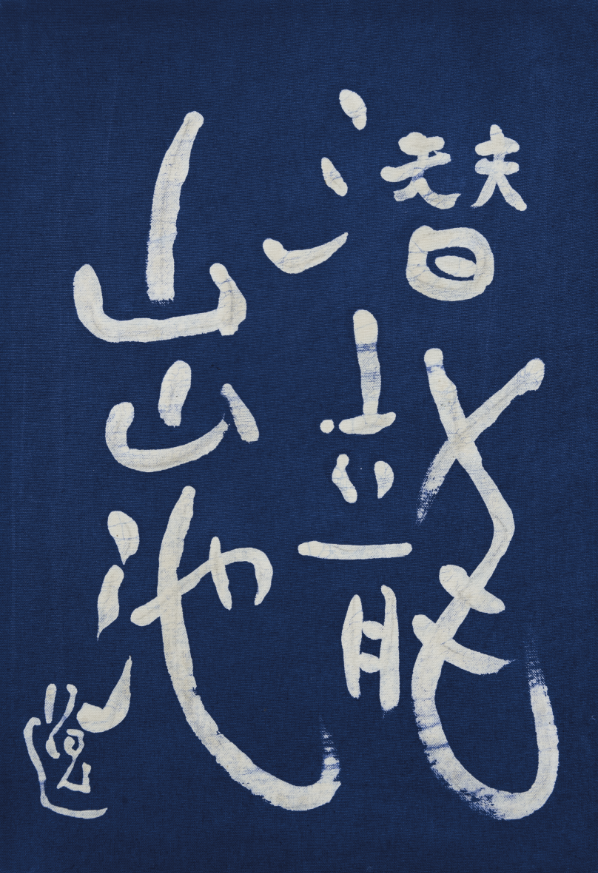
Calligraphy by Itsuo Tsuda
If the beginnings are usually tough, its because people have lost part of their mobility and mostly because they have become hard so to be protected from the world around. They have built a carapace, an armour, certainly protective, but which has become a second nature and an invisible prison. To have Ki flow in our body again, so to recover fluidity, and follow a teaching based on sensitivity enables us to understand physically the Yin and the Yang.
Bathing in a sea of Ki
Exercices and basic or advanced techniques have not only in common the breath which is nothing but the materialization or even better the visualisation of Ki, but they also allow to become aware of our body, physically and of our sphere of ki, which the Indians call the AURA, and that we have today practically forgotten almost everywhere.What modern science and in particular neuroscience has been discovering for a few years is only a small part of what everyone can discover on his own and put into practice in his daily life simply through the practice of Aikido as Itsuo Tsuda Sensei taught it.He would repeat over and over again that Aïkido as presented by his Master Morihei Ueshiba is the union of Ka the inspiration, the ascending force, the square, the weft and Mi, the exhalation, the downward force, the cercle, the chain.Ka being in Japanese a prononciation for 火 fire (which appears for example as a radical in the word Kasai 火災, wild fire) and Mi the first syllable of Mizu 水 water, the whole forming the word KAMI 神 which means divine in the sense of the divine nature of all things. Itsuo Tsuda would add that ‘in this gloss one mustn’t see a similar value to that of a scientific etymology. It comes from punning, the use of which is common among mystics’. 2Itsuo Tsuda, The Science of the Particular, 2015, Chap. XVIII, Yume Editions, p. 153 (1st ed. in French, 1976, p. 137)
I have never seen such fluid movements as when he wanted us to feel a technique he showed to us. Moreover, in his dojo there used to be no accidents, nobody injured, everything would be in a flow of Ki both respectful and generous but at the same time firm and rigorous, that I can hardly find today in the sports halls where aikidokas have their trainings.
The dojo, an essential place
Do we really need a special place to practise Aikido? If we talk about the surface we need for falls, we could lay tatamis anywhere, from the moment we are sheltered from bad weather.
In his book Heart of Pure Sky, Itsuo Tsuda gives us his extremely clear view of what should be a dojo, he who was Japanese was in the best position to give us a glimpse:
‘Concretely, L’École de la Respiration is a “Dojo”, a particular kind of space in the East, which refers less to the material place itself than to the energetic space.’3Itsuo Tsuda, Heart of Pure Sky (posth.), ‘Interviews on France Culture radio’, ‘Broadcast no. 1’, 2025, Yume Editions, p. 13 (1st ed. in French, 2014)
Régis Soavi
‘As I have already said, the dojo is not simply a space carved out and reserved for certain exercises. It is a place where the space-time is different from that of a secular place. The atmosphere there is particularly intense. We enter it by bowing to sanctify ourselves and we go out by bowing to desacralise ourselves.
Spectators are admitted, provided they respect the atmosphere[…]. They must not gratuitously parody the practice with words and gestures.
I am told that in France [or in Italy], we come upon dojos that are simply gymnasiums or sports clubs. So be it. As for me, I want my dojo to be a dojo, and not a club with a boss and his regulars, so as not to disturb the sincerity of the practitioners. This does not mean that they should wear a scowling constipated expression. On the contrary, we must maintain a spirit of peace, communion and joy.’4ibid., ‘Early Writings’, ‘Booklet n°3 – Respiratory Practice in Aikido’, p. 102
A sacred space therefore and yet fundamentally non religious, a secular space, a space of great simplicity where the freedom to be as we are exists, beyond the social. And not what we have become with all the compromises we had to accept in order to survive in society. This freedom remains inside us, deep within us in our intimate heart, our Kokoro 心 as Japanese language talks so well about it, and is only asking for a chance to be revealed.
‘Respiration, in my experience, is the very foundation of Aikido.’
Itsuo Tsuda, The Path of Less (Chap. XIX)
The teaching that we have received and continue to receive allows us to experience the accuracy of the above quotation. Whether we are quiet in our dōjō, where the atmosphere favours concentration and thus focusing on respiration – which makes our dōjō valuable –, or when we are away, since the dōjō is then within us.
A demo session of Aikidō was organized by Bodai Dōjō, on 30 January 2016. And it was a real pleasure for all those who took part of it. Starting from February there will be a session every Wednesday at 8 p.m. for those who want to discover the Aikidō of the Itsuo Tsuda School. The dōjō that hosted us, and which will be our home for regular practice, is a dōjō where they practice Jūdō essentially. It is located in Francavilla, 250 km from Rome on the other side of the Adriatic Sea, and lies on the border with Pescara, where Bodai dōjō has already organized a reading with the presentation of the new Yume edition of The Non-Doing and a seminar to introduce to Katsugen Undō.
Writer and director Yan Allégret is interested in aikido and traditional Japanese culture since 20 years. He practiced in France and Japan and became interested in the concept of a dojo: what makes at some point a space “the place where we practice the way.”
6 am. People leave home and head for a place. On foot, by car, by subway. Outside, the streets of Paris are still sleepy, almost deserted. Dawn is near. Those outside have not put on the armour needed for the working day ahead. There is something in the wind. At the break of dawn it feels like walking in a twilight zone.
It is in this gap we find Tenshin dojo of the Itsuo Tsuda school. In this place dedicated to Aikido and Katsugen undo, the sessions are daily. Every weekday morning, a session at 6:45 am, on weekends at 8am, regardless the weather or holidays, except January 1, the day of the ceremony of purification of the dojo. Dawn influence practice. At all times this porosity was considered in the Japanese tradition. Just read the Fushi Kaden from Zeami, creator of the Noh theater, to understand how the traditional arts were on the lookout for the “right moment” (taking into account time, weather, temperature, the quality of silence, etc.) to perfect their art. Walking towards the dojo at 6:30, we will realize, practising in the morning creates a relief. The mental capacity is not yet assailed by concerns of family and social life. The mind has not yet taken control. We come as a white sheet at 120, rue des Grands-Champs in the 20th arrondissement.
The association Tenshin is established here since 1992. It was founded by a group of people wishing to follow the teaching of Itsuo Tsuda, transmitted by Régis Soavi. Itsuo Tsuda was a student of Morihei Ueshiba and Haruchika Noguchi (founder of aikido and katsugen undo). Concerning Régis Soavi the current Sensei, he was a direct student of Master Tsuda. The dojo is not affiliated to any federation. He follows his path, independent and autonomous, with continuity and patience.
When passing the doorstep, we feel that we enter “into something”. A mixed form of density and simplicity emerges from the place. In Japanese, one would say, the “ki” of the place is palpable, the space is silent. People are gathered around a cup of coffee, accompanied by the Sensei. On the other side the space with the tatamis, yet at sleep.
A void at work
The dojo is vast. All the walls are white. The central tokonoma includes a calligraphy of master Tsuda. Portraits of founders (Ueshiba for Aikido, Noguchi for Katsugen Undo and Tsuda for the dojo) are located on the opposite wall.It is 6:45. The session will begin. The mats were left to rest since the previous day. The space is not rented for other courses because of profitability. One begins to understand what this “something” is we felt entering. A void is at work. Another crucial element in the Japanese tradition: the importance of a linked emptiness.
Between sessions, the space is left to recharge, to relax, like a human body. You should have seen the place, naked and silent like a beast at rest, to understand the reality of this fact. Practitioners sit in seiza, silence falls and the session begins. The person conducting faces the calligraphy, a bokken in hand, then sits. We salute a first time. Then comes the recitation of the norito, a Shinto invocation, by the person conducting. Master Ueshiba began each session accordingly. Mr. Tsuda, customary of Western mentality, did not deem it necessary to translate this invocation. He insisted only on the vibration that emanates from it by the work of the breathing. Of course, the sacred dimension is present. But no religion so far, no mystical “Japanese style” Westerners are sometimes fond of. No. Here it is much simpler.
Beyond the combat
Hearing the norito, we feel resonating something in the space that facilitates concentration, the return towards oneself. As one can be touched by a song without the need to understand the words.
Thereupon follows the “breathing exercises,” a series of movements done alone. Master Tsuda kept this part of the work of Master Ueshiba that wrongly could be considered as a warming up. The term warming up is restrictive. It engages the body only and assumes that true practice begins after. In both cases, this is false. One movement can infinitely be deepened and involves, if you work in this direction, the totality of our being.
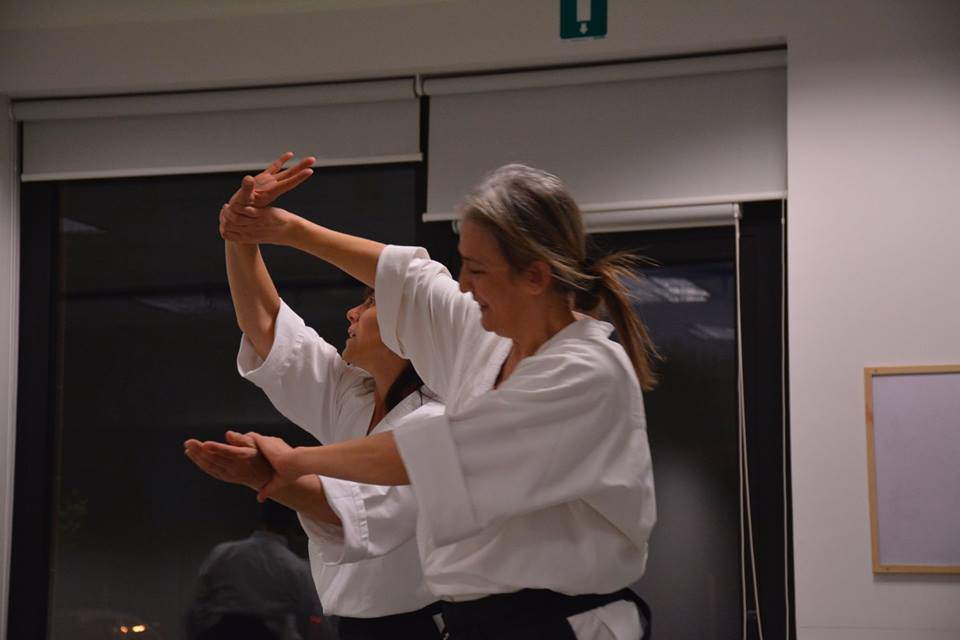
Then comes the work in couple. We choose a partner, one day a beginner, the next day a black belt. Any form of hierarchy predominates. We work around four to five aikido techniques per session. The Sensei demonstrates a technique, then everyone tries it with his or her partner.What emerges from practice, is the importance of breathing and attention to what circulates between the partner and yourself. A circulation, when taking the premise of a fight as a starting point, that leads beyond. A beyond the combat.
It isn’t no doubt by chance that Régis Soavi uses the term “fusion of sensitivity” to speak about aikido. “The way of fusion of ki”.
The art of uniting and separating
On the tatami, no brutal confrontation. But no weak condescension either. The aikido practiced is flexible, clear, fluid. We see hakamas describing arabesques in the air, we hear laughter, sounds of falls, we see very slow movements, then suddenly without a word, partners accelerate and seem drawn into a dance until the fall frees.
We think back to the words of Morihei Ueshiba: ‘Aikido is the art of uniting and separating.’
There is no passing grade. No examination. No dan or kyu. Instead, wearing hakama and black belt. Beginners, meanwhile, are in white kimonos and white belt. The time just to wear the hakama is decided by the practitioners theirselves, after talking with elders or the Sensei. To choose to wear the hakama involves to assume freedom, but also responsibility. Because we know that beginners take more easily as a model those who wear the traditional black skirt. The issue of grade is turned inside out. The key is not outside. It is our own feeling we must sharpen, to recognize the right moment. Of course, mistakes can be made, the hakama is put on too early or too late. But the work has begun. It is obvious that we must seek inside. As for the black belt, the Sensei gives it to the practitioner the day he thinks the person is ready to wear it, the latter never being informed of this decision. And that’s all. The person wears the black belt. No blah-blah. The symbol is taken for what it is: a symbol and nothing more. The path has no end.
A special atmosphere
Seeing the Sensei demonstrating the free movements, in which techniques are linked spontaneously we think again about a term often used in the literature and the teaching of Itsuo Tsuda: “The non-doing”. And this is what probably brings this special atmosphere in the dojo at dawn, the smell of flowers at the tokonoma and the emptiness. A path of non-doing.The session ends. Silence returns. We greet the calligraphy and the Sensei. He leaves. The practitioners leave the space or fold their hakama on the tatami.
Around 8:30, we find ourselves around breakfast. We seek to learn more about how the dojo functions. For this lively place is both alive and financially independent, considerable energy is invested by practitioners. Some have chosen to dedicate much of their lives to it. They are a bit like Japanese Uchi Deshi, internal students. In addition to the practice, they manage the spine of the dojo, then taken in turns by the other practitioners that could be involved as external students. Everyone involved is encouraged to take initiatives and to take responsibility.
Work with less
An elder summarizes the instructions received: “Aikido. Katsugen undo. And the dojo.” The life of a dojo is a job in itself, an unique opportunity to practice out of the tatamis what one learns on the tatamis. Rather than a refuge, a greenhouse, the picture is rather that of an open field in the middle of the city, in which we lay fallow at dawn, where we clear weeds to allow gradually its place to other blooms.Before leaving we look at the empty space with tatamis one last time. It seems to breathe. The day dawned and the city is now in a fast and noisy rhythm. It awaits us. We leave the dojo and walk away with a wisp of a smile.
In a world of unbridled accumulation and filling up, there are places where you can work with less. This one makes part of it.



 Yet, rather than giving up, we have taken this challenge and turned it into an opportunity.




 The teaching that we have received and continue to receive allows us to experience the accuracy of the above quotation. Whether we are quiet in our dōjō, where the atmosphere favours concentration and thus focusing on respiration – which makes our dōjō valuable –, or when we are away, since the dōjō is then within us.


