Why is practising Katsugen Undo important in our life? Régis Soavi, who has been teaching and introducing people to Katsugen Undo for forty years now, gives a brief answer and provides an overview of the impact that an individual gives on their daily life when orienting themselves according to Seitai.
Subtitles available in French, English, Italian and Spanish. To activate the subtitles, click on this icon. Then click on the icon to select the subtitle language.
Would you like to hear about the next article?
Subscribe to our newsletter
Some additional information
Seitai was developed by Haruchika Noguchi (1911-1976) in Japan. Katsugen Undo (or Regenerating Movement) is an exercise of the extrapyramidal motor system that is part of Seitai. Itsuo Tsuda (1914-1984), who introduced Katsugen Undo in Europe in the 70s, would write about it: ‘The human body is endowed with a natural ability to readjust its condition […]. This ability[…] is the responsibility of the extrapyramidal motor system.’ 1Itsuo Tsuda, One, Chap. VI, 2016, Yume Editions, p. 46 (1st ed. in French: 1978, Le Courrier du Livre (Paris)
Excerpts from the video
‘We no longer see things in the same way. Obviously, our relationship with illness changes completely. Once we understand that illness is a response from the body, that illness as a symptom is a response from the body, we accept the symptoms and get through the illness. It changes everything. You are no longer dependent on the doctor or therapist; you no longer need them. You realise that lots of things are returning to normal. Before, you always had pain here and there, you had trouble digesting, you couldn’t sleep – and now, little by little, it’s all disappearing.
That doesn’t mean that afterwards we are an elite… a super elite… no, not at all! But when we have small problems that arise, they are resolved more quickly. So in terms of health, we react more quickly. Our immune system works faster. Skin reactions are faster. Digestive reactions are faster. Our minds also open up. We no longer see things in the same way. And there are things that no longer seem acceptable to us. We can no longer accept that children, women or foreigners are treated like animals… Something inside us changes. We are no longer the same. Our outlook on life changes. That’s why, after a while, people who knew us before look at us and say, “Hey, it’s funny, you’ve changed…” They don’t really know how to put it… Well, yes, we have changed. We haven’t changed. We’ve found ourselves, that’s all. We’ve found ourselves inside.’
Notes
1
Itsuo Tsuda, One, Chap. VI, 2016, Yume Editions, p. 46 (1st ed. in French: 1978, Le Courrier du Livre (Paris)
Sequel of interviews where Régis Soavi, who has been teaching and introducing people to Katsugen Undo for forty years now, gets back to basics about Seitai and Katsugen Undo. In this third video, the concept of Yuki is explored.
Subtitles available in French, English, Italian and Spanish. To activate the subtitles, click on this icon. Then click on the icon to select the subtitle language.
Subscribe to our newsletter
Some additional information
Seitai was developed by Haruchika Noguchi (1911-1976) in Japan. Katsugen Undo (or Regenerating Movement) is an exercise of the extrapyramidal motor system that is part of Seitai. Itsuo Tsuda (1914-1984), who introduced Katsugen Undo in Europe in the 70s, would write about it: ‘The human body is endowed with a natural ability to readjust its condition […]. This ability[…] is the responsibility of the extrapyramidal motor system.’ 1Itsuo Tsuda, One, Chap. VI, 2016, Yume Editions, p. 46 (1st ed. in French: 1978, Le Courrier du Livre (Paris)
Excerpts from the video on Yuki
‘There is natural Yuki. The Yuki that mothers naturally do on their stomachs. There is natural Yuki, which is very simple: when a friend is in pain, you place your hand on their back, and that is natural Yuki. Sometimes we add a few words.
There is natural Yuki, when you have a headache, you put your hand on your head. If you have a very bad headache, you put both hands on your head. But not everyone puts their hands there, precisely. Some people put their hands like this, some put them like that, and that’s natural Yuki. That’s precisely why you can’t teach Yuki. You can’t say, “If you have a headache, put your hands like this and do Yuki, circulate the ki.” “Oh yes, but that doesn’t work for me.” — Oh yes, yes, that’s the technique. — When I have a headache, I do it like this — And I do it like this — And I do it like this, there, that feels good.”
And then there is Yuki as an exercise.
Yuki’s exercise is a specific moment. We do it during Katsugen Undo sessions. At a certain point during the session, there is Yuki. So first we bow to each other. The bowing between two people is the coordination of breathing. Then, one of the two turns their left side toward the other. One hand behind, you see, at eye level, and one hand in front. Then the person lies down, we put our hands on their back and circulate the ki. In this case, it is the exercise to rediscover Yuki. During the movement sessions, it lasts 5 minutes, up to maybe 8 minutes. We all do it together. It is both an exercise that allows us to become aware of ourselves and to make the other person aware. It is not learning, it is discovery. We discover and we deepen our understanding.
Yuki is circulating ki. But ki has no form. Well, here it takes on a form. Ki has no form, ki is atmosphere… the concept of ki is very vague. But here, because there is an action, it has a form. Some people want to associate it with energy, we talk about vital energy. I don’t really like that. I don’t really like that term. “Energy” immediately makes us think of electricity, etc. Or psychic energy that bursts forth, etc. And that’s not what this is about.
Yuki is an experience. It is first and foremost an experience.
he first time I encountered Yuki was because — I remember we were at a café with my master Itsuo Tsuda. It was in the early 1970s, and during a conversation, he simply placed his hand on my back and said, “Yuki is this.” That changed everything.’
Notes
1
Itsuo Tsuda, One, Chap. VI, 2016, Yume Editions, p. 46 (1st ed. in French: 1978, Le Courrier du Livre (Paris)
This seems to be a recurring question in the dojos and one which divides practitioners, teachers, as well as commentators in more or less all schools. Since no definitive answer can be given, one turns to the story of martial arts, to social requirements, to the history of the origin of human beings, to the cognitive sciences, etc. entrusting them to provide an answer which, even if it does not solve the problem, will at least have the merit of justifying what is claimed.
Aikijutsu has become a dō
From the moment it has dropped the suffix jutsu to become a dō, Aikijutsu has acknowledged itself as an art of peace, a way of harmony on the same basis as Shodō (the way of calligraphy) or also Kadō (the way of flowers). By adopting the word that means the path, the way, has it become for this an easier path? Or in the contrary does it compel us to ask ourselves questions, to look again at our own course, to make an effort of introspection? Does an art of peace necessarily have a compliant side, is it a weak art, an art of acceptance, in which cheaters may gain a reputation at little expense?
It is certainly an art that has managed to adapt to the new realities of our time. But do we have to foster the illusion of an easy self-defence, within everyone’s reach, suiting any budget, with no need to get involved in the least bit? Can you really believe or make people believe that with one or two hours of practice a week, furthermore excluding holidays (clubs are often closed), one can become a great warrior or acquire wisdom and be able to solve any problem thanks to one’s calm, peace of mind or charisma?
Does the solution then lie in strength, muscular work and the violent arts?
If a direction exists at all, it can be found in my opinion, and despite what I have just said, in Aikido.
A School without grades
Tsuda Itsuo never gave grades to any of his students and, when somebody had a question about that, he used to answer: ‘There is no such thing as a black belt in mental emptiness’. One might say that these words had ended all discussion. Having served as an interpreter between O-sensei Ueshiba Morihei and André Nocquet when the latter had come to Japan as a learner, Tsuda Itsuo later acted as an intermediary when French or American foreigners showed up at the Hombu Dōjō to start learning Aikido. This allowed him, since he translated the students’ questions and the master’s answers, to have access to what was underlying the practice, to what made it something universal, to what made it an art beyond pure martiality. He talked to us about O-sensei’s posture, about his amazing spontaneity, about his deep gaze which seemed to pierce him to the very depths of his being. Tsuda Itsuo never tried to imitate his master whom he considered inimitable. He was immediately interested in what inspired this incredible man capable of the greatest gentleness as well as of the greatest power. That is why, when he arrived in France, he tried to pass on to us what for him was the essential, the secret of Aikido, the concrete perception of ki. What he had discovered, and later summarized in the initial sentence of his first book: ‘Since the very day when I had the revelation of “ki”, of breath (I was over forty years old at the time), the desire to express the inexpressible, to communicate what cannot be communicated had kept growing in me.’1Tsuda Itsuo, The Non-Doing, Yume Editions, 2013, p. 9
For ten years he travelled Europe to make us Westerners, who very often had a Cartesian, dualistic frame of mind, discover that there is another dimension in life. That this dimension is not esoteric but exoteric as he liked to say.
A School with its own specificity
There is obviously a variety of motivations leading people to start this practice. If I think of the people who practice in our School (the Itsuo Tsuda School), apart from a few of them, there are not many who came for the martial aspect. On the other hand, many of them did not see anything martial about it at first sight, even though at each session I show how the techniques could be effective if performed with precision, and dangerous if used in a violent way. The martial aspect arises from the posture, the breathing, the ability to concentrate, the truthfulness of the act of attacking. Dealing with a learner, it is essential to respect the partner’s level, and to practice known forms.
But the discovery one can make by practising known forms goes far beyond that. It is about making something else grow, revealing what lies deep within individuals, freeing oneself from the underpinning influence exerted by the past and sometimes even by the future, on our gestures, on the whole of our movements, physical as well as mental. Indeed in our dojo everybody realizes that.
The session starts at 6:45am. The fact of coming to practice so early in the morning (O-sensei and Tsuda Sensei always started their own sessions at 6.30) has neither to do with an ascesis nor with a discipline. Some practitioners arrive around 6 every morning, to share some coffee or tea, and to enjoy this moment before the session (a pre-session so to speak), sometimes so rich thanks to the exchanges that we can have between us. It is a moment of pleasure, of conversation about the practice, as well as about everyday life sometimes, and we share it with the others in an extremely concrete way and not in the virtual way that society tends to suggest us.
Of course all this may appear regressive or useless, but it avoids the aspect of easy entertainment and does not encourage clientelism, which does not mean that it does not exist, but in that way there is less of it and with time it evolves. This is because people change, they are transformed, or more precisely they find themselves again, they retrieve unused capacities that they sometimes thought they had lost or often, more simply, had forgotten.
Yin the feminine: understanding
There are so many women in our School that equality is not respected, men are outnumbered, by a narrow margin of course, but that has always been the case. I would not want to speak on behalf of women but what can one do? As far as I know they do not form a separate world, unknown to men.
As a matter of fact, for many men, maybe it is so!… Nevertheless I think all a man has do is to take into account his yin side, without being afraid of it, to find and understand what brings men and women closer and what separates them. Is it a matter of personal affinity, is it a research due to my experience during the events of May 68 and to this blossoming of feminism which revealed itself once again in those days, or maybe more simply is it the fact that I have three daughters, who, by the way, practice Aikido all three of them: the result, whatever the reasons, is that I have always encouraged women to take their legitimate place in the dojos of our School. They take the same responsibilities as men and there is of course no disparity in level, neither in studying nor in teaching. It is really a pity to have to clarify things like that, but unfortunately they cannot be taken for granted in this world.
Despite everything, women scarcely take the floor, or I should even say take up the pen in martial arts magazines. It would be interesting to read articles written by women, or to devote space in Dragon magazine special Aikido to the female perspective on martial arts and on our art in particular. Do they have nothing to say or does the male world take up all the space? Or else maybe these sectarian disputes on the efficiency of Aikido bore them, for women seek and often find, so it seems to me, another dimension, or in any case something else, thanks to this art? Tsuda Itsuo Sensei gives us an idea of this “something else”, which is perhaps closer to O-sensei’s search, in this passage of his book The Path of Less:
‘Do people see Mr Ueshiba as a man completely made of steel? I had quite the opposite impression. He was a serene man, capable of extraordinary concentration, but very permeable in other ways, inclined to outbursts of ringing laughter, with an inimitable sense of humour. I had the opportunity of touching his biceps. I was amazed. The tenderness of a newborn. The opposite of hardness in every way one could imagine.
This may seem odd, but his ideal Aikido was that of girls. Due to the nature of their physique, girls are unable to contract their shoulders as hard as boys can. Therefore their Aikido is more flowing and natural.’ 2Tsuda Itsuo, The Path of Less, Yume Editions, 2014, p. 157
Yang the masculine: fighting
We are educated to competition from early childhood; under the pretext of emulation, school tends to go in the same direction, all this to prepare us for the world of work. They teach us that the world is tough, that we absolutely need to gain our place in the sun, to learn to defend ourselves against other people, but are we so sure about that? Would our desire in fact not tend to guide us in a different direction? And what do we do to achieve this goal? Could Aikido be one of the instruments for this revolution in social values, habits, should it and above all should we do the necessary effort so that the roots of this evil corroding our modern societies may regenerate and become healthy again? In the past there have been examples of societies in which competition did not exist, or hardly existed in the way it does today, societies in which sexism was absent too, even though you cannot present them as ideal societies. Reading the writings on matriarchy in the Trobriand islands by the great anthropologist Bronislaw Malinowsky, discovering his analysis, may help find new leads, and perhaps even remedies to these problems of civilization which have so often been denounced.
Tao, the union: a path for the fulfilment of the human being
The path, in essence, not that I am an idealist, justifies itself and takes all its value by the fact that it normalizes the terrain of individuals. For those who follow it, it adjusts their tensions, restores balance, and it is appeasing for it allows a different relationship to life. Is it not that what so many “civilized” people are desperately seeking and what in the end is to be found deep inside the human being?
The path is not a religion, furthermore it is what separates it from religion that makes it a space of freedom, within the dominant ideologies. According to me the way of thinking that seems closest to this is agnosticism, a philosophical current which is little known, or rather known in a superficial way, but which allows to integrate all the different schools. In Aikido there is quite a number of rituals that are kept up even though their real origin (the source O-sensei drew from) is not understood or there are sometimes other rituals that other masters found through ancient practices as Tamura sensei himself did. Those rituals have often been associated to religion whereas the fact could be checked that it is the religions which have taken over all these ancient rituals to use them as instruments serving their own power, and way too often they are used for the domination and the enslavement of people.
A means: the respiratory practice
The first part of the session in O-sensei Ueshiba Morihei’s Aikido, far from being a warming up, consisted of movements the depth of which it is primordial to retrieve. It is neither to get an intellectual satisfaction, nor out of some fundamentalist concern and even less to gain “higher powers” that we continue them, but in order to return to the path that O-sensei had taken. Some exercises, like Funakogi undo (the so-called rower’s movement) or Tama-no-hirebori (vibration of the soul), have a very great value, and if they are practised with the necessary attention, they can allow us to feel beyond the physical body, beyond our sensation, limited as it is, to discover something greater, much greater than ourselves. It is an unlimited nature which we take part in, in which we are immersed, which is fundamentally and inextricably linked to us, and yet which we find it so hard to reach or even sometimes to feel. This notion that I made mine is not the result of a mystical relationship with the universe, but rather of a mental and physical opening which many modern physicists have reached through a theoretical approach and are trying to verify. It is something that you can neither learn by watching Youtube videos, nor by consulting books of ancient wisdom, despite their undeniable importance. It is something you discover in a purely corporal way, in an absolutely and fully physical way, even though this dimension is expanded to an unusual extent. Little by little all the practitioners who agree to look in this direction find it. It is not related to a physical condition, nor to age and obviously not to sex or nationality.
Education
Almost all psychologists consider that the essential part of what will guide us in our adult life takes place during our childhood and more precisely in our early childhood.
The good as well as the bad experiences. Therefore particular care should be taken in education to preserve the innate nature of the child as much as possible. In no way does this mean letting the child do whatever he wants, making him a king or becoming his slave; the world is there and surrounds him, so he needs reference points. But very quickly, often shortly after birth, sometimes after a few months, the baby is put in the care of persons outside the family. What happened to his parents? He no longer recognizes his mother’s voice, her smell, her movement. It is the first trauma and we are told: ‘He will get over it’. Sure, unfortunately it is not the last trauma, far from it. Then comes the day care center, followed by kindergarten, primary school, junior high, and finally the baccalaureate before perhaps university for at least three, four, five, six years or even more.
But what can you do? ‘That’s life.’ I am told. Each of these places in which the child will be spending his time in the name of education and learning is a mental prison. From basic knowledge to mass culture, when will he be respected as an individual full of the imagination that characterizes childhood? He will be taught to obey, he will learn to cheat. He will be taught to be with the others, he will learn competition. He will receive grades, this will be called emulation, and this psychological disaster will be experienced by top as well as by bottom of the class students.
In the name of what totalitarian ideology are all children and young people given an education that breeds fear of repression, submission, decommitment and disillusionment? Today’s society in wealthy countries does not propose anything really new: work and free time are only synonyms of the roman ideal of bread and circus games, the slavery of the ancient times is only turned into our modern wage employment. A somewhat improved state of slavery? Perhaps… with spectacular brain washing, guaranteed without invoice, thanks to the advertising for products that is pushed on us, with its corollary: the hyper-consumption of goods both useless and detrimental.
The practice of Aikido for children and teenagers is the opportunity to go off the grids proposed by the world around them. It is thanks to the concentration required by the technique, a calm and quiet breathing, the non-competitive aspect, the respect for differences, that they can keep or, if necessary, retrieve their inner strength. A peaceful strength, not aggressive, but full and rich of the imagination and the desire to make the world better.
A practical philosophy, or rather, a philosophical practice
The particular character of the Itsuo Tsuda School derives from the fact that we are more interested in individuality than in the dissemination of an art or a series of techniques. It is neither about creating an ideal person, nor about guiding anyone towards something, towards a lifestyle, with a certain amount of gentleness, a certain amount of kindness or wisdom, of balancing ability or exaltation, etc. It is about awakening the human being and allowing him to live fully in the acceptance of what he is in the world surrounding him, without destroying him. This spirit of openness can do nothing other than waking up the strength pre-existing in each of us. This philosophy leads us to independence, to autonomy, but not to isolation, on the contrary: through the discovery of the Other, it brings us to the understanding of what this person is, also perhaps beyond what the person has become. This whole process of learning, or rather this reappropriation of oneself, takes time, continuity, sincerity, in order to realize more clearly the direction in which one wishes to go.
What lies beyond, what lies behind
I am interested in today is what lies behind or more precisely what lies deep inside Aikido. When you take a train you have an objective, a destination, with Aikido it is a little bit as if the train changed objective as you moved further, as if the direction became at the same time different, and more precise. As for the objective, it pulls away despite the fact that you think you have come closer. And this is where you have to recognize that the object of our journey is the journey itself, the landscapes we discover, which become more refined and reveal themselves to us.
Sequel of interviews where Régis Soavi, who has been teaching and introducing people to Katsugen Undō for forty years now, gets back to basics about Seitai and Katsugen Undō. This second video tackles the notion of health according to Seitai.
Subtitles available in French, English, Italian and Spanish.To activate the subtitles, click on this icon. Then click on the icon to select the subtitle language.
Would you like to hear about the next article?
Subscribe to our newsletter
Some additional information
Seitai was developed by Haruchika Noguchi (1911-1976) in Japan. Katsugen Undo (or Regenerating Movement) is an exercise of the extrapyramidal motor system that is part of Seitai. Itsuo Tsuda (1914-1984), who introduced Katsugen Undō in Europe in the 70s, would write about it: ‘The human body is endowed with a natural ability to readjust its condition […]. This ability[…] is the responsibility of the extrapyramidal motor system.’ 1Itsuo Tsuda, One, Chap. VI, 2016, Yume Editions, p. 46 (1st ed. in French: 1978, Le Courrier du Livre (Paris)
Régis Soavi starts practising martials arts with Judo when he is twelve. He then studies Aikidō, especially alongside Masters Tamura, Nocquet and Noro. He meets Tsuda Itsuo sensei in 1973 and will follow him until his death in 1984. With the permission of the latter, Régis Soavi becomes a professional teacher and disseminates his Aikidō and Katsugen Undō throughout Europe.
Notes
1
Itsuo Tsuda, One, Chap. VI, 2016, Yume Editions, p. 46 (1st ed. in French: 1978, Le Courrier du Livre (Paris)
Many thing are being said and circulated on the internet about Seitai and Katsugen Undō (Regenerating Movement). In this round of interviews, Régis Soavi, who has been teaching and introducing people to Katsugen Undō for forty years now, gets back to basics to address the question: ‘What are Seitai and Katsugen Undō?’
Subtitles available in French, English, Italian and Spanish.To activate the subtitles, click on this icon. Then click on the icon to select the subtitle language.
Would you like to hear about the next article?
Subscribe to our newsletter
Some additional information
Seitai was developed by Haruchika Noguchi (1911-1976) in Japan. Katsugen Undō (or Regenerating Movement) is an exercise of the extrapyramidal motor system that is part of Seitai. Itsuo Tsuda (1914-1984), who introduced Katsugen Undō in Europe in the 70s, would write about it: ‘The human body is endowed with a natural ability to readjust its condition […]. This ability[…] is the responsibility of the extrapyramidal motor system.’ 1Itsuo Tsuda, One, Chap. VI, 2016, Yume Editions, p. 46 (1st ed. in French: 1978, Le Courrier du Livre (Paris)
Régis Soavi starts practising martials arts with Jūdō when he is twelve. He then studies Aikidō, especially alongside Masters Tamura, Nocquet and Noro. He meets Tsuda Itsuo sensei in 1973 and will follow him until his death in 1984. With the permission of the latter, Régis Soavi becomes a professional teacher and disseminates his Aikidō and Katsugen Undō throughout Europe.
Notes
1
Itsuo Tsuda, One, Chap. VI, 2016, Yume Editions, p. 46 (1st ed. in French: 1978, Le Courrier du Livre (Paris)
Continuation of Régis Soavi Interview’s about Katsugen Undō (or Regenerating Movement), a practice made by Haruchika Noguchi and spread in Europe by Itsuo Tsuda. An article by Monica Rossi, published in Arti d’Oriente #4, May 2000.
– It helps, in the case where one has done the three exercises, or the exercises for Mutual Movement (activation through stimulation of the second pair of points on the head; that is another way to activate the Movement). Yuki helps because it activates; It’s very important for me to say that Yuki is fundamentally different from what we often hear spoken of, because when we do Yuki, we clear our heads, we don’t cure anyone, we don’t look for anything. We are simply concentrated in the act. There is no intention, and that is primordial. In the statutes of the dojo, in fact, it is underlined that we practice without a goal”.
Interview of Régis Soavi about Katsugen Undō (or Regenerating Movement), a practice made by Noguchi Noguchi and spread in Europe by Itsuo Tsuda. Article by Monica Rossi publisehd in the review Arti d’Oriente (#4, May 2000).
Part 1
‘After reading the books of Tsuda Itsuo (1914-1984), I was fascinated by his arguments, which range freely from the subject of Aikido to that of children and the way they are born, illness, or his memories of Ueshiba Morihei and Noguchi Haruchika, and I wanted to know more. I continued to have a sensation of something beyond my understanding.
So I began to ask, what exactly is this Regenerating Movement (Katsugen Undo) that Tsuda spoke of, a spontaneous movement of the body that seemed able to rebalance it without needing to intoxicate it with medication; an ancient concept but still revolutionary, above all in our society. I was unable to get any satisfactory answers to my questions: those who have practiced the Regenerating Movement couldn’t describe it or explain; the answer was always: “You should try it yourself in order to understand; the first time, it will probably unsettle you a bit.” So I decided to try it. In Milan, the school that refers to the teachings of Itsuo Tsuda is the “Scuola della Respirazione”. There, one can practice Aikido and the Regenerating Movement ( in separate sessions ). But, in order to go to the sessions of Movement, one must first participate in a week-end course conducted by Régis Soavi, who has continued the work of Tsuda in Europe.
One often tends to consider the spirit of an art as a mental process, a path that should be consciously taken, or rules to observe. All this because in the West we live in a world of separation, division. On one side there is spirit, on the other side body, on one side the conscious, on the other the unconscious, this is what is supposed to make us civilized beings while this separation actually generates inner conflicts. Conflicts which are strengthened by the systems of prohibition set up in order to protect society, to protect ourselves against ourselves.
The practice of Aikido leads us to the reunification of the human being.
Towards the reunification of human being, this is the Path we head for through practising Aikido. This reunification is necessary in a world where the human being is objectified, where the human being becomes both a consumer and a commodity. Without realizing the way taken, the civilized person executes life instead of living it. This society that leads us to consumption leaves little room for inner work, it leads us to search outside for what lies inside. To buy what we already have, to search for solutions to all our problems outside ourselves, as if other people had better solutions. This leads to the individual being cared for and supported by the different protection systems, which are at the same time social, ideological or health care, thus increasing supply and creating an ideal market for dream-sellers of any kind, charlatans, gurus and co.
Today I have heard that a new practice has just been created: “Respirology”, and as usual, customers abused by the power of words will certainly flock. Should we, in the name of body and mind normalization, of people getting back into shape, change the name of our art into: “Aikido therapy”?
The spirit of Aikido cannot be taught
I do not believe it can be told that there is a specific spirit of Aikido but rather that Aikido must be the reflection of something much greater that we, little human beings, have difficulties to realize during our life.
The spirit of an art cannot be taught, it is rather a transmission, but an Aikido without a spirit, what would it be: a struggle, a fight, a kind of brawl without head nor tail. Teaching the technique without transmitting anything of the spirit is quite possible, but then, it happens to be a totally different thing. It may be self-defence or a wellness technique.
Like in any martial art, we have the Rei, the salute, which is obviously the most immediately visible expression of it, but what is most important will be transmitted through the teacher’s posture. By posture I mean an extremely complex set of signs that students will find recognizable: of course the physical aspect, dynamics, precision, etc., but also the way of conveying a message, the attention given to each practitioner according to thousands of factors that the teacher must perceive. It is through developing intuition that one can get the greatest and finest pedagogy, and so provide the elements needed by practitioners to deepen their art, to better understand its roots.
The spirit of Aikido cannot be learnt
The spirit of Aikido cannot be learnt, it is discovered, it does not change us, it enables us to recover our human roots, to join what is best in human being.
‘Aikido is the art of learning in depth, the art of knowing oneself.’
The Aikido founder’s desire was to bring human beings closer, to him the world was like a big family:
‘In Aikido, training is not meant to become stronger or beat the opponent. No. It helps to get the spirit of placing oneself at the centre of the Universe and contribute to world peace, bring all human beings to form a big family.’
A hymn to joy
O-sensei used to say: ‘Always practice Aikido in a vibrant and joyful manner’.
We do not talk about joy often enough, our world incites us to sadness, to react violently to events, to criticize the systems’ failures, to see other people’s flaws, to be competitive. But all this eventually makes us grumpy, harsh and spoils our pleasure of living, quite simply.
Joy is a sensation that I consider sacred. The joy of living, of feeling fully alive in everything we do, or don not do. Joy enables us to experience in a totally different way what many people consider as constraints, to consider them as opportunities allowing us to go further, to deepen what my master used to call respiration.
Joy leads us little by little to inner freedom, which is the only freedom that is worth discovering, as so well told by the Taji Quan master Gu Meisheng (1926-2003) who discovered it in Chinese prisons during Mao’s era.
It enables us to get out of the conventions that different systems impose on us.
Aikido is the art of learning in depth, the art of knowing oneself
The spirit of Aikido is to be found in nature, not in a nature external to the human being but rather in the human being as a part of nature, as nature.
‘The practice of Aikido is an act of faith, a belief in the power of non-violence. It is not a type of rigid discipline or empty asceticism. It is a path that follows the principles of nature, principles which must be applied to daily life. Aikido must be practised from the moment you get up to welcome the day until the moment you withdraw for the night.’
To start every morning in the dojos quiet with a two or three minute meditation in order to refocus, to concentrate. Then switch to the Respiratory Practice, as Tsuda sensei named it, and which O-sensei Ueshiba Morihei used to do at every session. It is then possible to turn to the second part, the practice with a partner, the pleasure of communication through technique, the Ka Mi respiration and all of this very early in the morning while many people outside have just emerged from sleep.
When nothing is planned, when we are devoid of any thought, in these sublime moments when fusion with the partner takes place, then we are in the spirit of Aiki.
Like in Zen, it is suggested to us to live here and now, to be no different from what we are, but to look with lucidity at what we have become.
The transmission of the spirit
In order to understand the spirit of Aikido, one must, in my opinion, dive into the past, not only that of Japan but also, and maybe even mostly, that of ancient China. Go and search for the thinkers, philosophers, poets who enriched reflexion and gave weight to the Oriental way of thinking.It is thanks to my master Tsuda Itsuo that I dug in this direction: not that he gave lectures on philosophy or held seminars on the matter, he who only spoke with parsimony, but on the other hand he bequeathed to us through his books a reflexion on the East and the West, bridging the gap between these two worlds which seemed antinomic.
The immense culture of this master whom I was fortunate enough to know had flabbergasted me at the time but little by little I was able to enter the understanding of his message and philosophical work which had nourished me. But this man I had admired had also left traces I could see without understanding them, other signs in the way Zen masters did: he left calligraphies. As in this art nowadays called Zenga he transmitted a teaching to us through ideograms, maxims by Zhuangzi, Laozi, Bai Juyi, or folk proverbs. Each of these calligraphies introduces us to a story, a text, an art which actually enables us to go further in the understanding of this spirit which underlies our practice.
Awakening the inner force
‘There are forces in us but they remain latent, dormant. They must be awakened, activated’, wrote Nocquet sensei in an article published in 1987. To me this sentence echoes Tsuda sensei’s calligraphy The dragon gets out of the pond where it remained asleep, talent shows through. In both cases, these masters were referring to ki and they incite us to search in this direction.
Without the concrete sensation of ki we miss the point. How can we talk about the spirit of Aikido without making it a sequence of rules to observe, other than by following, rediscovering the foundations of the human being. Our modern, industrial society makes life so easy for us that we move no more, we get around too easily, in the cities we just have to cover a few meters to find food instead of running, hunting or cultivating. Aikido enables us to spend this excessive energy which otherwise would make us sick. But this is not only about the physical, motor aspect, its our whole body which needs to recover, normalize itself. Our mind, overloaded with useless information, also needs to rest, to find peace in the middle of the surrounding agitation.
The spirit of Aikido is Aikido
The spirit of Aikido just lies in practice and little by little it comes to be discovered. And this discovery is real enjoyment. Beginners, when becoming aware of its importance, get fully involved in this art of ours. That is often the moment when difficulties to explain what we do begin. We feel like talking about it, inviting friends to participate at least to a session.
We try to make what we feel understood. Other people witness our enthusiasm but do not come to understand what it is about. And the answers we get to our explanations, to what we try to hand down are often rather disappointing. They may vary from: ‘Ah yes, me too, I practised Yoga last year during my holiday at Club Med. But I don’t have time to do a stuff like this, you see, I really don’t have time.’ to ‘Yes, your stuff is nice but it racks brains, I practice Californo-Australian self-defence, you know, and it’s really efficient’. To move from a world to another requires to be ready, ready to just discover what you do not know yet but have sensed. We start practising because we have read a book, an article, and we have been shocked, we said to ourselves: ‘Strange guy but I like what he tells, I like this spirit, it’s close to me, to what I think’.
An art to normalize the individual
It is the spirit of the practice, quite often, that makes us go on for many years, and seldom physical or technical achievements which anyway will be limited by ageing. The only ageless thing is ki, attention, respiration as Tsuda sensei used to call it. This can be deepened without any limit and thats why there have been great masters.
If you awaken your sensibility, if you have persistence, and if you are well guided; if the teaching is not limited to surface but enables us to dig deeper, to open by ourselves doors that we did not suspect, then everything is possible. When I say everything is possible I mean that everyone becomes responsible for oneself, for one’s life, for the quality of one’s life.
As Yamaoka Tesshū says: ‘Unity of body and mind can do everything. If a snail wants to ascend mount Fuji then it will succeed.’
No seeking for reputation, no attempting to become something but rather seeking to be, thanks to self fulfilment. Pacifying internal tensions, unifying body and mind which quite often work in the wrong way if not one against the other. Heres the deep meaning of the research we can do in the practice of martial arts.
Article by Régis Soavi (about the spirit of Aikido) published in October 2017 in Dragon Magazine Spécial Aikido n° 18.
Quotations are from O-sensei Ueshiba Morihei’s collected talks, some through the book: The Art of Peace, teachings of the Founder of Aikido, compiled and translated by John Stevens, pub. Shambhala.
Aikido is an instrument of my evolution, it made me evolve, I just had to follow with perseverance and obstinacy the road that was opening in front of me, that was opening inside me.
Like many other people, I came to this practice for its martial aspect. However, its beauty, as well as the aesthetic of its movements, quickly fascinated me, and this with my first teacher Maroteaux Sensei already. Then, when I saw Noro Masamichi Sensei, and Tamura Nobuyoshi Sensei, I had confirmation of what I had sensed: Aikido was a wholly different thing from what I knew.
I came from the world of Judo, with the images transmitted to us, for example, that of the cherry tree branch covered with snow which all of a sudden lets the snow slide down and the branch straightens up. I had already gone beyond the ideas that had been conveyed by the beginning of the century and the fifties, of a “Japanese Jiu Jitsu which turns a small thin man into a monster of efficacy”.Read more →
Certainly the Jō, the stick, has always been used in Aikido. But does it really belong to our Art? Its teaching has always been particular and often even separated from the regular courses. Many of us have tried, through other schools of Jūjutsu, to find some forms, some kata, some “secret thrusts”. Some have taken an interest in Kobudō. Yet the art of the Jō in Aikido has its own specificities, its rules.
Personally, what has always fascinated me, is more the extreme accuracy that can be obtained by following a certain type of training. Instead of working on power, I found it more profitable to concentrate on motion, movements and above all precision.
Training to precision
I was a young instructor when I started to train more regularly with the stick. Back then, I tied a soda cap at the extremity of a rope that I hung from the ceiling. My training consisted in making tsuki on the soda cap and each time that it moved to immobilize it again. Then I changed heights. Later I worked on the yokomen and the hits from below, always trying to be precise and without increasing the speed.
I worked slowly looking for the right angle, using the displacements and little by little I increased the speed of the execution. Finally I started to hit by using the movement of the cap that flied around to the left, the right, with sudden leaps that were sometimes odd, or even scary if it had been the Jō or the Bokken of an adversary. I could go around that axle that I hung from the centre of the small dojo that used to be in the backyard of number 34 in rue de la Montagne-Sainte-Geneviève in Paris.
I still remember it with emotion because it was thanks to Master Henry Plée that I could do this type of work. Indeed, he had allowed and even supported me in this direction (an accomplished Budōka, he loved that we trained to the very best of our ability). After several months of this type of training, I moved on to the work on makiwara, but I have to admit, without insisting too much because I found it tedious. Instead I loved the hits in all directions, in the “shadow boxing” style.
In this exercise I found the difficulties of the work with the soda cap, plus the power that I had to control, the circular movements, the speed and above all the visualization. That work of visualization that I already glimpsed in the teaching of my master Tsuda Itsuo. It is also thanks to this that I have discovered the importance of having your own stick, I mean a personal working instrument. I am one of those teachers who believe that the Jō must not be a manufactured product of a predetermined length, thickness, or weight. The Jō has to be in proportion, with no exaggeration, otherwise we will be dealing with a Bō, to the person who uses it, his or her height and musculature: as there are enormous differences, it seems to me a mistake not to take this into account, but in any case it is the way the Jō is used that remains the most important point.
Pedagogy
As far as I am concerned, I now use the stick more as a pedagogical tool. As always it is about retrieving and understanding the ancient forms, of course, but above all about channelling the released energy, feeling it circulate and flow along this piece of wood.
Master Tsuda used to tell us: ‘The Jō has three parts, the two ends and a centre, unlike the Bō that numbers four parts due to the way one seizes it, with both hands at an equal distance from the extremities’. Doing tsuki the technical aspects of the strokes vary, whether one uses it in the ancient form suited to the spear, or as a Jō, that is something much shorter, holding it with both hands in the same direction or one opposite to the other. All this did not matter to him: what was important was the transmission of ki and the act of non resistance.
The Jō was only there to enable us to discover the Non-doing, to deepen our breathing.
Then the stick (I suggest to call it that way) is used as if it was an empty tube that gets filled with ki, that has a certain autonomy, that becomes alive again.
The stick exacerbates distances. It forces us to have another relationship with the distance, to feel the axes as well as the changes of direction, of orientation.
Some people have a particular affinity with the Jō, others prefer the Bokken. Even if it is part of my teaching, I give them the time to find out whether it makes sense to them, whether it helps them go deeper in their practice.
It is one of the means I sometimes use to make people understand how the strengths involved in our practice circulate: it is precisely with the stick that I can show this.
I ask uke to grab the stick very strongly and tori has to find the axis, the direction by the mere movement of his body, of his koshi, not of his muscles or arms, to slide the force applied, so that when tori moves, it creates such an imbalance for uke, that he accepts to fall and drops like a ripe fruit falling from the tree.
Practising outdoors
There is a moment in which it is particularly pleasant to practice the stick, and this is when you are outside, in the open air.
And the time for this is the summer workshops, which we have organized for almost thirty years at Mas d’Azil, in Ariège. There we are lucky enough to be able to change an old gym, practically unused, into a wonderful dojo, in the course of several pleasant working days. Since it is next to a soccer field, we can go outside to practice weapons.
I know that practitioners are then very happy to practice outside the tatami mats.The space is so much bigger that we can rediscover the dimensions that the old arts required.
After having been confined to an enclosed space, the whole point of these open air sessions is to expand physically: no more ceiling, no more walls, no more limits. It is the moment when everyone can experience different dimensions, the ideal moment to try, in this space, to feel further.
Practising outside, whilst we are used to the uniformity of the tatami mats, is a constraint for the entire body: the ground is no longer that flat, there are some holes, some bumps, all movements, taisabaki, and obviously the falls or the immobilisations become more difficult.The speed of the attacks is often reduced due to the unusual conditions. But in turn, when we practice on the tatami mats again, everything becomes easier: one has gained skill, speed, strength in the legs, and balance that one did not have before.
We then take the opportunity to practice with many people, three, four, six, or even up to eight attackers (one tori and seven ukes) who, in the respect of our Art and with no competitive spirit, try to reach out and put the one in the centre in danger. No need to pretend it’s a movie: we are neither samurai nor secret agents whom nothing can stop. Its about moving more and better than we usually do, feeling the movement of our sphere, the gaps in it and the risks there are of having an impact in those places.
The importance is not given to a perfect technical skill, whether in defence or in attack, but much more to the sensation of the other people’s movement, to distance, to the energy that one can throw.
Such a wide space allows circumferences of about eight or ten meters, sometimes. In circular movements Tori’s gaze, with its intensity and precise direction, relays the power and speed of the stick. This alone is sometimes enough to create the right conditions for a reply, a correct move.
I do not know if I am well understood: it is a game in which all participants, from the very beginner to the most experienced, have their own role depending on their level. The six or eight attackers will moderate the power and speed of the attacks (tsuki, shomen, yokomen) according to this.
Each of them seeks the right position so as to find the weak point, the speed of approach, the right angle.
The attacks are as much as possible genuine attacks, but they are always done without violence and even if possible not too fast, in any case not hastily.
It is important in this type of work to be careful not to block or corner the one in the centre, so as not to drive him into a spiral of fear that would lead to aggressiveness, but on the contrary to help him come out of his imprisonment, both physical and mental, and to allow him to develop his potential.
The summer workshop lasts for two weeks and is very concentrated: two Aikido sessions, two Katsugen undo sessions and one weapon session every day. It means seven or eight working hours per day, about fifty hours a week. That is why we need this kind of work with the Jō, enabling bodies to unwind, to open out and find another dimension.
Sticks spin, spaces move about, bodies which are at times weary stretch. The atmosphere remains peaceful, sometimes even cheerful, but accuracy is there.
Men, women, children of all ages, in the respect of the specificities of each of them.
The sensitivity of the foetus
However, a clarification: pregnant women sometimes practice until the very last moment in our School. But since the beginning of their pregnancy we pay particular attention to the fact that being in such a special state, even if of course we never touch the body with the stick, it is forbidden to do tsuki in the direction of the womb. Regardless of the risk of accident, to which we always pay a lot of attention. The point is not to direct the ki in that way, in other words with “the intention to hit”. Such a directed and guided ki would be instinctively recorded as dangerous and felt by the mother, and most of all by the baby, who is nothing but sensitivity, as an aggression, to the point of risking to cause at least a fear, or a contraction that would harm his good development. When we work on tsuki strokes, pregnant women step aside and watch, but do not participate.
A centripetal force can become a centrifugal force
Sometimes we work with Jō against Bokken. The point then is, precisely because the weapons are different, to understand on the one hand the way to use them and on the other hand their limits and capabilities, without forgetting that behind all this there is a human being. At other times, it is only uke who has a weapon.
A stick, a Bokken, can be frightening if you have no weapon.You do not know in which direction it will start, men, yokomen, tsuki, you cannot stop the stroke with a simple wave of your hand. Only by dodging, doing taisabaki, can you avoid the shock. Taking hold of the stick or of the Bokken, is then one of the chances to stop the attack, to transform it and make it harmless, so that we can use its energy in the opposite direction or divert it towards another direction. It is a wonderful opportunity to see, to feel how for example a centripetal force, when it gets in contact with a centre, can turn into a centrifugal force so that it is driven towards the outside.
What do we mean by “stopping the spear”1? The real point is not a question of winning or losing but rather of changing the system, of allowing something else to arise, and for this, the knowledge of the partner, the understanding between both partners is essential.
In every person there are some good and some bad sides, some good and some bad habits: all of this has to be guided towards harmony. Harmony is at the origin of our life, the thing is to get back to what is natural and always there deep inside every individual. That is, for me, the way of Aikido.
Our horizon can light up if we understand better the words of O-sensei Ueshiba, transmitted by my Master Ueshiba Itsuo in his teaching and through his nine books. These words did not remain a dead letter; on the contrary they have come to life, once more, and continue through those who are willing to follow this path.
Talking about omote-ura as an Aikidō subject immediately reminds me about yang-yin (in Japanese: yō-in).
Nevertheless in the West the general trend is to perceive it as black and white; they are opposed to each other, divided between light and dark, categorised as positive and negative, like at school or even with sexist references. It is very easy, we have habits and we do not even realise that.
The Tao is represented flat, to be more exact as a ball where yin and yang interpenetrate each other, but in fact each one keeps its own space: you, me, him, the other.
Philosophically we talk extensively on one or the other, but we forget the great Chinese thinkers: Lao Tzu, Chuang Tzu, Li Tzu, or Sun Tzu, to name just the most famous.
Black or white, yin or yang. And what is grey?
If we keep on thinking in a dualistic way, it is a mixture of both.
My Master Tsuda Itsuo hardly ever quoted omote or ura, besides that, he rarely gave a Japanese name for what he did or showed. Fluently bilingual, he has always preferred French for his explanations, and particularly in his books he wrote in one go, almost without correction.He could guide our sensitivity and make us feel thanks to the practice of Katsugen undō (Regenerating Movement), yuki, and particularly through his touch or even his silent presence, this non dualistic world that he had come to help us discovering.
Discovering with the body
Aikidō is a way of discovering your own body, I mean physically, concretely feel those fluids that run following networks with a yin or yang tendency.
yin becomes yang
When during the practice omote or ura is mentioned, it usually refers to the whole movement, the tendency, possibly his ending.
The breathing can help us understand it better, feel, what it is all about. It is better to start working with a rather slow pace, if you go too fast at the beginning there is a big chance not to succeed. The focus is on breathing, by following the inhale, then the exhale, you move focusing on the inner feeling, you can work on this kind of exercises with a partner, closing your eyes and remaining focused on the center. Arms for example open or close independently of our will, they obey to a necessity that comes from the yin or the yang.
If you want to practice Aikidō as the practice of the not-doing, all the work must be about feeling, you dig, deepening more and more and gradually something will move within us; and one day you will realize that you have overcome something. The wall that was blocking us, which resulted in a stiff or uncertain technique, and therefore artificial, completely unrealistic, it has dropped. At that point you feel free, extremely free.
The research takes then a different turn. The perception of the yin/yang becomes self-evident. It is something that I find difficult to express in words, because everything becomes simple: gestures, movements, there is no mental action. It comes directly from the center, and then a great sweetness naturally arises, a sweetness that can be yin or yang, but very strong in any case, a powerful sweetness which has an effect on and knows how to act in harmony with the partner or the opponent, depending on the circumstances that led the one in front of us to act like this or that.
The tendency during the inspiration is rather towards an opening and thus is yin; expiration closes the body and its tendency is yang. Already just with the breathing you can hear, if you pay attention, the yin and yang, but they are only the expression and the direction of the energy that has materialised.
The visible part, the one that the physical body can finally use, is ready.
When looking at the body, the front part is yin and the back is yang, although the front leg is yang and the back of the leg is yin: this is admitted in all schools, but the passage of ki from one to the other is rarely explained in martial arts, it often remains only looked at the surface.
Meeting Tsuda Itsuo, the practice of Katsugen undō and the discovery of the Seitai by Master Noguchi Haruchika were fundamental during my research and gave me an understanding of the body and its movement that was missing until then. Some areas that had remained vague in the teaching of Aikidō, as the hara, have become extremely accurate with the Seitai. One can for example verify the state of the “three points of the belly.” The first must be yin, the second one should be neutral, the third yang, positive and reactive.
‘The purpose of the Regenerating Movement is to regulate our body, normalize it. Regulate our body is not only necessary to make us healthy. Whatever kind of activity we practice, whether is calligraphy, or drawing or practising martial arts, the first need is the one to start regulating our body, otherwise you miss an opportunity.’1
Non-Doing and non-dualism
In Aikidō we let the ki arise from Seika Tanden, the hara (3rd point in the belly in Seitai), and its tendency is yang because it results from the strength that comes from the back, force that is not expressed in the shoulders, as we see too often, but naturally thanks to the koshi.
The crossing point of this force, of ki that became yang, is the 3rd lumbar vertebra which is actually in a yin position in the spine. By visualizing the abdominal breathing one can tell that the yin inspiration inflates the abdomen and prepares the action which is going to be yang, and at the same time, ki goes down along the spine and permeate the entire body2.
When the ki gets out directly from the center its tendency is yang, but depending on the circuit that it will take it will express as yin or yang. If it follows the internal circuits of the stomach and arms, the inside of the body, then it becomes yin, otherwise its expression will be yang. The resulting force will also be yang or yin depending on the moment when it is used.
Of course, in a world that is not separated, time is also part of this unity. Although we can slow down or speed up the moment of an impact, for example to be precisely in the right place, at the right moment with the right breathing and the right ki, this cannot happen without the coordination happening in our “involuntary system”. This is precisely where the teaching by Tsuda Itsuo has brought decisive elements. To make us enter the world of sensation, insisting on the Non-Doing, allowing us to discover the non-dualism, he gave us the keys we can still use today, because they are within reach of all, as his books testify.
Yin and Yang
If we break down a movement like ryote-dori tenchi-nage in the omote form, uke comes up with a yang force. He is in the middle of the exhalation, tori receives that at the end of his yang, yin has already expanded in him, it has become in-compressible, it will still expand and will ultimately overwhelm uke. Then its the time for yang to expand, you notice that because the arms turn, this time it is the dividing line between yin and yang that goes from bottom to top. For uke the movement started already at the beginning of the inspiration, unable to resist it breaks off and falls, like when a fruit is ripe and falls in the hand. In the ura form, tori must wait because yang is still too powerful, he turns to deviate the force but as soon as he gets his yin force back, it can use the yang force to start in omote or let the yin force continue its work until total envelopment of uke.
Similarly in kokyū hō, there are different ways to do it: either you project immediately the yang force or you allow the yin force to expand and at the end you use the yang. Again it all depends on the condition, the moment, the partner.
The yang force is more direct, more interventionist than the yin force, but can easily harden people. The authoritarian fathers know this problem with their children and a fracture is often accomplished during the adolescence.
The yin force is enveloping, sweet but sometimes misused, like some mothers do. They may risk to imprison their child and he will then struggle to get out of the footprint of the family cocoon.
Ideally when yin ends it allows the radiant take off, after the “dark” inner work of preparation during childhood, a real detachment without fracture, like the ripe fruit falls off the tree at the right moment. The radiant take off is freedom without thoughts. The ability to be the own Tao. Simply the realization of being.
The body spheres
Our body is in between others with an external surface: the skin is somehow the material sphere. But we are not limited by the skin, it only defines the internal yin from the external yang, ura and omote. This surface is a sphere that has taken the form of a human being.
Beyond this there is another sphere that everyone can instinctively feel. It occurs rather in the form of a deform-able egg as needed. This sphere is often represented in religions, it is called Mandorle or Aura. It is the visual representation of a reality experienced by everyone, and kept alive in martial arts. It is also yin internally and yang outside with an extremely precise limit, it is possible to observe that what is yang compared to the skin it is yin compared to the energy sphere.
Irimi and tenkan
When doing irimi for example, we allow uke to enter our yin sphere, he is relieved from his yang ki excess that had became hard and rigid, his terrain is normalised, we allow him to find an internal balance. Then with irimi nage we end up with a yang movement that will cause in him the desire to fall in order to avoid the worst. On the other hand with tenkan both spheres barely touch each other and only merge at the level of the hand. The Yang surfaces push, sustained by the internal yin, become strong, standing side by side, rejecting and sliding against each other.
If tori lets his elbow slide to enter the sphere of uke, then his yin movement will grow so to overwhelm uke that, once again, will fall to avoid the inconvenience of this turnaround.
In our school, the first part of the Aikidō session is dedicated to a solitary practice. One of the exercise involves lifting the arms palm facing the sky to then lower them. Tsuda Itsuo told us: ‘Lift the sky then push the earth.’ There are different ways to do this exercise. If we try to raise them using the yang the shoulders will contract, if we try to push the earth with the yin we will remain stuck in the middle of the movement. Raising the arms unifying with heaven (yin) and down in harmony with the earth (yang), it was this kind of work, the visualization that I started with my master and I still continue after forty years.
Allowing a conscious circulation of ki, improving our perception of this movement, of this sphere of energy that many speak about but only a few can perceive so clearly, this is how I intend my current work.
To allow the normalisation of the terrain of those people who come to the dojo and give them visible or invisible instruments, conscious or unconscious to enable them to achieve independence, autonomy, inner freedom.
For this the awareness about omote-ura, as an expression of the yang-yin, is in my opinion essential.
Article by Régis Soavi (on Omote/Ura) published in January 2016 in Dragon Magazine Spécial Aikido n° 11.
Notes:
Abstract of the conference Regulate the body by Noguchi Haruchika sensei, translated by Tsuda Itsuo into French (Eng. trad. The Unstable Triangle, Chapter XIX).
Master Noguchi Haruchika, on the other hand, advocated the exercise Sekitsui Gyōki 脊椎 行気法 or Breathing through the column that starts from the “second points of the head” and that allows the normalization of the terrain (the whole body, of course in a unified manner, physical, mental, etc.).
We are pleased to propose this short video showing the work of Régis Soavi.
A work that he keeps on doing for over thirty years, during workshops and in the daily practice.
You can find all the dates of the next workshops on this page: https://www.ecole-itsuo-tsuda.org/en/stages/ (subtitle available in French, click the first icon to the right of the video)
In one of his booksTsuda Itsuo gives us his views on kokyū:
‘In learning a Japanese art, the question of “kokyu” always arises, strictly speaking, the equivalent of actual respiration. But the word also means to have a knack for doing something, to know the trick. When there is no “kokyu”, we cannot do a thing properly. A cook needs “kokyu” to use his knife well, and a worker his tools. “Kokyu” cannot be explained; it is acquired.
When I was young, I saw a labourer working with his screwdriver on very rusty machinery. I tried to unscrew a piece of the machine, but in vain; it was too rusty. For the labourer, it posed no problem; he unscrewed it with ease, not because he was stronger but because he had “kokyu”.
When we acquire “kokyu” it seems that tools, machines, materials, until then “indomitable”, suddenly become docile and obey our commands with no resistance.
Ki, kokyu, respiration, intuition are themes that are pivotal to the arts and crafts of Japan. It constitutes a professional secret, not because people want to keep it like a patent, or a recipe for earning their living, but because it cannot be passed on intellectually. Respiration is the final word, the ultimate secret of learning.
Only the best disciples gain access to it, after years of sustained effort.
A martial arts master whom dogs bark at is not a good master, they say. The French know how to silence dogs by sliding a piece of sugar in their mouths. That’s the trick, that’s “the thing”, but it is not kokyu, respiration, which is something else entirely.’
Tsuda Itsuo, The Path of Less, Yume Editions, Paris, 2014, p. 33-34.
I discovered kokyū with my master Tsuda Itsuo. Previously, it was to me just the name of a technique, with Tsuda Itsuo this notion became much more concrete, firstly by the orientation of his practice. He said: ‘To me technique is simply a test of knowing whether I have evolved in my breathing.’ Thus our attention was brought directly to kokyū. There could not be aikidō and breathing. Aikidō is breathing. And then, from his first books on, Tsuda Itsuo illuminates us in terms I did not knew; almost too simple and yet so difficult to achieve.
When I attacked him it was crystal clear, regardless the strength I put in he remained both, relaxed and powerful.
He made us use visualization to teach us kokyū. E. g. for kokyū hō he said: ‘It is the lotus flower opening.’ Today few people have seen the lotus flower, so I speak of a daisy. Visualization should talk to us, directed to us. For it to act, it must be anchored in the concrete life of each person. So sometimes to help someone to get beyond a partner that is holding the wrists to prevent him or her to move, I say, ‘You welcome a friend you have not seen for years, who steps out of the train, take him in your arms!’ Then the person forgets the other and ki, instead of being coagulated, flows in the given direction, the person raises the arms without any effort. The power of visualization is colossal.
Sure, posture is essential, I would even say primordial. If the body stiffens to become an impeccable posture; it is screwed. If it is too flabby; it is screwed. If the third lumbar is wrongly positioned: it is screwed. With the practice of aikidō and Katsugen undō I see that my students are gradually recovering. Ki begins to flow without blockage, without disruption, it is the discovery of unforced abdominal breathing, but clear and limpid, from the kokyū. In my view, without kokyū, all the work in aikidō is only intended to strengthen the body, it is a work of hardening.
With the deepening of breath little by little the needlessness disappears, we do not need to work on flexibility or strength, stiffness and our ideas of strength and weakness are leaving. So ki circulates better.
For this direction, the respiratory practice we do in the beginning of the sessions is important.
You can not teach kokyū, but you can guide individuals to discover it.
If we practice kokyū ho every morning at the end of each session, it is precisely to make people sensitive and also to improve our posture. As our posture and the way we behave refines and improves, we are able to help the normalization of the terrain of our partner. If you breathe deeply from the hara to the hara of the partner, you revitalize the channels through which ki flows, you enable these circuits to function better, and the other understands (feels) with his entire body what it is about.
It is not about looking at the demonstration and working harder and harder, but rather about being pervaded with this kokyū feeling of the other. I often say: to work on the kokyū we must start by listening. We listen to the other, not with the ears but with the whole of our body, we feel the breathing, the ki, of the other. It is like a perfume. We listen to the inner movement, so the feeling becomes more accurate and we can guide him or her to a better posture, towards a release of tension.
It is also the work of senior practitioners to encourage this discovery. By bathing the other in breath, they help them to feel it, by dint of being soaked with “something”.
In the practice of Katsugen undō Tsuda sensei introduced in Europe, first comes the awareness by the breathing, by the movement of ki. Tsuda wrote: ‘In the regenerating movement (Katsugen undō), we do the opposite of the tradition: we begin with the supreme secret, straight off’1.
Kokyū is no more magical than ki is an energy. As soon as we launch ourselves into an explanation, even if we let know that it will be approximately, big chance we blow it.
The ancient tales, such as those recorded by the Grimm Brothers, can show us an aspect of kokyū powers. As in fairy tales, it can transform toads into a prince or princess and grow people more beautiful by the simple fact of transforming their posture. This posture, the result of many years of contraction, weakness, or attempts of correction. When the posture finds back something natural, it is the return to the source, to the root of being.
The discovery of kokyū leads us to different behaviours in everyday life. This respiration, far from being seen as in “New Age”, awakens in the individuals’ daily life forgotten qualities, lost simplicity, and intuition finally found. It is what can be admirable in the work of a craftsman and an artist, but it is also what surprises those who do not know it. Because we did not understand nor felt what is behind this entirety in the performed act: kokyū is a revelation of the unity of being.
Tsuda Itsuo has guided us in that direction, leaving us free to go further or stay put. This freedom was fundamental in his teaching.
It is said that sometimes when the posture, the breathing, the coordination was perfect, Ueshiba O-sensei exclaimed ‘Kami Wasa’. God-technique? Supreme realization? Could we not talk about kokyū or Non-Doing in the greatest simplicity? Like a child who drops a toy to take another, in the same way as he aspires us to take him in our arms for protection.
A small child has kokyū. ‘The baby is as big as the universe, but treated poorly fades quickly’2, Tsuda Sensei wrote in his last book. Is it not our duty to enable him to preserve it? And to us adults, it to regain?
Aikidō is not made for fighting, but to allow a better harmony between people.I breathe deeply, I listen to the body of the other, in his or her body I visualize the flow of ki, I hear and clearly understand it, so I let ki passing into the body of the other. This circulation brings us fullness, the feeling of being fully alive, everything disappears, there is nothing but the present moment with its sensations, its colours, its music.
Born in 1914, Itsuo Tsuda would now be one hundred years old. This atypical character, fiercely independent, considered himself first and foremost a philosopher and he is a key figure of the Aikidō in France. He is the one who introduced Katsugen undō* in Europe in the early 70s.
Direct student of O-sensei Morihei Ueshiba during the last ten years of his life, Itsuo Tsuda did not consider important the sporty or martial art aspects of Aikidō, but rather the chance to make use of this art for inner search, for personal search. He qualified this dimension as “solitary practice” and devoted himself to pass it on in his books and in his teaching.
By beginning Aikidō at forty-five years of age, the ki and Non-Doing were the two aspects that mainly attracted him. These aspects were particularly tangible in a series of exercises preceding, during O-sensei Ueshiba sessions, the technique, which Itsuo Tsuda named after the expression “Respiratory Practice.”
O-sensei Ueshiba gave a lot of importance to these exercises that meant to him something completely different then warming up. Itsuo Tsuda in an interview with France Culture said:
‘For me what is important is what I do at the beginning: I sit, breathe, I breathe with the heaven and the earth, that’s all. Many people love aikido as a technique, don’t they? For me, the technique is simply the test to find out if I have evolved through breathing.’
In the technique that happens during the second part of the session there is no struggle, but an opportunity to develop sensitivity, the ability to fuse.
The voice of Itsuo Tsuda, who died in 1984, still resonates today through the nine books published in French and through his students. One of them, Régis Soavi, he has dedicated more than thirty years to Aikidō and Katsugen undō teaching. He is the technical adviser for the Itsuo Tsuda School .
— Good morning, Mr. Soavi, when you met Itsuo Tsuda in the 70s you were already engaged in the practice of martial arts. What made you decide to consecrate to the Aikido of Itsuo Tsuda?
— I had just started Aikidō when I met Itsuo Tsuda, my teacher was Roland Maroteaux. I met Tsuda during a workshop organized by this teacher. What struck me at first was his ability to dodge. During this workshop I saw my teacher, who was an actual budōka, attacking him with determination and at any time Tsuda was not there, he was dodging, he had created void in front of him. That was what shocked me. I had already experienced a lot of Jūdō, Jūjutsu and weapons and then, more or less at the same time, during my training as a professional Aikidōka, I worked with other teachers like, Master Noro, Master Tamura, Master Nocquet, as well as I took part of some workshops with Master K. Ueshiba, Yamaguchi sensei, etc.. At the time we were all a bit like Rōnins, we were going from a dojo to another trying to uncover the masters’ secrets. At first I was timidly interested of Master Tsuda, but the quality of this void, this emptiness that was moving around, it was very impressive and that was what made me decide: you have to go and see this master.
— What does represent for you the first part of the Aikidō practice that Itsuo Tsuda called “Respiratory Practice”?
— Master Tsuda used to say that it was the essence of Aikidō. At the beginning, when I was about twenty years old, I saw this part as a kind of respiratory warming up, not to mention muscle warming up. And then little by little I found out that it was something much more intimate! And after seven years, the Respiratory Practice had become the most important part of Aikidō for me. The rest was, as Tsuda said very well, a way to verify to what extent I was getting with my breathing.
— You speak about Aikidō proposing the translation “the way of the ki fusion”. How does this differ from the definition “the way of the harmony” that it is normally used?
— Now, “Aikidō” is an ideogram, there are no words therefore in itself. What I try to pass on through “the way of the ki fusion” is the direction we take. In Aikidō this fusion of feelings between people allows you to practise in another way. It completely differs from the idea of fighting. It is rather a complementary. I think Ueshiba had such a fusion capacity with the person who attacked, by anticipating his acts, his gestures. For me, harmony is insufficient as a translation, this may purely be aesthetic. The fusion turns into something deeper. When two metals come together into a fusion to become for example bronze, they become Bronze, it is not only harmonizing them, they become something different. And it is in this sense that I want to translate it with “the way of the ki fusion.” But this is purely ideograms interpretation.
— What role do you think the technique plays?
— It is essential. It is the base. For me, technique must be extremely precise. It is the technique that leads the breathing. The technique also means the body, the posture. If your posture is correct, if the positioning is right, then it is easy, breathing is better. when one is blocked, congested, closed or too open, too soft or too hard, nothing will really happen. The technique is there to allow through its precision to find the lines that help us breathing better, to get better into the fusion. It is also for this reason that I often ask to work slowly. It is no use doing something quickly and badly.
— Does the practice of Katsugen undō, you’ve discovered with Master Tsuda, affected your approach to Aikidō?
— I think if I had not practised Katsugen undō I would have not practise Aikidō the way I do today. We should never forget that Katsugen undō is something that normalizes the ground, the body. And only now I see Aikidō as a process of normalization of the body as well. The practise of Katsugen undō allows you to practise Aikidō in this way, it is for me a base, the basic. It develops in you the breathing, once we breathe better, we are more relaxed. Aspects like aggressiveness, competitiveness disappear, they fall by themselves. Instead of practising by hurting the others, one goes towards the normalization of the body, for example I usually show how, by twisting the arm in a certain way, during the mobilization, you allow your ki to get up to the third lumbar in fact the person’s body twists slightly on that point. Well, it is a process of normalization of the body through Aikidō, which I discovered because of the Katsugen undō practice. This applies to many other techniques, the way to get in, to reach the center, the hara, and so on. I’m not saying that you cannot find out if you only practise Aikidō, but Katsugen undō was an open door, it has allowed me to feel better, to understand better, to be more in the spirit… I think this was very important for Tsuda as well. He practised with Ueshiba for ten years. But when he started Aikidō he had already been practising for more than ten years Seitai and Katsugen undō. His terrain was thus in a certain condition, for example with regard to the flexibility – which is often lost when at forty-five years of age. And then the kind of spirit condition: for Tsuda was clear that we were not there to destroy ourselves, but rather to find a certain tone, and at the same time a balance. Aikidō should lead to a balance. And Katsugen undō task is the balance.
— you practise early in the morning, this may be surprising.
— Sessions during the week start at 6:45am while at the weekend they are at 8.00. I know we live in a society where you go to bed very late and you get up very late too. In my case I really love the morning. One can be tired in the evening, people after working hours are stressed. Sessions of martial arts then very easily turned into a relief valve, and so on. Rather in the morning, competitiveness does not have too much importance … you get up, you are in the dojo, you can easily breathe, you start your day. Furthermore we are very lucky to be in a permanent dojo. One comes and it is like being at home, in an association but at home, the dojo are used only for this reason. There are gyms with more or less clean changing rooms where you can not even leave your watch otherwise they might stole it, and so on. So you come here in the morning, take a little coffee, tea, and then practise. And so the day begins and starts well, it is a real pleasure. Every morning I have a great pleasure to see people getting there and taking their time, we are in a world where we do not take our time anymore…
— Your sessions are designed for all without distinction of age and levels, you talk about a school without grades.
— Master Tsuda said: ‘There is no black belt for mental emptiness.’ With Ueshiba there was no national program for black belts. When Master Noguchi was teaching he was used to say “Forget, forget, when you will need it, it will come back naturally” It’s a little bit like this, the technique is important, but we do not repeat ten thousand times how to get attacked or some other staff. It makes no sense. Hierarchy, degrees, kyu, dan, and so on. For me this is not really important … And then in terms of age, why should we make a difference? Modern society created that difference, it has created the teenage (which by the way teenage is now up to forty years), the third and then the fourth age, and so on. All these categories do not correspond to anything. For me, when we talk about life within us we are all equal. Then, of course, it makes a difference, if I work with a six year old child it is not like when I work with a sixty years old person or somebody on their twenties.
— Other then passing on the bases, what can you really teach through Aikidō?
— Ah, not much, actually, on a given moment people are going to start their own search by themselves. So, since I’m older, and my own search is also a long-term one, I can give them some information, and then I can help them to better understanding through visualizations. It’s my way of teaching people today. I suggest visualizations, for example by saying this movement looks like when you place a baby in bed. At the same time people search, there are a number of people who I consider companions they are no longer students. As sensei, as a good craftsman with a greater seniority, I can say, ‘Look further, that is it’, by looking further, the body opens and the person says, ‘Oh, okay It is fine.’ It is very subtle. It is a kind of communication that I establish with my students. And then people go and search in that direction. We do not work on making the technique perfect, that does not exist. Aikidō is not going to become more effective, more aesthetic, and so on. But we will be closer to ourselves, I think that this is the most important thing.
Want to receive future articles? Subscribe to the newsletter
Abonnez-vous à notre newsletter
Katsugen undō, translated as Regenerating Movement, is a technique developed by Haruchika Noguchi, creator of Seitai.
Writer and director Yan Allégret is interested in aikido and traditional Japanese culture since 20 years. He practiced in France and Japan and became interested in the concept of a dojo: what makes at some point a space “the place where we practice the way.”
6 am. People leave home and head for a place. On foot, by car, by subway. Outside, the streets of Paris are still sleepy, almost deserted. Dawn is near. Those outside have not put on the armour needed for the working day ahead. There is something in the wind. At the break of dawn it feels like walking in a twilight zone.
It is in this gap we find Tenshin dojo of the Itsuo Tsuda school. In this place dedicated to Aikido and Katsugen undo, the sessions are daily. Every weekday morning, a session at 6:45 am, on weekends at 8am, regardless the weather or holidays, except January 1, the day of the ceremony of purification of the dojo. Dawn influence practice. At all times this porosity was considered in the Japanese tradition. Just read the Fushi Kaden from Zeami, creator of the Noh theater, to understand how the traditional arts were on the lookout for the “right moment” (taking into account time, weather, temperature, the quality of silence, etc.) to perfect their art. Walking towards the dojo at 6:30, we will realize, practising in the morning creates a relief. The mental capacity is not yet assailed by concerns of family and social life. The mind has not yet taken control. We come as a white sheet at 120, rue des Grands-Champs in the 20th arrondissement.
The association Tenshin is established here since 1992. It was founded by a group of people wishing to follow the teaching of Itsuo Tsuda, transmitted by Régis Soavi. Itsuo Tsuda was a student of Morihei Ueshiba and Haruchika Noguchi (founder of aikido and katsugen undo). Concerning Régis Soavi the current Sensei, he was a direct student of Master Tsuda. The dojo is not affiliated to any federation. He follows his path, independent and autonomous, with continuity and patience.
When passing the doorstep, we feel that we enter “into something”. A mixed form of density and simplicity emerges from the place. In Japanese, one would say, the “ki” of the place is palpable, the space is silent. People are gathered around a cup of coffee, accompanied by the Sensei. On the other side the space with the tatamis, yet at sleep.
A void at work
The dojo is vast. All the walls are white. The central tokonoma includes a calligraphy of master Tsuda. Portraits of founders (Ueshiba for Aikido, Noguchi for Katsugen Undo and Tsuda for the dojo) are located on the opposite wall.It is 6:45. The session will begin. The mats were left to rest since the previous day. The space is not rented for other courses because of profitability. One begins to understand what this “something” is we felt entering. A void is at work. Another crucial element in the Japanese tradition: the importance of a linked emptiness.
Between sessions, the space is left to recharge, to relax, like a human body. You should have seen the place, naked and silent like a beast at rest, to understand the reality of this fact. Practitioners sit in seiza, silence falls and the session begins. The person conducting faces the calligraphy, a bokken in hand, then sits. We salute a first time. Then comes the recitation of the norito, a Shinto invocation, by the person conducting. Master Ueshiba began each session accordingly. Mr. Tsuda, customary of Western mentality, did not deem it necessary to translate this invocation. He insisted only on the vibration that emanates from it by the work of the breathing. Of course, the sacred dimension is present. But no religion so far, no mystical “Japanese style” Westerners are sometimes fond of. No. Here it is much simpler.
Beyond the combat
Hearing the norito, we feel resonating something in the space that facilitates concentration, the return towards oneself. As one can be touched by a song without the need to understand the words.
Thereupon follows the “breathing exercises,” a series of movements done alone. Master Tsuda kept this part of the work of Master Ueshiba that wrongly could be considered as a warming up. The term warming up is restrictive. It engages the body only and assumes that true practice begins after. In both cases, this is false. One movement can infinitely be deepened and involves, if you work in this direction, the totality of our being.
Then comes the work in couple. We choose a partner, one day a beginner, the next day a black belt. Any form of hierarchy predominates. We work around four to five aikido techniques per session. The Sensei demonstrates a technique, then everyone tries it with his or her partner.What emerges from practice, is the importance of breathing and attention to what circulates between the partner and yourself. A circulation, when taking the premise of a fight as a starting point, that leads beyond. A beyond the combat.
It isn’t no doubt by chance that Régis Soavi uses the term “fusion of sensitivity” to speak about aikido. “The way of fusion of ki”.
The art of uniting and separating
On the tatami, no brutal confrontation. But no weak condescension either. The aikido practiced is flexible, clear, fluid. We see hakamas describing arabesques in the air, we hear laughter, sounds of falls, we see very slow movements, then suddenly without a word, partners accelerate and seem drawn into a dance until the fall frees.
We think back to the words of Morihei Ueshiba: ‘Aikido is the art of uniting and separating.’
There is no passing grade. No examination. No dan or kyu. Instead, wearing hakama and black belt. Beginners, meanwhile, are in white kimonos and white belt. The time just to wear the hakama is decided by the practitioners theirselves, after talking with elders or the Sensei. To choose to wear the hakama involves to assume freedom, but also responsibility. Because we know that beginners take more easily as a model those who wear the traditional black skirt. The issue of grade is turned inside out. The key is not outside. It is our own feeling we must sharpen, to recognize the right moment. Of course, mistakes can be made, the hakama is put on too early or too late. But the work has begun. It is obvious that we must seek inside. As for the black belt, the Sensei gives it to the practitioner the day he thinks the person is ready to wear it, the latter never being informed of this decision. And that’s all. The person wears the black belt. No blah-blah. The symbol is taken for what it is: a symbol and nothing more. The path has no end.
A special atmosphere
Seeing the Sensei demonstrating the free movements, in which techniques are linked spontaneously we think again about a term often used in the literature and the teaching of Itsuo Tsuda: “The non-doing”. And this is what probably brings this special atmosphere in the dojo at dawn, the smell of flowers at the tokonoma and the emptiness. A path of non-doing.The session ends. Silence returns. We greet the calligraphy and the Sensei. He leaves. The practitioners leave the space or fold their hakama on the tatami.
Around 8:30, we find ourselves around breakfast. We seek to learn more about how the dojo functions. For this lively place is both alive and financially independent, considerable energy is invested by practitioners. Some have chosen to dedicate much of their lives to it. They are a bit like Japanese Uchi Deshi, internal students. In addition to the practice, they manage the spine of the dojo, then taken in turns by the other practitioners that could be involved as external students. Everyone involved is encouraged to take initiatives and to take responsibility.
Work with less
An elder summarizes the instructions received: “Aikido. Katsugen undo. And the dojo.” The life of a dojo is a job in itself, an unique opportunity to practice out of the tatamis what one learns on the tatamis. Rather than a refuge, a greenhouse, the picture is rather that of an open field in the middle of the city, in which we lay fallow at dawn, where we clear weeds to allow gradually its place to other blooms.Before leaving we look at the empty space with tatamis one last time. It seems to breathe. The day dawned and the city is now in a fast and noisy rhythm. It awaits us. We leave the dojo and walk away with a wisp of a smile.
In a world of unbridled accumulation and filling up, there are places where you can work with less. This one makes part of it.
When I began to teach aikido, like many people, I had a photo of Master Ueshiba in the tokonoma. That was the way I had been taught, bowing in the direction of the master. When I went to Master Tsuda’s dojo for the first time, there was a calligraphy, printed by a friend of his who was an artist, after an ancient stone engraving. It was Bodai. This calligraphy was there, when I had expected to see a photo of Master Ueshiba… Moreover the lines were thick… – 8 cm, that is very thick! – And it resonated in a different way, it had another respiration…It is another dimension. And seeing the calligraphy at each session… makes things change completely.Read more →
Our appointment is at 6:45 AM, in Milan’s Chinese quarter. The place: a former garage, transformed into a traditional, spartan-looking dojo where, once inside, you are told gently but firmly to remove your shoes. The participants arrive little by little, sleepy-faced; they murmur their greetings as though reluctant to disturb the pale atmosphere of the Milanese dawn.
I had been invited to an aikido session by Régis Soavi, during one of the periodic courses he conducts in Italy. Régis Soavi teaches and transmits the message of Itsuo Tsuda (1914-1984), a direct disciple of master Ueshiba. I had read a few of Tsuda’s books; he was Japanese and lived in France. His books are strange. They cannot be classed with “martial arts” books, or as “essays”, or with “stories”. In Tsuda’s school, we find the convergence of two fundamental experiences: Aikido and Katsugen undo (Regenerating Movement). I wanted to speak more in depth of that, with Régis Soavi.
Who Itsuo Tsuda was
You were a direct student of Master Tsuda. Tell me a bit about him.
He was very simple. We called him Mr. Tsuda. I myself only began to address him as “Master” in his last years. He wished to be considered above all as a philosopher and writer. His quest was of a personal nature. When you met him, you realized at once that he had a strong personality, but at the same time, he seemed to be an Oriental like any other. If you were to come across him in the street, you’d never realize he was an expert in Martial Arts, he just seemed to be an ordinary Japanese. In any case, on the tatami, he was a real discovery. Tsuda addressed himself to each person individually, he never generalized. In the morning, after aikido, we would have coffee together and he would tell stories, speaking to all who were there; but we understood that, each time, he wished to reach certain people in particular. He was characterized above all by his simplicity.
I’m looking at Tsuda’s biography: ‘At 16, he rebelled against his father’s wish for him to inherit the family patrimony; he left his family to wander, in search of freedom of thought. Later, reconciled with his father, he came to France in 1934, where he studied under Marcel Granet and Marcel Mauss until 1940, when he returned to Japan. After 1950, he became interested in Japanese culture, studying the recitation of “Noh” with Master Hosada, the “Seitai” with Master Haruchika Noguchi, and Aikido with Master Morihei Ueshiba. Itsuo Tsuda returned to Europe in 1970, to disseminate the practice of “Regenerating Movement” and his ideas about the “Ki”.’ What did Itsuo Tsuda do during the Second World War?
In 1940 he was mobilized and had to return to Japan, on the last boat to go through the Suez Canal. The canal was then closed. He was enrolled in the army, where he worked in an administrative capacity. He never fought. Right after the war, he worked for Air France as an interpreter. That is how he met Master Ueshiba. A French Judoka, André Noquet, came to Japan to discover the practice of Aikido, and as he spoke no Japanese, he needed an interpreter. He found Tsuda, who until then knew nothing about Aikido, but he was deeply interested at once.
Did Tsuda know Ueshiba first, or Noguchi?
Noguchi. He was about 30 when he first met Noguchi, and 45 when he encountered Ueshiba.
What was the meaning of his refusal to accept the family heritage?
His father came from a family of Samourai, who became factory owners and business heads at the Meiji modernization. Tsuda did not want to work in the family business. He wanted to live his own life. At first it was very difficult; he even worked for a time in a chemical factory. Then, when he had reconciled with his father, he decided to study in France. Tsuda was very fond of France.
Aikido
For you, is Aikido a martial art?
No, you already know the answer. Aikido is a non-martial art; it is the practice of non-doing. Master Ueshiba, in another epoch, could have responded that Aikido is a martial art. Still, if I say it is not a martial art, then people respond, ‘Oh, it’s a dance then’. That is why I define Aikido as a “non-martial art”. In any case it is something quite different; That is why Ueshiba called it ai-ki-do. The term is often translated as “The Way of Harmony”, but a more appropriate definition is “The Way of Fusion of Ki”. Two people can undergo what we call fusion. They do more than simply harmonize. From two, they become One, then two again. Habitually in martial arts, two adversaries confront each other and only one remains. But in Aikido we have the fusion of sensitivity. In our school, he who attacks, attacks; the other becomes one with him: he accepts and absorbs the attacker and from two creates one. He acts in such a way that the other begins to be a part of him. In this way he disarms the attack, which no longer works.
Does that mean that one learns to take responsibility for the other as well? Or to put it differently, in a relation between two people, does the will of one of them suffice to modify the quality of that relation?
One learns to take one’s own responsibility. In our school, the attacker will help the other who is not yet able to create the state of fusion; he makes it possible. If he were to attack brutally, the beginner would be unable to create this fusion; but if he acts as a guide, he helps the other rediscover his own capacity for movement. He already has that capacity. If, when crossing a street, a car suddenly arrives, we jump to the side. It’s the art of avoidance. These capacities manifest themselves spontaneously, in certain exceptional circumstances. Here, we reintroduce them, so that they become more natural, so that they are present in every moment of our lives.
You practice early every morning. Why?
Master Ueshiba practised early in the morning, Master Tsuda as well; I continue to practice early in the morning. That is the first reason. The second reason is that only those who are very determined, very well motivated, come in the morning, because to be here at this time, you must get up at around 5:30 AM. In the morning we are fresher than at the end of the day and it’s easier to practice “non-doing”, at least for beginners. We are also more “involuntary” – still a bit half asleep, we are not yet entirely into our “social being” that we use during the day, to encounter others and go about our work: smile when we should, or not; say ‘thank you’, etc. In the morning we arrive at the dojo still clean, not very structured yet, and there is something more authentic there.
How is your Aikido different from that of other schools?
There is no difference, it is Aikido. I do not know what is done these days in other organizations, at Aikikai for example; I left them 20 years ago. I do believe that certain things have been forgotten; for instance, the first part of the “Respiratory Practice” that Master Ueshiba did every morning, and that we have preserved. In other schools, some forms of this have been maintained, but a large part has been lost. I think that those schools have adapted themselves more to Occidentals and to our epoch; as for myself, I prefer to remain more traditional.In our Aikido sessions, there is a first part, where we practice alone for about 20 minutes, and a second where we practice in pairs: one partner attacks, and the other executes the technique. The techniques are the same as those practised at Aikikai or with Master Kobayoshi, or any other master. The difference is in our approach, which gives much more importance to the role of the partner. We take the other person completely into account, and for that, I feel that our practice of Katsugen Undo has played a fundamental role.
The Regenerating Movement
What is Katsugen Undo?
In our school there are two practices, united through a common spirit: Aikido, of which we have just spoken, and the Regenerating Movement, which Tsuda learned from Master Noguchi – a ‘movement that permits a return to the source’. This is what allows us to better understand the aspect of “non-doing” in Aikido.
Often, when people arrive from other dojos, I see that they possess a technique: they respond to the attacks in a certain way, but there is no spontaneity. Everything is calculated, inculcated, schooled, and ordered.
The regenerating movement is supposed to bring the individual back to a state of spontaneity?
Yes, it is the art of spontaneity par excellence.
It is derived from Noguchi’s “Seitai”, if I have understood correctly?
Yes.
What does Seitai mean?
It means a “natural condition”; “Seitai Soho”, for example, is a technique used to “Seitai-ise” the individual, that is, to give him the possibility of a return to a natural condition. Katsugen Undo, on the other hand, is the movement of the extrapyramidal motor system, the involuntary movement that is activated spontaneously, and that, in itself, acts to take us to a condition of seitai. It is not a method of acquisition, on the contrary, it is a Way of detachment. We do not acquire greater flexibility; rather, we free ourselves from rigidity. We acquire nothing; rather, we lose things, we free ourselves from what hampers us. This is important in Aikido as well. Aikido is not a Way of “acquiring” techniques, or of “obtaining” results, but rather a Way of coming back to simple things. On this subject Master Tsuda spoke of ‘becoming a child again, but without puerility’.
Did Ueshiba know of Seitai? How did Seitai and Aikido come together?
It was Tsuda who united them. I do not believe that Ueshiba knew of Seitai. However, Master Noguchi once went to see a demonstration by Master Ueshiba, of which he said, ‘It’s good’. In Japan, that is sufficient.
The Ki
Did Noguchi create the discipline of Seitai, or did a tradition already exist that he perpetuated?
No, he created it. Initially, Noguchi was a healer, until his “discovery” of involuntary movement. One day, he realized that people fell ill, and came to see him; he would allow the ki to circulate, they would recover and go off. Then they would fall ill again and come back to see him…. Any other therapist would have been happy to observe that, as they would be guaranteed a steady clientele. But Noguchi started from a different point of view: ‘What good is it to heal them since they just fall ill again? Every time they fall ill, they depend on me.’ To him it was absurd. He had discovered that, with Katsugen Undo, there was no more need for someone to heal us. The body does not need anyone, it does everything all by itself.
Can we say then, that our ki heals us?
No, ki does not heal us. Ki activates the vital capacities of the individual, but we are already full of ki! If our body works normally, we need nothing else. If I have some microbes in my body, the body creates a fever and produces home-made antibiotics, antibodies, etc. Noguchi did nothing but activate the life force, when the individual was too weak. What is even more interesting is that the individual can activate his life force on his own, with no need for another person, no need to ask someone else to do it for him.
Does this method work to cure people?
We are not cured. If we break a bone, once the bone is back in place, what makes it knit back together? It is not medicine, it is not doctors, and it is not the ki either. Even if we do nothing the bones knit, simply because we are alive! If we find this capacity again, the whole body will function in this way.
And with cancer, what happens? Is it more difficult to find a normal function when the cells have gone crazy?
In the case of cancer, it is a matter of a certain corporal laziness: the body is so damaged that it is near death. But there are people who survive a cancer. How does that happen? That is not my domain, as I am not a therapist; I do not attempt to cure people. But it is clear that there are people who have not allowed their bodies to do their work normally; for every little problem, they take medicine. Today, that is how it is as well, for giving birth and for pregnancy. From the beginning of life, we are medicalised, hospitalised, even though these are natural events, where life manifests its workings in us.
Can we say then that it is our ideas that have become ill?
Not only our ideas. It all goes together. But what is new with Noguchi, is the possibility to awaken oneself if one wishes it . It’s not a question of awakening each person at any price, nor of proposing a great new method that will cure everyone. It can be useful only to those who wish to go in a certain direction. The others, the lazy ones, do not belong here. In this society, there is already an infinite number of specialists to take care of them: doctors,priests, psychoanalysts, gurus, etc. As for me, I prefer to live my own life totally. I prefer that no one need to take care of me.
In our magazine, we have begun a discussion about the ki, about the way each Oriental discipline interprets and uses it. It would be interesting to hear your point of view.
Ki is an untranslatable word today. The ki has a thousand forms; good ki, bad ki… it is indefinable. When we enter a certain place, with a certain atmosphere, one can say we feel a certain sort of ki. But what seems a pleasant sort of ki to some can be quite disagreeable to others. In Aikido, there is, effectively, the ki of the attack which is to come. Sometimes, walking along the street, we can feel something at the nape of the neck. We turn, see no-one, but then notice, up on a roof, a cat observing us. We have felt the ki of the cat’s look. How can we explain that? We can observe it, but as for explaining it… “To be in harmony with the ki.” But which ki? It is not simple.
I remember one of your conferences where you said that when something hurts it is natural to put one’s hand on the painful spot. For example, if we have a headache we naturally put our hand to our head, and that is already a way of using the ki.
Yes, the “laying on of hands” is yuki. When you have a headache, you put on your hand, and the ki circulates. In this way, the ki is concentrated. The ki is already there, it circulates already, but we concentrate it. When we have something wrong somewhere, we lay our hands on the spot without thinking of it, it happens spontaneously. When, on the contrary, we do yuki with someone, it adds a certain concentration, a direction.
So in your school you do yuki with each other?
When we practice the regenerating movement, we also practice the exercise of yuki. All the same, rather than doing yuki, it is a matter of a rediscovery. We come back to something everyone already knows, from when we were children.
The translation of yuki?
Joyful ki.
The perception of the sacred dimension
Does Seitai contain a reference, close or remote, to a religious tradition, as does Aikido?
Neither discipline adheres to a religious belief.
But Ueshiba was so deeply influenced by the sect Oomoto-kyō (a Shintoist religious group), that in his thoughts, Aikido and his religious practice are not always easy to distinguish.
But Aikido in itself is not at all religious. It does fit into a sacred tradition, that yes. Ueshiba had without doubt a very strong relation to what is sacred. Master Tsuda also considered the dojo to be a sacred place. After all, what is the dojo? It is a place where we practice the Way. And the Way is represented in Japanese by the ideogram of Tao. One does not practice the Way just anywhere. A place consecrated to that practice is necessary.
But what is the sacred dimension for you?
I cannot give a precise definition. People do say, The sacred dimension, yes, but religion, no! One particularity of our school is that we don’t practice before a picture of Ueshiba or of Tsuda, but before a calligraphy. The calligraphy that hangs in this dojo, for example, is Mu, the Void.
Is it the same in each dojo?
No. In Toulouse, there is a calligraphy that signifies “The dragon emerges from the pond, where he had been asleep”. At Avezzano the calligraphy signifies Bodai, that is, the state of illumination.
What is the meaning of this custom?
To practice before a calligraphy creates a different atmosphere than would a picture. Personally, to stand before a calligraphy that signifies The Void, gives me a feeling of plenitude. To practice before a picture of someone, even if he is the founder of the school, seems to me to indicate a religious attachment or devotion. Ueshiba did not practice before a photograph. A calligraphy is by nature “void”. Also, I find it important that those who come to the dojo to practice, understand the sacred aspect, but at the same time, that there are no gods to venerate here.We are not concerned with peoples’ religious or political beliefs. At the same time, this space is not only physical. It is not a gymnasium, where one trains, sweats, and showers. It is a permanent dojo, where we practice only Aikido and the regenerating movement.
I think that people are also interested in the cultural, philosophical and religious origins of the discipline they practice. In the Chinese tradition, for instance, the classical martial arts were born, or in any case, greatly developed, in the Buddhist and Taoist monasteries.
Everything began in religion. Art in Europe began in religion. Today, it is publicity which gives its impetus to art. Publicity is the new religion. Ueshiba himself said that Aikido is not a religion, but that it sheds light on religion, allowing a better understanding of it. In fact, he himself recited the “Norito” before a little altar, either Buddhist or Shintoist, or even before an image of Jesus.
Why do you recite the “Norito”, a Shintoist invocation, before each session?
It is not Shintoist. I do not know what it is. I say that it is not Shintoist because it is something older, something which has since been adopted by Shintoism. Master Ueshiba spoke in this case, of “Kotodama”.
What is “Kotodama”?
It is a resonance.
Like a mantra?
If you like. Shintoism has its source in ancient traditions, in the same way that Christianity has integrated earlier traditions like Easter (originally a Hebrew celebration) and Christmas (the Roman “Saturnalia”, the Celtic and Nordic “Yule”).
What is the “Norito” exactly?
It is a short text. It takes just a few minutes to recite.
Do you teach the meaning of the words to the participants?
No. What is important is the vibration, the resonance.
And people accept participating in something they do not understand?
Yes.
But do you yourself understand the meaning of the text?
No. It is my inner sensation that is important to me. We do so many things that we feel, but do not understand.
Everyone already knows what they need
Stage d’été de l’Ecole Itsuo Tsuda
From the person who begins to practice a martial art, a great deal of confidence in the master is always required. The disciple supposes that one day he will understand, and that he will obtain some results. He hopes to see some visible effects, the proof that what he is doing works, even if it’s perhaps not immediate.
We always behave according to reason. We do something, then we understand, then we change, etc. But with Master Tsuda we discovered something different. I practised Aikido with other masters before him, I have known different forms, different schools, but with Tsuda, I discovered the “non-form”: in fact, the form exists, but it is very vague. With Tsuda, the orientation changed. In the practice as he taught it, one comes back to oneself. The sensation of coming back to myself is what led me to abandon the other things I did; federation Aikido, Jujitsu, etc.One no longer needs explanations. I think that those who come here feel that. They rediscover sensation, and don’t need one to explain that we do this for this reason and that for that reason… They feel, they see, they understand deep inside, they discover; that’s what counts for them.In any event, today, the consequences of knowledge are harmful. The more things we discover, the more problems are raised. I don’t want to say we should know nothing, or learn nothing, but we must have confidence in what is instinctive for humans: in women’s intuition when they care for their newborn babies, for example. When a woman takes a newborn into her arms, she does not wonder, ‘Is he hungry, is he wet, is he sleepy?’ She already knows what the baby needs, intuitively. She has always known. When she was a child herself, she did not need to use that knowledge, but when she becomes a mother, she uses it, that is all.People do feel these things, but generally this sort of perception stops at the unconscious level, and doesn’t emerge into our consciousness. So, officially, we say, ‘I don’t know’, but deep down, we already do know it all.
Individual responsability
How can you define what Master Tsuda’s school proposes?
Simply, to provide, for the individual, a place where one can discover oneself to be autonomous and responsible. For example, here in Milan, the dojo is named Scuola de la Respirazione, and it is the members who manage it and share all the responsibility. Naturally, there are people who come to the courses looking for solutions to their problems, but that is not what we propose- just as we don’t propose an ideal model that one can copy to lead one’s life. That’s why our practice of Aikido is suited to individuals who are very different one from another; it is not at all a matter of one style, one school. We are all different individuals who practice together, to return to what we have at the deepest level inside us; he who comes here, doesn’t come to be taken care of by others. He comes to discover something which must be of service to him in his daily life, and which, otherwise, would be of no value.
Some concrete examples, of the way your practice can come into play in daily life?
The individuals find themselves less stressed; they take more time for themselves and are more concentrated. Be careful, it is not a miraculous method, that makes everyone become handsome, intelligent, rich and generous. It can serve you at work, in your relations with others, in your relationship with your own children, but it is not a panacea.
There are those who begin to practice martial arts to become stronger, but then discover something else, other values. One can, for example, learn to give way instead of responding aggressively to an attack, as in Tai Chi. To take the example of Tai Chi Chuan, one lets the adversary enter instead of opposing him in a block, and then one goes in the same direction, taking advantage of his movement. This attitude can also be applied to human relationships outside of the gymnasium.
Certainly, instead of having aggressive relationships with others, we can enter into a certain harmony with them, and so find something more authentic. Today, relations among people are too superficial. We don’t take care of our children anymore: we put them in child care centres, then in school, then they do their military service… To get back in touch is important- or to return to the pleasure of working, doing work because it interests us. That does not mean we should all act in the same way. For each of us, different things are important. We must respect each person’s rhythm. Some take a hundred years to discover the simplest things; others find them right away, but without putting them to use: they hastily discover piles of things, then disappear.
The important thing is that it has been useful to them.
The important thing is that there exist places like this, where those who are seeking something, can come to find it.
But perhaps what is even more important is that, once one has found that something, one begins to give. Once having found it, one can then serve someone else.
I agree, but there are so many people who live only to give: they give, and they give. In the end, the others cannot take anymore. It is like feeding a baby: ‘here is a spoonful for mama, a spoonful for papa, a spoonful for little sister’ – the baby finally bursts out crying, he cannot take anymore. Parents do that for our own good. But dictators also do things for the good of the nation. What can we do for the good of others? Piles of things.
It is an expression of ecocentrism.
Certainly. There are also people who give to others to avoid doing things themselves, or for themselves. I am rather mistrustful of that. But it is true that when one gives in the right way, a balanced way, we can feel that, and then it is something authentic.
That is why in certain martial arts influenced by Zen Buddhism, one seeks to eliminate the ego…
But it is not possible to eliminate the ego. One can say that we should not be egoistic, or egocentric. However, the little me represents the unity of our personality. The important thing is that it not become the “boss”.
Once the session is finished, the participants at the Scuola de la Respirazione set up a large, low table, around which they breakfast together, seated on tatamis on the floor. Although it is now well past 8 o’clock and everyone is wide awake, their voices remain quiet, as if they wished to postpone for a little bit more, the entry into the daily rhythm and hullabuloo of the town, to keep in themselves for as long as possible, that other rhythm, interior and peaceful.
An interview with Régis Soavi, by Monica Rossi, published in February 1999 in Arti d’Orienten° 2



 The Aikido founder’s desire was to bring human beings closer, to him the world was like a big family:


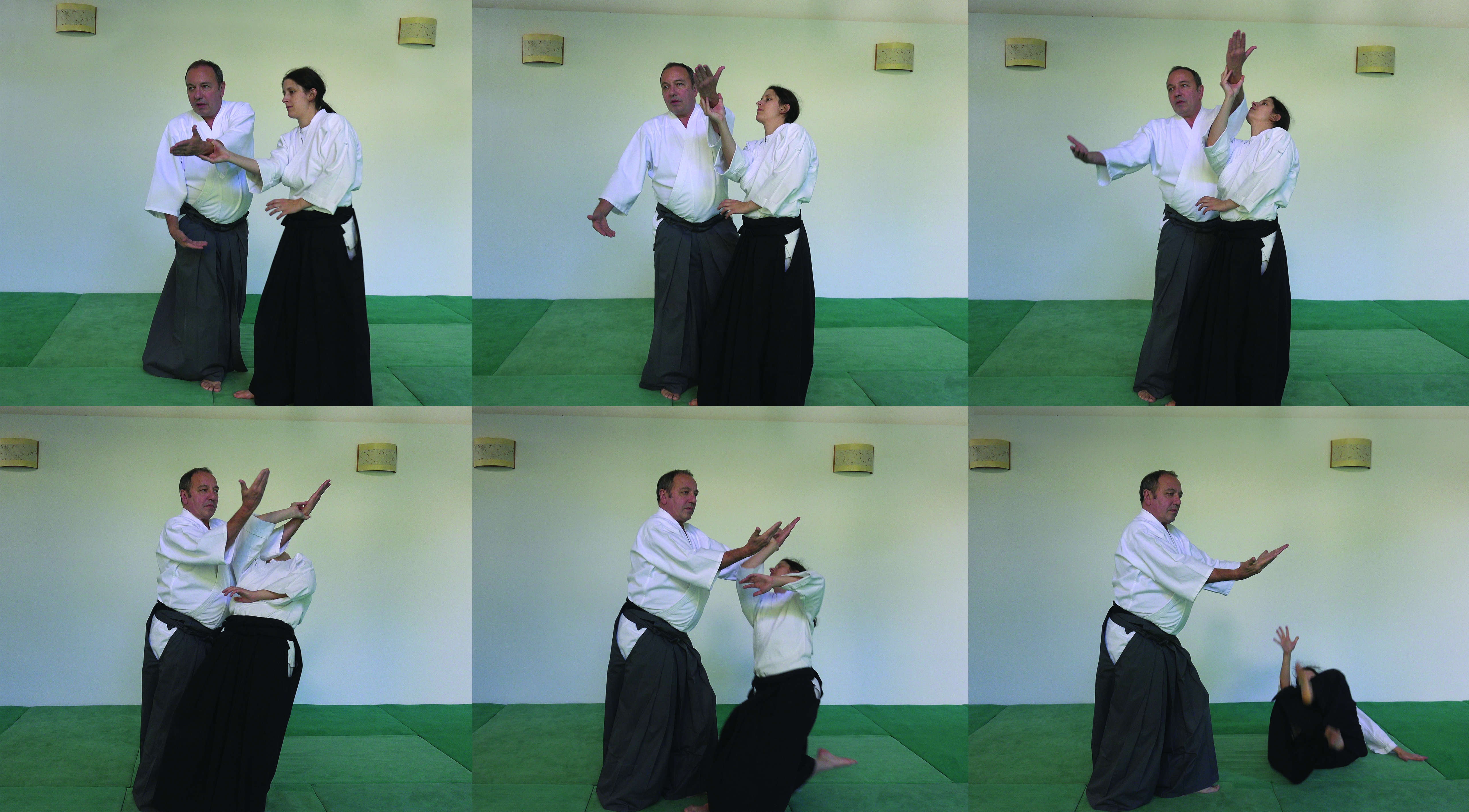


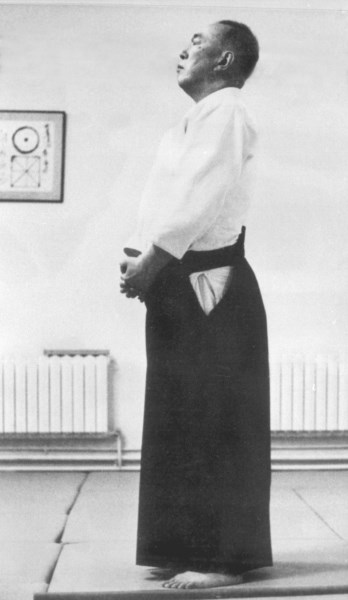


 live in a society where you go to bed very late and you get up very late too. In my case I really love the morning. One can be tired in the evening, people after working hours are stressed. Sessions of martial arts then very easily turned into a relief valve, and so on. Rather in the morning, competitiveness does not have too much importance … you get up, you are in the dojo, you can easily breathe, you start your day. Furthermore we are very lucky to be in a permanent dojo. One comes and it is like being at home, in an association but at home, the dojo are used only for this reason. There are gyms with more or less clean changing rooms where you can not even leave your watch otherwise they might stole it, and so on. So you come here in the morning, take a little coffee, tea, and then practise. And so the day begins and starts well, it is a real pleasure. Every morning I have a great pleasure to see people getting there and taking their time, we are in a world where we do not take our time anymore…


