Category Archives: FR

Seizing, an Art of Detachment

by Régis Soavi

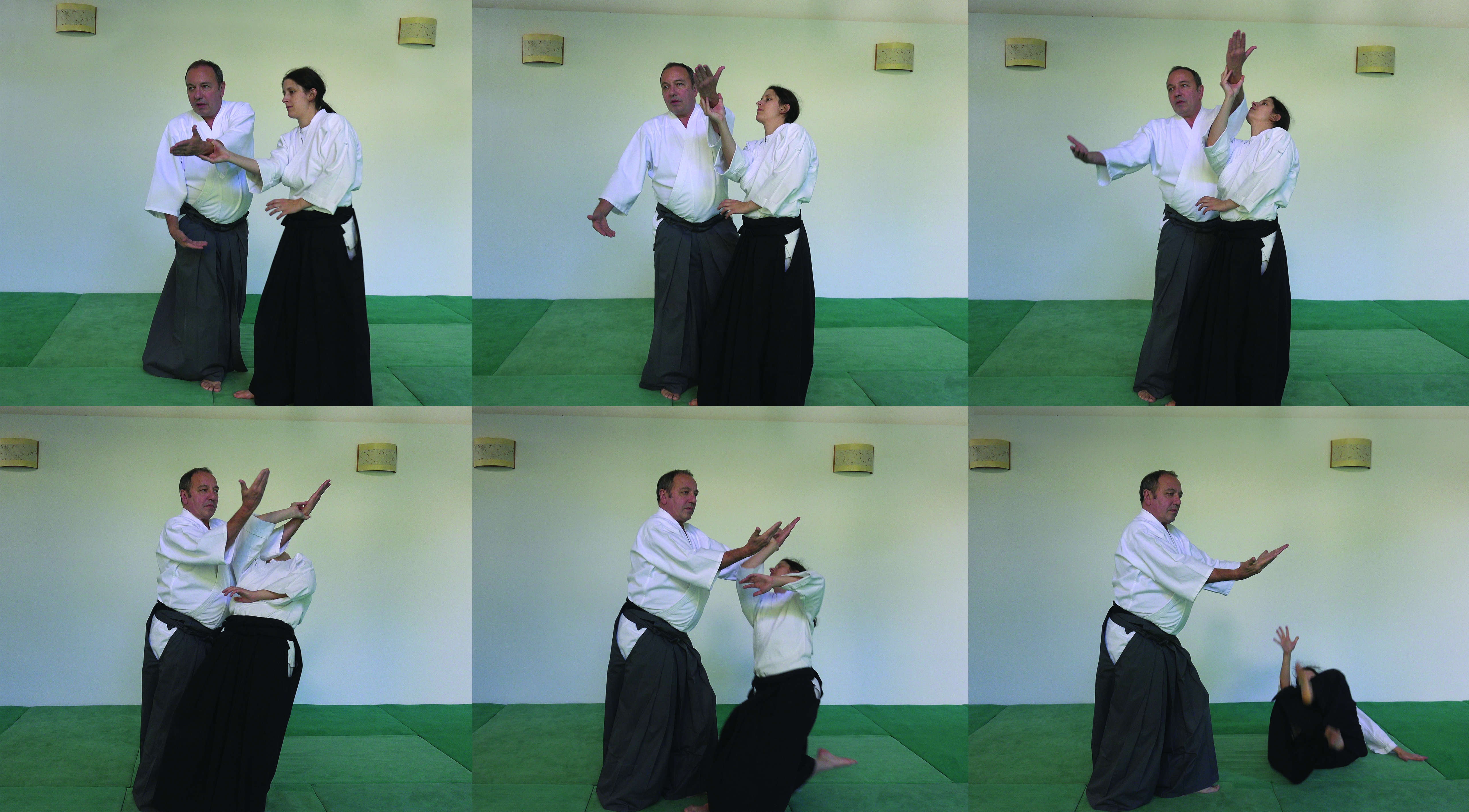
Seizing in itself is not the difficulty, it is the coagulation of ki in the wrist, the arms or around the body that causes a problem and blocks us, and it is through detachment that we can get free of it. The way to achieve this is visualization. Tsuda sensei provides us with an example in his second book The Path of Less:

Aide-mémoire Itsuo Tsuda saisie
Drawing by Master Tsuda showing different types of seizures.

Aikido for me is an art of becoming a child again. […] It takes art to become a child without being childish.[…]] John, for example, tackles me from behind. I want to crouch down to sit, but he prevents me from doing so. He has biceps twice as big as mine and weighs almost 200 pounds (90 kilos). I cannot move, he is holding me so tightly. What should I do? Throw him before I sit down? I try but I cannot do it because he is too heavy and too strong.

So I become a child. I see a wondrous seashell on the beach and bend down to pick it up. I forget John, who is still grasping me from behind. (There is an important technical detail here: I move one foot forward to make two sides of a triangle with the other foot, because it is more concentrated that way.) There is flow of ki, starting with me and moving towards the seashell, whereas before, the ki was frozen at the thought of John. John’s 200 pounds become very light, and he falls forward over my shoulders.How is it that with different ideas, we obtain opposite results, while the situation remains the same?

The idea of throwing provokes resistance. In the child’s gesture, there is the joy of picking up the shell that makes one forget the enemy’s presence.’ (1)

Grabbing, appropriating

There are many ways of seizing and it is the intention put into it that is often determinant. Some of them can be considered as superficial or even unharmful, others more dangerous, like for instance those which carry a mark of appropriation or others which can sometimes be insidious and insistent.

The scenography which allows training in Aikido considers seizing as the result of an act manifesting itself with some kind of aggressivity. This act in itself is already an attempt to appropriate the other person, so as to use him in some way, rob him, destroy him, destroy his person or personality, setting apart the well-founded cases which are not of our concern in this example. What I am talking about is the abuse of a power, whether it be real or unreal, known or desired, over the other, this other person being presumed unable to react when faced to such a display of strength.

Assuming power

In the animal world, the power of an individual or clan in the bosom of a larger group of the same kind matches quite definite criteria, generally in relation to reproduction, preservation or to the defense of a species. As a consequence, it is borne and finally accepted by the whole group; in case of any attempt to contest, genetic or merely ancestral rituals are meant to clarify the situation.

In human societies, particularly in ours which would like itself to be more modern in some respect, the need for assuming power over the other person seems to me more like a dysfunction, or even a disease, which are fully created by the behaviours induced by civilization. Uncertainty about one’s own power, as well as the conditionings exerted by all those already installed in the bosom of society bring about frustration and lead human beings to try to reconquer their power through words or even acts, trying where this power does not lie, where they vill not find it, that is in the other person who anyway does not detain it. But on the other hand, it forces them mentally to take all the risks implied by this vain hope. The arising of such aggressivity is often due to a lack or deficit of one’s own power, whether admitted or not, that one tries to make up. Pressure undergone and felt, hence experienced as such, sometimes since early childhood brings in people the will to reappropriate what they feel intimately robbed of, deprived of, or even what they just lost. It makes them dangerous persons, merely due to their frustration. We can all understand and feel that kind of thing when helplessly faced to an administration, or when put under power by somebody against whom there is apparently no possible opposition. From that point, there is just one step to becoming aggressive, which some people take, while others manage to be reasonable, resign themselves because they have already accepted this state of domination out of habit and they daily undergo it. If a few people are only hardly moved, it is because they have already overcome these difficulties and are not damaged in their own power, never having lost it or having already recovered it.

Prisoner

‘It’s a case of the biter bit’ says the proverb and this reversal of perspective is indeed what happens when seizing. We forget too easily that the one who is seizing becomes prisoner of what he has seized. He canot get rid of it without risking to lose something in the process he has initiated. His freedom, if he has any at all, is now transferred to the one he thought he could detain or retain. He becomes a jailer to the other person, who will only think of getting free, who will put all his strength, intelligence, sometimes all his craftiness or even perfidiousness into it, because he is totally within his right and nobody can blame him for it. Our society generates this type of alienating behaviour in which both persons try to free themselves, one against the other, instead of moving to another dimension which would be more human, intelligent, and respectful of the this other person. Wanting to change these behaviours might seem utopic, yet if Aikido exists and continues to be an art at the service of mankind, it is maybe to assert and demonstrate that, like others have already stated, other relations are possible between people and we aikidokas are not the only ones who wish to continue in this direction.

Respiration, an answer to a specific situation

It is through ventral respiration and the calmness it brings about that one can find the immediate solution to some difficult situations. To prepare for that, it is not absolutely necessary to be an outstanding technician, or someone brave as a blizzard, or a very competent analyst but on the other hand there is need to recover this force which has taken refuge at the very bottom of our body, of our kokoro, or which even sometimes has been scattered in multiple defense systems. Trying to find a defensive solution in violent martial arts when faced with the awareness of our weakness, real or assumed, is just dodging the issue, seeking an alternative, or worse, forging ahead regardless. Aikido, by its philosophy, suggests another direction but if this fails to be heard and above all understood, it may well cause Aikido to lose its justification, its singularity.

Attacks in Aikido are just a way of setting a situation in order to enable practitioners to solve a problem, or even a conflict, which by the way puts them in opposition more with themselves than to with their partners. Seizings, for instance, often represent attempts to immobilize the body, therefore to block the other’s movement, through imprisonment of the wrists, arms, trunk, keikogi or any other part which can be grabbed for this purpose. Sometimes, however, seizings may follow on from an attempt to strike that has failed. They are seldom solely a matter of blocking; considered in the perspective of a fight, they should almost always be followed by an Atemi or a final immobilization. They are only the first act, the first scene of a play which is much longer, if one may say so. It might seem paradoxical but it is through working on seizings that one will discover detachment.

Sensibility, instinct

Quite before seizing or hitting materializes, our sensibility is touched by something invisible even though very physical. This may be inexplicable as scientific knowledge currently stands, but this is something we know well, and even sometimes very well. That is what makes us move, dodge, although we have seen nothing but simply felt it in an indefinable way. In order to give a clearer example, one which everybody has been able to verify in one way or another, in different circumstances, I would like to write about gazing. Gazing carries an energy, an extremely concrete Ki that our instinct can perceive. Have you not ever experienced, while taking a walk one evening or one night, feeling something indescribable behind you as if someone was gazing at you, watching you; you turn around, nobody there, and still the sensation lingers? The sensation, if you are not at peace, can turn into anxiety or perhaps trigger an “irrational-since-there’s-nobody” fear, when at the angle of the street behind a half-opened curtain you suddenly discover somebody observing you – or on an overhanging roof a cat watching you. The gaze of cats, and of animals in general, as well as the gaze of humans when intently observing something or somebody, carries an extremely powerful Ki. Our instinct can feel it, but it all depends on our state of mind at that moment. If we are talking with a friend, if we are lost in our thoughts after a love encounter for instance, our instinct, if not well-prepared, will have difficulty feeling this kind of things. The same obviously applies when we are worried, frightened or anguished, in this case all our being is somehow weakened, it loses its instinctive abilities.

Discovering the direction taken by Ki

Aikido enables us to re-discover and conduct our instinctive abilities. It is thanks to a slow work on ourselves and our sensations that will appear again what we have often let go to sleep, rocked as we were by the comfort due to modern society which may seem so reassuring to us.The work based on seizing corresponds, like everything we do in Aikido, to a process of renewed learning and to a training of the body as a whole so that there will no longer be any separation between body and spirit. First of all, when our partner gets closer, there is no question of waiting kindly for him to seize us as requested, our whole body must feel the directions followed by the different parts of his body: arms, legs, his bearing points, all of this without looking, without observing, because it would already be too late. With unexperienced beginners, if the exercise is done slowly enough, they will be able to discover the routes taken by their partner’s Ki, the force lines. Since they work without any risk, they start again trusting the reactions and sensations of their bodies. During sessions, I do not only show the techniques, I am constantly on the move, serving as Uke to one person, as Tori to another; without blocking them, I make them feel the direction their body must take by putting myself in the situation, making ki more material, by materializing the force lines, visualizing the openings they can use, while allowing them to act and respond as they will.

Discovering the Non-doing

Seizing can be a first step on the path that leads to what Lao Tseu and Chouang Tseu would name Wu wei, the Non-acting, and it was the basis of my master Tsuda Itsuo’s teaching. How to teach what cannot be taught, how to show the invisible, how to guide a beginner or even an experienced practitioner towards what is the essence of the practice in our School? What is difficult to explain with words is easily understood when we let sensation guide us. To do so we have to take a few steps backward. To let go of our acquiring and piling up habits, those consumer reflexes of people always ready to fill up their trolleys with various products, techniques which are more or less modern, fashionable or old style, miraculous, easy and effortless, or even tough but efficient. Advertising is today the source of many illusions, luring its clients with colourful wonders of a world that has become so virtual. When will the new Wii console enable us to practice Aikido with enhanced reality glasses and a partner whose potentiometer can be adjusted depending on our level, our shape, or our mood?

But maybe I am behind and it already exists.

Seizing with Ki

Young children know and naturally use a certain way of seizing which is extremely efficient. It is a seizure devoid of any useless contraction. When they seize a toy they put all their ki into the act and when they let go of this toy they do it with complete indifference, there is no more Ki in it. On the other hand they have an incredible capacity when they do not want to let go of what they have seized and are holding tight in their small hand. If this is something dangerous, their parents must sometimes unfold their fingers one by one, though their hand is so small and devoid of any true muscular strength as adults mean it. They know in a manner completely unconscious how to use Ki, they do not need to learn, unfortunately they often lose this ability for the benefit of what is reasonable and most of the time education and schooling are responsible for this.

To learn again how to seize like a small child, without tension, and thus discover natural prehension. I often give as an example the way birds alight on a branch: they have skin micro-sensors in the middle of their paws which inform receptors which, thanks to these indications, stimulate reflex functions at the level of the involuntary, and give the order to their fingers to close as soon as they touch the branch. This manner of seizing avoids contortions, failures, and enables a very subtle adequacy of the members to the place caught (they catch). A quality seizure is a seizure which uses the palm of the hand as first contact, then the fingers close up on the object, the limb, the Keikogi. If we act in this way, seizing is faster, without any excessive tensions, and it has remarkable efficiency, allowing therefore a good quality work with a partner.

The only seizures which respect the other one’s freedom are light but powerful, like for instance that of a small child who wants to take along one of his parents to look at a small frog he’s just seen in the tall grass and is curious about, or like that of two beings, friends or lovers, bound by tenderness and respectful of each other.

Régis Soavi

Would you like to hear about the next article?

Subscribe to our newsletter

Article by Régis Soavi published in April 2019 in Self & Dragon Spécial Aikido n° 24.

(1) Tsuda Itsuo, The Path of Less, p. 175, Yume Editions, Paris, 2015 (trans. from La Voie du dépouillement, Le Courrier du Livre, 1975)

Misogi

Starting with a theme taken from I Ching hexagram K’an (the Abysmal), Régis Soavi writes in this article about Aikido as a Misogi pratice.


Misogi 禊 is widely practised among shintoists. It consists of an ablution, sometimes under a waterfall, in a stream, or in the sea and allows a purification of the body at both physical and psychical levels. In a broader sense, Misogi encompasses a whole process of spiritual awakening. Misogi is also a way to relieve the being of what overwhelms him, so to allow him to wake up to life. Water has always been considered one of its essential elements.

Like water, Aikido is a way to achieve Misogi

Founder of Aikido O Sensei Morihei Ueshiba kept on telling his students that the practice of this Art is above all a Misogi.

Aikido is one of the Japanese martial arts for which the main character, the very nature, is, like water, fluidity. The teaching brought by Itsuo Tsuda Sensei who was during ten years a direct student of the Founder Morihei Ueshiba has definitely confirmed it. Although his words seem to have largely been forgotten, he kept on repeating that in Aikido there is no fighting, it’s just the art of uniting and separating1Itsuo Tsuda, The Path of Less,  2014, Chap. XIX, Yume Editions, p. 182 (1st ed. in French, 1976, p. 174–5). However, when you watch an Aikido session, it seems that two people are fighting each other. In fact one of them plays the role of the assaillant, but in real he is a partner, facing him there is no aggressiveness, you won’t see any malicious gesture, no violence, even if the response to the attack may be impressive because of its efficiency.

Overall, the Aikido practised in the Itsuo Tsuda School is an Art of great fluidity, an art in which sensitivity and caring for the partner have the main part, and it is always through the smoothness of a first part practised individually that an Aikido session begins.Far from starting with warm-up exercices, an Aikido session begins with smooth, slow but still invigorating exercises. Breathing coordination is essential, as it allows us to harmonize with Ki, and thereby to take a step forward to discover a world with an additional dimension, the “World of Ki”.

This world is not a revelation, it is more what comes to light, what appears clearly when one recovers one’s sensitivity, when rigidity vanishes into thin air and that the living appears through. It is often women who first understand the importance of such a way of practising. That is why so many women practise in our school because they have experienced the bitter taste of sexist oppression in our society and they find in this art a way, a path, far beyond the simple martial art.

Ki, a driving force

Ai, 合 Union, Harmony
Ki, 気 Vital energy, Life

Do, 道 Path, Way, Tao

Ki is not a concept, a mystical energy nor a sort of mental illusion. We can feel Ki. In fact everybody knows what it is, even if, in Western countries nowadays, we do not give it a name. Learning to feel it, to recognize it, to make the most of it, is necessary for who wants to practise a martial art, and even more if you practise Aikido. In Aikido, if you don’t focus on Ki, only the empty form of its contents remains, this form becomes quickly a fight, a struggle in which the strongest, or the most cunning will manage to defeat his partner. We are really far away from the founder’s teaching for whom it was an art of peace, an art in which there is neither winner, nor defeated. Each movement of the partner is accompanied by a complementary movement from the other partner, like the water that marries each roughness, every nook, leaving nothing behind or separate.

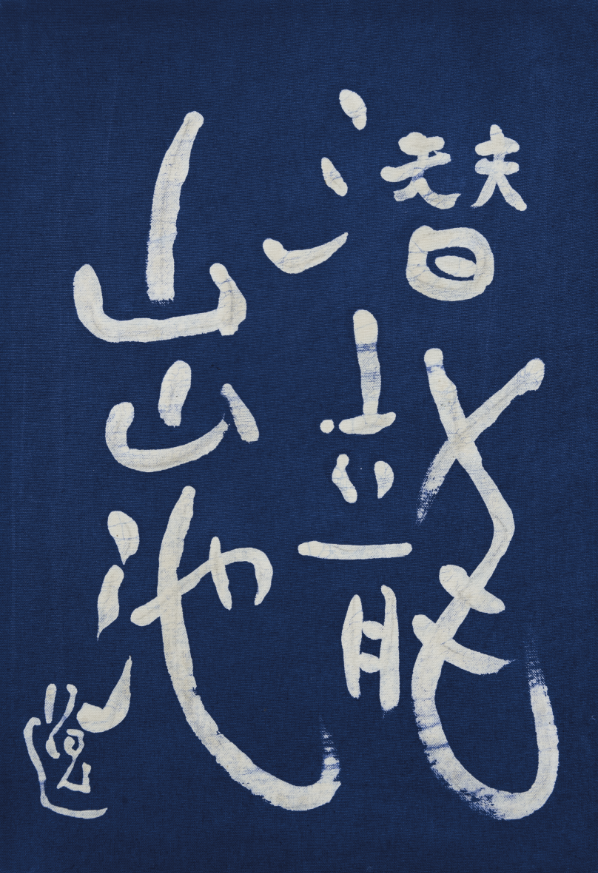
misogi
Calligraphy by Itsuo Tsuda

If the beginnings are usually tough, it’s because people have lost part of their mobility and mostly because they have become hard so to be protected from the world around. They have built a carapace, an armour, certainly protective, but which has become a second nature and an invisible prison. To have Ki flow in our body again, so to recover fluidity, and follow a teaching based on sensitivity enables us to understand physically the Yin and the Yang.

Bathing in a sea of Ki

Exercices and basic or advanced techniques have not only in common the breath which is nothing but the materialization or even better the visualisation of Ki, but they also allow to become aware of our body, physically and of our sphere of ki, which the Indians call the AURA, and that we have today practically forgotten almost everywhere.What modern science and in particular neuroscience has been discovering for a few years is only a small part of what everyone can discover on his own and put into practice in his daily life simply through the practice of Aikido as Itsuo Tsuda Sensei taught it.He would repeat over and over again that Aïkido as presented by his Master Morihei Ueshiba is the union of Ka the inspiration, the ascending force, the square, the weft and Mi, the exhalation, the downward force, the cercle, the chain.Ka being in Japanese a prononciation for 火 fire (which appears for example as a radical in the word Kasai 火災, wild fire) and Mi the first syllable of Mizu 水 water, the whole forming the word KAMI 神 which means divine in the sense of the divine nature of all things. Itsuo Tsuda would add that ‘in this gloss one mustn’t see a similar value to that of a scientific etymology. It comes from punning, the use of which is common among mystics’. 2Itsuo Tsuda, The Science of the Particular, 2015, Chap. XVIII, Yume Editions, p. 153 (1st ed. in French, 1976, p. 137)

I have never seen such fluid movements as when he wanted us to feel a technique he showed to us. Moreover, in his dojo there used to be no accidents, nobody injured, everything would be in a flow of Ki both respectful and generous but at the same time firm and rigorous, that I can hardly find today in the sports halls where aikidokas have their trainings.

The dojo, an essential place

Do we really need a special place to practise Aikido? If we talk about the surface we need for falls, we could lay tatamis anywhere, from the moment we are sheltered from bad weather.

In his book Heart of Pure Sky, Itsuo Tsuda gives us his extremely clear view of what should be a dojo, he who was Japanese was in the best position to give us a glimpse:

‘Concretely, L’École de la Respiration is a “Dojo”, a particular kind of space in the East, which refers less to the material place itself than to the energetic space.’3Itsuo Tsuda, Heart of Pure Sky (posth.), ‘Interviews on France Culture radio’, ‘Broadcast no. 1’, 2025, Yume Editions, p. 13 (1st ed. in French, 2014)

misogi eau
Régis Soavi
‘As I have already said, the dojo is not simply a space carved out and reserved for certain exercises. It is a place where the space-time is different from that of a secular place. The atmosphere there is particularly intense. We enter it by bowing to sanctify ourselves and we go out by bowing to desacralise ourselves.
Spectators are admitted, provided they respect the atmosphere[…]. They must not gratuitously parody the practice with words and gestures.

I am told that in France [or in Italy], we come upon dojos that are simply gymnasiums or sports clubs. So be it. As for me, I want my dojo to be a dojo, and not a club with a boss and his regulars, so as not to disturb the sincerity of the practitioners. This does not mean that they should wear a scowling constipated expression. On the contrary, we must maintain a spirit of peace, communion and joy.’4ibid., ‘Early Writings’, ‘Booklet n°3 – Respiratory Practice in Aikido’, p. 102

A sacred space therefore and yet fundamentally non religious, a secular space, a space of great simplicity where the freedom to be as we are exists, beyond the social. And not what we have become with all the compromises we had to accept in order to survive in society. This freedom remains inside us, deep within us in our intimate heart, our Kokoro 心 as Japanese language talks so well about it, and is only asking for a chance to be revealed.

Régis Soavi

Would you like to hear about the next article?

Subscribe to our newsletter

Notes

Taiheki, The Revelator

By Régis Soavi.

Noro Sensei, in the 70’s, used to tell us that O-Sensei Ueshiba Morihei would sometimes reproach his learners for their lack of attention when they phoned from a phone booth, concentrated as they were on their conversation: “You must be ready under any circumstances, whatever you do!” he would say.

Aikido opts for a natural position, with no guard stance, which is called Shizen Tai. But a natural posture is not a laid-back posture as we understand it today, concentration and attention mustn’t be eased in any case. Given that the most widespread guard stance in Aikido remains Hanmi no Kamae, it depends more than we believe, on the polarization of energy in the body, as do all the other guards.

Kamae, the body’s instinct

I remember what Maroteaux Sensei had told us during one of my first Aikido sessions at the “Montagne Sainte-Geneviève” dojo: ‘You open the door, a dog jumps at your throat, what do you do?’ Obviously I remained speechless, but this question he had asked us had shattered me – I was a young practitioner of martial arts quite sure of himself at the time – and this became the root of my research on Kamae.

Assuming a guard stance is the response to an act of aggression or to the sensation of danger. This response, coming from someone who does not know martial arts, will be instinctive whereas it will be the result of training coming from a practitioner. Personal research can lead the practitioner to use his body in a manner different from what he had learned and for this he will find a positioning or a guard that suits him, sometimes a more appropriate one, sometimes one meant as a trap suggesting an opening or a weakness on his part. Even if there are many ways to assume a guard stance, hence to protect ourselves, we must take our own body into account, in spite of all we have learned, despite the many years of training, ultimately instinct will be our guide. The work in martial arts, far from being pointless, will rather be in this case a backing, a support. Training may sometimes induce over-confidence, a belief in techniques, postures which, though beautiful on pictures or on the tatamis, do not correspond to any reality in daily life.

Finding the right posture depends on each person’s body. Far too many practitioners try by working very hard to model their body in order to bring it into line with the idea they have of their art, or more simply with the efficiency they hope to gain. We consider the aesthetics of the art but then we miss its depth. We can see the work which has been done but we are not aware of the deformations acquired because of it. So many students repeat an incredible number of times the same exercise, the same technique thus hoping to reach the mastery of their art by imitating the master or simply the teacher, while they are instead following the path of deformation without realizing. One shall not be surprised by the number of accidents or disabilities resulting from this. How many people are unable to practice anymore because of a knee, an elbow, a wrist or their back, though they are still young and full of energy?

Noguchi haruchika. Taiheki
Noguchi Haruchika Sensei 1911-1976, founder of Seitai

The Kamae depend on the Taiheki

Seitai brought us a remarkable tool, the study of corporal tendencies which Noguchi Haruchika Sensei called Taiheki. Tsuda Sensei gave a first description of them, which though brief was already a revelation when his first book The Non-Doing was published in the early seventies. Later he supplemented this teaching in the books which followed over the years, continually giving examples which enabled one to understand Taiheki better. Reading Noguchi Sensei’s texts also enabled us to deepen our knowledge of human behaviours and particularly of their relationship with the body. Comprehending the bodily movements of individuals enables to help beginners improve their posture, so they do not deform themselves. Since explaining this teaching to uninformed readers would require a whole book, all I can do is give a few indications, without going into details.

The Taiheki classification developed by Noguchi Sensei is based on human involuntary motion. It is not a typology meant to make people fit into small boxes, but rather to identify the habitual behavioural tendencies, at the same time taking into account the interpenetrations that may occur between them.

This classification includes six groups: each of the first five is related to a lumbar vertebra, the last group being more related to a global state of the body rather than to the spinal column. According to either the Yang or the Yin aspect, each group is divided into two subgroups or types, called “active” or “passive”. In order to fully understand the interest of such a study, I have chosen a few examples which seem to me more telling than other in the light of the Taiheki.

La posture taiheki
Régis Soavi. Finding the right posture depends on each person’s body.

Taiheki, the revelator

According to the classification, the first group is also called the “vertical category” and it is related to the first lumbar vertebra. The energy tends to polarize to the brain.
Type 1, for instance, is extremely confident with respect to Kamae, his position is unchangeable and he is able to explain it to everybody, in a very logical way. Even with little experience he at once has an idea on the topic and sticks to it. Since his heels tend to get off the ground because of the tension he has in the cervical vertebrae, he will for example develop a theory according to which this position allows you to jump faster and further in case of attack and will refute any contradiction, until another idea emerges which will seem to him more brilliant and relevant.

Type 2 knows everything on the Kamae in almost all martial arts, the historical origins, the value of each one and its major flaws, the contribution of each master. He even knows little stories illustrating what he says, he is a mine of knowledge who does not hesitate to complete it as soon as he feels a lack somewhere in his argumentation or his references.

The second group is called the “lateral category” and it is related to the second lumbar vertebra. The energy tends to polarize to the digestive system.
Type 3 is a bon vivant, when he practices martial arts he chooses his club according to the ambiance rather than to the efficiency of the art he is being taught, or to the reputation of the master. All these stories about postures, guard stances, are of little interest to him, as usual he has his own little opinion about this topic, and he likes or dislikes, which means it is convenient to him or not.

Type 4, on the other hand is always restrained in his manner, it is hard to know what he thinks. An affable person, he seldom gives his opinion, even if a debate initiates about the value of different Kamae, he does not have any real opinion, everything seems possible to him depending on the circumstances. He is rather a diplomatic, moderate kind of person.

The third category is called the “pulmonary category”or “forwards/backwards category” and it is related to the fifth lumbar vertebra. The energy tends to polarize to the respiratory system.
Type 5 does not like to argue about nothing, a stance must have a practical meaning, either it is efficient, or it is not. We must check, and if it works, move ahead… Dodging is not his strong point, he prefers Omote techniques to Ura techniques. Because the bearing point of his posture tends to be the fifth lumbar vertebra, his shoulders lean forward and this incites him to act. He is easily combative but knows how to leave himself a way out if necessary.

Type 6 has too much tension in the shoulders to be able to act in a simple way. When this tension relaxes, it releases a huge amount of energy that goes off in all directions and that even he himself can’t handle. In front of him, no guard stance is possible, he is completely out of control and unpredictable at the risk of putting himself in danger.

The fourth category is called the “twisted category” and it is related to the third lumbar vertebrae. The energy tends to polarize to the urinary system.

Some Taiheki may a priori seem to be a help in assuming a good guard stance, as it is the case with the “twisted category” (type 7 or 8), because in order to defend themselves they instinctively adopt a kind of posture, rather a profile position, with arched lumbar vertebrae, one foot forward etc. The posture may look ideal, to strike a pose or on a picture. But apart from the precision of the position and the bearing points, the ability to move depends obviously and maybe mainly on the state of mind. There is a huge difference, which will completely change the deal, between a type 7 twist and a type 8 one. To put it in a simple way, I would say that the type 7 wants to win whereas the type 8 does not want to lose. The whole posture changes, one gets ready to pounce, the other to try dodging. Furthermore, the people of the twisted category have a permanent agitation which in this case turns out harmful. They are so restless all they are waiting for is to take action. Waiting is unbearable to them; unable to take it any longer, all of a sudden they get started, never mind if it is not the right moment.

The fifth group is called “pelvian” or “pelvis” group and it is related to the fourth lumbar vertebra. Its energy is not polarized towards a definite part of the body, it is the body as a whole which stretches and releases from the hips with one blow.
Type 9 is an example of continuity, when he practices martial arts, he tends to make it his unique reason of living, the trend of his pelvis to close gives to his koshi a lot of strength that makes his learning easier but he has got a predisposition to perfecting that may sometimes go to the point of absurdity. He cares about details and will perfect kamae to the slightest element, as long as his posture is not perfect according to his views he will not be satisfied, but this dissatisfaction, far from discouraging him, is precisely what pushes him forward. Nothing can be opposed to him, his only reference is inner satisfaction. Like O-sensei Ueshiba Morihei as well as other great masters, he may come to the conclusion that the natural position is the ideal kamae because it transcends all the others. But this natural position is the fruit of his many years of work and training, not a theoretical facility nor a slackening on his part.

As for type 10, he considers that a good guard stance is indispensable, that it is a guarantee of stability and that if we respected others, there would be no conflict. His open pelvis generally makes him someone very friendly, he has a great sensitivity and his intuition is fearsome. His open posture prevents him from being aggressive, he will tend to perform Ura techniques at which he is better and his guard will be more in the direction of absorbing the attack rather than repelling it.

Concentration and attention must not be relaxed under any circumstances.
The two last types that form the last group are, actually, states of the body called hypersensitive and apathetic.
Type 11 fails to have a precise and defined guard stand, because of his hypersensitivity, he is an unsettled person, unable to find benchmarks. His guard stand is imprecise, even confused or messy and almost every time totally ineffective. Fear tends to liquefy his legs. In his case, Aikido can be an excellent activity, provided the teacher understands his difficulties well and does not rush him, so as to to lead him to a normal sensitivity.
On the contrary, type 12 is an example of rigidity, his guard stance is very physical and often lacks flexibility, he is able to take any blow without flinching. His body may sometimes have a certain muscle laxity in the joints but this does not make him less rigid.

It is according to Taiheki that one can understand the uselessness of a given posture, hence of a given kamae. Support points being different from an individual to another, the potential for mobility or simply for movement is basically different too. So it is no use proposing an exercise, which even if it makes the apparent posture better, destroys the person in the very bases, or at least might cause physical as well as mental deformations.

Kamae and rigidification

Tsuda Sensei considered that rigidification and slackening of individuals are a part of the great flaws induced by our modern societies, but he did know that these problems existed long before, that they are inherent in human society. In his book The Path of the Gods he tells an anecdote about kamae which I found once more very evocative. It is significant of the risks to which imagination may expose people, even those whose profession it was, like the samourai.

‘Involuntary contraction gets stronger as imagination is filled with fear. Fear doesn’t remain in the head. It paralyses the whole body. The wrists especially lose flexibility and the arms become insensitive. That’s what happened to two samourais fighting a duel in a story I read somewhere. They were holding their sabre with both hands and were facing each other several meters apart. At this distance, they were still safe whatever they did but their faces were already pale. They were probably soaked in cold sweat. They stayed there at the same distance for some time. Finally they got closer, one of them was lying on the ground and the other was standing. The fight was over. But the winner was staying there, unable to let go of his sabre because his fingers were clenched on the handle. The contraction was such that it was difficult for him to loosen them ’.

If we want to avoid rigidification that can be caused by guard stands which don’t agree with us or imply constraints that deform us, only commonsense and personal search for balance can allow that to us. There is no definitive solution for all problems and forever.

Régis Soavi

Would you like to hear about the next article?

Subscribe to our newsletter

Article by Régis Soavi published in January 2019 in Dragon Magazine Spécial Aikido n° 23.

Notes:
  1. Tsuda Itsuo, The Non-Doing, Yume Editions, Paris, 2014 (trans. from Le Non-faire, Le Courrier du Livre, 1973)
  2. Tsuda Itsuo, La Voie des dieux, Le Courrier du Livre, 1982, p. 60

Photos credits: Régis Sirvent, Sara Rossetti

Seitai

The Seitai principles, which could even be described as “Seitai philosophy” – a way of seeing and thinking about the world – were developed by Haruchika Noguchi (1911-1976) in the first half of the twentieth century. In brief (!), Seitai is a “method” or a “philosophy” that includes Seitai sōhō, Taisōs, Katsugen undō, Katsugen sōhō, and Yukihō. These are practices that complement, permeate each other, and form the breadth of Haruchika Noguchi’s Seitai thinking. We can also mention the study of Taihekis (postural tendencies), the use of the hot bath, the education of the subconscious, the importance of birth, illness and death…

An art of living from beginning to end.

Today, unfortunately, the term “Seitai” is overused and means anything and everything. Some manual therapy practitioners too easily lay claim to Seitai (Itsuo Tsuda would say it takes twenty years to train a Seitai sōhō technician!). As for the charlatans who offer to transform you in a few sessions…, let’s not talk about it! The magnitude of the art of living, the global understanding of the human being in Seitai seem far away. If all there is left is a technique to be applied to patients, the essence is lost. If all there is left of Katsugen undō is a moment to “recharge your batteries”, the essence is lost.

Haruchika Noguchi and Itsuo Tsuda both went much further than that in their understanding of the human being. And the seeds they sowed, the clues they left for humans to evolve are important. Can we then speak of a way, of Seitai-dō (道 dō/tao)? Because that is a radical change of perspective, an upheaval, a totally different horizon opening up.

Let us go back in history…

The meeting with Haruchika Noguchi: the individual as a whole

Itsuo Tsuda met Haruchika Noguchi around 1950. The approach to the human being as proposed in Seitai interested him from the very beginning. The sharp observation of individuals taken in their indivisible entirety/complexity, which Itsuo Tsuda found in Noguchi, was an extension of what had already captured his interest during his studies in France with Marcel Mauss (anthropologist) and Marcel Granet (sinologist). Itsuo Tsuda then began to follow Noguchi’s teaching and continued for more than twenty years. He had the sixth dan of Seitai.

‘Master Noguchi enabled me to see things in a very concrete way. Through the things manifested by each individual, it is possible to see what is going on inside. It is completely different from the analytical approach, in which the head, the heart, the digestive organs each have their own specialization; and there’s the body on one hand and the psyche on the other, isn’t that so? Well, he made it possible to see the human being, that is, the concrete individual, in its totality.’ 1Itsuo Tsuda, Interviews on France Culture radio, “Master Tsuda explains the Regenerating Movement”, Broadcast N° 3, early 1980s (Heart of Pure Sky, 2025, Yume Editions (Paris), p. 23 (1st ed. in French, 2014, p. 24))

Illness as a balance factor

All the more as it was precisely in the 1950s that Haruchika Noguchi, who had very early discovered his capacity as a healer, decided to give up therapeutics. He then created the concept of Seitai, i. e. “normalized terrain”.

‘the word “terrain” referring to the whole that makes up the individual, the psychic and the physical, whereas in the West we always divide things into psychic and then physical.’2Itsuo Tsuda, ibid., Broadcast N° 4, p. 28 (1st ed. p. 29)

The change of perspective with regard to illness was crucial in this reorientation of Noguchi.

‘Illness is natural, the body’s effort to recover lost balance. […]
[…]
It is good that illness exists, but people must avoid becoming enslaved to it. This is how Noguchi happened to conceive of the notion of Seitai, the normalisation of the terrain, if you will. Diseases are not to be treated; it is useless to cure them.

If the terrain is normalised, illness disappears of its own accord. And moreover, one becomes more vigorous than before. Farewell to therapeutics. The fight against illness is over.’3Itsuo Tsuda, The Dialogue of Silence, Chap. IX, 2018, Yume Editions (Paris), p. 75–76 (1st ed. in French, 1979)

Itsuo Tsuda. Photo de Eva Rodgold©
Yuki. Itsuo Tsuda. Photo by Eva Rodgold©

A path towards autonomy

Abandoning therapy also goes hand in hand with the desire to get out of the dependence relation that binds the patient to the therapist. Noguchi wanted to allow individuals to become aware of their ignored capacities, he wished to awaken them to the fulfilment of their own being. During the twenty years they followed each other, the two men spent long moments talking about philosophy, art, etc., and Noguchi found in Tsuda‘s vast intellectual culture the substance to nourish and expand his observations and personal reflections. Thus a relation which was enriching for both developed between them.

Itsuo Tsuda was the editor of the magazine Zensei, published by the Seitai Institute, and he actively participated in the studies led by Noguchi on Taihekis (postural tendencies). A text by Haruchika Noguchi published in the magazine Zensei of January 1978 reveals that it was Itsuo Tsuda who advanced the hypothesis – validated by Noguchi – that type nine (closed basin) would be the archetype of the primitive being.4About Taihekis, consult Itsuo Tsuda, The Non-Doing, 2014, Yume Editions (Paris) (1st ed. in French, 1973)

The development of Katsugen undō (Regenerating Movement) by Noguchi particularly interested Itsuo Tsuda, who immediately understood the importance of this tool, especially as regards to the possibility it gives to individuals to regain their autonomy, without needing to depend any more on any specialist. While recognizing and admiring the precision and the deep capacity of the Seitai technique, Tsuda considered that the spreading of Katsugen undō was more important than the teaching of the technique. He therefore initiated groups of Regenerating Movement (Katsugen Kai) in a great many places in Japan.

Conférence d'Itsuo Tsuda. Photo d'Eva Rodgold©
Itsuo Tsuda giving a talk. Photo by Eva Rodgold©

Itsuo Tsuda favoured the spread of Katsugen undō in Europe as a gateway to Seitai.

Today, even in Japan, Seitai sōhō has taken an orientation that brings it closer to therapy. One problem: one technique to apply. Katsugen undō becomes a kind of “light” gymnastics for well-being and relaxation. This is far from the awakening of the living, of the autonomous capacity of the body to react that Haruchika Noguchi‘s Seitai is meant to be.

The yuki exercise, which is the alpha and omega of Seitai, is practised at every Katsugen undō session. Thus, although Tsuda did not teach the technique of Seitai sōhō, he transmitted its essence, the simplest act, this “non-technique” that yuki is. The one that serves us every day, the one that gradually sensitizes the hands, the body. This physical sensation, that is real, that can be experienced by all, is today too often considered a special technique, reserved for an elite. We forget that it is a human and instinctive act. The practice of mutual Katsugen undō (with a partner) is also getting lost, even in the groups that followed Tsuda‘s teaching. What a pity! Because through yuki and mutual Katsugen undō, the body rediscovers sensations, those that do not go through mental analysis. This dialogue in silence, which makes us discover the other from the inside and which therefore brings us back to ourselves, to our inner being. Yuki and Katsugen undō are for us essential tools, recommended by Haruchika Noguchi, on the path towards “normal terrain”.

But time goes by and things get distorted, like words of wisdom of some people become religious oppressions… Little by little Katsugen undō is nothing more than a moment to “recharge”, relax and above all not change anything in one’s life, in one’s stability. Seitai, a method to lose weight after childbirth… While it is a life orientation, a global thinking. The huge step Haruchika Noguchi took in moving away from the idea of therapeutics is a major advance in the history of mankind. His global understanding of the individual, the sensitivity to ki, sufficiently recovering sensitivity and a center in oneself from where to listen to one’s own body and act freely.

It is not even about opposing methods, theories or civilizations. It is purely and simply about the evolution of humanity.

Manon Soavi

Subscribe to our newsletter

See also:

  1. practising Katsugen undō
  2. biography of Itsuo Tsuda
  3. biography of Haruchika Noguchi

Notes

Ukemi: the Flow of Ki

by Régis Soavi

The fall in our art – Ukemi – is more than a liberation, mere consequence of an action. It is the Yin or Yang of a whole, the Tao. In practice, at the end of the technique, Tori emanates a yang energy: if he wants to avoid injuring his partner, Tori lets him absorb this yang energy and transfer it to the fall.

Breathing during the fall

Aikido is an art where there is no loser, an art dedicated to human beings, to the intuition of humans, to their adaptability, and going beyond the contradiction brought by a technique by means of the fall is nothing else than adaptability to it.

Not to teach a beginner how to fall would amount to putting him in a situation of handicap from the start and risking discouragement, or to shaping a spirit of resentment, or even of revenge.

There are different attitudes among beginners, those who hurl themselves at the risk of getting hurt, and those who, because of fear, contract when about to fall and who of course take a bad fall and suffer painful consequences if you force them. My answer to this problem is softness and time…

When surprised by a noise, an act, the first reaction is to breathe in and block the breath, this is a reflex and vital functioning that prepares the answer and therefore the action. Surprise starts a series of biomechanical processes which are totally involuntary, it is already too late for reasoning. It is by breathing out that the solution to the problem will come. If there is no risk after all, or if the reaction is exaggerated and the risk minor, one drops the blocking and the breath is released in a natural way (ha, the usual sigh of relief). If there is danger, whether great or small, we are ready for action, ready to act thanks to the breath, thanks to breathing out. Problems occur when, for instance, we do not know what to do, when the solution does not arise immediately, we remain blocked in inspiration, with our lungs full of air, unable to move. It is a disaster! It is approximately the same pattern that occurs when we are a beginner, our partner is performing a technique and the logical answer that will enable us to get free, and thus to fix up this contentious problem is the Ukemi. But if one is afraid to fall, if one has not had the technical training of many forward and backward rollings done in a slow, nice and easy way, one remains with lungs blown up like a soccer ball, and if the technique is completed, one ends up on the floor, with more or less damage done.

Bouncing painfully on the tatamis like the aforesaid ball would then be the least harm. Learning to let go as soon as absolutely necessary, not falling before by caution, as this impairs Tori’s sensation and gives him a false idea of the value of his technique and often of himself. Grasping the right moment to breathe out and land softly on the tatamis without any air left in the lungs. Then as for the clapped falls, which one does when more advanced, it will be enough to breathe out faster and let oneself go so that the body finds the right receiving position by itself.

Training the old way!

My own training through Judo in the early sixties, in Parisian suburbs, was very different. To us school youngsters, Judo was a way to expend our energy and canalize what otherwise ended badly, that is turned into struggles and other kinds of street fights. The training, twice a week, required two essential things: absolute respect to our teacher and learning how to fall. It was still a time when our teacher transmitted the « Japanese » Judo without weight categories. In spite of Anton Geesink’s recent victory at the Olympic Games, he would define himself as a traditionalist. Falls were one of the lessons foundations: rolling forward, backward, sideways, we used to spend about twenty minutes practising that before performing the techniques, and sometimes, when he would not find us focused enough, too much scattered, he would say: ‘Turn your kimonos inside out so you won’t dirty them’ and we would go out for a series of forward falls, in the small paved blind alley in front of the dojo. Afterwards, we were not afraid to fall anymore, well, that is, those who still wanted to continue!

The world has changed, society has evolved, would nowadays parents agree to trust such a “barbarian” with their progeny, besides there are rules, protective laws, insurances.

Bob – that was his name – felt a responsibility for our training, and teaching us how to fall whatever the circumstances and on any sort of ground was part of his values and his duty was to retransmit them to us.

Bodies have changed, through food, lack of exercise, over-intellectualisation; how can we pass on the message that learning physically how to fall is a necessity, provided that the results of it will be ascertained only several years later. What benefit is to be expected of it, what profitability, nowadays everything is accounted for, there is no time to lose.

It is the philosophy of Aikido which attracts new practitioners, so that’s where our chance lies to pass on the message of this necessity.

Dualism

Aikido, by nature and above all because of the orientation O-sensei Ueshiba Morihei gave to it, carries a vision of the fall completely different from that of Boxing or Judo for instance, where falling is losing. To an external viewer, and that is what falsely gives a certain character to our art, it seems that Tori is the winner when Uke falls on the tatamis. It is psychologically difficult to admit that this is not at all so. Society gives us but rarely any examples of behaviour other than this Manichean dualism ‘Either you win or you lose’. And it is logical, at first sight, not to understand and to see only that. In order to understand the matter differently, one must practice, and practice with another conception in mind, which can only be given by the teacher. Tsuda Itsuo sensei provides an example of this pedagogy in his book The Path of Less:

‘In Aikido, when there is a flow of Ki from A, who is performing the technique, towards object B, opponent C, who is grasping A by the wrist, is thrown in the same direction. C is pulled in and joins the main current that goes from A to B.
I have often used this psychological mise-en-scene, for example, with the phrase “I’m already there”. When the opponent grabs your wrists and blocks your movement, as in the exercise of sitting Kokyu, one is inclined to think that this is a pushing exercise. If you push the opponent, it immediately produces resistance in that person. Push against push, they struggle. It becomes a sort of sitting sumo.
In the phrase “I’m already there”, there is no struggle. One simply moves, pivots on one knee to make an about turn, the opponent is driven by the flow of Ki and flipped into his side. It takes very little for this exercise to become a struggle. As soon as the idea of winner and loser gets mixed up in it, exaggerated efforts are made to obtain a result, all to the detriment of overall harmony. One pushes, the other resists, bending excessively low and squeezing the wrists to prevent being pushed. Such a practice will not benefit either one. The idea is too mechanical.

[…] The idea of throwing provokes resistance. […] Nonetheless, to forget the opponent while knowing he’s there is not easy. The more we try to forget, the more we think about it. It’s the joy in the flow of Ki that makes me forget everything.’ (1)

Imbalance serving the purpose of balance

Balance is definitely not rigidity, that is why falling as the consequence of a technique may perfectly enable us to rebalance ourselves. It is necessary to learn how to fall correctly, not only in order to enable Tori to be free of any fear for his partner, because Tori knows him and anticipates that his capacities will enable him to come out of this situation as well as a cat does in difficult conditions. But also and simply because thanks to the fall, we get rid of fears our own parents or grandparents have sometimes instilled in us with their “precautionism” of the kind ‘Be careful, you’ll fall down.’ invariably followed by ‘You’ll hurt yourself’. This Pavlovian impregnation has often led us to rigidity and in any case to a certain apprehension as regards falling, dropping down.

The French word chuter (to fall) has obviously a negative connotation, while in Japanese the most commonly accepted translation of the term Ukemi is receiving with the body, and we understand here that there is a world of difference. Once more the language shows us that the concepts, the reactions, differ profoundly, and it underlines the importance of the message we have to convey to people beginning Aikido. Without being especially a linguist, nor even a translator of Japanese, the understanding of our art also involves the study of Eastern civilisations, their philosophies, their artistic tastes, their codes. In my opinion, extracting Aikido from its context is not possible, despite its value of universality, we have to go and look in the direction of its roots, and therefore in that of the ancient texts.

One of the basis of Aikido can be found in ancient China, more precisely in Taoism. In an interview with G. Erard, Kono sensei reveals one of the secrets of Aikido that seems to me essential although quite forgotten today: he had asked Ueshiba Morihei:  ‘O-sensei, how come we don’t do what you do?’ O-sensei had answered smiling: ‘I understand Yin and Yang. You don’t!’ (2)

To project in order to harmonize

Tori, and this is something peculiar to our art, can guide the partner’s fall so that the latter may benefit from the action. Tsuda Itsuo tells us about what he used to feel when he was projected by O-sensei:

‘What I can say from my own experience, is that with Mr Ueshiba, my pleasure was so great that I always wanted to ask for more. I never felt any effort on his part. It was so natural that not only did I feel no constraint, but I fell without knowing it. I have experienced the surge of great waves on the beach that topple a,d sweep one away. There is, of course, pleasure, but with Mr Ueshiba it was something else. There was serenity, greatness, Love.’ (3)

There is a will, conscious or not, to harmonize the partner’s body. In this case it may be called projection. It is thus relevant to say that Aikido is not anymore in martiality but rather in the harmonization of mankind. In order to realize this we need to leave behind us any idea of superiority, of power over another, or even any vindictive attitude, and to have the desire to give the partner a hand in order to allow him self-realization, without him needing to thank anybody. The fusion of sensibility with the partner is indispensable to achieve this, it is this same fusion which guides us, enables us to know our partner’s level and to release at the right moment if they are a beginner, or to support their body if the moment is adequate for going beyond, to allow them to fall further, faster, or higher. In any case pleasure is present.

The involuntary

We cannot calculate the direction of the fall, its speed, its power, nor even its angle of landing. Everything happens at the level of the involuntary or the unconscious if we prefer, but which unconscious are we referring to? It is an unconscious devoid of what cluttered it up, of what prevented it from being free, that is why O-sensei would so often recall that Aikido is a Misogi, practising Aikido is realizing this cleaning of body and spirit.

When we practise this way, there is no accident in the dojo, this is the path Tsuda Itsuo sensei had adopted and the indications he was giving were leading us in this direction. This makes his School a particular School. Other paths are not only possible, but certainly match even more, or better, the expectations of many practitioners. I read many articles in magazines or blogs which take pride of violence or the ability to solve conflicts through violence and toughening up. To me, it does not seem to be the way indicated by O-sensei Ueshiba Morihei, nor by the masters I was fortunate to meet, and particularly Tsuda sensei, Noro sensei, Tamura sensei, Nocquet sensei, or others through their interviews, such as Kono sensei.

Ukemi enables us to understand better physically the principles which rule our art, which guide us beyond our small self, our small mind, to glimpse something greater than us, to be one with nature which we are part of.

Régis Soavi

Would you like to hear about the next article?

Subscribe to our newsletter

Article by Régis Soavi published in October 2018 in Dragon Magazine Spécial Aikido n° 22.

Notes:
  1. Tsuda Itsuo, The Path of Less, pub. Yume Editions (Paris), pp. 171–2
  2. Guillaume Érard, Entretien avec Henry Kono: Yin et Yang, moteur de l’Aikido du fondateur [Interview with Henry Kono: Yin & Yang, the Drinving Force of Founder’s Aikido], 22 April 2008, www.guillaumeerard.fr
  3. The Path of Less (op. cit.), p. 180

Seitai and daily life #4

Why is practising Katsugen Undo important in our life? Régis Soavi, who has been teaching and introducing people to Katsugen Undo for forty years now, gives a brief answer and provides an overview of the impact that an individual gives on their daily life when orienting themselves according to Seitai.

Subtitles available in French, English, Italian and Spanish. To activate the subtitles, click on this icon. Then click on the icon to select the subtitle language.

Would you like to hear about the next article?

Subscribe to our newsletter

Some additional information

Seitai was developed by Haruchika Noguchi (1911-1976) in Japan. Katsugen Undo (or Regenerating Movement) is an exercise of the extrapyramidal motor system that is part of Seitai. Itsuo Tsuda (1914-1984), who introduced Katsugen Undo in Europe in the 70s, would write about it: ‘The human body is endowed with a natural ability to readjust its condition […]. This ability[…] is the responsibility of the extrapyramidal motor system.’ 1Itsuo Tsuda, One, Chap. VI, 2016, Yume Editions, p. 46 (1st ed. in French: 1978, Le Courrier du Livre (Paris)

Excerpts from the video

‘We no longer see things in the same way. Obviously, our relationship with illness changes completely. Once we understand that illness is a response from the body, that illness as a symptom is a response from the body, we accept the symptoms and get through the illness. It changes everything. You are no longer dependent on the doctor or therapist; you no longer need them. You realise that lots of things are returning to normal. Before, you always had pain here and there, you had trouble digesting, you couldn’t sleep – and now, little by little, it’s all disappearing.

That doesn’t mean that afterwards we are an elite… a super elite… no, not at all! But when we have small problems that arise, they are resolved more quickly. So in terms of health, we react more quickly. Our immune system works faster. Skin reactions are faster. Digestive reactions are faster. Our minds also open up. We no longer see things in the same way. And there are things that no longer seem acceptable to us. We can no longer accept that children, women or foreigners are treated like animals… Something inside us changes. We are no longer the same. Our outlook on life changes. That’s why, after a while, people who knew us before look at us and say, “Hey, it’s funny, you’ve changed…” They don’t really know how to put it… Well, yes, we have changed. We haven’t changed. We’ve found ourselves, that’s all. We’ve found ourselves inside.’

Notes

Coming Out Of the Shadows

By Manon Soavi

I discovered late in life that I was a girl. Of course I knew it, but it did not matter, it had no impact on my life, the way I would get in touch with other people and practice Aikido. I was not aware, unlike most of my fellow women citizens, that I was a “girl”, before being an “individual”. Part of the explanation for why I grew up outside of these ubiquitous schemes is that I have never been to school.

My parents had chosen a different path, it was a revolutionary decision, it was disobedience to “compulsory” schooling as Catherine Baker recounts in her book [1]… Of course this conditioning of women does not only take place within the school environment, but also within families, social circles, the media and culture in general. In families, it is always the little girls who are told that they are “so pretty, so cute”. Whether with a judo Keikogi or a pink tutu, they are being dressed like dollies. This is so present, as plain as the nose on your face, that we no longer consider it a problem. What is wrong with complimenting a little girl, a baby, on their clothes, their curls or smile? Well, precisely because the current importance of beauty and appearance is learnt during early childhood, and because this will brand them for life. It is with all those remarks and comments, these pink toys and these smiles that future women are being taught their traditional role: to please, and to enjoy pleasing. As writer Mona Chollet puts it: ‘the consequences of this alienation [for women] are far from being limited to a loss of time, money and energy. The fear of not pleasing, not meeting expectations, the subjugation to others’ judgments, the conviction of not being good enough to deserve love and attention from others both reflect and amplify a psychic insecurity and a self-depreciation whose effects reach every area of women’s life.’ [2].

In my case, I was preserved from this situation in my early childhood, I only discovered it during adolescence, I got shocked when I became aware that I was regarded and talked to, first and foremost as “a girl”! Of course I could not bear it and rebelled, as many other women did, against this treatment. But unfortunately no one ever fully escapes a culture, a society, I am part of it and I was affected by it too. The situation of Western women is obviously not to be compared with that of other countries where women have no right. Yet can that be a reason why we should not get things to progress? Because, even though women suffer from this situation, which they themselves perpetuate by raising over and over their daughters and sons to reproduce the same schemes, it is actually humankind as a whole which loses out from this imbalance. If men can be perceived as “oppressors”, I think women have the keys to get our society out of this impasse. Kobayashi sensei’s saying ‘Freedom is expressed by moving where it is possible’ (3) supports my thought that it is for women to exert their freedom. It is our responsibility not to reproduce over and over this story. And this is where, precisely where, that for me, this issue connects with Aikido.

Aikido, a third path

Aikido can be an answer to this “fight or submit” impasse which women have to face. Because Aikido is a martial art which has nothing to do with fighting. May one dare use the word ‘non martial art’? Many Masters and great experts repeat it (again recently Steve Magson, student of Chiba Kazuo sensei, in Aikido journal): it is ridiculous to raise the question of Aikido’s “efficiency” in a “real fight situation”. It is meaningless (which of course does not mean that one should do anything). But while a high level martial expert can write this without the value of his Aikido practice being questioned, a woman saying the same thing would immediately be suspected of not being up to it, not being capable enough. This issue however precisely concerns women, because we face very acutely the question of fighting as a dualistic situation. Even if it is not about fistfighting but rather cultural and social fighting. In addition, we are as soon as we are born potential victims of violence. Maybe we will escape it, but it will then be an exception. All women live knowing they will be a victim one day or another. And when we wish to express ourselves, get a job, again we are obliged to demonstrate our value, our right to stand where we are, all along our life. And, precisely, Aikido falls completely outside this framework! There will be no winner, nor loser. Aikido is like another dimension where our values no longer hold. If practised in a certain way, it can be a tool to practice, human being to human being, without any distinction. Régis Soavi sensei writes about Aikido that it is ‘a school for life, a school that arouses the life of those who practice it. Far from being just another string to our bow, it questions the fallacies and subterfuges which our society offers’ (4). I am also inclined to think that Cognard sensei follows the same line when writing about an Aiki ritual that could change us so much as to overcome history that has been legitimating violence for centuries (3). It is a pity that women do not take hold of this tool, this art, in order to escape submission, without imitating men in position of power, but rather by entering a third path. Where no one expects them.

Following this third path has always been my direction since my childhood, by walking, of course, outside of the school system, but also by practising Aikido since I was 6. I am not saying that I always manage to find the right way, but I am working on it. Daily reviving the practice of going down another path, of getting out of situations differently. I consequently practice with my own father being my Master. At the same time, it is a chance and it is not easy. I have always seen him ahead of me, on this path. He has been walking for a long time, before I was born, and I sometimes had the impression he was an unreachable horizon in Aikido. Benevolently, but with extraordinary firmness, he guided me, held my hand, without overlooking anything but letting time work. Now I walk by his side, I also teach Aikido myself… and I can better see how fortunate I am. I wish I could prompt other women (without excluding men of course) to practice this art with the state of mind I have experienced, the one of the Itsuo Tsuda School. And to practice it long enough, because it takes time, one cannot change one’s culture in a few years. One can acquire a few techniques, some self-confidence maybe. But really deciding for a different life course will require more time. The first step is daily practice, at least regular practice, which brings us back to ourselves. Writing on a seemingly completely different topic (calligraphy), sinologist J. F. Billeter gives us a remarkably vivid account which strikingly resonates with Aikido practice:

‘In the current world, practice also brings us back to ourselves by reintroducing us to the pleasure of gratuitous gesture. Dictated by machines, our daily activity more and more shrinks to moves that are programmed, domesticated, produced with indifference, without any imagination nor sensitivity taking part. Practice remedies this gesture atrophy by arousing our stiffened abilities. It restores the pleasure of playing, it brings back to life capacities which, even though not immediately “useful”, are nonetheless essential. As the most evolved among animals, human beings need more playing than any other species to maintain their balance. Practice also affects our perception of time. In our daily life, we keep going back in time and projecting ourselves into the future, leaping from one to the other without being able to stop at the present time. Because of this, we are haunted by the feeling that time is slipping away. By lining up with ourselves, practice on the contrary suspends the flight of time. When we handle the paintbrush, the present time seems to detach from the string that tied it to the past and the future. It absorbs in itself all duration. It amplifies itself and transforms into a vast space of tranquility. It is no longer governed by the flow of time, but it resonates with moments of the same nature which we experienced yesterday, the day before yesterday and the days before. These moments get threaded to each other, they create another continuity, a kind of majestic avenue that travels across the disorganized time of our daily activities. Our life tends to reorganize around this new axis and the inconsistency of our external activities stops impeding us. Daily practice performs the function of a ritual.’ (5)Manon Soavi Jo stage été femmes aikido

Restoring sensation

But how did we get there? According to Tsuda sensei, today’s world tends to favour cerebral hypertrophy and voluntarism at the expense of the living. He said about it: ‘I don’t refuse to understand the essential character of Western civilisation: it is a challenge of the human brain to the order of the world, an effort of the will to extend the boundaries of the possible. Whether it is about industrial development, medicine or Olympic games, this character predominates. It is an aggression against nature. Superb human acts, yet without knowing it, against nature. Life suffers, despite our increased knowledge and possession.’

There also precisely lies the matter. We disconnect from our sensations, from the sensation of living inside us. It is also because women no longer feel their needs, their profound natures, that they let themselves carried away into situations that do not suit them. Too busy with acquiring and fighting, their instinct which should safeguards their life no longer reacts. It got atrophied. Even with their babies today’s women struggle to feel, to know what to do and turn to science and books to dictate them how to behave. Listening to their baby and listening to their intuition is outdated, it is archaic! And after centuries when being a mother was the only horizon for respectable women, we have nowadays achieved the feat of strength of reversing the imperative. Now, being “only” a stay-at-home mother is shabby! What a breakthrough!

Here also Aikido brings us back to our sensations. One cannot mentally compute a move. Upon an oncoming attack one has to move, it is too late to think. One has to sense one’s partner in order to move in a right, appropriate way. We (men or women) are often like the famous overfull cup in the Zen philosophy, which spills out when more tea is added. We are too agitated and too full of ourselves to be able to perceive the other. Let us not even talk about understanding them! This is also the meaning of the Non-Doing Tsuda sensei was talking about. We need to be empty, we need to start by listening. Women first should start by listening to themselves. Listening to their own body in Aikido everyday is rewriting their own experience. Relearning to trust themselves, restore the confidence in what their body says. Hino sensei makes the same observation, he writes about humans who have become ‘insensitive and incapable’ (6). He deplores the blatant lack of perception of what happens in the other person. Whether we grab his/her wrist or discuss with him/her, sensation is broken off. Intuition no longer works. We content ourselves with ‘Hi, how are you? — Fine, how are you?’, how superficial! If one is sensitive, it just takes a simple look to feel the other, to know whether they are happy or sad, whether they are half-asleep or on top form. But because of repeated stereotyped relationships we lose sight of authentic human relationships. Here again some masters have left us guideposts to reconnect with ourselves.

Tsuda sensei used to talk about intuition and authenticity of the relation we have with our child. Because, if when searching for intense sensations and experience some martial arts practitioners fantasize about past masters’ uchideshis, about experiences one can live under an icy waterfall, about the total availability for the Master, etc., there is one extreme experience which a woman can go through, a life experience rather similar to what Noro sensei recounts, he who once was Ueshiba Morihei’s Otomo. I can attest to it, it really feels like this: ‘If s/he sleeps, you have to watch over her/his sleep. If s/he wakes up at night, you have to be ready to satisfy her/his needs. If s/he gets bored, you have to entertain her/him. If s/he gets ill, you have to take care of her/him. You have to prepare her/his bath, her/his meals, and clean everything up as soon as s/he changes activity. […] It is obviously about adapting and even about becoming capable of anticipating the very precise desires in order to remain, day and night, awake or not, in total harmony.’ (7).

In total harmony with whom? With one’s newborn of course for a mother or a father! But why should one choose such a treatment? While there are so many solutions to relieve us from the burden of having a child. It is like slavery! Yet, for those who live this experience of a unique, wordless communication with a human being, it is an inestimable teaching. It is most likely when this state of fusion with the other person was reached that the genuine transmission from the Master, the transmission of the spirit of an art, could be achieved. Martial arts practitioners are looking for this life intensity! Unfortunately, when a woman experiences it with her child, this is relegated to a mere domestic task, which could be done by any underpaid nurse. Tsuda sensei used to talk about childhood as the only area where one could still live such an impossible experience. He was even saying that ‘knowing how to take care of a baby was the acme of martial arts’! Here again, if women became aware of this, would they realize the potential of hidden power they have? Would we then stop aiming at equaling men as the only path towards self-realisation?Manon Soavi Iai - femmes aikido

Living in this world, while still being in another

If the purpose of our practice is human evolution, I believe the Dojo to be its casket. A Dojo can be a microcosm where we let go our social conventions, even temporarily. Through his books and calligraphies, Tsuda sensei prompts us to question the established order, to look further beyond the social organisation. If we practice in a certain direction, we can forget with whom we practice. If, and only if, we leave behind our social reflexes. It is obviously very difficult at the beginning not to bring in with us our baggage. It is as difficult for men as for women to forget who they have become in this world so to focus on what they are inside. Before any distinction, of sex, colour, age, fortune, culture, etc. Looking into ourselves for this shared humanity requires from us a voluntary act of breaking away from codes. The Dojo, its atmosphere of serenity and concentration (which cannot be found in a sports hall), the feeling of an intangible dojo, all this brings us into a certain state. The sequence of a session, with its first part of individual movements which brings breathing back to the center, followed by the practice with a partner, the harmonization of breaths, the attention to sensation. A combination that allows the Dojo to be a little bit “outside” the world, which prompts us to let go so to get into a different state during practice. Ivan Illich mentions such a state of consciousness when saying: ‘I don’t wan’t anything between you and me. [I am] afraid of the things that could prevent me from being in contact with you’ (8). In a dojo, we sweep these things away, conventions, fears, which stand between one another. It is not about abandoning our culture, no, it is simply about abandoning the manifestations of the social being in order to find each other so to walk along together.

For this to happen, we need women to wake up and come out of the shadows.

Manon Soavi

Would you like to hear about the next article?

Subscribe to our newsletter

Article by Manon Soavi published in October 2018 in Dragon Magazine Spécial Aikido n° 22.

Notes :
1) C. Baker, Les cahiers au feu, Éd. Barrault, 1988
2) M. Chollet, Beauté fatale, Les nouveaux visages d’une aliénation féminine, Éd. La Découverte, p. 8
3) A. Cognard, « Rituel et Symbole », Dragon Magazine Spécial Aïkido n°19, janv. 2018, p. 22
4) R. Soavi, Mémoires d’un Aïkidoka, Dragon Magazine Spécial Aïkido n°19, janv. 2018, p. 60
5) J. F. Billeter, Essai sur l’art chinois de l’écriture et ses fondements, Éd. Allia, 2010, p. 164
6) H. Akira, Don’t think, listen to the body!, 2017, p. 226
7) P. Fissier, Chroniques de Noro Masamichi, Dragon Magazine Spécial Aïkido n°12, p. 77
8) I. Illich, Mythologie occidentale et critique du “capitalisme des biens non tangibles”, Entretien avec Jean-Marie Domenach dans la série “Un certain regard”, 19 mars 1972.

Yuki #3

Sequel of interviews where Régis Soavi, who has been teaching and introducing people to Katsugen Undo for forty years now, gets back to basics about Seitai and Katsugen Undo. In this third video, the concept of Yuki is explored.

Subtitles available in French, English, Italian and Spanish. To activate the subtitles, click on this icon. Then click on the icon to select the subtitle language.

Subscribe to our newsletter

Some additional information

Seitai was developed by Haruchika Noguchi (1911-1976) in Japan. Katsugen Undo (or Regenerating Movement) is an exercise of the extrapyramidal motor system that is part of Seitai. Itsuo Tsuda (1914-1984), who introduced Katsugen Undo in Europe in the 70s, would write about it: ‘The human body is endowed with a natural ability to readjust its condition […]. This ability[…] is the responsibility of the extrapyramidal motor system.’ 1Itsuo Tsuda, One, Chap. VI, 2016, Yume Editions, p. 46 (1st ed. in French: 1978, Le Courrier du Livre (Paris)

Excerpts from the video on Yuki

‘There is natural Yuki. The Yuki that mothers naturally do on their stomachs. There is natural Yuki, which is very simple: when a friend is in pain, you place your hand on their back, and that is natural Yuki. Sometimes we add a few words.

There is natural Yuki, when you have a headache, you put your hand on your head. If you have a very bad headache, you put both hands on your head. But not everyone puts their hands there, precisely. Some people put their hands like this, some put them like that, and that’s natural Yuki. That’s precisely why you can’t teach Yuki. You can’t say, “If you have a headache, put your hands like this and do Yuki, circulate the ki.” “Oh yes, but that doesn’t work for me.” — Oh yes, yes, that’s the technique. — When I have a headache, I do it like this — And I do it like this — And I do it like this, there, that feels good.”

And then there is Yuki as an exercise.

Yuki’s exercise is a specific moment. We do it during Katsugen Undo sessions. At a certain point during the session, there is Yuki. So first we bow to each other. The bowing between two people is the coordination of breathing. Then, one of the two turns their left side toward the other. One hand behind, you see, at eye level, and one hand in front. Then the person lies down, we put our hands on their back and circulate the ki. In this case, it is the exercise to rediscover Yuki. During the movement sessions, it lasts 5 minutes, up to maybe 8 minutes. We all do it together. It is both an exercise that allows us to become aware of ourselves and to make the other person aware. It is not learning, it is discovery. We discover and we deepen our understanding.

Yuki is circulating ki. But ki has no form. Well, here it takes on a form. Ki has no form, ki is atmosphere… the concept of ki is very vague. But here, because there is an action, it has a form. Some people want to associate it with energy, we talk about vital energy. I don’t really like that. I don’t really like that term. “Energy” immediately makes us think of electricity, etc. Or psychic energy that bursts forth, etc. And that’s not what this is about.

Yuki is an experience. It is first and foremost an experience.

he first time I encountered Yuki was because — I remember we were at a café with my master Itsuo Tsuda. It was in the early 1970s, and during a conversation, he simply placed his hand on my back and said, “Yuki is this.” That changed everything.’

Notes

Is Aikido a Martial Art?

by Régis Soavi

This seems to be a recurring question in the dojos and one which divides practitioners, teachers, as well as commentators in more or less all schools. Since no definitive answer can be given, one turns to the story of martial arts, to social requirements, to the history of the origin of human beings, to the cognitive sciences, etc. entrusting them to provide an answer which, even if it does not solve the problem, will at least have the merit of justifying what is claimed.

Aikijutsu has become a dō

From the moment it has dropped the suffix jutsu to become a dō, Aikijutsu has acknowledged itself as an art of peace, a way of harmony on the same basis as Shodō (the way of calligraphy) or also Kadō (the way of flowers). By adopting the word that means the path, the way, has it become for this an easier path? Or in the contrary does it compel us to ask ourselves questions, to look again at our own course, to make an effort of introspection? Does an art of peace necessarily have a compliant side, is it a weak art, an art of acceptance, in which cheaters may gain a reputation at little expense?

It is certainly an art that has managed to adapt to the new realities of our time. But do we have to foster the illusion of an easy self-defence, within everyone’s reach, suiting any budget, with no need to get involved in the least bit? Can you really believe or make people believe that with one or two hours of practice a week, furthermore excluding holidays (clubs are often closed), one can become a great warrior or acquire wisdom and be able to solve any problem thanks to one’s calm, peace of mind or charisma?

Does the solution then lie in strength, muscular work and the violent arts?

If a direction exists at all, it can be found in my opinion, and despite what I have just said, in Aikido.

A School without grades

Tsuda Itsuo never gave grades to any of his students and, when somebody had a question about that, he used to answer: ‘There is no such thing as a black belt in mental emptiness’. One might say that these words had ended all discussion. Having served as an interpreter between O-sensei Ueshiba Morihei and André Nocquet when the latter had come to Japan as a learner, Tsuda Itsuo later acted as an intermediary when French or American foreigners showed up at the Hombu Dōjō to start learning Aikido. This allowed him, since he translated the students’ questions and the master’s answers, to have access to what was underlying the practice, to what made it something universal, to what made it an art beyond pure martiality. He talked to us about O-sensei’s posture, about his amazing spontaneity, about his deep gaze which seemed to pierce him to the very depths of his being. Tsuda Itsuo never tried to imitate his master whom he considered inimitable. He was immediately interested in what inspired this incredible man capable of the greatest gentleness as well as of the greatest power. That is why, when he arrived in France, he tried to pass on to us what for him was the essential, the secret of Aikido, the concrete perception of ki. What he had discovered, and later summarized in the initial sentence of his first book: ‘Since the very day when I had the revelation of “ki”, of breath (I was over forty years old at the time), the desire to express the inexpressible, to communicate what cannot be communicated had kept growing in me.’1Tsuda Itsuo, The Non-Doing, Yume Editions, 2013, p. 9

For ten years he travelled Europe to make us Westerners, who very often had a Cartesian, dualistic frame of mind, discover that there is another dimension in life. That this dimension is not esoteric but exoteric as he liked to say.

A School with its own specificity

There is obviously a variety of motivations leading people to start this practice. If I think of the people who practice in our School (the Itsuo Tsuda School), apart from a few of them, there are not many who came for the martial aspect. On the other hand, many of them did not see anything martial about it at first sight, even though at each session I show how the techniques could be effective if performed with precision, and dangerous if used in a violent way. The martial aspect arises from the posture, the breathing, the ability to concentrate, the truthfulness of the act of attacking. Dealing with a learner, it is essential to respect the partner’s level, and to practice known forms.

But the discovery one can make by practising known forms goes far beyond that. It is about making something else grow, revealing what lies deep within individuals, freeing oneself from the underpinning influence exerted by the past and sometimes even by the future, on our gestures, on the whole of our movements, physical as well as mental. Indeed in our dojo everybody realizes that.

The session starts at 6:45am. The fact of coming to practice so early in the morning (O-sensei and Tsuda Sensei always started their own sessions at 6.30) has neither to do with an ascesis nor with a discipline. Some practitioners arrive around 6 every morning, to share some coffee or tea, and to enjoy this moment before the session (a pre-session so to speak), sometimes so rich thanks to the exchanges that we can have between us. It is a moment of pleasure, of conversation about the practice, as well as about everyday life sometimes, and we share it with the others in an extremely concrete way and not in the virtual way that society tends to suggest us.

Of course all this may appear regressive or useless, but it avoids the aspect of easy entertainment and does not encourage clientelism, which does not mean that it does not exist, but in that way there is less of it and with time it evolves. This is because people change, they are transformed, or more precisely they find themselves again, they retrieve unused capacities that they sometimes thought they had lost or often, more simply, had forgotten.

Yin the feminine: understanding

There are so many women in our School that equality is not respected, men are outnumbered, by a narrow margin of course, but that has always been the case. I would not want to speak on behalf of women but what can one do? As far as I know they do not form a separate world, unknown to men.

As a matter of fact, for many men, maybe it is so!… Nevertheless I think all a man has do is to take into account his yin side, without being afraid of it, to find and understand what brings men and women closer and what separates them. Is it a matter of personal affinity, is it a research due to my experience during the events of May 68 and to this blossoming of feminism which revealed itself once again in those days, or maybe more simply is it the fact that I have three daughters, who, by the way, practice Aikido all three of them: the result, whatever the reasons, is that I have always encouraged women to take their legitimate place in the dojos of our School. They take the same responsibilities as men and there is of course no disparity in level, neither in studying nor in teaching. It is really a pity to have to clarify things like that, but unfortunately they cannot be taken for granted in this world.

Despite everything, women scarcely take the floor, or I should even say take up the pen in martial arts magazines. It would be interesting to read articles written by women, or to devote space in Dragon magazine special Aikido to the female perspective on martial arts and on our art in particular. Do they have nothing to say or does the male world take up all the space? Or else maybe these sectarian disputes on the efficiency of Aikido bore them, for women seek and often find, so it seems to me, another dimension, or in any case something else, thanks to this art? Tsuda Itsuo Sensei gives us an idea of this “something else”, which is perhaps closer to O-sensei’s search, in this passage of his book The Path of Less:

‘Do people see Mr Ueshiba as a man completely made of steel? I had quite the opposite impression. He was a serene man, capable of extraordinary concentration, but very permeable in other ways, inclined to outbursts of ringing laughter, with an inimitable sense of humour. I had the opportunity of touching his biceps. I was amazed. The tenderness of a newborn. The opposite of hardness in every way one could imagine.

This may seem odd, but his ideal Aikido was that of girls. Due to the nature of their physique, girls are unable to contract their shoulders as hard as boys can. Therefore their Aikido is more flowing and natural.’ 2Tsuda Itsuo, The Path of Less, Yume Editions, 2014, p. 157

Yang the masculine: fighting

art martial

We are educated to competition from early childhood; under the pretext of emulation, school tends to go in the same direction, all this to prepare us for the world of work. They teach us that the world is tough, that we absolutely need to gain our place in the sun, to learn to defend ourselves against other people, but are we so sure about that? Would our desire in fact not tend to guide us in a different direction? And what do we do to achieve this goal? Could Aikido be one of the instruments for this revolution in social values, habits, should it and above all should we do the necessary effort so that the roots of this evil corroding our modern societies may regenerate and become healthy again? In the past there have been examples of societies in which competition did not exist, or hardly existed in the way it does today, societies in which sexism was absent too, even though you cannot present them as ideal societies. Reading the writings on matriarchy in the Trobriand islands by the great anthropologist Bronislaw Malinowsky, discovering his analysis, may help find new leads, and perhaps even remedies to these problems of civilization which have so often been denounced.

Tao, the union: a path for the fulfilment of the human being

The path, in essence, not that I am an idealist, justifies itself and takes all its value by the fact that it normalizes the terrain of individuals. For those who follow it, it adjusts their tensions, restores balance, and it is appeasing for it allows a different relationship to life. Is it not that what so many “civilized” people are desperately seeking and what in the end is to be found deep inside the human being?

The path is not a religion, furthermore it is what separates it from religion that makes it a space of freedom, within the dominant ideologies. According to me the way of thinking that seems closest to this is agnosticism, a philosophical current which is little known, or rather known in a superficial way, but which allows to integrate all the different schools. In Aikido there is quite a number of rituals that are kept up even though their real origin (the source O-sensei drew from) is not understood or there are sometimes other rituals that other masters found through ancient practices as Tamura sensei himself did. Those rituals have often been associated to religion whereas the fact could be checked that it is the religions which have taken over all these ancient rituals to use them as instruments serving their own power, and way too often they are used for the domination and the enslavement of people.

A means: the respiratory practice

The first part of the session in O-sensei Ueshiba Morihei’s Aikido, far from being a warming up, consisted of movements the depth of which it is primordial to retrieve. It is neither to get an intellectual satisfaction, nor out of some fundamentalist concern and even less to gain “higher powers” that we continue them, but in order to return to the path that O-sensei had taken. Some exercises, like Funakogi undo (the so-called rower’s movement) or Tama-no-hirebori (vibration of the soul), have a very great value, and if they are practised with the necessary attention, they can allow us to feel beyond the physical body, beyond our sensation, limited as it is, to discover something greater, much greater than ourselves. It is an unlimited nature which we take part in, in which we are immersed, which is fundamentally and inextricably linked to us, and yet which we find it so hard to reach or even sometimes to feel. This notion that I made mine is not the result of a mystical relationship with the universe, but rather of a mental and physical opening which many modern physicists have reached through a theoretical approach and are trying to verify. It is something that you can neither learn by watching Youtube videos, nor by consulting books of ancient wisdom, despite their undeniable importance. It is something you discover in a purely corporal way, in an absolutely and fully physical way, even though this dimension is expanded to an unusual extent. Little by little all the practitioners who agree to look in this direction find it. It is not related to a physical condition, nor to age and obviously not to sex or nationality.

Education

Almost all psychologists consider that the essential part of what will guide us in our adult life takes place during our childhood and more precisely in our early childhood.

The good as well as the bad experiences. Therefore particular care should be taken in education to preserve the innate nature of the child as much as possible. In no way does this mean letting the child do whatever he wants, making him a king or becoming his slave; the world is there and surrounds him, so he needs reference points. But very quickly, often shortly after birth, sometimes after a few months, the baby is put in the care of persons outside the family. What happened to his parents? He no longer recognizes his mother’s voice, her smell, her movement. It is the first trauma and we are told: ‘He will get over it’. Sure, unfortunately it is not the last trauma, far from it. Then comes the day care center, followed by kindergarten, primary school, junior high, and finally the baccalaureate before perhaps university for at least three, four, five, six years or even more.

But what can you do? ‘That’s life.’ I am told. Each of these places in which the child will be spending his time in the name of education and learning is a mental prison. From basic knowledge to mass culture, when will he be respected as an individual full of the imagination that characterizes childhood? He will be taught to obey, he will learn to cheat. He will be taught to be with the others, he will learn competition. He will receive grades, this will be called emulation, and this psychological disaster will be experienced by top as well as by bottom of the class students.

In the name of what totalitarian ideology are all children and young people given an education that breeds fear of repression, submission, decommitment and disillusionment? Today’s society in wealthy countries does not propose anything really new: work and free time are only synonyms of the roman ideal of bread and circus games, the slavery of the ancient times is only turned into our modern wage employment. A somewhat improved state of slavery? Perhaps… with spectacular brain washing, guaranteed without invoice, thanks to the advertising for products that is pushed on us, with its corollary: the hyper-consumption of goods both useless and detrimental.

The practice of Aikido for children and teenagers is the opportunity to go off the grids proposed by the world around them. It is thanks to the concentration required by the technique, a calm and quiet breathing, the non-competitive aspect, the respect for differences, that they can keep or, if necessary, retrieve their inner strength. A peaceful strength, not aggressive, but full and rich of the imagination and the desire to make the world better.

A practical philosophy, or rather, a philosophical practice

The particular character of the Itsuo Tsuda School derives from the fact that we are more interested in individuality than in the dissemination of an art or a series of techniques. It is neither about creating an ideal person, nor about guiding anyone towards something, towards a lifestyle, with a certain amount of gentleness, a certain amount of kindness or wisdom, of balancing ability or exaltation, etc. It is about awakening the human being and allowing him to live fully in the acceptance of what he is in the world surrounding him, without destroying him. This spirit of openness can do nothing other than waking up the strength pre-existing in each of us. This philosophy leads us to independence, to autonomy, but not to isolation, on the contrary: through the discovery of the Other, it brings us to the understanding of what this person is, also perhaps beyond what the person has become. This whole process of learning, or rather this reappropriation of oneself, takes time, continuity, sincerity, in order to realize more clearly the direction in which one wishes to go.

What lies beyond, what lies behind

I am interested in today is what lies behind or more precisely what lies deep inside Aikido. When you take a train you have an objective, a destination, with Aikido it is a little bit as if the train changed objective as you moved further, as if the direction became at the same time different, and more precise. As for the objective, it pulls away despite the fact that you think you have come closer. And this is where you have to recognize that the object of our journey is the journey itself, the landscapes we discover, which become more refined and reveal themselves to us.

Régis Soavi

Would you like to hear about the next article?

Subscribe to our newsletter

Article by Régis Soavi published in July 2018 in Dragon Magazine Spécial Aikido n° 21.

Notes

Health condition according to Seitai #2

Sequel of interviews where Régis Soavi, who has been teaching and introducing people to Katsugen Undō for forty years now, gets back to basics about Seitai and Katsugen Undō. This second video tackles the notion of health according to Seitai.

Subtitles available in French, English, Italian and Spanish. To activate the subtitles, click on this icon. Then click on the icon to select the subtitle language.

Would you like to hear about the next article?

Subscribe to our newsletter

Some additional information

Seitai was developed by Haruchika Noguchi (1911-1976) in Japan. Katsugen Undo (or Regenerating Movement) is an exercise of the extrapyramidal motor system that is part of Seitai. Itsuo Tsuda (1914-1984), who introduced Katsugen Undō in Europe in the 70s, would write about it: ‘The human body is endowed with a natural ability to readjust its condition […]. This ability[…] is the responsibility of the extrapyramidal motor system.’ 1Itsuo Tsuda, One, Chap. VI, 2016, Yume Editions, p. 46 (1st ed. in French: 1978, Le Courrier du Livre (Paris)

Régis Soavi starts practising martials arts with Judo when he is twelve. He then studies Aikidō, especially alongside Masters Tamura, Nocquet and Noro. He meets Tsuda Itsuo sensei in 1973 and will follow him until his death in 1984. With the permission of the latter, Régis Soavi becomes a professional teacher and disseminates his Aikidō and Katsugen Undō throughout Europe.

Notes

Seitai and Katsugen Undo #1

Many thing are being said and circulated on the internet about Seitai and Katsugen Undō (Regenerating Movement). In this round of interviews, Régis Soavi, who has been teaching and introducing people to Katsugen Undō for forty years now, gets back to basics to address the question: ‘What are Seitai and Katsugen Undō?’

Subtitles available in French, English, Italian and Spanish. To activate the subtitles, click on this icon. Then click on the icon to select the subtitle language.

Would you like to hear about the next article?

Subscribe to our newsletter

Some additional information

Seitai was developed by Haruchika Noguchi (1911-1976) in Japan. Katsugen Undō (or Regenerating Movement) is an exercise of the extrapyramidal motor system that is part of Seitai. Itsuo Tsuda (1914-1984), who introduced Katsugen Undō in Europe in the 70s, would write about it: ‘The human body is endowed with a natural ability to readjust its condition […]. This ability[…] is the responsibility of the extrapyramidal motor system.’ 1Itsuo Tsuda, One, Chap. VI, 2016, Yume Editions, p. 46 (1st ed. in French: 1978, Le Courrier du Livre (Paris)

Régis Soavi starts practising martials arts with Jūdō when he is twelve. He then studies Aikidō, especially alongside Masters Tamura, Nocquet and Noro. He meets Tsuda Itsuo sensei in 1973 and will follow him until his death in 1984. With the permission of the latter, Régis Soavi becomes a professional teacher and disseminates his Aikidō and Katsugen Undō throughout Europe.

Notes

Hello Illness #2

Continuation of Régis Soavi Interview’s about Katsugen Undō (or Regenerating Movement), a practice made by Haruchika Noguchi and spread in Europe by Itsuo Tsuda. An article by Monica Rossi, published in Arti d’Oriente #4, May 2000.

You can read part 1 here.


Part 2

– How can one define Yuki?

– Letting the Ki circulate.

– How can Yuki help to activate the Movement?

– It helps, in the case where one has done the three exercises, or the exercises for Mutual Movement (activation through stimulation of the second pair of points on the head; that is another way to activate the Movement). Yuki helps because it activates; It’s very important for me to say that Yuki is fundamentally different from what we often hear spoken of, because when we do Yuki, we clear our heads, we don’t cure anyone, we don’t look for anything. We are simply concentrated in the act. There is no intention, and that is primordial. In the statutes of the dojo, in fact, it is underlined that we practice “without a goal””.

Read more

Hello Illness #1

Interview of Régis Soavi about Katsugen Undō (or Regenerating Movement), a practice made by Noguchi Noguchi and spread in Europe by Itsuo Tsuda. Article by Monica Rossi publisehd in the review Arti d’Oriente (#4, May 2000).


Part 1

‘After reading the books of Tsuda Itsuo (1914-1984), I was fascinated by his arguments, which range freely from the subject of Aikido to that of children and the way they are born, illness, or his memories of Ueshiba Morihei and Noguchi Haruchika, and I wanted to know more. I continued to have a sensation of something beyond my understanding.

So I began to ask, what exactly is this Regenerating Movement (Katsugen Undo) that Tsuda spoke of, a spontaneous movement of the body that seemed able to rebalance it without needing to intoxicate it with medication; an ancient concept but still revolutionary, above all in our society. I was unable to get any satisfactory answers to my questions: those who have practiced the Regenerating Movement couldn’t describe it or explain; the answer was always: “You should try it yourself in order to understand; the first time, it will probably unsettle you a bit.” So I decided to try it. In Milan, the school that refers to the teachings of Itsuo Tsuda is the “Scuola della Respirazione”. There, one can practice Aikido and the Regenerating Movement ( in separate sessions ). But, in order to go to the sessions of Movement, one must first participate in a week-end course conducted by Régis Soavi, who has continued the work of Tsuda in Europe.

Regis Soavi en conférence

Read more

The Spirit of Aikido Lies In the Practice

by Régis Soavi

One often tends to consider the spirit of an art as a mental process, a path that should be consciously taken, or rules to observe. All this because in the West we live in a world of separation, division. On one side there is spirit, on the other side body, on one side the conscious, on the other the unconscious, this is what is supposed to make us civilized beings while this separation actually generates inner conflicts. Conflicts which are strengthened by the systems of prohibition set up in order to protect society, to protect ourselves against ourselves.

regis soavi meditation
The practice of Aikido leads us to the reunification of the human being.

Towards the reunification of human being, this is the Path we head for through practising Aikido. This reunification is necessary in a world where the human being is objectified, where the human being becomes both a consumer and a commodity. Without realizing the way taken, the civilized person executes life instead of living it. This society that leads us to consumption leaves little room for inner work, it leads us to search outside for what lies inside. To buy what we already have, to search for solutions to all our problems outside ourselves, as if other people had better solutions. This leads to the individual being cared for and supported by the different protection systems, which are at the same time social, ideological or health care, thus increasing supply and creating an ideal market for dream-sellers of any kind, charlatans, gurus and co.

Today I have heard that a new practice has just been created: “Respirology”, and as usual, customers abused by the power of words will certainly flock. Should we, in the name of body and mind normalization, of people getting back into shape, change the name of our art into: “Aikido therapy”?

The spirit of Aikido cannot be taught

I do not believe it can be told that there is a specific spirit of Aikido but rather that Aikido must be the reflection of something much greater that we, little human beings, have difficulties to realize during our life.

The spirit of an art cannot be taught, it is rather a transmission, but an Aikido without a spirit, what would it be: a struggle, a fight, a kind of brawl without head nor tail. Teaching the technique without transmitting anything of the spirit is quite possible, but then, it happens to be a totally different thing. It may be self-defence or a wellness technique.

Like in any martial art, we have the Rei, the salute, which is obviously the most immediately visible expression of it, but what is most important will be transmitted through the teacher’s posture. By posture I mean an extremely complex set of signs that students will find recognizable: of course the physical aspect, dynamics, precision, etc., but also the way of conveying a message, the attention given to each practitioner according to thousands of factors that the teacher must perceive. It is through developing intuition that one can get the greatest and finest pedagogy, and so provide the elements needed by practitioners to deepen their art, to better understand its roots.

The spirit of Aikido cannot be learnt

The spirit of Aikido cannot be learnt, it is discovered, it does not change us, it enables us to recover our human roots, to join what is best in human being.

‘Aikido is the art of learning in depth, the art of knowing oneself.’

The Aikido founder’s desire was to bring human beings closer, to him the world was like a big family:

‘In Aikido, training is not meant to become stronger or beat the opponent. No. It helps to get the spirit of placing oneself at the centre of the Universe and contribute to world peace, bring all human beings to form a big family.’

A hymn to joy

O-sensei used to say: ‘Always practice Aikido in a vibrant and joyful manner’.

We do not talk about joy often enough, our world incites us to sadness, to react violently to events, to criticize the systems’ failures, to see other people’s flaws, to be competitive. But all this eventually makes us grumpy, harsh and spoils our pleasure of living, quite simply.

Joy is a sensation that I consider sacred. The joy of living, of feeling fully alive in everything we do, or don not do. Joy enables us to experience in a totally different way what many people consider as constraints, to consider them as opportunities allowing us to go further, to deepen what my master used to call respiration.

Joy leads us little by little to inner freedom, which is the only freedom that is worth discovering, as so well told by the Taji Quan master Gu Meisheng (1926-2003) who discovered it in Chinese prisons during Mao’s era.

It enables us to get out of the conventions that different systems impose on us.

Aikido is the art of learning in depth, the art of knowing oneself

The spirit of Aikido is to be found in nature, not in a nature external to the human being but rather in the human being as a part of nature, as nature.

‘The practice of Aikido is an act of faith, a belief in the power of non-violence. It is not a type of rigid discipline or empty asceticism. It is a path that follows the principles of nature, principles which must be applied to daily life. Aikido must be practised from the moment you get up to welcome the day until the moment you withdraw for the night.’

To start every morning in the dojo’s quiet with a two or three minute meditation in order to refocus, to concentrate. Then switch to the Respiratory Practice, as Tsuda sensei named it, and which O-sensei Ueshiba Morihei used to do at every session. It is then possible to turn to the second part, the practice with a partner, the pleasure of communication through technique, the Ka Mi respiration and all of this very early in the morning while many people outside have just emerged from sleep.

When nothing is planned, when we are devoid of any thought, in these sublime moments when fusion with the partner takes place, then we are in the spirit of Aiki.

Like in Zen, it is suggested to us to live here and now, to be no different from what we are, but to look with lucidity at what we have become.

The transmission of the spirit

In order to understand the spirit of Aikido, one must, in my opinion, dive into the past, not only that of Japan but also, and maybe even mostly, that of ancient China. Go and search for the thinkers, philosophers, poets who enriched reflexion and gave weight to the Oriental way of thinking.It is thanks to my master Tsuda Itsuo that I dug in this direction: not that he gave lectures on philosophy or held seminars on the matter, he who only spoke with parsimony, but on the other hand he bequeathed to us through his books a reflexion on the East and the West, bridging the gap between these two worlds which seemed antinomic.

The immense culture of this master whom I was fortunate enough to know had flabbergasted me at the time but little by little I was able to enter the understanding of his message and philosophical work which had nourished me. But this man I had admired had also left traces I could see without understanding them, other signs in the way Zen masters did: he left calligraphies. As in this art nowadays called Zenga he transmitted a teaching to us through ideograms, maxims by Zhuangzi, Laozi, Bai Juyi, or folk proverbs. Each of these calligraphies introduces us to a story, a text, an art which actually enables us to go further in the understanding of this spirit which underlies our practice.

Awakening the inner force

‘There are forces in us but they remain latent, dormant. They must be awakened, activated’, wrote Nocquet sensei in an article published in 1987. To me this sentence echoes Tsuda sensei’s calligraphy The dragon gets out of the pond where it remained asleep, talent shows through. In both cases, these masters were referring to ki and they incite us to search in this direction.

Without the concrete sensation of ki we miss the point. How can we talk about the spirit of Aikido without making it a sequence of rules to observe, other than by following, rediscovering the foundations of the human being. Our modern, industrial society makes life so easy for us that we move no more, we get around too easily, in the cities we just have to cover a few meters to find food instead of running, hunting or cultivating. Aikido enables us to spend this excessive energy which otherwise would make us sick. But this is not only about the physical, motor aspect, it’s our whole body which needs to recover, normalize itself. Our mind, overloaded with useless information, also needs to rest, to find peace in the middle of the surrounding agitation.

The spirit of Aikido is Aikido

The spirit of Aikido just lies in practice and little by little it comes to be discovered. And this discovery is real enjoyment. Beginners, when becoming aware of its importance, get fully involved in this art of ours. That is often the moment when difficulties to explain what we do begin. We feel like talking about it, inviting friends to participate at least to a session.

We try to make what we feel understood. Other people witness our enthusiasm but do not come to understand what it is about. And the answers we get to our explanations, to what we try to hand down are often rather disappointing. They may vary from: ‘Ah yes, me too, I practised Yoga last year during my holiday at Club Med. But I don’t have time to do a stuff like this, you see, I really don’t have time.’ to ‘Yes, your stuff is nice but it racks brains, I practice Californo-Australian self-defence, you know, and it’s really efficient’. To move from a world to another requires to be ready, ready to just discover what you do not know yet but have sensed. We start practising because we have read a book, an article, and we have been shocked, we said to ourselves: ‘Strange guy but I like what he tells, I like this spirit, it’s close to me, to what I think’.

An art to normalize the individual

It is the spirit of the practice, quite often, that makes us go on for many years, and seldom physical or technical achievements which anyway will be limited by ageing. The only ageless thing is ki, attention, respiration as Tsuda sensei used to call it. This can be deepened without any limit and that’s why there have been great masters.

If you awaken your sensibility, if you have persistence, and if you are well guided; if the teaching is not limited to surface but enables us to dig deeper, to open by ourselves doors that we did not suspect, then everything is possible. When I say everything is possible I mean that everyone becomes responsible for oneself, for one’s life, for the quality of one’s life.

As Yamaoka Tesshū says: ‘Unity of body and mind can do everything. If a snail wants to ascend mount Fuji then it will succeed.’

No seeking for reputation, no attempting to become something but rather seeking to be, thanks to self fulfilment. Pacifying internal tensions, unifying body and mind which quite often work in the wrong way if not one against the other. Here’s the deep meaning of the research we can do in the practice of martial arts.

Régis Soavi

Would you like to hear about the next article?

Subscribe to our newsletter

Article by Régis Soavi (about the spirit of Aikido) published in October 2017 in Dragon Magazine Spécial Aikido n° 18.

Quotations are from O-sensei Ueshiba Morihei’s collected talks, some through the book: The Art of Peace, teachings of the Founder of Aikido, compiled and translated by John Stevens, pub. Shambhala.

Aikido: An Evolution of the Inner Being

by Régis Soavi

Itsuo Tsuda in front of the tokonoma

Aikido is an instrument of my evolution, it made me evolve, I just had to follow with perseverance and obstinacy the road that was opening in front of me, that was opening inside me.

Like many other people, I came to this practice for its martial aspect. However, its beauty, as well as the aesthetic of its movements, quickly fascinated me, and this with my first teacher Maroteaux Sensei already. Then, when I saw Noro Masamichi Sensei, and Tamura Nobuyoshi Sensei, I had confirmation of what I had sensed: Aikido was a wholly different thing from what I knew.

I came from the world of Judo, with the images transmitted to us, for example, that of the cherry tree branch covered with snow which all of a sudden lets the snow slide down and the branch straightens up. I had already gone beyond the ideas that had been conveyed by the beginning of the century and the fifties, of a “Japanese Jiu Jitsu which turns a small thin man into a monster of efficacy”.Read more

Noguchi on Chuang-Tzu #5

Concerning Chuang-Tzu’s chapter ‘The spirit of cultivating life’ (V) by Noguchi Haruchika. You can read the beginning here.


For as long as human beings live, they will at some point die. This statement has been tested for thousands of years, and so it is not a misapprehension. People generally do not accept the irrefutable fact that men die, and as they draw closer to death and feel death in their hearts, they worry and act impatiently, since they don’t want to die. But human beings are creatures that die. Bach composed the Goldberg variations for the sake of someone’s sound sleep, and this piece says again and again that men are mortal. Read more

Noguchi on Chuang-Tzu #4

Concerning Chuang-Tzu’s chapter ‘The spirit of cultivating life’ (IV) by Noguchi Haruchika. You can read the beginning here.


When Kung Wen Hsien saw the Commander of the Army, he said in surprise, ‘I wondered who it was, and it‘s you. That one foot — is it the work of man or of Heaven?’ The Commander replied, ‘It was Heaven’s, and not man’s work. Essentially, a man’s form is determined. From this, I know that being one-footed, too, is the work of heaven, and not of man.’

The Commander’s words are followed with: ‘A pheasant that lives in a marsh walks ten paces for one beakful of food and a hundred paces for one sip of water, but it doesn’t want to be kept in a cage. Though a bird may be filled with vitality there, it cannot enjoy its life.’

Chuang-tzu broke the various cages that environ people’s lives: the attachment that comes from being ruled by the things around you, the sense of values that goes against life, partial philosophies that hinder the development of life. He demands that we should step out from these prisons and conveys the Buddhist priest’s spirit of renouncing the world by casting off all attachments. Again, Yun-men wondered why a priest should robe himself at the sound of the bell, when the world, so full of splendours, is very wide; and there was the European thinker who threw away all his books and possessions.

‘Common people breathe from their throats. Those who are slaves to the world choke out their words as though they were vomiting… Human life —is it in its essence as murky as this? Is it I alone who see it as murky? And is there someone who does not see it as murky?’

Is it not because people don’t comprehend the pleasure a pheasant has from walking ten paces for a beakful of food and a hundred paces for a drink of water ? Is it because the children of men do not enjoy the fate of having no place to rest their heads ?

Because past knowledge is attached even to a single action like raising a hand or kicking out with a foot, human activity lacks buoyancy. Because with every breath drawn in and breathed out people vomit for joy or anger, or love or hate, human life lacks transparency.

When, as soon as someone spreads his wings, he injures them, it is because he is in a cage. To spread your wings is life’s demand. So long as they remain shrunken, without spreading their wings, human beings do not become strong. Breathe expansively and get out of the cage that hinders you from doing so. Throw off the weight of duty and act buoyantly. This is what cultivating life is. Chuang-tzu never stopped hoping that human beings would live actively without being hindered by anything.

‘Life arises from death and death from life. What comes into existence passes out of it, what passes out of existence comes into it.’ As for Chuang-tzu’s thoughts on the problem of what happens after death, he believed neither in the immortality of the soul, not in eternal life. ‘At one time, I may become a rooster… or a bullet.., or an insect.’ In the one real world, there is nothing but the continuation of ceaseless change as various forms of life disperse and come together.

The last sentence of the chapter entitled ‘The Spirit of Cultivating Life’ goes: ‘Although there is an end to the fingers putting fuel on the fire, the fire endures and we don’t know the end of it’. These words should be understood in the light of what has just been said. Chuang-tzu points to the continuity and flow of life, conceived of as fire, not for a moment entertaining the idea of any opposition between mind and body.

It is an especially interesting point that this chapter ends by broaching the question of death.

[to be continued…]

Noguchi on Chuang-Tzu #3

Concerning Chuang-Tzu’s chapter ‘The spirit of cultivating life’ (III) by Noguchi Haruchika. You can read the beginning here.


Living is a more important matter than thinking. Being alive is not a means, but an end. So life should be carried on naturally only with the aim of maintaining life: a breathing in, a breathing out, a raising of the hand, a movement of the leg – all these should be for the cultivation of life.
Therefore, simply dwelling in health is a very precious thing. Zensei, which is to say, “A fulfilled life”, is nothing but the road men follow, and it is the road, of nature. Fulfilling the life that is given in peace of spirit is not for the sake of spiritual content, but is what should already have been undertaken before all else. We have to live in a vital way human life, which is health. Living always cheerfully and happily – this has always been what is of true value to human beings.

Human beings live because they are born, and because they are living, they eat and they sleep. They are born as a result of a natural demand, and they live as a result of the same demand. To live is natural. And so to die is also natural. Human beings’ accomplishing the life that is given them comes before all else. But this does not mean being attached to life at all. Chuang-tzu disliked any craving for particular things. For him, the arising of any attachment is at once a departure from the way. So he speaks about cultivating life and maintaining the body in order that the present moment that is given, precisely because it is the present moment, may be used fully, and certainly not because the thing given is life.

Chuang-tzu saw as a single whole the contraries of good and evil, of beauty and ugliness, and of the useful and the useless, and for him life and death were also a single whole, what comes into existence passing out of it and what passes out of existence coming into it. ‘Life arises from death and death arises from life’ he wrote.

When Tsu-yu contracted a crippling illness, Tsu-szu visited him and asked, ‘Do you think your fate is unpleasant?’ Tsu-yu’s answer was astounding: ‘Why should I find it unpleasant? If changes are brought about and my left arm turns into a rooster, I’ll use it to herald the dawn. If my right shoulder is transformed into a bullet, I’ll use it to bring down a pigeon for roasting. If my buttocks become carriage-wheels and my spirit a horse, I’ll ride along on them. Then I would need no other vehicle but myself – that would be wonderful!’

Time does not cease even for an instant, and if it is destiny for a human being to be born, then it is natural that living form should be lost. If you are content with time’s flow and in accord with the order of things, then there is not especially any joy or sorrow. This is what the ancients called “deliverance from bondage”. You put a noose round your neck and you can’t get it off; this is because it is tied by the mind that thinks in terms of right and wrong and good and bad. Nothing can overcome heaven. Nothing comes of hating heaven.

Chuang-tzu’s point about cultivating life is clear in the words that come in the passage where Kung Wen Hsien speaks to the Commander of the Army: ‘The work of man is still the work of nature.’ This is the road he walks. Within his attitude – that whatever happens, it is proper, and that when something happens, you go forward and affirm reality – there is not a trace of the resignation that lies in submitting tu destiny. His affirmation of reality is nothing but the affirmation of reality. The dignity of the man is conveyed only by Lin Chi’s words: ‘Wherever you are, be master.’

From Chuang-tzu’s point of view, the security of the bird-cage is no better than being obliviously asleep. He feels the vitality of life only so long as existence is unconstrained.

[to be continued…]

Picture: Chuang Tzu. Lu Chih (1496–1576)

Noguchi on Chuang-Tzu #2

Concerning Chuang-Tzu’s chapter ‘The spirit of cultivating life’ (II) by Noguchi Haruchika. You can read the beginning here.


‘In doing what is considered good, avoid fame; in doing what is considered wrong, avoid penalties; make it a principle to keep a middle course, and you will preserve your body, fulfil your life, support your parents and live out your natural span of days.’

Read and accepted as they are, these words are the principles of health. I feel in them, close to me, the force of the man’s spirit.

When the king of So heard of Chuang-tzu’s cleverness, he sent, with a great show of courtesy, officials to Chuang-tzu, asking him to become prime minister; but Chuang-tzu laughed and remarked that ten thousand pieces of gold was a large amount and a prime minister’s position was very superior. But he asked the officials whether they had ever seen a sacrificial bull decked for a festival. Such a bull, he said, is fattened with various nourishing foods for the occasion, decked with beautiful cloth, and driven into the chamber of the gods. However much the bull wants to be merely a bull at this time, it cannot. He told the officials to leave without making a fuss and not to sully his life, and he said that he simply wanted to enjoy himself in his own squalid situation. Words like these are extremely characteristic of Chuang-tzu, and they still raise a smile after two thousand years.

In the end right and wrong and praise and blame are one, Chuang-tzu said.The distinguishing of things involves definition. Definition involves disruption. With things, there is neither definition nor disruption, only one-ness. Only the true sage knows that everything is one. In this way, Chuang-tzu stamped on the world of oppositions and shattered it. That is why he said unworriedly, ‘In doing what is considered good, avoid fame; in doing what is considered wrong, avoid penalties.’

When someone sleeps on the damp ground, strength drains from him and he develops rheumatism. Put an eel on a treetop, and it trembles with fear; do the same to a monkey, and this doesn’t happen. ‘Within these three, is there any one that doesn’t know the place that is proper for its life?’Noguchi Tchouang tseu

The human being eats pork, the deer likes grass, the centipede finds worms delicious, the crow delights in rats. ‘Within these four, is there any one that doesn’t know what it likes to eat?’

The male monkey takes the female monkey in its arms, the stag copulates with the doe, the eel plays with fish. Mao Chiang and Li Chi were reputed to be the most beautiful women under the heavens, but at the sight of them, fish dived into the depths, birds flew up into the sky, and deer ran away. Which of these does not know the proper object of its affections?

Standing beyond good and evil and merging with the nature of all things: this is the secret of Chuang-tzu’s cultivation of life.

Chasing after a healthy life and running to avoid an unhealthy one only makes you hot and bothered. Being proud of your talents and wanting to become first in the world in something is to have forgotten the most important principle of cultivating life.

A great tree is toppled by the wind; the high status of a minister attracts the envy of the masses, but for the person who has cast off every fetter and enjoys a life of freedom, a minister, though he has a high status and receives a high salary, is no more than a broken sandal.

‘A pheasant that lives in a marsh walks ten paces for one beakful of food and a hundred paces for one sip of water, but it doesn’t want to be kept in a cage.’

Chuang-tzu teaches that there is no need to be over-pernickety about a “healthy” or an “unhealthy” life and to make yourself hot and bothered. He teaches that one breathes quietly and follows disinterestedly and calmly the body’s demands, and that this is the essence of preserving life and living fully.

How can we live up to this? Do we adopt the attitude of someone who sees a fire on the other side of the river and folds his arms? Or is there something more to be done, something positive?

Prince Wen Hui’s cook said, ‘I handle things with the spirit, and not with the eye. When the senses cease functioning, the spirit leads.’ This is to close yourself off from appearances and at once to forget them; essentially it is the same as the Zen priest Lin Chi’s saying, ‘Mind does not differ from mind.’

Thus, in all this there is nothing but the unfolding of a pure act, and this, fundamentally, is what is asserted in the master swordsman’s adage: ‘Forget your skills and forget your opponent; let him cut skin-deep, while you carve his flesh; only if you abandon yourself to the flood may you reach the shallows.’

Can we not say that within the way the art of killing leads to the road of being in true earnest, the road of cultivating life is concealed? Conquering attachment to things, the adherence to rule and the fear of death, and making the spirit free allows you to use the sword freely in the swordsman’s world without damaging anything, and in the ordinary. world it allows you to enter on the road of cultivating life and to foster the essence of life. I suspect that Wen Hui learned from his cook’s words that it is by following the nature of things that one cultivates life; the important thing was his recognising that the cook’s knife moved without the intervention of the self and without the knife’s being damaged. One Zen priest was asked, ‘You come and go, come and go. What do you mean by it?’ ‘I wear out shoe-leather to no purpose,’ he replied.

[to be continued…]

Does Aikijô Exist?

by Régis Soavi

Certainly the Jō, the stick, has always been used in Aikido. But does it really belong to our Art? Its teaching has always been particular and often even separated from the regular courses. Many of us have tried, through other schools of Jūjutsu, to find some forms, some kata, some “secret thrusts”. Some have taken an interest in Kobudō. Yet the art of the Jō in Aikido has its own specificities, its rules.

Personally, what has always fascinated me, is more the extreme accuracy that can be obtained by following a certain type of training. Instead of working on power, I found it more profitable to concentrate on motion, movements and above all precision.

Training to precision

regis-soavi

I was a young instructor when I started to train more regularly with the stick. Back then, I tied a soda cap at the extremity of a rope that I hung from the ceiling. My training consisted in making tsuki on the soda cap and each time that it moved to immobilize it again. Then I changed heights. Later I worked on the yokomen and the hits from below, always trying to be precise and without increasing the speed.

I worked slowly looking for the right angle, using the displacements and little by little I increased the speed of the execution. Finally I started to hit by using the movement of the cap that flied around to the left, the right, with sudden leaps that were sometimes odd, or even scary if it had been the Jō or the Bokken of an adversary. I could go around that axle that I hung from the centre of the small dojo that used to be in the backyard of number 34 in rue de la Montagne-Sainte-Geneviève in Paris.

I still remember it with emotion because it was thanks to Master Henry Plée that I could do this type of work. Indeed, he had allowed and even supported me in this direction (an accomplished Budōka, he loved that we trained to the very best of our ability). After several months of this type of training, I moved on to the work on makiwara, but I have to admit, without insisting too much because I found it tedious. Instead I loved the hits in all directions, in the “shadow boxing” style.

In this exercise I found the difficulties of the work with the soda cap, plus the power that I had to control, the circular movements, the speed and above all the visualization. That work of visualization that I already glimpsed in the teaching of my master Tsuda Itsuo. It is also thanks to this that I have discovered the importance of having your own stick, I mean a personal working instrument. I am one of those teachers who believe that the Jō must not be a manufactured product of a predetermined length, thickness, or weight. The Jō has to be in proportion, with no exaggeration, otherwise we will be dealing with a Bō, to the person who uses it, his or her height and musculature: as there are enormous differences, it seems to me a mistake not to take this into account, but in any case it is the way the Jō is used that remains the most important point.

Pedagogy

As far as I am concerned, I now use the stick more as a pedagogical tool. As always it is about retrieving and understanding the ancient forms, of course, but above all about channelling the released energy, feeling it circulate and flow along this piece of wood.

Master Tsuda used to tell us: ‘The Jō has three parts, the two ends and a centre, unlike the Bō that numbers four parts due to the way one seizes it, with both hands at an equal distance from the extremities’. Doing tsuki the technical aspects of the strokes vary, whether one uses it in the ancient form suited to the spear, or as a Jō, that is something much shorter, holding it with both hands in the same direction or one opposite to the other. All this did not matter to him: what was important was the transmission of ki and the act of non resistance.

The Jō was only there to enable us to discover the Non-doing, to deepen our breathing.

Then the stick (I suggest to call it that way) is used as if it was an empty tube that gets filled with ki, that has a certain autonomy, that becomes alive again.

The stick exacerbates distances. It forces us to have another relationship with the distance, to feel the axes as well as the changes of direction, of orientation.

Some people have a particular affinity with the Jō, others prefer the Bokken. Even if it is part of my teaching, I give them the time to find out whether it makes sense to them, whether it helps them go deeper in their practice.

It is one of the means I sometimes use to make people understand how the strengths involved in our practice circulate: it is precisely with the stick that I can show this.

I ask uke to grab the stick very strongly and tori has to find the axis, the direction by the mere movement of his body, of his koshi, not of his muscles or arms, to slide the force applied, so that when tori moves, it creates such an imbalance for uke, that he accepts to fall and drops like a ripe fruit falling from the tree.exterieur

Practising outdoors

There is a moment in which it is particularly pleasant to practice the stick, and this is when you are outside, in the open air.

And the time for this is the summer workshops, which we have organized for almost thirty years at Mas d’Azil, in Ariège. There we are lucky enough to be able to change an old gym, practically unused, into a wonderful dojo, in the course of several pleasant working days. Since it is next to a soccer field, we can go outside to practice weapons.

I know that practitioners are then very happy to practice outside the tatami mats.The space is so much bigger that we can rediscover the dimensions that the old arts required.

After having been confined to an enclosed space, the whole point of these open air sessions is to expand physically: no more ceiling, no more walls, no more limits. It is the moment when everyone can experience different dimensions, the ideal moment to try, in this space, to feel further.

Practising outside, whilst we are used to the uniformity of the tatami mats, is a constraint for the entire body: the ground is no longer that flat, there are some holes, some bumps, all movements, taisabaki, and obviously the falls or the immobilisations become more difficult.The speed of the attacks is often reduced due to the unusual conditions. But in turn, when we practice on the tatami mats again, everything becomes easier: one has gained skill, speed, strength in the legs, and balance that one did not have before.

We then take the opportunity to practice with many people, three, four, six, or even up to eight attackers (one tori and seven ukes) who, in the respect of our Art and with no competitive spirit, try to reach out and put the one in the centre in danger. No need to pretend it’s a movie: we are neither samurai nor secret agents whom nothing can stop. It’s about moving more and better than we usually do, feeling the movement of our sphere, the gaps in it and the risks there are of having an impact in those places.

The importance is not given to a perfect technical skill, whether in defence or in attack, but much more to the sensation of the other people’s movement, to distance, to the energy that one can throw.

Such a wide space allows circumferences of about eight or ten meters, sometimes. In circular movements Tori’s gaze, with its intensity and precise direction, relays the power and speed of the stick. This alone is sometimes enough to create the right conditions for a reply, a correct move.

I do not know if I am well understood: it is a game in which all participants, from the very beginner to the most experienced, have their own role depending on their level. The six or eight attackers will moderate the power and speed of the attacks (tsuki, shomen, yokomen) according to this.

Each of them seeks the right position so as to find the weak point, the speed of approach, the right angle.plusieurs-attaquants

The attacks are as much as possible genuine attacks, but they are always done without violence and even if possible not too fast, in any case not hastily.

It is important in this type of work to be careful not to block or corner the one in the centre, so as not to drive him into a spiral of fear that would lead to aggressiveness, but on the contrary to help him come out of his imprisonment, both physical and mental, and to allow him to develop his potential.

The summer workshop lasts for two weeks and is very concentrated: two Aikido sessions, two Katsugen undo sessions and one weapon session every day. It means seven or eight working hours per day, about fifty hours a week. That is why we need this kind of work with the Jō, enabling bodies to unwind, to open out and find another dimension.

Sticks spin, spaces move about, bodies which are at times weary stretch. The atmosphere remains peaceful, sometimes even cheerful, but accuracy is there.

Men, women, children of all ages, in the respect of the specificities of each of them.

The sensitivity of the foetus

However, a clarification: pregnant women sometimes practice until the very last moment in our School. But since the beginning of their pregnancy we pay particular attention to the fact that being in such a special state, even if of course we never touch the body with the stick, it is forbidden to do tsuki in the direction of the womb. Regardless of the risk of accident, to which we always pay a lot of attention. The point is not to direct the ki in that way, in other words with “the intention to hit”. Such a directed and guided ki would be instinctively recorded as dangerous and felt by the mother, and most of all by the baby, who is nothing but sensitivity, as an aggression, to the point of risking to cause at least a fear, or a contraction that would harm his good development. When we work on tsuki strokes, pregnant women step aside and watch, but do not participate.

A centripetal force can become a centrifugal force

Sometimes we work with Jō against Bokken. The point then is, precisely because the weapons are different, to understand on the one hand the way to use them and on the other hand their limits and capabilities, without forgetting that behind all this there is a human being. At other times, it is only uke who has a weapon.

A stick, a Bokken, can be frightening if you have no weapon.You do not know in which direction it will start, men, yokomen, tsuki, you cannot stop the stroke with a simple wave of your hand. Only by dodging, doing taisabaki, can you avoid the shock. Taking hold of the stick or of the Bokken, is then one of the chances to stop the attack, to transform it and make it harmless, so that we can use its energy in the opposite direction or divert it towards another direction. It is a wonderful opportunity to see, to feel how for example a centripetal force, when it gets in contact with a centre, can turn into a centrifugal force so that it is driven towards the outside.

What do we mean by “stopping the spear”1? The real point is not a question of winning or losing but rather of changing the system, of allowing something else to arise, and for this, the knowledge of the partner, the understanding between both partners is essential.

In every person there are some good and some bad sides, some good and some bad habits: all of this has to be guided towards harmony. Harmony is at the origin of our life, the thing is to get back to what is natural and always there deep inside every individual. That is, for me, the way of Aikido.

Our horizon can light up if we understand better the words of O-sensei Ueshiba, transmitted by my Master Ueshiba Itsuo in his teaching and through his nine books. These words did not remain a dead letter; on the contrary they have come to life, once more, and continue through those who are willing to follow this path.

Régis Soavi

Would you like to hear about the next article?

Subscribe to our newsletter

Article by Régis Soavi (on Aikijō – the stick in Aikidō) published in July 2016 in Dragon Magazine Spécial Aikido n° 13.

Notes:
  1. Budō may be originally understood as “the way to stop the spear”.

#4 The Idea of the Body in Japanese Culture and its Dismantlement

End of #1,2 and 3 The Idea of the Body in Japanese Culture and its Dismantlement

by Hiroyuki Noguchi, published in 20041


Part 4/4

The Philosophy of Kata

It is the way we view our own bodies – whether consciously or unconsciously – that decides which perceptual experiences we choose to value. In trying to achieve those experiences, we then establish the ways in which we use and move our bodies. In short, each and every motion made by a human being is a reflection of his or her own idea of the body. This is not limited to visible physical movement. For example, while it is true that our breathing is restricted by the structure of our respiratory organs, exactly what we consider a “deep breath” is determined by each individual’s view of the body. Similarly, while the act of eating cannot deviate from the structure of the human digestive system, it is our idea of the body that dictates exactly what feeling we consider “satisfying”, and when we feel we have had enough. And whereas our physical balance is affected by the force of gravity on the structure of our bodies, exactly what bodily sensation we choose to call “stable” depends on each person’s concept of the body.

Therefore, if a group of people possesses a distinct way of moving or using the body, it follows that they must share a common view of the body. The formal way of sitting in Japan, called Seiza, may generate nothing but a sense of restriction to most Westerners. For the Japanese however, sitting in Seiza traditionally brought a sense of peace to the mind. This way of sitting with both knees bent results in a sense of complete immobility. It halts the mind from intending any following motion, and in fact, executing sudden movements from this position is quite difficult. Sitting in Seiza forces one to enter into a state of complete receptivity, and it is in this position that the Japanese wrote, played music, and ate. In times of sadness, of prayer, and even of resolve, Read more

#3 The Idea of the Body in Japanese Culture and its Dismantlement

continuation of #1 and #2. The Idea of the Body in Japanese Culture and its Dismantlement

by Hiroyuki Noguchi, published in 20041


Part 3/4

The Idea of the Body in Asceticism

Hiroshige,_The_moon_over_a_waterfall_512

With the arrival of Buddhism fifteen hundred years ago, the era of kings, symbolized by the great tombs, came to an end, and Japan was ushered into a new era, ruled by religion. As with the Meiji Restoration, the lifestyles of the Japanese people were dramatically transformed. Curiously enough though, in contrast with the Meiji Restoration, the changes that occurred with Buddhism’s arrival actually seemed to clarify the distinct nature of Japan’s culture.

Fortunately for Japan, Buddhism was not transmitted directly from India, coming through China instead. During its travels in China, Buddhism had no choice but to merge with the antecedents of China’s indigenous Taoism, such as the various practices of mysticism including fangshu, and the philosophies of Lao-Tzu and Chuang-Tzu. These practices, which were later integrated into Taoism, all involved ascetic practices for the purpose of cultivating longevity. Therefore the Buddhism that arrived to Japan was one already baptized by the Chinese, meaning that it was characterized by a strong emphasis on Taoist-like ascetic practices [Sekiguchi, (1967)].Read more

#2 The Idea of the Body in Japanese Culture and its Dismantlement

continuation of #1 The Idea of the Body in Japanese Culture and its Dismantlement

by Hiroyuki Noguchi, published in 20041


Part 2/4

Perceiving Life in All Things

Hiroshige

Among the policies of Westernization that drove the disassembly of traditional Japanese culture was the calendar change, issued in 1873. With this, the Meiji government decided to abolish the lunar-solar calendar that had been used for twelve hundred years and replace it with the Gregorian, or solar calendar. Actual use of the new calendar was implemented only twenty-three days after issuing the order, and as such, caused great confusion amongst the general population. But more importantly, it had an enormous impact on the Japanese people’s fundamental sense of the seasons and cycles of life. The old calendar was commonly called the “farmer’s calendar” because of its close ties to the cycles of agricultural activities [Fujii, (1997)]. It was calculated not only through astronomy, but was based on a deep understanding of the life cycles of plants and creatures of the land, with further adjustments made according to observations of the heavenly planets. It can be said that the switch from the old to the new calendar was in essence a switch from a life-cycle-centered time order to an objective time order based on the Western science of astronomy.

The old calendar marked New Year’s Day at the first signs of spring, symbolized by the blooming of plum blossoms and the bush warbler’s song; the second month with the cherry blossoms; the third month with the peach. Time was kept according to the cycles of nature-life activities, which basically do not act in regular time intervals, as do the planets and stars. For this reason, a gap will inevitably occur over time between a life-cycle-based calendar and an objective planetary time order.Read more

#1 The Idea of the Body in Japanese Culture and its Dismantlement

by Hiroyuki Noguchi  published in 20041.

In four sections1 The scenario of death in modern society. 2 Perceiving life in all things. 3 The idea of the body in asceticism. 4 The philosophy of Kata


Part 1/4

At the heart of a culture lies a certain view of the body, and this view decides which perceptual experiences the culture chooses to value. In trying to achieve those experiences, certain principles for moving and handling the body are established, and these principles then set the standards for the mastery of essential skills that penetrate through all fields of art, creating a rich foundation from which the culture can flourish. The culture of traditional Japan, which disintegrated at the hands of the Meiji Restoration, indeed possessed such a structure. The idea of the body, the shared perceptual experiences, and the principles of movement that existed in traditional Japanese culture were radically different from those that arrived from the West and have been blindly disseminated by the Japanese government ever since the Meiji Restoration.

This paper discusses the feeble underpinnings of modern Japan as a culture built upon the destruction of its own traditions, and explores the possibility of giving birth to a new culture by looking into the structure of its lost traditional culture.

The Scenery of Death in Modern Society

There is a national policy in Japan that has continued without pause to this day, for nearly one hundred and forty years since the Meiji Restoration in l868. This is the policy of Westernization, which has led to the continuing disintegration of the traditional Japanese view of life and body, as a whole. By accepting this policy, the Japanese people did gain the practical lifestyles of a modernized society filled to the brim with Western scientific technology. At the same time, however, they have, by their own hands, effectively dismantled and obliterated a culture with a 2000-year tradition. It is still not known who actually instigated the most drastic social reform that ever occurred in Japan’s history; of which class they belonged to, or what their objectives were [Oishi, (1977)]. In any case, the Meiji Restoration was triggered by the opening of Japan’s ports to foreign trade in 1854, when the Tokugawa Shogunate, succumbing to military pressure by the United States and European countries, made the decision to end its 200-year policy of isolation. This decision by the Shogunate caused chaos throughout the nation. Samurai, angered by the cowardly stance of the Shogunate, rose in rebellion, while the exportation of raw silk led to economic turmoil caused by drastic rises in prices. As a result of internal and external pressure, Tokugawa Yoshinobu, then Shogun, had no choice but to surrender his power in 1867.

The new Meiji administration established an Emperor system based on the constitutional monarchy of Prussia, deploying State Shinto, a nationalistic form of Shintoism, in place of Christianity – the core of Western culture – and quickly proceeded to recreate the nation. While politics, economics, and industry went through reforms based on Western models, the policy of modernization. Westernization, and scientific progress would also extend to the lifestyles of the general population.

On the surface, this policy of Westernization seemed to be a measure for guiding the people of Japan to adjust to their new government, constructed in the short span of just two years after the collapse of the Shogunate. In reality, however, it aimed to reject and dismantle every aspect of traditional Japanese culture through the unyielding glorification of Western civilization. The policy consisted of three main factors – agitation, governmental orders and regulations, and information control – none of which permitted room for traditional culture to coexist with the new order.

It was the imperial and royal families who first adopted Western lifestyles, as though setting an example for the rest of the nation, inciting a sense of yearning amongst the people for all things Western. Thus the emperor – the symbol of Japan – came to serve also as the symbol of Westernization. The media followed, spreading shallow words glorifying Western civilization and boycotting tradition. Their slogan, “Bunmei Kaika” (the blooming of civilization), resounded throughout the nation.

Even the historically adored wild cherry trees were cut down and used as firewood all over the country, because they stood as a reminder of the former feudal system.

Hasegawa Ky?z? - Shimizu, Christine: L'art japonais, Flammarion, Public Domain,
1592 Hasegawa Ky?z? – Shimizu, Christine: L’art japonais, Flammarion, Public Domain,

And instead, Someiyoshino, an artificially created hybrid cherry tree, was prized because it was a product of “science”: it flourishes in most any type of soil condition, blooms gloriously and almost simultaneously, and possesses a sense of uniform beauty, where its flowers bloom before any leaves appear on its branches. But like all other artificially bred plants, the Someiyoshino has no scent; it did not inherit the intense scent of the wild cherry. And while the life span of wild cherries is said to be three hundred, sometimes five hundred years, Someiyoshino lasts for only seventy or eighty [Horibe, (2003)]. This uniformly beautiful, artificial cherry, deprived of scent and longevity by human hands, was planted all across the nation, and would eventually be designated as the national flower of Japan. If the birth of modern Western civilization could be compared to the blooming of a flower rooted in the soil of the traditional cultures of the West, then modernity in Japan is an artificial flower that did not come from any real soil. The fate of the cherry trees suggests the true nature of the emergence of an artificial and deformed modernity in this country.

Naturally, the destruction of wild cherries was only a small part of the monumental changes taking place. Perhaps the most significant of the Restoration’’destructive activities was the government order to separate Shinto and Buddhism. This act, which was carried out in order to establish State Shinto, triggered the anti-Buddhist movement, leading to the destruction of historically valuable Buddhist temples, statues, and tea huts throughout the nation.

Even staging of the traditional theater art, Noh, was prohibited after the Restoration, forcing almost all Noh actors to switch occupations or terminate their careers.

Amidst such an atmosphere of total rejection of anything traditional, the Westernization of clothing was popularized, first through military and government uniforms. At the same time, Western food culture was introduced through hospital meals, and Western architecture through public facilities. Wearing neckties and clothes with buttons, eating beef, drinking cow’s milk, entering buildings with one’s shoes on such things never done by the people of Japan in its two thousand years of history became the first tests of loyalty imposed by the Meiji government.

The government proceeded to issue increasing numbers of prohibitions and orders to switch trade or leave public service. For example, with the decision to introduce Western medicine as the official medicinal practice of Japan, the government devoted enormous effort into eradicating the long-standing practice of Chinese medicine. Resistance by doctors of Chinese medicine was strong, and in the end, it took more than forty years until this effort was finally realized. During this time, in order to decide which of the two was superior, a hospital was established in order to gather data on the effectiveness of both medicines on the disease, beriberi. The result of the so-called East-West beriberi competition however, was an equal match, and conflicts between the two schools intensified – even lea-ding to the attempted assassination of Sohaku Asada, famous doctor of Chinese medicine and leader of the resistance [Fukagawa, (1956)]. Here is where we see the shameless scheming nature of the Meiji government’s policy of Westernization. A look at the newspaper articles in those days reveal series of irrational writings such as, ‘Compared to the ugly black liquids prepared by doctors of Chinese medicine, look how beautiful the snow-white powders of Western medicine are!’ Practitioners of Chinese medicine were forced to fight such unfair accusations spread by the media.

The introduction of Western medicine sought to accomplish more than the Westernization of medicinal practices. It was by nature, an anti-Shogunate policy. For example, the preserving of acupuncture practices, which did not exist in Western medicine, seemed from the outside to be a salvation measure for the blind, who were traditionally relegated to this line of work. However, the practice of acupuncture recognized by the Shogunate was Japanese acupuncture, the system of which was created after a thorough scrutiny and revamping of Chinese acupuncture. So it was Japanese acupuncture that was prohibited, and those who practiced it were ordered to switch to Chinese acupuncture instead [Machida, (1985)]. In other words, the policy of Westernization was characterized by the complete rejection of Japanese tradition, and anything of foreign origin was valued and welcomed.

Students of various fields such as architecture, cooking, and medicine, were all forced to learn Western theories if they desired to acquire official trade licenses, newly required by the government. It was through the establishment of such systems that the government attempted to cut off the transmission of experiential knowledge and thereby end the tradition of the apprenticeship system. For example, by imposing the study of Western architectural theory – based on the metric system – on Japanese architects, the government effectively obstructed the passing of knowledge from master carpenters, who based their building art on the traditional Japanese scale system, to their apprentices.

1877-1878
woodwork, ca 1877-1878

The traditional architectural methods of Japan, which enabled construction of the world’s largest wooden structure with no less than a thousand years’ lifespan, were based on an entirely different theoretical system from Western architectural methods. Riding the wave of Western theory worship, the Japanese government, however, has continued to force the Westernization of architecture to this day, without due investigation or recognition of the value of its country’s traditional methods. In 1959, the government officially adopted a resolution proposed by the Architectural Institute of Japan, to prohibit the construction of wooden architecture. Six years later it issued an order that forbid use of the traditional Japanese scale system [Matsuura, (2002)]. Japan’s building codes promote the construction of concrete structures that are advantageous in making fortresses out of cities, and this is leading to the disappearance of wooden structures, born from this land and climate, which have upheld the lifestyle of the Japanese for two thousand years. As a result, the magnificent forests of Japan are now in deterioration.

Governmental control of information also occurred within the new educational system, established in 1872. With its curriculum constructed entirely on Western theories, the educational system became a stronghold for the process of Westernization. The biased education system, which again glorified Western studies, would lead the intellect and sensitivities of the Japanese people towards ignorance of, and disdain for, their own traditional culture.

Even such subjects as art, music, and physical education, designed to cultivate students’ aesthetic sensibilities – not to mention more general subjects – played a major role in dismantling traditional culture and spurring the process of Westernization.

The curriculum of art introduced the brilliant colors of the West, while traditional Japanese colors were thoroughly forgotten; their principles of harmony left untaught. The traditional Japanese rich sensitivity for colors is obvious when we look at kimonos or the traditional mountings used for calligraphy and painting. A book of sample dye colors from kimono makers in the Edo period reveals one hundred shades of grey and forty eight shades of brown, each with a name of its own [Nagasaki, (2001)]. The dye-makers’ ability to create such an enormous variety of colors through the use of plant materials is a testament to their superb skills. But more astonishing is the fact that clothes-makers and even consumers were able to distinguish all of these shades. To the Japanese, colors were something that seeped into the materials; they worked to enhance the inherent quality of the raw material. The new colors that arrived from the West, on the other hand, coated over raw materials. This encounter shocked and confused the subtle sensitivity toward colors that the Japanese had held until then. One hundred and forty years later, the result of such education is demonstrated in the vulgar sense of colors seen in the cities of modern Japan. On the streets, store signs and handout pamphlets show no sign of subtlety. It is as if the use of loud and flashy colors alone could suffice in imitating the Western sense of colors. Such education has surely squandered more than a few fine talents out of which excellent Japanese paintings could have been born [Nakamura, (2000)].

1877-1878.
ca 1877-1878

Meanwhile, music education disarranged the traditional concept of sound. The Japanese sense of sound was developed through religion. Sound created through deep and focused intensity was considered to have the power to cleanse impurities. The Ki-ai techniques handed down by Shinto priests and mountain ascetics, the chanting of Buddhist monks, and even the act of cleaning were all religious practices, or music, based on the mystery of sound. The use of the hataki – a duster made of paper and stick – broom originates from Shinto rituals, which invited the Divine by purifying the surrounding environment through the use of sound. They were not used for the purpose of achieving sanitary cleanliness. The sound of the Noh-kan (bamboo flute used in Noh drama) was for resting the dead, the Shino-bue (reed flute) for inviting the dead to visit this world. The sense of depth held by sound in traditional Japanese culture was based on a sensitivity towards sound that was entirely different from that found in Western music. Yet music education in schools taught only Western music, with its theory based on an equally tempered scale that is essentially an exception among all other music born on this planet, and students who sang according to the traditional Japanese scales were looked down upon as being tone-deaf.

Physical education likewise dismantled traditional ways of moving the body (explained later in this article), teaching only exercises and movements based on the mechanics of movement transmitted from the West. This resulted in the creation of great disparity between perceptions of the body held by old and new generations, making transmission of the body-culture from pa-rent to child unduly difficult. As a consequence, today there are countless adults who cannot even use chopsticks properly, let alone sit in the traditional form of Seiza.

1869-1942
Japan, 1869-1942

The one hundred and forty years of biased education has forced the Japanese intellect to be utilized solely for translating, interpreting, and imitating Western civilization. Certainly, du-ring those years, Japan has produced high-quality electronic goods, and automobiles that were jokingly called “mobile living rooms”, but those things have nothing to do with Japanese culture. They are rather simple expressions of the shock experienced by the Japanese in encountering the modem civilization of the West. In other words, those things are copies of the image of modem civilization reflected in the Japanese eye. That strange and exaggeratedly soft car seat and suspension is a simulation of the sweet soft feeling the Japanese people, who up to that point had never sat on anything but hard Tatami mats, felt when they sat in Western-style sofas for the very first time. The excessively pragmatic electronic products, filled with more conveniences than the average person can handle, is an expression of the impact felt by the Japanese as they were blinded by the brilliantly bright light of the electric bulb, after living so long under the wavering light of old Japanese candles.

The lengthy closed-door policy of Japan warped its encounter with Western civilization. Lacking any common denominators with modern societies of the West, the Japanese had turned their tremendous sense of disparity into glorification and worship, as a means of self-protection.

Since the Meiji Restoration, Japan has been quite successful in dismantling its own traditional culture. However, it has not been able to create any kind of new culture through the assimilation of Western civilization. This is of course only natural, for culture cannot be born from imitation and yearning alone. Blinded by that brilliant image of modern civilization, the Japanese were not able to meet with the actual culture, which gave birth to, supported, and managed that very civilization. In other words, they never truly understood the traditional sensitivities of the Western people, and therein lies the tragedy of today’s Japan. Of course, there is no way to transplant a culture. The culture of a country, nurtured through the accumulation of experiences over centuries of tradition, belongs to the land from which it was born, and to that land only. It does not permit absorption or imitation by another. Scientific thought, founded on pragmatism, objectivism, and positivism, which Japan so avidly attempted to emulate since the Restoration, must then also have been an inevitable product of the culture – the land and spirit – of Western countries. Japanese scientists who participate in international academic gatherings for the first time are always startled to find that Western scientists mention God without any hesitation during discussions. This is because in Japan, being a scientist necessarily means being a materialist and atheist at the same time. For post-Restoration Japan, science was virtue and also religion or faith.

Modern Japan has thus become an anomaly in world history – a pure product of “modernity”, established without ever possessing a foundation of true culture. It is a nation, in which experiments of the most extreme “modernity” occur.

After all, “culture” is nothing but the ability to make the world in which we live one of richness and beauty. It is the perceptual ability to convert and recompose objective time-space into human time-space. Through the discovering and sharing of this ability, “culture” enables the people belonging to its land to appear in all of their beauty. Yet, at the same time, it comes with the dangerous potential for self-destruction because, by nature, its existence and value cannot be perceived by those who live within it, those whose very lives are supported by it.

It is the scenery of birth and death that symbolizes, most directly, the culture of any country. The scenery of death in today’s Japan is a mechanical one. Its background is the hospital, where people are detained by life-support systems. Behind the closed doors of their waiting rooms, doctors call this the “spaghetti syndrome”. This is the scene we find in geriatric wards, where our elders are restrained with belts around their arms and legs so as to prevent them from their unconscious attempts to pull off the numerous catheters attached to their bodies. What we see here is not the sacred image of one greeting the final chapter of his or her life. It is not the image of transmission from parent to child of the final and most profound word, the drawing of one’s “final breath”, which throughout history was considered one of the most important activities in human life. In a mere thirty minutes after death, salesmen from funeral services appear in front of the surviving family. In recent years, merchants asking for organ transplants will arrive beforehand. It is this empty, “scientific” image of death that symbolizes our nation’s modernity, and this has come to be because modern society separates body from life, body from character, body from self. Our “freedom-loving” modern government may not govern its citizens’ lives, but it does govern its citizens’ bodies. While they do recognize freedom in most other aspects, not one “developed” country recognizes freedom of choice when it comes to medical treatment. If our bodies were considered inseparable from the lives that we lead, then choosing methods of medical treatment, birthing, and dying, would naturally be an issue belonging to each individual’s ideology and thought. Modern nations, however, have implemented Western medicine, which considers body and life to be of separate spheres, as their official form of medicine. Thus, they try to control birth, medical treatment, and death, or in other words, our bodies. In Western medical science, the body is only a tool: a machine to be used by its owner’s will. Therefore receiving medical treatment is no different from repairing broken machinery, and death becomes merely the production of waste material. Hospitals have already turned into processing facilities for industrial waste, with organ transplants serving as part of their recycling business. Anybody who senses something strange about this mechanical image of death that is now the norm in the hospitals of Japan will realize immediately that science in itself can never become “culture.

As we greet the 21st Century, perhaps the time has come to reconsider the disintegration of our traditional culture that began with the Meiji Restoration. Time passed can never be reclaimed, but at least we must come to understand our past to the point that we are able to genuinely mourn its loss. We should look back now at our lost culture so that we can move forward towards the shaping of the new culture that is to come.

[end of Part 1/4]

Next chapter: #2 Perceiving Life in All Things

Would you like to hear about the next article?

Subscribe to our newsletter

1Journal of Sport and Health Science, Vol. 2, 8-24, 2004 (available online: cir.ni, pdf)

Pictures:

Out of Dualism

by Régis Soavi

Soulevez le ciel puis repoussez la terre_TSUDA_WEBTalking about omote-ura as an Aikidō subject immediately reminds me about yang-yin (in Japanese: yō-in).

Nevertheless in the West the general trend is to perceive it as black and white; they are opposed to each other, divided between light and dark, categorised as positive and negative, like at school or even with sexist references. It is very easy, we have habits and we do not even realise that.

The Tao is represented flat, to be more exact as a ball where yin and yang interpenetrate each other, but in fact each one keeps its own space: you, me, him, the other.

Philosophically we talk extensively on one or the other, but we forget the great Chinese thinkers: Lao Tzu, Chuang Tzu, Li Tzu, or Sun Tzu, to name just the most famous.

Black or white, yin or yang. And what is grey?

If we keep on thinking in a dualistic way, it is a mixture of both.

My Master Tsuda Itsuo hardly ever quoted omote or ura, besides that, he rarely gave a Japanese name for what he did or showed. Fluently bilingual, he has always preferred French for his explanations, and particularly in his books he wrote in one go, almost without correction.He could guide our sensitivity and make us feel thanks to the practice of Katsugen undō (Regenerating Movement), yuki, and particularly through his touch or even his silent presence, this non dualistic world that he had come to help us discovering.

Discovering with the body

Aikidō is a way of discovering your own body, I mean physically, concretely feel those fluids that run following networks with a yin or yang tendency.

yin becomes yang
yin becomes yang

When during the practice omote or ura is mentioned, it usually refers to the whole movement, the tendency, possibly his ending.

The breathing can help us understand it better, feel, what it is all about. It is better to start working with a rather slow pace, if you go too fast at the beginning there is a big chance not to succeed. The focus is on breathing, by following the inhale, then the exhale, you move focusing on the inner feeling, you can work on this kind of exercises with a partner, closing your eyes and remaining focused on the center. Arms for example open or close independently of our will, they obey to a necessity that comes from the yin or the yang.

Soulevez le ciel puis repoussez la terre_en action_ Regis Soavi_HORIZ-1_WEBIf you want to practice Aikidō as the practice of the not-doing, all the work must be about feeling, you dig, deepening more and more and gradually something will move within us; and one day you will realize that you have overcome something. The wall that was blocking us, which resulted in a stiff or uncertain technique, and therefore artificial, completely unrealistic, it has dropped. At that point you feel free, extremely free.

The research takes then a different turn. The perception of the yin/yang becomes self-evident. It is something that I find difficult to express in words, because everything becomes simple: gestures, movements, there is no mental action. It comes directly from the center, and then a great sweetness naturally arises, a sweetness that can be yin or yang, but very strong in any case, a powerful sweetness which has an effect on and knows how to act in harmony with the partner or the opponent, depending on the circumstances that led the one in front of us to act like this or that.

The tendency during the inspiration is rather towards an opening and thus is yin; expiration closes the body and its tendency is yang. Already just with the breathing you can hear, if you pay attention, the yin and yang, but they are only the expression and the direction of the energy that has materialised.

The visible part, the one that the physical body can finally use, is ready.

When looking at the body, the front part is yin and the back is yang, although the front leg is yang and the back of the leg is yin: this is admitted in all schools, but the passage of ki from one to the other is rarely explained in martial arts, it often remains only looked at the surface.

Meeting Tsuda Itsuo, the practice of Katsugen undō and the discovery of the Seitai by Master Noguchi Haruchika were fundamental during my research and gave me an understanding of the body and its movement that was missing until then. Some areas that had remained vague in the teaching of Aikidō, as the hara, have become extremely accurate with the Seitai. One can for example verify the state of the “three points of the belly.” The first must be yin, the second one should be neutral, the third yang, positive and reactive.

‘The purpose of the Regenerating Movement is to regulate our body, normalize it. Regulate our body is not only necessary to make us healthy. Whatever kind of activity we practice, whether is calligraphy, or drawing or practising martial arts, the first need is the one to start regulating our body, otherwise you miss an opportunity.’1

Non-Doing and non-dualism

In Aikidō we let the ki arise from Seika Tanden, the hara (3rd point in the belly in Seitai), and its tendency is yang because it results from the strength that comes from the back, force that is not expressed in the shoulders, as we see too often, but naturally thanks to the koshi.

The crossing point of this force, of ki that became yang, is the 3rd lumbar vertebra which is actually in a yin position in the spine. By visualizing the abdominal breathing one can tell that the yin inspiration inflates the abdomen and prepares the action which is going to be yang, and at the same time, ki goes down along the spine and permeate the entire body2.

When the ki gets out directly from the center its tendency is yang, but depending on the circuit that it will take it will express as yin or yang. If it follows the internal circuits of the stomach and arms, the inside of the body, then it becomes yin, otherwise its expression will be yang. The resulting force will also be yang or yin depending on the moment when it is used.

Of course, in a world that is not separated, time is also part of this unity. Although we can slow down or speed up the moment of an impact, for example to be precisely in the right place, at the right moment with the right breathing and the right ki, this cannot happen without the coordination happening in our “involuntary system”. This is precisely where the teaching by Tsuda Itsuo has brought decisive elements. To make us enter the world of sensation, insisting on the Non-Doing, allowing us to discover the non-dualism, he gave us the keys we can still use today, because they are within reach of all, as his books testify.

Yin and Yang

If we break down a movement like ryote-dori tenchi-nage in the omote form, uke comes up with a yang force. He is in the middle of the exhalation, tori receives that at the end of his yang, yin has already expanded in him, it has become in-compressible, it will still expand and will ultimately overwhelm uke. Then it’s the time for yang to expand, you notice that because the arms turn, this time it is the dividing line between yin and yang that goes from bottom to top. For uke the movement started already at the beginning of the inspiration, unable to resist it breaks off and falls, like when a fruit is ripe and falls in the hand. In the ura form, tori must wait because yang is still too powerful, he turns to deviate the force but as soon as he gets his yin force back, it can use the yang force to start in omote or let the yin force continue its work until total envelopment of uke.

Tenshi-nage-uraSimilarly in kokyū hō, there are different ways to do it: either you project immediately the yang force or you allow the yin force to expand and at the end you use the yang. Again it all depends on the condition, the moment, the partner.

The yang force is more direct, more interventionist than the yin force, but can easily harden people. The authoritarian fathers know this problem with their children and a fracture is often accomplished during the adolescence.

The yin force is enveloping, sweet but sometimes misused, like some mothers do. They may risk to imprison their child and he will then struggle to get out of the footprint of the family cocoon.

Ideally when yin ends it allows the radiant take off, after the “dark” inner work of preparation during childhood, a real detachment without fracture, like the ripe fruit falls off the tree at the right moment. The radiant take off is freedom without thoughts. The ability to be the own Tao. Simply the realization of being.

The body spheres

SPHERES_Irimi_WEBOur body is in between others with an external surface: the skin is somehow the material sphere. But we are not limited by the skin, it only defines the internal yin from the external yang, ura and omote. This surface is a sphere that has taken the form of a human being.

Beyond this there is another sphere that everyone can instinctively feel. It occurs rather in the form of a deform-able egg as needed. This sphere is often represented in religions, it is called Mandorle or Aura. It is the visual representation of a reality experienced by everyone, and kept alive in martial arts. It is also yin internally and yang outside with an extremely precise limit, it is possible to observe that what is yang compared to the skin it is yin compared to the energy sphere.

Irimi and tenkan

Irimi nage

When doing irimi for example, we allow uke to enter our yin sphere, he is relieved from his yang ki excess that had became hard and rigid, his terrain is normalised, we allow him to find an internal balance. Then with irimi nage we end up with a yang movement that will cause in him the desire to fall in order to avoid the worst. On the other hand with tenkan both spheres barely touch each other and only merge at the level of the hand. The Yang surfaces push, sustained by the internal yin, become strong, standing side by side, rejecting and sliding against each other.

If tori lets his elbow slide to enter the sphere of uke, then his yin movement will grow so to overwhelm uke that, once again, will fall to avoid the inconvenience of this turnaround.

In our school, the first part of the Aikidō session is dedicated to a solitary practice. One of the exercise involves lifting the arms palm facing the sky to then lower them. Tsuda Itsuo told us: ‘Lift the sky then push the earth.’ There are different ways to do this exercise. If we try to raise them using the yang the shoulders will contract, if we try to push the earth with the yin we will remain stuck in the middle of the movement. Raising the arms unifying with heaven (yin) and down in harmony with the earth (yang), it was this kind of work, the visualization that I started with my master and I still continue after forty years.

Allowing a conscious circulation of ki, improving our perception of this movement, of this sphere of energy that many speak about but only a few can perceive so clearly, this is how I intend my current work.

To allow the normalisation of  the terrain of those people who come to the dojo and give them visible or invisible instruments, conscious or unconscious to enable them to achieve independence, autonomy, inner freedom.

For this the awareness about omote-ura, as an expression of the yang-yin, is in my opinion essential.

Régis Soavi

Would you like to hear about the next article?

Subscribe to our newsletter

Article by Régis Soavi (on Omote/Ura) published in January 2016 in Dragon Magazine Spécial Aikido n° 11.

Notes:
  1. Abstract of the conference Regulate the body by Noguchi Haruchika sensei, translated by Tsuda Itsuo into French (Eng. trad. The Unstable Triangle, Chapter XIX).
  2. Master Noguchi Haruchika, on the other hand, advocated the exercise Sekitsui Gyōki 脊椎 行気法 or Breathing through the column that starts from the “second points of the head” and that allows the normalization of the terrain (the whole body, of course in a unified manner, physical, mental, etc.).
  3. Photos by Régis Sirvent and Jérémie Logeay

#2 Breathing, a Living Philosophy

respiration philosophie vivante

Here is the second of the Six Interviews of Itsuo Tsuda by André Libioulle, entitled ‘Breathing, a Living Philosophy’ and broadcasted on France Culture in the 1980s.

To read and/or to listen to.


(back to Broadcast N° 1)


BROADCAST N° 2

Q.: In this second week, we’re going to take a closer look at the books published by Itsuo Tsuda. They are all published by the “Courrier du Livre” in Paris, and there are currently six: The Non-Doing, The Path of Less, The Science of the Particular, a work entitled One, The Dialogue of Silence and recently The Unstable Triangle. They pertain to breathing and areas of thought related to breathing […]

The West has separated body and soul into clear-cut concepts. It has often aspired to the elevation of the soul but underestimated the body, considering it a place of temptation. For Plato, the soul is cramped inside its envelope of flesh, a prisoner of the body, but for a man like Itsuo Tsuda, it appears that the body is the prisoner of the soul. A soul that constantly manipulates abstractions and cuts itself off from the impulse of life. Increasingly, human beings live at a cerebral level. Society’s hopes rest on the intensive exploitation of the intellectual capacities, which it considers the privilege of human beings. But this cerebral hypertrophy creates a gap that is a source of imbalance between sensations, the body as life, as energy, as momentum, and the constructed, conceptualized, cerebralised world. Breathing is unification, a return to the self and, if we relax the separation between body and soul, if the soul ceases to be an abstraction, then it is everywhere; it is inside the body as well as outside it.
Well, the “ki”, that notion that we’ve touched upon in previous broadcasts, introduces us to the idea of unity. That’s what we’re going to try to understand now. It seems, Itsuo Tsuda, that the first step towards understanding ki is to recognise sensation in ourselves. This means not abstracting, not imagining ourselves as experiencing a sensation, but really being the sensation.

I. T.: There is a principle recognised in Chinese medicine: cold head and hot feet. Right now, the meaning is the other way round: hot head and cold feet. We don’t even feel our feet anymore. And then the head becomes hotter and hotter. There is a whole factor that contributes to this: Westernisation. But we can’t turn back. It is a longstanding tendency. And besides, there are obvious benefits that come from Westernization. But though it may help us at the material level, it puts us in a rather precarious position at an individual level. Individuals increasingly become prisoners of carefully-planned structures; they can no longer feel alive, feel themselves.

Q.: Moreover, you write that Europeans need to understand before they act. They do not jump straight into action.

I. T.: I don’t do things in the same way as things are done in Japan. Often in Japan we don’t explain things, we rush straight into the experience, and it’s up to each individual to learn the lesson, isn’t it? Well, in the West that doesn’t work. We need to understand things first. But understanding is not enough. No matter how many times I explain swimming to people who listen, it doesn’t help them dive into the water. If you have never experienced contact with water, you can fill your head with all sorts of explanations, but it’s of no use.

Q.: But people might argue: ‘what is the use of being close to my sensations? What’s in it for me ?’

I. T.: Well, precisely, there is the notion of “Seitai”, which Noguchi created after the war. At the moment, people think in dualistic terms: “there is good, and there is evil. Evil must be fought. Once we have fought evil, we will be left with the good”. But in fact, that is not the way we search; we normalise the terrain. This is what he called “Seitai”: the well-harmonised body. In the West, we try to find the cause; we try to exterminate the cause. Yet no sooner have we finished with one cause than others spring up. But that is the method that conforms to the mental structure. However, Noguchi presented this vision that is quite different, which transcends everything. If your organism is normalised, the same problem becomes less important. In the West we say: there is such-and-such a problem. It is defined, it does not change volume, it remains as is. You have to attack it in such-and-such a way, etc.

Q.: So, in short, for the West, there is an anatomical type of knowledge, a discursive type of knowledge, in which we distinguish between cause and effect, in order to act on one element or another. The notion introduced by Seitai is different. It is the notion of sensation. But if I understand correctly, it is a notion from which knowledge is not excluded. But it is another type of knowledge, an intuitive, a qualitative knowledge, let’s say, compared to the Western notion of measurement or quantification.

I. T.: The same problem increases or decreases in importance, depending on how it feels. A bottle is half empty or half full. But quantitatively, it’s exactly the same. However, the sensation differs, depending on the case. Then all it takes is one little thing to change the way people behave. If you say to yourself: ‘That’s it, I’m done for,’ from that moment on you can’t go any further. But if you say to yourself: ‘I’ve already taken three steps forward’, then you’re ready to take a fourth step, aren’t you?

Q.: Don’t you think there’s a notion presented by the West, that of totality or of wholeness but understood as an assembly of parts? With quality, we are also dealing with something global, but without the idea of assembly.

I. T.: In Seitai, we do not look at an individual as an assembly of different parts. That is the basic idea. An individual is an individual – total, yes? But, each is different in terms of movement, breathing, sensitivity. That’s what matters to us.

Q.: You’ve mentioned Master Noguchi several times. Could we not try to understand what globality and unity mean for an individual through a few examples from the practice of Master Noguchi, since Master Noguchi practised therapeutics? He was the creator of the Seitai method. What was his work like? What enabled him to grasp concrete, spontaneous things?

I. T.: For example, everyone has their own biological speed, which determines their behaviour, gait, movements etc. We think of it in a completely detached, objective way, so much per minute etc., etc., but for Noguchi, well, it is a concrete thing. Everything comes from this biological speed that is inherent in the individual. Without this notion of speed, he can do nothing. But this…

Q: … so here, the notion of speed has nothing to do with the notion of rapidity for example…

I. T.: … no, no …

Q.: … as we understand it? It is something else…?

I. T.: Yes. Contact must be established with the biological speed of that particular person. It’s not a general, objective speed. For example, a kid arrives screaming and crying because he’s broken his arm. The parents say, “It’s impossible to touch him, he just keeps crying…”. But Noguchi has already touched him. “Ah, well, then it’s because he doesn’t dare to cry in front of the master.” No, it’s not that. He touched the child at his biological speed, the speed of the child’s breathing, which is unique to him. That way, the child doesn’t feel the contact, it’s part of him, and that is so important.

Q.: You wrote that Master Noguchi, through observation and touch, was able to draw from the individual something like the notion of an unconscious movement.

I. T.: Yes, for him all movements are one hundred per cent unconscious. We believe just the opposite. We think we are the masters of ourselves, when in fact we can’t do very much, and we try to restrain ourselves. We remain composed in front of others, and so on. And then, one day the brakes fail, and then we wonder how that happened. For Noguchi, everything is unconscious, we are not the masters of ourselves.

Q.: Did Master Noguchi make a distinction between unconscious movement and posture?

I. T.: … but the posture is the realization of the unconscious movement.

Q.: So posture can be observed by everyone… from the outside, without any preparation, whereas unconscious movement requires preparation.

I. T.: If we envisage posture in a military sense, for example, “at attention”, then everyone tries to do more or less the same thing. But when you’re “at ease”, everyone is different.

Q.: What is the relationship between breathing and unconscious movement?

I. T.: There are people, for example, who have their breath cut short. When that happens, breathing comes from higher and higher up. Nowadays people breathe from the top of their lungs and finally, when they become weak, they breathe through the nose. What we’re doing is lowering the breath, so that we can breathe from the belly, or, if you like, from the feet. Without practice it is difficult to explain.

Q.: The concept of breathing is much broader than the notion of a simple biochemical operation. Breathing is life, it’s ki…, it is vitality, it is soul…

I. T.: Yes …

[end of Broadcast N° 2/6]

continue with Broadcast N° 3

Would you like to hear about the next article?

Subscribe to our newsletter

spot workshop 2016

We are pleased to propose this short video showing the work of Régis Soavi.

A work that he keeps on doing for over thirty years, during workshops and in the daily practice.

You can find all the dates of the next workshops on this page: https://www.ecole-itsuo-tsuda.org/en/stages/ (subtitle available in French, click the first icon to the right of the video)

© Itsuo Tsuda School 2016

Filming and production by Valentina Mele and Marta Andreose

Kokyû, Revelation of the Unity of Being

by Régis Soavi

In one of his books Tsuda Itsuo gives us his views on kokyū:

CouvTsuda_PathOfLess_Mini‘In learning a Japanese art, the question of “kokyu” always arises, strictly speaking, the equivalent of actual respiration. But the word also means to have a knack for doing something, to know the trick. When there is no “kokyu”, we cannot do a thing properly. A cook needs “kokyu” to use his knife well, and a worker his tools. “Kokyu” cannot be explained; it is acquired.

When I was young, I saw a labourer working with his screwdriver on very rusty machinery. I tried to unscrew a piece of the machine, but in vain; it was too rusty. For the labourer, it posed no problem; he unscrewed it with ease, not because he was stronger but because he had “kokyu”.

When we acquire “kokyu” it seems that tools, machines, materials, until then “indomitable”, suddenly become docile and obey our commands with no resistance.

Ki, kokyu, respiration, intuition are themes that are pivotal to the arts and crafts of Japan. It constitutes a professional secret, not because people want to keep it like a patent, or a recipe for earning their living, but because it cannot be passed on intellectually. Respiration is the final word, the ultimate secret of learning.

Only the best disciples gain access to it, after years of sustained effort.

A martial arts master whom dogs bark at is not a good master, they say. The French know how to silence dogs by sliding a piece of sugar in their mouths. That’s the trick, that’s “the thing”, but it is not kokyu, respiration, which is something else entirely.’

Tsuda Itsuo, The Path of Less, Yume Editions, Paris, 2014, p. 33-34.

I discovered kokyū with my master Tsuda Itsuo.aikido kokyu Previously, it was to me just the name of a technique, with Tsuda Itsuo this notion became much more concrete, firstly by the orientation of his practice. He said: ‘To me technique is simply a test of knowing whether I have evolved in my breathing.’ Thus our attention was brought directly to kokyū. There could not be aikidō and breathing. Aikidō is breathing. And then, from his first books on, Tsuda Itsuo illuminates us in terms I did not knew; almost too simple and yet so difficult to achieve.

When I attacked him it was crystal clear, regardless the strength I put in he remained both, relaxed and powerful.

He made us use visualization to teach us kokyū. E. g. for kokyū hō he said: ‘It is the lotus flower opening.’ Today few people have seen the lotus flower, so I speak of a daisy. Visualization should talk to us, directed to us. For it to act, it must be anchored in the concrete life of each person. So sometimes to help someone to get beyond a partner that is holding the wrists to prevent him or her to move, I say, ‘You welcome a friend you have not seen for years, who steps out of the train, take him in your arms!’ Then the person forgets the other and ki, instead of being coagulated, flows in the given direction, the person raises the arms without any effort. The power of visualization is colossal.

Sure, posture is essential, I would even say primordial. If the body stiffens to become an impeccable posture; it is screwed. If it is too flabby; it is screwed. If the third lumbar is wrongly positioned: it is screwed. With the practice of aikidō and Katsugen undō I see that my students are gradually recovering. Ki begins to flow without blockage, without disruption, it is the discovery of unforced abdominal breathing, but clear and limpid, from the kokyū. In my view, without kokyū, all the work in aikidō is only intended to strengthen the body, it is a work of hardening.kokyu ho régis soavi

With the deepening of breath little by little the needlessness disappears, we do not need to work on flexibility or strength, stiffness and our ideas of strength and weakness are leaving. So ki circulates better.

For this direction, the respiratory practice we do in the beginning of the sessions is important.

You can not teach kokyū, but you can guide individuals to discover it.

If we practice kokyū ho every morning at the end of each session, it is precisely to make people sensitive and also to improve our posture. As our posture and the way we behave refines and improves, we are able to help the normalization of the terrain of our partner. If you breathe deeply from the hara to the hara of the partner, you revitalize the channels through which ki flows, you enable these circuits to function better, and the other understands (feels) with his entire body what it is about.

It is not about looking at the demonstration and working harder and harder, but rather about being pervaded with this kokyū feeling of the other. I often say: to work on the kokyū we must start by listening. We listen to the other, not with the ears but with the whole of our body, we feel the breathing, the ki, of the other. It is like a perfume. We listen to the inner movement, so the feeling becomes more accurate and we can guide him or her to a better posture, towards a release of tension.

It is also the work of senior practitioners to encourage this discovery. By bathing the other in breath, they help them to feel it, by dint of being soaked with “something”.

In the practice of Katsugen undō Tsuda sensei introduced in Europe, first comes the awareness by the breathing, by the movement of ki. Tsuda wrote: ‘In the regenerating movement (Katsugen undō), we do the opposite of the tradition: we begin with the supreme secret, straight off’1.

Kokyū is no more magical than ki is an energy. As soon as we launch ourselves into an explanation, even if we let know that it will be approximately, big chance we blow it.

The ancient tales, such as those recorded by the Grimm Brothers, can show us an aspect of kokyū powers. As in fairy tales, it can transform toads into a prince or princess and grow people more beautiful by the simple fact of transforming their posture. This posture, the result of many years of contraction, weakness, or attempts of correction. When the posture finds back something natural, it is the return to the source, to the root of being.regis soavi aikido

The discovery of kokyū leads us to different behaviours in everyday life. This respiration, far from being seen as in “New Age”, awakens in the individuals’ daily life forgotten qualities, lost simplicity, and intuition finally found. It is what can be admirable in the work of a craftsman and an artist, but it is also what surprises those who do not know it. Because we did not understand nor felt what is behind this entirety in the performed act: kokyū is a revelation of the unity of being.

Tsuda Itsuo has guided us in that direction, leaving us free to go further or stay put. This freedom was fundamental in his teaching.

It is said that sometimes when the posture, the breathing, the coordination was perfect, Ueshiba O-sensei exclaimed ‘Kami Wasa’. God-technique? Supreme realization? Could we not talk about kokyū or Non-Doing in the greatest simplicity? Like a child who drops a toy to take another, in the same way as he aspires us to take him in our arms for protection.

A small child has kokyū. ‘The baby is as big as the universe, but treated poorly fades quickly’2, Tsuda Sensei wrote in his last book. Is it not our duty to enable him to preserve it? And to us adults, it to regain?

Aikidō is not made for fighting, but to allow a better harmony between people.I breathe deeply, I listen to the body of the other, in his or her body I visualize the flow of ki, I hear and clearly understand it, so I let ki passing into the body of the other. This circulation brings us fullness, the feeling of being fully alive, everything disappears, there is nothing but the present moment with its sensations, its colours, its music.

Régis Soavi

Article by Régis Soavi (with the topic of kokyū) published in October 2015 in Dragon Magazine Spécial Aikido n° 10.

Want to receive future articles? Subscribe to the newsletter

Abonnez-vous à notre newsletter

1) Tsuda Itsuo, The Path of Less, Yume Editions, Paris, 2014, p. 33

2) Tsuda Itsuo, Face à la science, Éditions Le Courrier du livre, Paris, 1983, p. 152.

Kokoro

A text by Haruchika Noguchi, founder of Seitai

‘The kokoro that resides deep within man, has invaluable faculties; its possibilities are so endless and inexhaustible that even if we put together all the ki and we make it concentrated we will never end being incapable or helpless. Everything begins to change, not just the body, when the ki focuses and concentrates in the kokoro. Those who practice it told me after the changes experienced.

kokoro haruchika noguchi
Haruchika Noguchi (Photo: Seitai Kyokai)

Many associate the word kokoro to willpower, but it in fact it does not have its own virtue; on the other hand, instead of pretending to achieve something by willpower force if we simply visualize that we are going to get there, our wish comes true. Anyone knowing how to use his kokoro will see the realization of his wishes.

Since the dawn of time up to now, human being has invented countless things. Here is a table. It has not been around forever, it was created by the use of visualization. Visualization always precedes what will then exist; the word comes just after. If we proceed in this order, step by step, without deviation and with firmness, our wish will be fulfilled. Only then the various worlds in which humanity evolves will widen further. Mankind is like that.Read more

Meeting the Breathing

itsuo tsuda respiration

Born in 1914, Itsuo Tsuda would now be one hundred years old. This atypical character, fiercely independent, considered himself first and foremost a philosopher and he is a key figure of the Aikidō in France. He is the one who introduced Katsugen undō* in Europe in the early 70s.

Direct student of O-sensei Morihei Ueshiba during the last ten years of his life, Itsuo Tsuda did not consider important the sporty or martial art aspects of Aikidō, but rather the chance to make use of this art for inner search, for personal search. He qualified this dimension as “solitary practice” and devoted himself to pass it on in his books and in his teaching.

By beginning Aikidō at forty-five years of age, the ki and Non-Doing were the two aspects that mainly attracted him. These aspects were particularly tangible in a series of exercises preceding, during O-sensei Ueshiba sessions, the technique, which Itsuo Tsuda named after the expression “Respiratory Practice.”

O-sensei Ueshiba gave a lot of importance to these exercises that meant to him something completely different then warming up. Itsuo Tsuda in an interview with France Culture said:

‘For me what is important is what I do at the beginning: I sit, breathe, I breathe with the heaven and the earth, that’s all. Many people love aikido as a technique, don’t they? For me, the technique is simply the test to find out if I have evolved through breathing.’

In the technique that happens during  the second part of the session there is no struggle, but an opportunity to develop sensitivity, the ability to fuse.

The voice of Itsuo Tsuda, who died in 1984, still resonates today through the nine books published in French and through his students. One of them, Régis Soavi, he has dedicated more than thirty years to Aikidō and Katsugen undō teaching. He is the technical adviser for the Itsuo Tsuda  School .

itsuo tsuda aikido

— Good morning, Mr. Soavi, when you met Itsuo Tsuda in the 70s you were already engaged in the practice of martial arts. What made you decide to consecrate to the Aikido of Itsuo Tsuda?

I had just started Aikidō when I met Itsuo Tsuda, my teacher was Roland Maroteaux. I met Tsuda during a workshop organized by this teacher. What struck me at first was his ability to dodge. During this workshop I saw my teacher, who was an actual budōka, attacking him with determination and at any time Tsuda was not there, he was dodging, he had created void in front of him. That was what shocked me. I had already experienced a lot of Jūdō, Jūjutsu and weapons and then, more or less at the same time, during my training as a professional Aikidōka, I worked with other teachers like, Master Noro, Master Tamura, Master Nocquet, as well as I took part of some workshops with Master K. Ueshiba, Yamaguchi sensei, etc.. At the time we were all a bit like Rōnins, we were going from a dojo to another trying to uncover the masters’ secrets. At first I was timidly interested of Master Tsuda, but the quality of this void, this emptiness that was moving around, it was very impressive and that was what made me decide: you have to go and see this master.

— What does represent for you the first part of the Aikidō practice that Itsuo Tsuda called “Respiratory Practice”?

Master Tsuda used to say that it was the essence of Aikidō. At the beginning, when I was about twenty years old, I saw this part as a kind of respiratory warming up, not to mention muscle warming up. And then little by little I found out that it was something much more intimate! And after seven years, the Respiratory Practice had become the most important part of Aikidō for me. The rest was, as Tsuda said very well, a way to verify to what extent I was getting with my breathing.

— You speak about Aikidō proposing the translation “the way of the ki fusion”. How does this differ from the definition “the way of the harmony” that it is normally used?

regis soavi

Now, “Aikidō” is an ideogram, there are no words therefore in itself. What I try to pass on through  “the way of the ki fusion” is the direction we take. In Aikidō this fusion of feelings between people allows you to practise in another way. It completely differs from the idea of fighting. It is rather a complementary. I think Ueshiba had such a fusion capacity with the person who attacked, by anticipating his acts, his gestures. For me, harmony is insufficient as a translation, this may purely be aesthetic. The fusion turns into something deeper. When two metals come together into a fusion to become for example bronze, they become Bronze, it is not only harmonizing them, they become something different. And it is in this sense that I want to translate it with “the way of the ki fusion.” But this is purely ideograms interpretation.

— What role do you think the technique plays?

It is essential. It is the base. For me, technique must be extremely precise. It is the technique that leads the breathing. The technique also means the body, the posture. If your posture is correct, if the positioning is right, then it is easy, breathing is better. when one is blocked, congested, closed or too open, too soft or too hard, nothing will really happen. The technique is there to allow through its precision to find the lines that help us breathing better, to get better into the fusion. It is also for this reason that I often ask to work slowly. It is no use doing something quickly and badly.

regis soavi aikido

— Does the practice of Katsugen undō, you’ve discovered with Master Tsuda, affected your approach to Aikidō?

I think if I had not practised Katsugen undō I would have not practise Aikidō the way I do today. We should never forget that Katsugen undō is something that normalizes the ground, the body. And only now I see Aikidō as a process of normalization of the body as well. The practise of Katsugen undō allows you to practise Aikidō in this way, it is for me a base, the basic. It develops in you the breathing, once we breathe better, we are more relaxed. Aspects like aggressiveness, competitiveness disappear, they fall by themselves. Instead of practising by hurting the others, one goes towards the normalization of the body, for example I usually show how, by twisting the arm in a certain way, during the mobilization, you allow your ki to get up to the third lumbar in fact the person’s body twists slightly on that point. Well, it is a process of normalization of the body through Aikidō, which I discovered because of the Katsugen undō practice. This applies to many other techniques, the way to get in, to reach the center, the hara, and so on. I’m not saying that you cannot find out if you only practise Aikidō, but Katsugen undō was an open door, it has allowed me to feel better, to understand better, to be more in the spirit… I think this was very important for Tsuda as well. He practised with Ueshiba for ten years. But when he started Aikidō he had already been practising for more than ten years Seitai and Katsugen undō. His terrain was thus in a certain condition, for example with regard to the flexibility – which is often lost when at forty-five years of age. And then the kind of spirit condition: for Tsuda was clear that we were not there to destroy ourselves, but rather to find a certain tone, and at the same time a balance. Aikidō should lead to a balance. And Katsugen undō task is the balance.

— you practise early in the morning, this may be surprising.

Sessions during the week start at 6:45am while at the weekend they are at 8.00. I know we regis soavi aikidolive in a society where you go to bed very late and you get up very late too. In my case I really love the morning. One can be tired in the evening, people after working hours are stressed.  Sessions of martial arts then very easily turned into a relief valve, and so on. Rather in the morning, competitiveness does not have too much importance … you get up, you are in the dojo, you can easily breathe, you start your day. Furthermore we are very lucky to be in a permanent dojo. One comes and it is like being at home, in an association but at home, the dojo are used only for this reason. There are gyms with more or less clean changing rooms where you can not even leave your watch otherwise they might stole it, and so on. So you come here in the morning, take a little coffee, tea, and then practise. And so the day begins and starts well, it is a real pleasure. Every morning I have a great pleasure to see people getting there and taking their time, we are in a world where we do not take our time anymore…

— Your sessions are designed for all without distinction of age and levels, you talk about a school without grades.

Master Tsuda said: ‘There is no black belt for mental emptiness.’ With Ueshiba there was no national program for black belts. When Master Noguchi was teaching he was used to say  “Forget, forget, when you will need it, it will come back naturally” It’s a little bit like this, the technique is important, but we do not repeat ten thousand times how to get attacked or some other staff. It makes no sense. Hierarchy, degrees, kyu, dan, and so on. For me this is not really important … And then in terms of age, why should we make a difference? Modern society created that difference, it has created the teenage (which by the way teenage is now up to forty years), the third and then the fourth age, and so on. All these categories do not correspond to anything. For me, when we talk about life within us we are all equal. Then, of course, it makes a difference, if I work with a six year old child it is not like when I work with a sixty years old person or somebody on their twenties.

— Other then passing on the bases, what can you really teach through Aikidō?

Ah, not much, actually, on a given moment people are going to start their own search by themselves. So, since I’m older, and my own search is also a long-term one, I can give them some information, and then I can help them to better understanding through visualizations. It’s my way of teaching people today. I suggest visualizations, for example by saying this movement looks like when you place a baby in bed. At the same time people search, there are a number of people who I consider companions they are no longer students. As sensei, as a good craftsman with a greater seniority, I can say, ‘Look further, that is it’, by looking further, the body opens and the person says, ‘Oh, okay It is fine.’ It is very subtle. It is a kind of communication that I establish with my students. And then people go and search in that direction. We do not work on making the technique perfect, that does not exist. Aikidō is not going to become more effective, more aesthetic, and so on. But we will be closer to ourselves, I think that this is the most important thing.

Want to receive future articles? Subscribe to the newsletter

Abonnez-vous à notre newsletter