Category Archives: FR

The World We Live In

by Manon Soavi

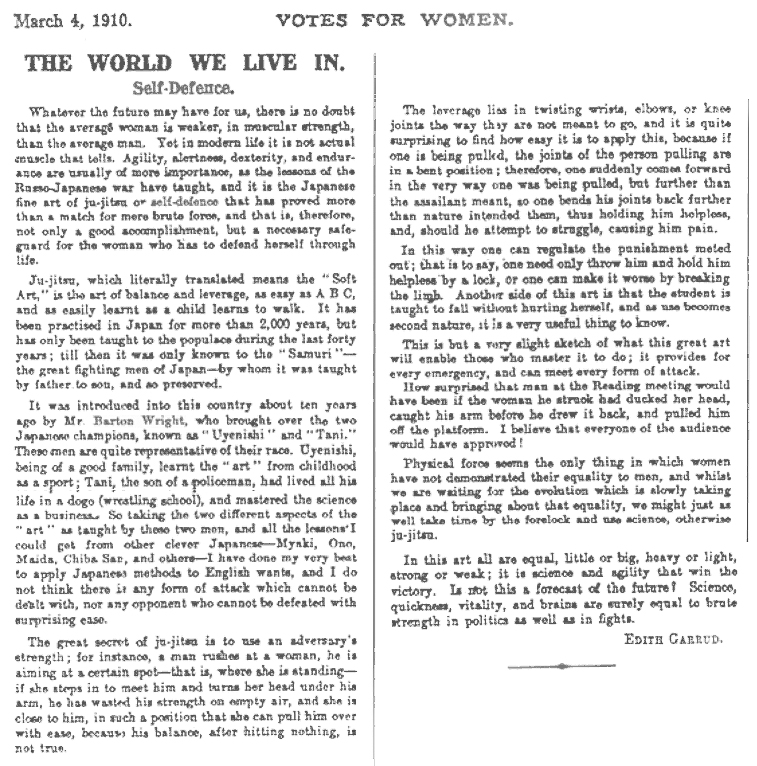
Our world is sick with violence (whether physical, verbal, psychological, symbolic, social, economic, etc.), sick with a dominant model based on competition, appropriation and fear that has been in place for centuries. From the powerful who own the world to our entertainment and media, violence is everywhere. The world often leaves us no choice: we either perpetrate violence or suffer it, or even both1this title is a reference to The World We Live In: Self-Defence by Edith Garrud (newspaper Votes for Women, 4 March 1910). For women, violence is often inherent in the very fact of being born female. Throughout our lives, we will be underestimated, mistreated and judged against the male model to which we are constantly compared. Martial arts are no exception to the rule: violence, condescension and sexist comparisons do exist. Much more than we want to admit.

Violence is therefore a festering wound that affects us all, with women unfortunately on the front line. While Aikidō is obviously not a solution to all the world’s problems, I believe that this art can be an exceptional tool for women to break free from the constraints imposed on them. It is a path that can lead us to overcome violence and escape the dualism of victim or perpetrator. To achieve this, I believe that the first step is to reclaim the issue of violence so that it is no longer seen as an inevitable fate.

Fate? Or political choices?

To do this work, we need to break free from certain deeply ingrained patterns of thinking. The historically narrow view that women have been subordinate to men since the dawn of time is no longer relevant. As some researchers have shown2cf. e. g. Marylène Patou-Mathis, Neanderthal, Une autre humanité [Neanderthal, Another Humanity], 2006, éd. Perrin (Paris), coll. Tempus; and Alison Macintosh, ‘Prehistoric women’s manual labor exceeded that of athletes through the first 5500 years of farming in Central Europe’, Science Advances, Vol. 3, No. 11, 29 Nov. 2017, during the thousands of years of prehistory, like other species in the animal kingdom, women and men gathered, hunted, cared for others, fought and used projectile weapons. As people became more sedentary, the status of women deteriorated throughout the world, but it was in Europe, during the Renaissance, that religion and political power brought about a decisive turning point in the history that shaped us. In her book In Defense of Witches, author Mona Chollet explores the immense violence of the witch hunts in Europe in the 15th and 16th centuries. These mass crimes, which have been largely ignored, not only killed thousands of women and children under the pretext of “witchcraft”, but also helped shape the world we live in today ‘by sometimes wiping out entire families, spreading terror, and mercilessly repressing certain behaviours and practices that are now considered intolerable’3Mona Chollet, In Defense of Witches: The Legacy of the Witch Hunts and Why Women Are Still on Trial, Introduction, ‘ “A Victim of The Moderns, Not of The Ancients” ’, pub. St. Martin’s Press, March 2022. [Our transl. from the original French: Sorcières, la puissance invaincue des femmes, 2018, pub. La découverte (Paris), p. 13] . The status of women was already difficult, but this historical episode marked a historic turning point in our world. Our European culture would establish itself as the dominant universal model, a consequence, among other things, of our conquests. In her book, Mona Chollet analyses the deep trauma that would remain with women and the indelible message that would be engraved and passed down from generation to generation, from woman to woman: submit! Do not rebel, for those who did so paid dearly.

Women of the 21st century, we are the heirs to this ultra-violent past, and the wound still festers, kept alive by the accumulation of violence today. In a number of countries, it is true that we no longer risk being burned and tortured – but that is because it is no longer necessary, as we have accepted the rules of the game and have even internalised violence to such an extent that we often no longer see it! And if we ever doubt, violence will always be there to remind us, in case we forget our place.

Maître Bow Sim Mark. Experte en Fu Style Wudangquan Shaolin (Tai chi, Bagua, boxe Tanglangquan) et mère de l'acteur Donnie Yen (star des films Ip man de Wilson Yip)
Master Bow Sim Mark. Kung Fu expert in Wudangquan Shaolin Style (Tai chi, Bagua, Tanglangquan boxing) and mother of actor Donnie Yen (star of _Ip man_ movies by Wilson Yip. Photo courtesy of Bow Sim Mark Tai Chi Arts Association.)

Women and violence

As a woman who practises and teaches martial arts (aikidō, jūjutsu, kenjutsu), I cannot help but feel concerned by this issue and seek answers. While yesterday’s society told women that they should not react, today’s society seems to oscillate between perpetuating this silence and immobility and suggesting that we become as aggressive as men (at work, in love, in combat, etc.). Are we then condemned, in order to liberate ourselves, to become as violent as men? Is this desirable? And can we compete on the same level?

Should we, like Hollywood, make the same action films but with female heroes to keep up with the times? Personally, while I do not doubt for a moment the power of women, I doubt that this is the right way to express it. So how can we find the right balance?

First, we must go back to the root cause: education. From childhood onwards, boys are allowed to occupy space, run, climb, kick a ball around, compete with each other, test their bodies and thus gain confidence in their developing bodies. Girls, on the other hand, are more or less excluded from this space. They are confined to more static games and cute, frivolous toys. Not to mention the clothes “so pretty” that hinder them. Their bodies are thus denied the experience of unfolding and discovering their power. We are conditioned to internalise any expression of violence and seek to please others. Fictional female role models will also show us the way.

As I have already said, I did not go to school and was not educated “like a girl”. I therefore remember my anger as a teenager at the lack of reaction from female characters in books and films. I did not understand why they were so submissive, so passive, or why they became schemers working in the shadows, using their charms to get revenge. As a result, I did not identify with the female characters at all, but always with the male characters, who took action, fought for great causes, and were free to do as they pleased.

As adults, women still find it very difficult to allow themselves to react to violence. I am not saying that victims are responsible for their assaults, absolutely not! But we are thus doubly punished, as Virginie Despentes says: ‘An ancestral, relentless political enterprise teaches women not to defend themselves. As usual, there is a double bind: we are made to understand that there is nothing more serious [than rape], and at the same time, that we must neither defend ourselves nor seek revenge.’4Virginie Despentes, King Kong Theory, ‘She’s so depraved, you can’t rape her’ (3rd Part), 2009, pub. Serpent’s Tail (London), p. 37. Trans. from the original French: 2006, pub. Grasset (Paris) I recently spoke with a young woman (an engineer and team leader in her company) about how difficult it is to break out of this pattern. She said that she was often afraid of her own violence if she reacted, so she often let the aggressor have his way, waiting a little longer (it may be “just” inappropriate gestures, heavy flirting or other ordinary violence) rather than reacting and having that reaction judged as disproportionate or hysterical.

Why is this the case? Is it fundamentally feminine? Philosopher Elsa Dorlin provides some answers by discussing a process she calls ‘the fabrication of defenceless bodies’5Elsa Dorlin, Se défendre : une philosophie de la violence [Defending Oneself: A Philosophy of Violence], 2017, pub. La Découverte (Paris), p. 21 or p. 66. This philosopher studies the ways in which bodies considered subordinate (slaves, colonised peoples, women, etc.) find their ability to defend themselves restricted, in the broadest sense of the term. For her, if women are “defenceless”, it is because of social forces that have been at work for centuries. We are taught that if we react, things will get worse, that it is inevitable that we will be attacked at some point, and that men will always be stronger. This male superiority is often nothing more than a fantasy.

Naginat et kusarikama : Shimada Teruko. Article la violence
Shimada Teruko sensei, expert of Jikishin-kage-ryū. Photo from Michel Random’s book _Les arts martiaux ou l’esprit des budô_ [Martial Arts or the Spirit of Budō], 1977, pub. Nathan (Paris)

I was “lucky” not to be seriously assaulted; so far, I have “only” experienced “minor” assaults. When I was a young girl, for example, I slept in a shared room in a building reserved for a summer music academy. In the middle of the night, a boy entered the room, whose door had no lock (which had shocked me when I arrived). He was drunk and came in shouting that he wanted to kiss us. Half awake, I heard him lean over the first bed where another girl was sleeping. She protested but was still more or less “groped”. I hear him approaching my bed, he leans over and gets my arm in his face. He is surprised, staggers and leaves the room after a few expletives. I was lucky, yes, and I did not use “Aikidō” to ward him off. But in my mind, I was certain that I was justified in reacting immediately, and that made all the difference. I am not advocating violence for violence’s sake, but the ability to exercise one’s capacity to react, to use the rage that rises within us when we are attacked. But we did not choose to be in this situation! The challenge then is to react effectively and, if possible, proportionately, but in that order of priority.

But practising an art such as Aikidō can be, like Jūjutsu practised by English feminists in the early 20th century, more than just a defensive art, but a “total art“ ‘because of its ability to create new practices of self that are political, physical and intimate transformations. By freeing the body from clothing that hinders movement, by deploying movements […] by exercising a body that inhabits, occupies the street, moves, balances’6ibid. and thus establishes another relationship with the world, another way of being. Little by little, our posture changes from ‘how can I defend myself without hurting anyone’ to ‘being myself’ and what means are at my disposal to maintain my integrity. Perhaps rage will be needed as a force for action, perhaps it will be enough to stand up and say ‘no’. It is our determination that will change everything.

Violence or coagulated energy

When we talk about violence, we are not usually referring to the violence of the wind or the violence of the feelings that pass through us. And yet, the word originally referred to willpower, strength (the force of the wind, the heat of the sun, etc.), even deriving from the Latin vis, which can mean life force or vitality! So why is this energy, this vitality, so often expressed through destruction? Tsuda Itsuo sensei explained:

‘When this invisible energy is unleashed, it gives rise to violence without justifiable reason, and then one feels pleasure in hearing shrill cries and crashing sounds. On the other hand, when reason curbs this unleashing, the unconsumed energy coagulates and prevents normal balancing.
[…]

[…] there are a great many people who, simply in order to deal with society, run around in circles in search of an easy solution, and never find the radical solution: the awakening of the being.’7Tsuda Itsuo, The Dialogue of Silence, Chap. VIII, Yume Editions, 2018, p. 68

Once we realise that blocking our energy and reactions traps us in the unbearable role of “victim” and can lead us to express our vitality by destroying others or ourselves, we can then take the next step: working to control violence. Stopping a hand, a word, looking the other person in the eye. Controlling does not necessarily mean restraining violence. It is not easy, but it also means assessing situations to know what the next step will be. We no longer hope that the other person will not approach us; we know that if we wait, it will be too late, and then the violence will be there. One of the tasks at hand is to be more sensitive, to feel our own state and that of others.

In our school, the tools for this awakening, which comes through the body, are Aikidō and Katsugen undō, which is part of Seitai. ‘The principle of Seitai is extremely simple: life always seeks to balance itself, despite the structured ideas we heap upon it. Life acts through our instincts and not our faculty of reason.’8ibid., p. 69 Thus, it is not a matter of external action or letting off steam, but rather a subtle balancing of our own energy. Through the involuntary movement that allows it to flow, it pacifies us from within.

For its part, the practice of Aikidō confronts us with the energy that comes to us from others. How do we deal with this, how do we react? In our school, the answer is harmonisation. Even if the other person is a danger, especially if the other person is a danger, harmonisation is necessary. As Ellis Amdur says, ‘There is, in fact, a naked intimacy in hand-to-hand combat […]. Expertise is not just skill at movement or technique – true expertise is the ability to be as un-barriered as a baby’9Ellis Amdur, Steal the Technique, KogenBudo blog, 21 Mar. 2021. Of course, harmonising does not mean giving up. It is a subtle process that leads to not really using force against force, but to guiding, to channelling that force elsewhere. It is through the areas of focus that are breathing, the development of sensation and non-doing that we practise. This is not a question of cheap non-violence. On the contrary, our dojos offer daily practice, and the intensity will gradually increase, always depending on tori’s ability to maintain these areas of focus, even when faced with attacks that become faster and more demanding. Women find a special place in this work, where they can exercise their abilities and gradually discover that ‘it is not so much a matter of learning to fight as of unlearning not to fight.’10Defending Oneself (op. cit.)

These two practices enable us to regain a more refined sensitivity. Often, in order to cope with things, we end up no longer feeling anything: neither suffering, nor the caress of the wind, nor, unfortunately, danger. Ellis Amdur puts it this way: ‘To truly survive in high-risk encounters, one has to develop an exquisite sensitivity to other people, both one’s own allies and one’s enemies. The development of kan [勘, intuition] is essential.’11Ellis Amdur, Senpai-Kohai: The Shadow Ranking System, KogenBudo blog, 21 Mar. 2021 This ability to sense others and listen to one’s intuition is essential in all aspects of our lives.

Aikidō is not some self-defence, it is much better than that, it is the possibility of rebalancing our relationship with the world. Reconciling with ourselves and the world by rediscovering our inner strength. This may seem very ambitious, but it is a possibility. I know a practitioner who, for years, following the violence she had suffered, had terrible nightmares. She would regularly wake up in the night screaming. When she reached a stage in Aikidō where the intensity of the exchanges increased, she began to react in her dreams. She still had nightmares, but she was no longer passive; she reacted in her dreams so that she would no longer be a victim. This “simple” fact was of paramount importance to her and her journey.

Naginat et kusarikama. Article la violence
Shimada Teruko sensei, cf. supra

Female gaze

In 1975, film critic Laura Mulvey theorised the male gaze in cinema, characterised by the fact that the camera always has a male point of view, looking at women’s bodies as objects. Since then, some female filmmakers have spoken of a female gaze, which is not the opposite (viewing men’s bodies as objects) but seeks to place itself at the heart of the experience of individuals, particularly women. This monopoly of representation based on the male point of view, highlighted in cinema, can be found in almost all fields.

This is especially true in martial arts, which are seen as almost exclusively masculine because they are warrior arts. But history is written by the victors. As author Chimamanda Ngozi Adichie says, this is the danger of a single story: ‘Start the story with the arrows of the Native Americans, and not with the arrival of the British, and you have an entirely different story.’12Chimanda Ngozi Adichie: The danger of a single story (from 10’30”), UTube channel TED, 7 Oct. 2009 Sometimes, telling the story from the other point of view means repairing deep societal traumas.

As I said earlier, the film industry today shows us more and more female heroes who fight. Although I recognised a certain satisfaction of my teenage frustration in this, I quickly grew tired of it. These women fight “like men” and are not realistic. So they are still not really the kind of female role models I would have wanted when I was sixteen. In Aikidō, as in most fields, the over-representation of men gives us a masculine universe with its physical and mental characteristics as our horizon and model of practice. Women who want to persevere often have to prove that they can perform on the same level as their male counterparts.

I am not advocating a feminine way of practising Aikidō, but rather the possibility that there are other ways of practising that are equally respectable and respected. Moreover, if the idea of a feminine way of practising Aikidō seems so unbearable to us women, it is because we still value a certain perspective, a certain way of doing things. We have done so for so long that we have internalised the superiority of a model that is no longer even masculine, but simply THE model. In order to recognise our excellence, we must compete with this model, in the same way, on the same ground, otherwise it will be a despised sub-discipline. We forget to ask ourselves the fundamental question: why is this male model more justified, more universal? It is, incidentally, a contemporary Western male model, as other cultures have had other models.

This phenomenon can be found in all fields. For example, writer Tanizaki Jun’ichirō explored this issue of the Western monopoly on science:

‘I always think how different everything would be if we in the Orient had developed our own science. Suppose for instance that we had developed our own physics and chemistry: would not the techniques and industries based on them have taken a different form, would not our myriads, which would consequently have evolved along different paths, would we not our myriads of everyday gadgets, our medicines, the products of our industrial art – would they not have suited our national temper better than they do? In fact, our conception of physics itself, and event the principles of chemistry, would probably differ from that of Westerners’.13Tanizaki Jun’ichirō, In Praise of Shadows, 1977, Leete’s Island Books (Sedgwick, state of Maine), p. 7 (Trans. by Thomas J. Harper & Edward George Seidensticker from the original Japanese: 陰翳礼讃, In-ei Raisan, 1933)

The trend towards “situated knowledge” in science follows the same line of thinking. Initiated by women, this trend is based on work that describes and analyses how all scientific knowledge is “situated”, coloured by culture, historical context, and the position (social, gender, etc.) of researchers. According to this trend, all knowledge, even scientific knowledge, is partial, and claiming to have neutral and objective knowledge is an illusion. It is by multiplying points of view and positions, and by explaining and accepting our situated nature, that we can move towards more solid and reliable knowledge.

Another example is that Native Americans can teach us a different way of adapting to the environment than our own:

‘Unlike European peasants stooped to the grind of agriculture, anxiously accumulating grain against future want, the Indian appeared free because confident of his ability to bear hardship; leisured because tough’14Matthew Bunker Crawford, The World Beyond Your Head: On Becoming an Individual in the Age of Distraction, Introduction, ‘Individuality’, 2015, pub. Farrar, Straus and Giroux (New York), p. 19 rather than far-sighted. Would it be possible to live without worrying about the future?

Similarly, is it possible that there is another way to fight? If prehistoric women were capable of fighting, there were also the Celts, the Amazons of Amazonia, several traditions of female warriors in Africa (the Amazons of Dahomey, the Linguères of Senegal, or among the Zulus), and there were also some in China and Japan. Or even Native American women15Patrick Deval, Squaws, la mémoire oubliée [Squaws, The Forgotten Memory], 2014, pub. Hoëbeke (Paris), who could be chiefs, shamans, healers, or warriors. And then there were the women of the French Revolution, the anarchists, and the English suffragettes. And surely there were other forgotten cultures where women were the bearers of specific martial traditions, and there is no reason to think that they could not have been effective in this field, depending on the goals sought. I would give anything to see how they fought, how they took advantage of their physical and psychological characteristics.

Hino Akira Sensei recounts his encounter with Tai Chi Chuan and Shaolin Kung Fu:

‘The teacher was a woman, an old lady who was very flexible. I was perplexed and wondered if it was a form of health gymnastics or a martial art. I asked her the question and she replied that it was a martial art. I then said to her, “Excuse me, but if it is a martial art, would you be so kind as to show me what you would do against a chūdan tsuki, for example?”. She said that was no problem, and I attacked her. Before I knew what was happening, I was thrown!

I thought to myself, “It really exists!”. Although I am not tall, I was still a young man full of vigour, and an old granny had just surpassed my attack with her flexibility. I had just discovered that there really were principles that allowed gentleness to overcome strength. I was stunned, but I had just discovered one of the keys that would allow me to continue my search.’16Léo Tamaki & Frédérick Carnet, Budoka no Kokoro (in French),‘Hino Akira, the Tengu of Wakayama’, Oct. 2013, self-pub.

Why, in Aikidō, could we not also develop our own way of doing things? If Aikidō is unique, it is in its multiplicity, both Yin and Yang, masculine and feminine. It does not matter if a 45kg woman is unable to perform kokyū hō when faced with a ryōte-dori grip from a 70kg man; we are competent precisely because we do not find ourselves in that position! If we move well beforehand, or if as a last resort we headbutt or kick you know where… So why compare? Imagine an arena with a strict rule that tori must wait passively for uke to arrive and grab his wrists in a downward blocking manner. Could the 70-year-old Master Ueshiba in this situation have beaten the 40-year-old Master Ueshiba grabbing his wrists like that? Probably not if he had tried to do as the 40-year-old did. It was precisely because he had a different body, a very different feeling of attack, that he was capable of something else.

It was the same absurdity of comparison within a defined framework that enabled Anton Geesink, a 1.98m tall Dutchman weighing 115 kg, to defeat the Japanese in jūdō in 1961. But was it not absurd to get to that point?

The power of women lies in being women. As Abe Toyoko sensei, a 70-year-old emeritus teacher of Tendō-ryū, says:

‘The first [naginata] tournament I saw my teacher in, it was amazing. She walked her opponent all the way across the hall, from the east side to the west side, not using any technique, just her stance and spirit. Everyone, even the old teachers were enthralled. Then she moved to cut, just once. […] She won the match’. ‘To be like a woman is not simply to be soft. To be woman-like is to be as strong or as soft, as servile or as demanding as a situation calls for:  to be appropriate and act with integrity. This […] is the heart of real budo.’17Ellis Amdur, Interview with Abe Toyoko of the Tendo-ryu, KogenBudo blog, 21 Mar. 2021

Paradoxically, it is by developing our specificity that we can create a completely different idea of an art, of a universal science. A multiple universal full of a diversity of colours and forms. An Aikidō that embodies the diversity of human beings in general.

Manon Soavi

Would you like to hear about the next article?

Subscribe to our newsletter

Article by Manon Soavi published in July 2020 in Self & Dragon Spécial Aikido n° 2.

Notes

Fukiko Sunadomari and the Women Erased from History

by Manon Soavi

Did you know that Morihei Ueshiba, one of the greatest budoka of the 20th century, would shout angrily whenever he saw his students practising: ‘No one here is doing aikido! Only the women are doing aikido!’1words reported by Guillaume Erard in « Entretien avec Henry Kono: Yin et Yang, moteur de l’Aïkido du fondateur » [‘Interview with Henry Kono: Yin and Yang, the Driving Force Behind the Founder’s Aikido’], 22 Apr. 2008 (French available online)?

Fukiko Sunadomari sensei at the Hombu Dōjō, teaching the women’s section, in 1956. in www.guillaumeerard.com

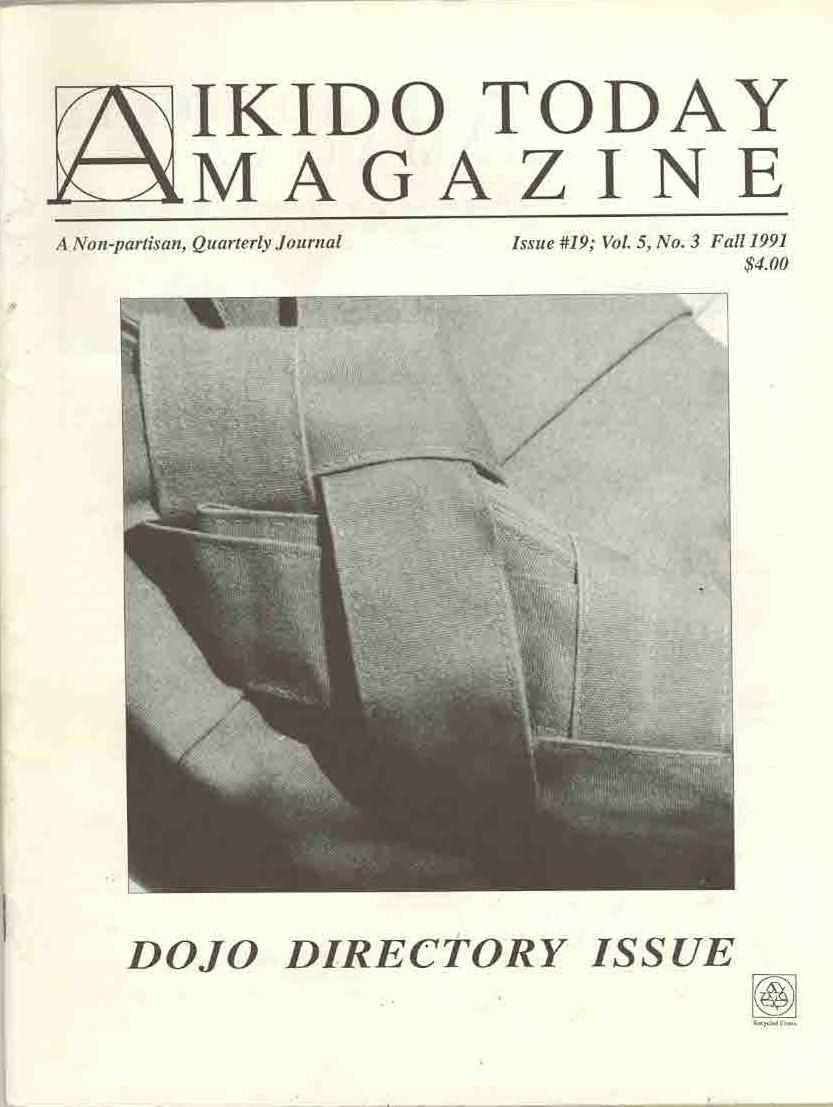
How could a Japanese man with a traditionalist view of the family and the place of women say such a thing and even claim that men are at a disadvantage in aikido because of their use of physical force2these words can be found – at least – in: ► Itsuo Tsuda, The Path of Less, 2014, Yume Editions, Chap. XVI, p. 157 (1st ed. in French: 1975, pub. Le Courrier du Livre (Paris), p. 148) ► Virgina Mayhew’s interview by Susan Perry pub. in Aikido Today #19, Vol. 5, No. 3, fall 1991 (French translation available online) ► Miyako Fujitani, ‘I am glad I have Aikido’, Magazine of Traditional Budo, n. 2, March 2019 (pdf link available online – at page bottom), p. 29 ► Mariye Takahashi, ‘Is Aikido the pratical self-defense for women ?’, Black Belt, Nov. 1964?

These remarks remain relevant today, since mainstream aikido still values strength. So why are these words, which shed light on the path developed by O-sensei, not better known?

This may be due to the silencing of the transmission of Ueshiba O-sensei’s female students. For, beyond the obvious injustice of rendering women invisible, silencing ways of doing things means erasing all memory of the gestures and ideas of the people who did those things. Our actions are nourished by the past, and the less we talk about women’s actions and how they operate, the more limited the range of possibilities is for future generations. We can see this clearly in aikido today: where are the women?

Men do not have to justify the need to be heard, but when it comes to women, we are obliged to justify the interest for everyone. However, men’s experiences cannot “count for everyone”; it does not work that way. Women’s experiences and ways of doing things are specific and different. That is why I am inviting you to discover a woman about whom very little is known, even though the path she followed would have justified her a place in the history of aikido.

Herstory, an militant history?

History is often mistakenly perceived as neutral and factual, when in reality it is a construct of those in power that influences the present. This is why Titiou Lecoq writes: ‘When working on women’s history, female historians are always suspected of being activists. Why should women’s history be militant? Isn’t the history we learn, which is masculine and non-mixed, also a form of militancy?’3Titiou Lecoq, « Tant qu’on ne cherche pas les femmes dans l’Histoire, on ne les trouve pas » [‘As Long as We Don’t Look for Women in History, We Won’t Find Them’], France Inter (French radio broadcast), 19 Sept. 2021 (available online)

The play on words her-story emphasises that history reflects male points of view: his-story. Herstory restores the active role of women in history. In her book The Great Forgotten Ones: Why History Erased Women, Titiou Lecoq explains that her aim ‘was not so much to feminise history as to demasculinise it. The approach is different. Demasculinising or devirilising implies the idea that there was a prior political process of masculinising society.’4Titiou Lecoq, « INTERVIEW: Pourquoi l’histoire a-t-elle effacé les femmes ? » [‘Interview: Why did History Erase Women?’], 7 June 2022, Revue Démocratie (French online review)

Lecoq cites French grammar5[In French, the standard gender is masculine, especially job names, and the plural of a list of items is traditionally masculine as long as at least one item is masculine] as an example of deliberate masculinisation6« Tant qu’on ne cherche pas les femmes dans l’Histoire, on ne les trouve pas », op. cit., as well as the fact that in the Middle Ages there were ‘female doctors, jugglers, goldsmiths, authors, illuminators and cathedral builders, and it was only at the end of this period that men forbade them from practising these professions.’ The masculinisation of society involved erasing women, their stories, their actions and their names.

A very obvious example of this erasure is that of Alice Guy, who invented cinema! While Méliès was interested in creating illusions and others used the camera to document their times, Alice Guy imagined telling fictional stories. In over twenty years, she made around a hundred films as a director, screenwriter and even producer. Yet the Lumière brothers and Méliès enjoyed great posterity despite having much shorter careers. Alice Guy was literally erased: many of her films were deliberately re-attributed to men in the registers, and many of her films were destroyed. She was not even mentioned in cinema encyclopaedias for a long time.

The story of Alice Guy is just a classic example of what happens to female creators. And if a work reaches us, historians question whether they really created it, when they do not outright dispute the existence of the person.

The delegitimisation of women is a form of symbolic violence that plays a major role in the mechanisms of male domination. This is why Aurore Evain advocates for the reintroduction of the term Matrimoine7[In French, patrimoine means heritage, and literally means ‘the inheritance of our fathers’. Matrimoine stands for women’s heritage.], because ‘[t]he symbolic power of language is immense[…]. Naming our matrimoine allows both women and men […] to recognise themselves in male AND female role models.’8Aurore Evain, « Vous avez dit “matrimoine” ? » [‘Did You Say “Matrimoine”?’], Mediapart blog, 25 Nov. 2017 (French available online)

The women’s heritage of aikido

What do we know about the her-story of aikido? Almost nothing. Once again, we need to “demasculinise” history in order to recover the memory of female aikidoka. This is why I wrote about Miyako Fujitani9Manon Soavi, ‘Miyako Fujitani, the “Matilda effect” of Aikido?’, Self&Dragon Spécial Aikido n° 17, April 2024, available online. Since I began my research on Fukiko Sunadomari, I have gone through phases of despondency and anger, as the potential seemed so interesting and yet there were no traces to be found.

Here is what little we know: Fukiko Sunadomari was born on 9th May 1914 into a family of devout followers of the Oomoto Kyō religion. In the late 1930s, she began studying naginata in the Jikishingake school under the guidance of Japan’s greatest expert – a woman –, Hideo Sonobe sensei.

Fukiko Sunadomari with her naginata. Sunadomari family Archives, all rights reserved.

In 1939, Sonobe sensei met Ueshiba O-sensei during a demonstration in Manchuria. She was enthusiastic about it and decided to send some of her advanced female students to learn aikido. This is how Fukiko began at the Hombu Dojo in the 1950s. Her two brothers (Kanemoto and Kanshu) had already begun practising under the guidance of Morihei Ueshiba.Fukiko ‘lived for many years in O-Sensei’s Wakamatsu Dojo in Shinjuku with his family and the live-in uchideshi.’10Stanley Pranin, Historical photo: Morihei Ueshiba, Aspiring Calligrapher!, 6 Nov. 2011, Aikido Journal, available online She held the position of Fujin Buchō (director of the women’s instructor section)11Stanley Pranin, The Aiki News Encyclopedia of Aikido, 1991, pub. Aiki News (Tokyo), p. 106, available online until O-sensei’s death in 1969. This tells us that there was a section for training female instructors! This raises many questions: why a separate class? How did it work, how many were there…?

A letter12Guillaume Erard, « Biographie d’André Nocquet, le premier uchi deshi étranger d’O-sensei Ueshiba Morihei » [‘Biography of André Nocquet, O-sensei Ueshiba Morihei’s First Foreign Uchi Deshi’], 2 Feb. 2013 (Fr. available online) written by Fukiko to André Nocquet’s family reveals that she was a key figure at the Hombu Dojo. She was involved in the dojo’s internal running and was close to the Ueshiba family. She was O-sensei’s confidante and personal assistant for twenty years, during which time he awarded her the rank of sixth dan. There is also a very short video of a demonstration on the roof of a building in Tokyo where O-sensei is seen demonstrating Ki no musubi with Fukiko.

Ueshiba O-sensei and Fukiko Sunadomari, Iwama, 1966

As O-sensei’s assistant, Fukiko often happened to accompany him on trips to the Kansai region, where he taught aikido while visiting long-standing students and friends. During these trips, O-sensei would often choose Fukiko to be his demonstration partner, particularly when teaching women13‘I am glad I have Aikido’, op. cit., p. 26. Fukiko apparently had many unpublished photos from this period14Historical photo: Morihei Ueshiba, Aspiring Calligrapher!, op. cit..

According to aikido researcher Stanley Pranin, Fukiko accompanied O-sensei on a series of trips in the mid-1960s and took the opportunity to gather material for a biography. She took photographs and interviewed former students of Morihei Ueshiba, as well as members of the Oomoto religion who had known him.15ibid.

After O-sensei’s death, she continued her extensive research and co-wrote the first authorised biography, Aikido Kaiso Morihei Ueshiba, with her brother Kanemoto. Of course, she is only mentioned as a collaborator; her brother is the sole official author of the book!

In the mid-1980s, Fukiko wanted to pay tribute to O-sensei by building a small votive temple in his memory in Kumamoto16Simone Chierchini, ‘Paolo Corallini’s Traditional Aikido Dojo’, 31 May 2020, available online. To finance her project, she decided to sell some of the many original calligraphies by O-sensei that he had given her17ibid..

Fukiko Sunadomari passed away on 1st May 2006 in Fujisawa, at the age of 92.

Make history

Stanley Pranin stated:

‘I knew Fukiko Sunadomari very well. Our association began in 1984 and continued through the end of 1996. She loved to come visit the Aiki News office in Tokyo, and we spent hours talking about aikido, Morihei, and the Omoto religion. I have many hours of recordings of our talks, one of which is being transcribed now.
Fukiko Sensei knew a great deal about the Founder’s public and private life due to her living in the Hombu Dojo and role as an assistant to Morihei. […]

[…] Fukiko Sensei’s testimony is very important to a deep understanding of Morihei’s history, character, and art.’18Historical photo: Morihei Ueshiba, Aspiring Calligrapher!, op. cit. (emphasis by M. Soavi)

From right to left: Stanley Pranin, Kanshu Sunadomari, and Fukiko Sunadomari

So, where are these hours of interviews, these articles reporting her words? I have searched thoroughly through all of Pranin’s publications, including books, AikiNews magazines and Aikido Journal issues – both print and web versions. I found nothing. There is no trace of them.

Current Aikido Journal editor Josh Gold confirmed to me that there are no recordings, either digitised or on archive tapes.

Pranin wrote in a short article: ‘[Fukiko] was an outspoken person and distanced herself from the Ueshiba family following Morihei’s death. As such, her comments and recollections are not always suitable for publication, and we have long refrained from releasing transcripts of these recordings, even in edited form. Given time and resources, we hope to remedy this situation’.19ibid..

In 2011, he justified himself as follows: ‘These areas are very sensitive, otherwise, I would have already published certain documents and testimonies. Even though many decades separate us from some of the events in question, the sensitivities of key individuals are a matter of concern. This is something I have wrestled with for a long time, and still don’t have a good solution. I felt very hesitant to publish Koichi Tohei Sensei’s letter of resignation, for example. We’ll see how things play out.’20ibid..

Thus, with a gentle shift, almost without intention, the masculinisation of history continues. Women disappear one after another from the scene, leaving only prevailing male voices.

‘She must be his mistress’ – a strategy for discrediting women

Given Fukiko’s position, it is not surprising that rumours spread that she was “sleeping with the boss”. This is the oldest weapon used to silence women.

It is assumed that if O-sensei “burdened” himself with a woman, there must have been a romantic story behind it. Strangely enough, the same is not assumed of the young male uchideshi of the dojo. Nor is it assumed that O-sensei had a secret lover in Iwama!

Fukiko Sunadomari and Ueshiba O-sensei

We can hypothesise about Fukiko’s views. Based on Pranin’s comments and the few comments she left, it is clear that she was a mystic21Michi-o Hikitsushi sensei said of Fukiko that she ‘understands spiritual matters well’ – see Hikitsushi sensei’s online biography (In French) or his biography pub. in Aikido Magazine No. 40, Oct. 1988 (French trans. available online) like Ueshiba O-sensei. She often emphasised the importance of this aspect in O-sensei’s path. Did she criticise the beginnings of a desacralised, sporting – and ultimately very masculine – aikido that, in her opinion, did not correspond to the founder’s vision?

Text by Fukiko Sunadomari written for the “Aikido Friendship Demonstration Tournament” in 1985. An event organized by Stanley Pranin. Sunadomari family archives. All rights reserved.

This aikido corresponds to Kisshōmaru Ueshiba’s efforts to expand his father’s art internationally. But for O-sensei, aikido was ‘a spiritual act’22Ellis Amdur, Hidden in Plain Sight: Tracing the Roots of Ueshiba Morihei’s Power, Chap. 13, 2018, Freelance Academy Press, p. 281: ‘[Ueshiba offered] not more spiritual lessons with which the world is uselessly glutted, but spiritual acts.’ (full quotation available online) and he himself stood on “Ame no Ukihashi, the celestial floating bridge”, that which connects the visible and invisible worlds. It was an art of universal love, recreating the bonds that unite us both as humans and to non-human living beings.

Could the West hear this? given that, as Isis Labeau-Caberia says, ‘[as a cosmovision, it] first set about destroying indigenous cosmovisions on the European continent itself – those of peasant, rural and “pagan” worlds; those of druids, bone-setters and witches – before pouring to the rest of the world’.23Isis Labeau-Caberia, « “La tête ne nous sauvera pas” (part. 1) : L’Occident est une cosmovision, la “raison” en est le mythe fondateur » [‘“The Head Alone Will Not Save Us” (Part 1): The West is a Worldview, and “Reason” is its Founding Myth’], 4 July 2023, blog La Griotte Vagabonde [The Wandering Female Griot] (available online). [Bold emphasis removed by M. Soavi.]

Elevating the intellect to the top and rejecting the body, emotions and spirituality: this artificial dualism was the matrix of the reification, domination and exploitation of everything that was not a “rational modern man”, i. e. non-human beings, women and non-white people, all of them being sent back to the belittled state of “Nature”.

In this context, aikido has become mainly a combat sport or a gold mine for gurus, when what we desperately need are spiritual but immanent practices for the body, stripped of all domination.

Other students of O-sensei criticised this new direction taken by the Aikikai, breaking away from the Ueshiba family: Kōichi Tōhei, Noriaki Inoue (O-sensei’s nephew), Itsuo Tsuda and Kanshu Sunadomari. However, we have no shortage of interviews with these famous practitioners.

There remains one difference: Fukiko was a woman with expertise who spoke to convey her truth, no more and no less than the others. But she was a woman… so they did not listen.

Fukiko Sunadomari in demonstration. Sunadomari family archive, all rights reserved.

Was O-sensei referring to her in particular when he said that his ideal aikido was that of young girls24The Path of Less, op. cit., loc. cit.? Or when he shouted: ‘Only women practise Aikido here!’?

Through the fragments of the story of Morihei Ueshiba’s closest female disciple, perhaps even his best, we can discern a relationship of transmission from master to student, and even beyond that, a spiritual relationship. So how can we not suppose that Fukiko’s aikido must have been breathtaking? And how can we not regret the loss of this link to the founder’s aikido?

I hope that I have played a small part in demasculinising aikido and raising awareness of this extraordinary figure. I would like to take this opportunity to thank Fukiko’s sister-in-law for kindly providing me with the unpublished photos and press clippings presented here.

By doing so, she is helping to preserve a women heritage where each piece of the puzzle is important.

Notes

I Go Rediscovering Freedom

The search for inner freedom in the practice of Aikidō and Seitai

by Andrea Quartino


Restrictions on freedom of movement are easing [May 2020 lockdown], although the timing and manner remain uncertain. For those who practise Aikidō in a dojo of the Itsuo Tsuda School, the day when they will be able to resume practising does not seem to be near. Beyond the different opinions on the cause of the emergency, the restrictions decided by governments should not limit our ability to judge. It is normal to maintain a critical view of the effectiveness and consequences of such measures while applying them.

Seitai founder Noguchi Haruchika did not shy away from talking about freedom during a period such as that experienced by Japan during the Second World War, when markedly nationalist and militaristic tendencies prevailed to such an extent that the word “freedom” was banned. Of course, he could count on the fact that he had several representatives of the ruling class among his clients.

The end of the war for Italy on 25 April 1945 was a relief for everyone, as was the fall of fascism, even for those who shared that ideology. The same relief was felt by many Japanese.1Tsuda Itsuo, Heart of Pure Sky (posth.), ‘Booklet no. 183’ (end), Yume Editions, 2025. See also Itsuo Tsuda. Calligraphies de printemps [Itsuo Tsuda, Spring Calligraphies], Yume Editions, 2017, p. 399 It was not only the return of peace and more or less formal freedom, but also the end of a climate of constant tension, which was felt everywhere and to which no one was immune. Allowing for the necessary differences, and net of the perplexities aroused by the war metaphors used by many when talking about the effort to contain the contagion, anyone with a modicum of sensitivity cannot fail to feel how everything and everyone is permeated by mistrust and fear, whether caused by the virus or by the penalties imposed for violating the rules. It is a very heavy oppression, and we too will feel relief when and if it ends.

‘When [Master Noguchi] heard about the cessation of hostilities on the radio, he suddenly felt a heavy burden lifted from his shoulders and an unexpected release of tension throughout his body.
His breathing deepened, revealing a deep calm in his mind. This calm brought a surge of fresh energy and inside his skin he felt a new world was beginning.

“Why did I talk so much about freedom during the war?” he said, “it was just words. On the contrary, I was just stuck in my attitude. The more I tried to fight the trend, the more I became locked into a narrow frame of mind, unable to breathe deeply.” ’2Tsuda Itsuo, One, Chap. IX, Yume Editions, 2016, p. 67. The following lines state that ‘[a] truly free man does not discuss freedom, just as a healthy man does not think about health.’ These very words seem to be echoed by Chinese poet Bai Juyi’s verses: ‘Those who speak do not know. Those who know do not speak.’ Tsuda also traced these verses in three of his calligraphies (see Itsuo Tsuda, Calligraphies de printemps (op. cit.), p. 284), quoted them verbatim in The Non-Doing (Chap. XVII, 2013, Yume Editions, p. 180), and evoked them in The Way of the Gods (‘I work in the hope […] another kind of freedom.’, Chap. VII, Yume Editions, 2021, pp. 53–4).

Why was this freedom nothing more than a word for Noguchi? Had he perhaps changed his opinion about the nature of the wartime regime? It is unlikely, but that is beside the point. The question is what we mean by freedom.

Tsuda Itsuo returns repeatedly in his books to the idea of freedom

For Tsuda, modern man ‘has fought some tough battles to acquire his right as a Man. He has obtained some liberties and keeps on struggling to acquire more. But one day he finds that these liberties only concern material conditions external to him.’3Tsuda Itsuo, The Non-Doing, Chap. I, Yume Editions, 2013, p. 15 So human beings often fight for freedoms in the plural, which are conditioned. ‘The fixation of ideas that guides us in the organisation of life, can also work against us by imposing unpredictable constraints upon us. Freedom becomes a fixation that fetters us. The more freedom one has, the less one feels free. Freedom is a myth.’ ‘We struggle against constraints to acquire freedom. Freedom gained never fails to produce other constraints. There does not seem to be any definitive solution. For the freedom we seek is primarily a conditional freedom. We do not possess any idea of absolute and unconditional freedom.’4One, op. cit., Chap. III, p. 24

“Conditional freedom”, almost an oxymoron, if this phrase were not used in law language. We are conditioned by the linear time of clocks, by the social organisation of work and by the market that urges us, with increasingly sophisticated and invasive advertising techniques, to satisfy needs that are mostly induced. Among the abundance of things on offers, available online or otherwise, ‘we find everything except desire. So we choose the chef’s recommendation, the advice of people who aren’t paying for the meal, the seductions of advertising, the clamour of the opinion leaders.’ ‘Certainly we have the freedom to choose, but it is a negative freedom: the freedom to accept or reject what on offer. As for the positive freedom, that of creating, we have neither the intuition nor continuity to enjoy it.’5Tsuda Itsuo, The Science of the Particular, Chap. IX, Yume Editions, 2015, p. 76

Itsuo Tsuda e Haruchika Noguchi
Masters Tsuda Itsuo and Noguchi Haruchika

Tsuda points out the possibility of “letting go” of everything that is apparent freedom, choices imposed on us by the market, consumable goods, marketable goods, however difficult this may be for civilised man, who is afraid of losing everything if he renounces his possessiveness. By letting go, we can ‘finally see the All that is ours; the sky, the earth, the sun, the mountains and rivers, without our having to put them in our pocket.’ We may feel ‘the desire to know true freedom.’ ‘Nothing external, such as money, honour and power, can bring us true Freedom, which is an inner sensation and does not depend on any material or objective condition. One can feel free under the worst kind of duress, and a prisoner at the pinnacle of happiness.’ 6Tsuda Itsuo, The Dialogue of Silence, Yume Editions, 2018, pp. 85-6

The deep desire for another kind of freedom arises together with an inner conviction, which in reality is rediscovered, found again because it has been in every human being since the beginning, since conception. But its rediscovery is not possible as long as we remain on the “path of acquisition” that is the norm in our society, where ‘[a]ll these accumulations weigh heavily on our destiny.’

‘In the way of less, we move in a diametrically opposite direction. We gradually get rid of all that is unnecessary to life. We feel more free because we no longer impose prohibitions or rules on ourselves for living well. We live simply, without being torn this way and that by false ideas.
We do not have to be anti-social or anarchists to feel free. Liberation does not require destruction. Freedom does not depend on conditioning, environment or situation. Freedom is a very personal thing. It arises from deep conviction on the part of the individual.

This conviction is a natural thing that exists in all human beings right from the start. It is not a product thrown together after the fact. But it will remain veiled for as long as we live in a climate of dependency. It isn’t worth it, says Noguchi, to help people who do not want to stand on their own two feet. If we release them, they fall down again.’7One, op. cit., Chap. VI, p. 47

It was this awareness that led Noguchi, when he found another freedom, a deeper breathing and calm at the end of the Second World War, to give up therapy and devote himself to awakening people, allowing each individual to rediscover their inner freedom in the times and ways that suit them.

How can practising arts such as Aikidō and Katsugen undō guide us in rediscovering our individual freedom?

One answer can be found in the words of Taichi Master Gu Meisheng:

‘Can “true naturalness” only be acquired through long and diligent practice? Are you like a child? Because only children are spontaneously natural and free at the same time. In fact, if you have not become like a child again, you are neither free nor natural. […] Usually, for an ordinary person, the body is an obstacle, not a driving force from which spiritual momentum can be drawn. Yet, thanks to very long training combined with diligent and rigorous practice, it is possible to liberate this ordinary person and allow them to act with wonderful, creative spontaneity. Then neither the body, nor the outside world, nor the many ties that bind him to the world constitute an obstacle for him. I first experienced this feeling of freedom in 1970 when I was in prison, and this freedom grew progressively throughout my imprisonment.’8La vision du Dao du professeur Gu Meisheng (video), no longer available – words probably inspired by this part 5 (French) video at the end (‘when I was in prison, in the 1970s’)

The words of Master Gu, who was imprisoned during the Chinese Cultural Revolution, apply equally to Tai Chi, Aikidō and Katsugen undō, and echo those of Tsuda when he says that one can be free even under the greatest constraints. And if the constraints we live under today are not those of a prison, they are nonetheless an opportunity to rediscover our inner freedom9The title refers to the passage from Dante Alighieri‘s Divine Comedy, ‘He goes seeking freedom’, in originale « Libertà va cercando », even giving ourselves the chance to practise alone when there is no dojo available. This discovery is not exclusive to great masters such as Master Gu, Master Noguchi or Master Tsuda, and although it is an individual quest that is pursued through continuous practice, we can begin here and now to be free as human beings, because “being free makes others free”10cf. the video and interview Manon Soavi, Being Free Makes Others Free.

Andrea Quartino

Notes

  • 1
    Tsuda Itsuo, Heart of Pure Sky (posth.), ‘Booklet no. 183’ (end), Yume Editions, 2025. See also Itsuo Tsuda. Calligraphies de printemps [Itsuo Tsuda, Spring Calligraphies], Yume Editions, 2017, p. 399 ↩︎
  • 2
    Tsuda Itsuo, One, Chap. IX, Yume Editions, 2016, p. 67. The following lines state that ‘[a] truly free man does not discuss freedom, just as a healthy man does not think about health.’ These very words seem to be echoed by Chinese poet Bai Juyi’s verses: ‘Those who speak do not know. Those who know do not speak.’ Tsuda also traced these verses in three of his calligraphies (see Itsuo Tsuda, Calligraphies de printemps (op. cit.), p. 284), quoted them verbatim in The Non-Doing (Chap. XVII, 2013, Yume Editions, p. 180), and evoked them in The Way of the Gods (‘I work in the hope […] another kind of freedom.’, Chap. VII, Yume Editions, 2021, pp. 53–4). ↩︎
  • 3
    Tsuda Itsuo, The Non-Doing, Chap. I, Yume Editions, 2013, p. 15 ↩︎
  • 4
    One, op. cit., Chap. III, p. 24 ↩︎
  • 5
    Tsuda Itsuo, The Science of the Particular, Chap. IX, Yume Editions, 2015, p. 76 ↩︎
  • 6
    Tsuda Itsuo, The Dialogue of Silence, Yume Editions, 2018, pp. 85-6 ↩︎
  • 7
    One, op. cit., Chap. VI, p. 47 ↩︎
  • 8
    La vision du Dao du professeur Gu Meisheng (video), no longer available – words probably inspired by this part 5 (French) video at the end (‘when I was in prison, in the 1970s’) ↩︎
  • 9
    The title refers to the passage from Dante Alighieri‘s Divine Comedy, ‘He goes seeking freedom’, in originale « Libertà va cercando » ↩︎
  • 10

Creating the Conditions

I recently wrote in an article for Dragon Hors-série Aïkido magazine that ‘The Dojo itself is a place out of the social time, out of the epoch, indifferent to the geographical location.’ Today [April 2020 lockdown], when all the dojos of our School, like those in much of the world, are closed, we find ourselves without these spaces.

We can practise at home, but it’s not always easy because everything catches up with us when we try to practise at home: social time, the era we live in, our geographical location. We find ourselves surrounded by our furniture, next to the telephone, not far from the children or the dog, in the confined space of a Parisian flat or in a vast expanse of countryside. We may feel too cramped or, on the contrary, lost in too much empty space. Everything reminds us of our daily lives, and it can become very difficult to detach ourselves from our surroundings. This is why dojos are so important, especially in our early years of practice.

Sometimes practitioners set up a space in their homes for practising. Placing a calligraphy piece and a few tatami mats can help us get into the right frame of mind and disconnect from our everyday environment. For some, it will just be a rug, for others one or two tatami mats in the living room, cleared of children’s toys for the occasion. Others will set up an attic or a corner in their bedroom. The only thing that matters is not adhering to an idea or imitating a ‘mini-dojo’, but the possibility for us to express a space and time for our practice.

This is usually used by practitioners when they are unable to go to the dojo for various reasons. They practise individual movement (Katsugen Undo), the respiratory practice of our Aikido or a few weapon kata. It all depends on the individual, their needs and the circumstances.

Of course, in the long run, it is possible to ignore the context, whatever it may be. If our ability to concentrate allows it, it is possible to practise in the midst of noise, next to a child playing with Lego, or whatever else. Human history is rich in examples of people who have gone through great trials while maintaining their art and their practices. Calligrapher Li Guoxiang, for example, practised calligraphy for ten years by tracing with water on stones because nothing else was available to her to practise his art(1). Master Gu Meisheng also recounts discovering unlimited inner freedom in Chinese prisons during the Cultural Revolution.

Nevertheless, I believe they appreciated having ink, a brush and freedom when it was possible!

All things considered, we look forward to returning to the calm and focused atmosphere of the dojos as soon as possible. During this period of lockdown, when it is becoming increasingly important for everyone to maintain a daily, or at least regular, practice, if you need to, don’t hesitate to clear some space, even if it’s minimal, to refocus and take the time to practise.

On the Itsuo Tsuda School Facebook page, several members have shared their practice spaces, which you can see at the end of the article ⇓ ⇓⇓

To further our approach, we are also creating an audio podcast channel where we will share readings aloud from chapters of Itsuo Tsuda‘s books. You can listen to them in the car, on the underground, while cooking or cleaning… It’s another way to discover or rediscover these works. Visit the Soundcloud channel or YouTube. The first recording is here:

Manon Soavi

Practitioners share their home-dojo


Manon Soavi

    1. Fabienne Verdier, Passagère du silence [Passenger of Silence], Eng. transl. The Dragon’s Brush: A Journey to China in Search of a True Master, Sept. 2006, Shambhala Publications Inc. (1st ed. in French: Sept. 2003, Albin Michel (Paris), p. 284)

Solitary Practice

Above the clouds, there is the immutable sky, the heart of pure sky, Tenshin.
(Itsuo Tsuda)


In these troubled times [March 2020 lockdown], when our daily lives have been disrupted and practising in dojos is impossible, we would like to remind you that it is still possible to continue your individual research and practice.

Here are a few suggestions for not just enduring the constraints, but taking advantage of them to do things that we don’t necessarily do on a regular basis.

Practice

Every day in our dojos, we do what we call “respiratory practice”, a set of movements codified by Itsuo Tsuda based on what O-sensei Ueshiba practised. While many today would call it Aiki-Taisō, Itsuo Tsuda referred to it as ‘solitary practice.’ So, although we do it in groups in the dojos, it is possible to do it at home, every day if you wish. It does not require much space and can be done silently.

It is also possible to practise katas and suburis with bokken or jō. You can also do visualisation work by repeating movements slowly, whether in the role of tori or uke (with your eyes closed if this helps you to block out your surroundings).

Katsugen Undō can of course be practised individually. If you have already done an introductory seminar, you will be familiar with the triggering and stopping exercises.

Deepening your practice in other ways

We also recommend that you take the time to read, or reread, the foundation of our school, the teachings of Master Tsuda. He wrote nine books, all translated in English and published by Yume Editions, as well as a posthumous book, Heart of Pure Sky.

In addition, on the ITS blog you will find numerous resources with articles on Aikido, Seitai, calligraphy, Japan, the concept of body, etc. They are also sorted by category under the ‘deepen’ tab on the website.

Several videos are also available on our YouTube channel.

And why not take the opportunity to discover Yashima magazine, in this March 2020 issue (No. 7). You will find two articles by Régis Soavi sensei: ‘Reishiki: a Music Score’ on the theme of etiquette in Aikido, and ‘Seitai’, an introductory article on this subject.

The Session of Katsugen Undô #6

In this sixth part, Régis Soavi describes a session of Katsugen undō (translated as Regenerative Movement).

Subtitles available in French, English, Italian and Spanish. To activate the subtitles, click on this icon. Then click on the icon to select the subtitle language.

Would you like to hear about the next article?

Subscribe to our newsletter

Some additional information

Seitai was developed by Haruchika Noguchi (1911-1976) in Japan. Katsugen Undo (or Regenerating Movement) is an exercise of the extrapyramidal motor system that is part of Seitai. Itsuo Tsuda (1914-1984), who introduced Katsugen Undo in Europe in the 70s, would write about it: ‘The human body is endowed with a natural ability to readjust its condition […]. This ability[…] is the responsibility of the extrapyramidal motor system.’ 1Itsuo Tsuda, One, Chap. VI, 2016, Yume Editions, p. 46 (1st ed. in French: 1978, Le Courrier du Livre (Paris)

Excerpts from the video on Yuki

It’s simplicity itself. We always want to add lots of things because when it’s too simple, we feel like it’s not working.

We’ll invite people to do two or three exercises. One exercise will relax the solar plexus area. Here, we exhale deeply. It’s like a kind of artificial yawn. So it’s a voluntary exercise. A kind of artificial yawn. We relax the solar plexus area.

One of the second exercises we do, for example to trigger individual movement, would be “spinal rotation.” Well, here it’s about regaining a little flexibility. I see people today with aging bodies, their spine is completely blocked, they can no longer turn around. They have to turn their whole body to look behind them. Whereas all they need to do is rotate their spine. But very often, even in people in their thirties, the spine is blocked. So this is an exercise that relaxes the body. That’s the second exercise.

And the third exercise, which is a little more complicated, involves putting your thumbs inside your closed fists and pulling everything back. Okay. It’s difficult to show you like this, you really need someone to show you more precisely. That’s why there are organized workshops. That’s for individual movement.

And then what do we do? Nothing! We do nothing. We let the body trigger the movement. If we do the individual movement, it’s very simple. You can do it anywhere. It can be very discreet. It’s not about starting to scream… It’s not something that’s very visible. It’s extremely discreet. There is no noise during a movement session. Sometimes there are slight noises, almost nothing. So that’s the individual movement.

And then in the dojos, during the week, that is, two or three times a week, depending on the dojo, we practice the mutual movement. So there we simply do the plexus exercise and add a few concentration exercises, such as breathing through the hands, Yuki, the activation chain, all of which allow the bodies to be ready to let the movement be triggered. However, the triggering itself will be done by activating the second points of the head. I can’t demonstrate it like that. By activating the second points of the head, in a way, the voluntary system will go into rest mode. And it is the involuntary system that will take over, that will lead.

So what does that mean? It doesn’t mean that suddenly we’re brainless and don’t understand anything anymore. When we eat, for example, it’s the digestive system that suddenly, when it was quiet and doing nothing, suddenly starts to activate. All kinds of gastric juices are produced, the stomach starts working, the intestines work harder, etc. That doesn’t mean we stop thinking. At most, we feel a little drowsy. The drowsiness that comes with digestion, or when we’ve eaten well, we feel a little… ah, there it is. Because the involuntary digestive system has been activated. It’s not because this digestive system has been activated that there is nothing else. Here too, when we do the regenerative movement, the voluntary movement is at rest, we don’t think about it anymore, we close our eyes, we let the body move according to its needs.

And then, because the body is in an involuntary state, it can do things that it doesn’t usually do, or that it has somewhat neglected. And so it starts to move. That’s why we do it in a dojo, because it does things that can sometimes seem incongruous. For example, if you do movements like this on the subway, people might think, “Oh dear, that guy’s a bit weird…” But in the dojo, we’re relaxed, our eyes are closed, no one is watching us, it’s a bit like being at home. The movement we practise in the dojo is a training. We often say it’s training for the extrapyramidal motor system, but it’s not just that. It’s training because our bodies have weakened, because we have trouble reacting, so we retrain ourselves. It’s a bit like someone who can no longer walk. At a certain point, even the smallest step is difficult: going from the kitchen to the bathroom is difficult for them. So from the moment they start walking again, their body will start to function better. It’s the same thing with involuntary movement.

And at some point, of course, since this is training, it’s within a given time frame. We also have to stop that time at some point. That is to say, during the session, we did the training, we let the movement be triggered, then we stop the movement. Here again, there is an exercise very similar to the first one to stop the individual movement. We stop the movement. Then we lie down for a few minutes. And we come back, we resume the voluntary system, which will act again.

So we let the individual movement act completely as it needed to, on its own, for a certain amount of time, and then we return to our normal daily life. And so, the body will now regain its involuntary abilities. We will allow the involuntary to work more than before in everyday life. Because the body will say, “Hey, I need this,” and it will trigger another type of work. So again, there are exercises that allow the involuntary system to be trained, and then there is everyday life. We are not in the involuntary state all the time. We work, we do a lot of things with the voluntary system. But since the involuntary system works underneath, the body remains normal.

Notes

Calligraphic Event in Rome

On 12 and 13 October 2018, the recently renovated Bodai dojo in Rome hosted the event One Book – One Exhibition, which attracted a good turnout, interest and favourable reviews.

On the evening of 12 October, in front of a large number of visitors, the presentation of the book Itsuo Tsuda, Spring Calligraphies (Yume Editions, 2017) took place in the enveloping atmosphere of the exhibition of 87 calligraphies in photographic reproduction. The original calligraphy The Tiger was also exhibited for the occasion.

During Saturday, we received several visitors: among friends, connoisseurs and experts in Japanese culture, we were delighted to welcome aikidoka, journalist and blogger Paolo Bottoni, who wrote an article on his blog about Master Tsuda‘s calligraphy.

In total, around 80 people came to Bodai Dojo.

For everyone, including us, the organisers, it was an opportunity to come into direct and simultaneous contact with almost all of Master Tsuda‘s calligraphies: an unforgettable and richly rewarding experience!

For those who have not had the chance to discover this book and the entire body of Master Tsuda‘s work, you can find them in Rome at the Bodai Dojo, as well as on the Yume Editions website.


Spring Calligraphies in Rome

The exhibition ‘Spring Calligraphies’ is coming to Rome in October!

Scheduled in Dojo Bodai (Rome) on Friday 12 and Saturday 13 October 2018 is the event One Book – One Exhibition.

Following on from previous previews in Paris and Milan, the event once again offers the Roman public the opportunity to see the book Calligrafie di Primavera [Spring Calligraphies] and the rich photographic exhibition dedicated to Itsuo Tsuda‘s calligraphy that inspired the book published by Yume Editions in 2018.

Read more

A Dream Comes True: Spring Calligraphies

On 18 and 19 May 2018, we presented the book entitled Itsuo Tsuda, Calligrafie di primavera [Itsuo Tsuda, Spring Calligraphies] in our dojo in Milan. We exhibited more than 80 high-quality photographic reproductions of Master Itsuo Tsuda’s calligraphy (chosen from the 116 featured in the book) as well as three original calligraphy pieces.

An article, photos and two videos to relive the event!

The event at Dojo Scuola della Respirazione Presentation of the book at RAI radio

Read more

Itsuo Tsuda’s Calligraphies #2

pratiquer devant une calligraphieContinuation of the interview with Régis Soavi, who tells us about his discovery of Itsuo Tsuda‘s calligraphies.

Putting up a piece of calligraphy rather than a photo of a master has another advantage, which I understood later: it avoids a certain “cult of personality”. Instead of putting up a photo of Master Ueshiba, I could have put up one of my master, Itsuo Tsuda… but then that would imply something about “a Gr-ow-ate Maaaaaster” who IS, and that also goes in the direction of religions where there are saints, paintings of saints, statues of saints… We have this in Buddhism, and in Christianity too, of course…

But this way, we no longer have the same resonance, because these are photos of people, of “characters”.

Read more

Spring Calligraphies, Thirty Years of History

Spring Calligraphies is the first monograph devoted to the calligraphic work of philosopher and writer Itsuo Tsuda, bringing together 113 calligraphies and the research we have been able to conduct to date.

To mark its publication, an exhibition based on the photos in the book will be held at Tenshin Dojo in Paris on November 18 and 19, 2017. An opening reception will be held on November 18 at 6:30 p.m. Anyone interested in discovering the work of Itsuo Tsuda is cordially invited to attend.

The dojo is open and admission is free. Welcome !

In the meantime, we wanted to share with you a few lines about the origins and behind-the-scenes story of this adventure, which began more than thirty-three years ago.Read more

The Empty Trace

by Manon Soavi

‘Chouang Tzu, the great Chinese philosopher, said 2,500 years ago: “True human beings breathe from their heels, whereas ordinary people breathe from their throat.”

Who breathes from their heels nowadays? People breathe from their chest, their shoulders or their throat. The world is full of these invalids who ignore themselves.’1Tsuda Itsuo, The Non-Doing, Chap. I, 2013, Yume Editions (Paris), p. 15

This is how Tsuda sensei begins his first book, published in 1973, setting the tone by quoting the philosopher who most accompanied him throughout his life.

Tsuda sensei was a relentless researcher and a man of great culture. Throughout his life, he worked tirelessly to enable human beings to free themselves from what burdens and hinders them. Starting from his personal quest for freedom of thought, it was ultimately a philosophical understanding of human beings that emerged through his practices: Aikido, Seitai, Nō… And Tsuda sensei spread this philosophy of human beings, this path, primarily through his books2nine books (plus one posthumous) published in French between 1973 and 1984 – still available[ – then in English from 2013 to 2025]and his teaching in dojos over a period of ten years. But there was a more secret medium that he took up in the last years of his life: calligraphy.

L'ermite véritable, calligraphie de Itsuo Tsuda
_The true hermit_, calligraphy by Tsuda Itsuo

Read more

Notes

  • 1
    Tsuda Itsuo, The Non-Doing, Chap. I, 2013, Yume Editions (Paris), p. 15 ↩︎
  • 2
    nine books (plus one posthumous) published in French between 1973 and 1984 – still available[ – then in English from 2013 to 2025] ↩︎

Living Without Certainty or Uncertainty

by Régis Soavi

It is undoubtedly certainties that cause the most harm in the practice of martial arts, as they often stem from thinking that has become stuck in patterns that others have tried and tested in the past. By keeping doubt at bay, we confine ourselves to a familiar world that is certainly reassuring, but which risks blocking the mind and body.

Certainties often lead to repetition – which is reassuring – and monotony – which is demotivating –, if not to pretension or complacency – which, for their part, prevent any real progress. Uncertainty, on the other hand, if not a pretext for shying away from a situation that could have been dealt with courageously, and if it does not block action already undertaken with doubts that are often unfounded and lead to going round in circles, can be a source of understanding, originality, creation, and therefore open-mindedness which leads to intelligence. By questioning established certainties, it can reveal the origin of techniques that were previously misunderstood, their importance at a given time and, consequently, their sometimes uselessness at another. When certainty is the result of the practitioner’s personal experience and is based on concrete practice devoid of presumptions, it can bring about a sense a tranquillity that is not artificial and encourage the awakening of an inner strength that knows how to use intuition in order to be in harmony with the situation at hand.

incertitude
favouring neither certainties nor uncertainties

Teaching

One of the difficulties in teaching is to avoid promoting either certainty or uncertainty, and to avoid idealisation that could arise from overly peremptory statements about the power of certain techniques, certain schools, etc. It is entirely possible and even very healthy for some students to have uncertainties and questions about their practice. All they need to do is react simply and ask for an explanation of the reason for a particular posture. This does not mean questioning the person in charge of the session, nor is it an opportunity to doubt their abilities in order to provoke them into demonstrating their skill. The principle of uncertainty should not be used to question the teacher’s qualities, with the aim of proving that there are flaws and causing problems by not following the rules of training, breaking them, or mixing techniques. When used correctly, uncertainty forces us to look further and deeper, both physically and mentally, to understand why this art has already convinced so many people before reaching us, and how it has been able to survive for years and sometimes centuries in hundreds of countries while remaining perfectly relevant in essence.

Certainty

Certainty can be very useful if one has a good understanding of the Taoist philosophy of Yin and Yang, each of which contains an active though small part of the other. There is therefore no disadvantage in using our conviction in the worth of a technique that is essentially considered Yang, as it intrinsically contains doubt (its Yin component). If this technique is undermined despite our certainties, an adaptation immediately arises to compensate for the imbalance that has been created, and order is restored. It is not the technique itself that is called into question, nor the certainty of its worth, but rather its overly rigid use due to overconfidence, poor mastery due to lack of training or a certain level of incompetence, or even a misunderstanding of the action being performed. Competence can sometimes lead us to certainties, which is important in terms of survival, for example, because there are circumstances where we cannot afford to have doubts; being uncertain could cause terrible damage. In this case, it is essential to set aside anything that could hinder the desired outcome.

While certainty drives us forward, with all the risks that this sometimes entails, uncertainty tends to hold us back or immobilise us. But it also forces us to reflect on reality, to escape the confusion created by the virtual and thereby unreal images, series and films that the world around us offers us. An individual will achieve greater balance if, after reflection, they move from uncertainty to certainty, even if it is relative, rather than following the opposite path, because uncertainty, if it is the result of this approach, can present itself as wisdom, serving as an excuse for fear or mistrust. In this case, it leads to hesitation, blockages and very often regrets about not having found the right path.

incertitude
regular practice of Aikido transforms our perspectives

Living with uncertainty

In fact, each of us lives day by day and therefore in uncertainty about what will happen the next day. Who can say with certainty when our life will end or what will happen tomorrow? Even though we have no certainty about anything, we live as if we were sure of the future, or to be more accurate, we avoid worrying too much because we instinctively know the consequences of worry. If this uncertainty prevents us from living normally because of the tension it causes, the logical consequence will be illness, debilitating blockages or mental problems, or even some form of neurosis. It is always possible to live with the conviction that our ideas are unquestionable, but if, on the occasion of an event, perhaps fortuitous, we step out of the illusion, we very quickly realise the falseness of the path we have taken.

Fundamentally, in order to live with certainty, it might seem almost unavoidable to embrace an ideology, whether religious, political, sectarian, scientific or otherwise, even unconsciously. It is an extremely reassuring and calming solution, and it makes life enviable because it seems to be a recourse, perhaps even the ideal refuge from the daily difficulties faced by human beings. It is not necessarily weak individuals who adopt this solution; there are many people who, thinking themselves free from influence or even being rebellious, find themselves drawn in by reasoning that, although fallacious, seems extremely convincing to them. Very often, it is also a mode of behaviour made indispensable or simply necessary by those around them in certain types of societies, whether modern or ancestral, and which thus makes relationships easier. Education and the media coverage of certain ideologies have ended up indoctrinating entire populations, with the result that people have become apathetic and thereby more easily manipulated.

Aikido to get through

Without certainty or uncertainty, the practice of Aikido allows us to reach that moment in the present so often described in Taoism or Zen Buddhism. It is through Non-Doing that we can rediscover the serenity that is essential to our practice. No technique is of any interest if it does not support the flow of a Ki that aims to purify our mind and body of what burdens us.

It is a matter of awakening phenomena buried deep within our humanity, which may escape rational understanding but bring us closer to childhood and, by the same token, to the Sacred in its simplest sense. From the moment we begin practising, we embark on an initiatory journey that takes us to shores that were unknown to us, but which we suspected existed because we had sensed them for a very long time.

At the end of each session, when the “free movement” part begins, we have the opportunity to escape for a few moments from the issues of certainty or uncertainty and, being in the present moment, busy feeling and even merging with our partner, communicate with a different dimension, one that is familiar to us but too often blocked in everyday life. Our attention, focused on what is happening “here and now”, is freed from what hinders it, allowing us to let the movements and techniques flow, unfolding with the greatest freedom and at the same time with the rigour that is essential to their realisation.

Les aveugles et l'éléphant par Katsushika Hokusai
The Blind Men and The Elephant, by Katsushika Hokusai

The story of the blind men and the elephant

This Indian fable, which has become one of the most famous philosophical parables, has been around for at least two and a half thousand years. It tells the story of six learned blind men who wanted to increase their knowledge and compared their information after touching an elephant, but because of their blindness, each of them had only had access to one part of the animal’s body. The result was disastrous because none of them had the same answer. One said it resembled a wall, another a long tube, and a third, who touched the leg, thought it was like a tree or a column. Each was individually convinced that he was right and, based on his past knowledge and his experience of yesterday and today, he was certain that he was correct. Their certainty could even lead them into conflict; a wise man who was passing by brought them the solution, resolving their problem and dispelling the conflict, thus restoring their peace of mind. They left feeling calm because neither of them was wrong, but simply because their truths were incomplete.

As in this tale, certainties can lead us in the wrong direction if we do not know how to look beyond appearances whenever we encounter and recognise them. Like blind people, we can recognise that our certainties are indeed a reality, but certainly not the only one, and if we search sincerely within ourselves, we may find answers that are different from what we thought. Where there were uncertainties or certainties, we may find understanding and intelligence.

Unimaginable

Regular practice of Aikido transforms our perspectives and takes us further than we initially thought possible. We cannot imagine what lies behind this practice, or perhaps I should say, at its core. It is a return to self-confidence, which is based on and verified by the experience gained during years of practice without competition but not without emulation. This confidence becomes both assurance and spontaneity, which we often thought we had lost due to disillusionment or disappointment over time.

It is no longer a question of seeking certainties in order to live in peace, or of feeling persecuted by the uncertainties of everyday life, but of facing reality and living it to the full, relying on our own unsuspected and unimaginable abilities, which are in fact more real and concrete than the world had, until now, allowed us to imagine. It is less a hope of resolving something that prevented us from fulfilling ourselves than an awareness of who we really are, which, thanks to this union of body and mind resulting from working on the circulation of Ki, finally blossoms to allow us the satisfaction of living without uncertainties or certainties.

Régis Soavi

Would you like to hear about the next article?

Subscribe to our newsletter

Article by Régis Soavi published in January 2023 in Self & Dragon Spécial Aikido n° 12.

Ame no Ukihashi Ken, the Sword That Links Heaven and Earth

by Régis Soavi

pousse_bokken_tsuda
Tsuda Itsuo, pushing of the bokken (uke : Régis Soavi & Jean-Marc Arnauve)

In the practice of aikido, I have always loved the ken. The sword, like kyūdō in the way Herrigel talks about it in his book on the art of archery, is an extension of the human body, a path to the realisation of our being. In our School, the first act at the beginning of the session is a salute with the bokken in front of the calligraphy. Every morning, after putting on my kimono and meditating for a few minutes in a corner of the dojo, I begin the respiratory practice with this salute towards the calligraphy. It is essential to harmonise with my surroundings, with the universe.

The simple fact of breathing deeply while raising the bokken in front of the tokonoma, with a calligraphy, an ikebana, changes the nature of the session.

For me, it is a matter of realising Ame no Ukihashi1see the Kojiki (古事記), a collection of myths about the origins of the islands that make up Japan and of the Kami, the celestial floating bridge, which links the human and their surroundings, the conscious and the unconscious, the visible and the invisible.

Throughout the respiratory practice, the first part of the session, my bokken is by my side, the same bokken I have had for forty years. It is like a friend, an old acquaintance. A gift from a simple and generous woman who used to run the shop when I was a young aikido teacher at Master Plée’s dojo in the rue de la Montagne Sainte-Geneviève.

My study of the sword

Tsuda Itsuo never taught ken. Of course he did use it for the salute in front of the tokonoma at the beginning of the session, and then when we ran in a circle around him on the tatamis before lining up to watch the demonstration. Otherwise he used it mainly to demonstrate the pushing of the bokken with two partners, as he had seen Ueshiba Morihei O-sensei do.

In fact, I make no distinction between bare-handed aikido or aikido with bokken or jō aikido. The most important thing to me is the fusion with the partner’s breathing. This other person so different and yet so close, and also, at times, so dangerous.

My main roots in weapons come from what I learnt from Tatsuzawa sensei. He is the one who influenced me the most. In the 1970s I started practising Hakkō-ryū Jūjutsu with Master Maroteaux. Then I studied weapons at the Noro Institute where specific courses were held, and during workshops with Tamura sensei and Sugano sensei – this work was part of aikido. What Tatsuzawa sensei showed me was a koryū (ancient school), which is something else. In Paris for his studies, this young Japanese man (we were both in our twenties) turned up unexpectedly one evening in the dojo where I was teaching aikido. So we started an exchange: he practised aikido with me and showed me techniques from his family’s school, which we worked on for a certain number of hours a week, maybe four or five, for about two years.

We practised a lot of Iaijutsu and also Bōjutsu2the bō is a long stick, 180 cm long, wielded with both hands The techniques he showed me impressed me by their extreme precision. He was the young master of his family’s school, Jigo-ryū. At that time, I did not even know the name of the school. Today, he is an important sensei, the 19th master of Bushūden Kiraku-ryū, a school that is over four centuries old.

There is a reality in weapons that can be lacking in the practice of aikido as it is sometimes taught today and then risks becoming a kind of dance.

With Tatsuzawa sensei, there was a breathing. It was not the same breathing I found with Tsuda sensei, but there was something and I liked what he taught. It was something so fine, so precise, so beautiful that I wanted to share it with my students. And for years, when I gave workshops, I would say: ‘What I’ve just shown is a technique from the School of Tatsuzawa sensei’. Gradually these two skies, the teaching of Tatsuzawa sensei and the work on breathing with Tsuda sensei, led me to give this name to what I was discovering myself, Ame no Ukihashi Ken, the sword that links heaven and earth, the conscious and the unconscious, the voluntary and the involuntary.

Tatsuzawa sensei and I did not see each other for thirty years, and it was during a trip to Japan that we met again! For the last ten years, my students have been studying the art of Bushūden Kiraku-ryū with him and one of his students, Sai sensei. It is a way for us to better understand the origins of the techniques we use, and it is a historical research that allows us to discover the path walked by Ueshiba O-sensei.

regis_soavi_baton
Régis Soavi, uke nagashi

A principle of reality

For Tatsuzawa sensei training had to be real; during our training sessions in the seventies, he used an iaitō and he hit like hell! ‘Men, men, kote, tsuki, men, tsuki’. Of course, at some point I got tired and caught the sword in my shoulder – I still remember it. Because it was a metal sword, it went a few centimetres into my shoulder, three, maybe four. It woke me up. I was never asleep on dodges again. Never again. It was a wake-up call, because obviously he was not there to hurt me. His state of mind was to wake me up, to push me in a direction, so that I would not be some kind of clumsy sleeping lump. Well, it served me right. In that sense, the sword can wake you up. A good kick in the ass is sometimes better than a thousand caresses. I am still very grateful to my master for bringing reality into my body.

Today, when aikido seems to have become a pastime for some, I gently but firmly bring them back to reality.

I have too often seen people parodying the drawing of the katana with a bokken where they simply opened their hand to draw the sword (those who practise Iai will understand).

We must not confuse the Noble Art of the Sword with the way we use it in aikido.

I have always advised my daughter, who has practised aikido since she was a child and loves the sword, to go and see a real sword school. As well as aikido, she too has chosen to study Bushūden Kiraku-ryū with Tatsuzawa sensei and Iaijutsu with Matsuura sensei, who teach her what I could never have taught her.

Aikiken is not Kendō

Aikiken is not Kendō or Iaidō. Poetry is not the novel, and vice versa, each art has its specificities, but when we use a bokken we must not forget that it is a katana which also has a tsuba and a scabbard, even if they are invisible. We must use it with the same respect, the same rigour and the same attention.

Every bokken is unique, despite its often rather industrial production. It is up to us to make it a respectable, unique object, through our attention, the way we handle it and the way we move it. For example, when working with a bokken, if we visualise drawing the sword, we must also visualise sheathing it. Little by little, as it is getting charged, you may get the impression that it is getting heavier. Moreover, the students who have the opportunity to touch my bokken, to hold it, or sometimes to work with it, always find it very special, both easier to handle and at the same time more demanding, they say. It is not quite the same, it is not an ordinary bokken. That is why I advise my students to have their own bokken, their own jō. Weapons get charged. If you have a bokken or a jō that you have chosen well, that you have charged with ki, and that you have used for years, it will have a different nature, it will resemble you in some way. You will already be able to know exactly how big it is, the size of the jō, the size of the bokken, to the nearest millimetre. This will prevent accidents.

It will have a different consistency when we act in this way, it will be a reflection of who we are. The circulation of ki changes the bokken and we can begin to understand why the sword was the soul of the samurai.

We remember the legendary swords that reflected the soul of the samurai to such an extent that they could only be touched by their owner. I had the opportunity to discover this at a time when, to continue practising and support myself, I was working in the field of antiques. I specialised in the resale of Japanese swords: katana, wakizashi and tantō. Being around them – for I could never have afforded to buy them – allowed me not only to admire them, but also to discover something inexpressible.

Some of them had such a charge of ki, that was extremely impressive! Just by drawing the blade ten or fifteen centimetres, you could feel if the sword had an aggressive or generous soul, or whether it exuded great nobility, and so on. At first this seemed absurd to me, but the dealers I worked with confirmed the reality of these sensations and later discussions with Tsuda sensei gave them the reality they needed.

regis_soavi_bokken
Régis Soavi, during the circle run

A weapon without breath, without fusion, what is it? Nothing, a piece of wood, a piece of metal.

Zhuangzi does speak to us of fusion, of the extension of the being with the tool, the weapon, when he speaks of the butcher:

The fusion with the partner

‘When I first began cutting up oxen, all I could see was the ox itself. After three years I no longer saw the whole ox. And now — now I go at it by spirit and don’t look with my eyes. Perception and understanding have come to a stop and spirit moves where it wants. I go along with the natural makeup, strike in the big hollows, guide the knife through the big openings, and following things as they are. So I never touch the smallest ligament or tendon, much less a main joint. […] whenever I come to a complicated place, I size up the difficulties, tell myself to watch out and be careful, keep my eyes on what I’m doing, work very slowly, and move the knife with the greatest subtlety, until — flop! the whole thing comes apart like a clod of earth crumbling to the ground. I stand there holding the knife and look all around me, completely satisfied and reluctant to move on, and then I wipe off the knife and put it away.’ 3Zhuangzi, translated Burton Watson, The Complete Works of Zhuangzi, 2013, Columbia University Press, pp. 71–72

If there is no fusion with the partner, you cannot work with a weapon, otherwise it is nothing but brutality, fighting. Precisely because we use it by merging our breath with our partner, you can discover what great masters have discovered before us. All their efforts to show us the way, the path to follow, will be lost if we ourselves do not make the effort to work as they suggested. With a weapon in our hands, we can discover our sphere and make it visible. And thanks to that, we can extend our breathing to something greater, which will not be limited to our little personal sphere, but will go further. If we use weapons in this way, I think it makes sense, but if we use them to try to cut off other people’s heads, to hurt them, or to show that you are stronger, we have to look elsewhere, not in our school.

Weapons are extensions of our arms, which are extensions of our centre. There are lines of ki that run from our centre, from the hara. They act through the hands. If we put a weapon at the end, a bokken, a wakizashi, a stick, these lines of ki can converge. They have an extension. It may be easier when you work with your bare hands, but it starts to get more difficult with a weapon. However, it also becomes very interesting: you are no longer limited, you become “unlimited”. That is what is important, it is a logical progression in my teaching. At the beginning you work a little bit small, in a way limited, then you try to extend, to go beyond while starting from your centre. Sometimes there are interruptions, the ki does not go to the shoulder, the elbow, the wrist, the fingers. Sometimes the bokken becomes like the stick of a puppet hitting the policeman, and then it makes no sense. That is why I show these lines, which everyone can see. This is something known in acupuncture. You can also see it in shiatsu and in many other arts. And there we go further. If we could materialise them as lines of light, it would be amazing to see. It is what binds us to others. It is what allows us to understand others. These are lines bound to the body, not just the material body, but the body as a whole, both physical and kokoro. It is the subtle, the immaterial that is bound, there is no difference.

Seitai-dō

In our School we practise the art of Seitai-Dō, the way of Seitai. This art, which includes Katsugen undō (Regenerative Movement in Tsuda Itsuo’s terminology), allows us to rediscover an unusual quality of response, both involuntary and intuitive.

It awakens the “animal” instinct in the good sense of the word, rather like when we were children, playful or even sometimes turbulent but without any real aggressivity, taking life as a game with all the seriousness that it implies.

It was thanks to this art that I discovered the breathing intermission, that space of time between inhaling and exhaling, and between exhaling and inhaling. That infinitesimal, almost imperceptible moment during which the body cannot react. It is in one of these moments that the seitai technique is applied. At first it is difficult to feel it, and even more difficult to act exactly in that moment, very precisely. Gradually, however, you get a very clear sense of this space – you get the impression that it is expanding, and in fact you get the impression that time is passing in a different way, as it sometimes does when you fall or during an accident. You may ask what this has to do with the use of weapons in aikido. Well, our research follows precisely this direction, and the following anecdote told by Tsuda sensei reveals us just how much:

Too high a level

Noguchi Haruchika sensei, the creator of Seitai, wanted to practise Kendo when he was young and enrolled in a dojo to learn this art. After the usual preparations, he was confronted by a kendoka. As soon as the other raised his shinai above his head, Noguchi sensei touched his throat, even though he did not know any of the techniques. The teacher sent him a more advanced practitioner, with the same result: he was given a sixth dan: no better. The master asked him if he had ever practised Kendo: ‘Not at all’, he replied, ‘I stab at the breathing intermission, that’s all’. ‘You’ve already reached too high a level, sensei’ he said. So Noguchi sensei could never learn Kendo.4[this story seems to be told in Tsuda Itsuo, The Path of Less, Chap. XII (end), 2014, Yume Editions (Paris)]

Whether you practise aikido with empty hands, Aikiken, Jō, Bō, Koryū or any other art, like Tsuda Itsuo himself who recited , the essential thing is not in the technique, but in the art itself and its teaching, which must allow the realisation of the individual. Tsuda sensei told us, citing the various arts he had practised:

Master Ueshiba, Master Noguchi and Master Hosada5 theatre: Kanze Kasetsu School dug ‘wells of exceptional depth […]. They have reached the streams of water, the source of life. […] However, these wells are not interconnected, although the water found in them is the same.’ 6Tsuda Itsuo, The Non-Doing, 2023, Yume Editions, p. 12 (1st ed. in French: 1973, pub. Le Courrier du Livre (Paris), p. 10)

Régis Soavi

Would you like to hear about the next article?

Subscribe to our newsletter

Article by Régis Soavi published in April 2016 in Self & Dragon Spécial Aikido n° 12.

Notes

  • 1
    see the Kojiki (古事記), a collection of myths about the origins of the islands that make up Japan and of the Kami ↩︎
  • 2
    the bō is a long stick, 180 cm long, wielded with both hands ↩︎
  • 3
    Zhuangzi, translated Burton Watson, The Complete Works of Zhuangzi, 2013, Columbia University Press, pp. 71–72 ↩︎
  • 4
    [this story seems to be told in Tsuda Itsuo, The Path of Less, Chap. XII (end), 2014, Yume Editions (Paris)] ↩︎
  • 5
    theatre: Kanze Kasetsu School ↩︎
  • 6
    Tsuda Itsuo, The Non-Doing, 2023, Yume Editions, p. 12 (1st ed. in French: 1973, pub. Le Courrier du Livre (Paris), p. 10) ↩︎

At the Core of Movement – the Involuntary

by Régis Soavi

‘If I have to give my Aikido a goal, it will be to learn to sit, stand up, move forward and backward.’1Tsuda Itsuo, The Path of Less, Chap. XVIII, 2014, Yume Editions, p. 174 (1st ed. in French: 1975, Le Courrier du Livre (Paris), p. 166 Tsuda I.

Movement: coordination, posture

To move correctly, you need to be stable, and stability issues cannot be resolved through learning. Stability must come from balance, which itself comes from the involuntary system. Human beings have the unique ability to stand upright with only the tiny surface area of their two feet as support. If it were just a matter of standing still, that would be fine, but we move around, and what is more, we are able to talk, think, move our arms in all directions, as well as our head and fingers, all while remaining perfectly stable. Involuntary muscle coordination takes care of everything. If we lose our balance without being able to hold on to anything, our body tries by all means to regain the lost balance, and often succeeds by shifting weight from one leg to the other, finding extremely precise points of support that we would have had difficulty finding using only our voluntary system. Tsuda Itsuo recounts a personal anecdote about his learning of Aikido that I find edifying in his book The Science of the Particular:Read more

Notes

Memoirs of an Aikidoka

by Régis Soavi

Talking to my students about the masters I have known is obviously part of my teaching. Some were so important that I cannot simply dismiss them and claim that I made it on my own. The masters I have known left their mark on me, shaping me and, above all, opening my mind to fields I knew nothing about, or which I sometimes suspected existed but could not reach.

Are the Masters of the past masters of life?

I have always felt it was important not to turn these masters into supermen, geniuses or gods. I have always considered these masters to be much better than that. Idols create an illusion, lulling us to sleep and impoverishing idolaters, preventing them from progressing and spreading their wings. In this regard, Tsuda sensei, now a master of the past, wrote in his eighth book, The Way of the Gods:

‘Mr Ueshiba planted signposts pointing the way, and I am very grateful to him. He left some excellent carrots to eat which I am trying to assimilate, to digest. Once digested, these carrots become Tsuda, who is far from excellent. That is inevitable. But it is necessary that carrots become something other than carrots, otherwise, on their own, they will rot, uselessly.

It is not for me to worship, deify or idolise Mr Ueshiba. Like everyone else, he had strengths and weaknesses. He had extraordinary abilities but he had weaknesses, especially vis-à-vis his students. He was fooled by them because of considerations that were a little too human.’1Tsuda Itsuo, The Way of the Gods, Chap. XVIII, 2021, Yume Editions (Paris), p. 144 (1st ed. in French: 1982, Le Courrier du Livre (Paris), p. 156–7)Read more

Notes

Harmony or Coercion and Escape Route

by Régis Soavi

Coercion: the act of compelling someone to act.

Escape route: a clever and indirect way of getting out of a difficult situation.

These are the definitions given by the [French] Larousse dictionary. Synonyms for escape route include: sidestep, exit, evasion, and even way out. Is this not the meaning we should give to ukemis, which, in fact, in Aikido, are simply intelligent responses to throws?

Ukemis, a way out

As we saw in a previous issue about ukemis, falling in our art is never considered a defeat but rather a way of surpassing oneself. It is also, sometimes, simply a means of escaping from a situation that in reality could be dangerous, even fatal if accompanied by certain atemis, or if there is a risk of hitting a vital spot at the end of the movement. Similarly, although throwing may seem like a constraint during a session, it always leaves a way out for Uke, a means for them to regain their integrity, which is what Ukemi is for. During the years of training, one of the essential requirements for everyone is to perfect their falls, as they will be used to improve their responses to Tori’s throwing techniques.

Training should not be confused with fighting; without controlled falls, it is dangerous to throw someone unless you are willing to risk an accident and its possible consequences, which is not at all the purpose of practising on the tatami mats. Whether the throws are short, as in Koshi-nage, or longer, as in Kokyū-nage, they always leave Uke the possibility of escaping the technique unharmed. Only throws with strict control, for example to the ground, leave no ambiguity as to the fact that there is no escape, but if we only work in this way, we might as well practice Jūjutsu, for which this is the rule, and which is perfectly suited to combat. In my opinion, Aikido is not about seeking efficiency but rather about deepening one’s physical, psycho-sensory, and human skills in order to rediscover the fullness of the body and its entire capabilities.

Projecting means distancing

When someone has the bad habit of “sticking” to others, of being so close during a conversation that you feel oppressed, you have only one desire: to distance them by any means necessary. Only our social side, or even propriety, sometimes prevents us from doing so. If we do not push them away, we try to distance ourselves from them, we create space. In the same way, projecting is distancing the other person, it is allowing ourselves to reclaim the space that has been invaded, or even stolen or destroyed during an incursion into our living sphere – all the more so during a confrontation. It is a matter of rediscovering Ma-ai, that perception of space-time whose understanding and, above all, physical sensation is the basis of our teaching and which is so essential to the exercise of our freedom of movement, our freedom to be. It is recovering your breath, perhaps breathing more calmly, possibly regaining a reorganised mind, a lucidity that may have been disturbed by an attack that triggered a response technique that has become instinctive and intuitive as a result of training. It also means, of course, the possibility of making the attacker aware of the futility and danger of continuing in the same direction.

nage waza

Treating the illness

Aikido leads us to have a different relationship with combat, which is more about clarity of mind in the situation than a violent and immediate reflex response to an attack. It is this attitude that can be described as wisdom, acquired through years of working on the body, which is the result.

The aggressor is seen in a way as someone who has lost control of themselves, often simply for social or educational reasons. A down-and-out, a misfit, an ill person in the psychological sense of the term as it were, who unfortunately can be harmful to society and those around them, who at best only disturbs the harmony of relationships between people, and at worst causes immeasurable damage to others. It is not a question of punishing the “ill” person, nor of excusing the illness on the grounds of societal contamination, but of finding a way out of the situation without becoming contaminated oneself. Aikido is a training for everyone, and its role is broader than many people generally think. It often brings relief, even peace, to our own psychological difficulties or habits. Through rigorous and enjoyable learning, it allows us to rediscover our inner strength and the right path, so that we can face these kinds of problems.

During training, if the throw comes at the end of the technique, it is never an end in itself. It could sometimes be considered a signature move, and a release for both Tori and Uke.

A good throw requires excellent technique, but above all, good coordination of breathing between partners. It is important never to force a practitioner to fall at all costs. Even at the last moment, we must be able to sense whether our partner is capable of performing a correct fall or not, otherwise an accident will occur and we will be responsible for it. It all depends on the partner’s level and their state “here and now”; if the slightest tension or fear manifests itself at the very last moment, it is imperative to sense it, feel it, and allow our Uke to relax so that they can fall safely. Sometimes it is better to abandon the idea of throwing and instead offer an effective yet gentle grounding technique, even if the ego of some will always remain unsatisfied at not having been able to show off as brilliantly as they would have liked. But it is by doing so that we will have enabled beginners to continue without fear. It is thanks to the confidence they will have gained with their partners that they will be encouraged to persevere. They will have realised that they are valued for their true worth, that their difficulties and their level are respected, and that their fear is not a handicap to practice. On the contrary, it allows them to overcome what they believed to be their incapacities and limitations. They are pleased to see that they are not guinea pigs at the service of the more advanced, but that with a little effort, they will be able to catch up with them or even surpass them if they so desire.

The most experienced members must be there to show the newer ones that falling is enjoyable when the projection is performed by someone who is technically capable of doing so in a way that combines gentleness and harmony, and therefore safety. Tsuda sensei recounts how O-sensei Ueshiba Morihei acted during the sessions he led:

‘If, when he was over eighty, Master Ueshiba, who was small of stature, would throw a band of robust young assailants as easily as if they were packets of cigarettes, this extraordinary force was in no way physical strength but respiration. Stroking his white beard he would lean over them anxiously and ask if he had not hurt them. The attackers did not realize what had happened to them. Suddenly they were lifted up as if on a cushion of air, and they saw the ground above them and the sky below before they landed. People trusted him absolutely knowing that he would never harm anybody.’1Tsuda Itsuo, The Non-Doing, Chap. I, 2013, Yume Editions (Paris), p. 21 (1st ed. in French: 1977, pub. Le Courrier du Livre (Paris), p. 18)

O-sensei’s behaviour towards his students should serve as an example to everyone, regardless of their level, because it leads us not towards renunciation or self-effacement, but towards wisdom, as expressed by Lao Tzu:

‘the sage is square but not cutting […], // Sharp but not injurious, // Straight but not overreaching, // Bright […] but not dazzling.’2Lao Tzu, Tao Te Ching, Chap. 58, trans. Ellen Marie Chen

nage waza régis soavi ukemis

Projection or brutality

Today’s Aikido seems to oscillate between two main trends, one leaning towards competition and a sporting vision, the other seeking ways to strengthen itself, drawing on ancient combat techniques such as Jūjutsu for an effectiveness that is no longer recognised.

Today’s Aikido seems to oscillate between two main trends, one leaning towards competition and a sporting vision, the other seeking ways to strengthen itself, drawing on ancient combat techniques such as Jūjutsu for an effectiveness that is no longer recognised.

Why turn Aikido dojos into places for training in street fighting, where effectiveness becomes the ultimate benchmark? The dojo is another world that must be entered as if it were a completely different dimension, because that is what it is, even if few students are aware of it. If throws have become nothing more than constraints, where is the harmony emphasised by the founder and his closest students, and which we still claim to uphold today? I have too often seen practitioners asserting their ego by crushing Uke at the end of a technique, even though their partner had offered almost no resistance up to that point. Or others, putting up ultimate resistance when the technique is already finished from a tactical point of view, in terms of the positioning and posture of both partners, forcing Tori to apply a severe and unnecessary throw, which therefore becomes very risky for Uke if they are not at a sufficient level.

What about demonstrations prepared under the auspices of self-proclaimed masters, which the internet bombards us with, complete with contortions and somersaults, all accompanied by viewers’ comments?

Whereas the project supported by the practice of Aikido is of a completely different nature, living under the daily constraints imposed by the behaviours generated by the type of society we live in, and practising martial arts to learn to “endure them without complaint,” or learning how to coerce others in order to recover the few crumbs of power left to us – is this not completely absurd?

nage waza régis soavi ukemis

A champagne cork

As he often does in his books, Tsuda sensei recounts his experience and practice with O-sensei Ueshiba Morihei. Here is another excerpt:

‘There is an exercise that involves letting your wrist get caught by the opponent, who grabs and blocks it with both hands. And then you flip the opponent backwards, breathing from the belly. When the wrist is blocked by someone very strong, it is impossible to move. This exercise is designed to increase the power of respiration.
One day Mr Ueshiba, smiling, presented me with two fingers of his left hand to do this exercise. I had never seen anyone do it with two fingers. I seized them with all my ability. And then oof! I was thrown into the air like a champagne cork. It was not strength, because I felt no physical resistance. I was simply carried away by a gust of air. It was really pleasant and nothing about it could be compared with what the other practitioners did.
[…]

Another time when he was standing, he beckoned me to come. I went and stood in front of him but he continued talking to everyone. This went on for quite some time, and I was wondering if I should stay or withdraw, when suddenly I was swept away by a cushion of air and found myself on the ground in a tremendous fall. All I was aware of was his powerful kiai and his right hand, after tracing a circle, heading for my face. I had not been touched. We could offer any psychological or parapsychological explanation for this, but all would be false. Before I had time to react with any reflex whatsoever, I had already been thrown. The famous air cushion is the only explanation.’3Tsuda Itsuo, The Path of Less, Chap. XV, 2014, Yume Editions, p. 148–9 (1st ed. in French: 1975, Le Courrier du Livre, p. 140)

‘Talking about decontraction when one is talking about Aikido seems to confuse many people. They are sufficiently tense and need to be even more so in order to feel good. What they seek is physical exertion and nothing else.
My Aikido is classified as soft Aikido. There are those who love it. There are those who prefer hard Aikido. I’ve heard people’s reflections. Someone said: “The real Aikido is hard Aikido.” He had a broken wrist and as a result was blocked for a month. To each his own.

Personally, I stop right away when I feel that an opponent is too stiff to be able to fall properly. I know how to repair broken wrists, and even broken ribs. I know how to repair because I have respect for the living organism. I avoid breakage. Those who prefer breakage will easily find teachers.’4ibid., Chap. XVI, p.156 (1st ed. in French: p. 148)

Is the power of breathing comparable to the force of coercion? Which direction should we take? It is up to each individual to decide which direction to follow; no one should force us, regardless of the good reasons given.

Régis Soavi

Would you like to hear about the next article?

Subscribe to our newsletter

Article by Régis Soavi published in July 2021 in Self & Dragon Spécial Aikido n°6.

Notes

Without Dreams or Fear

by Régis Soavi

For the first time in its history, Tenshin, our dojo in Paris, is closed for an indefinite period, as are all the dojos in our school (Milan, Rome, Turin, Ancona, Toulouse, Amsterdam, etc.). This is all the more exceptional given that the dojo has never closed since it opened in 1985. There are sessions every morning, all year round, regardless of vacations or public holidays.

The Itsuo Tsuda School is a special school because we practice Aikido, of course, but also Katsugen Undo (Regenerative Movement), which can be practised alone at home. And for a small number of students interested in the ancient koryū that are at the origin of our art, there are also sessions dedicated to the weapons of the Bushūden Kiraku Ryū school. This school, which includes many kata, has in its teaching curriculum the practice of bare-handed jūjutsu, Naginata, Kusarigama, Bō, Tessen, etc. There is also work on other techniques that come from the two-sword schools, Niten Ichi Ryū.

Despite the closure of dojos, as far as I know, almost no one has stopped practising. Some people practice weapon kata at home, but above all, we are fortunate to have a first part in the Aikido sessions (a kind of Aiki-Taisō) that my master, Tsuda sensei, had practised with O-sensei, and which he already called “solitary practice.” This first part lasts about twenty minutes and can be done in a small space (equivalent to a single tatami mat). What differentiates it from gymnastics is that it focuses on breathing and the circulation of ki in the body. In some ways, it resembles the exercises that some Tai Chi practitioners do, with its own specific characteristics, of course. This solitary practice can therefore be done every day. I know that practitioners also take advantage of this break to read or reread the books of Tsuda Itsuo (nine books published by Le Courrier du Livre – Paris) but also, as I have often recommended, the great authors and philosophers such as Chuang Tzu, Li Tzu, Sun Tzu, or even The Tale of Genji by Murasaki Shikibu.

kakugo
_Even if the stallion is locked in the stable, it is still capable of galloping thousands of miles_. Calligraphy by Tsuda Itsuo

While no practice is obviously a ready-made solution to the situation we are experiencing, it is clear to me that having a daily practice helps us to stay on track internally. Tatsuzawa Kunihiko sensei, 19th master of Bushūden Kiraku Ryū, a school with over four hundred years of history, talks about Kakugo 覚悟, which is usually translated as determination or clarity in the face of a situation. His personal interpretation struck me as relevant in the light of the crisis we are currently experiencing. When asked, ‘Why do people still practice such an ancient art?’ he replied, ‘It is to achieve stability of the heart (Kokoro). This is what Kakugo originally meant. Kakugo is difficult to translate into English. It means conceiving of oneself without dreams or fear. Becoming, having the mentality of Nec spe nec metu in Latin. Without hope of reward and without fear of punishment.’1Tatsuzawa Kunihiko, « Le sens de la beauté » [‘A Sense of Beauty’], interview by Yann Allegret, Karaté Bushido N° 371 (October 2008) Practice, even when solitary, helps us to regain our breath and inner calm.

Similarly, philosopher Hans Jonas – whom I have sometimes quoted in my lectures – seems to me to be particularly relevant in these uncertain times. On the occasion of the Rio de Janeiro environmental summit in 1992, the newspaper Der Spiegel published an interview entitled Closer to a fatal outcome. When asked by the journalist about the plundering of the planet and whether he thought it was possible to change our way of life, he replied, unfortunately already visionary: ‘Paradoxically, in my view, hope lies in education through catastrophes.’2Hans Jonas, Une éthique pour la nature [An Ethics for Nature], pub. Flammarion (Paris), 2017, p. 39 Nevertheless, there remains this imperative that concerns us all, which he expresses as follows:

‘Act in such a way that the effects of your actions are compatible with the permanence of an authentically human life on Earth.’3Hans Jonas, The Imperative of Responsibility, 1979

Afterword, January 2021

Ten months have passed, ten months of restrictions, ten months of a nameless night, with no end in sight. The rise of an insidious form of authoritarianism on health grounds that is currently taking place is leading us all to a form of self-censorship, so as not to hinder the resistance that has been put in place almost everywhere in this “new world” that is far from being a “new world.”

The stability of the “Kokoro” is maintained by our practices; without them, tensions would threaten to overwhelm us and we could succumb to the surrounding atmosphere.

A different atmosphere

All our dojos have been able to stay open and pay their rent despite being closed for months, thanks to the unique association model they have adopted since their creation, some as far back as the 1980s. The dojos belong to all their members, who are like “room-mates,” so it is of their own free will that they come together to keep these places of practice alive. The members pool what is necessary, without depending on any subsidies, municipal facilities, or even customers. Thus, this mode of operation, which usually seems quite fragile, is in fact proving to be quite resilient in the period we are going through.

The first part of our Aikido sessions, “individual breathing practice,” continued everywhere, depending on the weeks when it was legally permitted, sometimes in parks, as in Milan, to recreate the missing connection, or else at home or at the homes of friends who were already practitioners.

Everyone was able to continue practising Katsugen undo (Regenerative Movement) at home, alone or with their family, as they do whenever they are unable, for one reason or another, to come to the dojo. This practice, which allows the body’s innate movement to express itself, contributes to the overall balance of the individual. By keeping the involuntary system active, it promotes early reactions, accelerates and amplifies the regulatory aspect of the body’s functioning.

Contacts and exchanges between members, both nationally and internationally, have enabled the circulation of information and references, texts and books, emphasising and thus activating once again the cultural role of dojos. No one could have predicted what we are currently experiencing, but perhaps this excerpt from a poem by Estelle will calm everyone’s strength and guide them towards Non-doing, Wu-wei:

In a world undergoing destruction,
Building places where another space-time reigns,
Where another relationship with life is created,
Where beings can flourish. […]
The only way not to sink is to keep swimming.

Demori4Demori means “I remain” in Cathar (Occitan). Estelle Soavi, « Bâtir » [‘To Build’], Utomag N°4 (June 2020) [online: http://estellesoavi.fr/utomag/ ]

Régis Soavi

Would you like to hear about the next article?

Subscribe to our newsletter

Article by Régis Soavi (on the topic “Coronavirus, thoughts on the situation”) written in March 2020 for the review Aikido Journal n° 74

Régis Soavi

Notes

  • 1
    Tatsuzawa Kunihiko, « Le sens de la beauté » [‘A Sense of Beauty’], interview by Yann Allegret, Karaté Bushido N° 371 (October 2008) ↩︎
  • 2
    Hans Jonas, Une éthique pour la nature [An Ethics for Nature], pub. Flammarion (Paris), 2017, p. 39 ↩︎
  • 3
    Hans Jonas, The Imperative of Responsibility, 1979 ↩︎
  • 4
    Demori means “I remain” in Cathar (Occitan). Estelle Soavi, « Bâtir » [‘To Build’], Utomag N°4 (June 2020) [online: http://estellesoavi.fr/utomag/ ] ↩︎

Atemi Yes, Atemi No

by Régis Soavi

Practising Aikido without using atemis is a bit like trying to play a stringed instrument that is missing strings or has loose strings.

Atemis are part of martial arts, and of course it is essential in Aikido to teach them well and understand their importance. From ikkyō to ushiro katate-dori kubishime, every time I demonstrate a technique, I show that everything is ready to place an atemi: the circumstances, the positioning, the posture. If we practice while constantly being aware of the centre of the sphere and the points of contact between the partners’ spheres, we can see that there are empty spaces that allow us to place one or more atemis. It is necessary to train students from the beginning, otherwise they will not understand the deeper meaning of the movements, as well as their reality and concreteness. From the very beginning, it is important to help students discover and feel the lines of penetration that can reach our body and put it in danger. For this reason alone, Uke must be taught the spirit of atemi.

Atemi
‘Secret atemis’ by Fujita Saiko, Budo Magazine Europe, ‘judo Kodokan’, vol. XVI – n° 3, fall 1966, p. 55.

During the year, we hold a special workshop for more experienced practitioners, as well as those who lead sessions in their dojo. The training is more advanced and intense in every respect, and to feel the impact of strikes such as tsuki, shomen uchi, and yokomen uchi, we use portable makiwara. I think the best way to understand what this is about is that the atemis are really delivered, both for Tori and Uke, without real force and not every time, of course, but the mere fact of being touched leads to awareness of the risk.

It is about developing an instinct that awakens the true self that lies dormant behind an appearance of security caused by the comfort and assistance provided by developed societies. It is also about stepping out of the social role that each of us plays, in order to simply find ourselves.

When I started Aikido in the early 1970s, there was a lot of talk about vital points. Henry Plée sensei and Roland Maroteaux sensei showed us how to defeat an opponent by striking or touching one of these points with precision. There were maps, so to speak, of the human body that listed them. I feel that this has often been lost in many dojos in favour of techniques that are perhaps simpler, certainly more direct, definitely more violent, closer to street fighting, but which stray from the practice of Budō. Or, in the name of aesthetics, of a misunderstood and misinterpreted idea of peace, we have watered down and rendered harmless gestures that had a profound meaning.

The Itsuo Tsuda School is committed to preserving a traditional spirit, through teaching Aikido, of course, but also Seitai, without neglecting ancient knowledge. On the contrary, we draw on everything I have learned from the masters I have been fortunate enough to meet in both Aikido and jūjutsu, or in learning how to handle weapons in an era that still had a deep respect for traditions.

One point remains essential: KNOW-HOW. We could talk for hours on the subject, but if we do not teach correctly and concretely how to immobilise an attacker or render them harmless, at least for a moment, for example when grabbing someone by the collar or shoulders with one or two hands, which is a common approach when making sudden contact, all of this will be useless. It is through working on breathing in daily training and the ability to merge with a partner that we discover the breathing interval, that space between exhaling and inhaling where the individual is unable to react. Then it is the ability to use it when necessary that allows, with a fairly light but specific and deep strike to the solar plexus at that precise moment of breathing, to neutralise the opponent. At least for the few microseconds needed to execute a technique, immobilise your opponent, or sometimes simply when necessary to flee.

Régis Soavi

Would you like to hear about the next article?

Subscribe to our newsletter

Article by Régis Soavi (on the topic ‘Do you teach atemis?’) published in June 2020 in Aikido Journal no74.

Testifying

by Régis Soavi

Responsibility

If the teaching we have received and integrated has changed our lives, if it has allowed us to deepen the values we hold dear and discover others that, although previously unknown, have proved essential to our quality of life, it is important to “pass on this treasure” because it is our responsibility not to let a heritage of humanity that is there to serve the living fall into oblivion.

Passing on

Teaching Aikido is not a profession in the usual sense of the word; fortunately for our art, it is something else entirely. It is a task that we are called upon to accomplish, a bit like a freely accepted mission that has been given to us in order to allow others to discover this path, this way, this Tao that we continue to follow. “[W]hen we work in the human professions, we work in de-mastery, that is, in something over whose outcome we have no control, since it is the person themselves who shapes what they are becoming.”1Jacques Marpeau, Un mot, un enjeu : « Profession » et « métier », [One Word, One Issue: ‘profession’ and ‘trade’], 3 March 2023 (pub. online), emphasis by R. Soavi It is the transmission of a legacy that has been passed down to us little by little over many years and continues to resonate in our daily lives. Whatever rigid rules are imposed by the state and implemented by the various federations, there is still a small margin that allows the teaching of our art to remain above all a gift of self, and a way to deepen our own journey. It is mainly about communicating the incommunicable, and despite this, succeeding in conveying the message that was passed on to us by Tsuda sensei. Changing the world, at least locally, “regionally,” was, in my opinion, an important part of Itsuo Tsuda’s philosophical and physical work. He particularly emphasised what he called “solitary practice,” which he conducted every morning.

Within the Aikido session, this is a very ritualised, profound first part, based solely on “Breathing” (the circulation of Ki and its visualisation), and it was his way, besides writing his books, of directly intervening in his surroundings, in the world.

Itsuo Tsuda

In our school, it is specified in the first articles of the statutes that we ‘practice without purpose.’ Tsuda sensei insisted that these few words be prominently featured, because therein lies the essence of our practice. They are rarely understood at the very beginning, and even later, unfortunately, because they are often considered practically inconceivable in the West – except for people who are seriously involved in the practice and who, as a result, deepen their knowledge of Japan or the East in general. A wide variety of opinions are expressed during initial encounters or when discussing it with friends and acquaintances. They range from the mildest, such as ‘that is crazy,’ to ‘that is ridiculous, that is nonsense.’

What is more, and often unsettling and difficult to admit, there are no “classes” as in gyms or yoga clubs, just daily sessions usually led by the most experienced practitioners. There is no progression either, but rather a real deepening, also an opening towards a strengthened sensitivity and a world of sensations which, as soon as one is capable of it, allows anyone who has the courage and desire to discover what it means to lead a session: all that is needed is continuity, respect for others, and, of course, the agreement of the group. Even in the practice of Aikido, it is not a question of teaching sophisticated techniques or correcting at all costs, but rather of creating an atmosphere conducive to the development of each individual. It is about allowing people to reach deep within themselves, at the level of the “Hara,” the “Breath,” to become aware of the circulation of Ki. This is all the more evident in the practice of Katsugen Undo, where, from a technical point of view, all you need to know is how to count to twenty at a given rhythm to enable the coordination of the group of practitioners.

The same applies to Aikido: it is the concrete, physical, non-intellectualized perception of yin and yang and posture that are the determining factors in conveying a message that is both visual and sensory. Conducting sessions has “no value in itself”; it is enough that they are appreciated by everyone. Nevertheless, it sometimes allows us to better understand where we are in our practice, to see if we are able to convey what we have discovered and which may be useful to others. It is important to communicate at different levels; sometimes we understand better when the demonstration is done by a senpai who is closer to what we are capable of doing, seeing, and feeling. On the other hand, if we understand this well, even if it does not flatter our ego, leading sessions allows us to break free from the social castration that limits our abilities and freezes us in whatever role we find ourselves in, to find ourselves without running the risk of a destructive overvaluation of the ego.

A School without grades

Given that our School is a School without grades, without levels, ‘without fixed benchmarks’ as Tsuda sensei told us, every step forward, every deepening of our practice is important, and even the smallest discoveries must be given their due value. Wearing the hakama is significant in more ways than one and has a meaning that must be discovered if we want to understand what it can bring us. There is incidentally an essential text available for those who wish to read it. The black belt is not a rank but an opportunity to be seized (there is a text that lists the words spoken on this occasion). Each practitioner follows a path that is personal and purely individual. No one should be jealous or even envious of another’s journey, at the risk of losing the meaning of what is being taught.

Becoming a Sensei

It is not a matter of “fate” but rather a destiny that has been created independently of desire or will, by someone who, through correct and regular practice over many years, has become capable of giving back what he or she has received. The term Sensei, as everyone knows, is not a rank or even a recognition and has no particular value. It could be interpreted as “walking ahead,” being older (regardless of the number of years) and having real experience and abilities in one’s art, understanding and feeling “the Other” and knowing how to communicate with simplicity. As in everything, there is “chocolate and chocolate,” and so in all arts there is “sensei and sensei.” I think that no one can claim or, above all, impose such a title. It can be attributed to someone for a variety of reasons. In any case, it can only serve those who use it, because considering someone as one’s sensei is the student’s position, and it is this position that allows them to understand other things from their sensei.

A journey

When I was a child in my judo school, as in all martial arts, there were coloured belts. We were children, then teenagers, and this was supposed to motivate us, to “allow healthy competition alongside the school system,” in order to get a bigger piece of the pie, even if it meant crushing others to get it. The world encourages a certain lifestyle and educates us in that direction, there are winners and losers, that is the form of egalitarianism that is offered to us, a far cry from equity, is it not!

At the time, I had no other choice. If I wanted to practice a martial art, I had to play the game, pass the exams, and win fights to earn ranks. First white belt, then yellow, then orange, then green, and finally blue. From there, I had to prepare for brown belt with a view to the ultimate achievement, the black belt.

Another point of view

The 1960s brought about a reversal in perspective. As a result of the post-war period, a social, societal, and cultural upheaval began. Everything was called into question. I was seventeen and took a break from my training to devote myself to other discoveries. The world, or rather “my vision” of the world, had changed. As society disintegrated, something impossible became possible. Nothing would ever be the same again. I WOULD NEVER BE THE SAME AGAIN.

After this break, I took up martial arts again, specifically “judo jujitsu,” but I no longer found the same spirit there. My spirit too was different.

The old world is dead, another world is blossoming within me. I want to use the remains of the old world to turn them against itself in order to create a new situation. Aikido is one of the non-lethal weapons available to me to continue in the direction I have taken. I am twenty years old and I am starting Aikido, a new and revolutionary path for me.

A new journey begins, with a white belt, of course. Very quickly, I serve as Uke during demonstrations (I know how to fall very well and I have good balance). Maroteaux sensei gives me the 1st kyu, which means I can wear the hakama and be sempai.

Next came the black belt, which I obtained in the three streams originating from the Aikikai – first from Nocquet sensei, then from Tamura sensei, and then by Noro sensei – but above all, it was my encounter with the man who would become my master, Itsuo Tsuda, that guided me.

With my master, I continued to wear the white belt every morning and during training sessions, while I wore the black belt and led sessions as an instructor throughout the three “official” schools approved by the federations. Finally, after seven years of inner conflict, I could no longer bear this imbalance, so I let go and decided to only lead sessions as Tsuda sensei had taught us. This decision puts me in a somewhat unusual situation in the various dojos I work with, but it is the price I must pay to regain stability in my practice and further deepen my search for the truth about the circulation of Ki. This is the moment I choose to start wearing the black belt during Master Tsuda’s sessions.

Régis Soavi

A grey Hakama

A few years later, I am fifty years old and have deepened my practice. I have gained experience that allows me to guide practitioners in our school. I am responsible for seminars in many dojos where I am invited, even in other federations. I seek to demonstrate our way of practising, to convey the flow of Ki, and the general spirit of our school. It is at this point that I decide to wear a grey hakama, which for me is a sign of seniority and a statement of position. My master has been gone for over thirty years, and I feel it is my duty to ensure the continuity of a teaching that must not disappear, as I consider it a path and a hope for humanity. Many elements have matured in my personal practice over the years, from my breathing and concentration to the way I circulate Ki in the simplest of moments. During kokyū-Hō, for example, by simply placing my hand on people’s backs to make them feel the flow of Ki, instead of giving them technical instructions on the position of their body or hands.

One morning during the first part of the session, which Tsuda sensei called solitary practice, my “breathing” suddenly intensified. It is an event that is impossible to describe except in terms that could be described as mystical, when in fact it was much more rudimentary and spontaneous. This is a new breakthrough for me, giving me a feeling of natural freedom, but it is also a new step on a path that is familiar, modest, and difficult, as well as unknown. For several months, I had felt that my practice was deepening, but something was missing, a kind of confirmation that would make it tangible, more physical in some way. Today I am in my seventy-fifth year and, as with other transitions I have experienced, a new opportunity to evolve is presenting itself to me. It seems important to me now to confirm it, to give concrete form to the work I have done over the last fifty years. A simple act must reflect this: since “that morning,” I have simply put on a white belt again.

Visualising

The act of visualising depends essentially on the posture that allows the circulation of Ki, or “vital energy.”

If the body posture directs energy toward the brain, imagination comes into play and takes over. Imagination can be positive or negative, is difficult to control, and can easily run wild, so it is not very useful in immediate action. If the imagination is positive, it can be used in everyday life because it can be creative, for example in writing, drawing, or art in general, but it is a hindrance when it comes to taking action and giving a direct physical response. When it is negative, it very often blocks action and makes it impossible to react unless it is overcome by a rapid and supreme effort of will to avoid being drawn into an unproductive spiral.

When energy is produced and gathered in the lower body, “the hara,” then visualisation becomes possible. You have to start training it with exercises that can be done daily during Aikido. The most important thing is the resonance it must have for each individual. It must correspond to their personality, their era, or something that touches them. Visualisation must be simple and immediately usable; it must “speak” to us.

Tsuda sensei warns us:

‘Aikido is at risk of becoming an intellectual philosophy in which the body does not participate, a kind of swimming in the living room, or gymnastics of the reflexes for turning men into Pavlov’s dogs. Or a combat sport from which you emerge completely demolished. Or indeed a form of politics.
In any case ki, the essential point, is absent. This will be Aikido without ki, which often leads to stiffening of the muscles. That is why there are so many people who have accidents.

Visualisation plays an all-important role in Aikido. It is a mental act at first, but it produces physical effects. One of the aspects of ki is to visualise. What do you visualise in Aikido? Circles, triangles and squares.’2Itsuo Tsuda, The Path of Less, Chap. XV, Yume Editions (2014), pp. 150–151

Sengai, cercle, triangle, carré
Sengai

Reflection or obedience

This overly simplistic, overly familiar translation is too strong in my opinion. It distorts the meaning and causes us to reject the deeper meanings of the proverb, which we risk taking literally. We might say to ourselves: ‘I too looked at the finger, and yet I am not a fool, I have degrees and even a doctorate…!’ or ‘It is obvious he is pointing at the moon, I saw it right away.’

Sengai was a Zen monk of the Rinzai School (Lin-tsi School in China), a school that uses koans in its teaching. His drawing of this proverb, while perhaps not a koan, gives us food for thought. Is it not the innocent, or perhaps the child who looks at the finger because he is in the action, in the moment, in the present instant? And what about the little character playing at his feet and jumping for joy, and the enormous bag that Hotei is carrying behind him?’ We can also see the sensei, the wise man who shows the way, the direction, but for now the student only sees the finger, that is to say, the practice, even if he suspects that he should see something that is still invisible to him. Or is it a warning to those who, in order to show off, point their finger, seeming to indicate that they have understood, when in fact they are only showing their ego in order to have admiring followers who obey their every command so that they can take advantage of them?

So many possibilities and reflections are open to each of us.

Little by little, something becomes clearer, more refined; we emerge from mental stupor and awaken.

Hotei montre la lune. Dessin de Sengai
‘When Hotei points at the moon, the fool looks at the finger.’. Sengai


Is Aikido a martial art?

Everyone, whether they practise it or not, has the right to ask this question. Today, there are many different approaches to our art, and a large number of schools claim to be more authentic than all the others or to have a longer history, while others evoke a need for renewal, perhaps the appeal of modernity! The range of forms and techniques taught is enormous, sometimes varying considerably, from the gentlest to the most violent, from the most flexible, even acrobatic, to the most rigid, even lethal. Who can calmly judge their appropriateness or value in our world? Our school, whether for Aikido or Katsugen Undo, is based on the practice of Non-Doing (Wu-wei), which has its roots in Chinese philosophies such as Chan and Taoism, as well as Japanese philosophies such as Shinto. Like so many other schools, it finds its place in the great pacifist and universalist movements that emerged after the Second World War.

Régis Soavi

Subscribe to our newsletter

This article by Régis Soavi was written for Self & Dragon Spécial Aikido before the magazine ceased publication in 2025; the topic was “Professionalisation.”

Notes

Ki, a Dimension in its Own Right

by Régis Soavi

Ki belongs to the realm of feeling, not to that of knowledge.’1Tsuda Itsuo, The Non-Doing, Chap. II, 2013, Yume Editions (Paris), p. 27 (1re ed. in French, 1973). Tsuda Itsuo

As soon as you mention ki, you are dismissed as a mystic, a kind of crackpot: ‘It’s not scientific; no instrument or machine is capable of proving or demonstrating that ki exists.’ I completely agree. Indeed, if we consider ki to be a super-powerful energy, a kind of magic capable of throwing people across the room or killing them with just a shout, as was believed with kiai, we risk expecting miracles and quickly becoming disappointed.Ki une dimension a part entiere

Is ki an Eastern philosophy?

What is this “Eastern” philosophy that we supposedly do not have access to? Is there a specific domain reserved for a select few adepts, a handful of hand-picked disciples, or is this knowledge available to everyone, and what is more, without complicating our lives? I mean by leading a normal life, without being part of an elite group with access to secret knowledge, without having special, hidden practices that are doled out sparingly, but more simply by having a job, children, etc. When you practice Aikido, you are obviously engaged in both philosophical and practical research, but it is an “exoteric” rather than “esoteric” research.

Tsuda Itsuo wrote nine books, thus creating a bridge between East and West to enable us to better understand the teachings of Japanese and Chinese masters, to make them more concrete, simpler, and accessible to all. You do not have to be Eastern to understand and feel what it is all about. But it is true that in the world we live in, we are going to have to make a little effort. We need to break out of our habitual behaviours and references. We need to develop a different kind of attention, a different kind of concentration. It is not a question of starting from scratch, but of orienting ourselves differently, of directing our attention (our ki) in a different way.

First, we must abandon the very Cartesian idea that ki is one single entity, when in fact it is multiple. We must also accept that our bodies are capable of sensing things that are difficult to explain rationally, but which are part of our daily lives, such as sympathy, antipathy, and empathy. Cognitive science attempts to dissect all this using mirror neurons and other processes, but this does not explain everything, and sometimes even complicates matters.

In any case, there is an answer to every situation, but we cannot analyse everything we do at every moment in terms of the past, present, future, politics, or the weather. Answers arise independently of reflection; they arise spontaneously from our involuntary responses. Whether these answers are good or bad, analysis will tell us after the fact.

Ki in the West

The West was familiar with ki in the past; it was called pneuma, spiritus, prana, or simply vital breath. Today, this seems rather outdated. Japan has retained a very simple use of this word, which can be found in a multitude of expressions, which I will quote below, taking a passage from a book by my master.

But in Aikido, what is ki?

If any school can and should talk about ki, it is the Itsuo Tsuda School, not because we claim exclusivity, but simply because my master based all his teaching on ki, which he translated as breathing. That is why he spoke of a ‘School of Respiration’2ibid., Chap I, p. 17: ‘By the word respiration, I do not mean the simple bio-chemical process of oxygen merging with haemoglobin. Respiration is all at once vitality, action, love, a sense of communion, intuition, premonition, and movement.’3ibid., p. 16

Aikido is not a art of fighting, nor even a form of self-defence. What I discovered with my master was the importance of coordinating my breathing with my partner as a means of achieving a fusion of sensitivity in any situation. Tsuda Itsuo explained to us through his writings what his master Ueshiba Morihei had taught him. To convey this to us in a more concrete way, during what he called “the first part” – solitary practice, which we would now call Taisō – he would say KA when inhaling and MI when exhaling. Sometimes he would explain to us: ‘KA is the root of the Japanese word for fire, kasai, and MI is the root of the word for water, mizu.’4[see e. g. Tsuda Itsuo, The Science of the Particular, chap. XVIII, 2015, Yume Editions, p. 152–3 (1st ed. in French, 1976, p. 157–8)]. The alternation of inhalation and exhalation, their union, creates kami, which can be translated as the divine. ‘But be careful,’ he would tell us, ‘we are not talking about the God of Christianity or of any other religion – if you are lacking reference points, we could say that it is God the universe, God nature, or simply life.’

In the dojo, there was a drawing in Indian ink by Master Ueshiba containing fourteen very simple shapes and which we called Futomani because O-sensei had said that it had been dictated to him by Ame-no-Minaka-nushi: the Celestial Center. Tsuda Itsuo explains this in his book The Dialogue of Silence5Tsuda Itsuo, The Dialogue of Silence, chap. XII, 2018, Yume Editions, p. 106–7 (1st ed. in French, 1979, p. 157–8). Thanks to this, I gained a better understanding of the directions ki took when it had a form.

Dessin exécuté par Maître Ueshiba
drawing by Master Ueshiba

Reconnecting, rediscovering the links with what already exists deep within us

The founder spoke of Haku no budo and Kon no budo: kon being the essential soul that must not be stifled, but, he said, we must not neglect the haku soul, which ensures the unity of the physical being.6[see e. g. The Dialogue of Silence (op. cit.), chap. XII, p. 100–2; or The Way of the Gods (2021, same author & publisher), Chap XIII, p. 103–4]

Once again, we are talking about unity.

If our practice is called Ai-ki-do – “the way of unifying ki” – it is because the word ki has meaning.

Practical experience will allow us to understand this better than long speeches. And yet we must try to explain, try to convey this important message, because without it our art risks becoming a fight where “may the strongest, the most skilled, or the most cunning win,” or an esoteric, mystical, elitist, even sectarian dance.

And yet we know ki well; we can sense it from a distance. For example, when we walk down a small street at night and suddenly feel a presence, a gaze on our back, and yet there is no one there! Then suddenly we notice a cat watching us from a nearby rooftop. Just a cat, or a curtain that flutters surreptitiously. The gaze carries a very strong ki that everyone can feel, even from behind.

One of the practices of Seitai-dō called Yuki consists of placing your hands on your partner’s back and circulating ki. This is not about laying hands on someone who is, on the face of it, not sick to heal them, but about accepting to visualise the circulation of ki, this time as a fluid, like flowing water. At first, neither person feels anything, or very little. But then, little by little, they discover the world of sensation. You could say that it is a dimension in its own right, in all its simplicity. It is simple, it is free, it is not linked to any religion, it can be done at any age, and when you begin to feel this flow of ki, the practice of Aikido becomes so much easier. The kokyū hō exercise, for example, cannot be done without kokyū, and therefore without ki, unless it becomes an exercise in muscular strength, a way of defeating an opponent.

I would never have been able to discover the Aikido that my master taught if I had not willingly and stubbornly sought it out. In sensitive research, through all aspects of daily life, to understand, feel, and expand that understanding without ever giving up.

Atmosphere

Ki is also atmosphere, so in order to practice, you need a place that allows ki to flow between people. In my opinion, this place, the dojo, should, whenever possible, be “dedicated” to a particular practice or school. Tsuda Itsuo believed that entering the dojo was a sacred act, which is why we bowed when stepping onto the tatami mats. It is not a sad place where people ‘should wear a scowling constipated expression. On the contrary, we must maintain a spirit of peace, communion and joy.’7Tsuda Itsuo, Heart of Pure Sky (posth.), ’Booklet n°3 – Respiratory Practice in Aikido’, 2025, Yume Editions, p. 102 (1st ed. in French, 2014)

The atmosphere of the dojo is nothing like that of a club or a multi-sports hall that is rented for a few hours a week and used, for reasons of profitability, by different groups that have nothing to do with each other. The kind of place, the kind of gym where you go, train, then take a shower and say goodbye; at best, you might have a beer at the local bar to chat a little with each other. When you know about ki, when you start to feel it, and especially when you want to discover what lies behind this word, a place like the dojo is really something else entirely. Imagine a quiet place in a small Parisian passageway at the end of the 20th arrondissement. You cross a small garden and on the first floor of a very simple building is “The Dojo.”8[more of which in Yann Allégret, On the wach for the right moment, pub. online (Feb. 2014)]

Dojo
Dojo

You can come every day if you want, because there is a session every morning at quarter to seven: you are at home. You have your kimono on a hanger in the changing rooms, the session lasts about an hour, then you have breakfast with your partners in the adjoining area, or you rush off to work. On Saturdays and Sundays, you can sleep in, with sessions at eight o’clock.

Explaining ki is difficult, which is why only experience allows us to discover it. And for that, we must create the conditions that allow for this discovery. The dojo is one of the elements that greatly facilitates the search in this direction. It reconnects circuits, but also unties the bonds that constrain us and obfuscate our vision of the world.

Little by little, the work will be done, the knots will be untied, and if we accept that they are untied, we can say that the ki begins to flow more freely again. At that moment, it flows as vital energy; it is possible to feel it, visualise it, and in a way, make it conscious. Unnecessary tensions that cannot be released cause our bodies to stiffen. To make this as clear as possible, we could say that it is a bit like a garden hose that is blocked. It risks bursting upstream. The stiffening of the body forces it to react for its own survival. This triggers unconscious reactions that act on the involuntary nervous system. To avoid these blockages, micro-leaks of this vital energy occur, and sometimes even larger leaks, for example in the arms, at the koshi, and mainly at the joints. The immediate consequence is that people are no longer able to practice with fluidity, and it is strength that compensates for the lack. Parts of the body stiffen and begin to react like bandages or casts to prevent these losses of vital force. This is why it is so important to work on feeling the ki, on making it circulate. At first, visualisation allows us to do this, but as we deepen our breathing (the sensation, sensitivity to ki), if we remain focused on flexible practice, if we empty our minds, we can discover, see, and feel the direction of ki, its circulation. This knowledge allows us to use it, and the practice of Aikido becomes easy. We can begin to practice non-resistance: non-doing.

Women’s natural sensitivity to ki

Women generally have greater sensitivity to ki, or more accurately, they retain it more if they do not distort themselves too much in order to defend themselves in this male-dominated world where everything is governed by the criteria and needs of masculinity, the image of women that is conveyed, and the economy. Their sensitivity stems from the need to keep their bodies flexible so that they can give birth naturally and care for newborns. This flexibility cannot be acquired in gyms, weight rooms, or fitness centres; rather, it is a tenderness, a gentleness that can be firm and unwavering when necessary. Newborns need our full attention, but they cannot say ‘I’m hungry, I’m thirsty, or I’m tired,’ or ‘Mom, you’re too nervous, calm down, and tell Dad to speak more softly, it scares me.’2011-07-20 at 08-21-28

Thanks to their natural sensitivity, they sense the child’s needs, they intuitively know what to do, and ki flows between mother and child. When the father, who is always very rational, does not understand, the mother senses and therefore knows. Even if she is not a mother, even if she is a young woman with no experience, it is the body that reacts, it is the body that has this natural sensitivity to ki, and that is why, I think, there are so many women in our School. It is because ki is at the centre of our practice that nothing can be done without it. We focus our sensitivity in this direction and thus we can see the world and people not only on the level of appearances but much further, in their depth, what is behind the form, what structures it, or what drives it.

Some examples by Tsuda Itsuo, taken from The Non-Doing

‘“The most difficult thing to understand in the Japanese language is the word ‘ki’.”
It is true that the Japanese use the word many hundreds of times a day, without thinking about it, yet it is practically, and I would also say theoretically, impossible to find an equivalent in European languages.
While the word itself, taken out of context, remains untranslatable, it is nevertheless possible to translate current expressions of which it forms a part. Here are a few examples:
ki ga chiisai: literally, his/her ki is small. He (she) worries too much about nothing.
ki ga okii: his/her ki is big; he/she does not worry about petty things.
ki ga shinai: I do not have the ki to do… I do not want to. Or, it is too much for me.
ki ga suru: there is ki for… I have a hunch, a feeling, I sense intuitively…
waru-gi wa nai: he/she does not have bad ki, he/she is not a bad person or does not have bad intentions.
ki-mochi ga ii: the condition of ki is good; I feel well.
ki ni naru: it attracts my ki, I cannot free my mind from this idea. Something strange, not normal, is holding my attention, in spite of myself.
ki ga au: our ki matches, we are on the same wavelength.
ki o komeru: to concentrate ki. In the matter of concentration, nowhere else have I seen it taken to such heights as in Japan. […]
[…]
Ki-mochi no mondai: it is conditioned by the state of ki. It is not the object, the tangible result that counts, but the action, the intention.
[…]
One could give examples of several hundred more expressions which use the word ki.

Most Japanese themselves are incapable of explaining what ki is, yet they know instinctively when to use the word and when not.’9The Non-Doing (op. cit.), Chap. II, p. 25–7

Tsuda Itsuo started practising Aikido at the age of forty-five. He was not athletic, but his mere presence transformed the entire atmosphere of the dojo. I would like to tell you a story about one of the exercises I did in the 1970s, when my master was already over sixty years old. When I passed through the gate to the courtyard at the back of which the dojo was located, I would stop for a moment, close my eyes, and try to sense whether “he” was there. At first, it did not work very well; it was just random guesses, strokes of luck. Little by little, I understood: I should not try to know. So I began to “empty” myself, to stop thinking, and it came. Every morning, I knew whether he had arrived or not. I could feel his presence as soon as I approached the dojo.

From that moment on, something changed in me. I had finally understood a small part of his teaching, and above all, I had verified that ki was not part of the irrational, that it was concrete, and that its perception was accessible to everyone since it had been accessible to me.

Régis Soavi

Would you like to hear about the next article?

Subscribe to our newsletter

Article by Régis Soavi (on ki 気) published in January 2017 in Dragon Magazine Spécial Aikido n° 15.

Notes

When Tsuda recited Nô #2

tsuda_no_couleur_bordure2baniere-600x355

We are pleased to present a restored version of the video of Master Tsuda reciting Nō.

During the 1981 summer workshop in Coulonges-sur-l’Autize, Master Itsuo Tsuda recites an excerpt from a Nō play. Before beginning, Master Tsuda introduces the story.

Here is the transcript of the presentation:

‘It’s related to a legend. Once upon a time, there was a young monk who was on a pilgrimage, and every time he stopped in a village, he stayed with someone who had a little girl, and then, as a joke, her father would say, “Hey, this monk will be your future husband!”
The girl grew up believing this promise. One day, as the monk was passing by, she said, “When are you going to marry me?”
The monk was terrified. He fled the house because he was forbidden to marry, and the girl chased him over hill and dale. Finally, the monk crossed a river and she turned into a snake.
The monk found refuge in the Dōjō-Ji temple, explaining this story to the monks of the temple, who decided to grant him asylum. So they said to him: “Hide in the bell.”
The bell was a huge room that could hide several people, so he hid inside it.
The snake arrived and searched everywhere for him. Finally, it wrapped itself around the bell and struck it with its tail, melting the bell and burning the monk.
So the Waki said, “Don’t be struck by this event,” and some time later, they wanted to rebuild the bell.
Since then, on the day the bell was inaugurated, the monks have forbidden women from entering the temple grounds.
A young female dancer arrives and asks to see the bell. “No, it’s forbidden for women!—Yes, but I’m a dancer and I’d still like to celebrate this inauguration with my dance.”
Finally, she was allowed to enter.
So, on stage, she wears a large, big hat, like this, and then she starts to dance. It is a somewhat frenetic, very jerky dance that shows a hysterical intensity.
Meanwhile, there is a large bell hanging from the ceiling. Just before, there is a rope that attaches it to a ring, behind the choir, and a few minutes before, the choir members untie the knot and wait like that; there are three or four of them, it’s very heavy.
And then this dancer arrives in the middle of the stage.
Finally, she stands under the bell and then yep! She jumps, at the same time as the bell falls. So the bell is there, pofff! As if the dancer had been absorbed by the bell.
It’s difficult because if there’s even a fraction of a second’s delay, the actor falls and the bell arrives after him… or if you jump too early, you hit your head. It’s very difficult. It has to give the effect of absorption.
And then in the bell, the actor changes his mask, switches for another creature. He wears a demon mask and demon clothes. And then, after the bell, he is in a demon costume. He begins the second act.
This is the moment when the dancer arrives.

She dances and comes to the center of the stage, and suddenly she jumps and the bell falls.’

Would you like to hear about the next article?

Subscribe to our newsletter

Fear

It all started on an ordinary afternoon in my neighbourhood of Blanc-Mesnil in the “93” département1[number of French département Seine-Saint-Denis, colloquially referred to as “nine three” to emphasize the social difficulties in its working-class suburbs]. It was an altercation like many others, but that day, I found myself pinned down by a boy who was banging my head against the pavement and saying, ‘I’m going to kill you, I’m going to kill you.’ I do not even remember how it ended. But the following week, I was registered in a Jūdō Jū-jutsu Self-Defense class in the neighbouring town of Le Bourget.

I was twelve years old, and in my head there was this recurring thought: ‘Never again, never again.’

Two years later, at the middle school’s end-of-year party, the judo club was scheduled to give a demonstration. Everything was going very well when suddenly, a teenager wearing a black leather jacket jumped out of the front row and shouted at our group: ‘Your stuff is fake, you’re losers…’ Before anyone could react, he jumped onto the stage, pulled out a flick knife, and in a magnificent tsuki attempted to “stab” me. I dodged and executed a technique (I think it was a kind of oo-soto-gari). The audience was shocked and shouted! Then my attacker and I bowed to each other. The result: a lecture from the school principal, who made my friend Jean-Michel (the attacker) and me swear never to do anything like that again, because he had almost had a heart attack.

In addition to karate lessons for him and jūdō lessons for me, we trained as often as possible and for hours on end in my “personal dojo”.

Since we had moved into a detached house, located as we entered a small inner city where my mother had found a job as a concierge, I had converted the basement into a dojo, using pallets covered with recycled foam as tatami mats, and it was there that we had prepared our coup, he the karateka and I the jūdōka.

At the time, in the early sixties, we knew nothing about weapons such as katana, bokken, jō, or others. Apart from fencing, which was a sport, and Robin Hood’s stick, thanks to Errol Flynn, the only weapon we knew in everyday life was the knife.

When practising Aikido, there is always the possibility of imagining oneself as someone else. Cinema and special effects lend themselves well to inspiring dreams in teenagers and young adults of the new generations. In our industrialised countries, death has become virtual and often asepticised; spectacular fashion has distanced it. The screens everyone has today have enabled this psychological and physical distancing.

The work that can be done with a bokken, a jō, or even an iai is hugely important from a physical and psychological point of view. But I have never seen my students react in the same way as they do with a tantō.

As long as it is a wooden tantō, it is fine, but as soon as we offer a metal tantō, even if the blade is not sharp, there is a recognisable gleam in the practitioners’ eyes. With all kinds of nuances, from dread to panic to astonishment, in any case, fear – because we must call it by its name – is there. Whatever the denials, whatever the justifications.

We are often so far removed from this kind of reality.

Look under your feet

The calligraphy for our 2016 summer workshop was Look under your feet, written by my master Tsuda Itsuo. This phrase, which was displayed at the entrance to Zen monasteries, clearly resonates like a Koan. It is one of the many pieces of calligraphy he left behind and that intrigue us. A subliminal message? A message for posterity.

During our workshop, Look under your feet meant: “See and feel reality. Come out of your dream, your illusion, and become a true human being.”

The tantō is part of a principle of reality. Beyond the dexterity that training can bring, what is decisive and must be considered is precisely fear: fear of injury, which is already a lesser evil, and fear of death.

First, the people who will take turns being uke need to learn how to use the tantō: although the striking and cutting techniques are fairly simple, even rudimentary, they require what I would describe as rigorous training. The way to hold the weapon in the palm of the hand and the supports to be discovered for a good grip must be taught carefully and must be easy to understand, because if the tantō is held incorrectly, it can be more dangerous for uke themselves than for tori. In our school, very few people have ever held a weapon of this type in their hands when they arrive.

The simple fact of the blade’s direction, how it is held in the hand, the cutting angles. All of this determines a good attack.

Very often, people are reluctant to use metal tantō, which is too close to reality. They already visualise themselves as barbarians, their hands dripping with their partner’s blood!

No matter how much I explain and take the necessary precautions, these visions prevent them from making a real attack and block them. They stand there, waiting for I do not know what, or they attack weakly and, although the attacks are conventional, they warn, “call”, the moment of their attack. But if everything, absolutely everything, is planned, there is nothing left that is alive. If we protect and overprotect, life disappears. Breathing becomes shorter, gasping, inconsistent.

tanto regis soavi

Instinct cannot be developed. All that remains is repetitive and tedious training.

And here I must say: this is not just about martial arts, because all attacks are planned, which is normal and necessary in order to acquire the correct posture. It is even important to work slowly for a certain amount of time in order to get a good feel for the movements, as when practising a Jū-jutsu kata, for example. But from a certain level onwards, the timing and intensity must remain random and you have to give your all. Free movement – a kind of randori at the end of each session – is precisely the moment when you can work on your reactions, while respecting everyone’s level.

tanto

What sets the great masters of the past apart is not their exceptional technique but their presence, the quality of their presence. What still makes the difference today is the quality of being, not the quantity of technique.

When practising with a sword or a stick, one can take refuge in the art, the style, the beauty of the movement, the rules, the etiquette. With the tantō, it is more difficult because it is closer to our reality. Knives and daggers are, unfortunately, weapons that are still used too often today. Aggression is frightening, and transforming ourselves into aggressors for a few minutes is intimidating. This constraint is extremely unpleasant and sometimes even impossible for some people to overcome. My job is to help them break out of this immobility, this blockage in their bodies, to go to the end of this fear, to reveal it, to show that it is what prevents us from living fully. The tantō reveals what is going on inside us. And here, two main paths are possible: the path of reinforcement or the path of less.

In the first case: the fight against fear and its corollary – the fight against oneself, which is an illusion, because in the end, who is the loser? It is a path of desensitisation, of stiffening the body, of hardening the muscles, and its consequence: the risk of atrophy of our humanity.

Or it is about overcoming fear by accepting it for what it is, and by promoting the flow of ki that made it incapacitating. Fear, which is initially a natural sensation, stems from our instinct. It is merely the blockage of our vital energy when it cannot find an outlet. It transforms into stimulation, attention, realisation, and even creation when it finds the right path.

That is why our School offers Regenerative Movement (one of the practices of Seitai taught by Noguchi Haruchika sensei) as a way to normalise the terrain by activating the extrapyramidal motor system. This normalisation of the body involves developing our involuntary system, which, instead of functioning reflexively as a result of hours and hours of training, regains its original abilities, liveliness, and intuition. Little by little, we will discover that many of our fears, our inability to live fully, to react flexibly and quickly in the face of difficulties, and even more so in the face of physical or verbal aggression, as well as our slowness, are due to our body’s lack of reaction. To the blockages of our energy in a body that is too heavy or to a “mentalisation” that is too rapid and ineffective. When the imagination is focused on the negative and develops excessively, it is often the source of many difficulties in daily life and can be dramatically debilitating in exceptional circumstances.

External flexibility and internal firmness

Tsuda Itsuo gives a striking example from the life of the samurai Kōzumi Isenokami, as recounted in Kurosawa Akira’s famous film Seven Samurai:

‘A murderer took refuge in the attic of a private home, taking a child with him as a hostage. Alerted by the locals, Kōzumi, who was passing through the village, asked a Buddhist monk to lend him his black robe and disguised himself as a monk, shaving his head. He brings two rice balls, gives one to the child and the other to the murderer to calm him down. The instant he reaches for the ball of rice, Kōzumi seizes him and takes him prisoner.
If Kōzumi had acted as a warrior, the bandit would have killed the child. If he had been just a monk, he would have had no other recourse but to plead with the bandit, who would have refused to listen to him.
Kōzumi was reputed to be a very reserved and humble man, and lacked the arrogance common among warriors. An example of his calligraphy has been preserved, dated 1565, when he was about age 58, and it is said to indicate extraordinary maturity, flexibility and serenity. It is this flexibility that enabled him to accomplish the instant transformation of warrior-bonze-warrior.

When I think of this personality of external flexibility and internal firmness, compared to how we are, we civilised people of today, with our external stiffness and internal fragility, I think I must be dreaming.’2Tsuda Itsuo, The Way of the Gods, Chap. IX, 2021, Yume Editions (Paris), p. 70–71 (1st ed. in French, 1982)

tanto regis soavi

External flexibility and internal firmness

If I insist on the path of Seitai, which is unfortunately so little known in Europe, or sometimes so misrepresented, it is because it seems to me to be truly the path of guidance that a great many martial arts practitioners are seeking.

It is an individual path that can be followed without ever practising anything else, because it is a path in its own right. But when practising Aikido, I think it would be healthy to practice Regenerating Movement regardless of the level one has reached and even, or especially, from the very beginning. For example, it could prevent many inconveniences and minor accidents, and prepare you for the time when, as you are no longer young, you will need to rely on resources other than strength, speed of execution, or reputation, etc. to continue practising.

The Regenerative Movement is precisely what Germain Chamot refers to as ‘a regular personal health practice’ in his latest article3Germain Chamot, « Aïkijo : une histoire de contexte » [‘Aikijō: a matter of context’] (last paragraph, about Shiatsu), Dragon Magazine Spécial Aikido n° 13, p. 12–14. It is a path that requires neither funding nor physical fitness, but simply continuity and an open mind. I can only agree with his reflections on the difficulties in our society of offering a regular, long-term practice, as well as on the cost of weekly sessions with a Shiatsuki, etc. As the therapist treats the patient on an individual basis, they also have an obligation to achieve results, and the fact that they are consulted on an ad hoc basis for problems they are supposed to resolve as quickly as possible makes this difficult.

Seitai is not a therapy but a philosophical orientation, recognized by the Japanese Ministry of Education4[cf. Tsuda Itsuo, The Non-Doing, Chap. XI, 2023, Yume Editions (Paris), p. 120–121: ‘It was at the beginning of the 1950s, if I am not mistaken, that the department of physical education in the Japanese Ministry of Education chose the Regenerating Movement, after having studied many different worldwide known methods of relaxation, and of its own volition gave its support to the Seitai Society.’].

Noguchi sensei wanted to develop the practice of Regenerative Movement (Katsugen undo in Japanese). His aim was to “seitai-ise” (normalise) 100 million Japanese people, which is why he supported Tsuda Itsuo sensei in his desire to create Regenerative Movement groups (Katsugen kai), first in Japan and then in Europe. It was this, along with Tsuda Itsuo Sensei’s immense work, organising numerous workshops and conferences in France, Switzerland, Spain, etc., that made Regenerative Movement known and enabled the development of this invaluable approach to health.

His work continues today.

Régis Soavi

Subscribe to our newsletter

Article by Régis Soavi published in October 2016 in Self & Dragon Spécial Aikido n° 14.

Notes

  • 1
    [number of French département Seine-Saint-Denis, colloquially referred to as “nine three” to emphasize the social difficulties in its working-class suburbs] ↩︎
  • 2
    Tsuda Itsuo, The Way of the Gods, Chap. IX, 2021, Yume Editions (Paris), p. 70–71 (1st ed. in French, 1982) ↩︎
  • 3
    Germain Chamot, « Aïkijo : une histoire de contexte » [‘Aikijō: a matter of context’] (last paragraph, about Shiatsu), Dragon Magazine Spécial Aikido n° 13, p. 12–14 ↩︎
  • 4
    [cf. Tsuda Itsuo, The Non-Doing, Chap. XI, 2023, Yume Editions (Paris), p. 120–121: ‘It was at the beginning of the 1950s, if I am not mistaken, that the department of physical education in the Japanese Ministry of Education chose the Regenerating Movement, after having studied many different worldwide known methods of relaxation, and of its own volition gave its support to the Seitai Society.’] ↩︎

Haruchika Noguchi

He was born in Ueno, a district of Tōkyō, in September 1911. It all began at the age of three or four when he was surprised to find that he had relieved someone’s toothache simply by placing his hands on them. He was a child, and his hands moved toward the target without him realising what he was doing. He accomplished his first feat at the age of twelve, when he cured his neighbours who were suffering from dysentery after the great earthquake that struck the Tōkyō area in 1923. From that age on, he began to receive people who asked him to heal them. At the time, he had no knowledge, not even basic knowledge, of anatomy or medicine. As a teenager, he began to realise the consequences of his actions. At first, like almost all healers, he believed that he had an exceptional power that only he possessed. He found his calling but did not stop there; he continued on. He taught himself all Eastern and Western therapeutic methods. At the age of fifteen, he opened a dojo in Iriya. At seventeen, he formulated Precepts of Full Life (Zensei Kun), which provide a better understanding of his thinking. In 1930, he wrote Reflections on Integral Life, a surprising text for a young man who was only nineteen at the time.

Read more

#2 Dôhô and Internal Body Awareness

Part 2 of an article written in 1993 by Noguchi Hiroyuki1son of Seitai founder Noguchi Haruchika. Translated from the Japanese by the Itsuo Tsuda School. Sequel (and end) of Part 1.

2. The principles of Dōhō and katas

If we seek to understand the logic of the principles of Dōhō, katas will arise naturally. Dōhō and kata form a pair, and we cannot talk about one without talking about the other. Originally, Dōhō is the basic principle of kata performance. Each kata consists of three states2These three states are experienced with each performance of the kata as well as in a person’s development over a lifetime. They are concentric circles that deepen the movement. They can be compared to shu-ha-ri 守破離, which describes the stages of learning: ‘follow/obey’, ‘understand/explore’ and ‘integrate/transcend’. Or even jo-ha-kyū 序破急, slow, acceleration, fast, which is an organic rhythm present throughout Japanese culture. Playwright Zeami wrote about it: ‘Every phenomenon in the universe develops through a certain progression. Even the cry of a bird and the sound of an insect follow this progression.’ In nō theatre, each play, each act, each scene and each individual speech will have its own internal jo-ha-kyū. : welcoming3The use of the word ‘welcoming’ suggests the use of the non-dualistic principle of Non-doing, where there is no opposition between me – the acting subject – and the environment. It is not I who ‘initiate’ the action; my action consists of welcoming “the right action”, being physically and mentally ready to “welcome” the kata./beginning, transforming, and integrating/closing. Here, however, we will explore what runs through the three states of kata.

[Dōhō and the blossoming of internal perception]

The current era is an era without kata. The physical exercise that has been promoted instead is so-called ‘relaxation’ and ‘letting go’. With an emphasis on the fact that katas were oppressing freedom and individuality and were a form of coercive repression. Thus, katas have been unjustly perverted.

Yet, the principles of Dōhō cannot be “rigidity and discomfort”. On the contrary katas are used to move naturally and effortlessly. For example, despite Nō costumes weighing a total of thirty kilos, the dancers can still move freely and with ease. If the kata is broken, i. e. no longer performed correctly, this will no longer be possible.

Among the principles of Dōhō shared by the ancients are the expressions: kire (cut), tame (charge/prepare), shime (close/tighten), shibori (wring out), ochi (fall), otoshi (descend), etc. None of these expressions describe appearances from an external point of view. On the contrary, they all refuse to do so. It is impossible and meaningless to describe the external form of the body. When we say that ‘the koshi is engaged’, ‘the hara is determined’ or ‘the chest is lowered’, these are descriptions of internal perceptions of fullness when one achieves a superior movement. It can therefore only be valid and useful if your search within your internal perception.

Internal perception of the body is an integral part of Dōhō. There can be no Dōhō method without this internal perception. The reason for the current decline in the practice of Dōhō is the lack of daily attention to this internal perception of one’s own body. If this internal perception is lacking, it is not surprising that katas seem to be nothing more than a simple, empty and useless form.

The key to understanding Dōhō lies in the vision of the body from a time when anatomy did not exist. What I call ‘internal perception of the body’ is the image of the body obtained through inner sensation, forgetting anatomical divisions and feeling deeply inside one’s own body. The vision thus obtained is very different from a simple mental and objective image of the body; it could rather be described as a ‘gaseous body image’.

Now, sit down, close your eyes slightly and try to perceive the area of your own hara. An image of the belly will then appear. Some areas are indistinct and blurred, while those that are clear may resemble, for example, a squash or a half-moon. Next, we move from the internal perception of the surface of the belly to the deeper layers. The deepest layer is the inside of the back. People whose internal perception reaches the inside of their back will be able to feel their hara in three dimensions.

The hara felt with internal perception is three-dimensional and multi-layered. Furthermore, try exerting force in the abdomen while contemplating and observing this internal hara. This force cannot reach the deepest layer. For it is when the force fills the hara from the deepest layer to the surface layer, passing through several layers, that we use the expression hara ga kimaru 腹が決まる, a determined belly.

To do this, the origin of the force must be sought in the deepest layer. First, it concentrates at a point in the deepest layer, from where it generates a slight movement that can hardly be described as force. This movement spreads immediately to the upper layers and gradually increases. As soon as it reaches the surface, a feeling of power or antagonism appears. This is what the ancients meant by ‘moving the axis’ or ‘moving the centre’. If the deepest force reaches the surface, the hara naturally positions itself.

In addition, try doing the same with the koshi. You will find that the koshi shares space with the internal hara. In the internal perception of the body, koshi and hara are one and the same. The names koshi or hara are simply names based on the anatomical representation of the body.

However, the Dōhō norm of “determined hara” was developed with the internal perception of the person. This hara is that of the internal perception of the body. People today, who do not know how how to do this introspection of the body, try to apply the ancients’ wisdom of the Dōhō by taking as a basis the vision of an “objective” body, i. e. one that is theoretical and not felt through internal perception. But no matter how you try to move your “objective” belly, how you agitate yourself, how you concentrate your ki, you will only affect the superficial layer of your hara, it will not touch the deeper layers.

Consequently, it is impossible for them to achieve the blossoming of internal perception. In these conditions, it is hardly surprising that people today feel that mastery of katas is imposed on them. However, once you know the breadth and depth of the hara with internal perception, you will understand why the ancients attached so much importance to it. The calm and tranquil movements of gestures made in this way are well worth savouring.

I am convinced that one of the reasons why the Dōhō principles of body movement were deeply rooted in Japanese culture, and even had a strong influence on its spiritual practices, is that they came with the pursuit of a “perceived body”.

The satisfaction that comes from mastering the “perceived body” and doing what the “perceived body” is naturally ready for was the substance of ‘memorizing through the body’ and ‘feeling through the body’.

Tsukimi, celebrating the Moon

For example, when we see the moon in autumn, we do not see it with our eyes. It is through contemplation of the “perceived body”, clarified by sight, that we remember the beauty of the autumn moon. The Japanese lived with this “gaseous body”. It was a body with a vague space between flesh and spirit. And the ancients knew the techniques for realizing this “perceived body”.

Let us return to the question of katas.

[Inward & outward movement: the principles of the “Dōhō kata”]

The “Dōhō kata” is used to master movement. The more the “objective” body is motionless, the more clearly the “perceived body” appears, and the more vigorously this change takes place. Consequently, it can be said that kata induces the action of the “perceived body”.

Nō dance is restrained, as if rejecting movement. Similarly, the performer’s expression is hidden by masks. Japanese culture was originally based on the perception of the difference between interiority and exteriority of feelings, and on the perception of the difference between interiority and exteriority of appearances. It was considered vulgar to grit one’s teeth, make an effort or reveal one’s emotions.

Nō mask

It is a culture that tries to evoke a sense of luxury in a simple camellia bud in the tokonoma and a sense of absolute silence in the sharp sound of the koto4koto 琴: string musical instrument. This is where stands the particularity of this culture, which stems from the relationship between kata and internal perception of the body. The outward appearance of dance seems restrained, but in fact the world of inner perception is full of rich movement.

If you stop the outside, the inside moves; if you stop the inside, the outside moves.

Kata sums up this inversion of the order between outside and inside. There are three principles in the “Dōhō kata”.

The first principle is jungyaku kikkō. It means that forces balance each other. It applies not only to the relationship between inside and outside but also to the details of the kata, i. e. to the orientation of each body part. For example, the shizumi form5a baseball body position taken by the infielder (cf. part 1), considered to be the correct forward inclination of the body, is based on the standing position where the pubic bone moves backwards and the knees bend forward. They move simultaneously in opposite directions.

The second principles are tenkei dōshitsu and dōkei tenshitsu.

Tenkei dōshitsu means that no matter how the kata is modified, if the koshi of the “perceived body” is in place, it will never be destroyed, in other words, the essence of the kata remains unchanged.

Dōkei tenshitsu means that while the outer form of the kata remains the same the “perceived body” has been moved from within. For example, when tension is generated by clenching the fist and flexing the arm to release this tension, the angle of flexion of the arm must be relaxed, or the grip must be released. Dōkei tenshitsu is the process of relaxing thanks to the “perceived body” without changing the angle of the arm or the force of the grip.

The fact that the expression of the Nō mask changes freely is not only due to the performer’s Dōhō technique, but also to the fact that the performer has acquired the dōkei tenshitsu technique of moving the “perceived body”.

The third principles are dōchō and tenkan.

This is awareness of other people, through harmonization and movement. Try to shake hands with anyone. You will notice that the elbow angles of their right hands are synchronized without realizing it. If you adjust the angle of your elbow with more precision, you will no longer know whether you are moving the partner or the partner is moving you. You then have the feeling that you are both being moved by the other, and the two movements become one and the same.

This is the principle followed in the early stages of the Seitai method of internal perception, which I am continuing. Although techniques with the “perceived body” rather than the “objective body” are the norm in Seitai today, this basic principle is still relevant.

[Conclusion]

I believe that Japanese culture is founded on the pillars of Dōhō – the method of movement –, naikan6naikan 内観: lit. inner view. – internal perception – and kan-nō – sensitivity. If the other side is polite, we treat them with courtesy, whether they are enemies or friends. This form of harmonization is called “welcoming”.

The art of welcoming guests in Chanoyu 茶道 was originally a search for sensitivity. Why does the meeting during the tea service, ichigo ichie7lit. one life one encounter, or each experience is unique (cf. part 1), not take the form of direct contact, face-to-face with the main guest? Ask anyone today and you won’t get an answer. The answer is simple: the Japanese did not believe in interviews. They assumed that it was not the eyes that were central to the fusion of sensibility with another person. The Japanese is rather averse to making eye contact.

Our culture consisted in seeking an encounter with the other person from koshi to koshi8Tsuda Itsuo used to say ‘from intuition to intuition’ (see The Non-Doing, Chap. I, Yume Editions (2023), p. 17: ‘Noh theatre is not a means of expression. It strikes straight from intuition to intuition’). In this way, the Japanese rejoiced, respected and desired exchange in the mutual internal sensation of each other’s bodies.


Noguchi Hiroyuki (1993)

Translation: Itsuo Tsuda School (2025)

Subscribe to our newsletter

Notes

  • 1
    son of Seitai founder Noguchi Haruchika ↩︎
  • 2
    These three states are experienced with each performance of the kata as well as in a person’s development over a lifetime. They are concentric circles that deepen the movement. They can be compared to shu-ha-ri 守破離, which describes the stages of learning: ‘follow/obey’, ‘understand/explore’ and ‘integrate/transcend’. Or even jo-ha-kyū 序破急, slow, acceleration, fast, which is an organic rhythm present throughout Japanese culture. Playwright Zeami wrote about it: ‘Every phenomenon in the universe develops through a certain progression. Even the cry of a bird and the sound of an insect follow this progression.’ In nō theatre, each play, each act, each scene and each individual speech will have its own internal jo-ha-kyū. ↩︎
  • 3
    The use of the word ‘welcoming’ suggests the use of the non-dualistic principle of Non-doing, where there is no opposition between me – the acting subject – and the environment. It is not I who ‘initiate’ the action; my action consists of welcoming “the right action”, being physically and mentally ready to “welcome” the kata. ↩︎
  • 4
    koto 琴: string musical instrument ↩︎
  • 5
    a baseball body position taken by the infielder (cf. part 1) ↩︎
  • 6
    naikan 内観: lit. inner view. ↩︎
  • 7
    lit. one life one encounter, or each experience is unique (cf. part 1) ↩︎
  • 8
    Tsuda Itsuo used to say ‘from intuition to intuition’ (see The Non-Doing, Chap. I, Yume Editions (2023), p. 17: ‘Noh theatre is not a means of expression. It strikes straight from intuition to intuition’) ↩︎

#1 Dôhô and Internal Body Awareness

an article written in 1993 by Noguchi Hiroyuki1son of Seitai founder Noguchi Haruchika. Translated from the Japanese by the Itsuo Tsuda School.

In the past, a unique approach to body awareness and movement underpinned traditional Japanese culture. This tradition was linked to a way of moving that transcended the boundaries of disciplines, styles and schools, and was the norm for physical exercise.2Marcel Mauss pointed out that the body is an expression of ourselves, but above all of a cultural conception, of social organisation and the systems of representation of the world. Education plays a key role in the transmission of bodily techniques that shape our habitus – our way of being, general appearance, demeanour, state of mind. M. Mauss, « Les Techniques du corps » [‘Techniques of the Body’], Journal de Psychologie, vol. xxxii, no. 3–4, 15 March–15 April 1936..

Although there used to be no organised system, our predecessors benefited from this way of moving quite naturally and deepened their own movements. I call this traditional approach to the body Dōhō3dōhō 動法 : lit. method of movement. It is a way of experiencing the body that is disappearing, while it is an intangible heritage developed by our ancestors. I seek to rediscover this way of moving and its principles of internal body awareness from the perspective of the Seitai4Seitai was developed by Noguchi Haruchika (1911-1976). This ‘method’ includes the practice of Katsugen undo (Regenerative Movement) spread in Europe by Itsuo Tsuda in the 1970s. Seitai is based on the postulate that the body has a natural ability to rebalance itself in order to ensure its proper functioning. The practice aims to restore this sensitivity and the body’s self-regulating abilities. method.

1. Dōhō and Japanese culture

Japanese culture is a flower that has blossomed on the rich soil of dōhō. But if the soil deteriorates, the flowers will have no choice but to wither. Chadō – the art of tea –, theatre and hana – the art of flowers –, are extraordinary art forms created by great masters. However, the beauty of a tea ceremony does not lie in its form, but in the ground that underlies it, that is, in the subtle movements between the host and the guest.

Whatever the form, even if technically excellent, if there is no active movement of the body underlying it, it has no life.

The refinement of ichigo ichie5ichigo ichie 一期一会: lit. one life, one encounter, or each experience is unique can only be felt in the present moment, by being kan-nō dōkō6kan-nō dōkō 感応道交 (Buddhist expression): mutual communication between the feelings of Buddha and human beings. In a broader sense, it refers to understanding between people who are close but have a difference in position, such as between a master and a disciple., that is, in a mutual communication that can only occur when the way of moving the body involves a strong concentration of ki from both host and guest, who exchange and merge together.

The way a tea master moves is not always specific to tea ceremony. There is no doubt that the art of tea masters is imbued in each of their movements, their way of walking hokō, sitting posture zahō, approaching nijiri7躙り: the crawling position, approaching slowly, and walking on knees shikkō are common to Shintoism, nō theatre and martial arts.

Similarly, although the gesture of holding a bowl with one hand is different from the gesture of clapping hands and joining them in prayer, in Dōhō, the effect on the body is similar.

Dōhō permeates all the arts

In the muddy rice fields, peasants developed a way of moving in which they stretched their toes outwards to be flexible and stable at the koshi8koshi 腰: area of the hips, pelvis and lower spine. The Yagyū school of swordsmanship developed the same way of moving and sitting in seiza in order for one to be able to sense a presence behind them. One could even say that the way of handling chopsticks for kaiseki9kaiseki 懐石: the simple meal that the host of the tea ceremony (chanoyu) serves to his guests before the ceremony is the same as the movements of Japanese swordsmanship.

In nō recitation, the sensation of sound vibration in the hara10hara 腹: area below the navel, centre of the body in Japanese and Chinese traditions (tanden 丹田) is found in Shintoism and in the Shugen11Shugendō 修験道: an ancient Japanese spiritual tradition in which the relationship between humans and nature is paramount. It involves asceticism, mountain life and teachings from animism, Shintoism and Taoism. method of kiai. In any case, a certain arching of the koshi is absolutely needed. It can also be found in the nō dance, probably because nō actors originally used to sing while dancing.

This is how our ancestors created their own unique forms of agriculture, rituals, combat, ornamentation and elegance, in accordance with the principles of Dōhō, which are common to the Japanese people. Similarly, the foreign cultures imported into Japan were integrated thanks to Dōhō.

A good example is the forward bend of the koshi, which was not as emphasised on the continent, but which has become an integral part of Japanese Zazen.

With this arching of the koshi, during the practice of Zazen, when the hands are joined, the fingers are brought together while leaving a space between the thumbs as thin as a sheet of paper. This promotes a subtle movement, Dōhō.

Arching the koshi is a movement that the Japanese particularly appreciated and that is found in the trace of the calligrapher or the seiza, the sitting posture, as well as among ordinary people sitting around a traditional Japanese table.

If we look closely, we can see different types of arching of the koshi.

In the case of Nō, one sits with the sensation of pulling the sacral vertebrae upwards, while in the case of Zen, the sensation is that the sacral vertebrae push towards the hara, causing it to descend. It is a little as though the hara were being pulled downwards.

Modern sport is no exception in Japan, even in baseball. Here too, we find different ways of arching the koshi.

There is sonkyo – the catcher’s crouching position –, shizumi – the infielder’s position – and the batter’s position. The batter appears to be holding a Japanese sword symbolising the arch of the koshi.

These three positions correspond to the three specific ways of arching the koshi: the priest’s position, the nō style position, and the Zen style position.

Dōhō is like a “blood bond” for the Japanese, a “DNA” that, though partially disintegrated, has been passed down to the present day. This is proof that we are a people who, if we unleash our full potential, will naturally be in harmony with the principles of Dōhō.

A pulley called nanban was introduced to Japan, and the image of a worker using this pulley is said to have given rise to the word nanba, which could be one of the original characteristics of the Japanese way of moving.Nanba walking is when, while the right leg is forward, the right shoulder and the upper body are also forward.

In ancient martial arts, the standing posture so12so ソ: the basic standing position in the school Kashima Shin Ryū (鹿島神流) and the sideways posture shumoku are recognised as typical of nanba. From Awa Odori13odori踊り: folk dance Festival to nō dances, and even more so in the positions of peasants planting rice, all these movements come from nanba.

During the morning assembly at primary school, our generation had to do a walking exercise called Kōshin14kōshin 行進: walking in step. The modernisation policy of the Meiji era (after 1868) consisted of replacing traditional Japanese forms in all aspects. This also affected physical education through the introduction of Western gymnastics.. At the time, we were not yet accustomed to marching in step in the Western style, swinging our arms alternately in front and behind, so many students found themselves clumsy after two or three steps and were immediately labelled as having poor motor skills. It is strange, because the Japanese were mistreated simply because they moved in the traditional style.

Try it with today’s schoolchildren and you will see that nanba walking has completely disappeared. If we think about it, Japanese physical education in schools since the Meiji Restoration has attempted to eradicate the tradition of Dōhō represented by nanba walking. Today, a hundred years later, this national policy has triumphed, but it has also led to the disappearance of traditional techniques.

Once again, if the soil of Dōhō is lost, the flower can only perish, no matter how much protection it receives. However, even today, when many Japanese people have naturally adopted the Western way of walking, if you gather ten Japanese people and ask them to walk with long, energetic strides and large arm movements, as if they were trampling the earth, at least seven of them will do the nanba.

Nevertheless, they must be taught to walk with their feet flat rather than dropping their weight alternately on one foot then on the other. Today, people walk on their toes. If you do this, it will never be nanba walking. It can be said that nanba is clearly linked to the sensation of the arch of the foot and is closely related to the traditional gait of sliding feet (摺り足 suri-ashi).

To understand the characteristics of a country’s culture, it is useful to examine the relationship between objects and people. The production of objects is closely linked to the appearance of a culture. Traditional Japanese craftsman Akioka Yoshio identified that one of the qualities of Japanese culture is that objects have flexible and versatile uses. Chopsticks, for example, are a versatile tool, unlike Western forks and knives, which are single-purpose. The same chopsticks are used to pick up beans, grab The same chopsticks are used to pick up beans, grab tofu, eat rice porridge and cut potatoes. However, using a single object in such a versatile way means that the use of the Dōhō method is as subtle as possible.

Kenjutsuka Kono Yoshinori uses the example of the nihontō (Japanese sword) to illustrate the numerous uses of a single instrument. The nihontō is both a sabre and a sword, unlike the continental differentiation, where the sabre is a single-purpose instrument for cutting. However, this has led to functional ambiguity in that the nihontō is inferior to the sword for cutting and not as good as a sword for stabbing. Kono sensei states: ‘That is why we do not cut with the sword, but with the koshi. Kenjutsu (the art of the Japanese sword) is above all a taijutsu; an art of the body.’

Not only Japanese swords, but also the tools produced by Japanese masters, are unfinished objects. However, this does not mean, of course, that the skills of the craftsmen are immature. On the contrary, they remain unfinished in order to harmonise the function of the tool and the motor skills of its user. It is like the empty spaces in a Chinese ink painting. For Japanese craftsmen, a tool is only complete when it is connected to a person.

Furthermore, Japanese utensils are already designed to promote the user’s Dōhō. For example, the handle of a Japanese teapot must be too short to be grasped. Of course, this is not because our ancestors had small hands. First of all, the handle of a teapot is not meant to be grasped. It should be held between the thumb and index finger in a hook shape. This kata requires a strong and deep auricular presence in order to support the weight of the hot water in the teapot.

The use of the auricular is the basis of the skill of Dōhō. The auricular is the finger most closely connected to the koshi via the wrist. Therefore, if you hold the kyūsu (Japanese teapot) in this way, the weight of the hot water is naturally supported by the koshi. Thus, the shape of the kyūsu is designed to promote holding by the koshi.

This example clearly shows that Dōhō was present in every detail of daily life. There was a time when the katas formed by Dōhō actually functioned in everyday life. That time is not so distant.

The character 躾 (shitsuke: discipline) is not a Chinese character. It is a Japanese character written as 身ヲ美シウスル (lit. body that beautifies). This is where the vision of education held by the ancients lies. In simple terms, Japanese education was an education of the body. The emphasis was on “learning through the body” rather than memorisation with the head, and on respecting “the sensation of the body” rather than intellectual understanding.

Learning was not training the mind, but practising the body. Therefore, the first principle of education was discipline of the body, which meant the transmission of the principles and katas of Dōhō. Children learned to hold the bowl and chopsticks at the appropriate time. The bowl is held with the thumb of the left hand curved backwards. This was not only to avoid touching the rim for hygiene reasons. In fact, if you hold the bowl with the thumb joint arched, you can sit with the koshi also arched towards the belly. Whereas if you bend the joint, you immediately lose the hara, and the koshi slumps. ‘Losing the koshi’ means showing cowardice. On the contrary, if you have a stable koshi and hara, you will have confidence in yourself and you will be determined. The ancients saw a person’s character in their koshi and hara.

There are sensations and realisations that can never manifest themselves if the groundwork is not laid, that is, if the body is not “in order”. The ancients were well aware of this, which is why they developed these superior methods, Dōhō, to go further and discover a kokoro15kokoro 心: refers to the mind, heart or inner nature (wisdom, aspiration, attention, sincerity, sensitivity) that had not yet been discovered.

It is no exaggeration to say that this is the basis of the culture of shin-shin-ichi-nyo 心身一如, unity of body and mind. The arts of Dōhō were never the exclusive property of craftsmen, dancers or martial artists. The Japanese used kata to “be” in joy, anger, sorrow, reflection, appreciation and determination.

In addition, the Japanese distrusted the spirit stemming from a kata emptied of its meaning, but appreciated the spirit of a broken kata giving birth to a new form in a delicate balance. The aesthetic notions of iki16iki 粋: chic, fresh, direct, original. Can refer to attitude, behaviour, appearance, aesthetics. and sha-re17sha-re 洒落: fashionable, funny, witty, pleasant are good examples of this.

In the past, the spirit was very close to the body. The spirit is made up of words/sounds. The word is the voice. The voice emanates from the body. As we have already mentioned, vocalisation was done using the Dōhō method. Words were originally ideograms and calligraphy. Writing was done using the Dōhō method. This is how the intelligence of the ancients shone through the Dōhō method.

Hiroyuki Noguchi


Part 2 ‘The principles of Dôhô and katas’ can be read here.

Subscribe to our newsletter

Notes

  • 1
    son of Seitai founder Noguchi Haruchika ↩︎
  • 2
    Marcel Mauss pointed out that the body is an expression of ourselves, but above all of a cultural conception, of social organisation and the systems of representation of the world. Education plays a key role in the transmission of bodily techniques that shape our habitus – our way of being, general appearance, demeanour, state of mind. M. Mauss, « Les Techniques du corps » [‘Techniques of the Body’], Journal de Psychologie, vol. xxxii, no. 3–4, 15 March–15 April 1936. ↩︎
  • 3
    dōhō 動法 : lit. method of movement ↩︎
  • 4
    Seitai was developed by Noguchi Haruchika (1911-1976). This ‘method’ includes the practice of Katsugen undo (Regenerative Movement) spread in Europe by Itsuo Tsuda in the 1970s. Seitai is based on the postulate that the body has a natural ability to rebalance itself in order to ensure its proper functioning. The practice aims to restore this sensitivity and the body’s self-regulating abilities. ↩︎
  • 5
    ichigo ichie 一期一会: lit. one life, one encounter, or each experience is unique ↩︎
  • 6
    kan-nō dōkō 感応道交 (Buddhist expression): mutual communication between the feelings of Buddha and human beings. In a broader sense, it refers to understanding between people who are close but have a difference in position, such as between a master and a disciple. ↩︎
  • 7
    躙り: the crawling position, approaching slowly ↩︎
  • 8
    koshi 腰: area of the hips, pelvis and lower spine ↩︎
  • 9
    kaiseki 懐石: the simple meal that the host of the tea ceremony (chanoyu) serves to his guests before the ceremony ↩︎
  • 10
    hara 腹: area below the navel, centre of the body in Japanese and Chinese traditions (tanden 丹田) ↩︎
  • 11
    Shugendō 修験道: an ancient Japanese spiritual tradition in which the relationship between humans and nature is paramount. It involves asceticism, mountain life and teachings from animism, Shintoism and Taoism. ↩︎
  • 12
    so ソ: the basic standing position in the school Kashima Shin Ryū (鹿島神流) ↩︎
  • 13
    odori踊り: folk dance ↩︎
  • 14
    kōshin 行進: walking in step. The modernisation policy of the Meiji era (after 1868) consisted of replacing traditional Japanese forms in all aspects. This also affected physical education through the introduction of Western gymnastics. ↩︎
  • 15
    kokoro 心: refers to the mind, heart or inner nature (wisdom, aspiration, attention, sincerity, sensitivity) ↩︎
  • 16
    iki 粋: chic, fresh, direct, original. Can refer to attitude, behaviour, appearance, aesthetics. ↩︎
  • 17
    sha-re 洒落: fashionable, funny, witty, pleasant ↩︎

An Art of Uniting and Separating

by Régis Soavi

My master Tsuda Itsuo, quoting Ueshiba O-sensei, wrote in his second book: ‘Aikido is an art whereby people unite and become separate again (musunde hanatsu)’ 1.

regis_soavi_Aikido 1 This was a very present aspect of his teaching, but he never used the terms awase and musubi. He spoke to us in French, he spoke about something greater than ourselves. He invited us to empty our minds in order to perceive something. Sometimes he would say: ‘God (in the sense of kami) is talking all the time, but we humans can’t tune in, so we don’t hear anything. Or we only hear sounds like a scrambled radio. But God speaks clearly’. So for him, it was up to us to put ourselves in a state where we could “receive”. The Itsuo Tsuda School’s aikido is based on what he called the fusion of sensitivity, so on fusing with the partner: faced with an attack, there is a response, but for our response to be adequate, we have to fuse with the partner. During the sessions I talk, for example, about merging and harmonising with the partner, feeling their centre – then we are bound by something, nothing is foreign to us any more. Today I am starting to go a bit further in the practice of aikido and I feel much more what Tsuda sensei meant about the link that unites us with the Universe. You really feel yourself like a link between this Universe and your partner, and you realise it circulates, that everything returns to the Universe.

The Respiratory Practice: a Musubi practice

The Respiratory Practice2 we do at the beginning of the session puts us in a “state of mind” that allows us to receive, to create this link between the Universe and ourselves. We do not really know what the Universe is. It is not the stars, it is not a black hole, etc. It is something else. For the Respiratory Practice we stay as close as possible to the teachings of Ueshiba O-sensei; Tsuda sensei was very precise about this.

For example, we do the vibration of the soul, Tama-no-hireburi, three times, each time with a different rhythm (slow, medium, fast) and only while breathing in. The first time we evoke Ame-no-minaka-nushi, the Centre of the Universe. I sometimes say this is an “invocation-evocation”. Ueshiba O-sensei used to say that it should be evoked three times during the vibration of the soul: the person leading the session says it out loud and then you evoke twice more internally. I heard this from Tsuda sensei, but nowhere else.

Awase Musubi
Tama-no-hireburi (vibration of the soul) by Régis Soavi sensei

So when we evoke Ame-no-minaka-nushi, as Ueshiba O-sensei used to say, we place ourselves at the Centre of the Universe. Centre of the Universe does not mean “Centre of the World”, nor “me and others”, nor something religious. It is somehow elusive, but at the same time extremely concrete. In any case, it does not encumber us, it is the Centre of the Universe and we can be there.

Then the second time we evoke Kuni-toko-tachi, the Eternal Earth, for me it is human, it is matter. The first is immaterial, the second becomes concrete, it is matter.

Then the third Kami evoked-invoked is Amaterasu, the sun goddess, life, what animates us. I sometimes tell the story of the cave where Amaterasu took refuge and of the rock door3. Ueshiba O-sensei often told it and Tsuda sensei also quoted it. It is life which had shut itself away in a dark cave and which has re-emerged. It is important to open the rock door inside us. We have closed ourselves off, we have become rigid, we cannot hear anything, and then one day we open up a little bit.

Aikido gives us a breath of air, something that allows us to breathe a little better. Then, with this breath, we can open up more and perhaps hear better what the Kami have to say to us, what the Universe has to say to us. I am not religious at all, but every morning I recite the Norito, as Tsuda sensei did, as Ueshiba O-sensei did. Every morning, at the beginning of each session, at quarter to seven, I recite the Norito, then I do the vibration of the soul, and I have been doing this for over forty years. And little by little I discover something, I go a little further, I am more permeable.

Awase: practising with the same partner can help you harmonise with the other person.

Straight from the first part of the session, which is an individual practice, it is important to get into a certain state of mind. The harmonisation work continues in the second part, where we practise with a partner. To facilitate this, in our school we work with the same partner throughout the session. Of course, we could change for each technique, but if you want to harmonise, it is difficult to do so in just five or ten minutes with each person. For those who have been doing it for twenty or thirty years, this is fine… But if you are just starting out, say for the first ten years, it is also reassuring to stay with the same partner, so that you have time to harmonise and become imbued with the other person. Thus you can feel them, the first few contacts can sometimes be a bit difficult. But with the same technique, a second, then a third, you can go a little further, get closer to your centre, breathe the “fragance” of your partner better. Tsuda sensei used to talk about discovering the inner landscape of somebody, but it is more difficult to discover the inner landscape of seven or eight people in the same session. Sometimes, particularly at the end of a session, I ask people to change partners, especially during Free Movement. But of course we change every session – they are not partners for life!

The Non-Doing

Uke has a role to play, without being violent, they must be sincere in their attack because without this energy, Tori will be in the “Doing” and not in the “Non-Doing”. In aikido, I often see very gentle Ukes and Tori happily slaughtering their Uke. This is not my principle at all. When I talk about attack, I mean when Uke does a Shomen, a Yokomen, a Tsuki or a seizure, it is important that an energy comes out of it, he or she “does”. Tori, on the other hand, diverts it, lets the energy that expresses itself in the gripping of the wrist or the striking pass, he moves to the side and transforms it, then it is “Non-Doing”. Tori does not respond to the attack, they let that energy, that ki, flow, they go beyond the attack. Of course, Tori does not foolishly wait to be hit! Non-Doing does not mean doing nothing.

I also assume that when someone attacks another person, it is because they do not feel good about themselves… When you feel good about yourself, when you are alive, you have no desire to go and attack others. It would not even occur to you. It is because you do not feel good about yourself that this happens. We live in a violent world, and we have been brought up to react in line with this violence – we have to defend ourselves against this, against that… It has made us sick. By practising aikido, when you are Tori, you are “healing” this violence. This violence, which is in the other person, which is expressed by the role and firmness of Uke, one guides it to transform it into something positive and liberating.

Working with weapons: Ame-no-uki-hashi ken

Ame no uki ashi ken_2
Outdoor weapon session, summer workshop (Mas d’Azil), Régis Soavi sensei

Almost thirty years ago, I decided to use the term Ame-no-uki-hashi ken to refer to the work with weapons that we do in workshops and sometimes in regular practice. The ken, the sword, is a representation of the celestial floating bridge: Ame-no-uki-hashi. We speak of a celestial floating bridge when we see the katana with the cutting edge facing upwards, and we also speak of a celestial floating boat when the cutting edge is facing the other way, downwards. It is quite curious because it is both the bridge and the boat… It is what unites heaven and earth, the conscious and the unconscious, the Universe and us. When we work with weapons, they are an extension of ourselves, beyond our skin, something that allows us to go a little further, to discover our sphere too.

Ame-no-uki-hashi: being on the celestial floating bridge, this was an image used by Ueshiba O-sensei and passed on to us by Tsuda sensei. To be on the blade of the sword is to be in a state of attention that could even be described as “divine”, where a different perception can occur. I do not want to get into a discussion about whether or not weapons should be used in aikido, it does not matter. I work with weapons because it forces us to be in a state of extreme concentration while maintaining relaxation. They also help me to make the ki lines visible in a more obvious way, both those of my partner and those that come from myself. For example, when I place two bokken on my centre in a demonstration, I show that the strength comes from the hara and not just from the muscles.

demostration_2 bokken
Weapons make ki lines visible, the strength comes from the hara (Régis Soavi sensei)

Kokyū Hō: breathing

Traditionally with Tsuda sensei, the session always began with the Respiratory Practice, then we did the exercise he called Solfège4, then we worked on techniques and at the end there was always Kokyū Hō in suwari wasa.

For Tsuda sensei, Kokyū Hō was an opportunity to do just one thing: breathe. He gave us, among other things, the visualisation of opening the arms Kokyu Ho vertical as the lotus flower opens. There is no more technique, just a person grabbing you, and then you breathe through them, circulating the ki through your arms, through your partner. Whatever the partner’s resistance, we open up to it and achieve the fusion of sensitivity between ours and theirs.

For me, every Kokyū Hō is different, with every person. There is no particular technique, but there are lines that spread out from the hara, it is like a kind of sun that shines and you can follow each ray of sunlight to find that hara, something ignites and the person falls to the left, to the right and you do the immobilisation. For me, this is a special moment of deep breathing. When I talk about deep breathing, I am obviously talking about ki, meaning that when you breathe deeply the ki starts to circulate in a different way.

Awase beyond the tatami: taking care of the baby, the height of martial arts

‘Knowing how to treat babies well is for me the height of martial arts’ 5. When Tsuda sensei wrote this sentence, he was relating aikido to the way of looking after a baby in Noguchi Haruchika sensei’s Seitai. He also said that taking care of a baby is like having a sword over your head; as soon as you make a mistake, “snip” the sword falls.

If we draw a parallel with aikido, the baby is both much more demanding than the master and at the same time much more gentle; in Seitai, taking care of the baby means having constant attention, it means abandoning yourself. The greatest masters talk about the importance of abandoning yourself, it is central to martial arts. Awase, this fusion we talk about, is also accepting to abandon yourself. With a baby, it is all a question of sensation, we are in a constant fusion of sensitivity, like when a mother knows if her baby is crying because it has to pee or if it is hungry or tired. In the same way, but in reverse, for the samurai facing their adversary, the art was to discover in the other the moment when their breathing would become irregular, the moment when they would be able to strike. It means calling on all our abilities.

Taking care of a baby is discovering a world of sensitivity, for example through the art of giving a hot bath in Seitai. Knowing how to put a baby into the water when it breathes out and how to take it out of the water when it breathes in, when you are able to look after a baby in this way you are also in martial arts. Touching a baby, changing a baby in the rhythm of its breathing, putting a baby to sleep and laying it down without waking it up… Of course, it is much more flamboyant to pull out your katana and pretend to cut off a head! But for me, it is so much more difficult and important to put to bed a baby who has fallen asleep in your arms, to be able to take your hands out from under the baby without waking it up, that is art! With an aikido partner, you can “cheat”, you can use a little shoulder pressure, you can push… but with a baby, you cannot cheat. There is fusion or there is not. I learnt a lot from my babies, I think I learnt as much from them as I did from Tsuda sensei, although in a different way.

Musubi and awase: the beginning

It is generally believed that one must begin by learning the techniques and that after many years of work one can grasp awase and musubi. In our school, the Respiratory Practice and the fusion of sensitivity are at the beginning and inseparable from the rest. All our research is done through breath, “ki”. This direction allows us to deepen the research in simplicity rather than acquisition, and in this sense we meet Ueshiba O-sensei’s definition: ‘Aikido is Misogi’.

Régis Soavi

Article by Régis Soavi published in October 2014 in Dragon Magazine Spécial Aikido n° 6.

Subscribe to our newsletter

Notes :
  1. Tsuda Itsuo, The Path of Less, Chap. XIX, 2014, Yume Editions, p. 182 (1st ed. in French, 1975, pub. Le Courrier du Livre (Paris), pp. 174–175)
  2. A Series of exercises done individually that precede the technique, cf.The Itsuo Tsuda School, Meeting the Breathing’, an article by Régis Soavi published in July 2014 in Dragon Magazine Spécial H. S. Aikido n° 5 (on the theme: individual work), pp. 6–12
  3. Myth described in the Kojiki
  4. [French solfège literally reads music theory, and more precisely the basics of music theory. The solfège exercise contains indeed many fundamentals of Tsuda’s aikido but also refers to a “tuning” moment between the partners, akin to the moment before a concert when the musicians tune their instruments – for the sake of harmony. (Translator’s Note)]
  5. Tsuda Itsuo, Facing Science, 2023, Yume Editions, Chap. III, p. 23 (1st ed. in French, 1983, pub. Le Courrier du Livre (Paris), p. 24)

Sport, Violence and Women #2

by Manon Soavi

Part 2: The Path of the Dragon

Part 1 available here


In her book The Power of Mothers, Fatima Ouassak reminds us that there is nothing to expect from the authorities in power, that ‘we must become political subjects, rediscover our dragon power. Because our power to make the world is immense. That’s why it’s been taken from us.’ ‘It is our resistance that we must pass on.’ 1

Let us become dragons, let us become ReSisters! This brilliant play on words underlines the fact that it is possible to Resist as Sisters, as local ReSisters groups around the world are doing on food security, militarism, pollution, reproductive rights and land distribution.

Let us use the power of the concept of Reclaim – reappropriation/rehabilitation/reinvention – one of the most powerful tools of ecofeminists. This gesture of reappropriating and modifying the subject, and at the same time being transformed by it. Martial arts were not created by gods, they all evolved!

‘A permanent, unfinished creation’: this is, incidentally, how aikido creator Morihei Ueshiba considered his art at the end of his life. He himself had synthesised in aikido a lifetime of martial and ascetic practices much older than himself.

We also need to break down the rivalry between women that favours men, as some Olympic woman athletes have done by openly supporting their losing opponents. ReSisters support and inspire each other. From those of the past, like Édith Garrud’s jujitsuffragettes2, to those of today. MMA woman champion Djihene Abdellilah has turned her passion into a tool for women’s emancipation. In China, feminists are reclaiming Wing Chun3. In Mozambique, young women are inspired by their women’s boxing team, The Powerful Ones4. Finally, in Bolivia, the woman descendants of the Aymara and Quechua indigenous women, the Cholitas, dressed in their traditional skirts, have become figures of rebellion through mountaineering, skateboarding and wrestling.

This ReSisters and reclaim spirit inspired me to create women-only aikido sessions. A year after its creation, I can see that the non-mixed nature of the sessions removes a major barrier for female beginners and increases the sense of sisterhood in the dojo. In six months, the number of women who came for a trial session quadrupled and a third of them continued to practice.

Changing the rules

Rather than hiding behind the idea of equality, which is de facto protection of the status quo, let us take a fair approach that recognises unequal starting points and gives everyone a real chance in the world of sport.

A simple example comes from a small football club in the south-east of England.

Not content with having introduced equal pay between its men’s and women’s teams since 2017, the Lewes club is now going a step further with its See Us As We Are campaign, because ‘women footballers need their rules monitored, dark shorts to play in, extra coaching to build their confidence (they’ve been told they can’t play since they were little) [and] shoes that fit women (otherwise they’re prone to injury because of the angle between the knee and hip).’ They need ‘physiological and nutritional support and training programmes based on the female body, not on the male game.’ 5

Ultimately, ‘The initiative also invites the football industry to recognise the differences in culture and values between men’s and women’s football, and to not just try to squeeze women’s football into the broken mould of the men’s game.’ It ‘asks for the time, space and freedom to allow women’s football to develop according to its own emerging characteristics’. 6

Another example is the balance established in my aikido school7, which owes nothing to chance. There are 60% of women, and they have the highest responsibilities, including teaching. Régis Soavi sensei has been working towards this goal since the 1980s. To encourage the emergence of women and maintain this fragile balance in the dojos, everything is important: the way he teaches, the priorities he sets, the atmosphere, the attention. And intransigence in the face of macho behaviour.

Creating a vision

A reclaim requires profound change. Activist author Starhawk has written that magic is creating a vision. This vision gives us the courage to change the world and move towards a different kind of society8. In order to create a broad and positive vision of sport, the Move her Mind study proposed redefining sport as an activity that involves the body in movement, with a general sense of well-being, regardless of level or goal.

This more open vision puts competition back in its (small) place. Indeed, 96% of women participate in an activity primarily for their physical and mental health9. In amateur football, a study10 shows that winning a title is the least important aspect of a match for 82% of male and female players. In aikido, it is the state of mind (24%), the martial aspect (24%) and the absence of competition (21%)11 that stand out among woman practitioners. That is why our school has chosen to operate without ranks, so as not to reproduce the war of egos they entail and the damaging oppression that goes with hierarchical respect in too many clubs.

For my part, I would like to convey a vision of aikido as a transformative power, a practice that is a link between everything we have artificially separated. To reconcile with oneself, to position oneself with one’s body. Aikido can be this path of sensitivity that makes perceptible what weaves together the human and non-human worlds.

Having a partner is the great richness of aikido. We need to enter into a relationship and find in our bodies, through our gestures, a self-affirmation that does not crush the other. Instead of turning violence against the other, we must try to build another possible relationship outside the field of predation. This takes the conflict situation out of the narrow confines of destructive confrontation. Otherness is part of life; to eliminate it completely is a dictatorship nightmare. Aikido teaches us how to live together despite and with conflict. With humans and non-humans.

Performing without destroying yourself

Imbued with a certain masculine idea of what is rational and what is profitable, we continue to inherit toxic ways of learning. Perhaps we need to take a step back, remove our blinkers and draw inspiration from other cultures that experience physical activity in a much less harmful way.

Following the Ayurvedic tradition, Indian women’s health educator Sinu Joseph12 deplores the fact that ‘[m]odern day sports training push athletes to exceed their limit, assuming that this is how endurance is built’. She quotes a master of Kalaripayattu, an age-old martial art, as saying that ‘“[t]he exercises […] should be done only for 50% of that person’s capacity. Whereas in modern sports, if he can run 1 km, we make him run till he gets exhausted. In Kalaripayattu […] [we] bring the entire body to a stage where he/she can perform without getting exhausted. But, we do not begin by forcing the child to keep running till they exhaust themselves out.”’. The holistic aspect is striking in the Indian arts, which prescribe a certain diet and exercises, massages with specific oils, listening to biological cycles, etc.

It is important to review the concept of performance and endurance from this perspective. To value adaptation, continuity and, why not, small steps, instead of always long, hard and exhausting training sessions. Djihene Abdellilah points out that boxing sparring should not account for more than 10% of the preparation, which ‘is based on strategy, technique and adequate physical and mental preparation. […] What builds real warriors is not brutality, but mastery and precision.’ 13

In our aikido dojos, everyone comes at their own rhythm, but we offer daily practice. The sessions last an hour and a quarter, and the idea is not to do a lot of effort at once, but rather to establish a rhythm where the practice ends up acting by “capillarity”. It is not very intense, but it is very sustained over time. Ecofeminist Ariel Salleh describes this rhythm, which is analogous to the way living organisms function, as ‘enduring time’ 14. A cyclical temporality, like biological rhythms, which in the long term maintains the balance of the body in a much more enduring way.

Rehabilitating cycles

Cycles are only timidly beginning to be taken into account in the training of top-level woman athletes, but are far from being integrated into amateur practice. We can go even further by reversing the perspective. Look at cycles as an opportunity, after all. Menstruation is considered the fifth vital sign15 after blood pressure, temperature, pulse and respiratory rate. It reflects our state of health and offers a window into the proper functioning of many internal dynamics. Even better it contributes directly to our health, as the hormones produced by the ovaries perform an impressive number of useful functions for the cardiovascular, nervous and metabolic systems. Progesterone has an anti-depressant effect, contributes to breast health, and is essential for bone formation.16

Cycles are influenced by many factors: physical, emotional, psychological, cultural and socio-economic. A healthy menstrual cycle is not only a sign of good health, but also an indication of the quality of our close environment. This is clearly seen in sport, where some female athletes, because of the deleterious culture in which they develop, use amenorrhoea as proof of sufficient training and as a guarantee of their strength. But instead, this signal must be heard: training is too hard and the body is starting to break down. Men, who do not receive this signal, are therefore more prone to overtraining, which can lead to permanent damage.

Menopause should also no longer be a shameful taboo for those who go through it. With great humour, Élise Thiébaut explores the menopause, its setbacks and its joys, reminding us that it is not an illness, but rather a more or less harmonious dance, and sometimes also a trial. She concludes wisely: ‘I wish we could pay more attention to the subtle vibrations that speak of the importance of the sensitive, the spiritual, the invisible in our lives. What the menopause sometimes inflicts on us, in a modern world disconnected from natural cycles, where we are constantly asked to swear to our computer that we are not robots, we are now inflicting it on the Earth. Its hot flashes and our own seem to be condemning us to a final catastrophe. I believe, on the contrary, that the profound acceptance of who we are will allow us to give birth together to other forms of society, other ways of living together, linked to ancient and future knowledge.’ 17

Regaining our bodies

As Françoise d’Eaubonne said, we need practices that bring us back to the fact that we have a body, powerful and beautiful no matter what.

Beyond the sabotage of the pyramid of oppression and the anger against violence, there is the essential question of regaining the body. It is not “only” a matter of access to sport, or even of equality, but of the denial of the body, which is the loss of vitality and contact with reality. Human beings have not always been so uprooted, so devastated within themselves, so doubtful of their own sensation, their own intuition.

Let us re-appropriate these martial arts, these sports, from which we have not always been excluded18. Together we can revolutionise them.

‘You say there are no words to describe this time, you say it does not exist. But remember. Make an effort to remember. Or, failing that, invent.’ 19

Monique Wittig, Les Guérillères

Manon Soavi

Article by Manon Soavi published on 15 Sept. 2024 on Élise Thiébaut‘s Mediapart blog

Subscribe to our newsletter

Notes:   [all notes in square brackets are added by the Translator]
    1. Fatima Ouassak, La Puissance des mères [The Power of Mothers], août 2020, pub. La Découverte (Paris), p. 23 & al.
    2. Lisa Lugrin and Clément Xavier, Jujitsuffragettes, les Amazones de Londres [Jujitsuffragettes, the Amazones of London], 2020, pub. Delcourt (Paris)
    3. see 闯 Chuang’s blog, ‘Study the crotch-kick & use it for self-defense against sexual harassment’, 12 Jul. 2017 (original article in Chinese, 24 Apr. 2017)
    4. cf. Sandrine Mouchet, Boxeuses au Mozambique. Sur le ring pour sortir du K-O [Woman Boxers in Mozambique. In the Ring to Get Out of the Knockout], 18 Jan. 2020, pub. on French digital media Àblock! [PumpedUp!]
    5. Caroline Criado-Perez, Invisible Women: See Us As We Are, 2 Sept. 2024, Substack
    6. Lewes launch ‘See Us As We Are’ shirts for pre-season, 19 Jul. 2024, Lewes Football Club website
    7. the Itsuo Tsuda School
    8. see Starhawk, Dreaming The Dark: Magic, Sex, and Politics, 1982, 1988, 1997, Beacon Press (Boston)
    9. Move Her Mind 2023 study
    10. Michael Moynihan, ‘Women Are Not Little Men’ — how sports science is finally changing with the times, 25 Oct. 2019, Irish Examiner website
    11. Women’s Commission of the French Aikido and Budo Federation 2019 Report, available online
    12. Sinu Joseph, Sports and Menstruation: Exploring Indigenous Knowledge, 19-22 Nov. 2021, Indica today (originally published in Oct.-Nov. 2016 on IndiaFacts)
    13. Djihene Abdellilah, Arrêtons de normaliser la violence dans l’entraînement sous couvert de formation de guerrières [Let’s Stop Normalising Violence in Training Under the Guise of Training Women Warriors], 1 Sept 2024, LinkedIn
    14. Ariel Salleh, Ecofeminism as Politics, Chap. 9 ‘A Barefoot Epistemology’, ‘Grounded Solidarity’, 1997 & 2017, Zed Books (London), pp. 203–210. [The concept is actually attributed (see p. 202) to French thinker Georges Gurvitch.]
    15. see Chris Sweeney’s 10 Sept. 2019 post on Harvard T. H. Chan School of Public Health website
    16. cf. Menstruations en santé: un signe vital ! [Healthy Menstruation: a Vital Sign!], 17 Dec. 2020, Réseau québécois d’action pour la santé des femmes [Women’s Health Action Network of Quebec]
    17. Élise Thiébaut, Ceci est mon temps [This Is My Time], 2024, pub. Au diable vauvert (Vauvert, France), p. 238
    18. Adrienne Mayor, Les Amazones. Quand les femmes étaient les égales des hommes [The Amazons. When Women Were the Equals of Men], 2017, pub. La Découverte (Paris)
    19. Monique Wittig, Les Guérillères, 1985, Beacon Press (Boston), p. 89 (1st ed. in French: 1969, pub. Les Éditions de minuit (Paris), pp. 126–127). [The French word “guérillères” is the plural feminine of “guériller”, a neologism evoking both “guerrier” and “guérillero” – warrior and guerilla fighter.]

Sport, Violence and Women #1

by Manon Soavi

Part 1: Getting Out of Denial


The Olympic Games have drawn attention on women’s sport, implicitly underlining the extent to which sport remains a competitive and aggressive world designed by and for men.

Ranging from the sexualisation of the body with compulsory tight and uncomfortable outfits, to the sexist and misogynistic rhetoric of the commentators, including the magnificent low-angle shots of the athletes’ buttocks, not to mention the veil ban for Muslim athletes, the sequence of the 2024 Olympics Games has spared us nothing.

Just for a few women who shine – and at what cost? – how many are broken, disgusted or discouraged? Reports of abuse by coaches, mentors or peers are, unfortunately, “only” the tip of the iceberg. Underneath lies a continuum1 of violence that contributes to the domestication, objectification and annihilation of women. This abuse also affects amateur sport, as every year one in two women does not take part in physical activity despite wanting to2.

As an aikido teacher and a feminist, I feel anger: the world of martial arts is no exception. As the bearer of a fantasy that equates fighting and virility, this world is a true preserve of masculine identity. Under the guise of martial efficiency, violence against women is silenced, their difficulties to gain access to the tatamis are denied, and criticism is rejected, when these practices could be used as emancipatory arts for the benefit of all, including women who are deprived of their benefits.

Don’t keep silent any longer

Nevertheless, some voices are being raised: that of judoka Patrick Roux, who has denounced3 the violence inflicted on children under the pretext of training. That of American aikidoka Neilu Naini4, who was drugged and raped by her sensei (an aikido master), with the complicity of a tatami peer. Founder of #metooaikido, she campaigns for safer dojos through prevention work. Or yet Djihene Abdellilah5, grappling and MMA champion, who keeps denouncing the traumatising violence inflicted for the sake of combat preparation.

It is time to rebel and to remind the world that martial arts are not a ridiculous display of sweaty virility, nor a free pass to violence, but millenary tools rich in philosophies of life: respect, body work, flexibility, breathing, pushing one’s limits, development of sensitivity and intuition…

Even aikido which claims to be universal and open to all is in crisis: numbers are in free fall6, practitioners are getting older and the number of women is still as low as ever: 20% to 30%. But any criticism of its androcentric orientation is dismissed as “feminist hysteria”. The old recipe: a pinch of gaslighting7 mixed with a healthy dose of mansplaining8.

When I set up a women-only aikido session in Paris9, I received – fortunately – a lot of support but also a lot of criticism from aikidokas: epidermal reactions warning me not to create divisions within this universalist art at the risk of provoking an unlikely disaster. However, I believe it necessary not only to denounce abuses, but also to take a closer look at the reality of women and what prevents them from engaging in sport and martial arts.

Systemic inequalities

Several studies have provided revealing figures in this regard. The Move Her Mind study10 is the world’s largest11 research carried on gender inequality in sport.

The first finding of this study is the disparity between men’s views and women’s daily reality. 54% of men think that women have given up sport because they do not like it, and 56% believe that the main obstacles are physical complexes, fear of harassment and fear of being judged. However, lack of time is the number one barrier cited by the women concerned.

In fact, women worldwide are dissatisfied with their level of physical activity – 53% in Europe – and face systematic barriers to exercise. When asked, they identified five main obstacles12.

Time (76%)

Influenced by gender conditioning, women lack time. According to them, the main obstacle is the distribution of domestic tasks and care work – care, education, care of dependents, emotional support – within the family13. According to INSEE14, when both parents work full time, 70% of women do at least one hour of domestic work a day, compared with 28% of men.

Costs (62%)

Men earn (on average) 32% more than women, which puts a strain on the budget the latter can devote to sport. In addition, mothers’ purchasing power falls after divorce: they lose 14.5% of their standard of living, while men increase it by 3.5%15.

Environment (43%)

The common – and daily – experience of being subjected to violence leads women to adopt strategies of self-exclusion from any situation that is perceived as unsafe. The paradox is that this inculcated fear makes them afraid of strangers outside, while they are in greater danger with their close relatives in familiar surroundings. As a reminder, 91% of rapes and attempted rapes are committed by family and friends16.

Women’s vulnerability, presented as a “natural” characteristic, leads to hyper-vigilance in the public spaces, fuelled by unpleasant, intimidating or humiliating experiences – punishment through sport as a child, violence by physical education coaches, compulsory swimming, etc. Unwanted comments will always call women to order, so that this male social control continues17.

Even in martial arts, the contempt shown towards women and beginners or occasional practitioners contributes to this vicious circle of lack of self-confidence. Traumatic experiences suffered from an early age have a lasting effect: ‘When I was twelve, the aikido teacher told me to lie down to demonstrate the strength of the hara. He stood on my belly. The pain was terrible, I thought I was going to faint. I stopped practising martial arts forever.’ 18

Female aikido beginners talk: ‘I got on the tatami for the first time, we did the salute, a man grabbed me without a word and I found myself on the floor with my nose against a stinking tatami. I never went back.’ Another: ‘After a 3-minute warm-up, my aikido teacher sets off for 20 minutes of techniques with a breakfall19. The ten beginners who don’t know how to fall in this way have no explanation nor any accessible alternative’.

This mistreatment also applies to older people. Between the ages of 40 and 70, women can lose 40% of their bone mass and are therefore more prone to fractures. A Parisian woman reports: ‘Starting aikido when I was over 60, I practised with a tall, burly man. I had never seen the proposed technique, but without any explanation he lifted me up, put me on his hip and threw me straight down to the ground (koshi nage)’.

A study carried out by the Women’s Commission of the French Aikido and Budo Federation20 deplores the same situation in aikido clubs. Instead of putting all their energy into their art, female aikido practitioners exhaust themselves trying to protect themselves from the brutal behaviour of their partners: ‘I’m physically afraid, some of them slaughter your wrists, force you to take a breakfall, don’t let you fall safely. They don’t pace their force or hold back the blow’.

Under the guise of training, female practitioners are subjected to aggression: ‘I get real blows to the face on the pretext that I am in the wrong place and that it is natural for me to get them in the face’. When I visited another aikido school, I saw an older teacher, armed with a stick, repeatedly hitting a young girl in the plexus. She ended up with a bruise.

Djihene Abdellilah reminds us that there is no justification for beating and insulting people to supposedly toughen them up, and that being beaten does not create “warriors”, but victims. The violence she herself has suffered did not make her stronger, but normalised in her mind the physical and psychological violence she now denounces. ‘According to sociologist and sport & gender specialist Christine Mennesson’s work, some women adopt “warrior” attitudes not by choice, but in order to be accepted and respected in male-dominated environments. This dynamic creates an illusion of consent to violent practices’ 21.

Physical condition (42%)

The self-limiting beliefs due to gender stereotypes and to lack of female representation lead to feelings of exclusion. This lack of self-confidence leads some women to believe that they are not fit enough for physical activity.

Aikidokas would also like22 to see more female teachers and practitioners highlighted in communications, seminars and demonstrations. As Yeza Lucas says: ‘If another woman joins the group, I am no longer alone. And if a third woman comes and already sees two women on the tatami, she too might feel less intimidated’ 23.

Lack of places (38%)

Women have learnt to see their biology as a “disadvantage” that must be set aside, even at the cost of losing their health, in order to gain a foothold in a world that idolises strength. Lola Lafon sums it up with humour: ‘Firmness is worshipped: firm breasts, firm thighs, “muscular” political and ballsy speeches. Anything but being a Flanby24. Horror of the fragile, the soft, the trembling’ 25.

Anything rounder, more flexible or tender is condemned to contempt and to endure violence. In this suffocating world, women, like the fish that has to climb a tree to prove its worth26, think they are stupid and incapable, or they take the blows while hurting themselves. This is why the younger generation (45%) demands places where they can exercise according to their wishes, in safety, and where their specific biology is taken into account.

I have in the above taken stock of the situation and it is not encouraging. Does this mean that the situation is hopeless? No, not at all: as we will see in the rest of this article, the solution exists, and it is very simple. All you have to do is become a ReSister27, or even to turn into a dragon.

Manon Soavi

To read the sequel, follow The Path of the Dragon

Article by Manon Soavi published on 13 Sept. 2024 on Élise Thiébaut‘s Mediapart blog

Subscribe to our newsletter

Notes:   [all notes in square brackets are added by the Translator]
  1. See Christelle Taeraud (ed.), Féminicides. Une histoire mondiale [Feminicides: A World History], 2022, pub. La Découverte (Paris)
  2. Move Her Mind 2023 study, 53% in Europe do not do as much as they would like. Source Santé Publique France [France Public Health], 2024, 41% of women do not do enough to maintain their health. 81% forget about themselves, putting their health and the needs of their loved ones first.
  3. Patrick Roux, Le revers de nos médailles [The Other Side of Our Medals], 2023, pub. Dunod (Paris)
  4. Read Neilu Naini’s story and commitment online
  5. World and French MMA grappling woman champion; founder of Djihene Academy
  6. Since 2016: Karate -15%, Judo -16%, Aikido -35%. Find out more on the aiki-kohai and paressemartiale blogs
  7. Gaslighting is a psychological concept that describes manoeuvres used to manipulate another person’s perception of reality. Information is distorted or presented in a different light, selectively omitted to favour the aggressor or distorted to make the victim doubt their perception and their mental health. See Hélène Frappat, Gaslighting ou l’art de faire taire les femmes [Gaslighting or the Art of Silencing Women], 2023, pub. L’Observatoire (Paris)
  8. Mansplaining refers to a situation in which a man explains to a woman something she already knows, or is even an expert in, in a patronising and paternalistic tone
  9. Women-only sessions and workshops at Tenshin dojo in Paris 20th district, Yuki-ho dojo in Toulouse and Yume dojo in Milan
  10. Commissioned by ASICS, a Japanese company that has been creating sports footwear and clothing since 1940
  11. Move Her Mind 2023 study, op. cit.
  12. Ibid.
  13. L’Observatoire des inégalités [The Inequalities Observatory]
  14. INSEE, 2022, online data
  15. INSEE data, available here and here
  16. Le Monde, “Viols: plus de neuf victimes sur dix connaissaient leur agresseur” [‘Rape: More than Nine Out of Ten Victims Knew their Attacker’], 2018
  17. Marylène Lieber, “Le sentiment d’insécurité des femmes dans l’espace public: une entrave à la citoyenneté?” [‘Women’s Feeling of Insecurity in the Public Space: a Barrier to Citizenship?’], Nouvelles Questions Féministes [New Feminist Issues], Vol. 21, pp. 41–56
  18. Oral testimony collected (in French) by the author
  19. [Falling from standing position in a swift, lively and powerful manner. It is a very constrained ukemi, very difficult to execute if you are not well-centred.]
  20. 2019 report, available online
  21. Djihene Abdellilah, Arrêtons de normaliser la violence dans l’entraînement sous couvert de formation de guerrières [Let’s Stop Normalising Violence in Training Under the Guise of Training Women Warriors], 1 Sept. 2024, pub. on LinkedIn
  22. FFAB 2019 report, op. cit.
  23. Yeza Lucas, Communiquer vous permet de fidéliser vos adhérents ! [Communicating Helps You Build Loyalty Among Your Members!]
  24. [This expression became popular during the presidency of François Hollande, who was criticised by some for being too soft, and pejoratively nicknamed Flanby, which is the name of a famous brand of French flan.]
  25. Lola Lafon, Prendre notre place dans ce monde [Taking Our Place in This World], podcast Chaud Dedans [Hot Inside], 12 June 2024
  26. Phrase attributed to Einstein
  27. [A play on the French and English words meaning: to resist as sisters (résister in French means to resist). An eponym comics has been published in 2021 by French artist Aurore Chapon and philosophy teacher and ecofeminism specialist Jeanne Burgart Goutal.]

Deepening

by Régis Soavi

Letting go… letting go… letting go… Forgetting in order to lose our judging habits on others as well as on ourselves, whose only purpose is, too often, to justify our actions, to hide our misunderstandings or our fears, and which confuse our healthy reflections coming from the depths of our beings. Progress or regression are part of the same world, a deceptive world in which learning, like training or competition, has become a commodity to be bought and sold. Deepening, on the other hand, cannot be bought with money.

Citius, Altius, Fortius

Faster, higher, stronger. This is the motto of the Olympic Games, the ideal of top-level sport. Aikido, on the other hand, belongs to a completely different dimension, one that is open to all, to everyone, without in the least diminishing its status as a martial Art, as an Art of breathing and above all as an Art of harmony.

In Japanese martial arts practices, it is often said that all the arts follow paths that may seem very different from one another at the start – and so, even for quite a long time –, but they all point in the same direction, towards the apex of the mountain, Mount Fuji. Some are tortuous or difficult to access, others seem easier, faster or simply slower, but they all converge at the summit. The patriarchs of Zen Buddhism, who encourage perseverance, add: ‘when you reach the top, do not stop, just keep climbing’.

KATSUSHIKA HOKUSAI Fujiyama / 富士山
Hokusai, Fujiyama (富士山)

As for Tsuda sensei, he offered us a different image, a visualisation that allowed us to see things from a different point of view, a way of thinking that has always served as an orientation for me and allowed me to open up to another essential and yet simple dimension, a reorientation of which I had an imperative need. When he spoke of his masters – whether Japanese, such as Ueshiba Morihei O-sensei, Noguchi Haruchika sensei, creator of Seitai, Hosada sensei of the Kanze Kasetsu School, with whom he studied the recitation of , or French, such as Marcel Granet and Marcel Mauss at the Sorbonne University – he explained that they had dug “wells of great depth”1 thanks to their intense and continuous research in their speciality. And yet, although they were working in very different fields, what each of them had discovered as they got closer to their source was that it was the same “water” that flowed there. Speaking of his work and his research in Aikido, Seitai and communication through his books, he himself told us, two years before his death, that he was beginning to feel moisture. The direction he was pointing in was not the accumulation of knowledge, techniques and know-how, but always the path of less, which allows the individual to wake up, to emerge from their torpor. He gives us an example of this in this paragraph from his fifth book2:

‘The only thing that concerns me is how far I can develop my breathing. My experience tells me that there is no limit. […]
What seemed to me inconceivable, difficult, even impossible, one day becomes feasible, and then easy and joyful. […]

Everything takes place like the incubation of an egg. When the embryo becomes a chick, it breaks the shell and leaves. A new world opens up with the awakening of new sensations.’

Itsuo Tsuda approfondissement
Tsuda Itsuo

To go deeper is not to repeat endlessly

Every partner, every situation, is an opportunity to meet and discover something new, something subtly different. It is this diversity that allows us to grow.

On the other hand, I remember my first years of Judo. I was barely twelve at the time, and although we practised the method known as “Japanese Judo-jujitsu”, which was very different from “modern Judo” – for example, there were no weight categories and everything was based on imbalance rather than strength – our teacher saw fit to align himself with the more modern trends promoted by Anton Geesink, the first non-Japanese to win the world championship title in 1961. He began to make us work on a “special”, i. e. a single technique, two at the most, for each of us. We had to repeat them tirelessly in order to win in the few inter-community competitions and to be able to take part in the Île-de-France tournaments. For him, it was a stimulus that was perfectly in line with modern teaching methods, but as for me, I was already aware of how much we were moving from martial arts to sport. I loved sport, especially running, and more particularly cross-country running, but what I loved about judo was disappearing.

In spite of everything, I continued at the club, and at the same time, above all, in what I called my “personal Dojo” with a judoka and karateka friend of mine: it was a space of about twenty square metres of which I was very proud because I had managed to set it up in a basement on tatamis that were extremely homemade. But it had all the features we needed for our practice, including photos of the masters in a Tokonoma, etc. It was there that we practised the “real” martial arts, in the nobility of the spirit of the art, but of course also with suppleness and rigour, comparing our recently acquired experience – I was just fifteen at the time and had been practising for four years. Our repertoire was to be found in the first books published, and we did not leave out any kata, even the most difficult ones, although they were not yet at our level, but what fascinated us was to discover the richness and finesse of this art, which had its roots in the experience of past centuries.

Aikido and the discovery of ki

Our judo teacher had told us about aikido and showed us some simple techniques. What was behind the techniques he was talking about and of which he had given us a glimpse? How could we progress in martial arts? These were the questions that plagued me when I wanted to resume training after the events of 1968. I had left the suburbs where I lived and taken up a lot of different arts, as well as various training in all kinds of martial arts, but all this only partly suited me. When I enrolled at the Montagne Sainte-Geneviève dojo in Paris with Plée sensei, I hoped to finally find something that would satisfy me. It is just after the Judo lessons, and thanks to the Aikido sessions led by Maroteaux sensei and his demonstrations and explanations on the importance of Ki in both Aikido and Jiu-Jitsu, that I felt the direction I needed to take. It was through him that I found the thread that led me to the man who became my Aikido, Katsugen Undo and Seitai master over his last ten years: “Tsuda sensei” – and for that I can never thank him enough.

In all the masters I met later, I tried to see and feel the Ki that was invisible yet present in each of them. Through my encounters at national and international workshops, I also rubbed shoulders with practitioners from different schools, always with an eye not to confront myself or discover new techniques, or even to show what I could do, but to feel the Ki in the people with whom I practised. The essential thing for me was to perceive what was driving them, superficially or more deeply, no matter whether it proved positive or negative in relation to my own practice. All of this allowed me to check how far I had got to, but also to feel how far I had come to appreciate the path travelled, and so to go deeper and further.

Tsuda sensei’s books, in their simplicity and depth, were not only theoretical guides, but also practical guides that I used in my daily life, and which, little by little, forced me to “let go” so that I could finally find myself again and confirm what was propelling and leading me.

Régis Soavi approfondissement
Régis Soavi

Progressing to become or deepening to “be”

As long as we want to achieve a victory, whether over ourselves or over others, to gain advantages or comfort, we are basically following the same path – the path of acquisition, which focuses on the superficial, the container more than the content, the form more than the essence. Becoming aware of the path we are following – and the frustration that very often results – can lead us to reverse and begin to learn how to use dissatisfaction to seek out what is already there, waiting to be fulfilled, rather than try, in order to survive, to fill the gaps we feel in our character or physiological structure.

This is the path that Aikido offers us, an art of encounter, with a dimension that will surprise us as much as it will delight us, if we have the patience to discover it. To intensify sensation, not to fight against disappointment when it appears, but to accept it as a friend that helps us dig a little deeper in the direction we have ourselves decided to follow. To reawaken our intuition by merging with our partners and paying attention to every movement, to the flow of that inner energy that we need to discover and that is at our fingertips. To open up to our immanent humanity, without allowing ourselves to be dispossessed or invaded, because our sphere has become more perceptible, stronger, with a practice that is both realistic and, above all, without falsehood or complacency.

Going deeper means discovering an unknown world

It is when we are tired, depressed or sometimes just unwell that surprisingly unusual abilities come to the fore. Because we can no longer behave as we normally do, and provided we have worked in the direction of going deeper, then unknown abilities, different ways of doing things and understanding our surroundings emerge. Without us consciously noticing, our ego in that situation has the opportunity to submit to something it has never known. If we allow it to do so without fear, unsuspected possibilities then open up, the driving force of these being empathy and the consequence the desire to communicate. The need for action that arises from this situation propels us more or less quickly out of this difficult state, leading to an understanding of what we were looking for without being aware of it. The answers we find are often buried deep within ourselves. They are often very simple, such as “Why did I choose to practise Aikido?” or “Why do I keep digging despite the slowness and difficulty of this kind of path?”

The world we have access to is no different from the one we lived in, we need only add a new dimension, Ki. It is a fourth dimension, or a fifth if we think of time as the fourth dimension. If necessary, we can think of Ki in the same way we today conceive of gravity, or of anything else that is partly unknown to us at the moment, but I would not know how to define it because it is a “special” dimension. Tsuda sensei gave us a clue when he wrote in 1973, in the very first pages of his first book The Non-Doing:

‘Conveying the question of “ki” into the French vocabulary where every word must be defined and limited, is in itself contradictory, for “ki” is by nature suggestive and unlimited.’ 1 ‘In any case, the Western mind, with its intellectual and analytical tendency is incapable of admitting into its vocabulary a word as flexible as ki: infinitely large, infinitely small, extremely vague, extremely precise, very common, down-to-earth, technical, esoteric.’ 4

But after all, what we practise is called AI KI DO, is it not: the “Way of fusion and harmonisation of Ki”?

Régis Soavi

Article by Régis Soavi to be published in April 2025 in Self & Dragon Spécial Aikido n° 21.

Notes:
  1. [cf. Tsuda Itsuo, The Non-Doing, Foreword (‘wells of exceptional depth’), 2013, Yume Editions (1st ed. in French, 1973, pub. Le Courrier du Livre (Paris), p. 12) (Translator’s note)]
  2. Tsuda Itsuo, The Dialogue of Silence, Chap. X, Yume Editions, 2018, p. 84 (1st ed. in French, 1979, pub. Le Courrier du Livre (Paris), p. 36)
  3. The Non-Doing, op. cit., Foreword, p. 13 (French ed.: p. 13)
  4. ibid., Chap. I, p. 16 (French ed.: p. 16)

Photo credits: ???Paul Bernas

Subscribe to our newsletter